Coconut Coir Market Analysis & Forecast: 2026-2033

Coconut Coir Market Size and Forecast – 2026 – 2033
The Global Coconut Coir Market size is estimated to be valued at USD 1.57 billion in 2026 and is expected to reach USD 2.75 billion by 2033, exhibiting a compound annual growth rate (CAGR) of 8.3% from 2026 to 2033.
Global Coconut Coir Market Overview
Coconut coir products derive from coconut husk fibers and include coir pith (coco peat) blocks and loose substrate, coir fiber mats and ropes, geotextiles, growing media mixes (coir-perlite blends), and erosion control blankets. In horticulture, compressed coco peat blocks and loose grower substrates provide water retention, aeration, and a reusable peat alternative for potting mixes and hydroponics; horticultural grades are often washed and buffered to control salinity and pH.
Key Takeaways
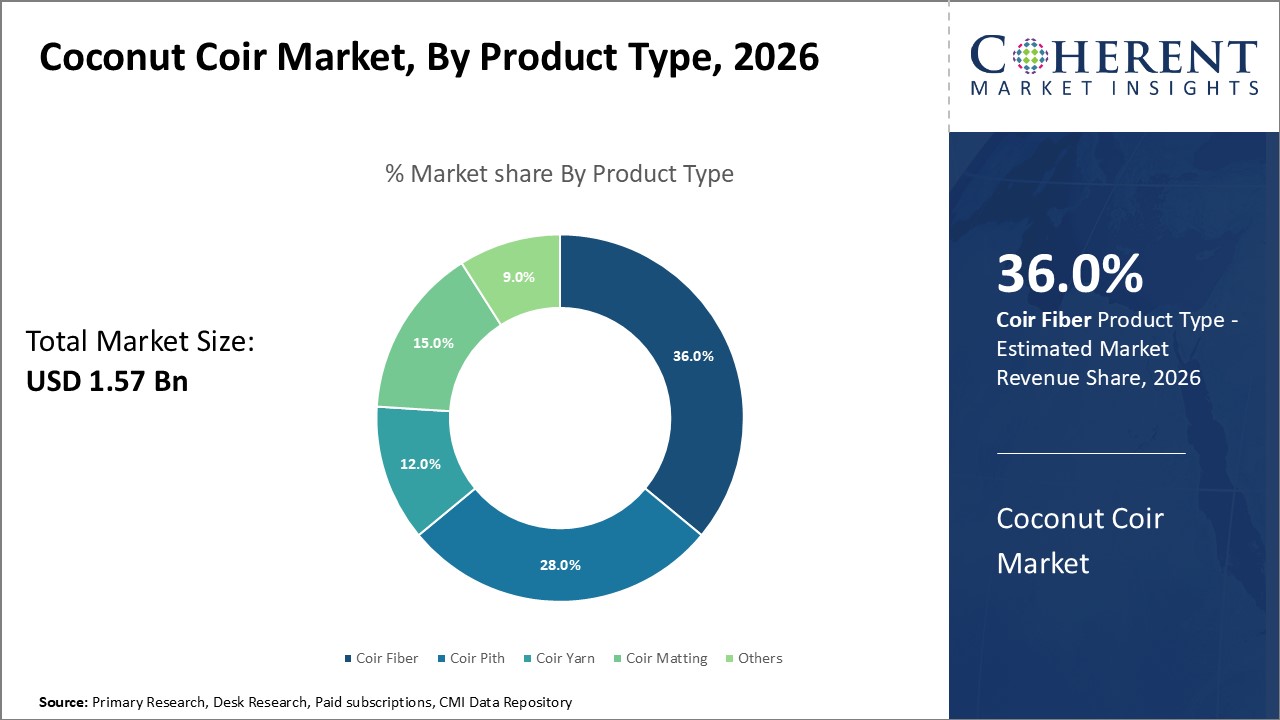
Coir Fiber, the dominant segment with 36% market share, is thriving due to enhanced processing methods improving fiber durability and market revenue. The Agriculture & Horticulture application is rapidly growing as a subsegment owing to soil enhancement benefits.
The processed form type is fast gaining ground, favored for high purity and performance, especially in home furnishing products. Other subsegments like Coir Pith and Composite maintain diversified market presence.
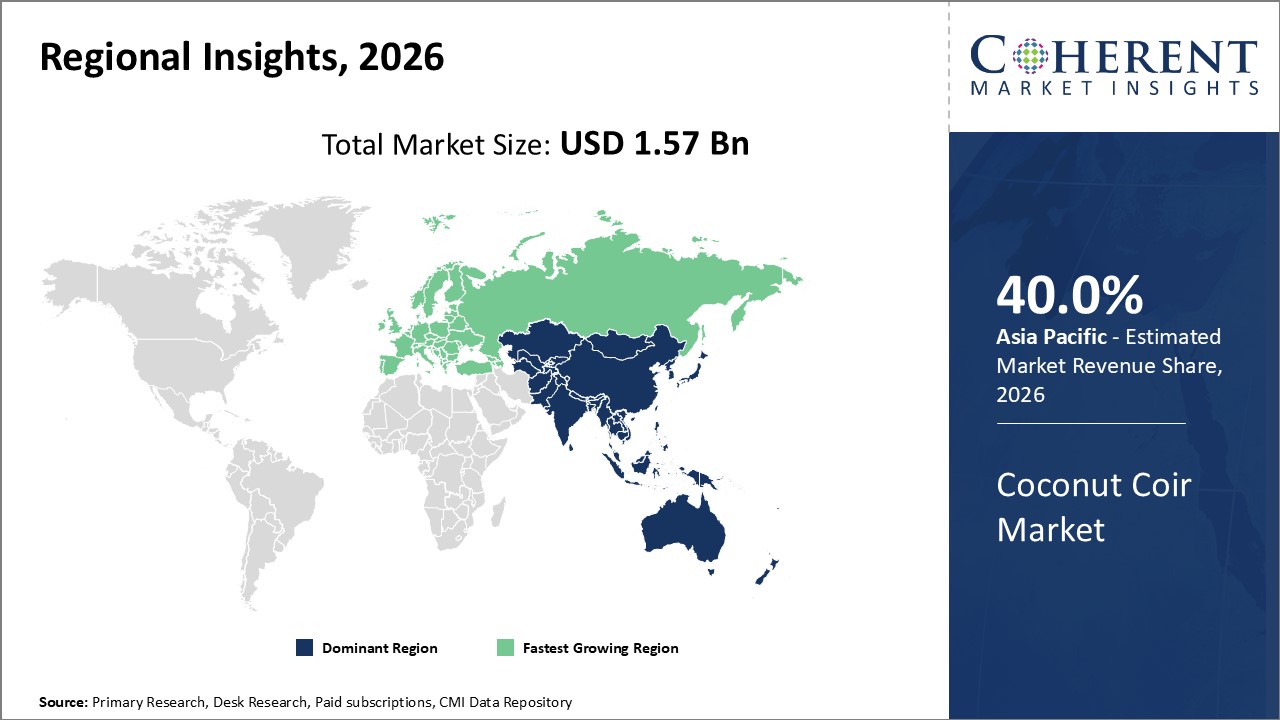
Asia Pacific leads with over 40% industry share, driven by vast coconut-producing countries and a robust ecosystem fostering innovation. North America follows with a mature market and stringent eco-policies supporting sustainable product demand.
Europe’s market is expected to experience significant growth due to rigorous environmental regulations influencing market growth strategies, creating new business growth avenues for coir suppliers.
Coconut Coir Market Segmentation Analysis
To learn more about this report, Request Free Sample
Coconut Coir Market Insights, By Product Type
Coir Fiber dominates the market share with 36%. Coir Fiber’s dominance is attributed to its extensive use in agriculture and industrial applications, supported by improved fiber extraction methods that enhance strength and durability. The fastest-growing subsegment is Coir Pith, increasingly used as a substrate in hydroponic farming and organic agriculture due to its superior water retention properties. Coir Yarn is predominantly utilized in matting and home furnishing, benefiting from the rising demand for natural textile alternatives.
Coconut Coir Market Insights, By Application
Agriculture & Horticulture retains the leading position, driven by organic farming growth and soil conditioning benefits. It shows stable market revenue backed by increased use of coir in greenhouses and nurseries. The fastest-growing application is Automotive, where coir composites are favored for environmentally compliant interiors and sound insulation. Construction applications are gaining pace with coir mats and geotextiles helping erosion control and insulation. Home Furnishing, comprising mats and mattresses, sustains steady demand as consumer preference for natural fibers grows.
Coconut Coir Market Insights, By Form
Loose Fiber is the dominant subsegment due to its versatility and cost efficiency across agriculture and industrial uses. Rapid growth is seen in Composite forms that integrate coir fibers with polymers for automotive seats and insulation materials, reflecting innovation-driven demand. Processed coir is commonly used in high-end home furnishings, offering quality and durability. Growth in composites is anticipated to continue as industries pursue greener alternatives and consumers favor sustainable home products.
Coconut Coir Market Trends
The Coconut Coir market is characterized by its increasing application in sustainable agriculture and technical fields.
One prominent trend is the rise in coir bio-composites that are replacing synthetic fibers in automotive interiors, driven by heightened regulations on carbon footprint reduction.
The sector has seen innovations, such as coir-based erosion control mats gaining traction in Latin America, reflecting a diversified application landscape.
Furthermore, digital supply chain enablement has improved traceability, causing more efficient inventory management and boosting import/export operations, particularly in the Asia Pacific.
Coconut Coir Market Insights, By Geography
To learn more about this report, Request Free Sample
Asia Pacific Coconut Coir Market Analysis and Trends
In the Asia Pacific, dominance is fueled by significant coconut-producing countries, including India, the Philippines, and Indonesia. The region holds over 40% market share due to extensive agricultural use and the presence of major coir manufacturers. Government support programs and eco-conscious consumer behavior further solidify its position.
Europe Coconut Coir Market Analysis and Trends
Meanwhile, Europe exhibits the fastest growth with a CAGR of approximately 9%, driven by stringent environmental regulations and strong demand for eco-friendly automotive and construction materials. Countries like Germany and the U.K. are leading with policies promoting renewable materials, propelling market dynamics. Key companies are capitalizing on this by increasing local presence and customized products.
Coconut Coir Market Outlook for Key Countries
USA Coconut Coir Market Analysis and Trends
The USA’s market is expanding due to stringent environmental regulations and evolving consumer demand for sustainable products. Recent tariffs on synthetic fibers have created an opportunity for increased coir imports and domestic production. Major players such as Keppel Corporation have introduced bio-composites that comply with the U.S. automotive industry's environmental standards, resulting in a 12% increase in related market revenue in 2025. The residential landscaping and horticulture sectors have also started incorporating coir mats and growing media extensively, contributing to the robust market growth.
India Coconut Coir Market Analysis and Trends
India's coconut coir market remains pivotal, dominated by extensive raw material availability and the presence of numerous manufacturing units. Domestic demand surged by 15% in agriculture and geotextile applications in 2026, propelled by government initiatives promoting sustainable farming. Leading firms like AVT Natural Products Ltd. have invested heavily in upgrading processing technology, enhancing export capabilities to Europe and North America. Continuous improvement in quality standards and product diversification is expected to grow India’s market influence globally.
Analyst Opinion
Production Capacity Expansion Plays a Pivotal Role: Expansion of manufacturing facilities, particularly in tropical regions like India and the Philippines, has increased production volumes by 13% year-on-year in 2025, driving market revenue. The deployment of automated machinery has improved processing efficiency, reducing production lead times by 19%, thereby augmenting market share.
Surge in Demand from Agricultural Application: Coconut coir’s superior water retention and aeration qualities are fueling demand in horticulture and soil conditioning. In 2026, the adoption of coir-based growing media increased by 21% across commercial farms in Southeast Asia, underscoring the demand-side dynamics propelling market growth.
Price Stability Amid Raw Material Fluctuations Enhances Market Attractiveness: Despite fluctuations in coconut husk availability due to climatic impacts, pricing of processed coir products remained stable with only a 4% variance in 2025, supporting steady market revenue streams. This pricing resilience has made coconut coir a favored alternative to synthetic fibers.
Diversification Into Technical Applications Boosts Market Depth: The integration of coir into automotive seat padding and bio-composites surged by 16% globally in 2026, evidencing new market dynamics and creating fresh revenue channels. This shift is aligned with rising environmental compliance in the automotive industry, fueling business growth and market expansion.
Market Scope
| Report Coverage | Details | ||
|---|---|---|---|
| Base Year: | 2025 | Market Size in 2026: | USD 1.57 billion |
| Historical Data for: | 2020 To 2024 | Forecast Period: | 2026 To 2033 |
| Forecast Period 2026 to 2033 CAGR: | 8.3% | 2033 Value Projection: | USD 2.75 billion |
| Geographies covered: |
|
||
| Segments covered: |
|
||
| Companies covered: | Keppel Corporation, Carib Agro Industries, KGF Natural Fibers Pvt Ltd., Saran Fibres, EcoCoir Pvt. Ltd., Sumangalam Enterprise, Coirfit Industries, Eastern Coir Industries Pvt. Ltd., Varkala Coir Industries, Brilliant Ocean Products Pvt. Ltd. | ||
| Growth Drivers: |
|
||
Uncover macros and micros vetted on 75+ parameters: Get instant access to report
Coconut Coir Market Growth Factors
Sustainability mandates globally are compelling industries to seek biodegradable alternatives, significantly driving coconut coir adoption. Increasing environmental regulations in Europe and North America, introduced in 2025, have accelerated the shift from synthetic to natural fibers, promoting business growth for market companies. Growth in organic farming has bolstered demand for coir as an effective soil conditioner and substrate. Asia Pacific witnessed a 17% rise in organic agricultural land use in 2026, supporting robust volume growth in coir fiber applications. Technological advancements in coir-based composites for automotive and construction sectors have unlocked new revenue streams. Recent developments, such as coir-geotextiles used in erosion control in Latin America, gained a 10% market traction in 2025, exhibiting sectoral market dynamics. Strategic government incentives fostering renewable material adoption, particularly in India and Southeast Asia, have catalyzed industry size expansion, reflecting in significant market revenue growth in these regions.
Coconut Coir Market Development
In 2022, India’s National Coir Research & Management Institute (NCRMI) launched a range of value-added coir products, including coir grow bags, coir pith fuel as a charcoal substitute, and a tender coconut crusher. The initiative aimed to accelerate market entry for sustainable coir-based alternatives through aggressive marketing strategies, supporting eco-friendly agriculture, renewable energy use, and waste utilization.
In 2019, Rx Green Technologies launched CLEAN COCO, an organic coir substrate developed specifically for cannabis cultivation. The product targeted high-value niche markets by offering a clean, renewable growing medium with improved water retention and aeration, reflecting the expanding global demand for specialized and sustainable horticultural substrates.
Key Players
Leading Companies of the Market
Keppel Corporation
Carib Agro Industries
KGF Natural Fibers Pvt Ltd.
Saran Fibres
EcoCoir Pvt. Ltd.
Sumangalam Enterprise
Coirfit Industries
Eastern Coir Industries Pvt. Ltd.
Varkala Coir Industries
Brilliant Ocean Products Pvt. Ltd.
Leading companies are adopting diversification strategies by expanding product portfolios and investing in research for bio-composites and automotive applications. For instance, AVT Natural Products Ltd. successfully launched eco-friendly coir composites in Q1 2026, boosting its market share by 6% in India. Meanwhile, Keppel Corporation has entered strategic partnerships with automobile OEMs, facilitating the integration of coir materials into interiors, which led to a 13% increase in revenue from technical applications globally during 2025.
Coconut Coir Market Future Outlook
The future outlook is strong, supported by global adoption of sustainable agriculture, large-scale hydroponic production, and urban gardening. Demand for coir-based grow bags, plugs, and precision-mixed substrates will rise as controlled-environment agriculture expands. Growth in erosion control, landscaping, and biodegradable geotextiles will diversify applications. Manufacturers are expected to strengthen washing and buffering processes to meet global quality standards, while logistics optimization will enhance competitiveness in major export markets.
Coconut Coir Market Historical Analysis
The coconut coir market historically expanded as global horticulture shifted toward sustainable substrates and peat alternatives. Coir gained significant traction in the 2010s with the rise of hydroponics, greenhouse farming, and organic cultivation, driven by its aeration, water retention, and biodegradability advantages. Export-oriented production hubs in India, Sri Lanka, and the Philippines scaled up rapidly as demand surged for washed and buffered coir products.
Sources
Primary Research Interviews:
Coir Exporters
Plantation Owners
Horticultural Substrate Buyers
Databases:
FAOSTAT Coconut Data
APEDA Exports
UN Comtrade Coir Data
Magazines:
HortiDaily
Coconut Development Magazine
AgriBusiness Global
Journals:
Journal of Agricultural Science
Industrial Crops & Products
Soil & Tillage Research
Newspapers:
The Hindu BusinessLine Agri
Reuters Agriculture
Financial Times Commodities
Associations:
Coir Board of India
International Coconut Community
Horticulture Export Associations
Share
Share
Vidyesh Swar is a seasoned Consultant with a diverse background in market research and business consulting. With over 6 years of experience, Vidyesh has established a strong reputation for his proficiency in market estimations, supplier landscape analysis, and market share assessments for tailored research solution. Using his deep industry knowledge and analytical skills, he provides valuable insights and strategic recommendations, enabling clients to make informed decisions and navigate complex business landscapes.

Credibility and Certifications

860519526


9001:2015
27001:2022


Need a Custom Report?
We can customize every report - free of charge - including purchasing stand-alone sections or country-level reports
Customize NowJoining thousands of companies around the world committed to making the Excellent Business Solutions.
View All Our Clients