
Delivery/Shipping Drones Market Analysis & Forecast: 2026-2033

Delivery/Shipping Drones Market Size and Forecast – 2026 – 2033
The Global Delivery/Shipping Drones Market size is estimated to be valued at USD 3.45 billion in 2026 and is expected to reach USD 12.87 billion by 2033, exhibiting a compound annual growth rate (CAGR) of 21.4% from 2026 to 2033.
Global Delivery/Shipping Drones Market Overview
The delivery and shipping drones market encompasses a variety of unmanned aerial vehicles designed for efficient transport of goods. Key product categories include multi-rotor drones, known for their stability and maneuverability in urban environments, and fixed-wing drones, preferred for longer-range deliveries due to higher energy efficiency. Hybrid drones combine vertical takeoff and landing capabilities with extended flight endurance, offering versatile solutions. Payload capacities vary, accommodating parcels from small consumer packages to heavier industrial goods. Advanced features such as GPS navigation, obstacle avoidance, automated flight planning, and real-time tracking enhance operational efficiency, safety, and reliability, making these drones increasingly vital in modern logistics and e-commerce ecosystems.
Key Takeaways
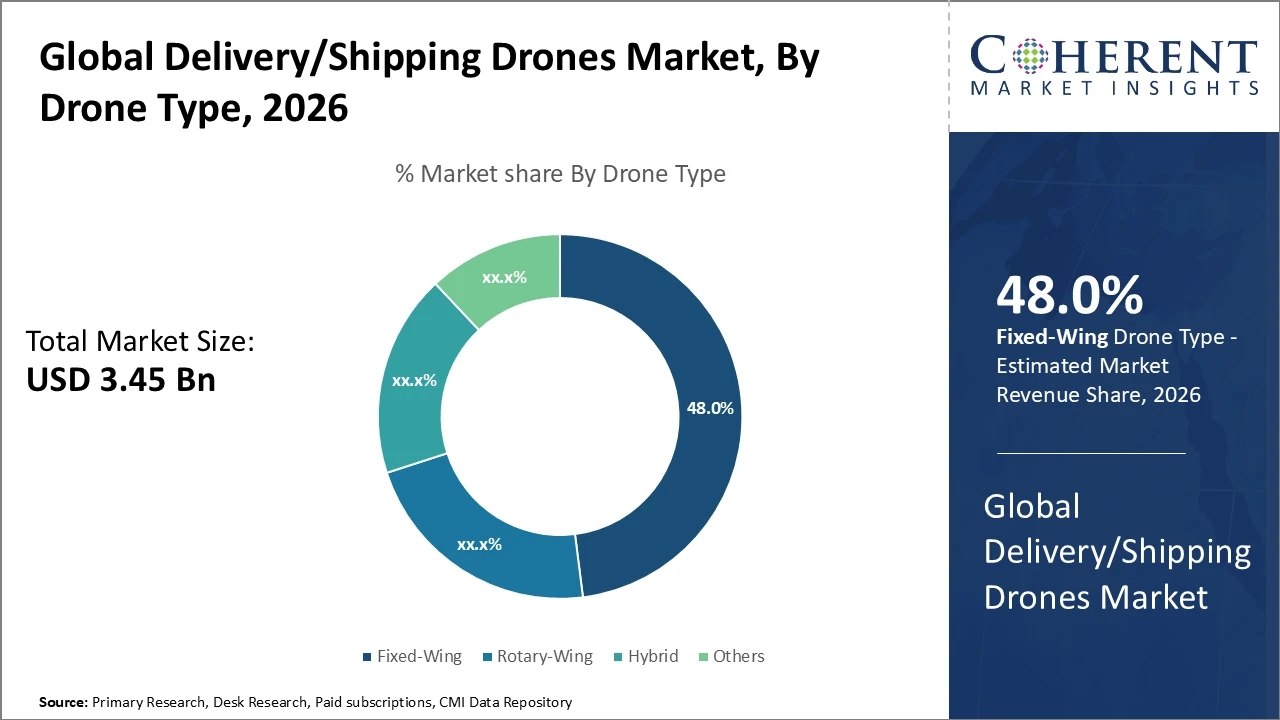
The fixed-wing drone segment dominates the market with a 48% share, attributed to its superior range and payload capacity.
Hybrid drones are the fastest-growing segment, driven by increasing adoption due to their versatility and combined vertical takeoff and long-range capabilities.
In terms of applications, e-commerce delivery contributes the most to market revenue, supported by changing consumer habits and rapid growth of online retail channels.
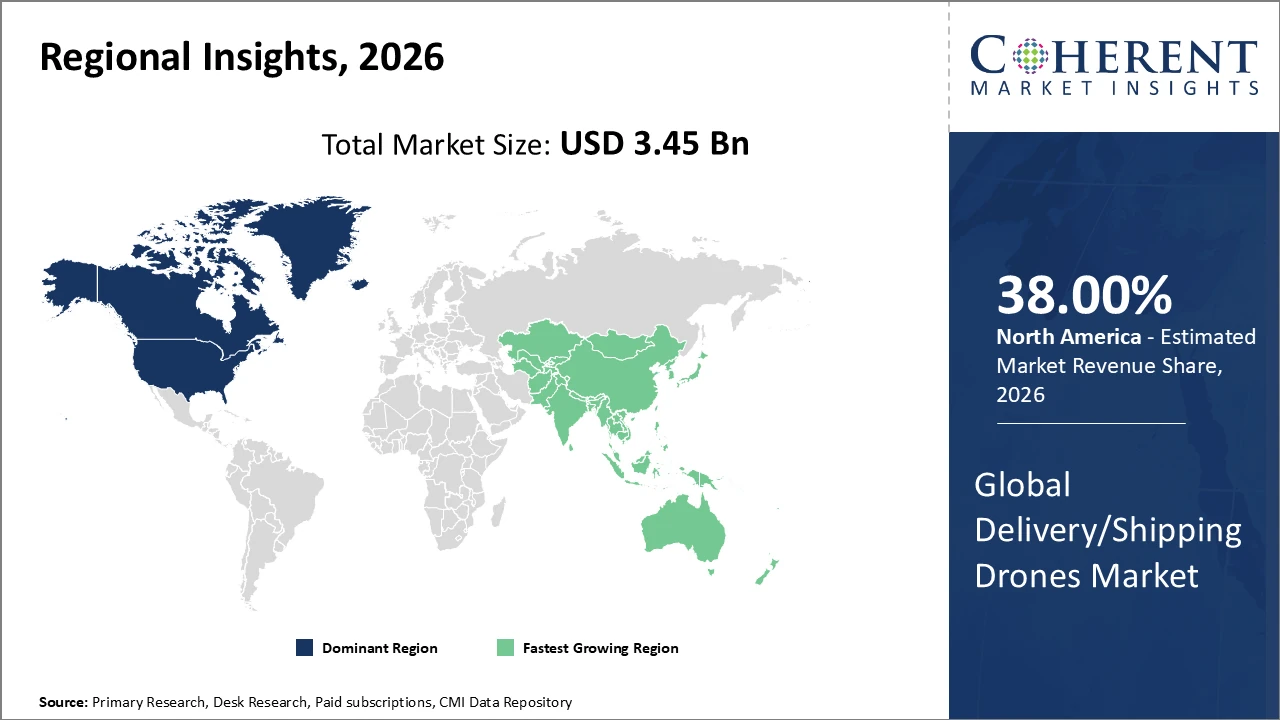
North America holds the largest regional market share at 38%, benefiting from mature infrastructure, favorable regulations, and active pilot programs.
Asia Pacific exhibits the highest CAGR, propelled by booming e-commerce and government initiatives promoting drone corridors, with China and India leading regional growth.
Delivery/Shipping Drones Market Segmentation Analysis
To learn more about this report, Request Free Sample
Delivery/Shipping Drones Market Insights, By Drone Type
Fixed-wing drones dominate the market with a 48% share, favored for long-range deliveries due to fuel efficiency and the ability to carry heavier payloads, making them suitable for intercity shipments and urgent healthcare logistics, such as transporting blood samples and vaccines. The hybrid segment is the fastest-growing, combining vertical takeoff capabilities of rotary drones with the extended endurance of fixed-wing models, effectively serving diverse delivery needs across complex terrains. Rotary-wing drones excel in short-range, agile last-mile deliveries, particularly in dense urban areas.
Delivery/Shipping Drones Market Insights, By End User
Retail and e-commerce lead the delivery/shipping drones market, using drones to meet rising consumer demand for rapid last-mile deliveries while reducing operational costs. The healthcare sector is the fastest-growing end user, driven by urgent medical delivery needs to remote or disaster-affected areas, supported by government health programs. Food and beverage companies employ drones to fulfill time-sensitive orders in congested urban areas. Logistics service providers integrate drones into their fleets as value-added services, enhancing efficiency and customer satisfaction. Government and military applications focus on strategic shipments and surveillance, while the others segment includes industrial maintenance and emergency response, leveraging drones for critical deliveries.
Delivery/Shipping Drones Market Insights, By Application
E-commerce delivery dominates the market, driven by rapid growth in online shopping and strong demand for expedited shipping worldwide. Food delivery is the fastest-growing segment, fueled by increasing consumer preference for convenience and fast order fulfillment. Healthcare and medical supplies applications prioritize critical, time-sensitive deliveries such as vaccines and emergency medical supplies, with pilot programs in Africa and Asia reducing delivery times by up to 40%. Postal delivery continues to serve remote areas with limited logistics infrastructure, while industrial parts delivery supports manufacturing and repair sectors requiring just-in-time supply. Other applications include governmental and environmental monitoring using drones for specialized deliveries.
Delivery/Shipping Drones Market Trends
The delivery/shipping drones market is witnessing rapid technological integration and expanding commercial applications across logistics, healthcare, and e-commerce.
AI-powered drones are increasingly deployed for optimized routing, autonomous load balancing, and enhanced operational efficiency, improving delivery speed and reliability.
Drone-as-a-Service (DaaS) models are gaining traction, enabling logistics providers to outsource fleet management, supported by successful implementations in the U.S. and Europe in 2025.
Regulatory developments emphasizing safe Beyond Visual Line of Sight (BVLOS) operations are facilitating the scaling of drone services beyond pilot programs, driving revenue growth and increasing overall market share.
Delivery/Shipping Drones Market Insights, By Geography
To learn more about this report, Request Free Sample
North America Delivery/Shipping Drones Market Analysis and Trends
In North America, the delivery/shipping drones market is dominated by a well-established ecosystem of drone technology developers, advanced air traffic management systems, and supportive regulatory frameworks, including the FAA’s comprehensive drone policies. The region accounts for approximately 38% of the global market, driven by strong adoption among logistics and e-commerce companies. Major players have invested heavily in pilot programs and trial deliveries to optimize last-mile operations and test autonomous systems. The combination of technological innovation, regulatory clarity, and robust infrastructure has enabled North America to lead the market, setting benchmarks for drone deployment and operational efficiency globally.
Asia Pacific Delivery/Shipping Drones Market Analysis and Trends
Asia Pacific is experiencing the fastest growth in the delivery/shipping drones market, with a CAGR exceeding 25%, fueled by rapidly expanding e-commerce sectors in China and India. Government initiatives, including the development of dedicated drone corridors and supportive regulatory frameworks, are facilitating safe and scalable drone operations. The region’s growing drone manufacturing capabilities further support market expansion, while cost-sensitive logistics environments encourage companies to adopt drones as efficient solutions to overcome infrastructure and last-mile delivery challenges. Rising urbanization, increased smartphone penetration, and consumer demand for faster deliveries are also driving accelerated adoption, positioning Asia Pacific as a key growth hub globally.
Delivery/Shipping Drones Market Outlook for Key Countries
USA Delivery/Shipping Drones Market Analysis and Trends
The USA leads in innovative delivery drone operations, with active participation from both tech giants and startups driving market advancements. In 2025, Amazon Prime Air completed over 10,000 autonomous parcel deliveries across multiple states, demonstrating scalability, efficiency, and cost advantages. Supportive government policies, including updated airspace regulations and public-private partnerships, have further accelerated adoption. Key players such as UPS Flight Forward and Wing Aviation continue to advance drone technology, focusing on automation, safety, and regulatory compliance. These initiatives reinforce the USA’s position as a global leader in drone-based logistics, setting benchmarks for operational efficiency and market growth.
Germany Delivery/Shipping Drones Market Analysis and Trends
Germany plays a strategic role in the delivery/shipping drones market by combining advanced manufacturing capabilities with stringent safety and regulatory standards. The country focuses on high-precision drones for logistics, healthcare, and industrial applications, emphasizing reliability and efficiency. Key trends include the adoption of AI-enabled navigation systems, BVLOS operations, and drone fleet integration within urban air mobility frameworks. German companies are also exploring Drone-as-a-Service (DaaS) models to support e-commerce and medical supply deliveries. Strong government support, including pilot corridors and regulatory guidance, along with collaboration between technology providers and logistics firms, positions Germany as a leading innovator in European drone deployment.
Analyst Opinion
The surge in e-commerce has been a key demand-side driver for the delivery/shipping drones market. In 2025, global e-commerce sales grew by 16.7%, increasing pressure on traditional logistics and accelerating drone adoption for last-mile delivery, especially in congested urban areas. Drone deployment offers cost advantages, with pilot programs in North America in 2024 reporting average delivery cost reductions of 25–30%.
On the supply side, manufacturing capacity expansion and technological innovation are critical for market scaling. Leading drone manufacturers increased production by 45% in 2026, supported by improvements in battery life and payload optimization. Exports to Asia Pacific rose 38% year-over-year in 2025.
Regulatory approvals and airspace integration have matured, enabling broader adoption. In 2024, the FAA approved over 3,000 commercial delivery drone operators. Southeast Asian countries also introduced drone corridors and dedicated zones to ensure safer operations.
Nano-scale use cases are growing, particularly in healthcare logistics. In 2025, a project in Rwanda reduced delivery times for medical supplies and vaccines by 40%, highlighting revenue opportunities beyond conventional parcel delivery and expanding market potential.
Market Scope
| Report Coverage | Details | ||
|---|---|---|---|
| Base Year: | 2025 | Market Size in 2026: | USD 3.45 billion |
| Historical Data for: | 2020 To 2024 | Forecast Period: | 2026 To 2033 |
| Forecast Period 2026 to 2033 CAGR: | 21.4% | 2033 Value Projection: | USD 12.87 billion |
| Geographies covered: |
|
||
| Segments covered: |
|
||
| Companies covered: | DJI Innovations, Zipline, Volansi, Elroy Air, Delair, Flylogix, Flytrex, Skyports, Amazon Prime Air, Thales Group | ||
| Growth Drivers: |
|
||
Uncover macros and micros vetted on 75+ parameters: Get instant access to report
Delivery/Shipping Drones Market Growth Factors
Rising demand for rapid, contactless delivery services is driving growth in the delivery/shipping drones market, accelerated by pandemic-induced shifts in consumer behavior, which led to a 34% increase in drone delivery trials in 2024. Urban logistics challenges, such as traffic congestion and last-mile inefficiencies, encourage companies to adopt drones, reducing delivery times by up to 60% in pilot zones across North America and Europe. Technological advancements, including improved battery endurance and AI-powered navigation, enable longer ranges and safer flights, expanding operational capabilities. Supportive regulatory frameworks, like Europe’s updated U-Space rules in 2025 allowing BVLOS operations, further unlock market growth opportunities.
Delivery/Shipping Drones Market Development
In 2025, Amazon Prime Air expanded its drone delivery network across multiple U.S. states, completing over 10,000 autonomous parcel deliveries. The initiative leveraged AI-powered route optimization and real-time obstacle detection, demonstrating scalability, cost efficiency, and faster last-mile fulfillment for e-commerce shipments. This development highlighted the potential of drones to handle high-volume operations while maintaining safety and regulatory compliance.
Key Players
Leading Companies of the Market
DJI Innovations
Zipline
Amazon Prime Air
Volansi
Elroy Air
Delair
Flytrex
Skysports
Flylogix
Thales Group
Leading market players are actively pursuing partnerships and strategic investments to expand delivery drone capabilities. In 2025, Amazon Prime Air scaled pilot programs across multiple U.S. states, achieving a 50% increase in successful autonomous deliveries. Meanwhile, DJI Innovations invested in research and development to enhance payload capacity by 20% in 2026, strengthening its position in healthcare logistics. DHL’s Parcelcopter operations in Europe capitalized on government collaborations to establish additional drone delivery corridors, improving operational efficiency and boosting regional revenue streams. These initiatives demonstrate how technological innovation and strategic alliances are driving competitive advantage in the market.
Delivery/Shipping Drones Market Future Outlook
The delivery/shipping drones market is poised for rapid expansion, driven by rising demand for fast, contactless deliveries and growing e-commerce penetration worldwide. Future trends indicate increasing adoption of AI-powered autonomous drones, extended battery life, and advanced navigation systems to enhance efficiency and safety. Drone-as-a-Service (DaaS) models are expected to gain traction, enabling broader deployment without heavy capital investment. Regulatory frameworks supporting beyond visual line-of-sight (BVLOS) operations will facilitate scalable operations across urban and remote regions. Additionally, healthcare, food, and industrial sectors will increasingly leverage drones for time-sensitive deliveries, positioning the market for sustained growth and technological innovation over the coming decade.
Delivery/Shipping Drones Market Historical Analysis
The delivery/shipping drones market has evolved rapidly over the past decade, beginning with early pilot programs focused on short-range parcel deliveries in urban areas. Initially dominated by fixed-wing and rotary drones, the market relied on government-approved trials and limited commercial applications. Between 2015 and 2020, advancements in battery technology, AI navigation, and lightweight materials enabled longer flight ranges and higher payload capacities. E-commerce growth and rising consumer demand for fast, contactless deliveries further accelerated adoption. By 2021, companies began integrating drones into logistics operations for healthcare, food, and industrial supplies, laying the foundation for the current expansion driven by automation, AI, and regulatory support.
Sources
Primary Research Interviews:
Drone technology developers and manufacturers
Logistics and e-commerce operations managers
AI, navigation, and battery system solution providers
Industry analysts and consultants specializing in drone-based logistics and delivery
Magazines:
DroneLife – Commercial Drone Applications and Industry Updates
UAV Magazine – Drone Technology and Logistics Developments
Robotics Business Review – Autonomous Systems in Delivery
Transport Topics – Drone Integration in Logistics and E-commerce
Journals:
Journal of Intelligent & Robotic Systems – Drone Navigation and Automation Research
International Journal of Advanced Logistics – UAV Delivery and Supply Chain Innovations
Journal of Field Robotics – Autonomous Drones for Last-Mile Delivery
Newspapers:
The Wall Street Journal – Drone Logistics and Market Developments
Financial Times – UAV Technology and Commercial Applications
Reuters – Drone Delivery, Technology, and Regulatory News
Bloomberg – Drone Logistics and Industrial Trends
Associations:
Association for Unmanned Vehicle Systems International (AUVSI)
European Drone Association (EDA)
Global Drone Alliance (GDA)
Share
Share
Monica Shevgan has 9+ years of experience in market research and business consulting driving client-centric product delivery of the Information and Communication Technology (ICT) team, enhancing client experiences, and shaping business strategy for optimal outcomes. Passionate about client success.

Credibility and Certifications

860519526


9001:2015

27001:2022


Need a Custom Report?
We can customize every report - free of charge - including purchasing stand-alone sections or country-level reports
Customize NowJoining thousands of companies around the world committed to making the Excellent Business Solutions.
View All Our Clients