
Genetically Modified Seeds Market Analysis & Forecast: 2026-2033

Genetically Modified Seeds Market Size and Forecast – 2026 – 2033
The Global Genetically Modified Seeds Market size is estimated to be valued at USD 27.8 billion in 2026 and is expected to reach USD 45.6 billion by 2033, exhibiting a compound annual growth rate (CAGR) of 7.8% from 2026 to 2033.
Global Genetically Modified Seeds Market Overview
The genetically modified (GM) seeds market is driven by rising global food demand, shrinking arable land, and the need for higher crop productivity. GM seeds offer improved yield, pest and disease resistance, and tolerance to herbicides and extreme environmental conditions such as drought and salinity. Growing adoption of modern agricultural practices, along with government support and favorable regulatory frameworks in several countries, further accelerates market growth. Additionally, increasing awareness among farmers about the economic benefits of GM crops, including reduced input costs and higher profitability, is boosting demand. Advancements in biotechnology and continuous research and development are also key factors propelling the expansion of the GM seeds market.
Key Takeaways
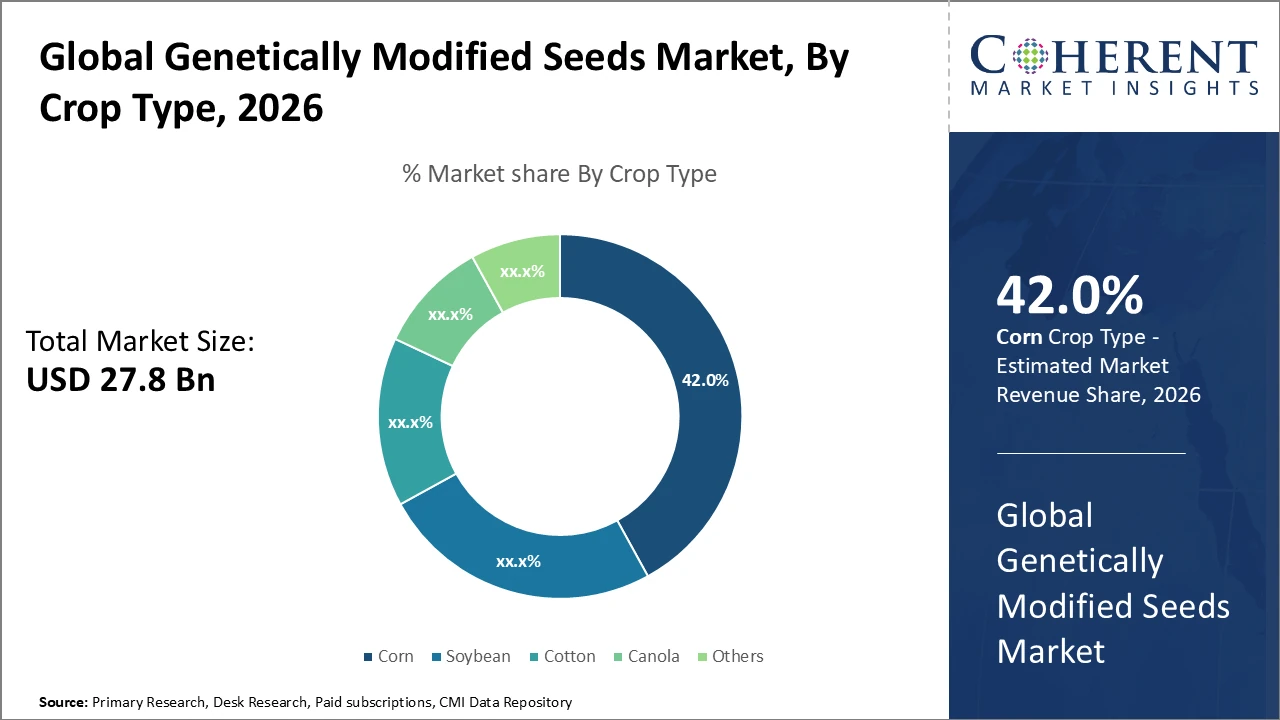
The corn segment remains a dominant force in the Genetically Modified Seeds Market with a share of 42% due to widespread adoption of multiple biotech traits that ensure yield stability and strong pest resistance.
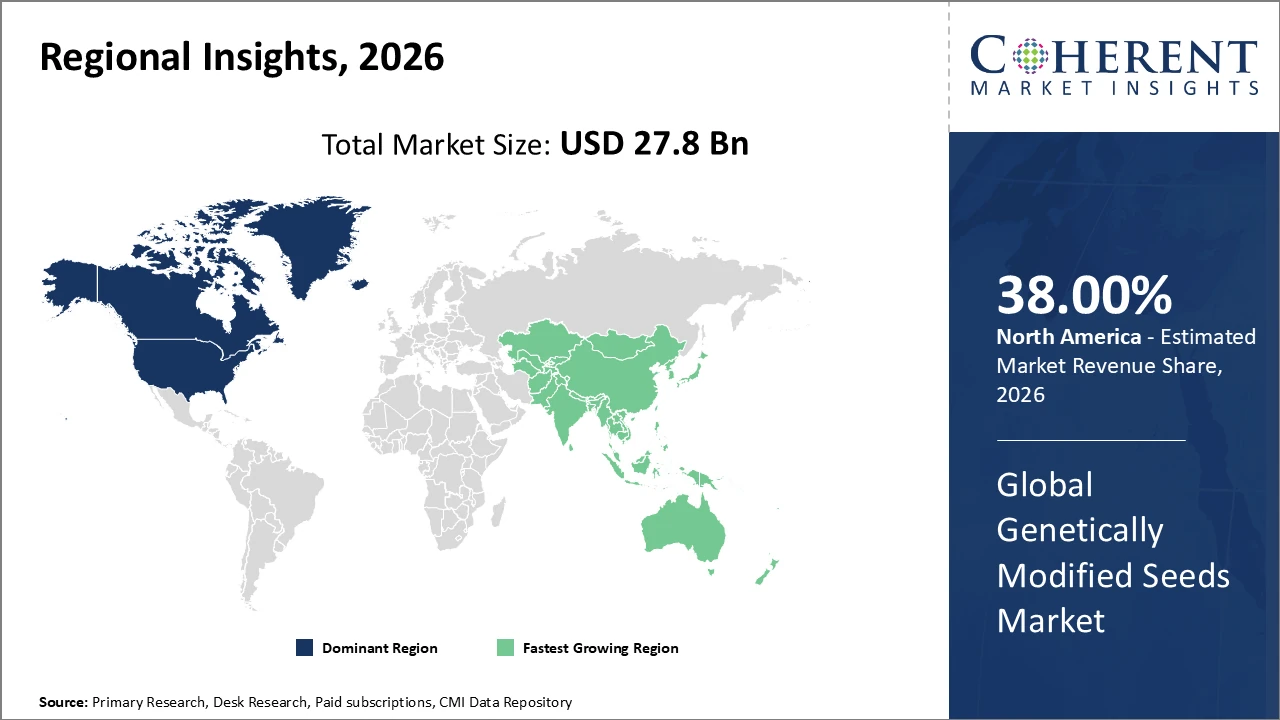
North America holds the largest market share, supported by a mature biotechnology ecosystem and favorable regulatory frameworks, accounting for approximately 38% of global revenue in 2026.
Asia Pacific is the fastest-growing region, recording a CAGR exceeding 9%, fueled by increasing investments in modern agricultural practices.
Government incentives and supportive policies in countries such as India and China are further accelerating market expansion in the Asia Pacific region.
Genetically Modified Seeds Market Segmentation Analysis
To learn more about this report, Request Free Sample
Genetically Modified Seeds Market Insights, By Crop Type
Corn dominates the Genetically Modified Seeds Market with a 42% share of total global biotech crop acreage. Its leadership is driven by extensive adoption of traits such as herbicide tolerance and insect resistance, which have improved effective yields by approximately 10% in recent years. Soybean is the fastest-growing segment, supported by rising demand from biofuel production and the animal feed industry, and is expanding at around a 9% CAGR due to improved drought-resistant traits. Cotton maintains steady growth across Asia Pacific and Latin America, while canola and other crops represent niche segments with moderate expansion driven by specialty oilseed demand and regional consumption preferences.
Genetically Modified Seeds Market Insights, By Trait Type
Herbicide Tolerance dominates the Genetically Modified Seeds Market with nearly 48% share, driven by strong farmer preference for simplified weed control and compatibility with no-till farming practices. Its adoption is particularly high in North and Latin America, where large-scale commercial farming is prevalent. Drought Tolerance is the fastest-growing trait, supported by increasing climate change impacts and expanding deployment across Asia Pacific and Latin America, registering around 15% year-over-year growth. Insect Resistance remains a key segment, especially in corn and cotton, reducing crop losses and pesticide usage. Disease Resistance and other traits are growing steadily as biotechnology research continues to advance.
Genetically Modified Seeds Market Insights, By Form Type
Seeds constitute the largest share of the Genetically Modified Seeds Market, accounting for over 85% of total revenue, as they serve as the primary medium for delivering biotech traits. Their dominance is driven by widespread adoption in major crops such as corn, soybean, and cotton, where genetic modifications enhance yield, pest resistance, and stress tolerance. Seed Coatings represent the fastest-growing subsegment, supported by innovations in formulation technologies that improve seedling vigor, nutrient uptake, and protection against pathogens, recording around 12% annual growth.
Genetically Modified Seeds Market Trends
The Genetically Modified Seeds market is witnessing strong innovation, with multi-trait stacking emerging as a key trend driving product advancement and farmer adoption.
In 2026, triple-trait seeds adoption increased by 20%, reflecting growing preference for combining herbicide tolerance, insect resistance, and drought resistance in a single seed variety.
CRISPR technology is transforming the sector by enabling non-transgenic gene editing, gaining regulatory acceptance in European and Asian markets that were previously more restrictive.
Regulatory reforms in India in 2025 have accelerated approvals for gene-edited crops, supporting faster commercialization and innovation.
Digital agriculture integration is expanding, with AI-based seed placement optimization trials in Brazil and the U.S. (2024–2025) improving yields by over 15% and driving market revenue growth.
Genetically Modified Seeds Market Insights, By Geography
To learn more about this report, Request Free Sample
North America Genetically Modified Seeds Market Analysis and Trends
North America dominates the Genetically Modified Seeds Market with a share of 38% due to strong biotechnology infrastructure, high R&D investment, and a well-established regulatory framework that supports efficient GMO approvals. Leading companies such as Corteva Agriscience and Bayer play a major role in driving innovation in seed traits, including herbicide tolerance and insect resistance. The region also benefits from mature distribution networks, high farmer awareness, and large-scale commercial farming practices, which collectively ensure consistent adoption and sustained market growth across the agricultural biotechnology sector.
Asia Pacific Genetically Modified Seeds Market Analysis and Trends
The Asia Pacific region is the fastest-growing market for Genetically Modified Seeds, registering a CAGR exceeding 9%. Growth is driven by increasing agricultural modernization, rising food demand, and supportive government subsidies in countries such as China and India. Recent policy reforms and improved regulatory frameworks have facilitated faster approval and adoption of insect-resistant and herbicide-tolerant crop varieties. Additionally, favorable trade policies are encouraging wider commercialization of biotech seeds across the region. Leading companies like Syngenta and BASF are expanding their breeding programs and distribution networks in Asia Pacific, strengthening market penetration and supporting sustained growth in genetically modified seed adoption.
Genetically Modified Seeds Market Outlook for Key Countries
USA Genetically Modified Seeds Market Analysis and Trends
The United States remains a key market in the Genetically Modified Seeds industry, driven by advanced adoption of seed biotechnology and large-scale commercial farming practices. In 2025, biotech corn acreage accounted for over 42% of the total corn planted, highlighting strong penetration of genetically modified traits. U.S. seed companies continue to invest heavily in gene-editing technologies, developing resilient crop varieties with higher yield efficiency and reduced reliance on pesticides. Additionally, supportive regulatory processes, including streamlined approvals by the USDA, have accelerated product commercialization, significantly contributing to market share growth and reinforcing the country’s leadership in agricultural biotechnology innovation.
Germany Genetically Modified Seeds Market Analysis and Trends
Germany’s Genetically Modified Seeds Market remains relatively constrained compared to other major regions due to strict regulatory policies and public resistance toward GMO cultivation. The country largely relies on imports of genetically modified crops, particularly for animal feed, rather than domestic production. However, increasing interest in advanced breeding techniques such as gene editing is gradually reshaping the market landscape. Research institutions and agritech companies are investing in CRISPR-based innovations that align with evolving European regulatory perspectives. Additionally, sustainability goals and the push for climate-resilient agriculture are encouraging cautious exploration of biotech solutions, positioning Germany as a research-driven market with selective growth opportunities.
Analyst Opinion
Rising adoption of biotech traits in staple crops such as corn, soybean, and cotton continues to drive market growth. In 2025, biotech corn accounted for nearly 42% of total corn acreage in the United States, while soybean adoption exceeded 90% in 2024, reflecting strong supply- and demand-side momentum.
Enhanced seed pricing strategies for value-added traits are strengthening revenue streams. In 2026, drought-tolerant genetically modified seeds commanded a price premium of 15–20% over conventional seeds in India, indicating farmers’ willingness to invest in yield protection.
Expansion of export activities from North America to emerging markets is influencing global trade flows. The U.S. exported over 12 million metric tons of biotech seeds in 2025, marking a 10% year-over-year increase.
Emerging applications in specialty crops such as alfalfa and canola are creating new opportunities. Canadian biotech alfalfa acreage grew by 25% in 2024, supporting market diversification and additional revenue streams.
Market Scope
| Report Coverage | Details | ||
|---|---|---|---|
| Base Year: | 2025 | Market Size in 2026: | USD 27.8 billion |
| Historical Data for: | 2020 To 2024 | Forecast Period: | 2026 To 2033 |
| Forecast Period 2026 to 2033 CAGR: | 7.8% | 2033 Value Projection: | USD 45.6 billion |
| Geographies covered: |
|
||
| Segments covered: |
|
||
| Companies covered: | Bayer AG, BASF SE, Evogene Ltd., Advanta Seeds, Dow AgroSciences, Limagrain, Corteva Agriscience, DuPont Pioneer, Land O’Lakes Inc., Nuseed | ||
| Growth Drivers: |
|
||
Uncover macros and micros vetted on 75+ parameters: Get instant access to report
Genetically Modified Seeds Market Growth Factors
The growing need to enhance agricultural productivity under increasing climate challenges is a major driver of the Genetically Modified Seeds Market. Biotech seeds with improved resistance to drought, pests, and herbicides are widely adopted to protect crop yields, as seen in the 8.5% increase in biotech corn acreage in Latin America in 2025. Supportive regulatory frameworks in countries such as Brazil and the United States are accelerating approvals and product launches. Rising demand for sustainable farming and reduced pesticide use is also encouraging innovation. Additionally, advancements in gene-editing technologies are enabling faster development of next-generation seeds with precise trait integration.
Genetically Modified Seeds Market Development
In February 2024, China expanded commercial trial plantings of genetically modified corn and soybeans to support broader adoption aimed at boosting production and lowering costs.
Key Players
Leading Companies of the Market
Bayer AG
BASF SE
Corteva Agriscience
Limagrain
Advanta Seeds
Land O’Lakes Inc.
Evogene Ltd.
Dow AgroSciences
DuPont Pioneer
Nuseed
Several market players are actively pursuing innovation-driven growth strategies to strengthen their position in the Genetically Modified Seeds Market. For instance, Corteva Agriscience invested over USD 500 million in 2025 to expand its CRISPR-Cas gene-editing capabilities, leading to the development of drought-tolerant corn varieties that achieved up to a 12% yield increase in field trials. Similarly, Bayer entered strategic collaborations with regional seed companies across Asia in 2024 to expand its footprint in high-growth markets. These partnerships enabled faster market penetration and contributed to an approximate 15% increase in revenue in the Asia Pacific region within 18 months.
Genetically Modified Seeds Market Future Outlook
The Genetically Modified Seeds Market is expected to experience steady growth driven by rising global food demand, climate change pressures, and advancements in agricultural biotechnology. Increasing adoption of multi-trait and gene-edited seeds will enhance crop productivity, resilience, and sustainability. Regulatory support in key markets and gradual acceptance in developing regions will further expand market reach. Innovations in CRISPR and precision breeding technologies are likely to accelerate product development cycles. Additionally, integration with digital agriculture tools will optimize farming efficiency. Growing investments by major agritech companies and expanding applications in specialty crops will continue to strengthen market potential through 2033.
Genetically Modified Seeds Market Historical Analysis
The Genetically Modified Seeds Market has evolved significantly since its commercialization in the 1990s, driven by the introduction of herbicide-tolerant and insect-resistant crops. Early adoption was concentrated in North America, particularly in the United States, where supportive regulations and large-scale farming enabled rapid expansion. Over time, countries in Latin America and Asia Pacific increasingly embraced biotech crops to improve yields and reduce pesticide use. Advancements in genetic engineering and trait stacking further enhanced seed performance. Despite regulatory and public acceptance challenges in Europe, continuous innovation and growing global food demand have sustained long-term market growth and expanded the scope of genetically modified seed applications.
Sources
Primary Research Interviews:
Agronomists, crop scientists, and plant geneticists focusing on biotech trait development and yield optimization
Seed company executives, product managers, and distribution partners involved in commercialization and supply chain of genetically modified seeds
Farmers, agricultural consultants, and agri-tech specialists assessing adoption trends, field performance, and sustainability outcomes
Databases:
FAOSTAT / USDA – Agricultural production data, biotech crop acreage, and global trade statistics
Magazines:
Successful Farming – Crop management practices, biotech seed adoption, and farmer insights
AgriBusiness Global – Seed technology trends, market expansion, and agribusiness strategies
CropLife – Crop protection, biotech traits, and regulatory developments
Modern Agriculture – Precision farming, seed innovations, and sustainable agriculture practices
Journals:
Nature Biotechnology – Genetic engineering advancements and CRISPR applications in crops
Plant Biotechnology Journal – Research on genetically modified crops and trait development
Field Crops Research – Crop yield optimization and biotech seed performance studies
Journal of Agricultural and Food Chemistry – Studies on crop quality, safety, and biotech innovations
Newspapers:
The Wall Street Journal – Agribusiness investments, seed company performance, and global trade trends
Financial Times – Agricultural technology developments and biotech market expansion
Reuters – Global agriculture updates, GMO regulations, and seed export trends
Bloomberg – Market analysis, corporate strategies, and commodity trends in agriculture
Associations:
International Service for the Acquisition of Agri-biotech Applications (ISAAA) – Global biotech crop adoption data and insights
Biotechnology Innovation Organization (BIO) – Policy advocacy and biotech industry developments
Food and Agriculture Organization (FAO) – Agricultural sustainability, food security, and biotech crop data
American Seed Trade Association (ASTA) – Seed industry standards, policies, and market trends
Share
Share
Yash Doshi is a Senior Management Consultant. He has 12+ years of experience in conducting research and handling consulting projects across verticals in APAC, EMEA, and the Americas.
He brings strong acumen in helping chemical companies navigate complex challenges and identify growth opportunities. He has deep expertise across the chemicals value chain, including commodity, specialty and fine chemicals, plastics and polymers, and petrochemicals. Yash is a sought-after speaker at industry conferences and contributes to various publications on topics related commodity, specialty and fine chemicals, plastics and polymers, and petrochemicals.

Credibility and Certifications

860519526


9001:2015

27001:2022


Need a Custom Report?
We can customize every report - free of charge - including purchasing stand-alone sections or country-level reports
Customize NowJoining thousands of companies around the world committed to making the Excellent Business Solutions.
View All Our Clients