

Indonesia Dietary Supplements Market Size and Share Analysis - 2026 To 2033
Indonesia Dietary Supplements Market size is projected to expand at a CAGR of 7.7% with USD 2,739.4 Mn in 2026 & is estimated to reach USD 4,603.3 Mn by 2033. The key factors are growing consumer awareness about preventative healthcare and rising health and wellness consciousness. In 2026, the National Agency of Drug and Food Control (BPOM) of Indonesia reported that 4,910 health supplement products were registered and had valid distribution permits in Indonesia, indicating the growing product landscape and rising consumer demand for regulated health supplements in the country.
Key Takeaways
- Vitamins segment is expected to dominate the market with a share of 34.8% in 2026 owing to the high presence of micronutrient deficiencies in Indonesia and widespread preventive health care practices. As per the statistics released by Indonesia's Ministry of Health via SSGI 2024 and other national nutrition programs, micronutrient deficiencies are still posing as a public health issue in Indonesia.
- Medicinal supplements segment will dominate the market with 49.6% in 2026, driven by growing preventive healthcare practices and nutrition enhancement programs. As stated by the Indonesia Food and Drug Authority (Badan POM), registration of supplements has grown tremendously during recent years because people rely more on nutraceuticals for boosting their immunity.
- Tablets will dominate the market with 31.4%, owing to the easy accessibility in the pharmaceutical-oriented health care environment of Indonesia. As per a clinical consumption study available at PubMed Central (Study on Indonesian adult dietary supplement use behavior), tablets and capsules account for almost 88% of the total dietary supplement intake, indicating their high acceptance among consumers.
- Adult segment is expected to dominate the industry by comprising 51.2% of the market in 2026 due to the growing awareness related to health and nutrition deficiencies among the workforce and adoption of preventative care approaches. Statistics on consumption and nutrition from the Badan Pangan Nasional (Indonesia National Food Agency) reveal that the functional food and supplements market is largely consumed by adults residing in metropolitan areas.
Segmental Insights
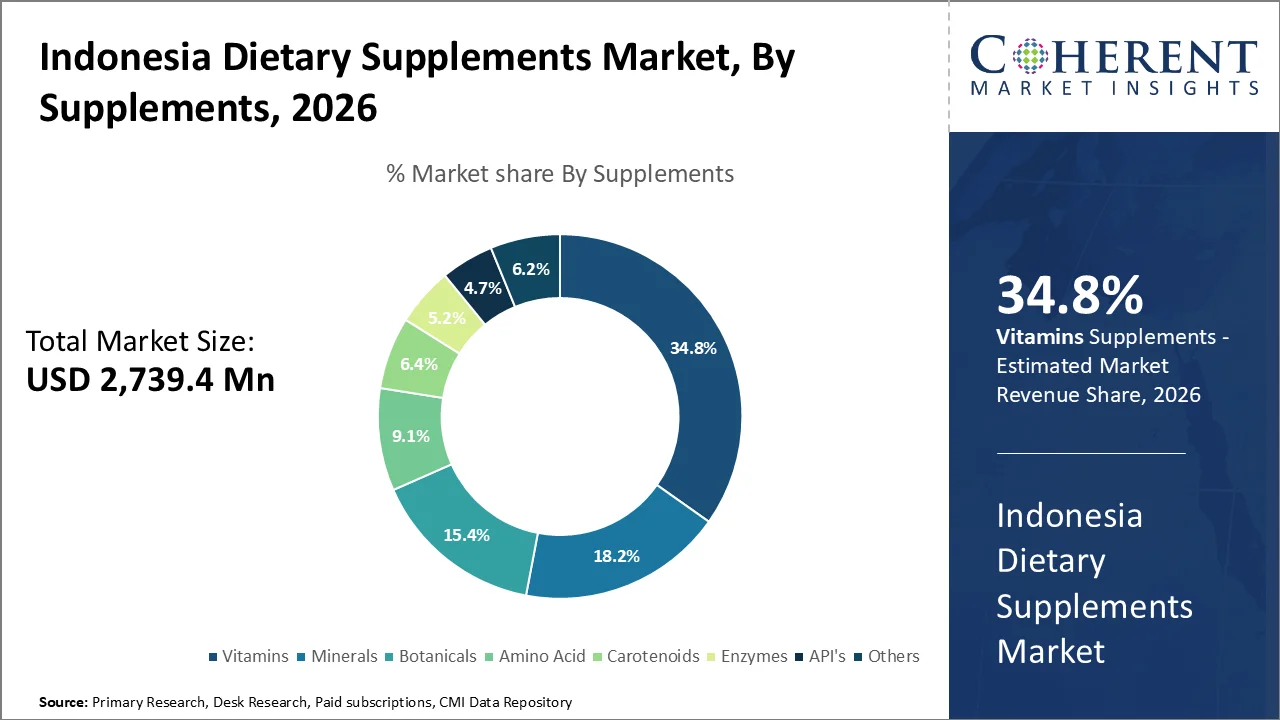
Why is Vitamins the Leading Segment in the Indonesia Dietary Supplements Market?
The vitamins segment is estimated to hold the greatest market share of 34.8% in 2026 owing to the high prevalence of micronutrient deficiencies and increased adoption of preventive healthcare in Indonesia. The Indonesia Ministry of Health (Kemenkes RI) has been taking measures to develop vitamin supplementation systems, especially those linked to vitamin A, vitamin D, and B complex vitamins. Implementation of these schemes will compensate nutritional inadequacies among children, adolescents and pregnant women and, hence, increase demand for vitamin-based supplements in the future.
In June 2025, Yakult Indonesia introduced a new mango-flavored probiotic variant, which is fortified with vitamin D to support immune health and calcium absorption.
- Current Industry Events of 2026
- Market Size Estimation
- Regional Breakdown
- Competitive Landscape
- Customer Intelligence
- Segmental Analysis
- Pricing Analysis
- Key Market Drivers, Challenges & Future Trends
- Customized Insights Section
Why do Medicinal Supplements Dominate the Application Segment?
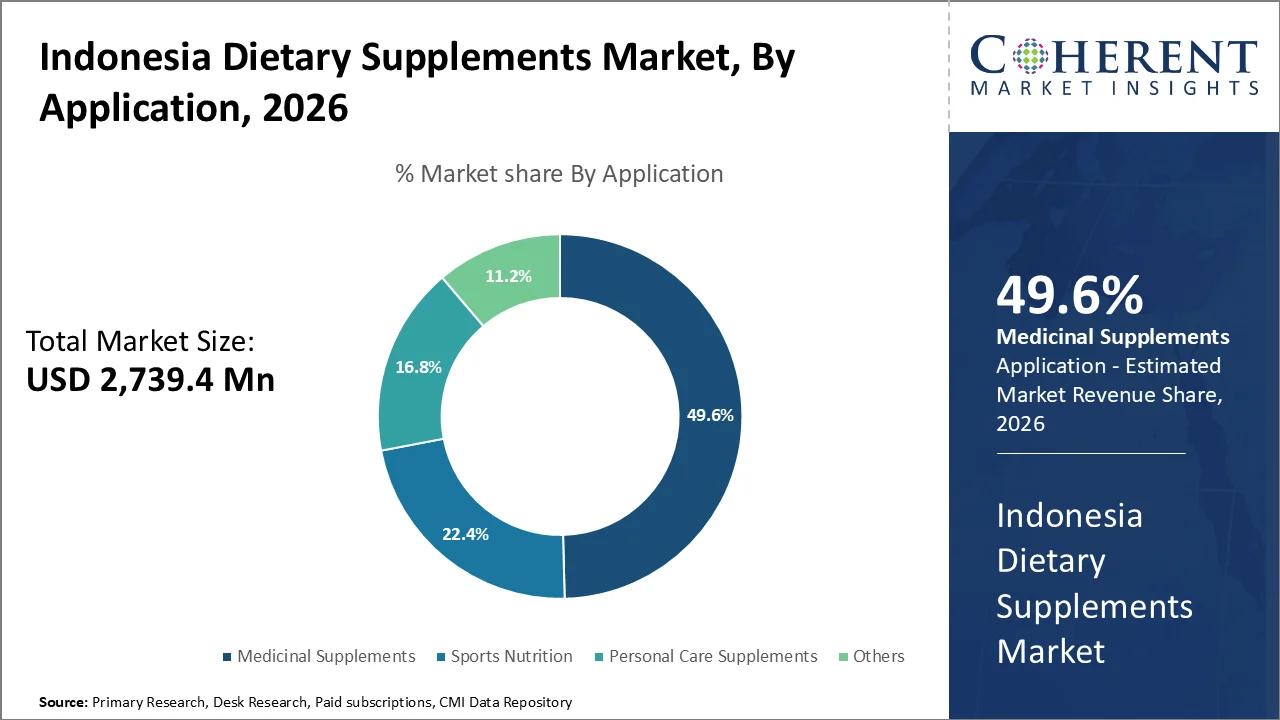
The medicinal supplements segment is expected to hold a prominent market share of 49.6% in 2026 due to the growing popularity of preventive healthcare, increasing government nutrition programs and increasing prevalence of micronutrient deficiencies in Indonesia. Vitamins, minerals, amino acids, herbal preparations, probiotics and medicinal nutraceuticals are broadly accessible through public health care programs and retail pharmaceutical outlets across the country.
In January 2026, the Indonesian Food and Drug Authority (BPOM) announced a draft decision regarding the list of raw materials in medicine used for health supplements, such as vitamins, minerals, amino acids, and others.
Why are Tablets the Dominant Form Segment in the Market?
The tablet market is expected to lead the industry with a market share of 31.4% in 2026. This is due to its affordability, ease of manufacture, availability in pharmaceutical retail shops, and strong consumer awareness of the Indonesian health care system. Tablets are also easy to use for self-medication, and can be given through institutions (hospitals and public health programmes). Tablets are very popular in government feeding programs because of the regulated dose and economic efficiencies.
In January 2026, Kerry Group launched its 2026 Supplements Taste Charts, revealing key flavour trends shaping the supplements and sports nutrition markets.
Why do Adults Dominate the Age Demographic Segment?
The adult population is anticipated to have the biggest market share of 51.2% owing to increased health awareness and nutritional inadequacies associated with the working age group. The adult demographic age 25 to 54 years is the most active group for dietary supplement usage due to the current living conditions, nutrition imbalance, stress and chronic health concerns in Indonesia.
In May 2026, PT Kalbe Farma Tbk announced that its consumer health business recorded positive growth during Q1 2026, supported by increasing demand for preventive health supplements.
Increasing Health Awareness and Preventive Healthcare Adoption is Accelerating Market Growth
The growing awareness of preventative health care is having a significant impact on the patterns of the dietary supplement consumption in Indonesia. According to the Central Statistics Agency (BPS), the urban population, particularly those of working age, were more involved in preventative health activities, including regular vitamin intake and health check-ups.
In February 2025, the Government of Indonesia officially launched the Free Health Check-Up (Cek Kesehatan Gratis) program to promote preventive healthcare and early disease detection nationwide.
Current Events and Their Impact on the Indonesia Dietary Supplements Market
Current Event | Description and its Impact |
2024–2026 Indonesia National Nutrition Acceleration Programs (SSGI + GERMAS Expansion) |
|
Expansion of Digital Health & E-Commerce Regulation in Indonesia (2025–2026) |
|
Indonesia Dietary Supplements Market Trends
- Immunological benefits remain the key driver behind supplement consumption since 81% of consumers take dietary supplements to enhance their immune system levels.
- Supplements containing probiotics, collagen, Vitamin D, and Omega-3 are gaining more popularity among customers.
- The aging population of Indonesia has increased the demand for bone, heart, and brain supplements.
- Government initiatives to supplement iron, vitamin A, and maternal vitamins have also been contributing to the market growth.
Who are the Major Companies in Indonesia Dietary Supplements Industry
Some of the major key players in Indonesia Dietary Supplements are ADM, PT Darya-Varia Laboratoria Tbk, Citra Nusa Insan Cemerlang PT, Sido Muncul PT, The Tempo Group, Bayer AG, BASF SE, Pfizer Inc., Nature’s Sunshine Products, Inc., Amway, and Glanbia PLC.
Key News
- In September 2025, Sido Muncul announced plans to expand exports into Indochina and African markets, supported by the launch of new products tailored for international consumers.
- In January 2025, ADM introduced its FlashMelt technology, enabling the development of instant-dissolving dietary supplement powders that dissolve in the mouth without water.
Market Report Scope
Indonesia Dietary Supplements Market Report Coverage
| Report Coverage | Details | ||
|---|---|---|---|
| Base Year: | 2025 | Market Size in 2026: | USD 2,739.4 Mn |
| Historical Data for: | 2020 To 2024 | Forecast Period: | 2026 To 2033 |
| Forecast Period 2026 to 2033 CAGR: | 7.7% | 2033 Value Projection: | USD 4,603.3 Mn |
| Segments covered: |
| ||
| Companies covered: | ADM, PT Darya-Varia Laboratoria Tbk, Citra Nusa Insan Cemerlang PT, Sido Muncul PT, The Tempo Group, Bayer AG, BASF SE, Pfizer Inc., Nature’s Sunshine Products, Inc., Amway, and Glanbia PLC | ||
| Growth Drivers: |
| ||
| Restraints & Challenges: |
| ||
Analyst Opinion
- The Indonesia dietary supplements market is shifting toward a preventive approach with more people being aware of their health and immunity and being mindful about their overall wellness. According to data released by the Indonesian Ministry of Health under the Free Health Screening (CKG) Program, the number of people who participated in the program has been recorded to be about 25 million students in 38 provinces.
- Domestic producers possess a competitive edge owing to their solid distribution systems and awareness of consumer preference, especially when integrating traditional herbs with contemporary formulations. The BPOM’s specific regulatory framework for traditional medicines and health supplements shows how important this category is to Indonesia.
- Innovation in dosage formats and functional ingredients is taking hold, with companies looking to diversify away from traditional offers and improve convenience to consumers, suggesting competition will increase. BPOM’s Directorate of Registration also informed that in the period of 2025 to April 2026 there were 501,196 product submissions and 33,139 completed product evaluations, showing that product innovation is still ongoing and new formulations are continuously entering the market.
Speak to the analyst
Want personalized insights?
Take the findings above to one of our principal consultants, or have the report rebuilt around the segments, geographies and competitors you actually track.
Market Segmentation
- By Supplements (Revenue, USD Mn, 2021-2033)
- Vitamins
- Minerals
- API’s
- Amino Acid
- Enzymes
- Botanicals
- Carotenoids
- Others
- By Application (Revenue, USD Mn, 2021-2033)
- Sports Nutrition
- Medicinal Supplements
- Personal Care Supplements
- Others
- By Form (Revenue, USD Mn, 2021-2033)
- Tablets
- Capsules
- Powder
- Liquid
- Soft Gel
- Gel Caps
- By Age Demographic (Revenue, USD Mn, 2021-2033)
- Infant
- Children
- Adult
- Pregnant Women
- Geriatric Population
Sources
Primary Research Interviews
- Interviews with dietary supplement manufacturers and nutraceutical companies operating in Indonesia
- Discussions with nutritionists, dietitians, and public health experts
- Interviews with pharmacists, retail pharmacy managers, and e-pharmacy executives
- Consultations with healthcare practitioners involved in preventive nutrition programs
- Discussions with distributors, wholesalers, and industry consultants specializing in dietary supplements
Databases
- Indonesia Statistics Agency (Badan Pusat Statistik – BPS) databases
- Indonesia Ministry of Health (Kementerian Kesehatan RI) databases
- Indonesia Food and Drug Authority (BPOM) product registration database
- National Food Agency (Badan Pangan Nasional) nutrition databases
- United Nations Comtrade international trade database
- World Bank Open Data
- World Health Organization (WHO) Health Observatory Database
Magazines
- Nutraceutical Business Review
- NutraIngredients-Asia
- Nutrition Insight
- FoodNavigator-Asia
- Asia Pacific Food Industry Magazine
Journals
- National Library of Medicine (PubMed) journals on dietary supplement consumption and nutrition
- Journal of Nutrition and Metabolism
- Nutrients
- Frontiers in Nutrition
- Asia Pacific Journal of Clinical Nutrition
- BMC Public Health
Newspapers
- The Jakarta Post
- Bisnis Indonesia
- Kontan
- The Business Times
- Nikkei Asia
- The Straits Times
Associations
- Indonesian Food and Beverage Association (GAPMMI)
- Indonesian Pharmacists Association (IAI)
- Indonesian Nutrition Association (Persagi)
- World Health Organization (WHO)
- UNICEF Indonesia
- ASEAN Alliance of Health Supplement Associations (AAHSA)
Public Domain Sources
- Indonesia Ministry of Health (Kementerian Kesehatan RI) reports and publications
- BPOM (Badan Pengawas Obat dan Makanan) regulations and health supplement registration records
- Statistics Indonesia (BPS) reports
- National Food Agency (Badan Pangan Nasional) reports
- WHO Indonesia publications and country health profiles
- UNICEF Indonesia nutrition reports
- Company annual reports, investor presentations, press releases, and official websites
- Publicly available customs and trade statistics
Proprietary Elements
- CMI Data Analytics Tool
- Proprietary CMI Existing Repository of Information for the Last 8 Years
- Internal triangulation models and market forecasting framework
- CMI primary interview repository and validation methodology.
Get access to 250+ pages report
Every segment, forecast, competitor profile and data table behind the analysis above — available for instant download.
- ESOMAR Member
- ISO 9001:2015 Certified
- D-U-N-S Registered
- GDPR & CCPA Compliant
Missing comfort of reading report in your local language? Find your preferred language:
Transform your Strategy with Exclusive Trending Reports
Frequently Asked Questions
The Indonesia dietary supplements market is estimated to be valued at USD 2,739.4 Mn in 2026.
The Indonesia dietary supplements market is expected to reach USD 4,603.3 Mn by 2033.
The Indonesia dietary supplements market is projected to register a CAGR of 7.7% during the forecast period from 2026 to 2033.
Major growth factors include rising preventive healthcare awareness and self-care adoption, increasing prevalence of vitamin and micronutrient deficiencies, growing demand for immunity-boosting products, and expanding availability of supplements through retail and online channels.
The vitamins segment, with a 34.8% share in 2026, is expected to dominate the market due to the high prevalence of micronutrient deficiencies and increasing preventive healthcare adoption.
The medicinal supplements segment, accounting for 49.6% of the market in 2026, is expected to lead due to rising preventive healthcare behavior and government-led nutrition initiatives.
The tablets segment, with a 31.4% share in 2026, is projected to dominate the market owing to their affordability, ease of distribution, standardized dosing, and strong consumer familiarity.