Geopolymer Market Analysis & Forecast: 2026-2033

Geopolymer Market Size and Forecast – 2026 – 2033
The Global Geopolymer Market size is estimated to be valued at USD 3.64 billion in 2026 and is expected to reach USD 7.8 billion by 2033, exhibiting a compound annual growth rate (CAGR) of 13.8% from 2026 to 2033.
Global Geopolymer Market Overview
Geopolymers are inorganic, eco-friendly materials produced by reacting aluminosilicate sources (fly ash, slag, kaolin) with alkaline activators. They serve as sustainable alternatives to Portland cement in construction and infrastructure, offering high mechanical strength, chemical resistance, and lower carbon emissions. The market includes geopolymer concrete, mortar, binder systems, coatings, fireproofing materials, and precast components used in building, transportation, offshore structures, and industrial applications.
Key Takeaways
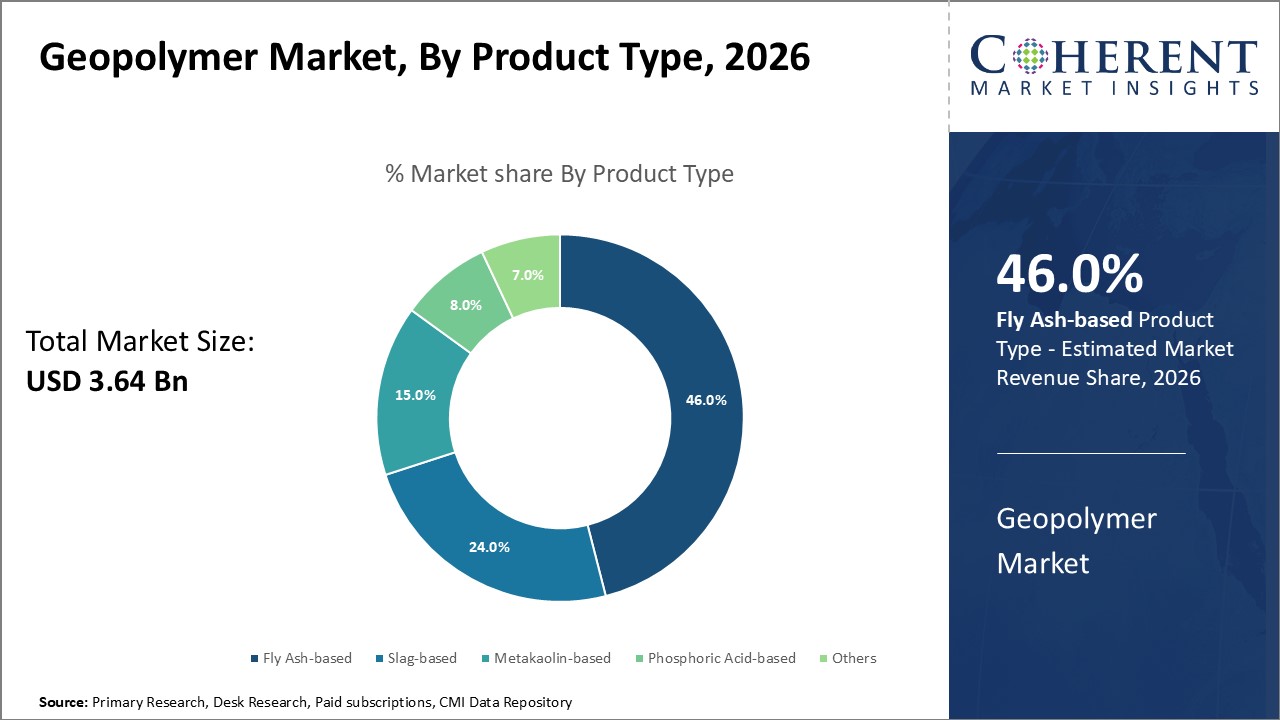
Fly Ash-based geopolymers dominate with a 46% market share, driven by the abundant availability of industrial by-products and superior performance in construction applications. Slag-based alternatives show the fastest growth, fueled by metallurgical waste utilization.
Construction leads with 53% market share, underscoring industry adoption for eco-friendly building materials; the Fire-resistant materials segment exhibits growing demand due to rising safety regulations.
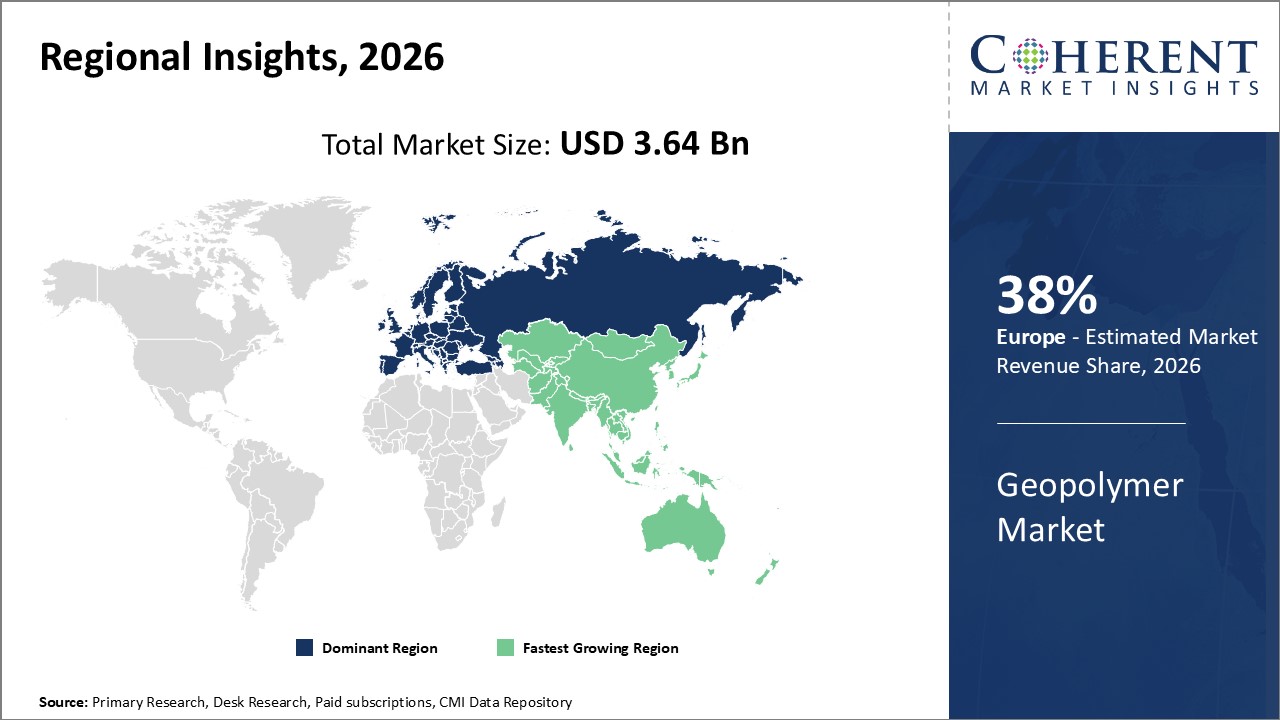
Region: Europe maintains a dominant market share of 38% attributed to stringent environmental policies and strong infrastructure investments.
Asia Pacific holds the fastest CAGR of 15%, powered by burgeoning urbanization and government subsidies promoting green technologies.
Geopolymer Market Segmentation Analysis
To learn more about this report, Request Free Sample
Geopolymer Market Insights, By Product Type
Fly Ash-based dominates the market share. Fly Ash-based geopolymers lead the industry due to the vast quantities of coal combustion by-products readily accessible worldwide, providing a low-cost and high-performance binder alternative. Their widespread availability and significant performance in concrete strength and durability make them fundamental to market revenue growth. Slag-based geopolymers exhibit the fastest growth, propelled by the rising utilization of metallurgical waste and enhanced strength characteristics for specialized engineering applications.
Geopolymer Market Insights, By Application
The Construction segment is dominating the market share. The dominance is primarily due to increasing global demand for sustainable and durable building materials that reduce CO2 emissions in large-scale infrastructure projects. The Construction segment’s rapid adoption is supported by government mandates promoting green building certifications and performance-based building codes. The fire-resistant materials segment is the fastest growing, driven by stricter fire safety regulations, especially in commercial and public buildings, where geopolymer composites offer superior thermal stability compared to traditional materials. Waste Management applications utilize geopolymers for immobilizing hazardous wastes, aligning with global circular economy initiatives. Aerospace & Defense uses geopolymers selectively for lightweight, heat-resistant components.
Geopolymer Market Insights, By Technology
Alkali Activation commands the dominant market share due to its widespread commercial viability, enabling effective geopolymer synthesis with readily available alkali solutions such as sodium hydroxide and silicates. This method balances cost-efficiency with performance, facilitating large-scale production. Thermal Activation is the fastest-growing segment, driven by innovations in kiln design and lower energy consumption processes introduced recently, increasing output quality and sustainability. Polymerization technology caters to high-purity, specialized geopolymer products for advanced applications such as aerospace. The Others category includes emerging technologies like microwave activation, which remain early-stage in commercial adoption but show promise for future market expansion.
Geopolymer Market Trends
Current market trends in the geopolymer sector emphasize sustainable product innovations and digital transformation of manufacturing.
In 2025, thermal activation technologies enhanced production efficiency by nearly 11%, simplifying scalability.
Nanotechnology adoption, particularly nano-silica incorporation, has recently accelerated, especially in China and Europe, delivering improved mechanical properties.
Another trend includes regional policy-driven demand spikes, such as North America’s focus on using geopolymers in fire-resistant building materials, which rose 22% in usage in 2026.
These trends collectively shape the market landscape, driving better industry share and margins for market companies.
Geopolymer Market Insights, By Geography
To learn more about this report, Request Free Sample
Europe Geopolymer Market Analysis and Trends
In Europe, the geopolymer market dominance is underpinned by advanced infrastructure development combined with stringent environmental policies, resulting in a 38% industry share by 2026. Robust investments in green construction projects across Germany, France, and the U.K. propel market growth, with notable contributions from Holcim and BASF SE in green cement solutions.
Asia Pacific Geopolymer Market Analysis and Trends
Meanwhile, Asia Pacific exhibits the fastest growth at a CAGR of approximately 15%, attributed to rapid urbanization, government initiatives for sustainable building, and abundant availability of industrial by-products. Leading market players like Wagners and Zeobond have significantly expanded their footprint in Australia, China, and India, capitalizing on growing infrastructure budgets and evolving market dynamics.
Geopolymer Market Outlook for Key Countries
USA Geopolymer Market Analysis and Trends
The USA market is driven by regulatory mandates enforcing lower carbon emissions in the construction sector. In 2025 alone, use of geopolymer cement in federal infrastructure projects increased by 18%, supported by government subsidies and green-building certifications. Leading market companies such as BASF SE and Sika AG have launched specialized geopolymer formulations tailored to comply with American standards, helping to boost market revenue and expand business growth trajectories.
India Geopolymer Market Analysis and Trends
India's geopolymer market has been fueled by abundant fly ash availability from coal power plants, enabling cost-effective material supply. Ongoing infrastructure projects, including mass housing schemes and metro rail expansions, have utilized geopolymers extensively, resulting in a year-over-year market revenue increase exceeding 25% in 2025. Local players alongside international companies have collaborated to innovate low-cost geopolymer products optimized for tropical climates, strengthening India's market share globally.
Analyst Opinion
The surge in demand for low-carbon construction materials is a key market driver, with recent policy shifts such as the European Green Deal enforcing stricter carbon emission standards. Adoption rates for geopolymers in infrastructure projects rose by 27% in 2025 across Europe, highlighting strong demand-side indicators reflecting market size expansion.
Production capacity enhancement has been pivotal to accommodating the rapid integration of geopolymers in industrial applications. For instance, a leading manufacturing plant in Asia increased its annual production capacity by 41% in early 2026 to meet domestic and export demands, signaling robust supply-side market dynamics.
Pricing trends increasingly favor geopolymers as raw material costs stabilize due to the utilization of industrial by-products such as fly ash and slag. Between 2023 and 2026, the average cost reduction has been recorded at approx. 9%, which positively influences market analysis for competitive positioning among market companies.
Import-export flows have demonstrated geographical variations, particularly in regions with infrastructure booms. Latin America showed a 15% rise in geopolymer import volumes in 2025, underlining diverse regional market drivers and contributing to key market revenue growth figures forecasted through 2033.
Market Scope
| Report Coverage | Details | ||
|---|---|---|---|
| Base Year: | 2025 | Market Size in 2026: |
USD 3.64 billion |
| Historical Data for: | 2020 To 2024 | Forecast Period: | 2026 To 2033 |
| Forecast Period 2026 to 2033 CAGR: | 13.8% | 2033 Value Projection: |
USD 7.8 billion |
| Geographies covered: |
|
||
| Segments covered: |
|
||
| Companies covered: | Geopolymer Technologies, Zeobond, Wagners, Holcim, BASF SE, Sika AG, Applied Materials Inc., Argex Titanium Inc., Joseph Hammond & Sons, ACE Geopolymer Solutions | ||
| Growth Drivers: |
|
||
Uncover macros and micros vetted on 75+ parameters: Get instant access to report
Geopolymer Market Growth Factors
The sustained momentum in infrastructure spending globally, especially in emerging economies, propels demand for geopolymers, which are increasingly preferred due to their superior durability and fire resistance. Growing environmental policies targeting CO2 emissions from cement production directly enhance market growth, evidenced by regional regulations in North America mandating low-carbon materials in urban development projects. Additionally, advancements in the utilization of industrial waste as feedstock reduce production costs and increase supply chain sustainability. Furthermore, increasing awareness of geopolymer's role in waste management and circular economy initiatives further pushes market revenue growth, amplified by cases such as India's use of fly ash geopolymers in municipal waste containment since 2025.
Geopolymer Market Development
In late 2023, Betolar partnered with Fujairah Concrete Products in the UAE to launch Geoprime-based geopolymer concrete paving, offering a low-carbon alternative to traditional cement-based materials. The technology reduced CO??? emissions while maintaining high durability, supporting the region’s shift toward sustainable construction solutions.
In March 2023, Schlumberger introduced EcoShield, a geopolymer well-cementing system designed to deliver cement-free, high-performance zonal isolation in oil and gas wells. The solution provided enhanced thermal stability, reduced environmental impact, and improved well integrity, positioning EcoShield as a next-generation sustainable alternative to Portland cement-based systems.
Key Players
Leading Companies of the Market
Geopolymer Technologies
Zeobond
Wagners
Holcim
BASF SE
Sika AG
Applied Materials Inc.
Argex Titanium Inc.
Joseph Hammond & Sons
ACE Geopolymer Solutions
Competitive strategies include product portfolio diversification led by BASF SE, which introduced a novel class of low-alkali geopolymers in 2025, enhancing material performance and securing new contracts in Europe and Asia. Meanwhile, Zeobond’s strategic partnerships with construction conglomerates in Australia have doubled its market revenue from geopolymer cement applications between 2023-2026.
Geopolymer Market Future Outlook
The future outlook for the geopolymer market is highly promising, driven by the global push for carbon-neutral construction and the circular economy. As countries implement net-zero emissions targets, geopolymer-based cement alternatives will gain significant market share in cementitious materials. The construction industry is expected to adopt geopolymer concrete for highways, bridges, precast structures, and industrial floors due to its long lifespan and lower environmental impact. Advances in alkaline activators, automated mixing technology, and large-scale 3D printing will make geopolymer materials more accessible. Government-backed sustainability standards and green certification programs will further encourage widespread adoption.
Geopolymer Market Historical Analysis
Historically, the geopolymer market emerged as industries sought eco-friendly construction materials to reduce reliance on carbon-intensive Portland cement. Early adoption was slow and limited to niche applications in fireproofing, waste encapsulation, and specialty construction due to limited awareness and higher costs. However, as environmental regulations tightened and industrial waste recycling gained momentum, materials like fly ash and slag became widely used feedstocks for geopolymer production. Research institutions and construction companies increasingly recognized geopolymers for their superior thermal stability, chemical resistance, and durability. Over the past decade, infrastructure projects, precast components, and green building initiatives accelerated commercial interest in geopolymer concrete and binders.
Sources
Primary Research Interviews:
Material Scientists
Civil Engineers
Geopolymer Producers
Construction Chemists
Sustainability Consultants
Databases:
ASTM Materials Data
Scopus Geopolymer Publications
UN Comtrade Building Materials
Magazines:
Concrete International
Materials World Magazine
Construction Europe
Chemical Engineering Magazine
Global Cement Magazine
Journals:
Construction and Building Materials
Journal of Materials Science
Cement and Concrete Research
Materials Today
Journal of Cleaner Production
Newspapers:
Financial Times (Infrastructure)
The Wall Street Journal (Construction)
Reuters Energy & Materials
The Guardian (Environment)
Bloomberg Green
Associations:
Geopolymer Institute
American Concrete Institute
European Materials Association
International Union of Materials Research Societies
Civil Engineering Associations
Share
Share
Yash Doshi is a Senior Management Consultant. He has 12+ years of experience in conducting research and handling consulting projects across verticals in APAC, EMEA, and the Americas.
He brings strong acumen in helping chemical companies navigate complex challenges and identify growth opportunities. He has deep expertise across the chemicals value chain, including commodity, specialty and fine chemicals, plastics and polymers, and petrochemicals. Yash is a sought-after speaker at industry conferences and contributes to various publications on topics related commodity, specialty and fine chemicals, plastics and polymers, and petrochemicals.

Credibility and Certifications

860519526


9001:2015

27001:2022


Need a Custom Report?
We can customize every report - free of charge - including purchasing stand-alone sections or country-level reports
Customize NowJoining thousands of companies around the world committed to making the Excellent Business Solutions.
View All Our Clients