Handheld Imaging Devices Market Analysis & Forecast: 2026-2033

Handheld Imaging Devices Market Size and Forecast – 2026 – 2033
The Global Handheld Imaging Devices Market size is estimated to be valued at USD 4.59 billion in 2026 and is expected to reach USD 8.55 billion by 2033, exhibiting a compound annual growth rate (CAGR) of 9.3% from 2026 to 2033.
Global Handheld Imaging Devices Market Overview
Handheld imaging devices are portable diagnostic tools designed to provide point-of-care visualization and imaging across medical, industrial, and security applications. These products include handheld ultrasound scanners, thermal imagers, optical cameras, and portable diagnostic viewers. Compact design, battery operation, and wireless data transfer enable use in emergency care, remote settings, and field operations. Handheld imaging devices emphasize ease of use, rapid deployment, and real-time imaging capabilities, allowing professionals to make quick and accurate assessments without reliance on fixed imaging infrastructure.
Key Takeaways
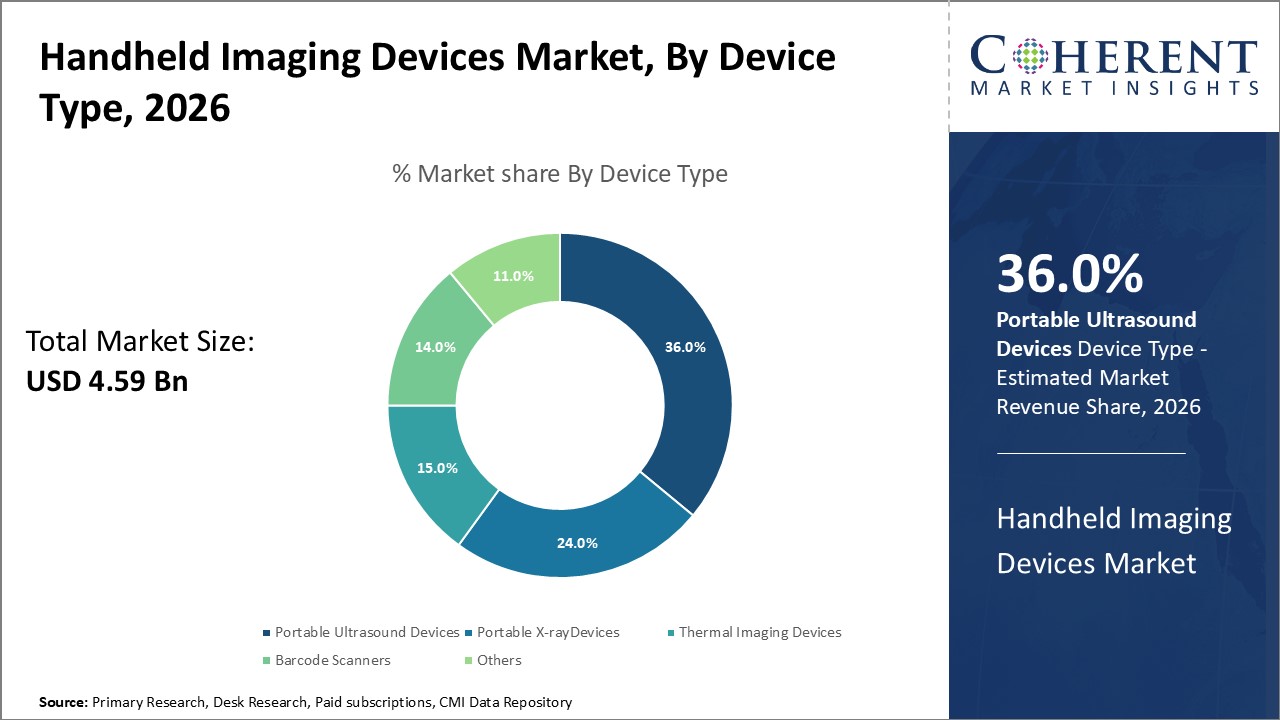
The portable ultrasound segment is dominating the market share due to increasing healthcare adoption and innovation in imaging accuracy.
Meanwhile, thermal imaging devices report the fastest growth, particularly in security and surveillance applications spurred by government funding for counterterrorism and border control programs.
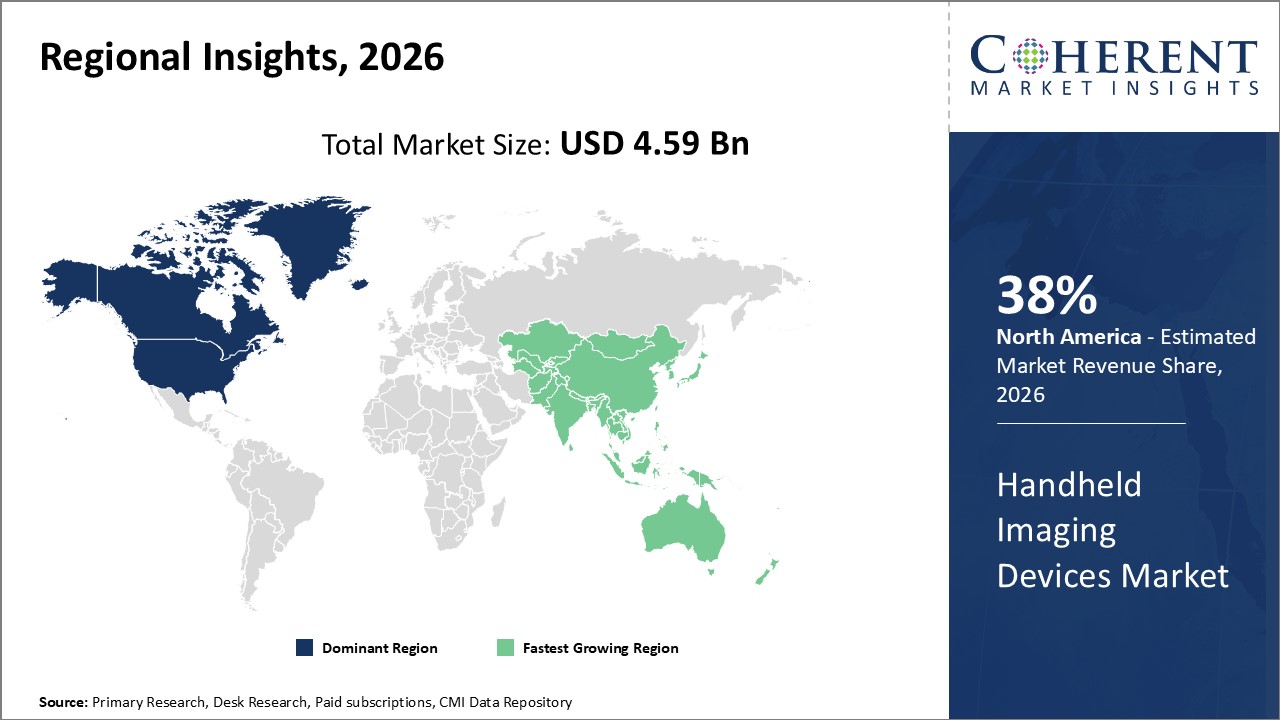
Regionally, North America continues to hold a significant industry share driven by widespread adoption of advanced healthcare technologies and strong industrial infrastructure.
Asia Pacific exhibits the fastest CAGR owing to favorable government policies supporting industrial automation and investments in digital healthcare.
Handheld Imaging Devices Market Segmentation Analysis
To learn more about this report, Request Free Sample
Handheld Imaging Devices Market Insights, By Device Type
Portable Ultrasound Devices dominate the market share, driven by rising adoption in emergency and point-of-care diagnostics. Their portability and improved imaging accuracy have made them indispensable in healthcare, especially with innovations focusing on battery life and wireless operation, enhancing field usability. Thermal Imaging Devices represent the fastest growing subsegment, propelled by increasing security and surveillance applications, where they provide non-contact detection capabilities vital for border security and industrial hazard monitoring. Portable X-ray Devices are widely used for on-site inspection in industrial and security fields, though growth is relatively moderate compared to ultrasound and thermal devices.
Handheld Imaging Devices Market Insights, By Application
Healthcare Imaging holds the leading market share, catalyzed by increasing demand for portable diagnostic tools in clinics lacking a stationary imaging infrastructure. Continuous regulatory approvals for handheld medical devices have reinforced trust and adoption. Security and Surveillance is the fastest growing application, with adoption fueled by rising concerns around public safety and terrorism, prompting investments in advanced handheld thermal and X-ray solutions. Industrial Inspection benefits from the surge in manufacturing automation and quality control standards that necessitate frequent on-site inspections using diverse imaging modalities.
Handheld Imaging Devices Market Insights, By End-User
Hospitals & Clinics dominate the market share, driven by the imperative need for timely diagnostic information and increasing expenditures on portable medical devices. Their role in streamlining hospital workflows and delivering point-of-care diagnostics underscores constant investment. Law Enforcement & Defense represents the fastest expanding end-user segment owing to heightened security challenges and increasing procurement of thermal imaging and portable X-ray devices for field operations. Manufacturing sees growth aligned with stringent quality inspections and automation, leveraging handheld imaging for defect identification. Retail primarily uses barcode scanners and related handheld devices to enhance inventory management.
Handheld Imaging Devices Market Trends
The handheld imaging devices market is heavily influenced by technological integration, driven notably by AI adoption in 2025 that enhances diagnostic efficiency and industrial inspection accuracy.
Another trend is the proliferation of wireless-enabled handheld devices facilitating real-time data sharing and remote diagnostics, especially important in healthcare and security scenarios.
An example includes the deployment of AI-empowered thermal scanners by border agencies in Europe, improving throughput and threat response times significantly.
Handheld Imaging Devices Market Insights, By Geography
To learn more about this report, Request Free Sample
North America Handheld Imaging Devices Market Analysis and Trends
In North America, the handheld imaging devices market shares dominance with approximately 38% of the market revenue share attributed to cutting-edge healthcare infrastructure and pervasive industrial automation. Robust investment in R&D by key players and early adoption of advanced technologies sustain the region’s leadership. The U.S. accounts for almost 70% of regional market activities, supported by leading hospitals and expanding defense sector procurement.
Asia Pacific Handheld Imaging Devices Market Analysis and Trends
Meanwhile, Asia Pacific exhibits the fastest growth with a CAGR surpassing 11%, driven primarily by industrial expansion in China and digitization of healthcare services in India. Supportive government subsidies for smart manufacturing and rising demand for cost-effective portable diagnostic tools propel this growth. Notable companies like Canon and Zebra are strengthening their presence through strategic partnerships within these countries.
Handheld Imaging Devices Market Outlook for Key Countries
USA Handheld Imaging Devices Market Analysis and Trends
The U.S. market is a critical contributor, with widespread adoption of portable ultrasound and thermal imaging devices in hospitals and homeland security. Leading companies focus on innovation partnerships and government contracts, resulting in sustained revenue growth of approximately 8% in 2025. The emphasis on point-of-care diagnostics and emergency response technologies has further spurred market penetration.
China Handheld Imaging Devices Market Analysis and Trends
China’s market has surged due to rapid expansion of manufacturing facilities integrating handheld inspection devices and accelerated healthcare digitization initiatives. Domestic manufacturers collaborating with international technology providers led to a 15% increase in sales of handheld imaging devices in 2026. Government initiatives for “Made in China 2026” bolster investments, cementing China’s role as a pivotal growth hub.
Analyst Opinion
Market dynamics around handheld imaging devices reveal a significant demand-side impetus fueled by expanding use cases in healthcare diagnostics such as portable ultrasound and point-of-care imaging. Recent healthcare digitization trends and initiatives by leading hospitals in Europe and North America have increased procurement of handheld diagnostic devices by over 18% in 2025, indicating growing acceptance and penetration.
Supply-side analysis highlights robust enhancements in sensor miniaturization and imaging resolution. For instance, manufacturers invested heavily in the development of compact CMOS and CCD imaging sensors in 2025, leading to a 13% reduction in device weight and a 16% increase in image clarity compared to 2022 models, directly influencing market share growth for top-performing products.
Export data underscores the growing market relevance of Asia Pacific, where export of handheld imaging technologies rose by approximately 22% in 2026, driven by expanding industrial automation and security applications in countries like China and India. This region’s rising contribution compensates for moderate growth rates observed in mature North American markets.
Pricing trends reveal an evolving dynamic where economies of scale and enhanced production technologies have driven a 8% decline in average unit costs in 2025. Consequently, the lowered price barrier supports wider adoption among small-to-medium enterprises in industrial inspection sectors and emerging markets, thus enabling broader market revenue expansion.
Market Scope
| Report Coverage | Details | ||
|---|---|---|---|
| Base Year: | 2025 | Market Size in 2026: | USD 4.59 billion |
| Historical Data for: | 2020 To 2024 | Forecast Period: | 2026 To 2033 |
| Forecast Period 2026 to 2033 CAGR: | 9.3% | 2033 Value Projection: | USD 8.55 billion |
| Geographies covered: |
|
||
| Segments covered: |
|
||
| Companies covered: | FLIR Systems, Canon Inc., GE Healthcare, Zebra Technologies, Samsung Electronics, Honeywell International, Philips Healthcare, Fujifilm Holdings Corporation, L3Harris Technologies, Varian Medical Systems, Teledyne DALSA. | ||
| Growth Drivers: |
|
||
Uncover macros and micros vetted on 75+ parameters: Get instant access to report
Handheld Imaging Devices Market Growth Factors
The rising demand for real-time diagnostic imaging in ambulatory and remote healthcare settings is a crucial growth driver, exemplified by the surge in portable ultrasound device procurements by rural clinics in the U.S. and India. Advancements in semiconductor and sensor technologies have allowed manufacturers to produce higher-resolution handheld imaging devices, which support broader adoption in security and industrial inspection applications. Additionally, expanding government initiatives aimed at upgrading security infrastructure in Asia Pacific and Europe have augmented demand for thermal and X-ray scanning solutions. Furthermore, increasing digitization and automation in manufacturing processes worldwide accelerate the need for handheld devices for quality inspections, contributing robustly to market revenue expansion.
Handheld Imaging Devices Market Development
In July 2023, Konica Minolta launched PocketPro H2, a wireless handheld imaging device designed for general point-of-care use. The compact system enables clinicians to perform rapid bedside assessments with improved mobility and ease of use, supporting faster clinical decision-making across primary care, emergency, and outpatient settings.
In December 2025, SuperSonic Imagine introduced PocketVu, a new handheld diagnostic ultrasound device, expanding its portable ultrasound portfolio. The launch aimed to improve accessibility to high-quality ultrasound imaging by offering a lightweight, easy-to-use solution for point-of-care diagnostics, reinforcing the company’s focus on decentralizing medical imaging.
Key Players
Leading Companies of the Market
FLIR Systems
Canon Inc.
GE Healthcare
Zebra Technologies
Samsung Electronics
Honeywell International
Philips Healthcare
Fujifilm Holdings Corporation
L3Harris Technologies
Varian Medical Systems
Teledyne DALSA
Competitive strategies include FLIR Systems’ expansion into thermal imaging solutions with a strong emphasis on government contracts, yielding a 14% revenue increase in 2025. Canon’s focus on innovation in portable ultrasound devices facilitated partnerships with healthcare providers across the Asia Pacific, resulting in a 12% uplift in market presence. Zebra Technologies enhanced its product portfolio with integrated AI analytics in barcode scanners, boosting its industrial client base by over 20% in 2026.
Handheld Imaging Devices Market Future Outlook
The market is expected to expand significantly as telemedicine and remote diagnostics continue to gain traction. Future product development will emphasize AI-assisted interpretation, smartphone integration, and seamless cloud-based data sharing. Increasing demand for fast, accurate diagnostics in emergency and home-care settings will further support market growth. In addition, expanding use across non-medical sectors such as infrastructure inspection and security will diversify revenue streams. Overall, continued digital transformation in healthcare and industry will strengthen long-term market prospects.
Handheld Imaging Devices Market Historical Analysis
The handheld imaging devices market developed as healthcare and industrial users sought portable alternatives to conventional imaging systems. Early handheld devices offered limited image quality and were mainly used for basic assessments in emergency and field settings. Over time, advancements in digital sensors, wireless connectivity, and battery technology have dramatically improved imaging performance. These developments allowed handheld imaging devices to gain acceptance across point-of-care diagnostics, rural healthcare delivery, and military and industrial inspection applications. As healthcare systems increasingly adopted decentralized care models, handheld imaging solutions became essential tools for rapid diagnosis and on-site decision-making.
Sources
Primary Research Interviews:
Emergency Physicians
Radiologists
Paramedics
Medical Device Engineers
Healthcare IT Managers
Databases:
FDA Device Data
WHO Digital Health
OECD Medical Technology
Magazines:
MedTech Dive
Healthcare Innovation
Diagnostic Imaging
Medical Device Network
HealthTech Magazine
Journals:
Journal of Medical Imaging
IEEE Biomedical Engineering
Sensors Journal
Digital Health
Ultrasound in Medicine
Associations:
IEEE
HIMSS
WHO
Radiological Society of North America
MedTech Europe
Share
Share
Komal Dighe is a Management Consultant with over 8 years of experience in market research and consulting. She excels in managing and delivering high-quality insights and solutions in Health-tech Consulting reports. Her expertise encompasses conducting both primary and secondary research, effectively addressing client requirements, and excelling in market estimation and forecast. Her comprehensive approach ensures that clients receive thorough and accurate analyses, enabling them to make informed decisions and capitalize on market opportunities.

Credibility and Certifications

860519526


9001:2015

27001:2022


Need a Custom Report?
We can customize every report - free of charge - including purchasing stand-alone sections or country-level reports
Customize NowJoining thousands of companies around the world committed to making the Excellent Business Solutions.
View All Our Clients