Medical Vacuum System Market Analysis & Forecast: 2026-2033
Medical Vacuum System Market Analysis & Forecast: 2026-2033
Medical Vacuum System Market, By Product Type (Standalone, Centralized, Portable, and Others), By Technology (Dry Claw Vacuum Pump, Oil-Sealed Liquid Ring, Water-Sealed Liquid Ring, Oil-Sealed Rotary vane, and Others), By Application (Diagnostics, Wound Care, Anesthesiology, Gynecology, and Others), By End User (Hospitals and Clinics, Diagnostic Centers, Ambulatory Surgical Hospitals, Academic and Research Institutes, Pharmaceutical and Biotechnological Companies, and Others), By Geography (North America, Latin America, Europe, Asia Pacific, Middle East, and Africa)
Medical Vacuum System Market Size and Trends: 2026-2033
Medical vacuum system market is estimated to be valued at USD 1,963 Mn in 2026 and is expected to reach USD 3,074 Mn by 2033, exhibiting a compound annual growth rate (CAGR) of 6.6% from 2026 to 2033.
Key Takeaways
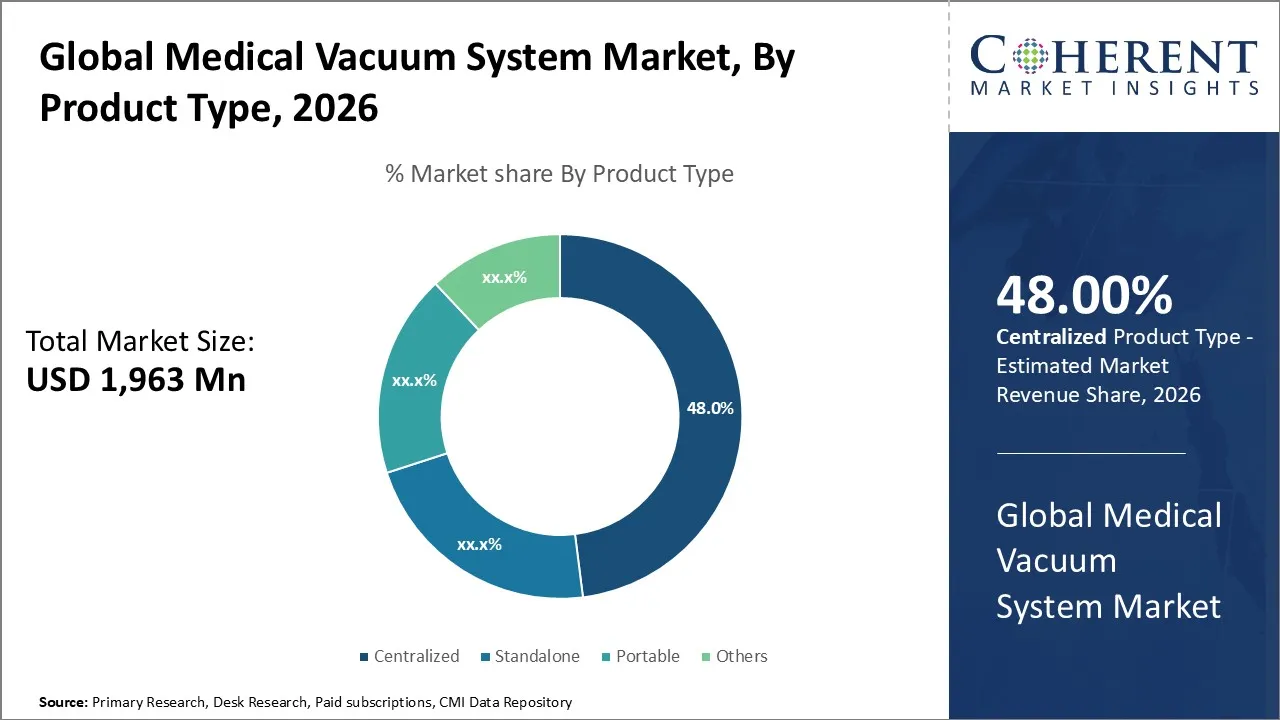
By Product Type, the centralized segment is expected to lead the market with 48%share in 2026, due to its widespread adoption in large hospitals and integrated healthcare facilities.
By Technology, the dry claw vacuum pump segment is projected to account for 34%share of the market in 2026, owing to its oil-free operation, lower maintenance requirements, and higher energy efficiency.
Based on Application, the anesthesiology segment is anticipated to hold 31%share of the market in 2026, driven by the increasing number of surgical procedures globally.
Based on End User, hospitals and clinics are expected to dominate the market with 56%share in 2026, supported by high patient inflow and continuous infrastructure upgrades.
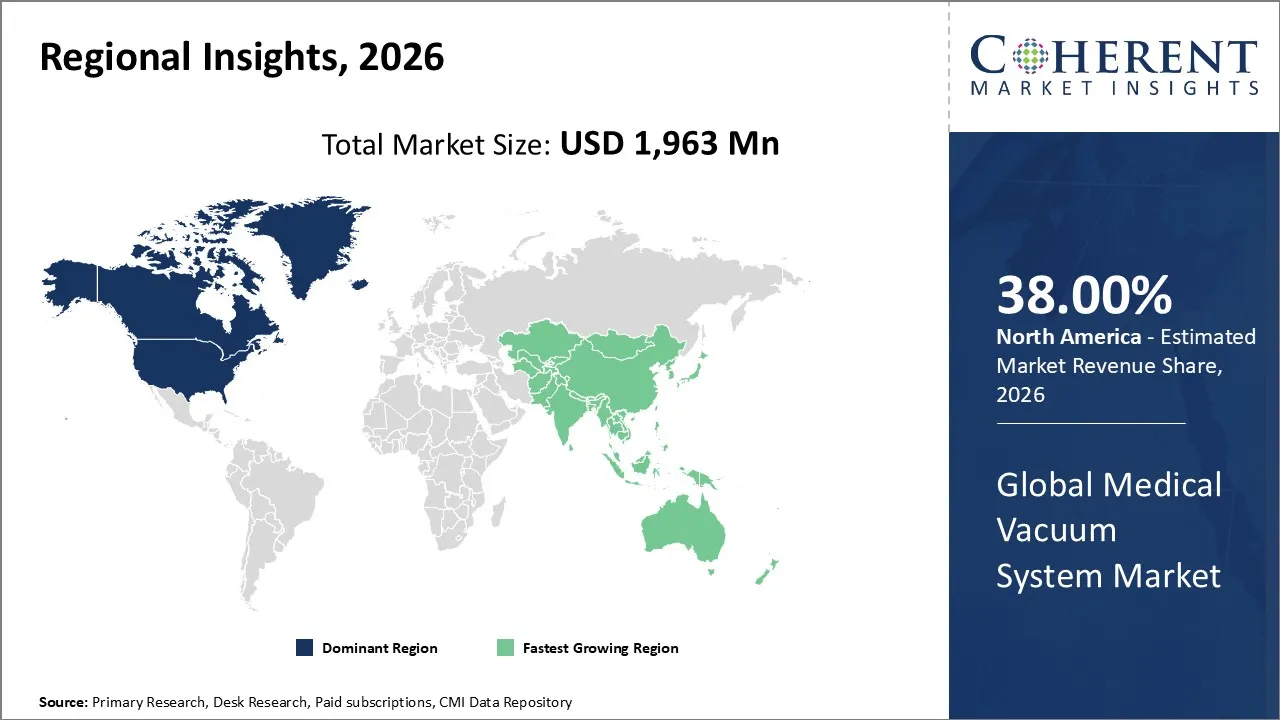
By Region, North America is set to lead the medical vacuum system market with 38% share in 2026. While, Asia Pacific is anticipated to be the fastest growing region.
Market Overview
The global market for medical vacuum systems is growing because there is a need for more advanced healthcare infrastructure and more surgeries and tests are being done. Hospitals and other healthcare facilities need medical vacuum systems because they let them safely suck up fluids, gases, and waste during operations, wound care, anesthesia, and diagnostic procedures. The need for reliable medical vacuum systems is growing as the population gets older and more people get long-term illnesses that need more hospital stays and surgeries.
Current Events and Its Impacts on the Medical Vacuum System Market
Current Events
and its impact
Global Healthcare Infrastructure Expansion and Modernization
Description: Emerging Markets Hospital Construction Boom
Impact: Driving significant demand for new medical vacuum installations in Asia-Pacific, Latin America, and Africa
How is Product Innovation driving the growth in the medical vacuum system market?
Oil-Free and Dry Vacuum Technologies: Dry claw and oil-free vacuum systems are gaining popularity because of their reduced maintenance needs, lesser risk of contamination, and compliance with stringent healthcare hygiene laws.
Energy-Efficient Systems: To help hospitals reduce running costs and their carbon footprint, manufacturers are introducing vacuum pumps with variable speeds and energy efficiency.
Compact and Portable Designs: Creation of medical vacuum systems that are lightweight and portable to assist ambulatory surgical centers, emergency rooms, and outpatient operations.
Smart Monitoring and Automation: IoT-enabled monitoring systems can boost uptime and dependability through predictive maintenance, real-time performance tracking, and system alerts.
Medical Vacuum System Market Insights, By Product Type – Centralized systems dominate due to high adoption in large healthcare facilities
Based on product type, the centralized segment is estimated to contribute the highest market share of 48% in 2026, owing to its widespread installation across large hospitals and integrated healthcare facilities. Centralized medical vacuum systems are better because they provide reliable and continuous suction in many places, such as operating rooms, intensive care units, and emergency wards.
For instance, in May 2025, Atlas Copco released DZS 600 VSD+ and DZS 1200 VSD+ dry claw vacuum pump. These energy-efficient, oil-free solutions are suitable for a range of vacuum applications, including centralized systems used in hospitals and large facilities.
Medical Vacuum System Market Insights, By Technology – Dry claw vacuum pumps gain traction due to oil-free and low-maintenance operation
Based on technology, the dry claw vacuum pump segment is expected to have the biggest market share of 34% in 2026. The main reason for the development of dry claw technology is that hospitals and other medical facilities need more vacuum solutions that don't use oil. These systems are less likely to get dirty, need repairs, or break down than oil-sealed systems.
Medical Vacuum System Market Insights, By Application – Anesthesiology leads supported by rising surgical volumes
By application, the anesthesiology segment is expected to contribute the largest market share of 31% in 2026, driven by the increasing number of surgical procedures performed globally. Medical vacuum systems are crucial to anesthesiology because they manage airways, remove anesthetic gases, and keep patients safe during surgery.
For instance, in October 2025, GE HealthCare unveiled the next generation Carestation 850 anesthesia delivery system at the ANESTHESIOLOGY 2025 conference, demonstrating advancements in anesthesia care technology that can support perioperative settings where medical vacuum systems, especially suction and aspirator integration, are critical for fluid clearance during anesthetic and surgical procedures.
Medical Vacuum System Market Insights, By End User – Hospitals and clinics remain the primary demand generators
Based on end user, hospitals and clinics are projected to dominate the market with a share of 56% in 2026. High patient inflow, continuous infrastructure expansion, and sporadic adjustments to meet evolving healthcare standards are the main factors supporting this segment's leadership. Medical vacuum systems are used in hospitals for a wide range of procedures, including emergency procedures, wound care, surgery, and diagnostics.
For instance, in June 2025, Exactitude Consultancy said that hospital infrastructure was still growing. They said that the growing use of centralized medical vacuum systems in hospitals and other healthcare facilities was a major factor in market growth, as healthcare providers spend money on better suction solutions for surgeries, ICU and emergency care, and infection control across departments.
North America Medical Vacuum System Market Analysis & Trends
North America is expected to dominate the medical vacuum system market in 2026, with an estimated market share of 38%. Some of the factors driving the region's market expansion include significant investments in healthcare infrastructure, a large number of cutting-edge hospitals and clinics, and the growing demand for centralized, energy-efficient vacuum systems. Regulatory compliance and the need for high-performance medical equipment in critical care and surgical settings both contribute to adoption.
For instance, in August 2024, Ohio Medical announced FDA clearance for its next-generation centralized medical vacuum system designed for large hospital networks, enhancing performance and reliability across multiple departments.
Asia Pacific Medical Vacuum System Market Analysis & Trends
The Asia Pacific region is anticipated to be the fastest-growing market for medical vacuum systems due to rising healthcare infrastructure investments, increasing hospital construction projects, and growing awareness of advanced surgical and critical care technologies. Key growth factors include government measures to improve healthcare facilities, increasing patient volumes, and rapid urbanization.
For instance, in February 2025, BeaconMedaes signed a multi-year contract to provide centralized medical vacuum systems to several hospital projects in Asia that are similar to the NHS. This shows that more and more large healthcare facilities are using advanced vacuum solutions.
Medical Vacuum System Market Outlook for Key Countries
Is the U.S. medical vacuum system market growing due to advanced hospital infrastructure and regulatory standards?
The U.S. medical vacuum systems market is growing gradually due to the existence of sophisticated institutions, an increase in surgical operations, and strict infection control regulations. Hospitals and healthcare facilities are increasingly installing centralized, energy-efficient vacuum systems to ensure consistent suction during surgeries, critical care unit care, and critical treatment areas.
Is China’s healthcare modernization fueling medical vacuum system growth?
China's increased spending on hospital infrastructure and rapid modernization of healthcare are driving the growth of the market for medical vacuum systems. Centralized and energy-efficient vacuum systems are becoming more common because the government wants to make hospitals better overall, especially in the areas of surgery and intensive care units. Local hospitals are slowly adding oil-free and dry claw vacuum technology to their departments to offer dependable, low-maintenance suction solutions.
For instance, in December 2024, Atlas Copco introduced the DZS A series dry claw vacuum pumps, suitable for hospitals and large healthcare facilities in China, providing energy-efficient, oil-free solutions that meet high operational standards.
Market Report Scope
Medical Vacuum System Market Report Coverage
Report Coverage
Details
Base Year:
2025
Market Size in 2026:
USD 1,963 Mn
Historical Data for:
2020 To 2024
Forecast Period:
2026 To 2033
Forecast Period 2026 to 2033 CAGR:
6.6%
2033 Value Projection:
USD 3,074 Mn
Geographies covered:
North America: U.S. and Canada
Latin America: Brazil, Argentina, Mexico, and Rest of Latin America
Europe: Germany, U.K., Spain, France, Italy, Russia, and Rest of Europe
Asia Pacific: China, India, Japan, Australia, South Korea, ASEAN, and Rest of Asia Pacific
Middle East: GCC Countries, Israel, and Rest of Middle East
Africa: South Africa, North Africa, and Central Africa
Segments covered:
By Product Type: Standalone, Centralized, Portable, and Others
By Technology: Dry Claw Vacuum Pump, Oil-sealed Liquid Ring, Water-Sealed Liquid Ring, Oil-Sealed Rotary Vane, and Others
By Application: Diagnostics, Wound care, Anesthesiology, Gynecology, and Others
By End User: Hospitals and Clinics, Diagnostic Centers, Ambulatory Surgical Hospitals, Research and Academic Institutes, Pharmaceutical and Biotechnological Companies, and Others
Companies covered:
Asahi Kasei ZOLL Medical Corporation, INTEGRA Holdings, Medela AG, Precision Medical, Inc., Dregerwerk, AG & Co KGaA, Allied Healthcare Products Inc. Gardner Denver Holdings, Busch Holdings GmbH, Laerdal Medical, and Air Techniques.
Growth Drivers:
Growth in surgical procedures and critical care facilities globally
Expansion of healthcare infrastructure in emerging markets
Restraints & Challenges:
Expansion into emerging markets with growing healthcare infrastructure
Development of customized solutions for specialized hospital departments
Rising adoption of centralized medical vacuum systems in hospitals and clinics
The growing need for centralized medical vacuum systems in hospitals and other healthcare settings is one of the main things driving market growth. Large hospitals, surgical centers, and critical care units need reliable, energy-efficient, and low-maintenance vacuum solutions to help with surgery, anesthesia, operations in the intensive care unit, and infection control. The growth of healthcare infrastructure and the rise in the number of surgeries done around the world are also helping these technologies become more widely used.
Medical Vacuum System Market Opportunity
Introduction of advanced, energy-efficient, and oil-free vacuum technologies
The market has significant growth potential due to the introduction of advanced vacuum system technologies. Dry claw vacuum pumps, oil-free and water-sealed liquid ring pumps, and smart vacuum monitoring systems can all boost output, reduce maintenance expenses, and enhance patient safety. Additionally, the integration of digital monitoring and IoT-enabled vacuum systems has given hospitals access to real-time data, predictive maintenance, and remote troubleshooting capabilities, creating new opportunities for market expansion.
Analyst Opinion (Expert Opinion)
The market for medical vacuum systems is steadily growing because hospitals are getting bigger, more surgeries are being done, and new, energy-efficient vacuum technologies are being used. More and more hospitals, clinics, and critical care units are using centralized and dry claw vacuum systems to make sure they have reliable suction, keep patients safe, and cut down on maintenance costs.
Healthcare facilities are gradually replacing their antiquated vacuum systems with oil-free and Internet of Things-enabled models. Medical vacuum systems are regarded as essential infrastructure, and hospitals routinely plan modifications every five to seven years to maintain performance criteria, according to surveys and discussions with hospital procurement teams.
North America continues to be the largest market because of its sophisticated facilities, stringent regulations, and widespread use of low-maintenance, energy-efficient vacuum systems. Due to rising surgery volumes, healthcare modernization initiatives, and new hospital development, Asia-Pacific is now the market with the quickest rate of growth. Particularly for monitoring and service agreements related to sophisticated vacuum systems, online and direct sales channels are becoming more crucial.
Top Strategies Followed by Medical Vacuum System Market Players
Reliability and technological innovation are priorities for established players. Prominent companies sucha as Ohmeda, Atlas Copco, and BeaconMedaes make significant investments in research and development to improve infection control, lower maintenance costs, and increase energy efficiency in dry claw and centralized vacuum systems. To enhance performance in surgical, anesthesiological, and critical care applications, they test novel designs, monitoring systems, and materials.
Mid-level competitors compete on price without sacrificing quality. These companies use efficient manufacturing techniques and source parts from all around the world to provide portable and standalone vacuum systems. As a result, their systems maintain low production costs and are competitive for emerging markets, smaller hospitals, and clinics.
Niche applications are the focus of small brands. They concentrate on specialized vacuum systems for mobile hospitals, outpatient clinics, and specialty surgical facilities. Even with limited funding, they could increase their visibility and customer loyalty by utilizing cutting-edge technology like IoT-enabled remote monitoring or predictive maintenance services.
Emerging Startups in the Medical Vacuum System Market
Innovative technology focus. Several startups are leading the way in developing intelligent and energy-efficient vacuum systems. Companies are developing IoT-integrated equipment, oil-free hospital architecture, and real-time performance tracking. If properly applied, these advances have the potential to completely transform hospital operations and maintenance practices.
Energy efficiency and sustainability. Eco-friendly and low-energy vacuum solutions are being prioritized by startups. For instance, some are creating vacuum pumps that use less electricity while maintaining a steady suction in order to assist hospitals in lowering operating expenses and their carbon footprint.
Specialized healthcare facilities can use niche solutions. Some companies focus on creating portable or modular technology for ambulatory surgery centers, research facilities, or mobile healthcare units. Others form strategic alliances with hospital networks or biomedical engineering firms to collaboratively develop solutions appropriate for regional healthcare need.
Medical Vacuum System Industry News
In January 2026, ZOLL, Asahi Kasei company, launched the next‑generation LifeVest® wearable cardioverter defibrillator in the U.S., enhancing patient comfort and protection, reinforcing its position in critical care solutions.
In October 2025, Medela AG introduced the Motion InBra™ wearable breast pump, emphasizing comfort and performance for maternal care.
In March 2025, Atlas Copco introduced a next‑generation centralized medical vacuum system with predictive maintenance AI, resulting in improved reliability and energy performance in early hospital trials.
Market Segmentation
Product Type Insights (Revenue, USD Mn, 2026 - 2033)
Medical Vacuum System Manufacturers & Product Managers
Hospital Procurement Heads & Biomedical Engineers
Distributors & Suppliers of Medical Vacuum Equipment
Clinical End Users (Doctors, Nurses, Anesthesiologists)
Facility & Hospital Maintenance Managers
Research & Academic Institute Labs
Others
Databases
Bloomberg Terminal
PubMed & ScienceDirect
Others
Magazines
Medical Device & Diagnostic Industry (MD+DI)
Hospital Management Asia / Europe / North America
Medical Device News Magazine
Healthcare Design Magazine
MedTech Insight
Others
Journals
Journal of Clinical Engineering
Journal of Medical Devices (ASME)
International Journal of Healthcare Technology and Management
Medical Devices: Evidence and Research
Others
Newspapers
The Wall Street Journal (Healthcare Section)
Financial Times (Health & Technology Section)
Reuters Health & Pharma
Bloomberg News (Healthcare & Medical Devices Section)
The New York Times (Health & Science Section)
Others
Associations
Association for the Advancement of Medical Instrumentation (AAMI)
International Society for Respiratory Protection (ISRP)
European Society of Anaesthesiology and Intensive Care (ESAIC)
Medical Device Manufacturers Association (MDMA)
Others
Public Domain Sources
U.S. FDA Medical Device Approvals & Reports
European Medicines Agency (EMA) Reports
WHO Medical Equipment Guidelines
U.S. Centers for Medicare & Medicaid Services (CMS) Reports
Government Health Ministries & Public Hospital Data
Others
Proprietary Elements
CMI Data Analytics Tool
Proprietary CMI Existing Repository of Information for the Last 8 Years
Share
Share
About Author
Manisha Vibhuteis a consultant with over 5 years of experience in market research and consulting. With a strong understanding of market dynamics, Manisha assists clients in developing effective market access strategies. She helps medical device companies navigate pricing, reimbursement, and regulatory pathways to ensure successful product launches.
Missing comfort of reading report in your local language? Find your preferred language :
The Medical Vacuum System Market is estimated to be valued at USD 1,963 Mn in 2026 and is expected to reach USD 3,074 Mn by 2033.
The CAGR of the Medical Vacuum System Market is projected to be 6.6% from 2026 to 2033.
Rising hospital infrastructure, increasing surgical procedures, growing adoption of centralized vacuum systems, and technological innovations in vacuum pumps are the major factors driving market growth.
High initial costs of centralized systems, stringent regulatory requirements, and the availability of alternative suction technologies are major factors hampering market growth.
In terms of product type, the Centralized segment is estimated to dominate the market in 2026.
North America is expected to lead the medical vacuum system market in 2026, while Asia Pacific is anticipated to be the fastest-growing region.
Asahi Kasei, ZOLL Medical Corporation, INTEGRA Holdings, Medela AG, Precision Medical Inc., Drägerwerk AG & Co KGaA, Allied Healthcare Products Inc., Gardner Denver Holdings, Busch Holdings GmbH, Laerdal Medical, and Air Techniques are the major players.