Modular Construction Market Analysis & Forecast: 2026-2033

Modular Construction Market Size and Forecast – 2026 – 2033
The Global Modular Construction Market size is estimated to be valued at USD 124.82 billion in 2026 and is expected to reach USD 232.61 billion by 2033, exhibiting a compound annual growth rate (CAGR) of 9.3% from 2026 to 2033.
Global Modular Construction Market Overview
Modular construction products include pre-fabricated building modules manufactured in controlled factory environments and assembled on-site to create complete structures. These modules can include walls, floors, ceilings, bathrooms, kitchens, and mechanical systems integrated into structural frames. Products are made using steel, concrete, timber, or hybrid materials and are used for residential buildings, hospitals, hotels, classrooms, and commercial facilities. Key features include reduced construction time, consistent quality, and improved site safety.
Key Takeaways
The Residential Buildings segment, holding the largest market share of 39%, continues to dominate the Modular Construction Market due to rapid urban housing demand and affordable housing initiatives globally.
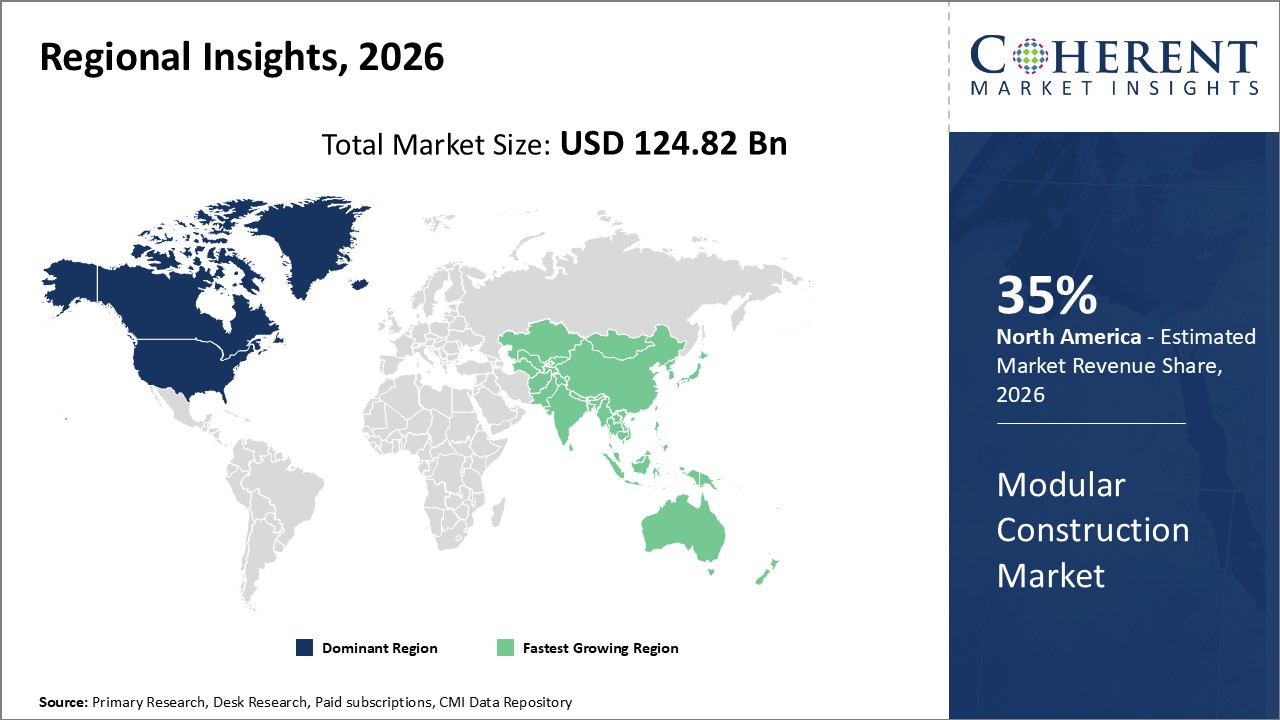
North America leads the market with a substantial share driven by high investments in infrastructure and early adoption of modular technologies.
Asia Pacific emerges as the fastest-growing region, benefiting from rapid urbanization, government support, and expanding industrial construction activities, particularly in China and India.
Modular Construction Market Segmentation Analysis
To learn more about this report, Request Free Sample
Modular Construction Market Insights, By Building Type
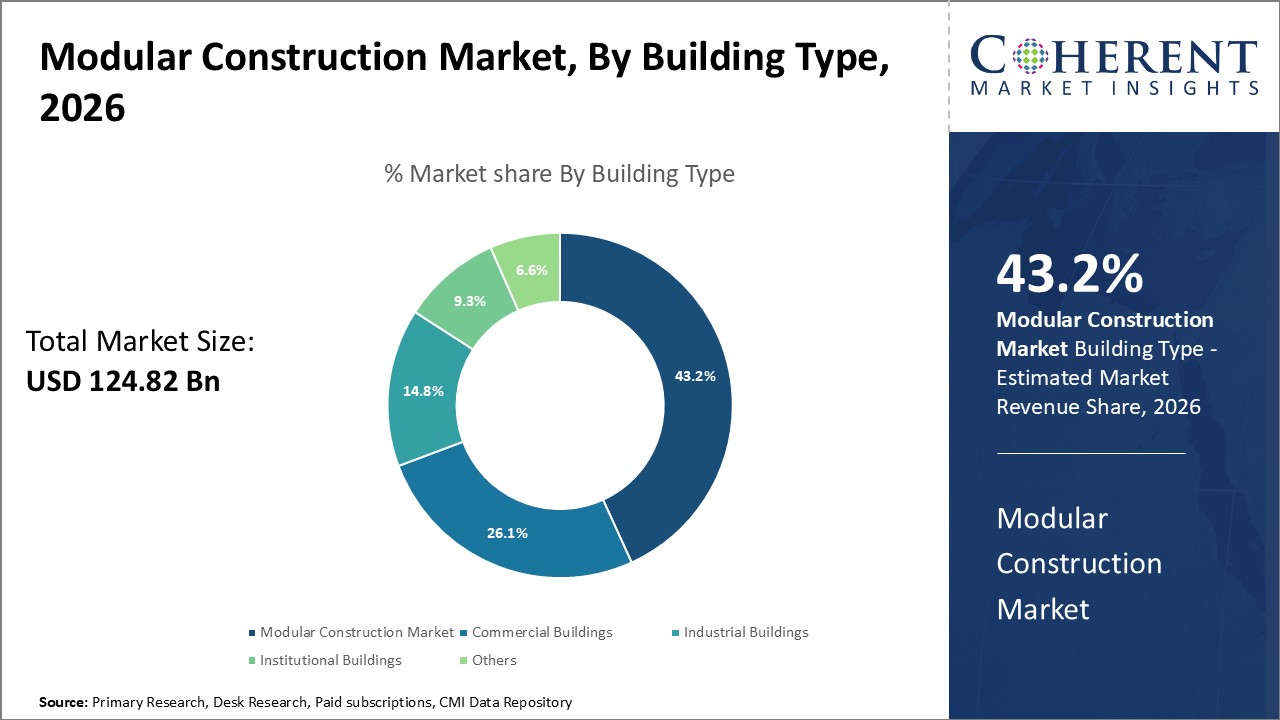
Residential Buildings dominate the market share with 38%. The dominance of Residential Buildings is driven by increasing urban housing shortages and government subsidies encouraging modular homes for affordable and rapid construction. This segment benefits from prefabrication efficiencies, lower labor requirements, and the ability to customize designs to meet diverse market demands. Commercial Buildings, the fastest growing subsegment, are rapidly adopting modular construction due to the demand for office spaces, retail stores, and hotels requiring speedy project completion and reduced operational disruption.
Modular Construction Market Insights, By Construction Type
Permanent Modular Construction holds the dominant position. This construction type appeals to long-term projects requiring durability, regulatory compliance, and full integration with conventional building methods. Projects adopting permanent modular methods deliver superior structural integrity and guarantee better lifecycle cost efficiencies. Hybrid Modular Construction is the fastest-growing category, combining the benefits of permanent and relocatable types. It offers architects and builders enhanced flexibility, allowing parts of structures to be prefabricated while some elements are built onsite.
Modular Construction Market Insights, By Material Type
In terms of Material Type, the market segmentation includes Steel, Concrete, Wood, and Others, with Steel dominating the market share due to its high strength-to-weight ratio, recyclability, and suitability for rapid assembly. Steel modules facilitate multi-story construction and have become the material of choice in urban megaprojects. Concrete is the fastest-growing subsegment fueled by innovations in precast concrete panels and enhanced structural properties, making it increasingly attractive for institutional and industrial buildings. Wood, valued for its sustainability and aesthetic appeal, maintains steady demand primarily within residential and low-rise commercial modular projects.
Modular Construction Market Trends
The Modular Construction market has embraced several transformative trends in recent years.
A major market trend is the digitization of construction workflows, with countries like the U.K. reporting a 41% increase in digital tool adoption in modular projects by 2026.
This digital shift enhances project transparency and reduces costs through better resource management.
Additionally, the use of eco-friendly materials and circular economy principles has become prominent, especially in Europe where regulations require carbon-neutral buildings by 2030, pushing modular firms to innovate in sustainable design.
Modular Construction Market Insights, By Geography
To learn more about this report, Request Free Sample
North America Modular Construction Market Analysis and Trends
Regionally, North America dominates the modular construction landscape, holding roughly 35% of the market share in 2026, attributed to its advanced infrastructure and large-scale government contracts.
Asia Pacific Modular Construction Market Analysis and Trends
Conversely, Asia Pacific is the fastest-growing region, registering a CAGR exceeding 11% from 2026 to 2033, due to rapid urbanization in China and India and favorable government policies promoting affordable housing projects. These trends are supported by strong market ecosystems, including robust supply chains and the presence of global industry players.
Modular Construction Market Outlook for Key Countries
USA Modular Construction Market Analysis and Trends
The USA remains a powerhouse in modular construction due to significant investments in commercial and residential projects, alongside supportive government initiatives promoting sustainable building practices. In 2025, the U.S. federal government allocated approximately USD 1.2 billion towards modular affordable housing projects. Major players such as Katerra and Laing O’Rourke have expanded their factory footprints, enabling mass production capabilities that have streamlined project timelines and lowered construction costs substantially.
China Modular Construction Market Analysis and Trends
China’s modular construction market is propelled by its massive urbanization drive and government-backed smart city initiatives. The nation's focus on industrialized construction has led to an annual increase in modular projects by roughly 15% between 2023 and 2026. Large state-owned enterprises and modular firms collaborate extensively on infrastructure development and affordable housing.
Analyst Opinion
One of the leading market drivers is the pronounced increase in urban population coupled with stringent building regulations focusing on green construction. For instance, cities like Singapore and Copenhagen have integrated modular construction frameworks in their urban planning strategies, which contributed to a 15% rise in market revenue in the Asia Pacific region alone during 2025. This demand-side indicator underscores how regulatory mandates are expanding the modular construction market share, particularly in environmentally sensitive projects.
On the supply side, improvements in production capacity of modular units have significantly impacted market growth strategies. Notably, manufacturers in North America scaled their modular output by over 25% in 2025, leveraging automation and robotics, which has reduced costs and expedited time-to-market, strongly influencing market dynamics across the U.S. and Canada. This surge in production resiliency is an essential quantitative metric affecting the market size and revenue.
Import-export flows of prefabricated building components reveal emerging demand hotspots. Data from 2026 shows that China exported nearly USD 5.5 billion worth of modular parts to Europe and North America, reflecting increasing international collaboration and trade in modular construction materials. These trade dynamics are critical for understanding regional market taxonomies and growth trajectories.
Various use cases across industries, such as healthcare and education sectors, have accelerated the adoption of modular construction. For example, the U.K. Such demand diversification offers valuable insights into niche market segments contributing to overall industry size and market revenue.
Market Scope
| Report Coverage | Details | ||
|---|---|---|---|
| Base Year: | 2025 | Market Size in 2026: | USD 124.82 billion |
| Historical Data for: | 2020 To 2024 | Forecast Period: | 2026 To 2033 |
| Forecast Period 2026 to 2033 CAGR: | 9.3% | 2033 Value Projection: | USD 232.61 billion |
| Geographies covered: |
|
||
| Segments covered: |
|
||
| Companies covered: | Katerra, Laing O’Rourke, Red Sea Housing Services, Skanska, Containex, Guerdon Modular Buildings, Champion Homes, LiteSteel Structures, BoKlok, Modscape. | ||
| Growth Drivers: |
|
||
Uncover macros and micros vetted on 75+ parameters: Get instant access to report
Modular Construction Market Growth Factors
Increasing labor shortages and rising labor costs have driven many construction firms toward modular methods, enabling faster and more predictable project timelines. In 2025 alone, the U.S. reported a labor scarcity pushing a 12% rise in modular construction adoption across commercial projects. Government incentives promoting sustainable and green building practices also fuel the sector’s expansion—Singapore’s Green Mark incentives led to a 25% increase in modular construction usage within governmental projects. The technology advancements in automation, including digital fabrication and BIM integration, further optimize design-to-delivery cycles, reducing onsite labor demand by up to 30% as reported by European modular firms. Additionally, the rising adoption of modular construction in disaster relief and temporary infrastructure projects, as seen in Australia’s 2026 wildfire rebuilding efforts, has expanded market scope and reinforced modular construction’s business growth.
Modular Construction Market Development
In May 2026, Turner Construction launched xPL Offsite, a dedicated platform focused on Design for Manufacturing and Assembly (DfMA)–driven modular construction solutions. The initiative aims to accelerate offsite manufacturing adoption by improving project predictability, reducing construction timelines, and enhancing quality across large-scale commercial and infrastructure projects.
At ELECRAMA 2026, ABB India introduced LIORA, a new modular switch range designed for modern residential and commercial applications. The product line combines contemporary aesthetics with enhanced safety, durability, and smart integration capabilities, strengthening ABB’s position in India’s fast-evolving electrical infrastructure and building solutions market.
In January 2026, Boldt established a new modular construction division focused on healthcare, industrial, and commercial building pods. The move reflects rising demand for prefabricated, scalable building solutions, enabling faster project delivery, improved cost control, and higher-quality outcomes in complex construction environments.
Key Players
Leading Companies of the Market
Katerra
Laing O’Rourke
Red Sea Housing Services
Skanska
Containex
Guerdon Modular Buildings
Champion Homes
LiteSteel Structures
BoKlok
Modscape
Competitive strategies among these players emphasize vertical integration and strategic partnerships to enhance production efficiency. For example, Katerra’s initiative to integrate supply chain management with off-site manufacturing plants has resulted in a 20% reduction in lead times within the U.S. market. Another notable approach is Laing O’Rourke’s implementation of digital twin technologies across their modular projects, which increased project accuracy and lowered rework costs by approximately 18% during 2025. These strategies illustrate evolving market growth tactics focusing on technological leverage and supply chain optimization.
Modular Construction Market Future Outlook
The modular construction is expected to play a growing role in global infrastructure development. The need for rapid, cost-effective, and sustainable construction solutions will drive demand across residential and institutional projects. Advancements in digital design, BIM integration, and automation will further enhance efficiency and scalability. Governments and private developers are likely to increasingly adopt modular methods to meet housing shortages and sustainability targets.
Modular Construction Market Historical Analysis
The modular construction market gained traction as traditional construction methods faced challenges related to labor shortages, cost overruns, and project delays. Initially used for temporary structures, modular construction evolved into a viable solution for permanent residential, healthcare, and commercial buildings. Improvements in off-site manufacturing precision and quality control strengthened market credibility.
Sources
Primary Research Interviews:
Construction Engineers
Modular Builders
Project Managers
Urban Planners
Government Infrastructure Officials
Databases:
World Bank Infrastructure Reports
OECD Construction Statistics
Magazines:
Modular Building Institute Magazine
Construction Week
Engineering News-Record
Building Design
Offsite Construction Magazine
Journals:
Automation in Construction
Construction Management & Economics
Journal of Building Engineering
Engineering Structures
Sustainable Cities Journal
Associations:
Modular Building Institute
International Code Council
World Green Building Council
Royal Institution of Chartered Surveyors
Construction Industry Institute
Share
Share

Credibility and Certifications

860519526


9001:2015

27001:2022


Need a Custom Report?
We can customize every report - free of charge - including purchasing stand-alone sections or country-level reports
Customize NowJoining thousands of companies around the world committed to making the Excellent Business Solutions.
View All Our Clients