

Protein Supplements Market Analysis & Forecast: 2026 to 2033
Protein Supplements Market is estimated to be valued at USD 34.53 Bn in 2026 and is expected to reach USD 59.56 Bn in 2033, exhibiting a compound annual growth rate (CAGR) of 8.1% from 2026 to 2033.
Key Takeaways
- Based on Form, the Powder segment is projected to capture 59.6% share in 2026, driven by versatility, affordability, and wide consumer appeal.
- Based on Source, the Animal-Based segment is expected to hold the largest share of the market in 2026, due to better amino acid profiles, faster absorption rates, and strong scientific support.
- Based on Distribution Channel, the Supermarket/Hypermarket segment is expected to lead the market with highest share of the market in 2026, driven by accessibility, variety, and consumer trust.
- Based on Region, North America is set to lead the protein supplement market in 2026 with 48.6% share. While, Asia Pacific is anticipated to be the fastest growing region.
Market Overview
The global protein supplements market is experiencing strong growth due to the rise in demand for protein supplements and growing geriatric population around the world. Moreover, growing participation in sports and fitness activities and increasing demand for sports nutritional supplements and rising demand for vegan and plant-based protein supplements is expected to boost growth of the market. However, factors such as increasing number of product recalls, high cost of protein supplements, and low acceptance rate are expected to hamper the market growth.
Current Events and Its Impacts on the Protein Supplements Market
Current Event | Description and its Impact |
Regulatory Changes and Quality Standards Evolution |
|
Technological Innovations and Alternative Protein Development |
|
Age And Gender Analysis Protein Supplements Market
Age Demographics
- Millennials and Gen Z (60%+ of consumers)
- These groups are highly influenced by fitness culture, social media, and wellness trends.
- They view protein supplements not just as sports nutrition but as part of daily lifestyle nutrition for weight management, energy, and convenience.
- Digital-first buying behavior: Most purchases are made via e-commerce platforms, subscription models, and influencer-led promotions.
- Preference shift: Younger consumers favor RTDs (Ready-to-Drink) and bars for portability, while powders remain dominant for gym-goers.
Gender Trends
- Women’s share has risen to 35% of total consumption:
- Historically, protein supplements were marketed toward men and athletes. The rise in female fitness participation and holistic wellness has changed this dynamic.
- Collagen + protein blends are especially popular among women, targeting skin health, joint support, and beauty-from-within.
- Plant-based proteins (pea, soy, rice) are preferred by women seeking clean-label, vegan-friendly, and digestive-friendly options.
- Marketing strategies increasingly highlight body toning, energy balance, and healthy aging, rather than just muscle building.
- Current Industry Events of 2026
- Market Size Estimation
- Regional Breakdown
- Competitive Landscape
- Customer Intelligence
- Segmental Analysis
- Pricing Analysis
- Key Market Drivers, Challenges & Future Trends
- Customized Insights Section
Segmental Insights
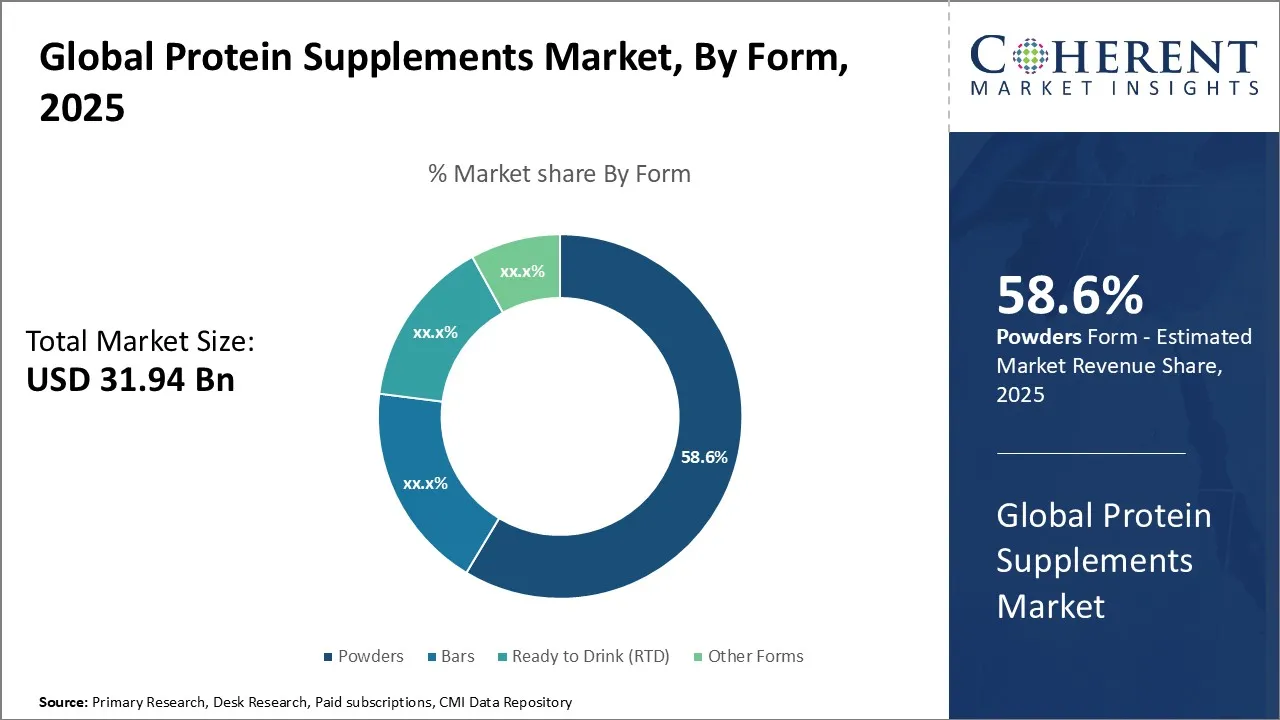
Global Protein Supplements Market Insights, By Form - Powders Dominance Is Driven by Versatility, Affordability, And Wide Consumer Appeal
In terms of form, the powder segment is expected to lead the market with 59.6% in 2026. Their popularity comes from the simplicity with which they are to use and how versatile they are. Powders can be easily mixed into shakes, smoothies, or recipes, making them good for athletes, fitness fans, and even people who just want to get more protein in their diet.
They are even more appealing as they entered a wide range of flavors, formulations (whey, casein, soy, pea, etc.), and benefits (muscle gain, weight loss, recovery). Powders are still the best option in this category because they are cheaper per serving than bars and ready-to-drink (RTD) options.
For instance, in August 2025, Ranveer Singh, a Bollywood actor, has entered the health and nutrition market with a fermented vegan protein powder that costs ₹3,000 per kg. Experts say that it is better than traditional options because it is easier to digest and lasts longer. The launch shows that more and more people in India want plant-based protein supplements as fitness and health trends grow.
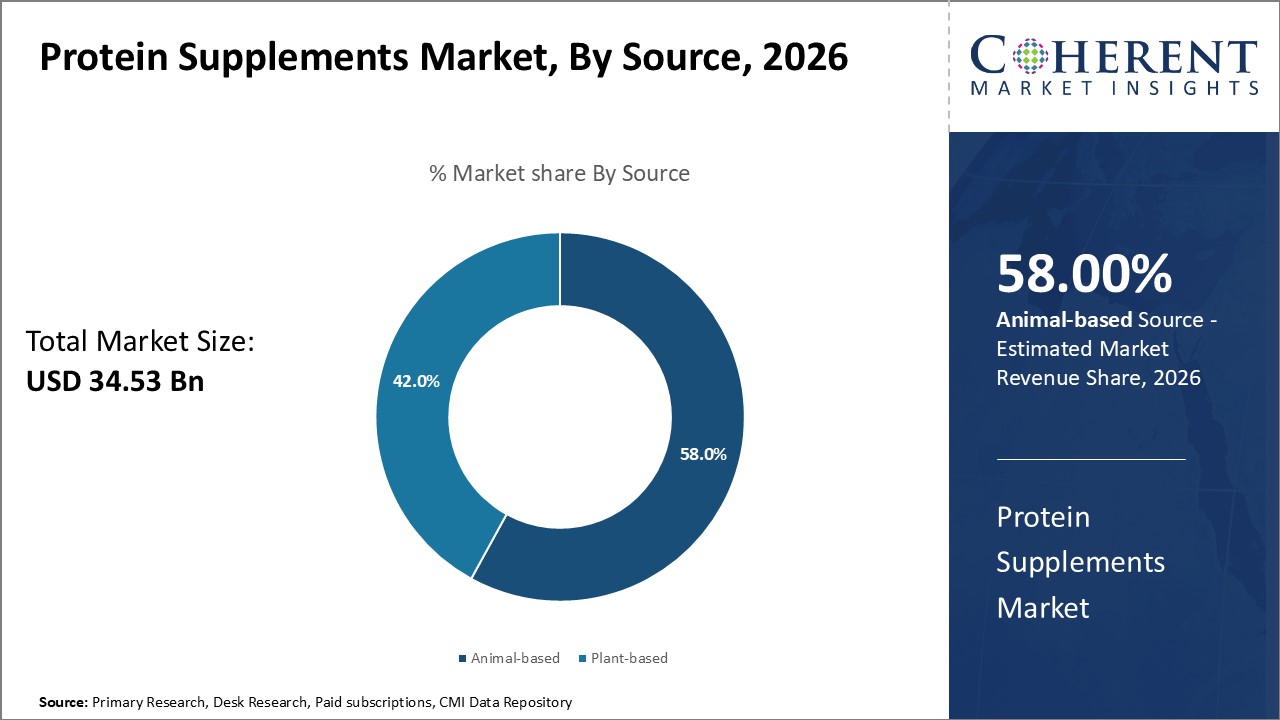
Global Protein Supplements Market Insights, By Source - Animal-Based Proteins Lead with the Largest Share, While Plant-Based Grow Fastest
In terms of source, the animal-based segment is expected to hold the largest share of the market in 2026. Their superiority is due to better amino acid profiles, faster absorption rates, and strong scientific support for muscle recovery and growth. Whey protein is the "gold standard" in sports nutrition, which is why professional athletes and people who go to the gym choose it.
Plant-based proteins are becoming more popular quickly because of veganism and sustainability trends, but they still have a smaller market share than animal-based proteins. However, they are the fastest-growing subsegment.
Global Protein Supplements Market Insights, By Distribution Channel - Supermarkets and Hypermarkets Dominance Is Driven by Accessibility, Variety, And Consumer Trust
In terms of distribution channel, the Supermarket/Hypermarket segment is projected to account for the highest share of the market in 2026. Their dominance is due to their accessibility it is to get to them, the wide range of products they offer, and the trust that customers have in well-known retail chains. Shoppers can compare different brands, take advantage of sales, and buy in bulk, which is good for them.
These stores also serve regular customers who may not go to specialty nutrition stores or gyms very often. Online shopping is growing quickly, thanks to e-commerce platforms, subscription models, and marketing by influencers. However, supermarkets and hypermarkets still make the most money overall.
For instance, in January 2025, Labrada Nutrition announced that its Lean Body® ready-to-drink protein shakes are scheduled to be available in Publix Supermarkets all over the U.S. The expansion makes the popular fitness supplement available to regular shoppers, giving them easy access to high-protein nutrition.
Regional Insights
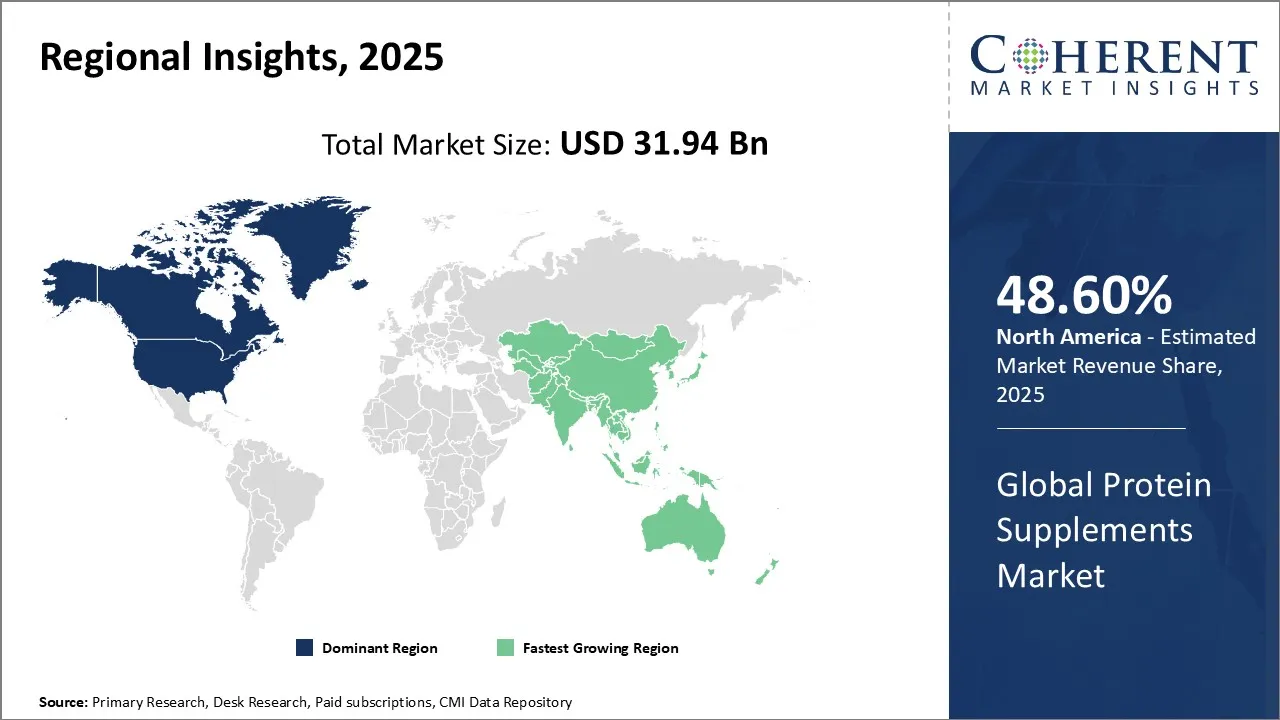
North America Protein Supplements Market Analysis & Trends
North America is expected to gain highest share in the market over the forecast period owing to the high consumer awareness regarding health and wellness, increasing emphasis on healthy lifestyle, rise in demand for protein supplements, and favorable government initiatives and campaigns in the region.
For instance, in November 2026, Kate Farms recently expanded its high-protein nutrition shakes available to more people by starting to sell them in some Walmart stores in the U.S. These clinically formulated shakes are made for both GLP-1 users and people who want to be healthy every day. They display how popular functional protein supplements are becoming.
Asia Pacific Protein Supplements Market Analysis & Trends
Asia Pacific is also expected to witness robust growth in the protein supplements market owing to the increasing emphasis on healthy lifestyle, increase in awareness among people about health and wellness, increase in demand for protein supplements, and higher percentage of young consumers in the Asia Pacific.
For instance, in July 2026, Nestlé launched Milo Pro, a new high-protein drink in Malaysia that is aimed at active teens and young adults who don't get enough protein every day. Milo Pro is a new functional drink from Nestlé that is meant to help with fitness and health. It shows how younger people in Asia-Pacific are looking for easy-to-use, protein-rich nutrition options.
Protein Supplements Market Outlook Country-Wise
The U.S. Protein Supplements Market Trends
The U.S. protein supplements market in 2026 is going to be driven by a strong fitness culture, rising health awareness, and a need for easy-to-use nutrition solutions. Supermarkets, gyms, and online shopping sites make it easier for people to get what they need, and new plant-based and functional proteins draw in a wide range of customers. The U.S. is the biggest market in the world because people have a lot of money to spend and follow certain lifestyle trends.
For instance, in March 2026, Vivici introduced Vivitein™ BLG, a whey protein made without animals through precision fermentation, to the U.S. market. The new product is the same as beta-lactoglobulin from milk, and it provides long-lasting, high-quality protein for powders, clear drinks, and bars. The launch sets a new standard for protein supplements, giving health-conscious and vegan-friendly customers more choices.
China Protein Supplements Market Trends
In 2026, China's protein supplements market will develop as more individuals are becoming health-conscious, more people are moving to cities, and the middle class wants easy access to healthy food. The growth of the market is fueled by fitness trends among young people, the demand for plant-based and fermentation-derived proteins that are good for you, and government support for functional foods. Because of these things, China is one of the fastest-growing markets for protein supplements in the world.
For instance, in November 2026, Angel Yeast opened a new protein fermentation plant in China, which is a step forward for biomanufacturing of sustainable proteins. The plant will make alternative protein ingredients for functional and nutritional foods, which will help meet the growing need for eco-friendly supplements
Market Report Scope
Protein Supplements Market Report Coverage
| Report Coverage | Details | ||
|---|---|---|---|
| Base Year: | 2025 | Market Size in 2026: | USD 34.53 Bn |
| Historical Data for: | 2020 To 2024 | Forecast Period: | 2026 To 2033 |
| Forecast Period 2026 to 2033 CAGR: | 8.1% | 2033 Value Projection: | USD 59.56 Bn |
| Geographies covered: |
| ||
| Segments covered: |
| ||
| Companies covered: | Mondelez Company, Meiji Holdings Co Ltd., Quest Nutrition LLC, MusclePharm Corporation, Post Holdings Inc., Nestlé SA, Abbott Laboratories, Scitec Nutrition, The Hut Group, Glanbia PLC, Weider Global Nutrition LLC, and Iovate Health Sciences International Inc., among others. | ||
| Growth Drivers: |
| ||
| Restraints & Challenges: |
| ||
Global Protein Supplements Market Drivers
High demand for protein supplements to augment market growth
One of the key factors expected to augment the growth of the global protein supplements market over the forecast period is the increase in demand for protein supplements worldwide. For instance, with the increasing awareness among people about health and wellness and increasing emphasis on healthy lifestyle, the demand for protein supplements is also increasing with the rapid pace.
Growing geriatric population to underpin market growth
Another factor which is driving the growth of the global protein supplements market is the rise in geriatric (aging) population around the world. For instance, protein supplements are increasingly used by older people to maintain nutrition and prevent or treat loss of muscle function. Thus, with the growing geriatric population, the demand for protein supplements is also increasing. According to the World Health Organization (WHO), by 2030, one in six people in the world will be aged 60 years or over, and by 2050, the world’s population of people aged 60 years and older will double (2.1 billion). This in turn is expected to drive market growth.
Global Protein Supplements Market Opportunities
Growing participation in sports and fitness activities and increasing demand for sports nutritional supplements is expected to offer significant growth opportunities for players in the global protein supplements market. For instance, sports supplements promote lean muscle growth, boost stamina, improve performance, and assist in weight reduction.
Rising demand for vegan and plant-based protein supplements is expected to offer lucrative growth opportunities for players in the global protein supplements market. For instance, rising awareness about animal welfare and environmental sustainability push consumers toward plant-based diets, and evolving perception of consumers that plant-based products are safer and healthier increases demand for plant-based protein supplements.
Global Protein Supplements Market Trends
Rise in consumption is a recent trend
There is a huge gap in knowledge and practices on the use of supplements among college students which needs to be bridged and thus, by highlighting gaps in nutritional knowledge, sport nutrition professionals may begin to address these gaps by educating sportsperson, minimizing injuries, and enhancing sport performance. Thus, with the growing participation in sports and fitness activities and increase in awareness, the demand for sports nutritional supplements is also increasing rapidly. This trend is expected to boost the market growth.
High demand for protein bars is another trend
Protein bars can be a good source of calcium, potassium, vitamin B, fibre, and iron. They can also help gain muscle mass and can even promote weight loss. Moreover, protein bars can be a good meal replacement or post-workout snack. Protein has become popular macronutrient among all consumers, including people opting for meal-replacement supplements, like protein bars, athletes looking for competitive edge, and aging population intent on maintaining muscle mass. This trend is also expected to propel the growth of the market.
Analyst Opinion (Expert Opinion)
- The protein supplements market value is steadily growing. This is mainly due to greater numbers of individuals are adopting fitness routines, there is a demand for functional nutrition, and high-protein diets are becoming more popular. Several independent market studies agree that the global industry will be worth billions of dollars in 2024–2025, with growth coming from powders, bars, and ready-to-drink (RTD) formats. North America is still the biggest market for this type of product, thanks to strong retail penetration and high spending on sports and lifestyle nutrition per person.
- Animal-based proteins still make up most of the sales in many categories, but plant-based proteins are gaining ground because people want clean labels and more people are eating flexitarian diets. Industry data show that ready-to-drink (RTD) and single-serve formats are the fastest-growing delivery types because they are easy to use and are becoming more popular with people who don't play sports.
- The dynamics on the supply side are still important. The prices of whey and dairy proteins are still going up and down, which is hurting manufacturers' profits. This has led them to look for new sources of plant protein and form contract-manufacturing partnerships. Industry reports also show that the competition is very fragmented, with well-known sports nutrition brands competing with new digital-native companies. Consolidation is still going on as established companies look for unique plant-protein portfolios and ready-to-drink (RTD) products.
- Brands that focus on omnichannel distribution, clean-label innovation, and sourcing raw materials that are resistant to change are better able to meet the strongest demand in this changing market.
Speak to the analyst
Want personalized insights?
Take the findings above to one of our principal consultants, or have the report rebuilt around the segments, geographies and competitors you actually track.
Global Protein Supplements Market: Key Developments
- In July 2025, Foodpharmer, a well-known health influencer, started a new whey protein brand in India called "Only What's Needed." The label stresses that nutrition products should have clean, clear formulations to gain customers' trust. This move shows how much more people in India want protein supplements and how influencer-led businesses are changing the country's fitness and wellness market.
- In June 2025, TrueBasics has released Clean Whey, a new protein supplement that aims to raise the bar for purity and openness. The product is in India's growing health and fitness market and focuses on clean-label nutrition to gain customers' trust. The launch shows that more and more health-conscious people want high-quality protein supplements that they can trust to work.
- In May 2025, GNC India released Keto Surge Whey Protein, a new supplement that combines high-quality whey with a formula that helps burn fat. The product is made for people who are into fitness and follow the keto diet. It helps with building muscle and keeping weight off. The launch shows that India wants more and more new protein supplements that are made to fit with modern health and lifestyle trends in 2025.
Market Segmentation
- Global Protein Supplements Market, By Form (Revenue, USD Bn, 2021 - 2033)
- Powders
- Bars
- Ready to Drink (RTD)
- Other Forms
- Global Protein Supplements Market, By Source (Revenue, USD Bn, 2021 - 2033)
- Animal-based
- Plant based
- Global Protein Supplements Market, By Distribution Channel (Revenue, USD Bn, 2021 - 2033)
- Supermarkets/Hypermarkets
- Convenience Stores
- Specialty Stores
- Online Retail Stores
- Gym & Health Clubs and Spas
- Other Distribution Channels
- Global Protein Supplements Market, By Geography (Revenue, USD Bn, 2021 - 2033)
- North America
- U.S.
- Canada
- Latin America
- Brazil
- Argentina
- Mexico
- Rest of Latin America
- Europe
- Germany
- U.K.
- Spain
- France
- Italy
- Russia
- Rest of Europe
- Asia Pacific
- China
- India
- Japan
- Australia
- South Korea
- ASEAN
- Rest of Asia Pacific
- Middle East & Africa
- GCC Countries
- Israel
- Rest of Middle East & Africa
- North America
- Global Protein Supplements Market: Key Companies Insights (Revenue, USD Bn, 2021 - 2033)
- Mondelez Company
- Meiji Holdings Co Ltd.
- Quest Nutrition LLC
- MusclePharm Corporation
- Post Holdings Inc.
- Nestle SA
- Abbott Laboratories
- Scitec Nutrition
- The Hut Group
- Glanbia PLC
- Weider Global Nutrition LLC
- Iovate Health Sciences International Inc.
Sources
Primary Research Interviews
- Sports Nutritionists & Dietitians
- Protein Supplement Manufacturers (Whey, Casein, Plant-based, Collagen)
- Ingredient Suppliers (Protein isolates, Concentrates, Hydrolysates, Amino Acids)
- R&D and Formulation Scientists
- Regulatory & Quality Assurance Officers (supplement firms)
- E-commerce Category Managers & Specialty Retail Buyers (health stores, pharmacies)
- Gym Chains, Fitness Trainers & Professional Athletes
- Foodservice & Meal-replacement OEMs
- Market Access & Pricing Analysts
- Others
Databases
- Euromonitor International
- Mintel
- Statista
- NielsenIQ / Nielsen HomeScan
- IRI (Information Resources, Inc.)
- SPINS (natural & specialty channel data)
- Bloomberg Terminal
- Thomson Reuters Eikon
- S&P Global Market Intelligence
- Others
Magazines
- Nutraceuticals World
- Nutrition Business Journal
- FoodNavigator / FoodNavigator-USA
- Supplement Business Magazine
- Sports Nutrition Review (industry trade titles)
- Others
Journals
- Journal of the International Society of Sports Nutrition (JISSN)
- Nutrients
- Journal of Nutrition
- Journal of Dietary Supplements
- Food Chemistry
- Current Developments in Nutrition
- Others
Newspapers & Newswires
- Financial Times
- The Wall Street Journal
- Reuters
- Bloomberg News
- Business Standard / Economic Times (regional markets)
- Others
Associations & Industry Bodies
- Council for Responsible Nutrition (CRN)
- International Society of Sports Nutrition (ISSN)
- SupplySide (Informa) / Natural Products Association
- International Food Information Council (IFIC)
- Food and Drink Federation (regional chapters)
- Others
Public Domain Sources
- U.S. Food & Drug Administration (FDA) — Dietary Supplements Guidance & Enforcement
- European Food Safety Authority (EFSA) — Nutrition & Health Claims
- U.S. Department of Agriculture (USDA) — Food Data & Market Reports
- World Health Organization (WHO) — nutrition datasets
- United Nations FAO — food & protein commodity data
- World Bank Open Data — demographic & economic indicators
- Others
Proprietary Elements
- CMI Data Analytics Tool
- Proprietary CMI Existing Repository of Information for the Last 8 Years
Definition: Protein supplements are essentially processed, refined protein products available in various forms, such as powders, bars, ready to drink, and other forms. These supplements are used as dietary supplements to boost overall performance
Get access to 250+ pages report
Every segment, forecast, competitor profile and data table behind the analysis above — available for instant download.
- ESOMAR Member
- ISO 9001:2015 Certified
- D-U-N-S Registered
- GDPR & CCPA Compliant
Missing comfort of reading report in your local language? Find your preferred language:
Transform your Strategy with Exclusive Trending Reports
Frequently Asked Questions
The Protein Supplements Market is estimated to be valued at USD 34.53 Bn in 2026, and is expected to reach USD 59.56 Bn by 2033.
The CAGR of the Protein Supplements Market is projected to be 8.1% from 2026 to 2033.
Increase in demand for protein supplements and growing geriatric (aging) population is fueling the growth of the market.
The powder segment is the leading form segment in the market.
Increasing number of product recalls and the high cost of protein supplements and low acceptance rate in developing countries are major factors restraining growth of the market.
Major players operating in the market are Mondelez Company, Meiji Holdings Co Ltd., Quest Nutrition LLC, MusclePharm Corporation, Post Holdings Inc., Nestlé SA, Abbott Laboratories, Scitec Nutrition, The Hut Group, Glanbia PLC, Weider Global Nutrition LLC, and Iovate Health Sciences International Inc., among others.