

Tissue Products Market Size and Share Analysis - 2026 To 2033
The global tissue products market size is estimated to reach approximately USD 82.6 Bn in 2026 and is projected to grow at a compound annual growth rate (CAGR) of 5.6% during the forecast period (2026–2033), surpassing USD 121.0 Bn by 2033. This is attributable to increasing consumer demand for hygiene and personal care products, expanding hospitality and healthcare sectors, and continuous product innovations in sustainable and premium tissue products. According to our research, the Global Personal Care Products Industry is expected to surpass 815 Bn by 2033.
Key Takeaways from the Tissue Products Market Report
- Toilet paper is expected to account for the largest market revenue share of 36.8% in 2026 due to its essential daily household use, high replacement frequency as well as widespread consumption across residential and commercial settings. For example, WEPA produces the equivalent of around 9 Bn toilet paper rolls each year, highlighting its widespread use.
- Residential sector is projected to lead the market with a share of 69.4% in 2026 due to high household use of toilet paper, facial tissues, napkins, and kitchen towels. For instance, the United Nations estimates that 45% of the world's 8.2 Bn people live in cities in 2025, supporting strong household demand for everyday tissue products.
- North America is anticipated to dominate the global tissue paper industry with a share of 38% in 2026 due to high tissue consumption, expanding hygiene products industry as well as strong consumer spending. For example, U.S. personal consumption expenditures increased by USD 65.2 Bn in June 2026, reflecting strong consumer spending on everyday products.
- Asia Pacific, recording a CAGR of 6.3% , is poised to emerge as the fastest-growing market for tissue products during the forecast period, owing to its large population, rising hygiene awareness, urbanization, and expanding disposable incomes,
Tissue Products Market Overview
The global tissue products market is poised to exhibit steady growth during the forecast period. This growth is primarily driven by rising consumer awareness of hygiene and sanitation, increasing disposable incomes, rapid urbanization, and growing demand for convenient and disposable paper products.
Expanding hospitality, healthcare, and commercial sectors are also supporting tissue products market growth through higher consumption of tissue products. In addition, product innovations, introduction of sustainable and eco-friendly tissue products, and expansion of organized retail and e-commerce channels are expected to create new growth opportunities for tissue product companies during the forecast period.
Expansion of e-commerce and organized retail is positively influencing tissue products market growth. Wider product availability through supermarkets, convenience stores, and online platforms is increasing consumer access and market penetration. In addition, rapid urbanization and rising living standards, particularly in emerging economies, are supporting higher consumption of tissue products due to growing hygiene awareness and changing lifestyles.
Premiumization trend is gaining traction in the tissue products industry as consumers increasingly seek enhanced comfort, skincare benefits, softness, and superior product quality. This shift is encouraging brands to develop premium tissue products featuring aloe vera or lotion infusion, vitamin E enrichment, antibacterial properties, ultra-soft multi-ply textures, and hypoallergenic materials to attract a broader consumer base.
For instance, in September 2025, Kleenex expanded its premium tissue portfolio with lotion-infused facial tissues containing aloe vera and coconut oil, designed to enhance skin comfort during frequent use. Advancements in tissue manufacturing are also supporting growth of the global market.
Tissue product manufacturers are investing in advanced production technologies to improve efficiency, enhance product quality as well as reduce energy consumption. For example, in January 2024, The machines are designed to produce high-quality facial, toilet, napkin, and handkerchief tissue grades from virgin market pulp while supporting efficient tissue production.
Similarly, in May 2026, Metsa Group inaugurated its expanded and modernised tissue mill in Mariestad, Sweden, which the company describes as the world’s most modern tissue mill. The €370 million investment is one of the largest in the European tissue industry and reflects Metsä Tissue’s focus on strengthening its European hygiene and tissue business.
Segmental Insights
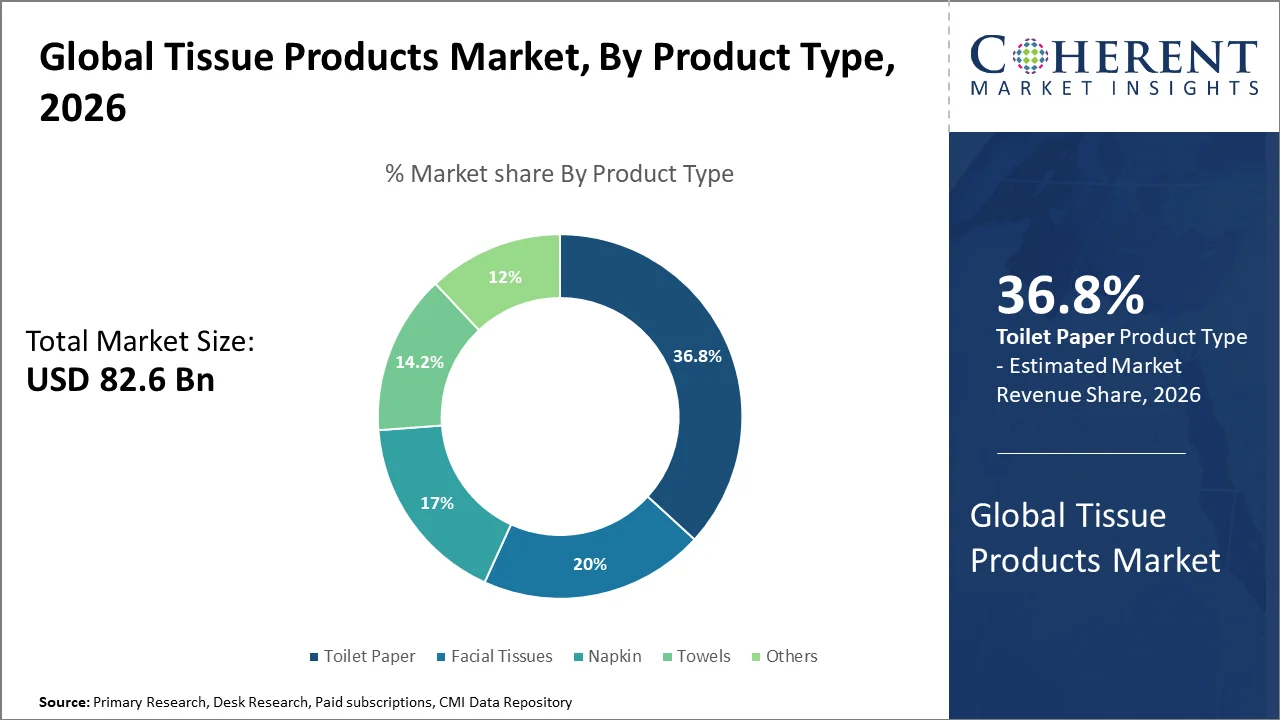
Which Product Type Dominates the Global Tissue Products Market?
Toilet Paper Dominates the Global Tissue Products Industry
According to Coherent Market Insights’ tissue products market analysis, toilet paper is set to lead the market, accounting for a revenue share of 36.8% in 2026. This dominance can be attributed to its essential role in daily personal hygiene, making it a household necessity with consistent demand across residential, commercial, and institutional sectors.
Rising urbanization, improving sanitation standards, growing consumer awareness of hygiene, and increasing disposable incomes are also driving toilet paper consumption. In July 2026, the National Highways Authority of India (NHAI) launched a nationwide initiative to develop world-class public toilet facilities at toll plazas through an Innovative Performance-Based Contracts (PBC) framework. The initiative includes renovating existing sanitation blocks and constructing new facilities using standardized, indigenous, and sustainable designs to ensure high standards of cleanliness, functionality, accessibility, and long-term maintenance across the National Highway network. In addition, expansion of hospitality, healthcare, and food service industries is set to increase demand for high-quality toilet paper products during the forthcoming period.
Manufacturers are also introducing premium, eco-friendly, and recycled tissue variants to meet evolving consumer preferences for sustainability and comfort. For example, in September 2025, Essity expanded its coreless toilet paper technology to additional markets through its Lotus Just-1 brand in France. The product eliminates the cardboard core and uses paper-based packaging, reflecting the industry's growing focus on premium, sustainable, and waste-reducing tissue products.
- Current Industry Events of 2026
- Market Size Estimation
- Regional Breakdown
- Competitive Landscape
- Customer Intelligence
- Segmental Analysis
- Pricing Analysis
- Key Market Drivers, Challenges & Future Trends
- Customized Insights Section
Which End User Leads the Global Tissue Products Market?
Tissue Product Demand Remains High in Residential Segment
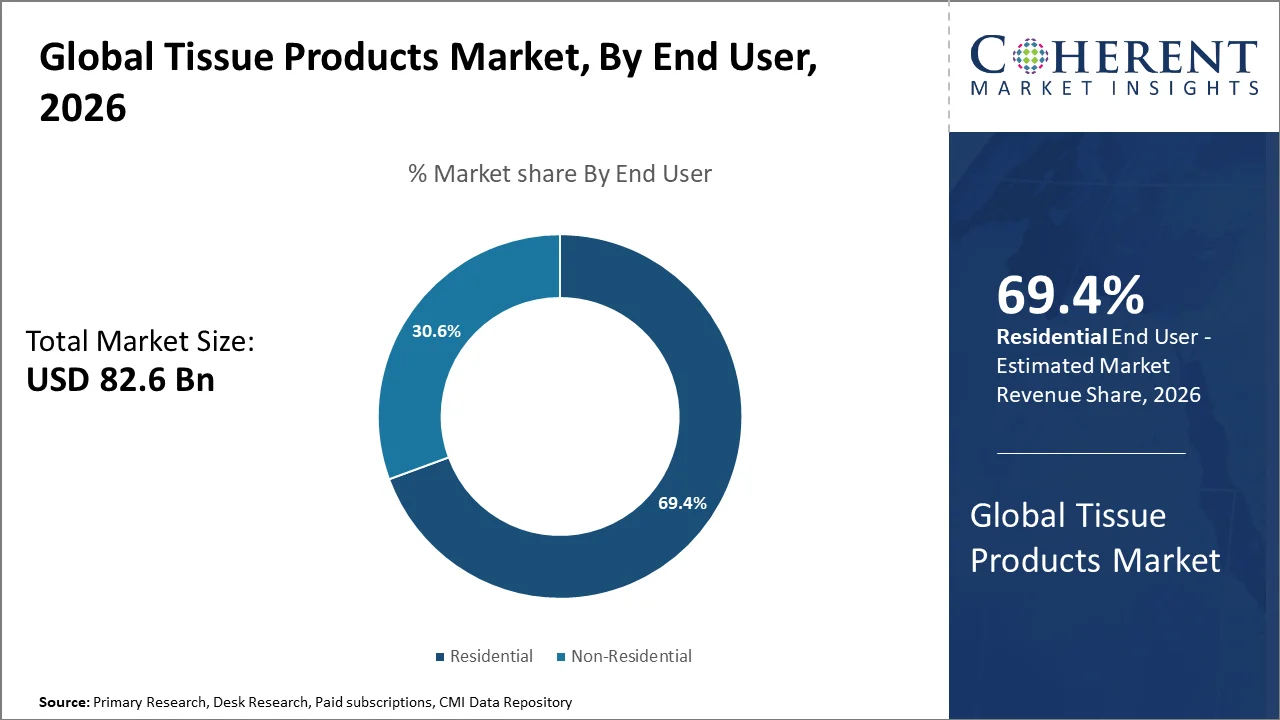
Based on end user, residential segment is expected to account for the prominent market share of 69.4% in 2026. This is mostly due to widespread daily use of tissue products such as toilet paper, facial tissues, paper towels, and napkins in households.
Rising hygiene awareness, growing urban populations, improving living standards, and higher disposable incomes are also contributing to increased household consumption. According to the United Nations, 55% of the global population lives in urban areas, a share projected to increase to 68% by 2050. Moreover, availability of premium and eco-friendly tissue products is encouraging consumers to purchase higher-value products, thereby boosting segment growth.
Tissue Products Market Growth Drivers
Rising Hygiene Awareness
Growing awareness of personal hygiene and sanitation is providing a strong impetus for the growth of the tissue products market. Consumers, especially in developing regions, are becoming increasingly conscious of maintaining personal hygiene. This, in turn, is driving demand for toilet paper, facial tissues, paper towels, and napkins across households as well as commercial and public spaces.
Tissue Products Market Opportunities
Expanding Applications in Commercial Sectors
Growing demand from healthcare facilities, hospitality establishments, restaurants, offices, and educational institutions is expected to create lucrative growth opportunities for the tissue products market during the forecast period. Increasing hygiene awareness and sanitation requirements are encouraging the use of tissue products such as toilet paper, paper towels, napkins, and facial tissues across these sectors. Thus, expansion of these industries will likely boost sales of tissue products in the coming years.
Tissue Products Market Trends
Shift Towards Sustainable Tissue Products
Rising adoption of sustainable tissue products is a key trend in the tissue products market. Consumers increasingly prefer recycled, biodegradable, FSC-certified, and bamboo-based tissue products, encouraging manufacturers to adopt eco-friendly materials. For example, in 2025, This reflects the growing shift toward sustainable materials in the tissue products industry.
Current Events and Their Impact on the Tissue Products Market
Current Event | Description and its Impact |
EU Approves Suzano–Kimberly-Clark Tissue Joint Venture (2026) |
|
Essity Launches Strategic Review of Global Consumer Tissue Business (2026) |
|
Regional Insights

North America to Retain its Dominance Over Tissue Products Market
North America is expected to lead the global tissue products market, accounting for a share of 38% in 2026. This dominance is attributable to high per-capita consumption of tissue products, strong household demand for toilet paper and paper towels, widespread adoption across commercial and healthcare facilities as well as rising preference for premium and sustainable hygiene solutions. Growing consumer interest in recycled and responsibly sourced tissue products is also encouraging manufacturers to expand their eco-friendly product portfolios.
Sustainability and responsible sourcing are becoming important trends in the North American tissue products market. According to Kimberly-Clark Corporation’s 2025 Sustainability Report, 77% of its virgin fiber purchases came from Forest Stewardship Council (FSC)-certified sources in 2025, highlighting the company’s focus on responsibly sourced raw materials. Increasing demand for environmentally friendly hygiene products is encouraging tissue manufacturers to adopt certified fibers and improve sustainable production practices.
Asia Pacific Emerges as the Fastest-Growing Tissue Products Market
Asia Pacific tissue products market is poised to record a CAGR of 6.3% during the forecast period. The growth is mostly due to rising hygiene awareness, rapid urbanization, improving sanitation infrastructure, expanding middle-class population, and increasing adoption of tissue products across households, hospitality, healthcare, and commercial sectors in nations like China and India.
Urbanization and improving living standards are key factors supporting tissue products demand in Asia Pacific. According to the increasing demand for modern hygiene products and packaged consumer goods in urban households. As more consumers move toward urban lifestyles with improved sanitation access and higher disposable incomes, the adoption of toilet paper, facial tissues, and paper towels continues to expand across the region.
Tissue Products Market Outlook – Country-wise
U.S. Tissue Products Market Trends
The United States is projected to remain a prominent market for tissue products during the assessment period. This is mainly due to high household consumption of toilet paper, facial tissues, and paper towels, along with strong demand from commercial, healthcare, and hospitality sectors. Growing preference for premium and sustainable tissue products, including recycled and responsibly sourced options, is also encouraging manufacturers to introduce innovative solutions.
China Tissue Products Market Forecast
China’s tissue products market is anticipated to grow steadily during the assessment period. This is attributable to rising urbanization, improving living standards, and increasing hygiene awareness among consumers, particularly in lower-tier cities. Expansion of modern retail channels, growth of e-commerce platforms, and rising demand for high-quality personal care and household hygiene products are also supporting market growth.
Who are the Major Companies in the Tissue Products Market?
Some of the major players in tissue products market are Essity AB, Kimberly-Clark Corporation, Georgia-Pacific LLC, Asia Pulp and Paper Group, Procter & Gamble Co., Sofidel Group, CMPC Tissue S.A., WEPA Hygieneprodukte GmbH, Metsä Group, and Cascades Inc.
Key Strategies Adopted by Industry Players
Leading manufacturers of tissue products are adopting various organic and inorganic strategies to boost their revenue as well as gain a competitive edge in the industry. These include new product launches, increasing investments in R&D, acquisitions, partnerships, collaborations, mergers, and distribution agreements. Companies are also focusing on using sustainable packaging materials to woo more and more eco-conscious customers.
- In October 2025, Valmet announced a new Advantage ThruAir tissue line for Sofidel America to support ultra-premium tissue production. The new line is designed to increase production capacity and meet the growing demand for high-quality tissue products in North America.
- In August 2025, Cascades launched Cascades Fluff Excellence, a new premium bathroom tissue line. The product was developed to meet consumer demand for softness, thickness, and strength in bathroom tissue.
- In June 2025, Suzano and Kimberly-Clark announced a strategic partnership to create a global tissue company through a joint venture. The new company will focus on manufacturing and selling consumer and professional tissue products across more than 70 countries.
- In October 2024, KP Tissue Inc. and Kruger Products Inc. announced the completion and start-up of their new LDC (light dry crepe) tissue plant in Sherbrooke, Québec. The Sherbrooke facility is estimated to produce more than 130,000 metric tons of tissue products annually at full capacity.
- In June 2024, Clearwater Paper Corporation announced a $23 million investment in a new state-of-the-art facial tissue converting line at its Shelby, North Carolina facility. The Shelby Mill produces private-brand bathroom tissue, paper towels, napkins, and facial tissue for major retailers.
Market Report Scope
Tissue Products Market Report Coverage
| Report Coverage | Details | ||
|---|---|---|---|
| Base Year: | 2025 | Market Size in 2026: | USD 82.6 Bn |
| Historical Data for: | 2020 To 2024 | Forecast Period: | 2026 To 2033 |
| Forecast Period 2026 to 2033 CAGR: | 5.6% | 2033 Value Projection: | USD 121.0 Bn |
| Geographies covered: |
| ||
| Segments covered: |
| ||
| Companies covered: | Essity AB, Kimberly-Clark Corporation, Georgia-Pacific LLC, Asia Pulp and Paper Group, Procter & Gamble Co., Sofidel Group, CMPC Tissue S.A., WEPA Hygieneprodukte GmbH, Metsa Group, and Cascades Inc. | ||
| Growth Drivers: |
| ||
| Restraints & Challenges: |
| ||
Analyst Opinion (Expert Opinion)
- Tissue products remain an essential everyday purchase rather than a discretionary item. Products such as toilet paper, facial tissues, and paper towels are used daily in homes, workplaces, hospitals, and public facilities, making demand relatively stable even during periods of economic uncertainty. This supports consistent sales and encourages manufacturers to invest in product innovation and capacity expansion.
- The growing trend toward better hygiene will ensure further demand growth in the future. Hygiene campaigns conducted by governments and health care organizations will encourage more use of tissues and paper towels at home and in businesses. Higher hygiene requirements will maintain the demand from hospitals, hotels, offices, and schools.
- Toilet papers account for the majority of tissue products. Metsä Tissue reports that Europeans consume approximately 14.3 kg of tissue paper annually per person and toilet papers constitute 68% of overall tissue consumption. The large percentage of toilet paper consumption drives manufacturers to focus on this type of product through innovations, premiumization, and capacity increases.
- Sustainability is gaining importance as an important competitive advantage. Growing demands of consumers and retailers in terms of using recycled or responsibly sourced fiber-based tissue products push companies to improve sourcing and create more environmentally friendly products.
Speak to the analyst
Want personalized insights?
Take the findings above to one of our principal consultants, or have the report rebuilt around the segments, geographies and competitors you actually track.
Market Segmentation
- By Product Type (Revenue, USD Bn, 2021-2033)
- Toilet Paper
- Facial Tissues
- Napkin
- Towels
- Others
- By End User (Revenue, USD Bn, 2021-2033)
- Residential
- Non-Residential
- By Region Insights (Revenue, USD Bn, 2021 - 2033)
- North America
- U.S.
- Canada
- Latin America
- Brazil
- Argentina
- Mexico
- Rest of Latin America
- Europe
- Germany
- U.K.
- Spain
- France
- Italy
- Russia
- Rest of Europe
- Asia Pacific
- China
- India
- Japan
- Australia
- South Korea
- ASEAN
- Rest of Asia Pacific
- Middle East
- GCC Countries
- Israel
- Rest of Middle East
- Africa
- South Africa
- North Africa
- Central Africa
Sources
Primary Research interviews
- Tissue product manufacturers
- Pulp and paper raw material suppliers
- Distributors and wholesalers
- Retailers and supermarket procurement managers
- Packaging industry experts
- Industry consultants
- Sustainability and recycling experts
- End users and institutional buyers
Databases
- UN Comtrade Database
- World Bank Open Data
- Eurostat
- U.S. Census Bureau
- FAOSTAT
- OECD Data
- ITC Trade Map
Magazines
- Tissue World Magazine
- Pulp & Paper International (PPI)
- Paper360°
- Paper Advance
- Resource Recycling Magazine
Journals
- BioResources
- TAPPI Journal
- Journal of Cleaner Production
- Resources, Conservation and Recycling
- Cellulose
Newspapers
- Financial Times
- The Wall Street Journal
- The New York Times
- The Economic Times
- Nikkei Asia
Associations
- Confederation of European Paper Industries (CEPI)
- American Forest & Paper Association (AF&PA)
- TAPPI (Technical Association of the Pulp and Paper Industry)
- European Tissue Symposium (ETS)
- Forest Stewardship Council (FSC)
- Programme for the Endorsement of Forest Certification (PEFC)
Public Domain sources
- World Health Organization (WHO)
- United Nations (UN)
- Food and Agriculture Organization (FAO)
- World Bank
- OECD
- U.S. Environmental Protection Agency (EPA)
- European Commission
- U.S. Bureau of Labor Statistics (BLS)
- National statistical offices of major countries
Proprietary Elements
- CMI Data Analytics Tool
- Proprietary CMI Existing Repository of information for last 10 years
Get access to 250+ pages report
Every segment, forecast, competitor profile and data table behind the analysis above — available for instant download.
- ESOMAR Member
- ISO 9001:2015 Certified
- D-U-N-S Registered
- GDPR & CCPA Compliant
Missing comfort of reading report in your local language? Find your preferred language:
Transform your Strategy with Exclusive Trending Reports
Frequently Asked Questions
Tissue products are disposable paper products used for hygiene, cleaning, and personal care. They include toilet paper, facial tissues, paper towels, napkins, and wipes.
The global market is estimated to be valued at USD 82.6 Bn in 2026.
The global Tissue Products Market value is expected to reach USD 121.0 Bn by 2033.
The global market is poised to exhibit a CAGR of 5.6% from 2026 to 2033.
Major growth factors include rising awareness of hygiene and sanitation, increasing demand for toilet paper and household tissue products, population growth and urbanization, expanding hospitality and healthcare sectors, and growing adoption of premium and sustainable tissue products.
Fluctuating wood pulp prices, environmental concerns related to deforestation, and increasing production costs are key challenges for manufacturers.
Toilet paper is set to lead the market with a share of 36.8% in 2026.