Nanocellulose Market Analysis & Forecast: 2026-2033
Nanocellulose Market Size and Forecast – 2026 – 2033
The Global Nanocellulose Market size is estimated to be valued at USD 1.48 billion in 2026 and is expected to reach USD 3.67 billion by 2033, exhibiting a compound annual growth rate (CAGR) of 14.8% from 2026 to 2033.
Global Nanocellulose Market Overview
The Nanocellulose Market is driven by rising demand for sustainable, bio-based, and lightweight materials across packaging, composites, paper, textiles, biomedical, and cosmetics applications. Growing pressure to replace petroleum-based plastics is increasing adoption of nanocellulose in biodegradable films, coatings, and barrier packaging. Its high strength-to-weight ratio, biodegradability, renewability, and excellent rheological properties make it suitable for advanced composites, 3D printing, wound dressings, drug delivery, and food packaging. Increasing investments in green materials, circular economy initiatives, and cellulose-based innovation further support market growth. Additionally, expanding use in electronics, water filtration, and personal care products is creating new commercial opportunities.
Key Takeaways
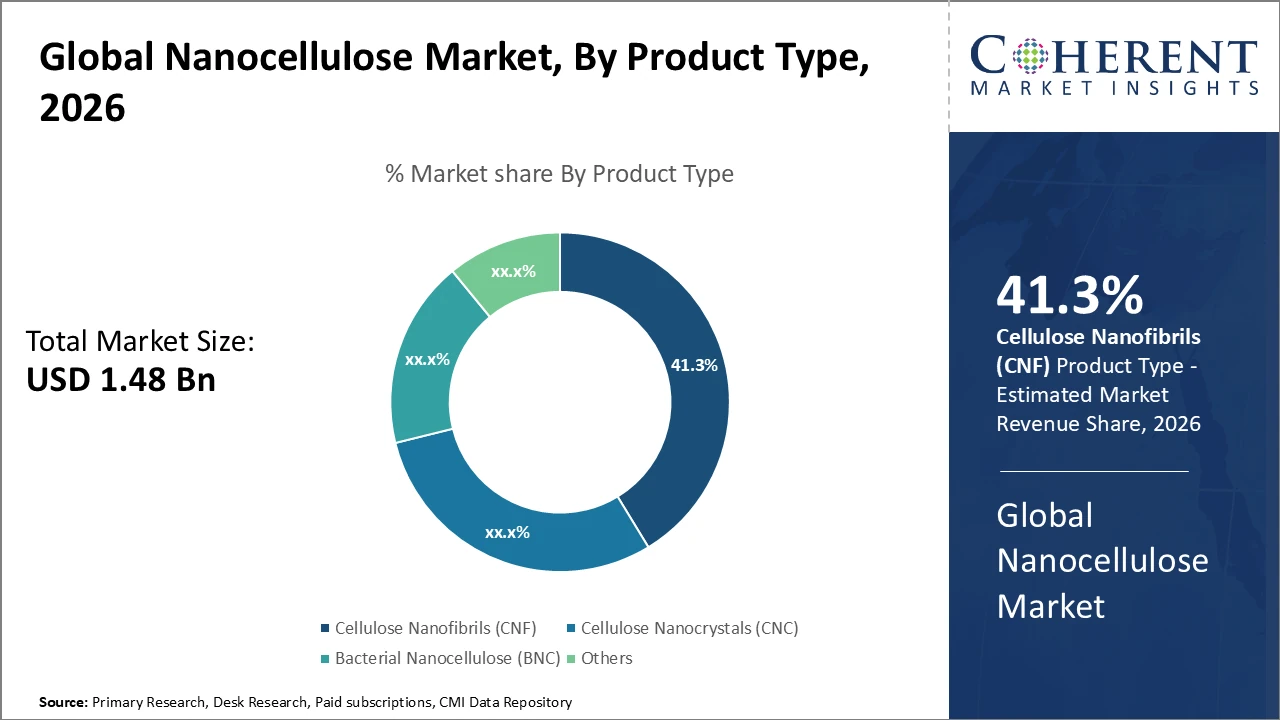
Cellulose Nanofibrils dominate the Nanocellulose Market due to their superior mechanical strength, lightweight properties, and versatility across packaging, automotive, paper, and composite material applications.
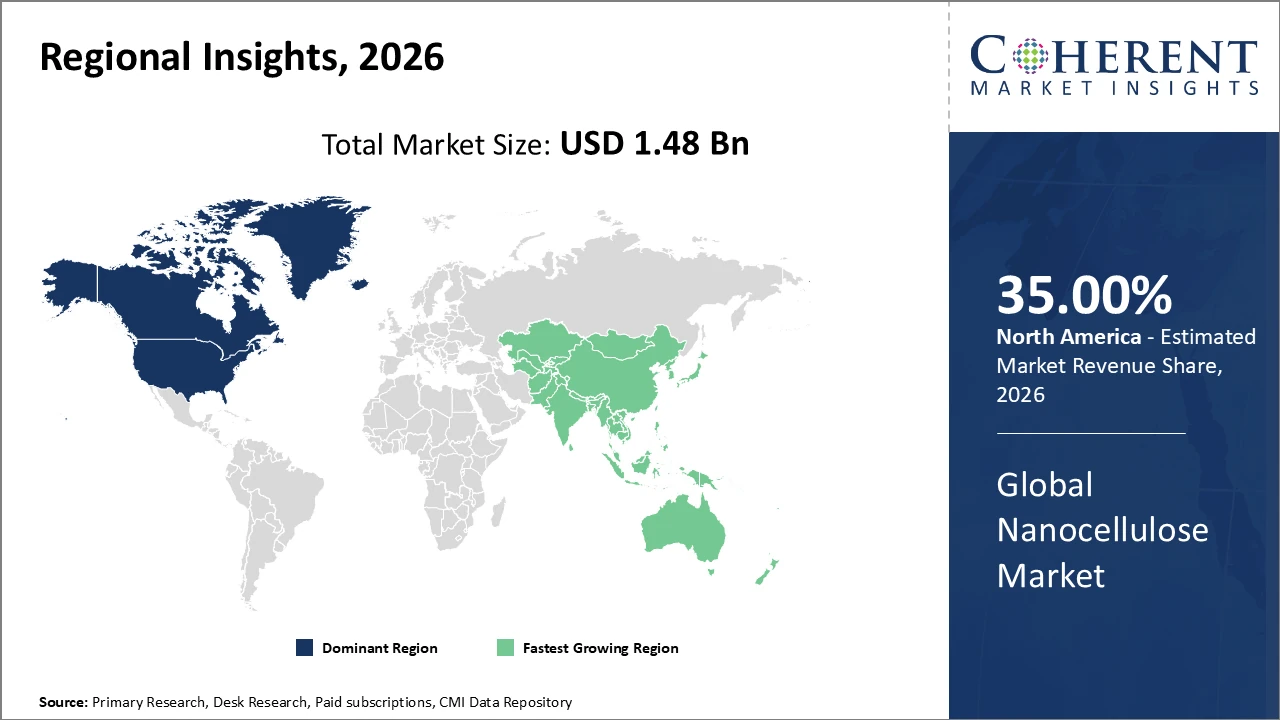
North America holds more than 35% of the global Nanocellulose Market share, supported by advanced technological infrastructure, strong research investments, and early adoption of bio-based materials.
Asia Pacific is the fastest-growing regional market, driven by expanding manufacturing industries in China and India along with supportive government initiatives promoting sustainable industrial materials.
Europe maintains strong market growth in high-value sectors including healthcare, biomedical products, and electronics, with countries such as Sweden and Finland playing major roles in nanocellulose exports and innovation.
Nanocellulose Market Segmentation Analysis
To learn more about this report, Request Free Sample
Nanocellulose Market Insights, By Product Type
Cellulose nanofibrils dominate the Nanocellulose Market with a share of 41.3% due to their exceptional tensile strength, lightweight structure, and versatility across packaging, automotive, textile, and composite material applications. Continuous advancements in fibrillation technologies are improving production efficiency, material performance, and commercial scalability, further accelerating adoption in high-performance industrial applications. Bacterial nanocellulose represents the fastest-growing segment because of its high purity, biocompatibility, and superior mechanical properties, making it increasingly valuable in healthcare, wound care, cosmetics, and biomedical products. Cellulose nanocrystals maintain strong demand in specialized applications requiring enhanced stiffness and crystallinity.
Nanocellulose Market Insights, By Application
Packaging dominates the Nanocellulose Market due to increasing global demand for sustainable alternatives to conventional plastics and foam-based materials. Regulatory pressure to reduce plastic waste and growing consumer preference for biodegradable packaging solutions continue driving adoption of nanocellulose-based barrier films, coatings, and lightweight packaging materials. The electronics and electrical segment represent the fastest-growing application area, supported by rising demand for flexible displays, energy storage systems, and lightweight electronic components. Automotive and aerospace industries maintain stable growth through utilization of high-strength, lightweight nanocellulose composites that improve fuel efficiency and reduce emissions. Healthcare applications are also expanding steadily, particularly in wound dressings, tissue engineering, and biomedical scaffold development.
Nanocellulose Market Insights, By End Use Industry
Food and beverage dominate the Nanocellulose Market due to extensive utilization of nanocellulose as a stabilizer, thickening agent, and biodegradable packaging material supporting clean-label and sustainable product trends. Increasing consumer demand for environmentally friendly food packaging solutions continues strengthening market growth across this segment. Personal care and cosmetics represent the fastest-growing application area, driven by nanocellulose’s excellent moisturizing, texturizing, and biocompatible properties that support development of eco-friendly skincare and cosmetic formulations. Pharmaceutical applications are steadily expanding through drug delivery systems and biomedical scaffold technologies. Construction industries increasingly use nanocellulose in composite materials for improved strength and insulation, while emerging textile and printing applications continue gaining commercial interest.
Nanocellulose Market Trends
The Nanocellulose Market is rapidly expanding into advanced applications such as flexible electronics, smart materials, and energy storage systems, moving beyond traditional packaging and paper-based uses.
Pilot-scale deployment of nanocellulose-based battery components and sustainable energy materials is accelerating innovation, particularly across technologically advanced markets such as Japan and Europe.
Hybrid composites combining nanocellulose with graphene and carbon nanomaterials are gaining strong commercial interest due to improved conductivity, durability, and mechanical performance.
Increasing environmental regulations in North America and Europe are encouraging greater adoption of biodegradable, recyclable, and functionalized nanocellulose materials across multiple industries.
Growing focus on circular economy models is driving research investments into recyclable nanocellulose composites and sustainable end-of-life material management infrastructure.
Nanocellulose Market Insights, By Geography
To learn more about this report, Request Free Sample
North America Nanocellulose Market Analysis and Trends
North America dominates the Nanocellulose Market with a share of 35% due to its advanced manufacturing infrastructure, strong research ecosystem, and continuous investments in sustainable material technologies. The United States accounts for more than 20% of global market revenue, supported by government incentives, leading academic institutions, and early adoption of nanocellulose across automotive, electronics, packaging, and biomedical industries. Increasing focus on reducing dependence on petroleum-based materials further strengthens regional market growth. Companies such as American Process Inc. have played a major role in advancing commercial nanocellulose production through proprietary processing technologies that improve scalability and lower manufacturing costs, enhancing industrial adoption across North America.
Asia Pacific Nanocellulose Market Analysis and Trends
Asia Pacific is projected to register the fastest growth in the Nanocellulose Market, with a CAGR exceeding 18% during the forecast period. Rapid urbanization, expanding industrialization, and increasingly strict environmental regulations across countries such as China and India are accelerating demand for sustainable bio-based materials. Strong government funding programs supporting green manufacturing and nanomaterial innovation are further driving commercialization of nanocellulose technologies across the region. Major regional companies including Technoble Manufacturing Pvt. Ltd. and Nippon Paper Industries are expanding production facilities and strengthening export capabilities to meet growing domestic and international demand for advanced sustainable materials and nanocellulose-based applications.
Nanocellulose Market Outlook for Key Countries
USA Nanocellulose Market Analysis and Trends
The United States Nanocellulose Market is strongly supported by growing applications in sustainable packaging, biomedical products, and advanced industrial materials. Nanocellulose is increasingly utilized in flexible packaging films, wound care products, and lightweight composites due to its biodegradability and high mechanical strength. Government initiatives such as the USDA BioPreferred Program continue encouraging adoption of bio-based materials through incentives and procurement support. Collaborative research partnerships between universities and industrial manufacturers are advancing enzymatic nanocellulose production technologies that improve scalability and cost efficiency. Companies including American Process Inc. and Stora Enso are expanding production capacity and strengthening U.S. export competitiveness.
Germany Nanocellulose Market Analysis and Trends
Germany’s Nanocellulose Market is witnessing rapid growth driven by strong sustainability initiatives, advanced manufacturing capabilities, and increasing adoption of bio-based materials across packaging, automotive, electronics, and biomedical sectors. The country benefits from extensive research collaborations between industrial manufacturers and institutes such as the Fraunhofer Society, accelerating commercialization of nanocellulose technologies. Cellulose nanofibers remain the dominant product segment due to widespread use in lightweight composites and sustainable packaging applications. Germany’s strict environmental regulations and circular economy policies are further encouraging replacement of conventional plastics with nanocellulose-based materials. Growing investments in green materials and electric vehicle applications continue strengthening long-term market expansion.
Analyst Opinion
Global nanocellulose production capacity has expanded rapidly due to advancements in enzymatic and chemical processing technologies, reducing manufacturing costs and improving commercial scalability across multiple industrial applications.
Asia Pacific is witnessing strong growth in nanocellulose imports, driven by increasing use in sustainable food packaging, cosmetics, and biodegradable material applications, particularly across China and India.
Declining nanocellulose pricing trends are improving affordability and accelerating adoption in high-value sectors such as pharmaceuticals, electronics, and advanced biomedical applications requiring premium material performance.
European countries including Finland and Sweden are strengthening their global export positions through government-supported sustainability initiatives and expanding production of bio-based nanocellulose materials for international markets.
Market Scope
| Report Coverage | Details | ||
|---|---|---|---|
| Base Year: | 2025 | Market Size in 2026: | USD 1.48 billion |
| Historical Data for: | 2020 To 2024 | Forecast Period: | 2026 To 2033 |
| Forecast Period 2026 to 2033 CAGR: | 14.8% | 2033 Value Projection: | USD 3.67 billion |
| Geographies covered: |
|
||
| Segments covered: |
|
||
| Companies covered: | Stora Enso, CelluForce, Suzano S.A., Daicel Corporation, Tenso USA, American Fiber Optics, Innventia AB, Melodea Ltd | ||
| Growth Drivers: |
|
||
Uncover macros and micros vetted on 75+ parameters: Get instant access to report
Nanocellulose Market Growth Factors
The Nanocellulose Market is primarily driven by rising global demand for sustainable, renewable, and biodegradable materials as governments and industries increasingly seek alternatives to conventional plastics. Growing environmental regulations and consumer preference for eco-friendly products are accelerating nanocellulose adoption, particularly in sustainable packaging applications. Expanding automotive and aerospace industries are further boosting demand for lightweight, high-strength composite materials that improve fuel efficiency and reduce emissions. Technological advancements in enzymatic and chemical processing methods are improving scalability, lowering production costs, and reducing energy consumption, thereby supporting wider industrial commercialization. Additionally, increasing government investments and supportive policies promoting bio-based materials across countries such as the United States, Germany, and Japan continue strengthening global market growth and innovation.
Nanocellulose Market Development
In February 2025, Gozen launched Lunaform, a microbial-grown and fermented nanocellulose textile, produced using their BioCraft technology at a 40,000 sq. ft. facility in Turkey, offering a sustainable alternative to plastic-based imitation leather.
Key Players
Leading Companies of the Market
Stora Enso
CelluForce
Suzano S.A.
Tenso USA
Daicel Corporation
Melodea Ltd
American Fiber Optics
Innventia AB
Competitive strategies in the Nanocellulose Market are increasingly centered on research collaborations, production scale-up, and technology innovation to strengthen commercial competitiveness. Stora Enso partnered with American Process Inc. to expand high-volume cellulose nanofibril production capacity, supporting growing demand for sustainable automotive and biodegradable material applications. Suzano S.A. invested heavily in proprietary hydrolysis technologies to improve nanocellulose quality for advanced electronics applications. Additionally, Nanocyl strengthened its healthcare and specialty materials portfolio through strategic acquisitions focused on functionalized nanocellulose derivative technologies.
Nanocellulose Market Future Outlook
The Nanocellulose Market is expected to experience strong growth in the coming years driven by increasing demand for sustainable, lightweight, and biodegradable materials across packaging, automotive, electronics, biomedical, and construction industries. Advancements in nanocellulose production technologies are improving scalability, cost efficiency, and commercial adoption worldwide. Growing regulatory pressure to reduce plastic waste is accelerating the use of cellulose nanofibers and nanocrystals in eco-friendly packaging and composite applications. Biomedical applications such as wound care, tissue engineering, and drug delivery are also expanding rapidly due to nanocellulose’s biocompatibility. Europe and North America are expected to maintain strong market positions, while Asia Pacific emerges as the fastest-growing regional market.
Nanocellulose Market Historical Analysis
The Nanocellulose Market has evolved significantly over the past decade due to growing environmental awareness and increasing demand for sustainable bio-based materials. Initially, nanocellulose adoption was concentrated within research and development applications because of high production costs and limited commercial scalability. Over time, technological advancements improved manufacturing efficiency, enabling broader use across packaging, paper, composites, biomedical products, and electronics industries. Cellulose nanofibrils historically dominated the market owing to their strong reinforcement and barrier properties. Europe and North America emerged as early market leaders because of strong sustainability regulations and research investments, while Asia Pacific gradually developed into a high-growth region driven by expanding industrialization and eco-friendly material adoption.
Sources
Primary Research Interviews:
Packaging manufacturers, paper industry executives, automotive engineers, and biomedical researchers utilizing nanocellulose for sustainable packaging, lightweight composites, wound care products, and advanced material applications.
Supply chain executives, chemical manufacturers, and procurement specialists responsible for sourcing cellulose fibers, nanomaterial processing equipment, and bio-based composite materials.
Market analysts, R&D directors, and sustainability experts involved in nanocellulose innovation, biodegradable materials development, and advanced industrial manufacturing technologies.
Magazines:
Packaging World – Updates on sustainable packaging technologies, bio-based materials, and nanocellulose innovations.
Chemical Engineering – Insights into nanomaterial processing technologies, industrial manufacturing trends, and advanced biomaterials development.
Pulp & Paper International – Coverage of cellulose processing, paper technology advancements, and nanocellulose commercialization trends.
Journals:
Cellulose – Research on nanocellulose production technologies, material properties, and industrial applications.
Carbohydrate Polymers – Studies focused on biodegradable materials, cellulose nanocrystals, and bio-based composites.
ACS Sustainable Chemistry & Engineering – Research on sustainable materials, green manufacturing processes, and nanocellulose-based product innovations.
Newspapers:
Financial Times – Coverage of sustainability investments, green manufacturing technologies, and industrial material innovations.
Reuters – Reporting on nanocellulose product launches, strategic partnerships, and developments in sustainable materials industries.
Bloomberg – Insights into mergers, acquisitions, R&D investments, and expansion strategies within advanced biomaterials and nanotechnology sectors.
Associations:
Technical Association of the Pulp and Paper Industry – Research updates, cellulose processing standards, and sustainable material innovations.
American Chemical Society – Scientific research, nanomaterial advancements, and conferences related to nanocellulose technologies.
European Bioplastics – Industry insights, sustainability initiatives, and developments in biodegradable and bio-based material applications.
Share
Share
Yash Doshi is a Senior Management Consultant. He has 12+ years of experience in conducting research and handling consulting projects across verticals in APAC, EMEA, and the Americas.
He brings strong acumen in helping chemical companies navigate complex challenges and identify growth opportunities. He has deep expertise across the chemicals value chain, including commodity, specialty and fine chemicals, plastics and polymers, and petrochemicals. Yash is a sought-after speaker at industry conferences and contributes to various publications on topics related commodity, specialty and fine chemicals, plastics and polymers, and petrochemicals.

Credibility and Certifications

860519526


9001:2015
27001:2022


Need a Custom Report?
We can customize every report - free of charge - including purchasing stand-alone sections or country-level reports
Customize NowJoining thousands of companies around the world committed to making the Excellent Business Solutions.
View All Our Clients