Poultry Feed Market Analysis & Forecast: 2026-2033

Poultry Feed Market Size and Forecast – 2026 – 2033
The Global Poultry Feed Market size is estimated to be valued at USD 158.84 billion in 2026 and is expected to reach USD 215.5 billion by 2033, exhibiting a compound annual growth rate (CAGR) of 5.4% from 2026 to 2033.
Global Poultry Feed Market Overview
Poultry feed consists of formulated nutritional blends designed to support the growth, health, and productivity of broilers, layers, and other bird species. The product typically includes grains, oilseed meals, amino acids, vitamins, minerals, enzymes, and probiotics. These feeds are optimized for specific growth stages—starter, grower, finisher, and layer diets—providing balanced energy and protein levels. High-quality feed enhances weight gain, egg production, immune function, and overall bird efficiency.
Key Takeaways
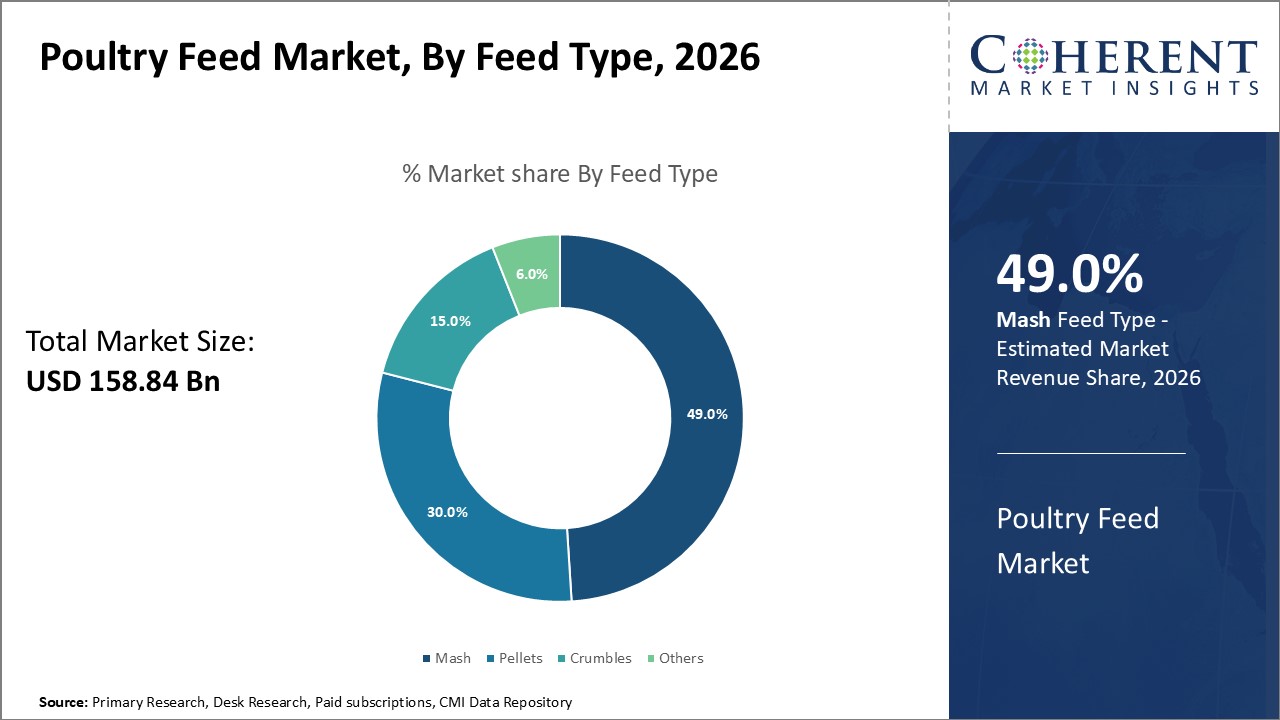
Mash feed type dominates with a 49% market share, supported by its prevalence in broiler applications which account for the largest segment in poultry feed revenue.
The cereals and grains ingredient category is pivotal, commanding the majority of market revenue due to its fundamental role in energy provision within feed formulations.
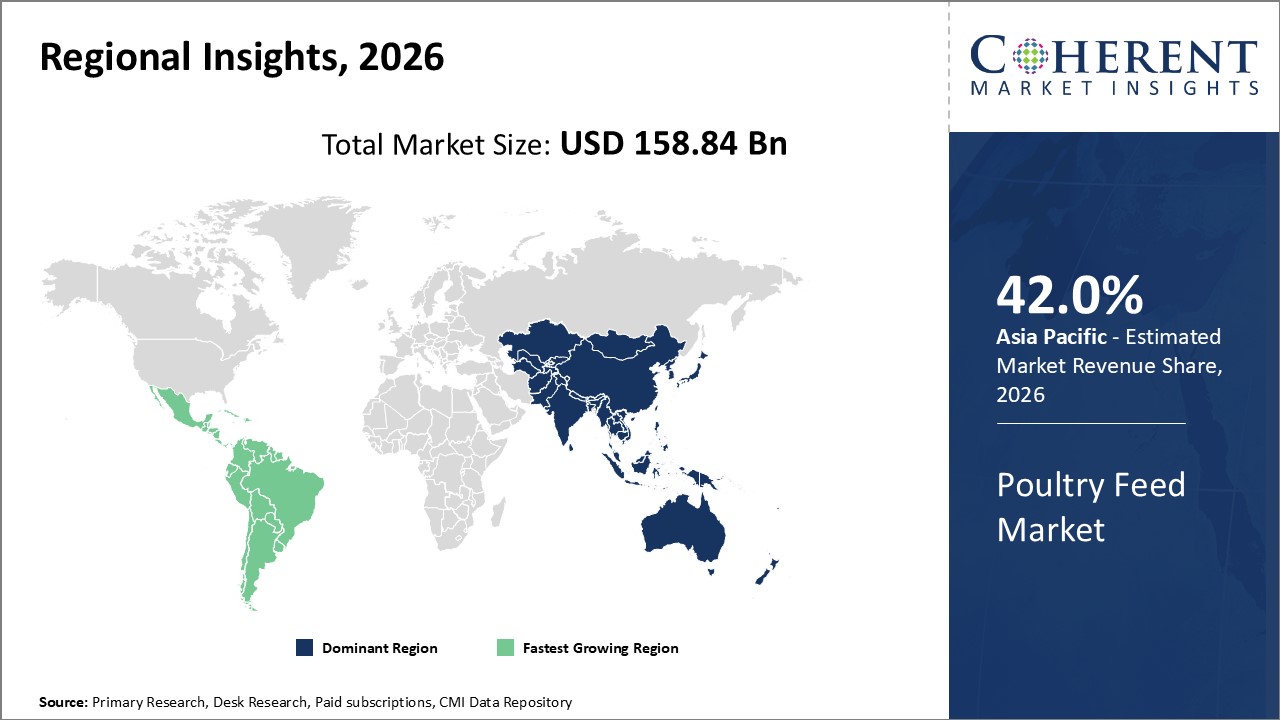
Asia Pacific leads the market in poultry feed consumption with significant contributions from China and India, capitalizing on expansive poultry farming operations and government support.
North America exhibits strong growth in additive-enhanced feed products, driven by technological investments and stringent regulatory frameworks promoting feed safety and efficiency.
Poultry Feed Market Segmentation Analysis
To learn more about this report, Request Free Sample
Poultry Feed Market Insights, By Feed Type
Mash dominates the market share with 49%. The dominance stems from mash feed’s flexibility in nutrient formulation and widespread acceptance across broiler and layer segments. Its ease of pelletization and cost-efficiency make it preferred in both commercial and small-scale farms. Pellets are the fastest-growing segment, perceived for improved feed conversion ratios due to reduced feed wastage, with a rising adoption rate in North American and European markets. Crumbles serve primarily as starter feeds for young chicks, providing optimal nutrition digestibility.
Poultry Feed Market Insights, By Ingredient Type
Cereals and grains dominate the market revenue due to their critical role as energy sources and basic feed constituents, accounting for over 50% of feed ingredient consumption globally. Protein meals and cakes, including soybean and fish meal, are the fastest-growing subsegment, propelled by rising protein requirements to support higher poultry productivity and improved bird health. Animal fats and oils contribute significantly to dietary energy density, enhancing feed palatability. Additives such as enzymes, vitamins, and probiotics are increasingly incorporated to optimize poultry health and performance.
Poultry Feed Market Insights, By Application
Broilers dominate the application segment owing to their extensive production, representing the bulk of global poultry meat supply, thereby generating the highest demand for feed. The layers segment is the fastest-growing application, driven by rising egg consumption and demand for enriched egg varieties requiring specialized feed compositions. Breeders hold a stable share focused on maintaining genetic stock health and performance, reflecting premium feed formulations.
Poultry Feed Market Trends
The poultry feed market trend in recent years has shifted towards adopting sustainable feed ingredients, notably insect-based proteins, as alternatives to traditional cereal and grain components.
Since regulatory bodies in the European Union approved insect protein usage in 2025, its incorporation has increased by 15% in feed formulations, supporting eco-friendly market momentum.
Another significant trend is the rise of digital precision feeding systems.
For instance, in North America, feed efficiency improved by 6% in 2025 through IoT-based automated feeding, signaling a technological leap in feed management.
Additionally, the organic poultry feed segment is expanding rapidly, responding to consumer demand for clean-label poultry products and stricter antibiotic regulations in many countries.
Poultry Feed Market Insights, By Geography
To learn more about this report, Request Free Sample
Asia Pacific Poultry Feed Market Analysis and Trends
In the Asia Pacific, the dominance in the market is driven by large-scale poultry farming in China and India, accounting for over 42% of global poultry feed consumption. Government subsidies and investments in feed manufacturing infrastructure, alongside growing domestic poultry meat demand, propel industry growth.
Latin America Poultry Feed Market Analysis and Trends
Meanwhile, Latin America exhibits the fastest growth with a projected CAGR exceeding 6.5%, bolstered by Brazil’s expanding export-oriented poultry sector and increasing adoption of advanced feed additives improving yield and quality.
Poultry Feed Market Outlook for Key Countries
USA Poultry Feed Market Analysis and Trends
The USA’s market is characterized by substantial use of feed additives and high-quality ingredient imports. In 2025, U.S. poultry meat production increased by 3.8%, stimulating demand for specialized feed formulations. Market players like Cargill and ADM enhanced their feed additive portfolios, supporting sustainable poultry farming practices. Regulatory initiatives restricting antibiotic usage encouraged innovations in natural growth promoters, reinforcing the U.S. as a market leader in feed technology advancements.
Brazil Poultry Feed Market Analysis and Trends
Brazil’s market is buoyed by its global leadership in poultry meat exports, contributing significantly to the Latin American poultry feed revenue. Feed manufacturers in Brazil, notably Bunge Limited, expanded capacity by 10% in 2025, providing cost-efficient and nutrient-dense feed to poultry farms. Favorable trade agreements and government incentives continue to drive competitive growth, facilitating technology adoption for feed efficiency improvements and meeting stringent export standards.
Analyst Opinion
The sustained rise in poultry production capacity worldwide directly correlates with the escalating demand for nutritionally enhanced poultry feed. For instance, poultry meat production in the Asia Pacific surged by 6.3% in 2025, amplifying the need for high-quality feed inputs to meet protein content standards. Additionally, feed mills in North America expanded operational capabilities by 8% in early 2026, further supporting market growth.
Demand-side indicators reveal a diversified application of poultry feed ranging from broilers to layers and specialty birds, intensifying imports of feed ingredients like soybean meal and corn. The U.S., a leading importer, recorded a 8% increase in feedstuff imports in 2025, driven by feed formulation innovations tailored for different poultry segments.
Price volatility in raw materials such as maize and soybean has led to shifts in poultry feed pricing strategies, prompting manufacturers to optimize blends for cost-effectiveness without compromising nutritive value. For example, in 2026, global corn prices averaged 16% higher year-over-year, motivating feed producers to implement alternative ingredient mixes.
Micro-level analytics highlight the rising integration of enzyme additives and probiotics in poultry feed, enhancing gut health and feed conversion ratio. Market players introduced over 45 new feed additive products in 2025 globally, underscoring innovation as a pivotal market driver.
Market Scope
| Report Coverage | Details | ||
|---|---|---|---|
| Base Year: | 2025 | Market Size in 2026: |
USD 158.84 billion |
| Historical Data for: | 2020 To 2024 | Forecast Period: | 2026 To 2033 |
| Forecast Period 2026 to 2033 CAGR: | 5.4% | 2033 Value Projection: |
USD 215.5 billion |
| Geographies covered: |
|
||
| Segments covered: |
|
||
| Companies covered: | AB Agri Ltd., Novus International, Inc., DSM Nutritional Products, Evonik Industries AG, Wilmar International Limited, Zinpro Corporation, Bunge Limited, Guangdong VTR Bio-Tech Co., Ltd., Kemin Industries, Inc., Zhengda Feed Group Co., Ltd. | ||
| Growth Drivers: |
|
||
Uncover macros and micros vetted on 75+ parameters: Get instant access to report
Poultry Feed Market Growth Factors
Increasing global poultry production, driven by rising protein consumption demand, forms the core growth driver. This trend is bolstered by a 7.1% growth rate in poultry meat output in Southeast Asia throughout 2025. Additionally, innovation in feed formulation addressing health and immunity support enhances productivity, as evidenced by a 4% improvement in feed conversion ratio (FCR) reported in multiple broiler farms globally in 2026. Integration of sustainable raw materials, including insect protein-based feed ingredients, is fast gaining traction, with regulatory approvals enabling pilot commercial use in Europe and North America. Moreover, government initiatives for livestock welfare and regulation on antibiotic usage in feed propel the adoption of natural feed additives, expanding market scope.
Poultry Feed Market Development
In 2021, Cargill expanded its animal nutrition portfolio with the launch of Nutrena® NatureWise® poultry feeds fortified with essential oils, designed to improve bird immunity, gut health, egg quality, and feed palatability. The formulation leveraged natural bioactive compounds to offer farmers a more holistic and performance-driven nutrition solution for both broilers and layers.
In 2023, IB Group inaugurated a large-scale poultry feed plant and integrated hatchery facility in Uttar Pradesh, significantly enhancing regional production capacity and supply-chain efficiency. The expansion strengthened North India’s poultry ecosystem by supporting higher-quality feed output, improved chick availability, and broader access to modern poultry farming infrastructure.
Key Players
Leading Companies of the Market
AB Agri Ltd.
Novus International, Inc.
DSM Nutritional Products
Evonik Industries AG
Wilmar International Limited
Zinpro Corporation
Bunge Limited
Guangdong VTR Bio-Tech Co., Ltd.
Kemin Industries, Inc.
Zhengda Feed Group Co., Ltd.
Several of these market players have adopted forward integration strategies, such as vertical farming feed production, to secure raw material supplies and stabilize costs. For example, Nutreco’s recent acquisition of a feed additive producer in 2025 enhanced its capacity to innovate, which resulted in a 12% increase in regional revenue for Asia Pacific operations.
Poultry Feed Market Future Outlook
The future of the poultry feed market will be shaped by precision nutrition, sustainable ingredient sourcing, and continued expansion of poultry meat as an affordable protein. Feed formulations will increasingly rely on alternative proteins like insect meal, algae, and fermentation-derived ingredients to reduce dependency on traditional soybean and corn inputs. Automation and data-driven feed management will support efficiency improvements at large-scale farms. Developing countries in Asia and Africa will experience strong growth due to population expansion and rising per capita meat consumption. Functional feed additives that improve gut health and immunity will gain traction as producers aim to reduce antibiotic use. Long-term growth will remain stable, supported by poultry’s comparative advantage over red meat in terms of cost and accessibility.
Poultry Feed Market Historical Analysis
The poultry feed market has experienced consistent growth driven by rising global poultry meat and egg consumption. Historically, the market expanded as industrial poultry farming replaced traditional backyard systems, especially in North America, Europe, and parts of Asia. The introduction of scientifically formulated feed revolutionized bird productivity, feed efficiency, and overall farm profitability. The industry saw major improvements through the incorporation of amino acids, enzymes, probiotics, and premixes. Disease outbreaks such as avian influenza created temporary disruptions, prompting stricter biosecurity measures and upgrades in feed quality standards. Over the years, intensification of poultry farming and global trade growth fueled demand for balanced, high-protein feed formulations
Sources
Primary Research Interviews:
Poultry Nutritionists
Feed Mill Managers
Integrator Procurement Leads
Veterinary Feed Advisors
Ingredient Suppliers
Databases:
FAOSTAT Feed & Livestock
Alltech Feed Databases
UN Comtrade Feed Ingredients
Magazines:
Feed & Grain
Poultry World
World Poultry
The Poultry Site
Feed International
Journals:
Poultry Science
Animal Feed Science and Technology
Journal of Nutrition
The Veterinary Record
Frontiers in Veterinary Science
Newspapers:
The Economic Times (Agriculture)
The Hindu (Agribusiness)
Financial Times (Agri-commodities)
Reuters Agribusiness
Bloomberg Agriculture News
Associations:
International Feed Industry Federation (IFIF)
National Chicken Council
World’s Poultry Science Association (WPSA)
American Feed Industry Association (AFIA)
Poultry Science Association
Share
Share
Kalpesh Gharte is a senior consultant with approximately 5 years of experience in the consulting industry. Kalpesh holds an MBA in Operations and Marketing Management, providing him with a strong foundation in market strategy and analysis. He has contributed to various consulting and syndicated reports, delivering valuable insights that support informed business decisions

Credibility and Certifications

860519526


9001:2015

27001:2022


Need a Custom Report?
We can customize every report - free of charge - including purchasing stand-alone sections or country-level reports
Customize NowJoining thousands of companies around the world committed to making the Excellent Business Solutions.
View All Our Clients