
Resistive Random Access Memory Market Analysis & Forecast: 2026-2033

Resistive Random Access Memory Market Size and Forecast – 2026 – 2033
The Global Resistive Random Access Memory Market size is estimated to be valued at USD 2.8 billion in 2026 and is projected to reach USD 10.5 billion by 2033, registering a compound annual growth rate (CAGR) of 22.4% during the forecast period from 2026 to 2033.
Global Resistive Random Access Memory Market Overview
The growth of the Resistive Random Access Memory (ReRAM) market is driven by increasing demand for high-speed, low-power, and non-volatile memory solutions across consumer electronics, automotive, and data center applications. Rising adoption of artificial intelligence, Internet of Things (IoT), and edge computing technologies is accelerating the need for efficient memory architectures with faster processing capabilities. ReRAM offers advantages such as high scalability, low latency, improved endurance, and reduced energy consumption compared to conventional flash memory technologies. Growing investments in next-generation semiconductor technologies, expanding use of smart devices, and increasing demand for compact and energy-efficient storage solutions further support market growth globally.
Top of Form
Bottom of Form
Key Takeaways
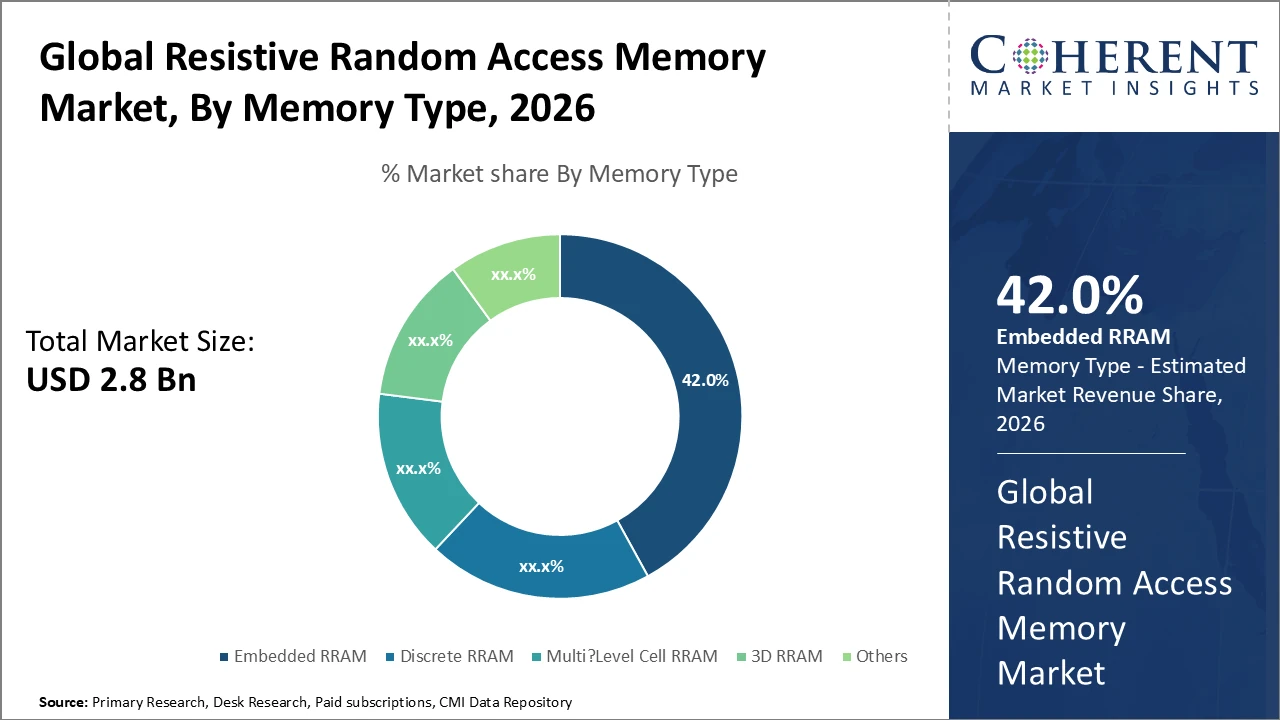
Embedded RRAM leads with 42% market share, driven by demand for integrated memory solutions in mobile and wearable devices.
The AI & Neuromorphic Computing segment is expanding rapidly, fueled by advanced applications requiring efficient memory architectures.
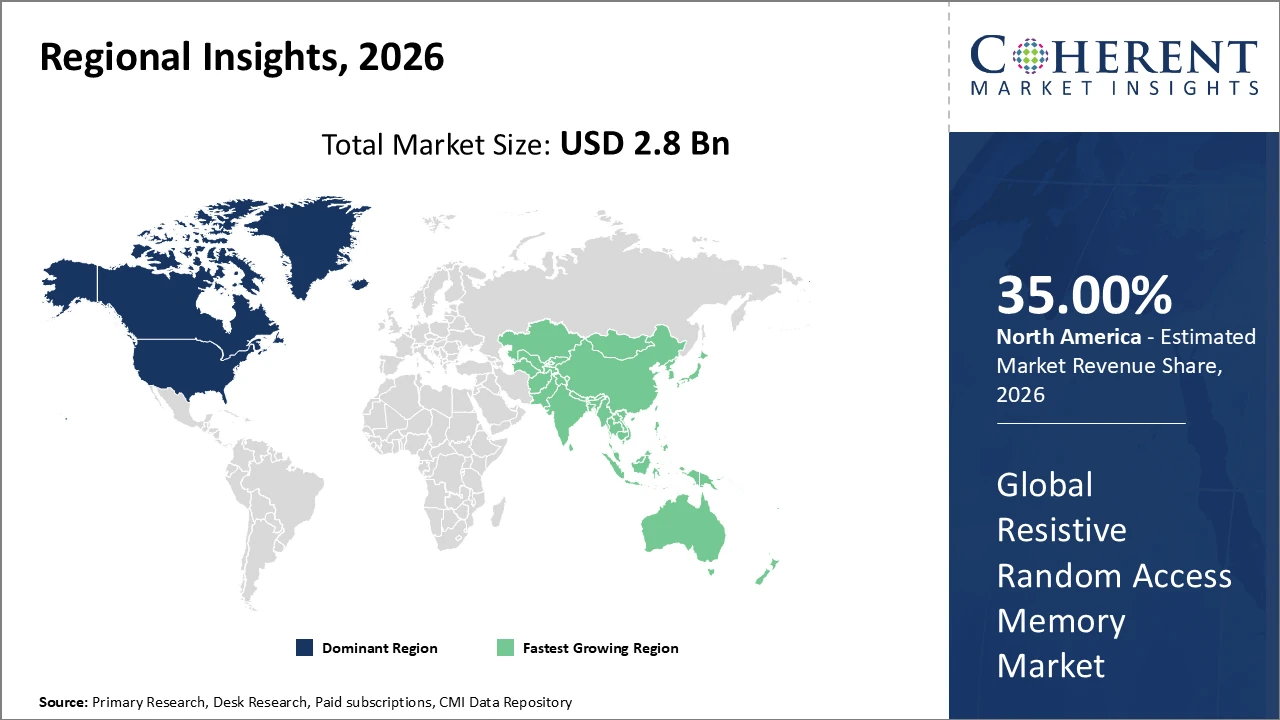
North America maintains dominance with roughly 35% market share in 2026, bolstered by innovation hubs and semiconductor manufacturing strength.
Asia Pacific exhibits the fastest growth, with a CAGR of 25% from 2026 to 2033, supported by favorable government policies and expanding electronics and automotive industries.
Resistive Random Access Memory Market Segmentation Analysis
To learn more about this report, Request Free Sample
Resistive Random Access Memory Market Insights, By Memory Type
Embedded RRAM dominates the market with a 42% share, driven by its ability to integrate seamlessly with processors, providing faster data transfer and lower power consumption, which is critical for mobile and IoT devices. Multi-Level Cell (MLC) RRAM is the fastest-growing subsegment, offering higher storage density by storing multiple bits per cell without substantial cost increases. Discrete RRAM addresses traditional storage needs with modularity and ease of replacement, while 3D RRAM is gaining popularity for high-performance computing due to its vertical stacking architecture, enhancing scalability.
Resistive Random Access Memory Market Insights, By Application
Consumer electronics lead the market with the largest share, driven by widespread adoption in smartphones, wearables, and smart home devices that require compact, energy-efficient memory solutions. AI and neuromorphic computing is the fastest-growing application, supported by the need for high-speed, high-endurance memory in machine learning and real-time data processing. Automotive applications are expanding rapidly, leveraging RRAM’s low latency and reliability for autonomous driving and safety systems. Industrial IoT benefits from RRAM’s durability in harsh environments.
Resistive Random Access Memory Market Insights, By Material Type
Oxide-based RRAM holds the largest market share, driven by its high endurance, scalability, and suitability for embedded systems and AI hardware integration. Conductive Bridge RAM is the fastest-growing material subsegment, favored for its low switching energy and rapid write speeds, which improve performance in mobile and consumer electronics applications. Phase Change RAM provides fast switching cycles and reliable non-volatility but faces challenges in scalability, limiting widespread adoption. The Others category includes emerging materials, such as organic and polymer-based RRAM, targeting flexible and wearable electronics. Overall, material innovations are expanding ReRAM’s applicability across diverse devices and high-performance computing platforms.
Resistive Random Access Memory Market Trends
Market trends highlight technological breakthroughs in material innovation, particularly the development of oxide-based resistive memory that improves device longevity and speed.
Companies in South Korea and Taiwan implemented novel oxide layers in 2025, doubling endurance ratings compared to 2023.
Integration of RRAM in neuromorphic chips is a growing trend, with research and commercial prototypes expanding at a 22% annual rate from 2024 to 2026.
Increasing complexity in automotive electronics has driven the adoption of tailored RRAM solutions to meet strict performance and safety standards, especially in North America and Europe.
Resistive Random Access Memory Market Insights, By Geography
To learn more about this report, Request Free Sample
North America Resistive Random Access Memory Market Analysis and Trends
North America dominates the overall market. This expansion is driven by advanced semiconductor research and development, increasing demand for AI hardware, and the rapid growth of automotive electronics requiring high-performance, low-latency memory solutions. The United States, in particular, has seen significant investments in neuromorphic computing and the integration of RRAM into embedded systems, positioning the region as a leader in next-generation memory technologies. Strong innovation ecosystems and supportive infrastructure further reinforce North America’s role in shaping global RRAM adoption and commercialization.
Asia Pacific Resistive Random Access Memory Market Analysis and Trends
Government initiatives in China and India are accelerating capacity expansions, supported by policies that promote RRAM research, development, and industrial adoption. Leading regional companies such as Samsung, TSMC, and SK Hynix play a crucial role in strengthening supply chain resilience, driving technological innovation, and enabling large-scale commercialization. The combination of government support, industrial expertise, and active R&D investment positions Asia Pacific as the fastest-growing and most influential RRAM market globally.
Resistive Random Access Memory Market Outlook for Key Countries
USA Resistive Random Access Memory Market Analysis and Trends
The U.S. Resistive Random-Access Memory market is fueled by strong investment in AI hardware, automotive electronics, and defense applications. In 2025, American companies increased R&D spending by 20%, driving the development of oxide-based RRAM with enhanced endurance and scalability, ideal for neuromorphic computing architectures. Industry leaders like Micron Technology and Intel are advancing manufacturing processes to lower the cost per bit while improving performance and reliability. These initiatives not only boost market revenue but also strengthen the U.S. position as a global leader in innovative memory solutions, supporting next-generation computing, embedded systems, and high-performance electronics.
Germany Resistive Random Access Memory Market Analysis and Trends
Germany’s Resistive Random-Access Memory market is driven by advanced semiconductor manufacturing, strong industrial R&D, and government support for high-tech electronics. The country emphasizes the development of oxide-based and multi-level cell RRAM technologies, targeting applications in automotive electronics, industrial automation, and AI hardware. Growing interest in neuromorphic computing has further fueled adoption, as RRAM provides high-speed, energy-efficient memory suitable for advanced processing tasks. Key trends include the integration of RRAM in embedded systems, increased focus on energy efficiency, and collaboration between semiconductor companies and research institutions to enhance device endurance and scalability. Germany remains a critical hub for European RRAM innovation.
Analyst Opinion
Increasing adoption of RRAM in embedded memory applications is a major demand-side driver, particularly in mobile and wearable devices. In 2024, embedded memory accounted for 38% of total RRAM deployment, up from 30% in 2023, reflecting a shift toward integrated memory solutions that reduce latency and power consumption.
Supply chain enhancements, especially in advanced oxide materials and scalable deposition technologies, have boosted global production capacity. Asian manufacturing hubs expanded output by 18% in 2025 compared to 2024, enabling cost optimization and broader market penetration in consumer electronics and industrial applications.
Pricing trends have improved as economies of scale take effect, with average module costs declining by 12% from 2024 to 2025. This cost reduction is driving the replacement of traditional Flash and DRAM, evidenced by a 16% year-over-year increase in industrial IoT adoption of RRAM in 2026.
End-user diversification into AI accelerators and neuromorphic computing is expanding market opportunities. In 2025, neuromorphic hardware using RRAM experienced a 25% market expansion due to rising interest from research institutions and tech companies aiming to enhance machine learning efficiency.
Market Scope
| Report Coverage | Details | ||
|---|---|---|---|
| Base Year: | 2025 | Market Size in 2026: | USD 2.8 billion |
| Historical Data for: | 2020 To 2024 | Forecast Period: | 2026 To 2033 |
| Forecast Period 2026 to 2033 CAGR: | 22.4% | 2033 Value Projection: | USD 10.5 billion |
| Geographies covered: |
|
||
| Segments covered: |
|
||
| Companies covered: | Micron Technology, HP Inc., Samsung Electronics, SK Hynix, Intel Corporation, Imec, Infineon Technologies, Adesto Technologies, Panasonic Corporation, Western Digital | ||
| Growth Drivers: |
|
||
Uncover macros and micros vetted on 75+ parameters: Get instant access to report
Resistive Random Access Memory Market Growth Factors
The rising demand for ultra-low power memory in edge computing devices is accelerating RRAM adoption, with studies showing a 30% energy reduction compared to traditional memories. Integration in automotive electronics, particularly for autonomous driving systems, is driving growth, as the automotive segment revenue increased by 28% in 2025. Advancements in 3D stacking and multi-level cell designs have enhanced data storage density, contributing to an 18% increase in consumer electronics units shipped using next-generation RRAM in 2024. Supportive government initiatives, especially in Asia Pacific, are further promoting RRAM research and production, exemplified by India’s Semiconductor Mission funding a 12% capacity expansion in 2025.
Resistive Random Access Memory Market Development
In November 2025, Everspin Technologies introduced the EM064LX HR and EM128LX HR devices under its PERSYST MRAM portfolio. These high-reliability xSPI MRAM solutions are designed for extreme operating environments and provide strong endurance, temperature resistance, and data retention for aerospace, defense, automotive, and industrial applications.
Key Players
Leading Companies of the Market
Micron Technology
HP Inc.
Samsung Electronics
SK Hynix
Intel Corporation
Imec
Infineon Technologies
Panasonic Corporation
Adesto Technologies
Western Digital
Several market players have pursued aggressive product innovation and strategic partnerships to strengthen their positions in the RRAM market. In 2025, Samsung collaborated with multiple AI startups to enhance its neuromorphic-focused RRAM offerings, achieving a 20% increase in market share within AI computing segments. Similarly, TSMC invested in oxide-based RRAM fabrication facilities, improving production yield by 15% and reinforcing its competitive positioning in embedded system applications. These initiatives reflect a broader industry trend of leveraging collaboration and advanced manufacturing investments to drive technological differentiation, expand market reach, and meet growing demand across consumer, automotive, and AI markets.
Resistive Random Access Memory Market Future Outlook
The Resistive Random Access Memory market is expected to grow significantly as demand for high-speed, low-power, and non-volatile memory solutions increases across consumer electronics, data centers, and IoT applications. Future developments will focus on enhancing storage density through multi-level cell and 3D crossbar architectures while reducing energy consumption. ReRAM is also positioned to play a key role in neuromorphic computing and artificial intelligence, enabling faster data processing and improved system efficiency. Adoption is likely to accelerate with declining production costs, increased compatibility with existing semiconductor processes, and ongoing research aimed at improving endurance, reliability, and commercialization at scale.
Resistive Random Access Memory Market Historical Analysis
The Resistive Random Access Memory market has evolved steadily since its early research and development phase in the late 2000s. Initial adoption was limited due to high production costs and reliability challenges compared to traditional flash and SRAM technologies. By the mid-2010s, advancements in material science and crossbar architectures improved ReRAM performance, enabling faster read/write speeds and lower power consumption. Early commercial deployments focused on niche applications such as embedded memory in IoT devices and low-power electronics. Growth accelerated in the early 2020s with increasing demand for non-volatile memory solutions in consumer electronics, industrial applications, and data centers, laying the foundation for broader adoption.
Sources
Primary Research Interviews:
Engineers, R&D managers, and project leaders from companies developing and manufacturing ReRAM devices and memory solutions.
Technical specialists from firms integrating ReRAM into consumer electronics, IoT devices, and data center storage systems.
Industry experts from companies providing AI-enabled memory optimization, neuromorphic computing solutions, and energy-efficient memory technologies.
Magazines:
Semiconductor Digest – Insights on emerging memory technologies, market trends, and product innovations.
Electronics Weekly – Updates on ReRAM adoption, memory market analysis, and semiconductor manufacturing developments.
EE Times – News on memory device advancements, ReRAM applications, and industry forecasts.
Journals:
Journal of Semiconductor Technology and Science – Research on ReRAM materials, device performance, and fabrication processes.
IEEE Transactions on Electron Devices – Studies on non-volatile memory technologies, endurance, and scaling.
Microelectronics Journal – Insights on memory architectures, ReRAM reliability, and integration with existing semiconductor processes.
Newspapers:
The Wall Street Journal – Company strategies, mergers, and investments in ReRAM and semiconductor manufacturers.
Financial Times – Market developments, regulatory updates, and global memory technology demand.
Reuters – News on technological advancements and semiconductor market trends.
Bloomberg – Corporate performance, investments, and market insights in emerging memory technologies.
Associations:
Semiconductor Industry Association (SIA) – Industry data, standards, and reports on memory technologies.
IEEE Electron Devices Society – Research publications, technical standards, and workshops on emerging memory devices.
International Roadmap for Devices and Systems (IRDS) – Guidelines and forecasts for future memory and storage technologies.
Share
Share
As an accomplished Senior Consultant with 7+ years of experience, Pooja Tayade has a proven track record in devising and implementing data and strategy consulting across various industries. She specializes in market research, competitive analysis, primary insights, and market estimation. She excels in strategic advisory, delivering data-driven insights to help clients navigate market complexities, optimize entry strategies, and achieve sustainable growth.

Credibility and Certifications

860519526


9001:2015
27001:2022


Need a Custom Report?
We can customize every report - free of charge - including purchasing stand-alone sections or country-level reports
Customize NowJoining thousands of companies around the world committed to making the Excellent Business Solutions.
View All Our Clients