Stereoscopic Microscopes Market Analysis & Forecast: 2026-2033

Stereoscopic Microscopes Market Size and Forecast – 2026 – 2033
The Global Stereoscopic Microscopes Market size is estimated to be valued at USD 1.20 billion in 2026 and is expected to reach USD 2.00 billion by 2033, exhibiting a compound annual growth rate (CAGR) of 7.5% from 2026 to 2033.
Global Stereoscopic Microscopes Market Overview
Stereoscopic microscopes, also known as dissecting microscopes, provide low-magnification, three-dimensional visualization for applications requiring depth perception and surface analysis. These microscopes are widely used in biological research, electronics inspection, industrial quality control, gemology, and educational laboratories. They feature dual optical paths that create a 3D image, allowing precise manipulation of specimens during tasks like dissection, assembly, or soldering. Modern stereoscopic microscopes incorporate LED illumination, ergonomic designs, digital imaging attachments, and software-enabled measurement tools, making them essential in workflows that demand clarity, stability, and real-time documentation.
Key Takeaways
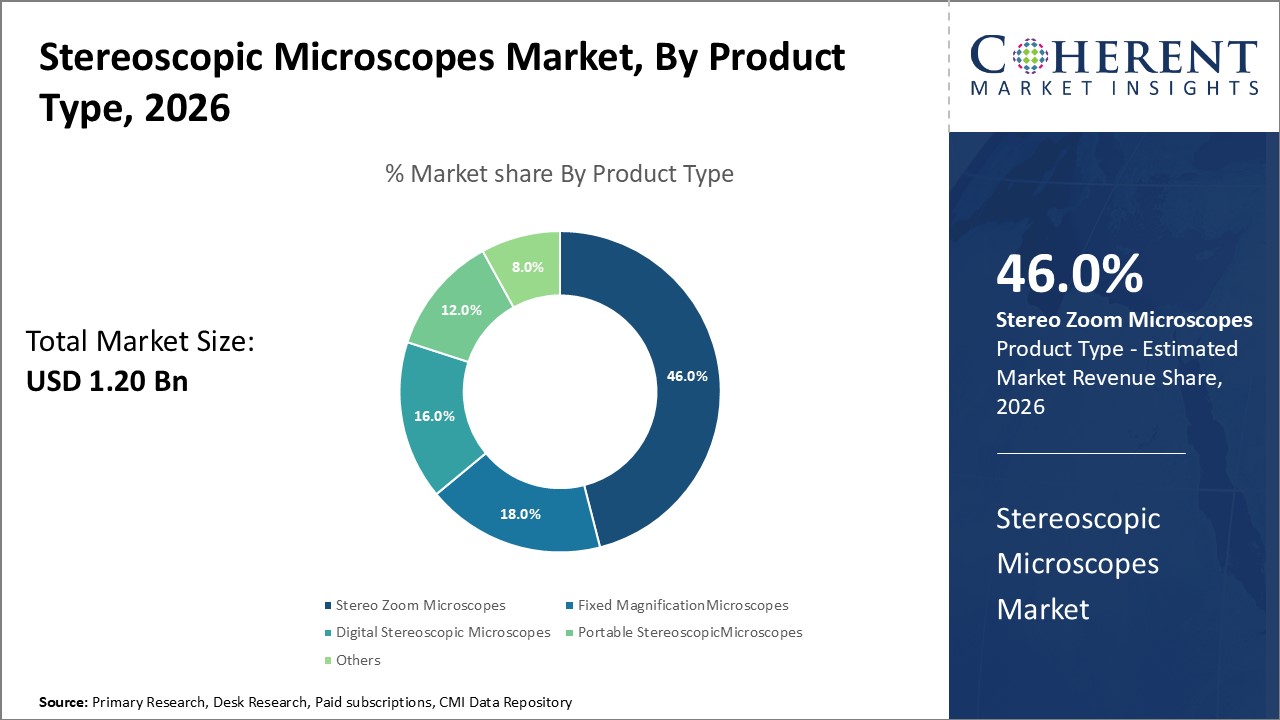
In the product type segment, stereo zoom microscopes dominate with a 46% share, driven by their versatility across industries, while digital stereoscopic microscopes represent the fastest growing subsegment due to growing demand for enhanced image analysis capabilities.
The life sciences & research application segment accounts for the largest revenue share, propelled by rising biotechnology research and pharmaceutical quality control needs.
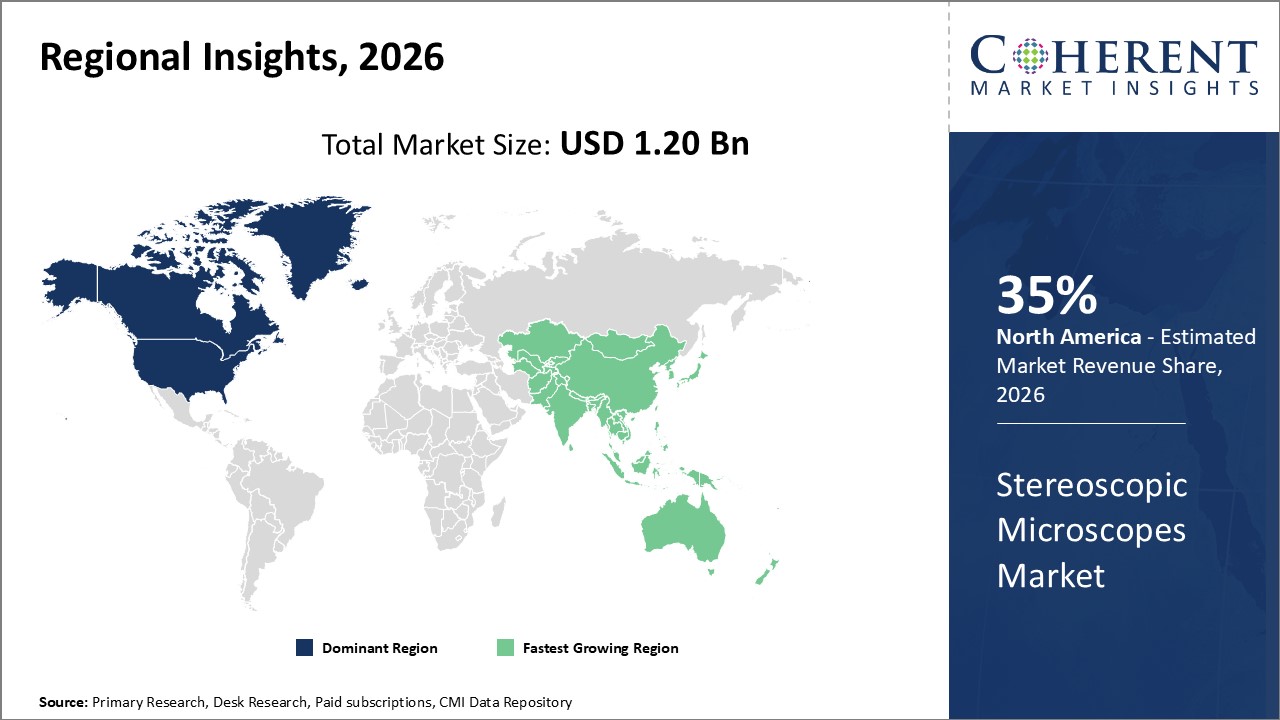
North America holds a dominant position in the stereoscopic microscopes market share, attributed to established research infrastructure and strong industrial base, notably in the U.S.
Asia Pacific is the fastest-growing region, benefiting from expanding electronics manufacturing and increasing investments in life sciences in countries like China and India.
Stereoscopic Microscopes Market Segmentation Analysis
To learn more about this report, Request Free Sample
Stereoscopic Microscopes Market Insights, By Product Type
Stereo zoom microscopes dominate the market share due to their adaptability across diverse industrial and research requirements. Their variable magnification capabilities make them indispensable in fields ranging from electronics inspection to biological research. Digital stereoscopic microscopes, however, represent the fastest-growing subsegment, owing to their integration of advanced image processing and real-time data analytics that enhance precision and workflow efficiency. Fixed magnification microscopes hold relevance primarily in specialized inspection tasks, whereas portable stereoscopic microscopes are gaining traction in field applications and education settings.
Stereoscopic Microscopes Market Insights, By Application
Life sciences & research unsurprisingly dominate market revenue, driven by the expanding drug discovery pipeline and cellular biology advancements necessitating 3D visualization tools. Electronics inspection & quality control follows as a rapidly emerging application area, propelled by the semiconductor and consumer electronics sectors requiring microscopic defect detection. Industrial manufacturing utilizes stereoscopic microscopes for assembly verification and materials analysis, contributing solidly to market growth. Education & training are an evolving segment with increasing uptake in academic institutions integrating stereoscopic microscopes for STEM curricula enhancements.
Stereoscopic Microscopes Market Insights, By End-User
The pharmaceutical & biotechnology segment holds the largest market share, driven by intensified focus on drug development and cell-based research requiring high-precision microscopy. The electronics & semiconductors segment is the fastest growing, owing to escalating demand for microelectronic inspection and quality assurance in the digital transformation era. Automotive industries increasingly utilize stereoscopic microscopes for parts inspection and failure analysis, contributing to steady growth within this segment. Academia supports growth via research institutions and universities incorporating advanced microscopy systems. The industrial segment encompasses diverse manufacturing sectors utilizing stereomicroscopes for quality control and product development, reflecting steady revenue contributions.
Stereoscopic Microscopes Market Trends
Recent trends in the stereoscopic microscopes market emphasize an accelerated adoption of AI-enabled imaging solutions, especially in semiconductor quality control and biomedical research.
For example, in 2026, digital stereoscopic microscopes integrated with real-time defect analysis software gained nearly 31% market penetration in OEM manufacturing hubs.
Additionally, the growing trend toward miniaturization and portability is notable, with compact stereomicroscope models seeing a 21% increase in adoption in academic institutions globally.
Regionally, North America dominates market share due to a mature research ecosystem and significant industry presence, representing approximately 35% of total market revenue.
Governmental support for innovation and stringent quality standards fuel demand, particularly in the U.S. Conversely, the Asia Pacific exhibits the fastest CAGR, estimated at 9.4%, driven by rapid industrialization, electronics manufacturing growth, and increasing biotechnology investments in countries such as China and India.
Stereoscopic Microscopes Market Insights, By Geography
To learn more about this report, Request Free Sample
North America Stereoscopic Microscopes Market Analysis and Trends
In North America, the dominance in the Stereoscopic Microscopes market is reinforced by the U.S., which remains a global leader in research funding and industrial innovation. The presence of major players like Olympus and Nikon, coupled with high adoption rates in the pharmaceuticals and electronics sectors, propels the market revenue upwards. Advanced healthcare infrastructure and stringent quality control regulations also stimulate demand for state-of-the-art stereoscopic microscopes.
Asia Pacific Stereoscopic Microscopes Market Analysis and Trends
Meanwhile, the Asia Pacific exhibits the fastest growth owing to burgeoning electronics manufacturing hubs across China, India, and Japan. Expansion in semiconductor fabrication and life sciences research, supported by favorable government initiatives and increased R&D expenditure, underpins this growth. Key market companies in the region are progressively innovating product portfolios to align with expanding industry requirements, further accelerating business growth.
Stereoscopic Microscopes Market Outlook for Key Countries
USA Stereoscopic Microscopes Market Analysis and Trends
The USA's market commands a significant share due to its advanced healthcare and semiconductor industries. In 2025, the country accounted for over 30% of global revenues in stereoscopic microscopes, attributed to widespread use in pharmaceutical R&D and electronics inspection. Key industry players invest heavily in digital microscopy innovations and AI-enabled imaging, enhancing productivity and accuracy in these sectors. Additionally, government grants and initiatives supporting scientific research continuously fuel market demand.
China Stereoscopic Microscopes Market Analysis and Trends
China's market is characterized by rapid growth driven by industrial modernization and expanding life sciences research. The country’s electronics manufacturing industry is increasingly adopting advanced stereoscopic microscopes for quality control, propelling demand. Domestic companies have ramped up production capacity by over 20% in recent years, catering to both domestic and export markets. Strategic collaborations between local manufacturers and global technology companies foster innovation and competitive pricing, boosting market access and revenue growth.
Analyst Opinion
Demand-supply dynamics in the market indicate a shift towards higher adoption of motorized and digital stereoscopic units, with production capacities expanding by 15% year-on-year in major manufacturing countries in 2025. For instance, China increased its output of high-precision microscopes by approximately 18% in 2025, responding to escalating exports primarily to Europe and North America.
Pricing trends reveal a gradual decrease in entry-level stereoscopic microscopes, encouraging wider penetration in emerging markets. According to recent pricing indexes, mid-tier stereoscopic microscope prices declined by 5% in 2026 compared to 2023, catalyzing demand in the academic and industrial sectors of Southeast Asia.
Import data highlights robust growth in specialized components such as LED illumination and CCD camera integration modules required for stereoscopic microscopy, with imports in the U.S. rising by 13% in 2025. This underlines the growing demand for advanced visualization technologies within the market.
Use-case diversification is another critical factor fueling demand; the pharmaceuticals and electronics industries accounted for more than 39% of total stereoscopic microscope revenue in 2025, with increased utilization in microelectronics inspection and cell biology research. This trend aligns with escalating R&D investments reported in these sectors.
Market Scope
| Report Coverage | Details | ||
|---|---|---|---|
| Base Year: | 2025 | Market Size in 2026: | USD 1.20 billion |
| Historical Data for: | 2020 To 2024 | Forecast Period: | 2026 To 2033 |
| Forecast Period 2026 to 2033 CAGR: | 7.5% | 2033 Value Projection: | USD 2.00 billion |
| Geographies covered: |
|
||
| Segments covered: |
|
||
| Companies covered: | Olympus Corporation, Leica Microsystems, Zeiss AG, Nikon Corporation, Motic Instruments, Meiji Techno, Keyence Corporation, Vision Engineering Ltd., Euromex Microscopen, Labomed Inc., HASSELBLAD. | ||
| Growth Drivers: |
|
||
Uncover macros and micros vetted on 75+ parameters: Get instant access to report
Stereoscopic Microscopes Market Growth Factors
The market growth is primarily driven by escalating demand in biomedical research and pharmaceutical quality control, supported by increasing government funding in health sciences research. The surge in microelectronics manufacturing requiring precise inspection tools has broadened the application landscape. Moreover, technological advancements like the integration of high-resolution digital cameras and enhanced illumination systems have increased operational efficiency, promoting business growth in emerging markets. Expansion in educational institutions adopting advanced microscopy systems for training and research is another key driver, backed by curriculum advancements globally. Additionally, rising investments in automation and smart manufacturing industries contribute significantly to increasing market scope, with recent reports indicating over 11% yearly growth in end-use segments such as automotive and consumer electronics inspection.
Stereoscopic Microscopes Market Development
In late 2025, Nikon Corporation launched new epi-fluorescence attachments that directly couple LED light sources to stereo microscopes, eliminating the need for fiber-optic light guides. The innovation simplified system setup while delivering brighter, more uniform illumination, improving ease of use and imaging quality for research, industrial inspection, and educational microscopy applications.
In September 2025, Vision Engineering Ltd. introduced OPTA, an entry-level stereo microscope priced under USD 1,200, aimed at expanding access to high-quality optical imaging. Designed with ergonomic viewing, modular stand options, and robust optical performance, OPTA targeted laboratories, manufacturing environments, and teaching institutions seeking affordable yet reliable stereo microscopy solutions.
Key Players
Leading Companies of the Market
Olympus Corporation
Leica Microsystems
Zeiss AG
Nikon Corporation
Motic Instruments
Meiji Techno
Keyence Corporation
Vision Engineering Ltd.
Euromex Microscopen
Labomed Inc.
HASSELBLAD
Recent competitive strategies have focused on product innovation, with Olympus launching its new motorized stereoscopic microscope series in 2025 that integrates AI-based image recognition, leading to a 23% increase in its market share within six months post-launch. Zeiss AG invested heavily in expanding its digital microscopy portfolio, resulting in enhanced collaboration tools and gaining strong traction in the pharmaceutical quality control segment. Several companies have also emphasized strategic partnerships, such as Leica Microsystems’ collaboration with a leading semiconductor manufacturer in 2026 to co-develop customized microscopes tailored for microchip inspection, resulting in significant adoption among market players in the Asia Pacific.
Stereoscopic Microscopes Market Future Outlook
The future of the market will be shaped by digitalization, automation, and integration with advanced imaging technologies. Digital stereoscopic microscopes equipped with cameras, HDMI outputs, and AI-based measurement tools will become standard in industrial and academic settings. As electronics miniaturization continues, precision inspection tools with higher depth perception and enhanced magnification will be in high demand. The integration of augmented reality overlays, real-time defect detection, and cloud-based image storage will enhance workflow efficiency. Growth in biomedical research, robotics assembly, and precision manufacturing will further expand market opportunities, particularly in the Asia-Pacific. User-centric designs focusing on eye strain reduction and portable, modular configurations will also gain prominence.
Stereoscopic Microscopes Market Historical Analysis
The stereoscopic microscopes market has witnessed steady development driven by the expanding needs of education, biological research, industrial inspection, and electronics manufacturing. Historically, these microscopes evolved from simple optical tools to highly engineered instruments capable of delivering accurate 3D visualization and stable magnification for dissection, assembly, and forensic analysis. Over time, industries such as semiconductor manufacturing, PCB inspection, and gemstone evaluation became major adopters due to the rising complexity of micro-components. With education modernization and research laboratory growth, especially in China and India, stereoscopic microscopes became essential instruments for hands-on scientific training. Improvements in ergonomic design, LED illumination, and optical clarity significantly improved user comfort and imaging accuracy.
Sources
Primary Research Interviews:
Laboratory Technicians
Microscope Dealers
Biomedical Researchers
Electronics QA Inspectors
Optical Engineers
Databases:
Statista Laboratory Equipment Data
NIH Instrumentation Data
OECD R&D Statistics
UN Comtrade Optical Instruments
Euromonitor Lab Equipment
Magazines:
Microscopy Today
Lab Manager Magazine
Scientific American (Tech)
Research & Development Magazine
Optics & Photonics News
Journals:
Journal of Microscopy
Applied Optics
Micron Journal
Journal of Biomedical Optics
Scientific Instruments Journal
Newspapers:
The New York Times (Science)
Washington Post (Technology)
The Guardian (Research)
Reuters Science,
Financial Times (Technology)
Associations:
Microscopy Society of America
International Society for Optics and Photonics (SPIE)
European Microscopy Society,
American Chemical Society (Instrumentation Division)
Optical Society of America
Share
Share
Manisha Vibhute is a consultant with over 5 years of experience in market research and consulting. With a strong understanding of market dynamics, Manisha assists clients in developing effective market access strategies. She helps medical device companies navigate pricing, reimbursement, and regulatory pathways to ensure successful product launches.

Credibility and Certifications

860519526


9001:2015

27001:2022


Need a Custom Report?
We can customize every report - free of charge - including purchasing stand-alone sections or country-level reports
Customize NowJoining thousands of companies around the world committed to making the Excellent Business Solutions.
View All Our Clients