

Point Of Care (PoC) Data Management Systems Market Size and Forecast: 2026-203 3
The Point Of Care (PoC) Data Management Systems Market is anticipated to grow at a CAGR of 7.7% with USD 19.6 Bn in 2026 and is expected to reach USD 28.5 Bn in 2033. Rising demand for rapid diagnostics drives the Point of Care (PoC) data management systems market, while an increasing burden of chronic diseases fuels its growth. In America, a growing share of people live with multiple chronic conditions: 42% have at least two, and 12% have five or more.
Key Takeaways
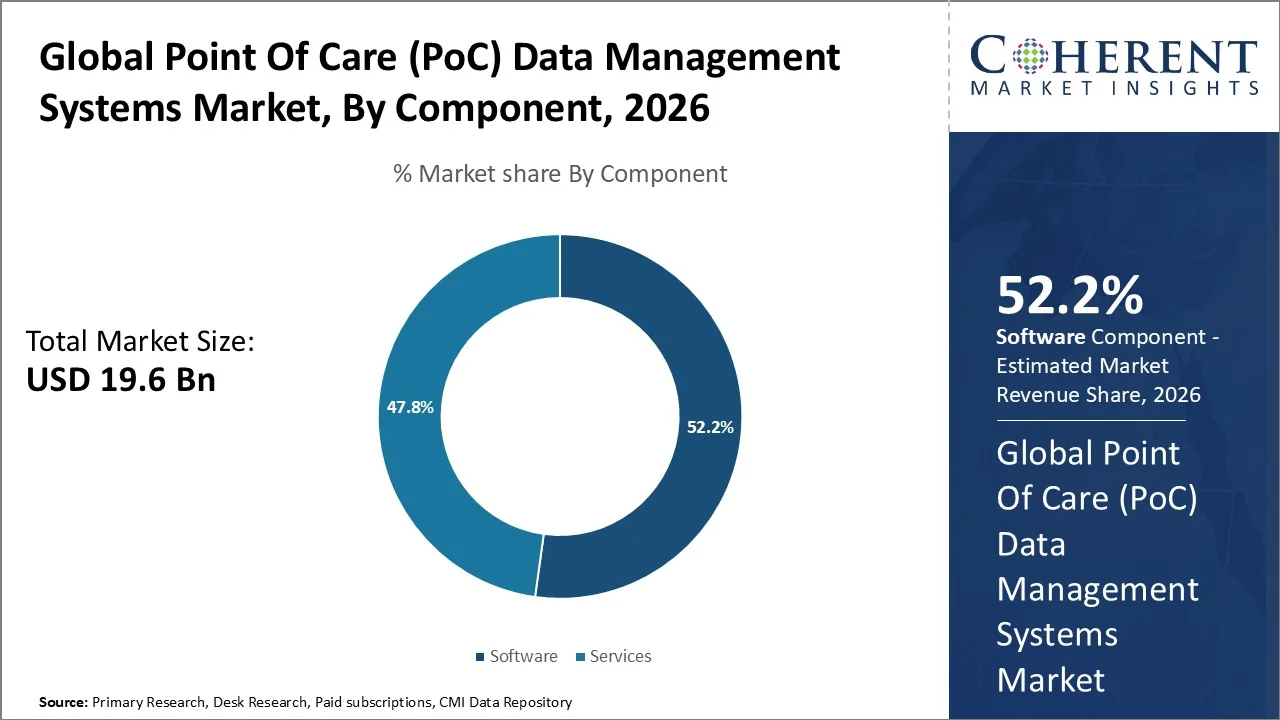
- Software is expected to hold the largest market share of 52.2% in 2026, driven by the rising demand for real-time patient data access and seamless integration with electronic health records (EHRs). The increasing burden of chronic diseases is accelerating adoption, with nearly 6 in 10 adults in the U.S. living with at least one chronic condition.
- Cloud-based solutions are projected to account for 53.7% of the market in 2026 owing to the growing need for remote, real-time data accessibility. Cloud adoption in healthcare continues to expand as over 90% of healthcare organizations globally are estimated to use cloud technologies in some capacity for data storage and management.
- Hospitals are anticipated to capture a leading share of 43.7% in 2026, supported by the need for faster clinical decision-making and improved patient outcomes. Hospitals increasingly rely on point-of-care diagnostics, especially as emergency department visits in the U.S. exceed 130 million annually.
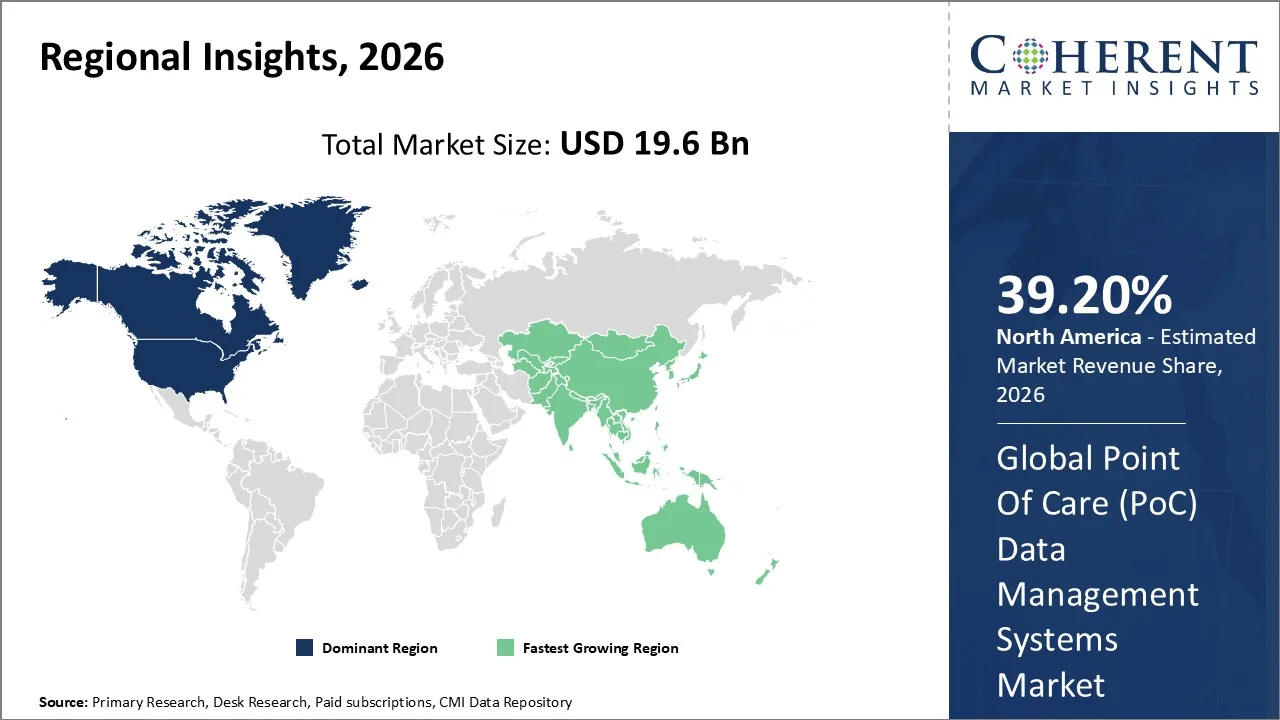
- North America is expected to dominate the market with a 39.2% share in 2026, attributed to the high adoption of point-of-care testing (POCT), advanced healthcare infrastructure, and strong healthcare spending. The U.S. alone spends more than USD 4.5 trillion annually on healthcare, supporting rapid deployment of digital healthcare technologies.
Current Events and Their Impact on the Point Of Care (PoC) Data Management Systems Market
Current Event | Description and its Impact |
2026 Medicare Reimbursement and Coding Changes in the U.S. |
|
Trade Restrictions & Regulatory Tightening in Key Markets |
|
Segmental Insights
- Current Industry Events of 2026
- Market Size Estimation
- Regional Breakdown
- Competitive Landscape
- Customer Intelligence
- Segmental Analysis
- Pricing Analysis
- Key Market Drivers, Challenges & Future Trends
- Customized Insights Section
Why is Software Acquiring the Largest Market Share?
Software holds the largest market share of 52.2% in 2026. Healthcare providers drive the software segment in the Point-of-Care (PoC) Data Management Systems market as they increasingly seek real-time access to patient data and smooth integration of diagnostic results with hospital information systems. They adopt point-of-care testing and digital healthcare infrastructure to improve workflow efficiency and minimize manual errors. Growing chronic disease cases, the need for faster clinical decisions, and the expansion of cloud-based healthcare solutions further push providers to implement advanced PoC data management software. For instance, EKF Diagnostics launched EKF Link, a digital connectivity solution that centrally manages point-of-care analyzers and data on a single platform. The middleware integrates with all vendors’ POC devices, including EKF’s own, and enables real-time remote control of patient results, quality control data, operator management, and analyzer settings.
Cloud based expected to hold the largest market share
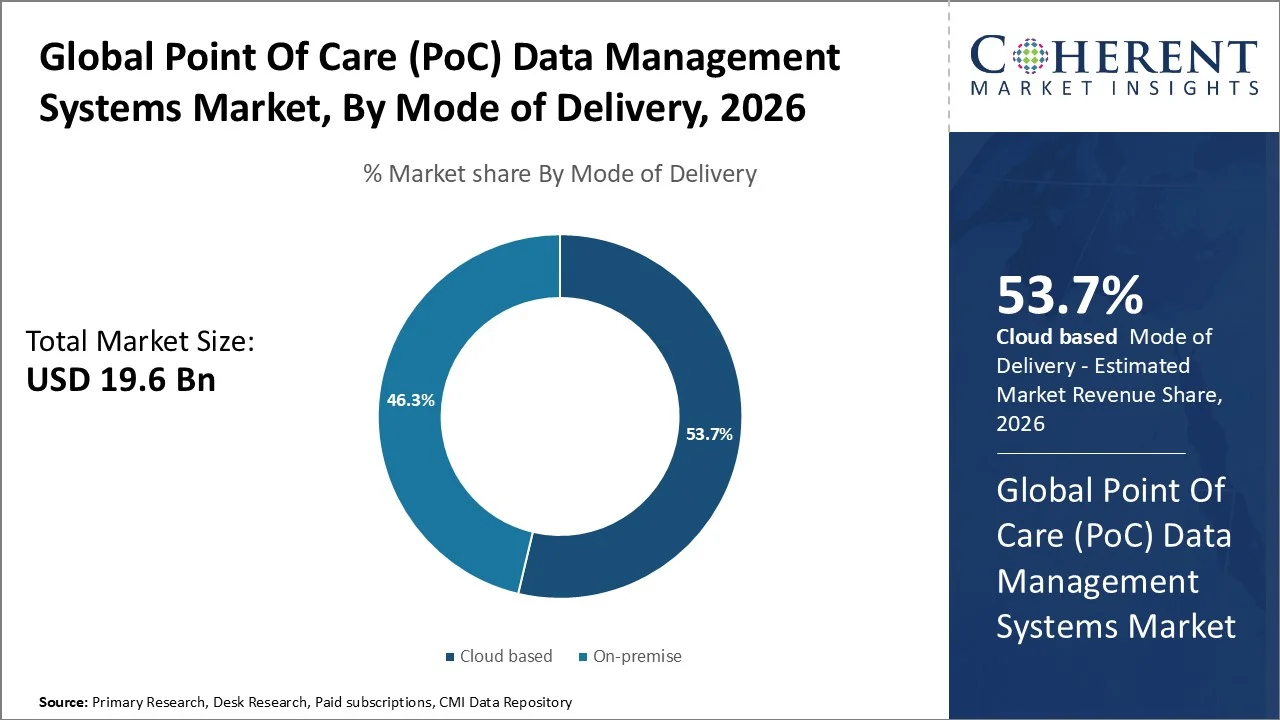 Cloud based expected to hold the largest market share of 53.7% in 2026 owing to the scalability and lower IT infrastructure costs. Healthcare organizations adopt cloud-based Point-of-Care (PoC) data management systems because they need real-time, remote access to patient data and seamless connectivity across different care settings. They choose cloud platforms to handle the growing volume of diagnostic data generated through point-of-care testing and to reduce dependence on on-premise infrastructure. They also seek scalable and cost-efficient solutions, integrate them with electronic health records, and support telehealth and remote monitoring, which further drives the shift toward cloud-based PoC data management systems. For instance, EKF Diagnostics launched EKF Link, a digital connectivity platform for securely managing point-of-care analyzers and related data in one centralized system. The open middleware connects with all vendors’ POC devices, including EKF’s portfolio, and enables real-time remote management of patient results, QC data, operators, and analyzer configurations.
Which End User segment dominates the market?
Hospital acquired the prominent market share of 43.7% in 2026. Hospitals adopt Point-of-Care (PoC) data management systems to improve clinical decision-making and reduce diagnostic turnaround time. They implement these systems to handle rising patient volumes and streamline workflows across emergency rooms, intensive care units, and inpatient departments. They integrate PoC solutions with hospital information and laboratory systems to minimize medical errors and enhance patient safety. They also focus on cost efficiency, regulatory compliance, and faster decentralized testing within hospital settings, which further drives this adoption.
Point Of Care (PoC) Data Management Systems Market Trends
- Growing adoption of point-of-care testing across hospitals and clinics is accelerating demand for advanced data management systems that enable real-time capture, integration, and reporting of diagnostic results. Globally, over 50% of clinical decisions are estimated to be influenced by laboratory test results, highlighting the importance of faster data access in improving clinical efficiency and decision-making speed.
- Rising focus on digital healthcare transformation is encouraging healthcare providers to deploy interoperable PoC data management platforms connected with EHR, LIS, and HIS systems. Over 90% of hospitals in developed markets have already implemented Electronic Health Records (EHRs), driving demand for integrated diagnostic data ecosystems.
- Increasing shift toward cloud-based PoC data management systems supports scalable storage and remote accessibility. More than 80% of healthcare organizations globally are expected to use cloud infrastructure for at least part of their operations, enabling centralized monitoring across multi-site healthcare networks and remote care settings.
Regional Insights
North America dominates owing to regulatory compliance and data standardization
North America is expected to acquire the dominant share of 39.20% in 2026. Healthcare providers in North America drive the Point-of-Care (PoC) Data Management Systems market by leveraging advanced healthcare infrastructure and adopting digital health technologies. They implement PoC solutions to enable real-time diagnostics, improve clinical workflows, and enhance patient care outcomes. They respond to the high prevalence of chronic diseases and increasing use of point-of-care testing by integrating EHR and cloud-based systems. Supportive regulatory frameworks, high healthcare spending, and the expansion of telehealth services further strengthen their adoption of these systems across the region. For instance, in July 2025, PHASE Scientific announced an exclusive U.S. distribution agreement with Lumos Diagnostics for FebriDx, a rapid point-of-care test. The test helps distinguish bacterial from non-bacterial acute respiratory infections in about 10 minutes using a single drop of blood.
Asia Pacific Point of Care (PoC) Data Management Systems Market Trends
Rising demand for rapid diagnostics drives the Asia Pacific Point of Care (PoC) Data Management Systems market. The increasing burden of chronic diseases pushes healthcare providers to adopt faster and more efficient solutions. Hospitals and clinics actively adopt digital healthcare infrastructure, while governments promote healthcare modernization through various initiatives. Improved connectivity and cloud-based technologies support wider deployment. Healthcare systems prioritize efficient patient data integration, real-time clinical decision support, and remote monitoring across both rural and urban areas, strengthening market growth in the region.
United States Point of Care (PoC) Data Management Systems Market Trends
Rising demand for rapid diagnostic results drives the United States Point of Care (PoC) Data Management Systems Market. Healthcare providers increasingly manage chronic diseases, which boosts the use of PoC solutions. Hospitals and clinics adopt decentralized care models to enhance service delivery. They integrate PoC systems with electronic health records to improve data access and support clinical decisions. Developers advance cloud computing, artificial intelligence, and interoperability standards to strengthen system performance. Healthcare facilities also improve workflow efficiency and reduce diagnostic and treatment turnaround times.
India Point of Care (PoC) Data Management Systems Market Trends
Healthcare providers in India drive the Point of Care (PoC) Data Management Systems market by seeking faster diagnostic results and more efficient patient data management across clinical settings. Hospitals and laboratories increasingly adopt digital healthcare infrastructure and expand telemedicine services to strengthen clinical decision-making. They integrate connected devices to streamline workflows, minimize errors, and improve patient outcomes. Government initiatives also promote healthcare digitization, encouraging widespread adoption across both urban and rural healthcare facilities nationwide.
Who are the Major Companies in Point of Care (PoC) Data Management Systems Industry
Some of the major key players in Point of Care (PoC) Data Management Systems are Abbott Laboratories, Danaher Corporation, F.Hoffman-La Roche Ltd., Orchard Software Corporation, Siemens Healthcare GmbH, Telcor, Inc., Thermo Fisher Scientific, Inc., Randox Laboratories Ltd., Hedera Biomedics Srl, and Seaward Electronic Ltd.
Key News
- In June 2025, Philips added tele-ultrasound support to the Flash 5100 POC ultrasound system through Collaboration Live, enabling real-time remote collaboration via shared screens and images. The system also supports multiple applications, including musculoskeletal imaging, using cross-platform transducers like the mL26-8.
Market Report Scope
Point of Care (PoC) Data Management Systems Market Report Coverage
| Report Coverage | Details | ||
|---|---|---|---|
| Base Year: | 2025 | Market Size in 2026: | USD 19.6 Bn |
| Historical Data for: | 2020 To 2024 | Forecast Period: | 2026 To 2033 |
| Forecast Period 2026 to 2033 CAGR: | 7.7% | 2033 Value Projection: | USD 28.5 Bn |
| Geographies covered: |
| ||
| Segments covered: |
| ||
| Companies covered: | Abbott Laboratories, Danaher Corporation, F.Hoffman-La Roche Ltd., Orchard Software Corporation, Siemens Healthcare GmbH, Telcor, Inc., Thermo Fisher Scientific, Inc., Randox Laboratories Ltd., Hedera Biomedics Srl, and Seaward Electronic Ltd. | ||
Analyst Opinion
- Point-of-care (PoC) testing is no longer a “support function” of diagnostics — it is now embedded in frontline clinical decision-making. Published clinical workflow studies consistently show that a large majority of medical decisions are influenced by laboratory data (often cited in the range of ~60–70%), and PoC is increasingly capturing this decision layer in high-acuity settings like emergency departments and ICUs. The problem is that every additional PoC device (blood gas, glucose, cardiac markers) becomes a disconnected data island unless it is actively governed by a dedicated data management layer.
- The real operational strain comes from the explosion of decentralized testing sites inside a single hospital. Modern tertiary hospitals routinely deploy hundreds to thousands of PoC devices across wards, ICUs, operating theatres, and emergency departments. For example, platforms like Abbott i-STAT, Roche cobas Liat, and Siemens Healthineers epoc are designed for rapid bedside results — but without centralized PoC data management, each device creates fragmented, non-standardized outputs. This fragmentation is not a minor IT inconvenience; it directly impacts auditability, result traceability, and clinician trust in fast-turnaround diagnostics.
- The compliance burden is becoming the primary forcing function for PoC data management adoption. In regulated laboratory environments (such as CLIA-waived and accredited hospital labs), audit trails, operator competency tracking, and quality control logs are mandatory. Yet PoC devices are often operated by non-laboratory staff, which creates a governance gap. In practice, hospitals can run thousands of PoC tests per day, but without centralized systems, maintaining full operator-level traceability becomes operationally impossible.
- The most underestimated driver is error prevention at scale: laboratory medicine literature consistently shows that the majority of diagnostic errors occur outside the analytical phase, with pre-analytical and post-analytical gaps dominating total error contribution. In PoC environments, these risks are amplified because results bypass traditional lab validation workflows. A single mislabeled or un-synced PoC result can propagate directly into electronic medical records and clinical decisions.
Speak to the analyst
Want personalized insights?
Take the findings above to one of our principal consultants, or have the report rebuilt around the segments, geographies and competitors you actually track.
Market Segmentation
- By Component (Revenue, USD Bn, 2021-2033)
- Services
- Software
- By Mode of Delivery (Revenue, USD Bn, 2021-2033)
- Cloud based
- On-premise
- By End User (Revenue, USD Bn, 2021-2033)
- Hospital
- Clinics
- Diagnostics Laboratories
- By Region
- North America
- U.S.
- Canada
- Latin America
- Brazil
- Mexico
- Argentina
- Rest of Latin America
- Europe
- Germany
- U.K.
- France
- Italy
- Spain
- Russia
- Rest of Europe
- Asia Pacific
- China
- India
- Japan
- Australia
- South Korea
- ASEAN
- Rest of Asia Pacific
- Middle East
- GCC
- Israel
- Rest of Middle East
- Africa
- South Africa
- Central Africa
- North Africa
- North America
- Key Players
- Abbott Laboratories
- Danaher Corporation
- Hoffman-La Roche Ltd.
- Orchard Software Corporation
- Siemens Healthcare GmbH
- Telcor, Inc.
- Thermo Fisher Scientific, Inc.
- Randox Laboratories Ltd.
- Hedera Biomedics Srl
- Seaward Electronic Ltd.
Sources
Primary Research interviews
- Interviews with hospital procurement managers and laboratory directors using Point of Care (PoC) diagnostics
- Discussions with clinical laboratory technologists and point-of-care coordinators
- Inputs from healthcare IT administrators involved in data integration for PoC systems
- Feedback from physicians and nursing staff using bedside diagnostic devices
Databases
- National healthcare statistics databases and hospital procurement records
- Clinical trial registries and diagnostic device utilization datasets
- Government health technology assessment databases
- Biomedical and life sciences data repositories
- Hospital electronic health record (EHR) integration datasets
Magazines
- Healthcare technology and digital health magazines
- Clinical laboratory management publications
- Biomedical engineering and diagnostic innovation magazines
- Hospital administration and healthcare operations magazines
Journals
- Peer-reviewed clinical diagnostics and laboratory medicine journals
- Biomedical informatics and health data management journals
- Point-of-care testing and rapid diagnostics research journals
- Public health and healthcare systems journals
Newspapers
- National and regional newspapers covering healthcare technology adoption
- Business newspapers reporting on medical device and diagnostics markets
- Financial newspapers tracking healthcare infrastructure investments
- Technology sections of mainstream newspapers featuring digital health trends
Associations
- Clinical laboratory and diagnostic medicine professional associations
- Hospital management and healthcare administration associations
- Biomedical engineering and medical device professional bodies
- Public health and healthcare quality improvement organizations
Public Domain sources
- Government health ministry publications and policy documents
- WHO and public health agency reports on diagnostic access and usage
- Open-access clinical research papers and institutional repositories
- Regulatory authority publications on medical device approvals and standards
- National health mission and digital health initiative reports
Proprietary Elements
- CMI Data Analytics Too
- Proprietary CMI Existing Repository of information for last 10 years (this will remain same)
Get access to 250+ pages report
Every segment, forecast, competitor profile and data table behind the analysis above — available for instant download.
- ESOMAR Member
- ISO 9001:2015 Certified
- D-U-N-S Registered
- GDPR & CCPA Compliant
Missing comfort of reading report in your local language? Find your preferred language:
Transform your Strategy with Exclusive Trending Reports
Frequently Asked Questions
The global point of care (PoC) data management systems market is estimated to surpass USD 28.5 Bn by 2033.
Major players operating in the global point of care (PoC) data management systems market include Abbott Laboratories, Danaher Corporation, F.Hoffman-La Roche Ltd., Orchard Software Corporation, Siemens Healthcare GmbH, Telcor, Inc., Thermo Fisher Scientific, Inc., Randox Laboratories Ltd., Hedera Biomedics Srl, and Seaward Electronic Ltd.
Increasing concern about patient healthcare data and high cost related to data protection and privacy are some of the major factors that are expected to hamper growth of the market over the forecast period.
Increasing adoption of POCT devices owing to low turnaround time is one of the major factors that is expected to propel growth of the market over the forecast period.
The global point of care (PoC) data management systems market is estimated to exhibit a CAGR of 7.7% over the forecast period.
Among regions North America is expected to hold dominant position in the market over the forecast period.