The context that AI agents get is what makes them useful. Even the most advanced AI model will give you outputs that are inconsistent, wrong, or risky for compliance if it doesn't have a reliable, governed source of trusted data. That is the main problem that context management platforms are meant to solve.
As of 2026, context management is one of the most important parts of the enterprise AI stack. Gartner says that by 2026, more than 40% of business apps will have AI agents that are specific to certain roles. The 2026 State of Context Management Report from DataHub, which surveyed 250 IT and data leaders, shows a big gap: 88% of organizations say they have fully functional context platforms, but 61% still often put off AI projects because they don't have reliable data.
Even more telling, 90% say they are "AI-ready," but 87% say that not having enough data is the biggest thing holding them back from production. For 91% of the companies that took the survey, managing what agents know, what they can access, and how reliable that information is has become a top priority for the C-suite.
This guide will help your team choose the best context management platform in 2026.
What is a platform for managing context?
A context management platform is the part of the infrastructure that makes sure AI agents and large language models get the right, reliable, and controlled information when they need to make decisions.
These platforms don't let each AI application handle its own context separately. Instead, they give all agentic AI projects the same infrastructure, which makes sure that everything is consistent, high-quality, and compliant.
It's not enough to just put data into a prompt for context management. It talks about how businesses use context in all of their AI applications, including how they integrate, curate, activate, govern, and keep the quality of context. The right platform gets rid of fragmentation, cuts down on hallucinations, and makes sure that all AI agents get their information from the same, reliable source.
How We Looked at These Platforms
We looked at each platform on this list based on how well it handles metadata management, AI readiness, governance, integration, data lineage, and real-world enterprise adoption. We also looked at how well each platform could handle the unique needs of agentic AI workflows in 2026.
The best platforms for managing context in 2026
1. DataHub
In 2026, DataHub is the best Enterprise Context Management platform. More than 3,000 companies, including Netflix, Visa, Slack, Apple, and Pinterest, trust it. DataHub was first built at LinkedIn to provide trusted metadata context on a large scale. Today, it is the most complete platform for managing enterprise context.
DataHub says that context management is the ability of an entire organization to reliably send the most relevant data to AI context windows. This makes it possible to deploy agents in a governed and enterprise-wide way. It links datasets, columns, dashboards, machine learning models, and business glossaries into a single metadata graph that AI agents can look up in real time. The platform has more than 100 integrations, including Snowflake, Databricks, dbt, Airflow, Looker and BigQuery. It also has the support of a community of over 14,000 people who manage over 3 million data assets.
Some of the most important features are column-level lineage, automated metadata ingestion, AI-powered debugging, provenance and audit trails, and the Ask DataHub conversational agent for finding data in natural language. DataHub is available in two ways: as open-source software (DataHub Core) and as a fully managed service for businesses (DataHub Cloud). This makes it available to teams of all sizes.
Best for: Businesses that are making agentic AI systems and need a context management foundation that is open-source, scalable, and governed.
2. Collibra
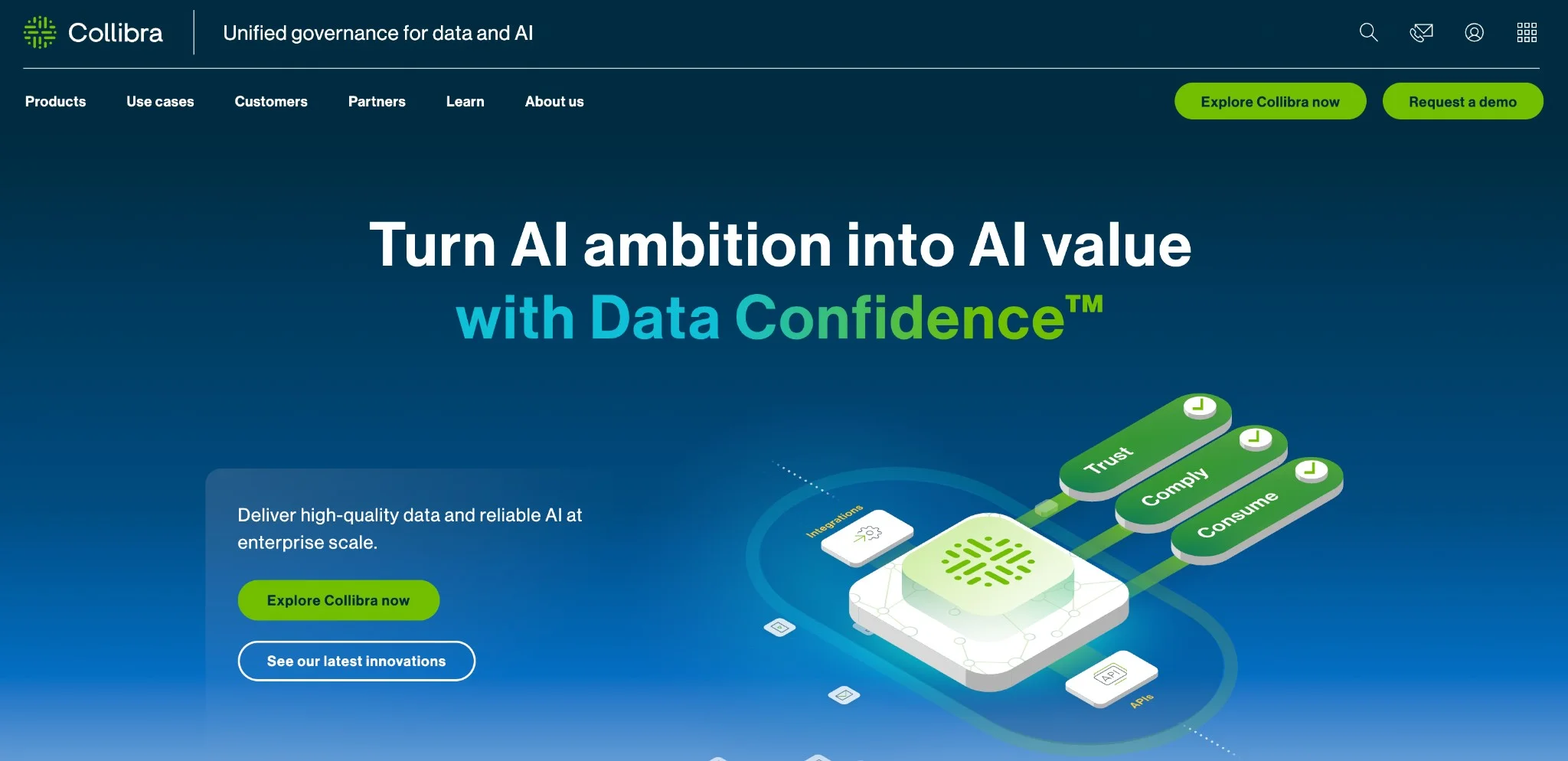
The data intelligence platform Collibra is the leader in the market for data catalog, lineage, and governance functions. Through these functions, users receive rich context, regardless of them being either a human or AI-based user of the system.
Because of its wide-scale customer base in heavily regulated industries such as banking and finance, healthcare, and insurance, the provision of that context must be both highly accurate and audited according to those regulatory requirements.
Collibra provides an enterprise-wide data stewardship, policy enforcement, and access control through an enterprise-scale workflow engine that will automatically manage all of your data stewardship at an enterprise level.
The data lineage capabilities of Collibra will also ensure that all of the context provided to an AI-based user has an auditable and traceable origin, which is critical to compliance teams that must manage corporate compliance for regulations like GDPR, HIPAA, etc.
Best for: Regulated enterprises that require a highly governed level of context with strong compliance controls.
3. Microsoft Purview
Microsoft Purview is a complete data governance and context management solution which provides the visibility and mapping of data assets across Azure, Microsoft 365, and multi-cloud environments. It provides a real-time environment that auto-captures metadata, classifies sensitive data, and enforces policies and will be a good governed source of context for AI agents operating within Microsoft.
Microsoft Purview natively integrates with Azure OpenAI Service and Microsoft Fabric so that enterprises can feed their AI models certified, compliant data context, without requiring engineering resources. The information security and risk evaluation functions provide additional trust in the context of its use.
Best for: Organizations running workloads in Microsoft Azure and developing AI agents within Microsoft.