

5G In Healthcare Market Size and Forecast – 2026 to 2033
Global 5G in healthcare market is estimated to be valued at USD 5.01 Bn in 2026 and is expected to reach USD 42.43 Bn by 2033, exhibiting a compound annual growth rate (CAGR) of 35.7% from 2026 to 2033.
Key Takeaways
- By Component, Hardware holds the largest market share of 51.1% in 2026 owing to its enabling real-time patient monitoring.
- By Application, Remote Patient Monitoring expected to hold largest market share of 32.9% in 2026 owing to the enhanced connectivity for real-time monitoring.
- By End-User, Healthcare acquired the prominent market share of 33.4% in 2026 owing to the enhanced connectivity for real-time applications.
- By Region, North America dominates the overall market with an estimated share of 36.7% in 2026 owing to the advanced digital infrastructure.
Market Overview
5G in healthcare market is expected to witness significant growth during the forecast period due to increasing demand for virtual healthcare, rising adoption of telehealth and telemedicine services, increasing investments by healthcare organizations and government bodies to adopt 5G technologies. Real-time health monitoring abilities and improved connectivity offered by 5G is also expected to boost its adoption across various healthcare applications like remote patient monitoring, connected ambulances, AR/VR enabled advanced surgeries, and wearable devices. The availability of high-speed internet through 5G network would allow healthcare organizations to adopt technologies like AI, ML and analytics with greater efficiency.
Current Events and Its Impact
Current Events | Description and its impact |
Geopolitical Developments in Telecommunications Regulation |
|
Economic and Infrastructure Investment Trends |
|
Policy and Data Privacy Regulations |
|
Role of AI (Artificial Intelligence) in the 5G In Healthcare Market
In the 5G healthcare market, AI drives improvements in data analysis, diagnostics, and personalized treatment. Leveraging 5G’s high-speed connectivity and low latency, AI algorithms quickly process large amounts of medical data in real-time, enabling healthcare providers to make faster and more accurate decisions. AI-powered tools enhance remote monitoring, predictive analytics, and robotic surgeries, leading to better patient outcomes. Additionally, AI actively optimizes network performance and resource management, making healthcare delivery smarter, faster, and more accessible through 5G integration. For instance, in July 2025, KIMS Hospitals, Thane, has partnered with Medulance to launch the region’s first AI-powered 5G Smart Ambulance, enhancing emergency care with real-time connectivity and advanced pre-hospital patient management.
- Current Industry Events of 2026
- Market Size Estimation
- Regional Breakdown
- Competitive Landscape
- Customer Intelligence
- Segmental Analysis
- Pricing Analysis
- Key Market Drivers, Challenges & Future Trends
- Customized Insights Section
Segmental Insights
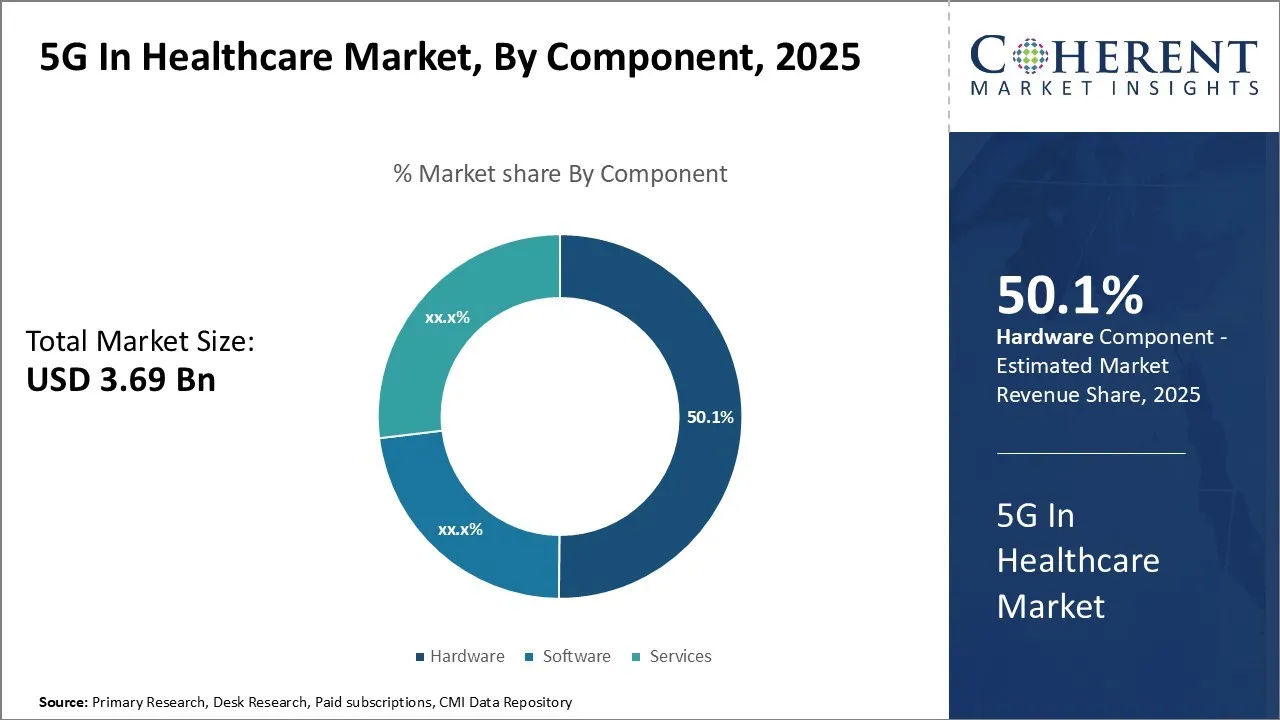
5G In Healthcare Market Insights, by Component - Hardware contributes the highest share of the market owing to its enhancing network performance in healthcare settings
Hardware holds the largest market share of 51.1% in 2026. Rising demand for real-time data transmission, telemedicine, and remote patient monitoring is driving the growth of hardware in the 5G healthcare market. Healthcare providers are deploying advanced hardware such as sensors, routers, and network infrastructure to enable seamless communication between medical devices and systems. The adoption of technologies like robotic surgeries, AI-powered diagnostics, and wearable health devices is also boosting hardware use. Additionally, organizations are investing in digital health infrastructure to ensure reliable, low-latency connectivity across healthcare environments.
In February 2025, Telstra teamed up with Ericsson to launch a cutting-edge programmable 5G Advanced network using Open RAN-ready hardware, AI-driven automation, and advanced software to enhance reliability, performance, and efficiency through self-diagnosing and self-healing capabilities.
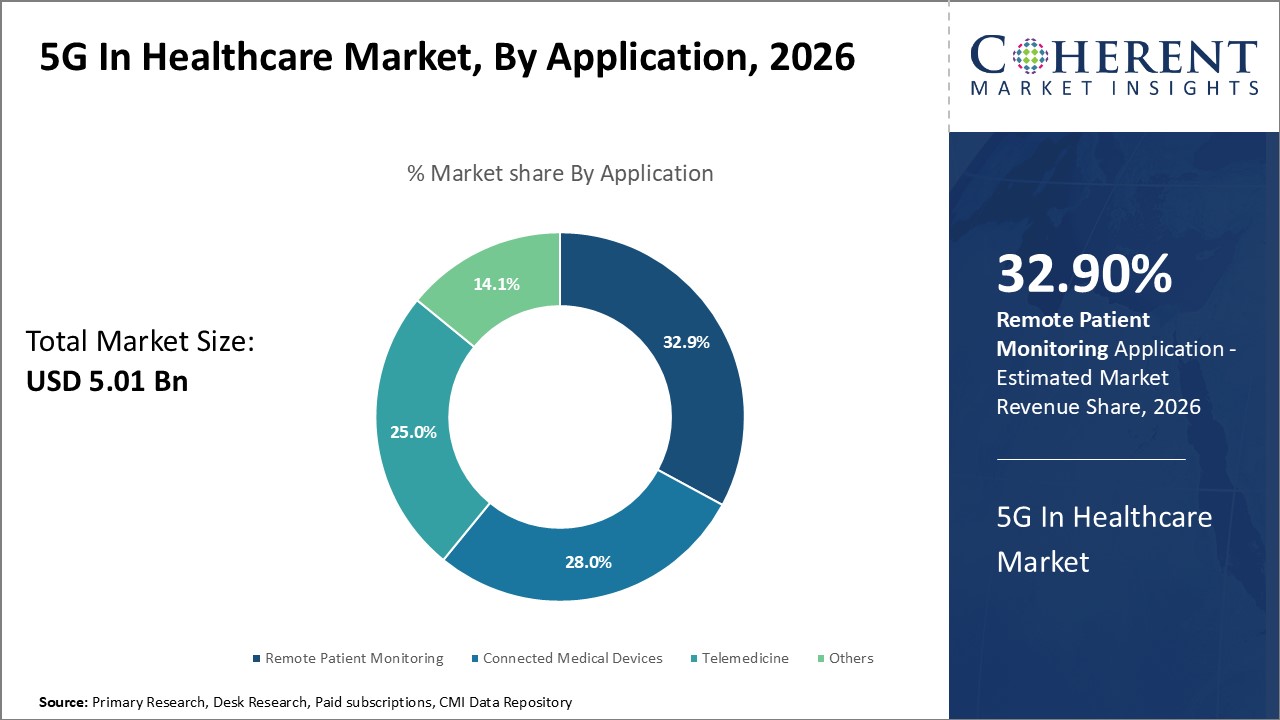
5G In Healthcare Market Insights, by Application - Remote Patient Monitoring contribute the highest share of the market owing to its expansion of IOT and wearable devices
Remote Patient Monitoring expected to hold largest market share of 32.9% in 2026. Healthcare providers are driving the growth of remote patient monitoring in the 5G healthcare market by seeking real-time health data, better chronic disease management, and more efficient home-based care. They use 5G to enable fast, reliable data transmission from wearable devices and sensors, which allows accurate remote monitoring. The healthcare industry is expanding IoT adoption, increasing telehealth services, and prioritizing reduced hospital visits. These efforts actively promote the use of remote monitoring technologies powered by advanced 5G connectivity. Airtel Business and Fortis Healthcare have launched a Smart Clinics solution using Airtel's 5G network to enhance telemedicine in urban and rural areas. The initiative enables real-time consultations, connected medical devices, and secure health data management.
5G In Healthcare Market Insights, by End-User - Healthcare contributes the highest share of the market owing to its government initiatives and investments
Healthcare acquired the prominent market share of 33.4% in 2026. Healthcare providers are driving growth in the 5G market by demanding faster, more efficient medical services and real-time communication with patients. They leverage 5G technology for high-speed data transfer, enabling advanced applications such as telemedicine, robotic surgery, and AI-based diagnostics. Providers are adopting connected devices and remote monitoring tools to enhance patient outcomes and accessibility. Increased investments in digital infrastructure, along with a focus on personalized and preventive care, actively accelerate the integration of 5G into healthcare services. For instance, in July 2025, RED Health, in collaboration with Dr. L.H. Hiranandani Hospital, Powai, launched a 5G-enabled Advanced Life Support (ALS) ambulance service. The new fleet includes state-of-the-art ambulances equipped with advanced medical technology, high-speed 5G connectivity, and highly trained paramedics. This is further propelling the 5G in healthcare market share.
Regional Insights
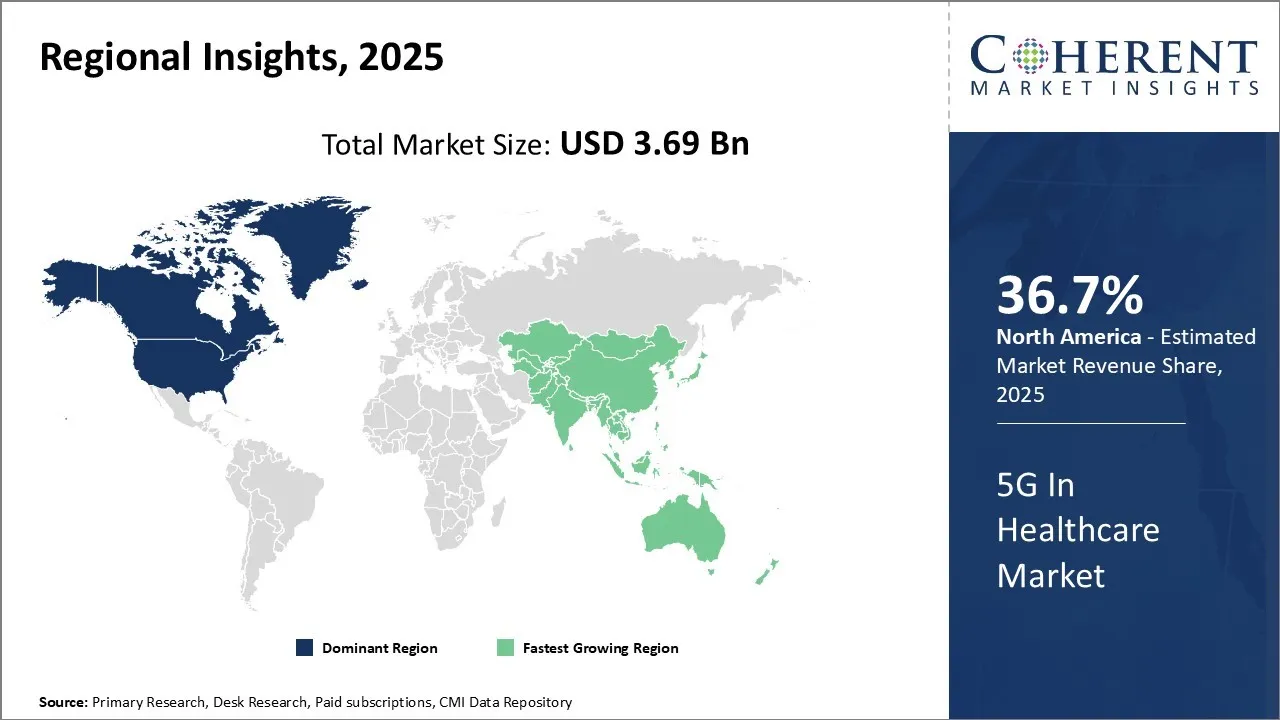
North America 5G In Healthcare Market Trends
North America dominates the overall market with an estimated share of 36.7% in 2026. Healthcare providers in North America are rapidly adopting advanced technologies like telemedicine, remote patient monitoring, and AI-powered diagnostics. They are investing more in 5G infrastructure to improve connectivity and enable real-time data sharing. Medical facilities increasingly use IoT devices and private 5G networks to enhance patient care and boost operational efficiency. Additionally, government initiatives and partnerships between technology companies and healthcare organizations actively drive innovation and speed up the integration of 5G into healthcare services across the region.
Asia Pacific 5G In Healthcare Market Trends
Healthcare providers in the Asia Pacific region are rapidly expanding the 5G healthcare market by investing in digital infrastructure and meeting the rising demand for telehealth services. They adopt 5G-enabled technologies such as remote patient monitoring, AI diagnostics, and wearable devices to enhance patient care, especially in rural areas. Governments actively support this growth through favorable policies and initiatives. Additionally, technology firms and healthcare institutions collaborate increasingly, driving innovation and accelerating the deployment of 5G solutions across various healthcare settings. For instance, in November 2024, Red.Health has partnered with Medanta Hospital, Lucknow, to launch Uttar Pradesh’s first 5G-enabled ambulance, aimed at transforming emergency care with real-time data transfer and specialist support during transit.
United States 5G In Healthcare Market Trends
Healthcare providers in the United States are rapidly advancing the 5G healthcare market by integrating telemedicine, remote patient monitoring, and AI-powered diagnostics. They are strengthening 5G infrastructure to boost connectivity, facilitate real-time data exchange, and enhance patient care. Hospitals increasingly deploy IoT devices and private 5G networks to streamline healthcare operations. Additionally, government initiatives and collaborations between tech firms and medical organizations actively drive innovation, speeding up the implementation of 5G technologies to revolutionize healthcare delivery nationwide.
India 5G In Healthcare Market Trends
Healthcare providers in India are accelerating the growth of the 5G healthcare market by adopting advanced technologies to meet the needs of the country’s large and diverse population. They are leveraging 5G networks to deliver faster and more reliable telemedicine, remote diagnostics, and health monitoring, particularly in rural and underserved areas. Governments and private sectors actively support digital health initiatives through collaborations. Additionally, the increasing use of wearable devices and AI-driven tools is reshaping patient care and driving India toward a more connected and efficient healthcare system. For instance, in May 2024, Apollo Hospital Guwahati has introduced the region’s first comprehensive 5G-connected ambulance, designed to revolutionize emergency care with real-time connectivity and advanced medical support during transit.
5G In Healthcare Market Trends
Expansion of Telemedicine and Remote Care
The 5G network’s high speed and low latency are transforming telemedicine by enabling seamless video consultations and remote diagnostics. Healthcare providers are expanding virtual care services, allowing patients to access medical expertise from home. This trend is especially impactful in rural and underserved regions, where access to specialists is limited. As telehealth gains traction, 5G supports real-time monitoring and interactive communication, enhancing patient engagement and reducing hospital visits.
Integration of IoT and Wearable Devices
The rise of Internet of Medical Things (IoMT) and wearable health devices is accelerating with 5G adoption. These devices continuously collect vital health data and transmit it instantly over 5G networks, allowing healthcare professionals to monitor patients’ conditions remotely and intervene proactively. The trend fosters personalized healthcare by supporting chronic disease management, fitness tracking, and early detection of health issues, ultimately improving overall patient outcomes through continuous, connected care.
Market Report Scope
5G In Healthcare Market Report Coverage
| Report Coverage | Details | ||
|---|---|---|---|
| Base Year: | 2025 | Market Size in 2026: | USD 5.01 Bn |
| Historical Data for: | 2020 To 2024 | Forecast Period: | 2026 To 2033 |
| Forecast Period 2026 to 2033 CAGR: | 35.7% | 2033 Value Projection: | USD 42.43 Bn |
| Geographies covered: |
| ||
| Segments covered: |
| ||
| Companies covered: | Ericsson, Telit, Verizon, Cisco, Orange S.A., Tata Elxsi, NEC Corporation, AT&T Inc., Fibocom Wireless Inc., BT Group, Huawei Technologies Co., Ltd., SK Telecom Co., Ltd., GE Healthcare | ||
| Growth Drivers: |
| ||
| Restraints & Challenges: |
| ||
5G In Healthcare Market News
- In September 2024, True Corp, through its business unit, collaborated with Intel to launch seven smart healthcare solutions that use 5G and AI to enhance diagnosis, treatment, rehabilitation, and patient data management across hospitals and healthcare agencies in Thailand.
- In September 2024, Tata Elxsi, a global design and technology services company, launched its 5G applications lab 'xG-Force' in Bengaluru to drive innovation and speed up digital transformation in sectors like transportation, healthcare, Industry 4.0, and media.
Analyst Opinion (Expert Opinion)
- The integration of 5G technology in healthcare is not just an incremental upgrade—it represents a paradigm shift that will fundamentally transform patient care and healthcare delivery. The ultra-low latency and massive bandwidth capabilities of 5G are already proving critical in scenarios where milliseconds matter. For example, in remote robotic surgeries, platforms like the one developed by Medtronic rely on near-instantaneous data transmission to perform delicate procedures from thousands of miles away. This is no longer futuristic; it’s happening now, with pilot projects showing latency reductions from over 100 milliseconds on 4G to under 10 milliseconds with 5G.
- Furthermore, the explosion of IoT medical devices—projected to exceed 50 billion globally by 2030—demands a network infrastructure capable of handling unprecedented data volumes in real-time. Without 5G, the sheer data throughput and reliability required to manage continuous streams from wearable monitors or implantable sensors would overwhelm existing systems, compromising patient safety. A case in point is the Mayo Clinic’s deployment of 5G to enable real-time monitoring of cardiac patients via connected devices, which has significantly reduced hospital readmissions.
- However, the transformative potential of 5G in healthcare hinges on more than just technology—it requires overcoming entrenched challenges such as regulatory barriers, cybersecurity risks, and integration complexities within legacy hospital IT systems. The recent Cybersecurity and Infrastructure Security Agency (CISA) warnings about healthcare ransomware attacks underscore the critical need for 5G networks to embed robust security protocols from the outset.
Speak to the analyst
Want personalized insights?
Take the findings above to one of our principal consultants, or have the report rebuilt around the segments, geographies and competitors you actually track.
Market Segmentation
- Component Insights (Revenue, USD Bn, 2021 - 2033)
- Hardware
- Software
- Services
- Application Insights (Revenue, USD Bn, 2021 - 2033)
- Remote Patient Monitoring
- Connected Medical Devices
- Telemedicine
- Others
- End User Insights (Revenue, USD Bn, 2021 - 2033)
- Healthcare Providers
- Healthcare Payers
- Regional Insights (Revenue, USD Bn, 2021 - 2033)
- North America
- U.S.
- Canada
- Latin America
- Brazil
- Argentina
- Mexico
- Rest of Latin America
- Europe
- Germany
- U.K.
- Spain
- France
- Italy
- Russia
- Rest of Europe
- Asia Pacific
- China
- India
- Japan
- Australia
- South Korea
- ASEAN
- Rest of Asia Pacific
- Middle East
- GCC
- Israel
- Rest of Middle East
- Africa
- South Africa
- North Africa
- Central Africa
- Key Players Insights
- Ericsson
- Telit
- Verizon
- Cisco
- Orange S.A.
- Tata Elxsi
- NEC Corporation
- AT&T Inc.
- Fibocom Wireless Inc.
- BT Group
- Huawei Technologies Co., Ltd.
- SK Telecom Co., Ltd.
- GE Healthcare
Sources
Primary Research interviews
- Healthcare IT professionals
- Telemedicine service providers
- Medical device manufacturers
- Network infrastructure engineers
- Hospital administrators
Databases
- PubMed
- IEEE Xplore
- National Institutes of Health (NIH) database
- ClinicalTrials.gov
- FDA Medical Device Databases
Magazines
- Healthcare IT News
- Telemedicine Magazine
- MedTech Innovation
- HealthTech Magazine
- Network World
Journals
- Journal of Medical Internet Research
- IEEE Journal of Biomedical and Health Informatics
- Telemedicine and e-Health
- Journal of Healthcare Engineering
- International Journal of Medical Informatics
Newspapers
- The Wall Street Journal – Health Section
- The New York Times – Health & Technology
- The Guardian – Healthcare Technology
- Financial Times – Healthcare Sector
- Reuters Health News
Associations
- American Telemedicine Association (ATA)
- Healthcare Information and Management Systems Society (HIMSS)
- Institute of Electrical and Electronics Engineers (IEEE)
- International Society for Telemedicine & eHealth (ISfTeH)
- World Health Organization (WHO)
Public Domain sources
- U.S. Department of Health and Human Services (HHS) reports
- World Health Organization (WHO) publications
- Government health department websites
- Open data from health ministry’s globally
- Publicly available patent databases
Proprietary Elements
- CMI Data Analytics Tool, and Proprietary CMI Existing Repository of information for last 8 years
Get access to 250+ pages report
Every segment, forecast, competitor profile and data table behind the analysis above — available for instant download.
- ESOMAR Member
- ISO 9001:2015 Certified
- D-U-N-S Registered
- GDPR & CCPA Compliant
Missing comfort of reading report in your local language? Find your preferred language:
Transform your Strategy with Exclusive Trending Reports
Frequently Asked Questions
The 5G In Healthcare Market is estimated to be valued at USD 5.01 Bn in 2026, and is expected to reach USD 42.43 Bn by 2033.
The CAGR of the 5G In Healthcare Market is projected to be 35.7% from 2026 to 2033.
Growing applications of telehealth and telemedicine and integration of healthcare LoT and medical devices are the major factors driving the growth of global 5G in healthcare market.
Lack of established 5G infrastructure and interoperability issues between different products and applications are the major factors hampering the growth of global 5G in healthcare market.
In terms of component, hardware segment is estimated to dominate the market in 2026.
Ericsson, Telit, Verizon, Cisco, Orange S.A., Tata Elxsi, NEC Corporation, AT&T Inc., Fibocom Wireless Inc., BT Group, Huawei Technologies Co., Ltd., SK Telecom Co., Ltd., GE Healthcare are the major players.
North America is expected to lead the global 5G in healthcare market over the forecast period.