

Global AI Chips Market Size and Forecast – 2026-2033
The Global AI Chips Market is estimated to be valued at USD 107.01 Bn in 2026 and is expected to reach USD 592.61 Bn by 2033, exhibiting a compound annual growth rate (CAGR) of 27.7% from 2026 to 2033.
Key Takeaways of the Global AI Chips Market
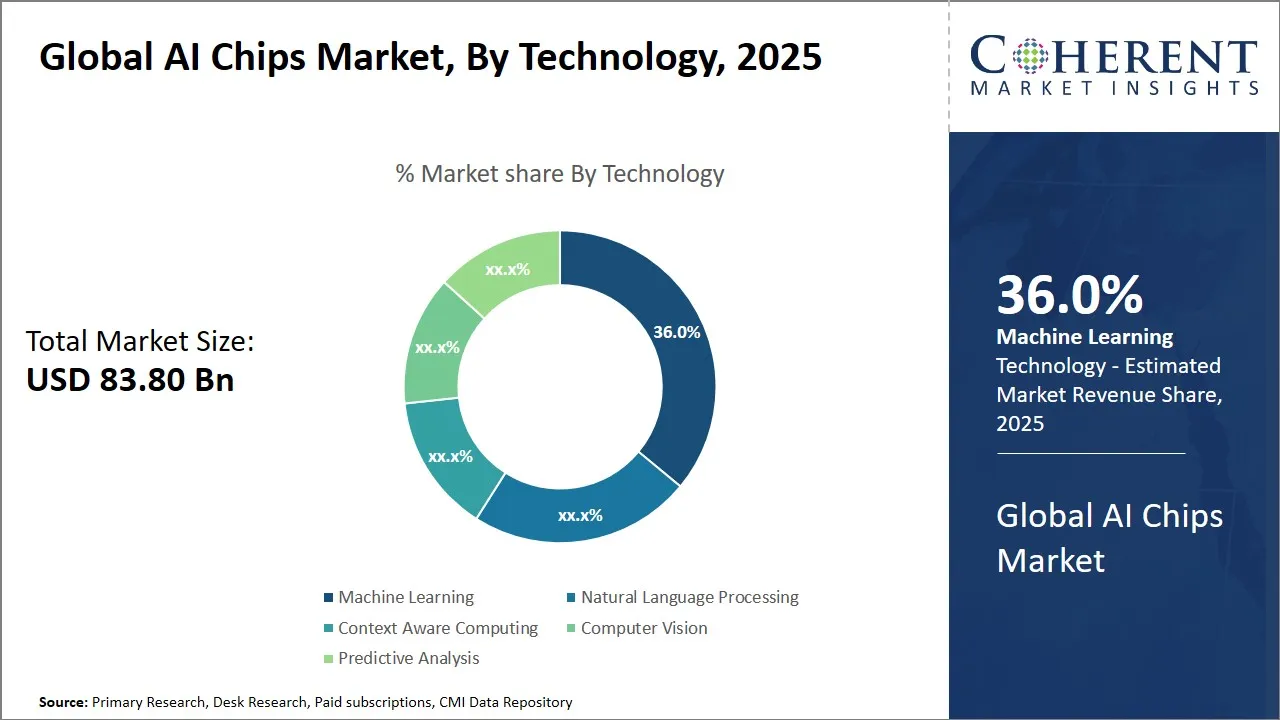
- The machine learning segment leads the market holding an estimated share of 37% in 2026.
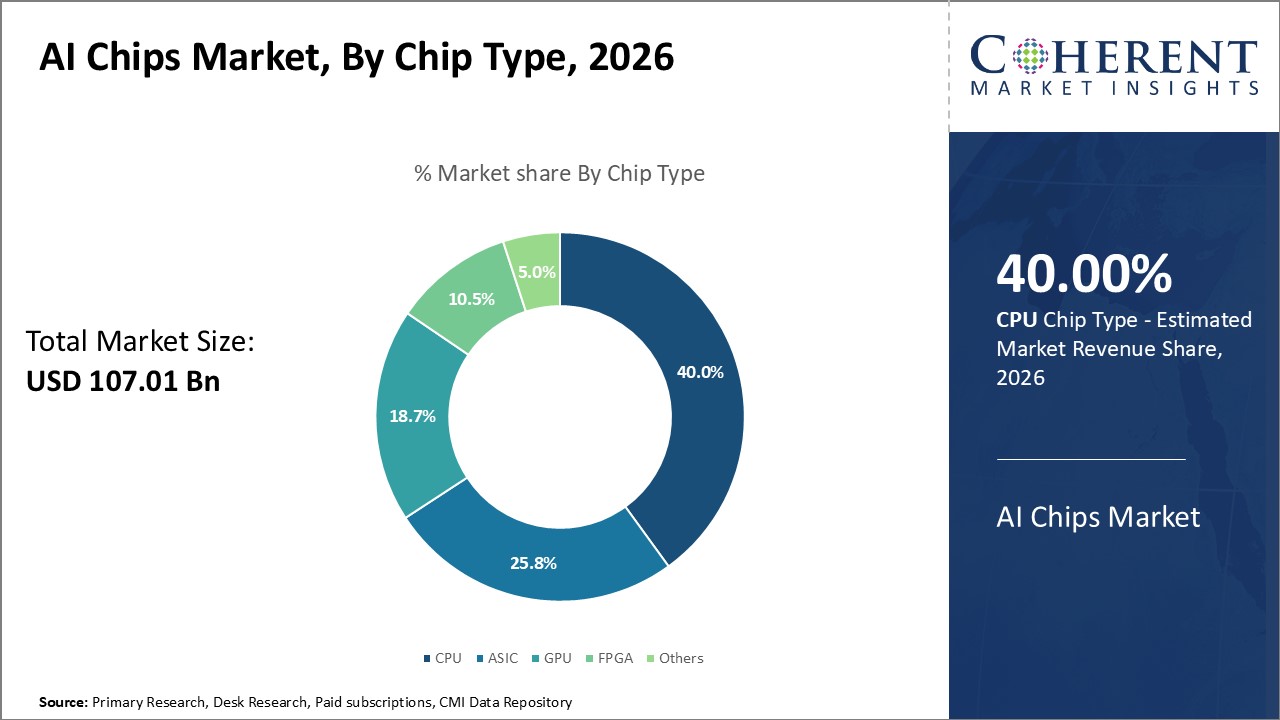
- The CPU segment is projected to dominate with a share of 40% in 2026.
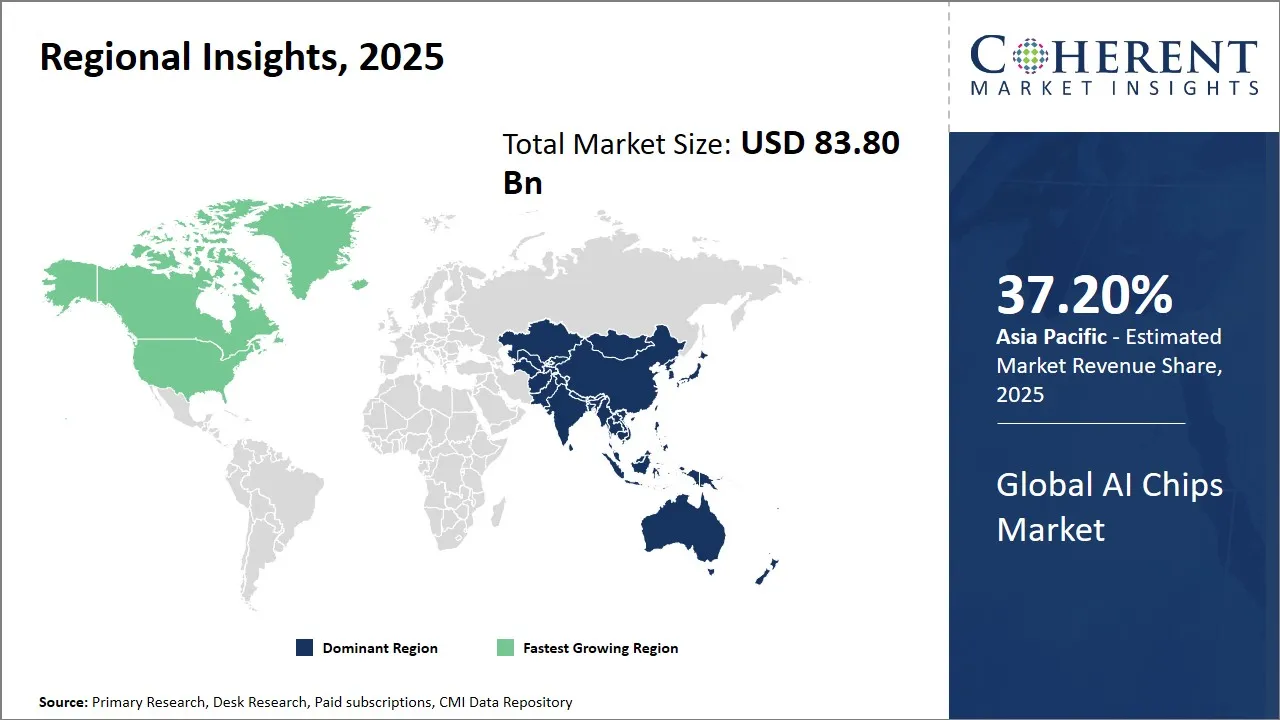
- Asia Pacific is estimated to lead the market with a share of 37. 2% in 2026.
- North America, holding a share of 27.7 % in 2026, is projected to be the fastest growing region.
Market Overview
The market is seeing a huge expansion in AI chip applications, particularly in autonomous vehicles, smart devices, and data centers. There is a lot of demand for specialized AI accelerators such as GPUs, TPUs, and neuromorphic chips that optimize machine learning tasks. Additionally, key players are investing heavily in research and development to deliver energy-efficient and cost-effective AI chips, further fueling market growth and enabling edge computing solutions that reduce latency and enhance real-time data processing.
Current Events and Its Impact
Current Events | Description and its impact |
Geopolitical Tensions and Trade Restrictions |
|
Technological Advancements and Innovation |
|
Segmental Insights
- Current Industry Events of 2026
- Market Size Estimation
- Regional Breakdown
- Competitive Landscape
- Customer Intelligence
- Segmental Analysis
- Pricing Analysis
- Key Market Drivers, Challenges & Future Trends
- Customized Insights Section
Global AI Chips Market Insights, by Technology - Machine Learning Leads Owing to its Wide-ranging Applications and Continuous Advancements
Machine Learning holds a dominant position, holding an estimated share of 37.0% in 2026. The technology enables computers to learn from data patterns and improve over time without explicit programming, making it the backbone of many AI-driven innovations. The widespread adoption of ML in sectors such as healthcare, automotive, finance, and retail acts as a significant growth driver for AI chips optimized for ML tasks.
One of the main contributors to the prominence of ML within the AI chips domain is the increasing complexity and volume of data generated in today's digital world. As organizations collect vast data sets, traditional computing systems struggle to analyze them efficiently. AI chips designed for ML provide the necessary computational power and speed to process large-scale datasets, enabling faster model training and real-time inference. These capabilities are critical for applications such as personalized recommendations, fraud detection, and medical diagnosis.
Moreover, advancements in ML algorithms have fueled the demand for specialized AI chips that can handle diverse workloads ranging from supervised learning to deep reinforcement learning. ML’s flexibility in solving complex problems, including image recognition, speech processing, and dynamic resource allocation, necessitates high-performing hardware platforms capable of parallel processing and energy efficiency. AI chip manufacturers are increasingly focusing on designing hardware that supports these requirements, further propelling the uptake of ML-centric chips.
Global AI Chips Market Insights, by Chip Type - CPU Leads Due to its Versatility and Established Infrastructure
The Central Processing Units (CPUs) segment is expected to continue to maintain the largest share of 40.0% in the AI chips market in 2026 by chip type, largely because of their versatile architecture and entrenched presence in computing environments. One key factor driving CPU dominance is their ability to efficiently support a broad spectrum of AI workloads, including both traditional and emerging algorithms. While specialized AI chips like GPUs and ASICs excel in certain operations, CPUs offer compatibility with a wide variety of software environments and flexible programmability. This makes them particularly attractive to developers and enterprises seeking to deploy AI solutions without heavily modifying existing infrastructure.
Moreover, the continuous evolution of CPU design has led to incorporating AI-specific instructions and extensions, enabling better performance in AI inference and training tasks. Manufacturers have introduced features such as vector processing units and optimized parallel execution capabilities, which enhance CPUs’ ability to handle machine learning workloads effectively. This convergence of traditional computing power with AI acceleration further cements CPUs’ relevance in the AI chips landscape.
The widespread availability of CPUs, along with their established manufacturing ecosystem, also supports their market leadership. Unlike specialized AI chips that may require unique fabrication processes, CPUs benefit from mature supply chains and economies of scale. This reduces the cost barriers for organizations adopting AI technologies, making CPUs a preferred starting point for many AI implementations. Additionally, enterprises often deploy CPUs in hybrid AI computing environments where they coordinate with other co-processors like GPUs and FPGAs.
End User Feedback and Unmet Needs in the AI Chips Market
- Users appreciate the high performance of GPUs and ASICs, especially in training large AI models. However, there's a rising demand for better energy efficiency, particularly for edge devices and on-device inference.
- Many enterprises highlight difficulties with software optimization for new chip architectures (e.g., AMD MI300, Intel Gaudi, custom ASICs).
- There is a need for robust SDKs, APIs, and ML frameworks optimized for non-NVIDIA hardware. Industries like automotive, robotics, and healthcare demand ultra-low latency AI chips, which current cloud-based solutions struggle to deliver.
- Startups and mid-sized firms express concern about the high cost of AI chips, particularly high-end GPUs and customized ASICs.
- Enterprises seek chips that support scalable deployment across edge-to-cloud ecosystems, with flexibility to support various AI models. There's a gap in low-power AI chips that can handle inference at the edge without requiring active cooling or cloud support.
Regional Insights
Asia Pacific AI Chips Market Analysis and Trends
Asia Pacific, holding a share of 37.2%, is expected to dominate the global AI chips market due to escalating demand across consumer electronics, automotive, telecommunication, and industrial sectors. Countries like China, South Korea, and Taiwan have prioritized AI chip development through aggressive government initiatives, fostering domestic innovation and reducing reliance on foreign technology.
The region boasts an expansive semiconductor manufacturing base, with companies such as Huawei’s HiSilicon, Samsung Electronics, and Taiwan Semiconductor Manufacturing Company (TSMC) leading advancements in AI chip design and fabrication. Trade dynamics, including efforts to strengthen supply chain resilience and localize chip production, also play a key role in driving growth.
North America AI Chips Market Analysis and Trends
North America, holding a share of 27.7% in 2026, is expected to exhibit the fastest growth in the AI chips market driven by a robust technology ecosystem, a mature semiconductor industry, and significant investments in artificial intelligence research and development. The presence of leading technology companies like NVIDIA, Intel, and AMD shapes the market landscape, pushing innovations in AI chip architectures and accelerating commercialization.
Government policies, including substantial funding for AI initiatives and defense-related applications, further propel market growth. Additionally, North America's well-established supply chain and advanced manufacturing infrastructure enable rapid prototyping and production of cutting-edge AI chips. The region also benefits from extensive collaboration among academia, startups, and industry leaders, creating a fertile environment for AI chip advancements.
Global AI Chips Market Outlook for Key Countries
U.S. AI Chips Market Analysis and Trends
The U.S. AI chips market is steered by dominant players including NVIDIA, Intel, and Qualcomm, focusing heavily on high-performance AI accelerators for data centers and edge devices. U.S. companies benefit from a strong innovation culture and vast venture capital presence, enabling rapid advancements in GPU and ASIC technologies tailored for AI workloads. Government programs, such as increased funding under national AI strategies, provide additional momentum for research. The country’s semiconductor foundries and design services create a synergistic ecosystem that bolsters both startups and established firms in AI chip development.
China AI Chips Market Analysis and Trends
China AI chips market is rapidly evolving, with significant government support through policies like “Made in China 2026” and multiple AI-focused Five-Year Plans. Domestic companies including Huawei HiSilicon, Cambricon Technologies, and Horizon Robotics are pushing forward with sophisticated AI chip designs aimed at local markets and global competitiveness. China’s large-scale adoption of AI in surveillance, autonomous vehicles, and smart cities generates strong demand. Investments in semiconductor fabrication facilities and efforts to enhance indigenous technology capabilities drive the acceleration of China’s AI chip ecosystem. Trade restrictions have motivated a strategic shift toward self-reliance, further energizing local innovation.
South Korea AI Chips Market Analysis and Trends
South Korea AI chips market benefits from the strong presence of Samsung Electronics and SK Hynix, both of which have extensive capabilities in semiconductor manufacturing and memory technologies critical for AI platforms. The country’s strong ICT infrastructure and government-led R&D investments support the development of AI chips optimized for consumer electronics, mobile devices, and automotive applications. South Korea’s integration of AI technologies into its manufacturing and telecommunications sectors underscores the strategic importance of AI chips. Collaborations between domestic technology giants and global players strengthen its position in the overall market.
Taiwan AI Chips Market Analysis and Trends
Taiwan continues to lead as a semiconductor manufacturing powerhouse, central to the global supply chain for AI chips. Taiwan Semiconductor Manufacturing Company (TSMC) plays a pivotal role in manufacturing cutting-edge AI processors for top global customers, driving innovation through advanced process technologies. The country’s ecosystem benefits from a unique alignment of foundries, design houses, and research institutions, providing comprehensive support for AI chip companies worldwide. Taiwan’s capacity to deliver high-volume, precision manufacturing attracts major AI chip developers seeking reliable fabrication partners.
Germany AI Chips Market Analysis and Trends
Germany AI chips market is shaped by its strong industrial base, particularly in automotive and manufacturing sectors, which are rapidly incorporating AI-driven solutions. Local companies, along with European partnerships such as Infineon Technologies and Bosch, focus on AI chips that enhance automation, autonomous driving, and Industry 4.0 applications. Government initiatives supporting AI research, alongside the European Union’s push for digital sovereignty, foster innovation in AI hardware. The well-established engineering ecosystem and emphasis on precision technology play significant roles in market growth for AI chips.
Market Players, Key Development, and Competitive Intelligence
Key Developments
- On July 8, 2025, GlobalFoundries (GF) announced a definitive agreement to acquire MIPS, a supplier of AI and processor IP. This strategic acquisition will expand GF’s portfolio of customizable IP offerings, allowing it to further differentiate its process technologies with IP and software capabilities.
- In June 2025, AMD delivered its comprehensive, end-to-end integrated AI platform vision and introduced its open, scalable rack-scale AI infrastructure built on industry standards at its 2025 Advancing AI event.
- In March 2025, Quest Global, a global product engineering services company, signed a Memorandum of Cooperation with Rapidus Corporation, a Japan-based manufacturer of advanced 2-nanometer (nm) semiconductor solutions. With this partnership, Quest Global is positioned to better serve Rapidus and its customers as a design partner, providing its expansive and deep expertise in advanced 2nm chip design.
- In March 2025, AMD acquired ZT Systems, a provider of AI and general-purpose compute infrastructure for the world’s largest hyperscale providers. The acquisition will enable a new class of end-to-end AI solutions based on the combination of AMD CPU, GPU and networking silicon, open-source AMD ROCm software and rack-scale systems capabilities.
Top Strategies Followed by AI Chips Market Players
- Established industry giants dominate through substantial investments in research and development (R&D), aiming to push the boundaries of performance and efficiency in AI chip technology. These players constantly innovate to deliver high-performance products that meet the demanding requirements of advanced AI applications such as machine learning, natural language processing, and autonomous systems.
- In 2024, Nvidia launched its Blackwell GPU architecture (B200) with over USD 10 billion R&D backing, targeting trillion-parameter AI models and hyperscale deployments.
- Mid-level players in the AI chips market adopt strategies centered on balancing quality with affordability, targeting price-sensitive segments that seek effective yet budget-conscious solutions. These companies focus on delivering cost-effective AI chip offerings that provide acceptable performance levels for applications that do not require bleeding-edge technology.
- Tenstorrent offers RISC-V–based AI chips that are more affordable and license-friendly.
- Small-scale players in the AI chips sphere tend to focus on niche markets or innovative product features to differentiate themselves from more established competitors. Their agility allows them to adopt cutting-edge technologies quickly, such as specialized neural network processors or energy-efficient architectures tailored for specific applications, thereby maintaining a competitive edge.
- Mythic focuses on analog AI processors optimized for low-power edge devices, such as smart cameras and wearables. The company offers Mythic M1076 AMP, an analog matrix processor that integrates AI inference directly into edge hardware, drastically reducing energy and latency.
Market Report Scope
AI Chips Market Report Coverage
| Report Coverage | Details | ||
|---|---|---|---|
| Base Year: | 2025 | Market Size in 2026: | USD 107.01 Bn |
| Historical Data for: | 2020 To 2024 | Forecast Period: | 2026 To 2033 |
| Forecast Period 2026 to 2033 CAGR: | 27.7% | 2033 Value Projection: | USD 592.61 Bn |
| Geographies covered: |
| ||
| Segments covered: |
| ||
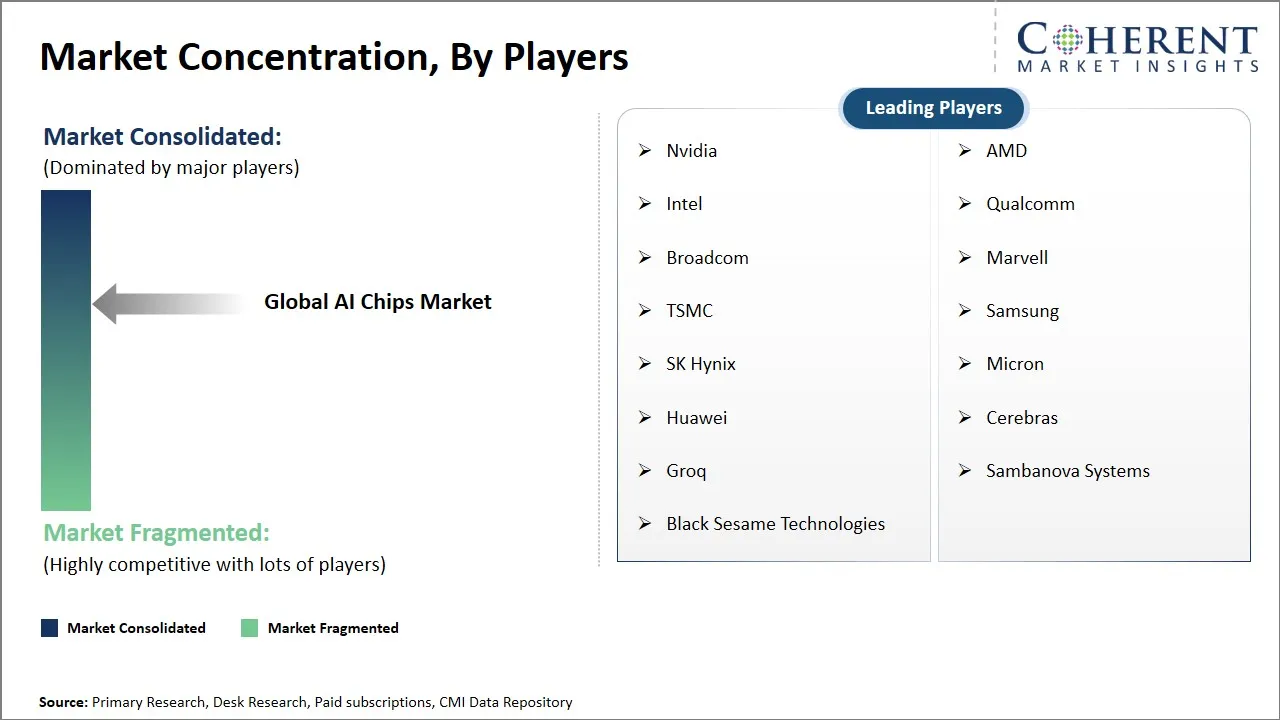
| Companies covered: | Nvidia, AMD, Intel, Qualcomm, Broadcom, Marvell, TSMC, Samsung, SK Hynix, Micron , Huawei, Cerebras, Groq, Sambanova Systems, and Black Sesame Technologies | ||
| Growth Drivers: |
| ||
| Restraints & Challenges: |
| ||
Market Dynamics
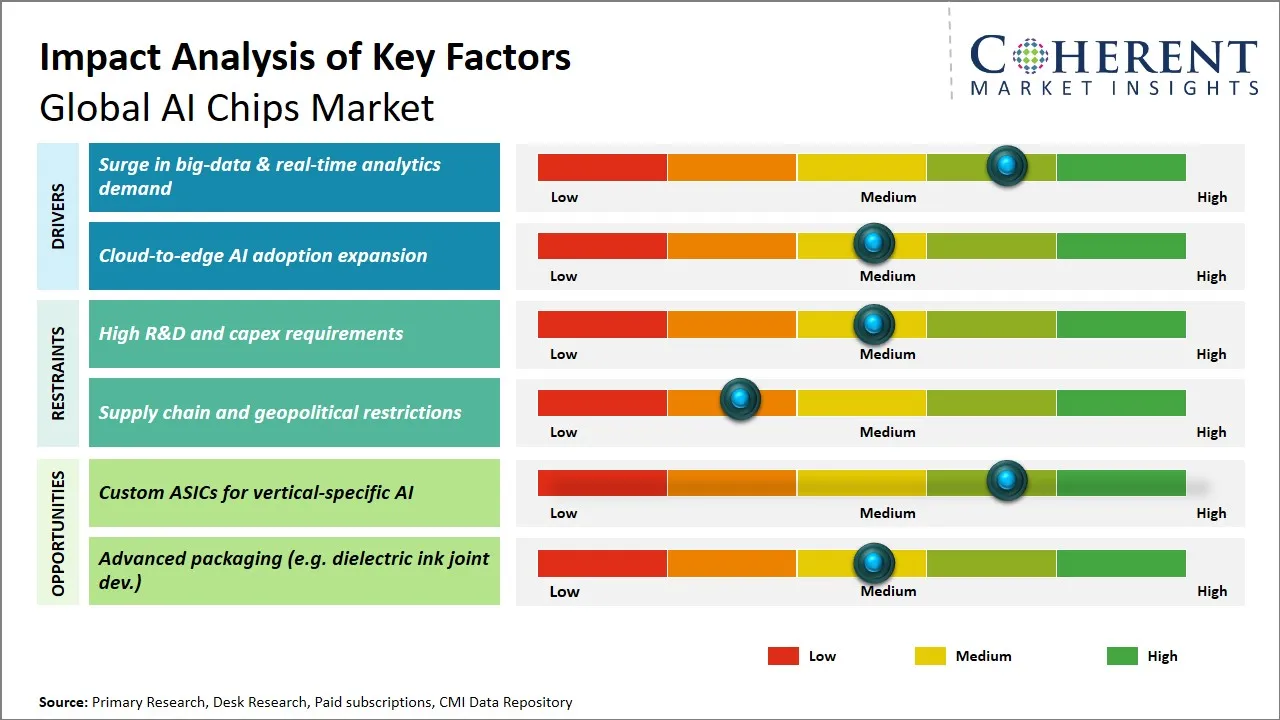
Global AI Chips Market Driver – Surge in Big ‑ data & Real ‑ time Analytics Demand
Organizations are increasingly leveraging big-data technologies and real-time analytics to gain actionable insights, improve decision-making, and enhance customer experiences. The need to process vast datasets with minimal latency has placed considerable pressure on traditional computing infrastructure, leading to the adoption of specialized AI chips capable of handling complex computations efficiently. These chips are specifically designed to support high-throughput data processing and enable rapid inferencing, which is critical for applications such as autonomous vehicles, financial trading algorithms, smart cities, and personalized healthcare.
For instance, Intel has partnered with Accenture and Prettech, a China-based industrial automation firm, to implement AI-driven real-time analytics in food processing plants using Intel AI chips. As enterprises and cloud service providers seek to optimize data workloads and enhance performance while reducing energy consumption, AI chips have emerged as a crucial component in meeting these demands.
Global AI Chips Market Opportunity – Custom ASICs for Vertical-Specific AI Applications
Unlike general-purpose AI chips, custom ASICs are designed to optimize performance for specific AI workloads by addressing unique requirements such as low latency, enhanced power efficiency, and specialized compute capabilities. Industries such as automotive, healthcare, finance, and manufacturing are increasingly adopting AI-driven technologies that necessitate highly specialized hardware to process domain-specific algorithms efficiently. For example, autonomous vehicles require AI chips optimized for real-time sensor fusion and decision-making, while healthcare applications demand chips with accelerated processing for medical imaging and diagnostics. Custom ASICs enable companies to unlock superior performance and cost advantages compared to off-the-shelf solutions, fueling innovation in edge computing and embedded AI devices.
For instance, Google has designed custom ASICs (TPUs) optimized for TensorFlow-based machine learning in its cloud. Moreover, as AI models become more complex, the constraints of general AI chips in terms of energy consumption and processing speed further drive the need for bespoke silicon solutions. Leading semiconductor firms and startups are investing heavily in developing proprietary ASICs tailored to these niche applications, signaling robust market demand.
Analyst Opinion (Expert Opinion)
- The future of AI chips lies in hybrid designs that combine CPUs, GPUs, and AI accelerators (like TPUs and NPUs) on a single die or package. This trend enables workload-specific optimization, drastically improving efficiency in generative AI, edge inference, and high-throughput training.
- Demand for real-time AI at the edge is pushing innovation toward analog compute-in-memory, neuromorphic chips, and RISC-V–based AI cores. These breakthroughs aim to deliver data-localized intelligence with minimal energy and latency, crucial for robotics, AR/VR, and smart wearables.
- As Moore’s Law slows, chipmakers are shifting to 2.5D/3D chip stacking, chiplet architectures, and die-to-die interconnects to scale AI performance. Players like AMD, Intel, and TSMC are leading in packaging innovation, making it a decisive factor in next-gen AI compute supremacy.
Speak to the analyst
Want personalized insights?
Take the findings above to one of our principal consultants, or have the report rebuilt around the segments, geographies and competitors you actually track.
Market Segmentation
- Technology Insights (Revenue, USD Bn, 2021 - 2033)
- Machine Learning
- Natural Language Processing
- Context Aware Computing
- Computer Vision
- Predictive Analysis
- Chip Type Insights (Revenue, USD Bn, 2021 - 2033)
- CPU
- ASIC
- GPU
- FPGA
- Others
- Regional Insights (Revenue, USD Bn, 2021 - 2033)
- North America
- U.S.
- Canada
- Latin America
- Brazil
- Argentina
- Mexico
- Rest of Latin America
- Europe
- Germany
- U.K.
- Spain
- France
- Italy
- Russia
- Rest of Europe
- Asia Pacific
- China
- India
- Japan
- Australia
- South Korea
- ASEAN
- Rest of Asia Pacific
- Middle East
- GCC Countries
- Israel
- Rest of Middle East
- Africa
- South Africa
- North Africa
- Central Africa
- North America
- Key Players Insights
- Nvidia
- AMD
- Intel
- Qualcomm
- Broadcom
- Marvell
- TSMC
- Samsung
- SK Hynix
- Micron
- Huawei
- Cerebras
- Groq
- Sambanova Systems
- Black Sesame Technologies
Sources
Primary Research Interviews
Stakeholders
- Semiconductor Manufacturers (e.g., Chip Architects, R&D Heads, Foundry Managers)
- AI Hardware Startups and Mid-Tier Chip Designers
- Cloud Service Providers and Data Center Operators (e.g., Infrastructure Leads, AI Infrastructure Engineers)
- Automotive OEMs & Tier-1 Suppliers (for AI-enabled ADAS systems)
- Edge Device Manufacturers (e.g., Smart Camera, Wearables, Industrial IoT Device Producers)
- Academic Researchers Specializing in Neuromorphic and Quantum AI Chips
Databases
- Asia Semiconductor Technology Consortium
- U.S. Bureau of Semiconductor Innovation
- AI Hardware Benchmarks Database (AI-HBD)
- World Semiconductor Trade Statistics (WSTS)
- Pacific Tech Manufacturing Index
Magazines
- AI Hardware Weekly
- Next-Gen Semiconductor Digest
- ChipScale Review
- Future Computing Insights
- Electronic Design Innovation Monthly
Journals
- Journal of AI Hardware and Systems
- Advanced Computing & Semiconductor Materials Journal
- Journal of Neuromorphic Engineering
- AI Edge Computing Research Quarterly
- Nano-Electronics and Intelligent Systems Journal
Newspapers
- The Silicon Valley Herald
- Tech Times Asia
- Chip Innovation Daily
- The Embedded Systems Tribune
- North America Semiconductor News (NASN)
Associations
- Global Alliance for AI Hardware (GAAIH)
- Semiconductor Research Council (SRC)
- AI Processor Innovation Forum (APIF)
- International Society for Edge AI Computing
- The RISC-V Industry Consortium
Public Domain Sources
- U.S. Department of Commerce – Semiconductor Industry Reports
- EUROSTAT
- World Intellectual Property Organization (WIPO)
- United Nations Centre for Trade Facilitation and Electronic Business (UN/CEFACT)
- OpenAI Research Index
Proprietary Elements
- CMI Data Analytics Tool, Proprietary CMI Existing Repository of Information for the Last 8 Years
Get access to 250+ pages report
Every segment, forecast, competitor profile and data table behind the analysis above — available for instant download.
- ESOMAR Member
- ISO 9001:2015 Certified
- D-U-N-S Registered
- GDPR & CCPA Compliant
Missing comfort of reading report in your local language? Find your preferred language:
Transform your Strategy with Exclusive Trending Reports
Frequently Asked Questions
The global AI chips market is estimated to be valued at USD 107.01 billion in 2026 and is expected to reach USD 592.61 billion by 2033.
The CAGR of the global AI chips market is projected to be 27.7% from 2026 to 2033.
Surge in big‑data & real‑time analytics demand and cloud-to-edge AI adoption expansion are the major factors driving the growth of the global AI chips market.
High R&D and capex requirements and supply chain and geopolitical restrictions are the major factors hampering the growth of the global AI chips market.
In terms of technology, machine learning is estimated to dominate the market revenue share in 2026.
Nvidia, AMD, Intel, Qualcomm, Broadcom, Marvell, TSMC, Samsung, SK Hynix, Micron, Huawei, Cerebras, Groq, Sambanova Systems, and Black Sesame Technologies are the major players.
Asia Pacific is expected to lead the global AI chips market in 2026.