

Global AI Infrastructure Market Size and Forecast – 2026-2033
Coherent Market Insights estimates that the global AI infrastructure market is expected to reach USD 90 Bn in 2026 and will expand to USD 465 Bn by 2033, registering a CAGR of 24% between 2026 and 2033.
Key Takeaways of the AI Infrastructure Market
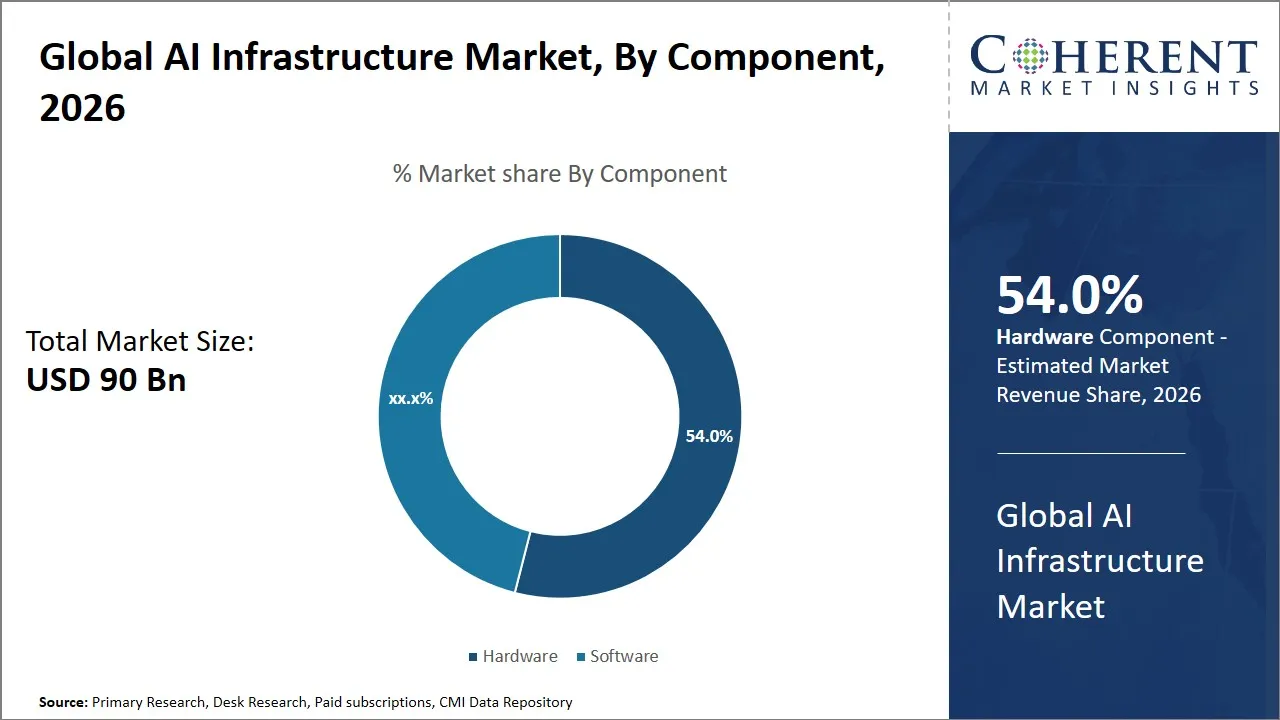
- The hardware segment is expected to account for 54% of the AI infrastructure market share in 2026.
- The on premise segment is estimated to capture 46% of the market share in 2026.
- The enterprises segment is projected to hold 48% share in 2026.
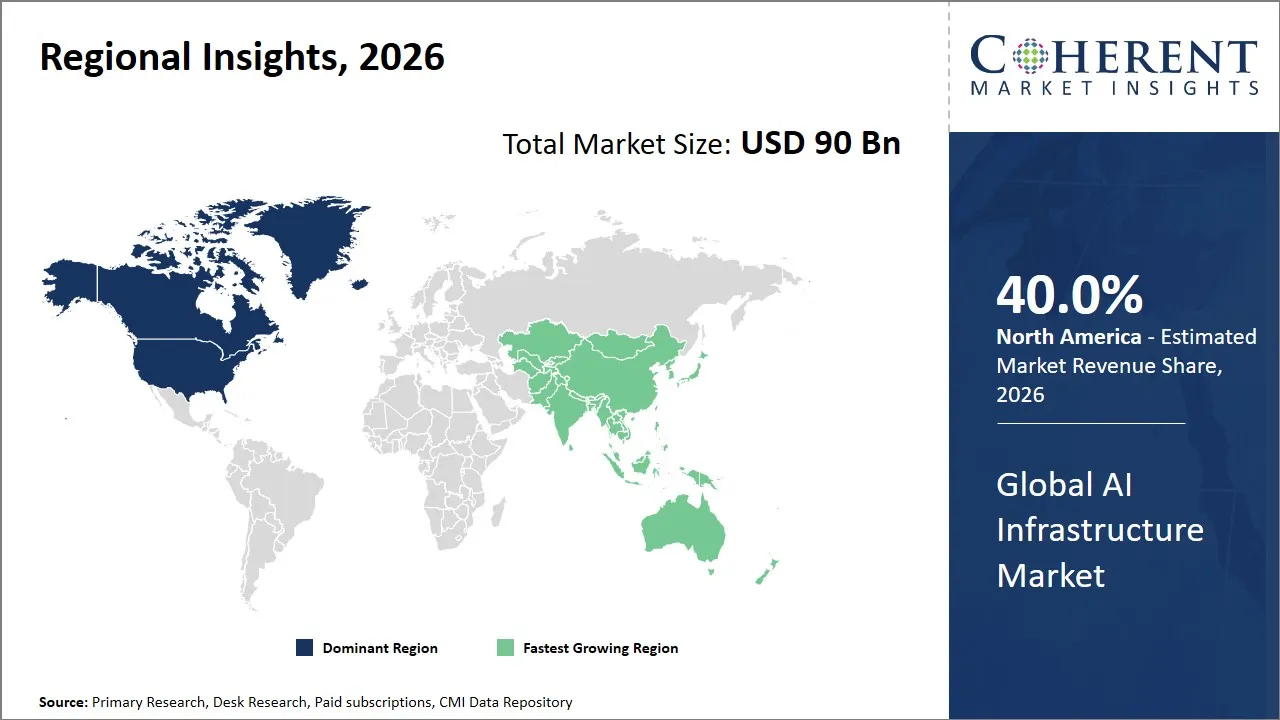
- North America will dominate the AI infrastructure market in 2026 with an estimated 40% share.
- Asia Pacific will hold 22% share in 2026 and is expected to record the fastest growth over the forecast period.
Current Events and Its Impact
Current Events | Description and their Impact |
New AI agent startup funding |
|
Product/Platform Launch |
|
Segmental Insights
- Current Industry Events of 2026
- Market Size Estimation
- Regional Breakdown
- Competitive Landscape
- Customer Intelligence
- Segmental Analysis
- Pricing Analysis
- Key Market Drivers, Challenges & Future Trends
- Customized Insights Section
Why Does the Hardware Segment Dominate the Global AI Infrastructure Market in 2026?
The hardware segment is expected to account for 54.0% of the global AI infrastructure market share in 2026. Growth ties closely to its function in supporting strong AI calculations. Because AI requires significant processing strength, handling large data volumes becomes possible. Complex algorithm execution relies on specialized equipment built for speed. Components like GPUs, TPUs, ASICs, or advanced CPUs meet intense computing demands effectively. Parallel processing improvements push progress forward steadily over time. Energy-conscious designs influence how widely such hardware gets used today. Evolution within these parts shapes the direction of modern AI setups noticeably. Performance gains emerge through architectural refinements made consistently year after year.
On Premise Segment Dominates the Global AI Infrastructure Market
The on premise segment is expected to account for 46.0% of the global AI infrastructure market share in 2026. Control, security, and customization shape much of the expansion seen today. Where data sensitivity matters, institutions within finance, medicine, or public administration lean toward physical installations. These setups reside inside internal networks rather than external servers. Governance stays centralized when systems run locally. Compliance becomes easier under national or sector-specific rules. Moving vital information across borders introduces exposure - on-site models reduce that chance. Fewer intermediaries mean fewer weak points. Full oversight emerges as a key outcome.
Why are Enterprises the Most Crucial End User in the AI infrastructure Market?
The enterprises segment is expected to capture 48.0% of the AI Infrastructure market share in 2026. Driven by a clear emphasis on modernizing operations through technology, companies aim to stand apart in crowded markets. Across industries like retail, manufacturing, finance, and telecom, investment in artificial intelligence continues at high pace - efforts center on streamlining workflows, reducing manual tasks, while offering tailored interactions. As usage spreads, so does the need for robust systems capable of handling varied applications: forecasting trends, interpreting human speech, recognizing visual data. Such expansion naturally raises requirements for adaptable, full-scale AI frameworks.
For instance, on January 16, 2025, Cognizant announced the launch of its Neuro AI Multi-Agent Accelerator and Multi-Agent Service Suite. These new offerings accelerate the development and adoption of AI agents, helping empower businesses to transform their business processes using AI agents for adaptive operations, real-time decision-making, and personalized customer experiences-to support all facets of business, from IT and finance to sales and marketing.
(Source: investors.cognizant.com)
TCO & Power Economics per AI Workload
Metric | Training Workload | Inference Workload |
Electricity Use per GPU Hour | High (aggregate GW-scale draws) | Moderate but continuous |
Data Center PUE (Power Usage Effectiveness) | ~1.1 – 1.4 typical | ~1.1 – 1.4 typical |
Server Rack Power Draw | ~40–250 kW per rack | ~40–250 kW per rack |
Electricity Consumption | ~50 GWh for training an LLM | NA |
Energy per Inference (LLM Token) | NA | ~0.34–0.43 Wh per query |
Regional Insights
North America AI infrastructure Market Analysis and Trends
The North America region is projected to lead the market with a 40% share in 2026. Growth originates within a developed tech environment, backed by major investment flows alongside active participation from top-tier AI infrastructure firms. What sets the U.S. apart is its dense web of cloud platforms, data centers, chip producers, and academic labs working in parallel. Momentum builds through policy moves - higher budgets for artificial intelligence studies, supportive legal frameworks, along with programs accelerating digital upgrades across sectors.
Companies including NVIDIA, Microsoft, Google, and AWS anchor North America's position, advancing computing gear and online systems tailored for intense AI processing demands. Leadership persists due to sophisticated information networks joined with cooperation between universities, emerging companies, and corporate players shaping next-generation tools.
For instance, on March 3, 2025, Panaya announced the launch of its autonomous self-healing test automation, designed to eliminate test script maintenance, enhance resilience, and accelerate automation adoption across enterprise applications.
(Source: panaya.com)
Asia Pacific AI infrastructure Market Analysis and Trends
The Asia Pacific region is expected to exhibit the fastest growth in the market contributing 22% share in 2026. Driven by swift movement toward digital systems, growth emerges alongside broader cloud networks and supportive state strategies that foster artificial intelligence progress. Notably, nations including China, India, Japan, while also South Korea contribute meaningfully due to sustained funding from both official bodies and corporate entities into intelligent technologies.
Manufacturing clusters of considerable size, together with extensive data processing sites, enable increased need for computing units specialized in artificial reasoning, graphics handling, and performance boosters. Trade patterns across the area evolve through policy-driven benefits and cross-border partnerships, which instead speed up the rollout of advanced computational frameworks. Firms like Huawei, Alibaba Cloud, Baidu, whereas Samsung stand out by advancing foundational systems and refining capabilities - positioning the Asia Pacific zone as a steadily strengthening force in machine-based cognition.
Global AI Infrastructure Market Outlook for Key Countries
Why is the U.S. Emerging as a Major Hub in the AI Infrastructure Market?
Despite global competition, the U.S. maintains strong positioning in artificial intelligence systems through major technology firms including NVIDIA, Intel, Google, Microsoft, and Amazon Web Services. Owing to their work, progress continues in graphics processing units, dedicated machine learning processors, online computing frameworks, and facilities that store vast quantities of information. With growing emphasis on localized data handling and intelligent network-based tools, activity thrives among small innovators and established organizations alike. One national effort - the National AI Initiative - helps guide long-term planning for scientific exploration and robust system design. As a result, advancements in physical components and digital offerings emerge consistently across the sector.
Is China the Next Growth Engine for the AI Infrastructure Market?
China’s AI infrastructure market is revolutionized by its massive investments in data centers, AI chips, and cloud platforms. State-backed enterprises including Huawei, Alibaba Cloud, Baidu, and SenseTime advance artificial intelligence systems designed for vast industrial and public sector deployments. With a national priority placed on homegrown semiconductor capabilities and control over digital resources, progress gains momentum. Because initiatives labeled “New Infrastructure” prioritize technologies like AI, 5G, and interconnected devices, expansion follows naturally. Close collaboration between technology developers and operational sectors - ranging from factories to urban networks - shapes the framework of implementation.
India AI infrastructure Market Analysis and Trends
Backed by state-driven efforts including Digital India and dedicated AI studies, improvements in technological frameworks gain momentum across the country. Alongside international platforms such as Amazon Web Services and Microsoft Azure, homegrown giants - Tata Consultancy Services, Infosys, and Wipro - are increasing their capabilities in artificial intelligence systems. Emerging companies prioritize intelligent tools tailored for medical services, farming, and financial operations, which raises pressure to support flexible, affordable computing setups. Because of widespread internet access and a large citizen base, massive volumes of information become available, prompting upgrades in processing networks capable of managing complex algorithmic tasks.
Japan AI infrastructure Market Analysis and Trends
Still ahead in AI systems, Japan draws on sophisticated chip production alongside a robust field of robotic engineering. Firms including Sony, Fujitsu, NEC, and Toshiba play key roles through work on powerful processors and computation frameworks. In factories and automated processes, artificial intelligence is steadily embedded, guided by national strategies like Society 5.0. Progress in localized data processing at the device level, along with advances in ultra-fast computing setups, strengthens competitiveness. Joint exploration involving companies and universities forms the base of sustained progress in building intelligent infrastructures.
South Korea AI infrastructure Market Analysis and Trends
Advanced digital systems form the base of South Korea’s AI hardware landscape, where major firms such as Samsung Electronics and LG Electronics lead efforts in semiconductor design and scalable computing platforms. Government-backed programs prioritize artificial intelligence studies alongside physical framework upgrades, enabling coordination between communication networks, vehicle automation, and household devices. With widespread 5G availability now active, localized machine learning tasks gain speed, increasing needs for responsive computational setups. Regulations favoring cross-border tech exchange help maintain consistent progress within this specialized environment.
Market Players, Key Development, and Competitive Intelligence
Key Developments
- On December 12, 2025, EverMind released EverMemOS, an open-source Memory Operating System designed to address one of artificial intelligence's most profound challenges: equipping machines with scalable, long-term memory.
- On April 30, 2025, UiPath, known for advanced automation tools, introduced a new version of its platform focused on agent-based processes. This updated system connects artificial intelligence agents, software bots, and human workers within one integrated environment. Built around open, safe coordination methods, it improves task handling across organizations. Users can develop, launch, and oversee automated systems efficiently.
Top Strategies Followed by Global AI Infrastructure Market Players
Player Type | Strategic Focus | Example |
Established Market Leaders | Microsoft Agent Platform Showcase | On November 19, 2025, during Microsoft Ignite 2025, Microsoft unveiled specialized agents for Word, Excel, and PowerPoint inside Microsoft 365 Copilot. As a result, people can now generate docs, sheets, or slides straight from Copilot Chat. Instead of switching apps, they’ll handle tasks right where they’re working. |
Mid-Level Players | Platform Launch | On August 5, 2025, Aisera, a leading provider of agentic AI for enterprise, announced the launch of Aisera Unify, the first open standards-based communication backbone and underlying architecture that enables multi-agent orchestration across disparate apps, systems, and platforms to truly deliver autonomous outcomes manageable and observable from a single agent interface. |
Small-Scale Players | Maisa Funding Round Completion | On August 28, 2025, Maisa, known for building hallucination-resistant AI agents, announced a USD 25 million funding round. The lead investor is Creandum with additional backing from Forgepoint Capital’s EU partnership with Banco Santander. |
Market Report Scope
AI Infrastructure Market Report Coverage
| Report Coverage | Details | ||
|---|---|---|---|
| Base Year: | 2025 | Market Size in 2026: | USD 90 Bn |
| Historical Data for: | 2020 To 2024 | Forecast Period: | 2026 To 2033 |
| Forecast Period 2026 to 2033 CAGR: | 24% | 2033 Value Projection: | USD 465 Bn |
| Geographies covered: |
| ||
| Segments covered: |
| ||
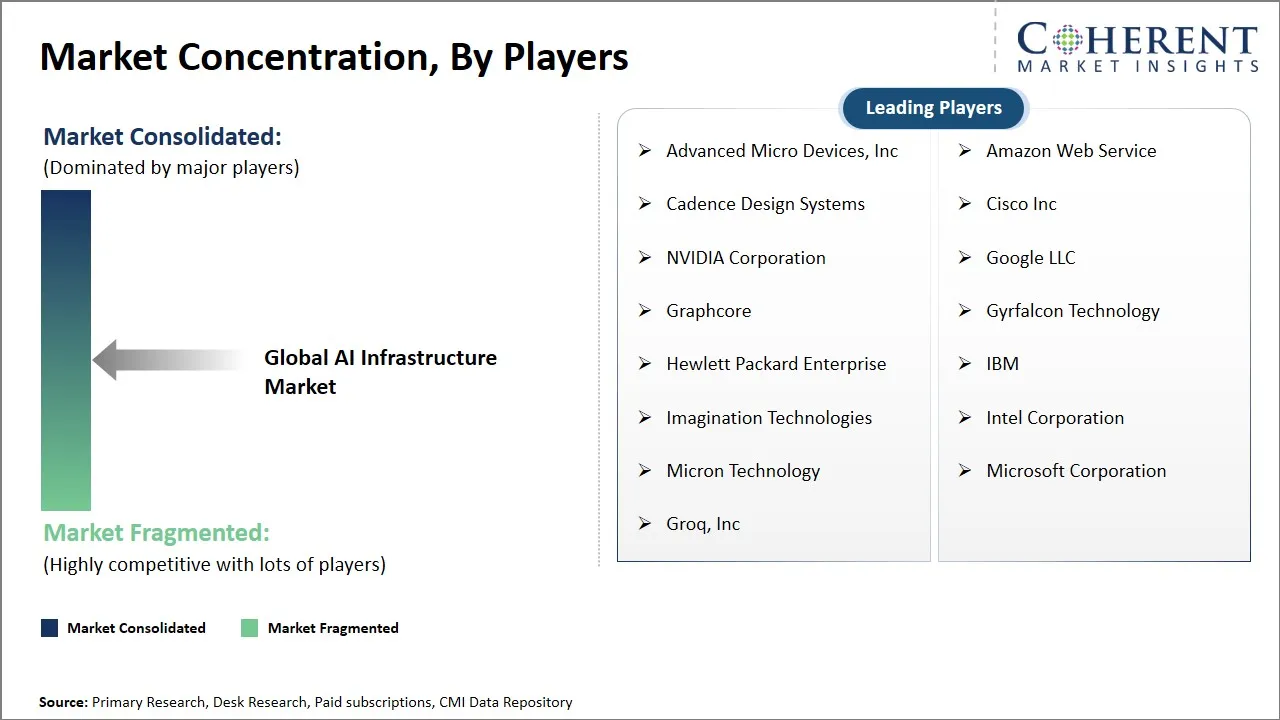
| Companies covered: | Advanced Micro Devices, Inc, Amazon Web Service, Cadence Design Systems, Cisco Inc, NVIDIA Corporation, Google LLC, Graphcore, Gyrfalcon Technology, Hewlett Packard Enterprise, IBM, Imagination Technologies, Intel Corporation, Micron Technology, Microsoft Corporation, and Groq, Inc | ||
| Growth Drivers: |
| ||
| Restraints & Challenges: |
| ||
Global AI Infrastructure Market Dynamics
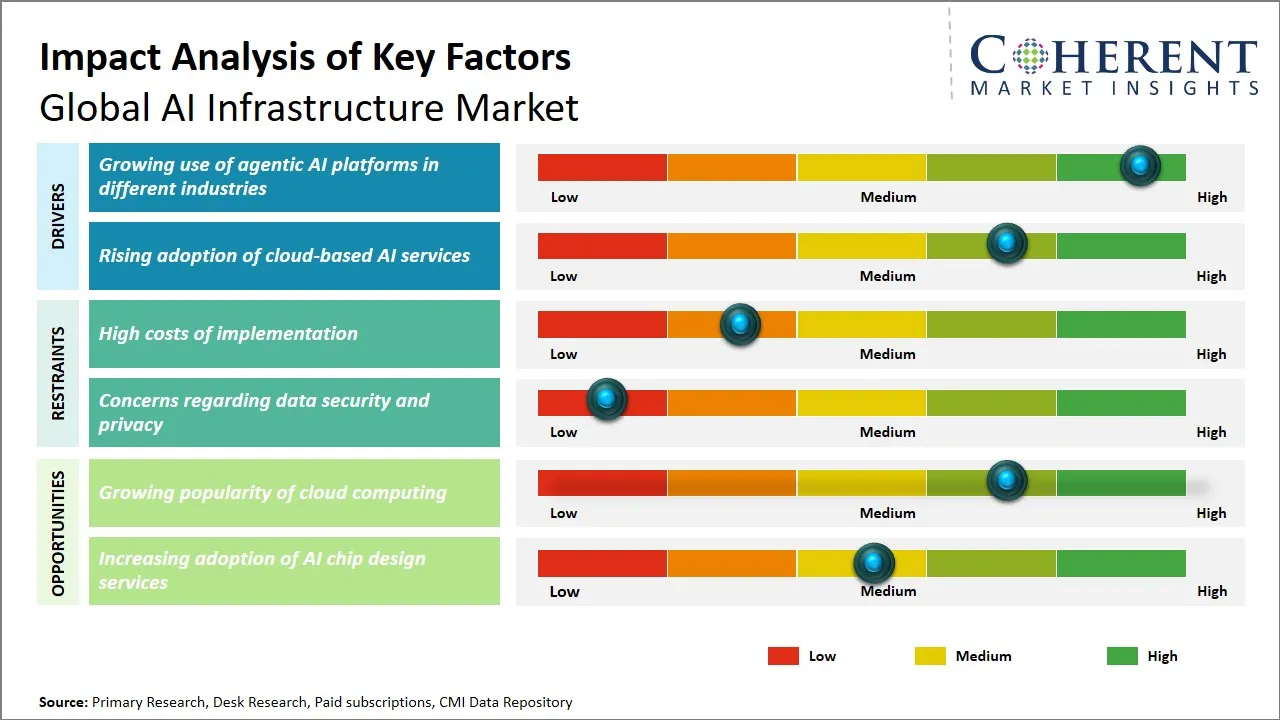
Global AI Infrastructure Market Driver - Growing Use of Agentic AI Platforms in Different Industries
With increasing frequency, agentic AI systems now shape how modern industries approach computation demands. What sets these platforms apart is independent task execution, reducing reliance on constant oversight. Across medicine, banking, production, and commerce, adoption continues to grow at a steady pace. Efficiency improves when automated reasoning supports daily workflows. Innovation emerges not from isolated tools but through seamless integration across environments. Real-time analysis places pressure on existing frameworks to adapt quickly. Infrastructure must respond with elasticity, raw speed, and distributed capacity. High-output processors, decentralized nodes, or network-near resources become essential under such conditions.
For instance, on October 15, 2025, Oracle introduced advanced AI agents inside its Oracle Fusion Cloud Applications to boost speed, cut expenses and facilitate smart decisions.
(Source: oracle.com)
Global AI Infrastructure Market Opportunity - Growing Popularity of Cloud Computing
As more companies are shifting workloads to public cloud services and computing, pressure grows to strengthen artificial intelligence frameworks worldwide. Digital transformation accelerates through virtual environments and reliance on intelligent systems tied to online networks rises steadily. Where once heavy machinery was essential, now access to smart algorithms comes via subscription-style setups. This shift allows clinics, banks, shops, and factories to apply complex data tools without owning physical processors. Growth in server rental services indirectly fuels progress in automated decision-making capabilities.
For instance, on November 24, 2025, Amazon announced an investment of up to USD 50 billion to expand AI and supercomputing capabilities for Amazon Web Services (AWS) U.S. government customers. This investment is set to add nearly 1.3 gigawatts of AI and supercomputing capacity across AWS Top Secret, AWS Secret, and AWS GovCloud (U.S.) Regions by building data centers with advanced compute and networking technologies.
(Source: aboutamazon.com)
Analyst Opinion (Expert Opinion)
- A shift unfolds within global systems designed for artificial intelligence, shaped by rising needs in performance and scale. Performance demands grow stronger as tools powered by algorithms require greater computational strength. Major platforms such as AWS, Google Cloud, and Microsoft Azure respond through large-scale expansions in digital capacity. Expansion includes vast funding directed toward physical components - GPUs, tailored chips - and broader network frameworks. Funding levels reach into billions, highlighting deep commitment beyond temporary trends. Commitment signals a structural change in how sectors operate, innovate, process information. Structural integration of AI reshapes workflows, decision paths, data handling practices across domains. Domains once reliant on traditional models now adopt accelerated architectures as standard practice.
- With growing use of artificial intelligence across health services, banking systems, and vehicle manufacturing, organizations now depend more heavily on specialized computing setups to manage large-scale information flows alongside complex algorithm development. Instead of traditional partnerships, extended computational agreements combined with advanced equipment designs have allowed firms including OpenAI and Nvidia to strengthen their positions significantly. Growth in this sector appears steady, driven by competition between major cloud providers and newer local operators seeking influence within an industry marked by constant change. Expectations point toward sustained momentum as technological demands increase across multiple domains.
Speak to the analyst
Want personalized insights?
Take the findings above to one of our principal consultants, or have the report rebuilt around the segments, geographies and competitors you actually track.
Market Segmentation
- Component Insights (Revenue, USD Billion, 2021 - 2033)
- Hardware
- Software
- Deployment Insights (Revenue, USD Billion, 2021 - 2033)
- On Premise
- Cloud
- Hybrid
- End User Insights (Revenue, USD Billion, 2021 - 2033)
- Enterprises
- Government Organization
- Cloud Services Provider
- Technology Insights (Revenue, USD Billion, 2021 - 2033)
- Machine Learning
- Deep Learning
- Regional Insights (Revenue, USD Billion, 2021 - 2033)
- North America
- U.S.
- Canada
- Latin America
- Brazil
- Argentina
- Mexico
- Rest of Latin America
- Europe
- Germany
- U.K.
- Spain
- France
- Italy
- Russia
- Rest of Europe
- Asia Pacific
- China
- India
- Japan
- Australia
- South Korea
- ASEAN
- Rest of Asia Pacific
- Middle East
- GCC Countries
- Israel
- Rest of Middle East
- Africa
- South Africa
- North Africa
- Central Africa
- North America
- Key Players Insights
- Advanced Micro Devices, Inc
- Amazon Web Service
- Cadence Design Systems
- Cisco Inc
- NVIDIA Corporation
- Google LLC
- Graphcore
- Gyrfalcon Technology
- Hewlett Packard Enterprise
- IBM
- Imagination Technologies
- Intel Corporation
- Micron Technology
- Microsoft Corporation
- Groq, Inc
Sources
Primary Research Interviews
- AI infrastructure solution providers and vendors
- Cloud service providers and data center operators
- Enterprise IT decision makers and CIOs
- AI/ML technology consultants and system integrators
Databases
- IDC Worldwide Infrastructure Tracker
- Bloomberg Terminal Market Intelligence
Magazines
- AI Magazine
- Data Center Knowledge
- InformationWeek
- CIO Magazine
- IEEE Computer Magazine
Journals
- IEEE Transactions on Computers
- Journal of Artificial Intelligence Research
- AI Communications
Newspapers
- The Wall Street Journal (Technology Section)
- Financial Times (Digital Economy)
- Reuters Technology News
- VentureBeat AI Coverage
- TechCrunch Infrastructure Reports
Associations
- Artificial Intelligence Infrastructure Alliance (AIIA)
- Data Center and Cloud Infrastructure Association
- IEEE Computer Society
- Association for Computing Machinery (ACM)
- Open Compute Project Foundation
Public Domain Sources
- U.S. Department of Commerce AI Reports
- European Commission Digital Strategy Documents
- International Data Corporation (IDC) Public Reports
- McKinsey Global Institute AI Studies
- World Economic Forum Technology Reports
Proprietary Elements
- CMI Data Analytics Tool
- Proprietary CMI Existing Repository of information for last 8 years
Get access to 250+ pages report
Every segment, forecast, competitor profile and data table behind the analysis above — available for instant download.
- ESOMAR Member
- ISO 9001:2015 Certified
- D-U-N-S Registered
- GDPR & CCPA Compliant
Missing comfort of reading report in your local language? Find your preferred language:
Transform your Strategy with Exclusive Trending Reports
Frequently Asked Questions
The global AI infrastructure market is expected to stand at USD 90 Bn in 2026 and is expected to reach USD 465 Bn by 2033.
The CAGR of global AI infrastructure market is projected to be 24% from 2026 to 2033.
Growing use of agentic AI platforms in different industries and rising adoption of cloud-based AI services are the major factors driving the growth of the global AI infrastructure market.
High costs of implementation and concerns regarding data security and privacy are the major factors hampering the growth of the global AI infrastructure market.
In terms of component, hardware is estimated to dominate the market revenue share in 2026.
Cloud platforms reduce upfront costs and provide scalable, on-demand resources for AI training and inference.
GPUs accelerate parallel processing, making them essential for training deep learning and large language models.