

Global Aluminum Smelting Market Size and Forecast – 2026-2033
The Global Aluminum Smelting Market is estimated to be valued at USD 122.47 Bn in 2026 and is expected to reach USD 182.94 Bn by 2033, reflecting a compound annual growth rate (CAGR) of 5.9% from 2026 to 2033.
Key Takeaways of the Aluminum Smelting Market
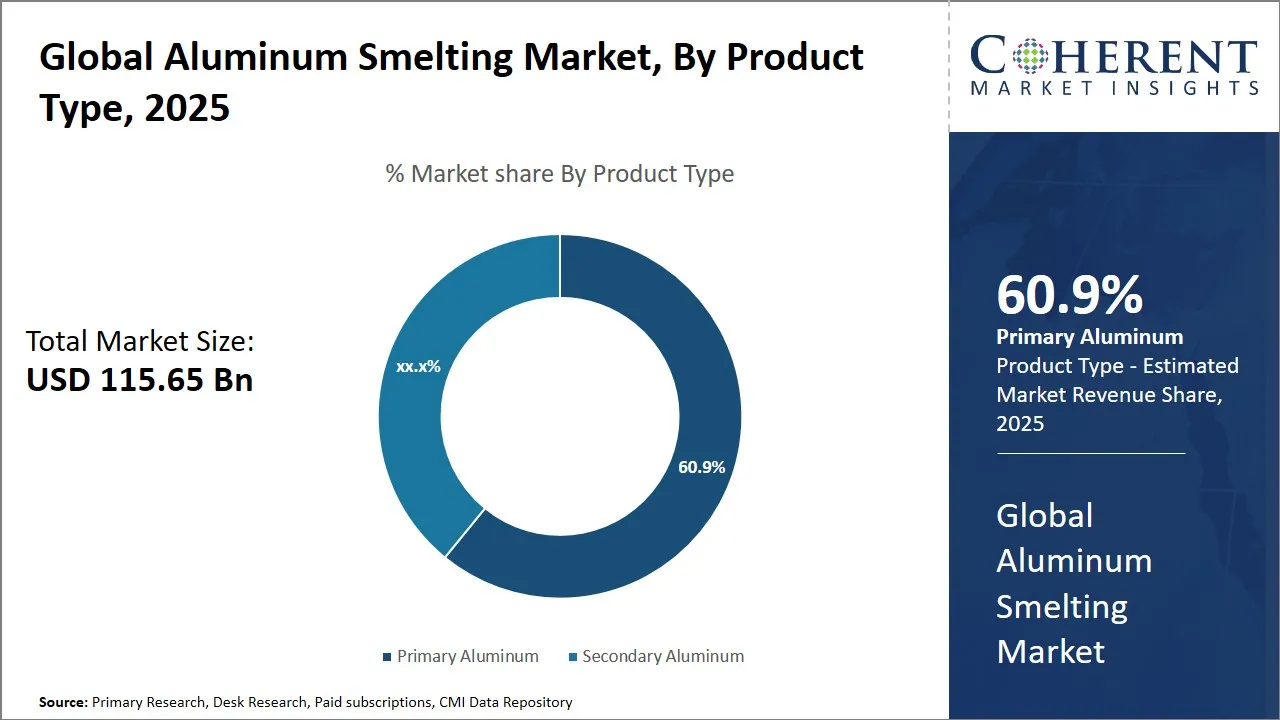
- Primary aluminum segment is estimated to hold 61.9 % of the market share in 2026.
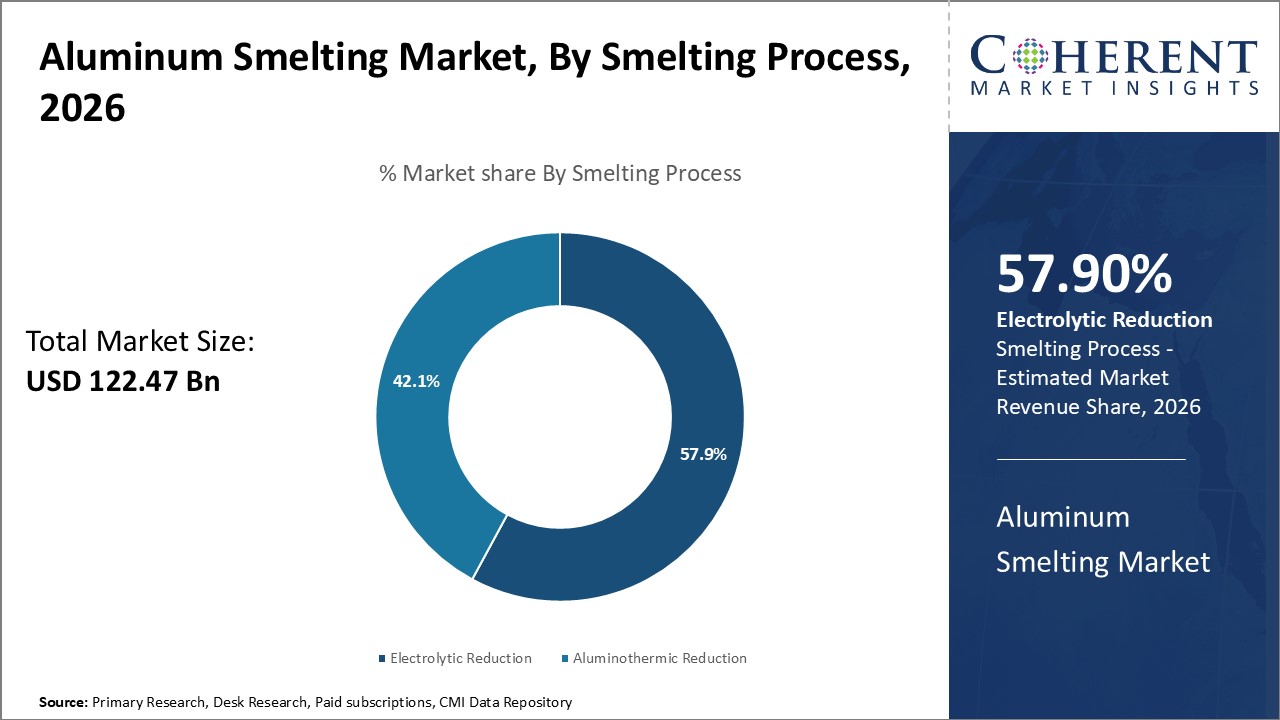
- Electrolytic reduction segment is projected to hold 57.9 % of the aluminum smelting market share in 2026.
- Automotive segment is projected to account for 35.7 % of the global aluminum smelting market share in 2026.
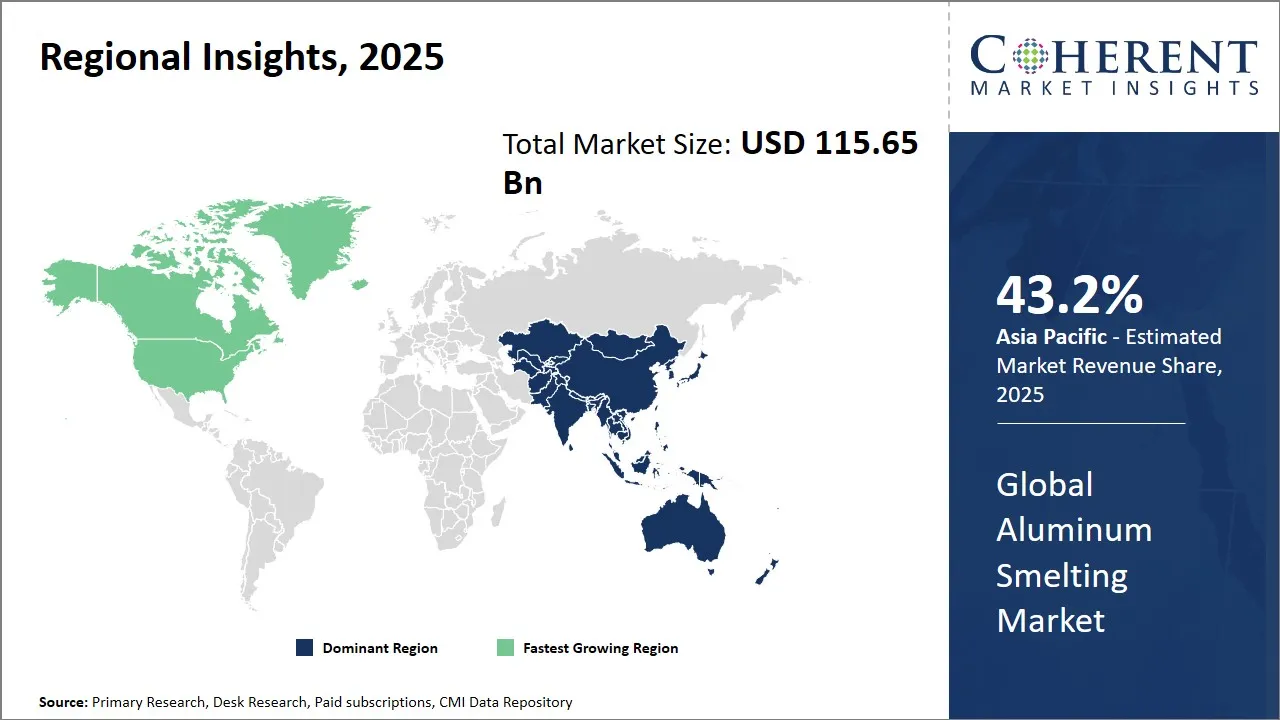
- Asia Pacific will lead the aluminum smelting market in 2026 with an estimated 43.2 % share.
- North America will hold 21.3 % share in 2026 and record the fastest growth.
Market Overview
- In terms of market trends, there is a significant shift towards sustainable and energy-efficient smelting technologies as environmental regulations tighten worldwide.
- Companies are investing in low-carbon processes and green energy integration to reduce the carbon footprint of aluminum production.
- Additionally, advancements in automation and digitalization are improving operational efficiencies and reducing costs, positioning the aluminum smelting market for resilient growth amid evolving global demand dynamics.
Current Events and Its Impact
Current Events | Description and its impact |
EU CBAM moves into “paying” phase from January 1, 2026 and expands focus to more downstream goods |
|
Mozambique’s Mozal smelter set for care-and-maintenance by March 2026 after power talks fail |
|
Segmental Insights
- Current Industry Events of 2026
- Market Size Estimation
- Regional Breakdown
- Competitive Landscape
- Customer Intelligence
- Segmental Analysis
- Pricing Analysis
- Key Market Drivers, Challenges & Future Trends
- Customized Insights Section
Why Does the Primary Aluminum Dominates the Aluminum Smelting Market in 2026?
Primary aluminum segment is expected to hold 61.9% of the aluminum smelting market share in 2026, owing to its fundamental role in the aluminum supply chain and its broad applicability across diverse industrial sectors. Aluminum is directly formed out of bauxite ore by a complicated process of refining and smelting into primary aluminum which is pure and meets high-quality and performance limits that are demanded in critical applications. This type of product is chosen where consistency, mechanical strength and corrosion resistance are the key factors, like in the aerospace and automotive production.
The coloration of primary aluminum is also due to the growing infrastructure growth development around the world and the growing automotive industries that require dependable raw materials to make them durable and effective. The lightweight but a strong aspect of primary aluminums helps in creating a significant fuel savings and emission controls in the automobiles, which is in line with international environmental efforts and other regulatory bodies. Also, recyclability of primary aluminum does not reduce its market relevance instead, it maintains high quality in the further manufacturing, which increases resource efficiency.
Why is Electrolytic Reduction the Dominant Aluminum Smelting Method at Commercial Scale?
Electrolytic reduction segment is projected to hold 57.9% of the aluminum smelting market share in 2026, due to its efficiency and scalability in producing aluminum on a commercial scale. The most common process in smelting aluminum is electrolytic reduction or commonly the Hall-Heroult process because it is able to directly convert alumina to pure aluminum in an energy-demanding electrochemical reaction. Although this process is energy-consuming, it is the most economical process to be used to obtain high quantities of aluminum with uniform quality.
The development of the electrolytic reduction is supported by the constant advancement of cell design, the decrease of power consumption, and the incorporation of renewable energy sources to ensure the reduction of environmental impact. Indicatively, in the case of Boeing and Airbus, airframe and wing parts of the plane are made of primary aluminum alloys because of stringent mechanical and fatigue considerations.
(Source:https://publicreg.vaccination.gov.ng/book-search/7FAN5I/271007/AirbusMaterialSpecifications.pdf
Automotive Dominates the Global Aluminum Smelting Market
Automotive segment is expected to contribute 35.7% of the market share in 2026, driven by the industry's pursuit of lightweight materials to improve fuel efficiency and reduce emissions. The high strength-to-weight ratio of aluminum gives this material a good reason to be used to replace other heavier metals in the production of vehicles, particularly steel. With the increasing regulatory policy of the global automotive environment to regulate the vehicle emission levels, automotive manufacturers are opting to incorporate more and more aluminum elements in the vehicle, such as body panel, engine elements, automobile wheels, and structural elements.
The transition to electric vehicles (EVs) further increases the pace of demand of aluminum in the automotive industry as aluminum does not only decrease the weight of the vehicle but enhances battery functions due to its ability to lighten frames and heat management. Furthermore, the enhanced emphasis on sustainability in the entire automotive supply chain values more materials that assist in recyclability and decrease environmental footprint, which strengthens the strategic role of aluminums.
Regional Insights
Asia Pacific Aluminum Smelting Market Analysis and Trends
The Asia Pacific region is projected to lead the market with a 43.2% share in 2026, due to the high rates of availability of raw materials and well-developed industrial infrastructure coupled with high government encouragement on growth and export of industries. China, India and Australia are some of the countries that have successfully exploited their bauxite deposits to provide an integrated supply chain of the raw material (bauxite), smelting of the alumina and the downstream production of fabricated products.
The industry is further reinforced by government policies that encourage the integration of renewable energy in the smelting activities and export incentives. The major players, including China Hongqiao Group, Hindalco Industries, and Alumina Limited, are the leading companies, which invest a lot in technological upgrades and capacity expansion. The established system of power supply that is essential in the energy-consuming smelting process and closeness to major markets in Southeast Asia favors the command of market position in Asia Pacific. There are also trade forces that prefer Asia Pacific because of comparatively low production costs and easy access to ports as strategic routes to distribution around the world.
North America Aluminum Smelting Market Analysis and Trends
The North America region is expected to exhibit the fastest growth in the market contributing 21.3% share in 2026. In the U.S. and Canada, the clean energy, particularly hydropower, is being used to support the development of modern, low-carbon smelting using government subsidies. Such players as the Alcoa Corporation, one of the biggest producers of aluminum in the U.S. keep on streamlining their presence in North American smelting by only emphasizing on low cost and energy saving assets and by developing their ELYSIS inert anode technology to reduce direct carbon emissions. The automotive, aerospace, EV, and sustainable packaging demand and excellent recycling infrastructure are creating a more resilient, hybrid primary-secondary aluminum.
Global Aluminum Smelting Market Outlook for Key Countries
China Aluminum Smelting Market Trends
The market of aluminum smelting is still in the lead position of China, because of the large scale of the industrial base and strong expansion policies with the help of the government programs on the insertion of clean energy in smelting. China Hongqiao Group and China Aluminum Corporation (Chinalco) among other large players have invested greatly in capacity development and technological advancements in an attempt to boost efficiency and environmental compliance. They are sustainable practices, enhanced infrastructure and logistical capacities of China, which strengthens its position on the leadership in domestic production, as well as exports.
Why is India Emerging as a Competitive Aluminum Smelting Market?
India’s aluminum smelting market benefits from rich bauxite deposits and ongoing infrastructural development. Major players like Hindalco Industries and National Aluminium Company Limited (NALCO) are adding more smelting units to ensure the demand is covered. Further government interest in Make in India and augmenting energy supply by renewable projects augers well with growth opportunities. High local demand of aluminum in the automotive, packaging and construction industry works as a momentum to invest and innovate in the process of smelting.
Australia Aluminum Smelting Market Trends
The market in Australia is influenced by the fact that it is the second largest bauxite producer and is oriented towards the production of sustainable aluminums. Companies such as Alumina Limited and Rio Tinto are actively involved in terms of technology development towards energy savings and low carbon emissions. The restrictive environmental policies and availability of renewable energy in Australia is in tandem with the trends in global sustainability and therefore the countries emphasis on the quality of its aluminum products to serve the export markets and primarily in the Asia Pacific market is assured.
U.S. Aluminum Smelting Market Trends
The U.S. maintains a significant position driven by its established industrial ecosystem and technological advancements. Companies such as Alcoa Corporation and Century Aluminum lead in producing value-added aluminum products, supported by government initiatives to bolster domestic manufacturing and reduce dependence on imports. Increased focus on recycling and cleaner production methods, along with investments in innovation, strengthens the market amid competitive international dynamics.
Why is the U.A.E. Strengthening its Position as a Global Aluminum Smelting and Export Hub?
The market development of the U.A.E.s aluminum smelting is based on such companies as Emirates Global Aluminium, which enjoy the availability of the low-cost natural gas and the support of the government-initiated infrastructure projects. The UAE has developed into an important aluminum exporting center through incorporation of sustainable and energy saving technologies in the smelting process. The positions favorable to international shipping routes and favorable regulatory environments are enhancing the positions of the regions, and the increasing demand with the construction and automobile sectors of the Middle East is driving additional growth.
For example, in May 2026, Gov. Kevin Stitt said a USD 4 Bn smelting plant will be based on the Port of Inola in Northeast Oklahoma. The governor signed an agreement with Emirates Global Aluminium as one of the deals of a broader range of deals with the U.A.E. announced by the Trump Administration. Although it is not situated within the U.A.E., the project highlights the global expansion policy of EGAs and supports U.A.E. as the capital, technological and expertise exporter on the aluminum smelting value chain.
Carbon Intensity per Ton of Aluminum by Smelting Technology
- Carbon intensity in aluminum smelting is primarily driven by anode chemistry, electricity source, and process efficiency.
- Inert anode technology represents the lowest-carbon pathway, emitting only oxygen instead of CO₂ during electrolysis. When paired with renewable power, its carbon intensity can fall below 2 tCO₂e per ton, making it strategically aligned with decarbonization mandates. However, commercialization remains limited due to high capex, technology risk, and slow retrofit feasibility at scale.
- Prebake technology, the global industry standard, offers a balanced trade-off between operational stability and emissions control. With controlled anode baking and higher current efficiency, carbon intensity typically ranges between 4.5–6.5 tCO₂e/ton, depending heavily on grid mix.
Regional Policy Exposure Impact
Policy Mechanism | Regions Most Exposed | Impact on Aluminum Smelting Market |
CBAM | EU importers, exporters from Asia & MEA | Penalizes high-carbon aluminum, favors low-carbon supply |
Carbon Taxes | EU, Canada | Increases OPEX for Söderberg and coal-based prebake |
IRA Incentives | U.S. | Improves ROI for clean and inert-anode smelters |
Market Players, Key Development, and Competitive Intelligence
Key Developments
- In July 2025, ABB joins Arctial’s low-carbon aluminum smelter project for Europe. ABB has joined project management organization Arctial as an investor and will become a member of a partnership of companies set to carry out in-depth feasibility studies for the Greentop low-carbon aluminum smelter project in Finland. This development is poised to be critical to Europe’s materials supply chain. Investment details were not disclosed.
- In February 2025, Rio Tinto and Hydro announced their plan to invest approximately USD 45 million over five years to develop carbon capture technologies for aluminum smelting. Rio Tinto and Hydro have signed a partnership agreement to explore carbon capture solutions for aluminum smelting. The collaboration focuses on identifying and assessing technologies to reduce CO2 emissions from the electrolysis process, which accounts for 75% of a smelter's direct emissions. The partnership aims to accelerate the aluminum industry's transition to net-zero emissions by 2050. Most of the work will take place at Rio Tinto's European facilities and Hydro's sites in Norway.
- In February 2025, Coordinating Minister for the Economy Airlangga Hartarto met with Abdulnasser Ibrahim Saif Bin Kalban, CEO of Emirate Global Aluminium (EGA), discussing the continuation of cooperation in developing aluminum production through the development of a smelter that processes bauxite in Indonesia. EGA is the world's largest producer of premium aluminum in the world. Having aluminum smelters in Dubai and Abu Dhabi, it is the largest industrial company in the U.A.E. outside the oil and gas sector.
Top Strategies Followed by Global Aluminum Smelting Market Players
Player Type | Strategic Focus | Example |
Established Market Leaders | Heavy R&D investments; strategic partnerships with OEMs; global capacity expansion; vertical integration | Rio Tinto company Invests in decarbonization (e.g., inert anode development) to serve automotive and packaging OEMs. Alcoa Concentrates on high-technology smelting, recycling-based production, and joint ventures with down-stream metal manufacturers on high-performance aluminum. |
Mid-Level Players | Cost-effective solutions with balanced quality | Vedanta Aluminium Leverages competitive operations and captive power to provide domestic and export markets with competitive products. |
Small-Scale Players | Niche specialization; flexible production; adoption of advanced alloys and sustainable processes; local alliances | Chalco (China Aluminum Corporation): Expands aggressively across Asia Pacific and Africa, combining state-backed scale with vertically integrated bauxite–alumina–aluminum operations. |
Market Report Scope
Aluminum Smelting Market Report Coverage
| Report Coverage | Details | ||
|---|---|---|---|
| Base Year: | 2025 | Market Size in 2026: | USD 122.47 Bn |
| Historical Data for: | 2020 To 2024 | Forecast Period: | 2026 To 2033 |
| Forecast Period 2026 to 2033 CAGR: | 5.9% | 2033 Value Projection: | USD 182.94 Bn |
| Geographies covered: |
| ||
| Segments covered: |
| ||
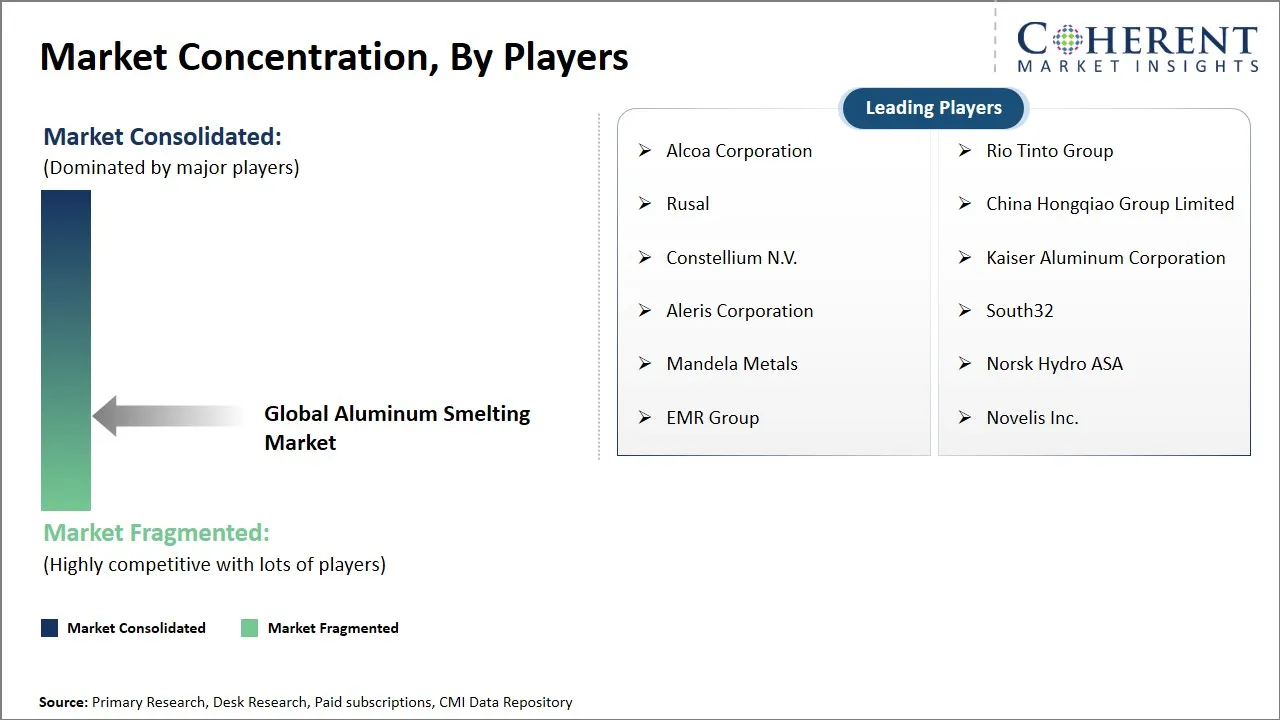
| Companies covered: | Alcoa Corporation, Rio Tinto Group, Rusal, China Hongqiao Group Limited, Constellium N.V., Kaiser Aluminum Corporation, Aleris Corporation, South32, Mandela Metals, Norsk Hydro ASA, EMR Group, and Novelis Inc. | ||
| Growth Drivers: |
| ||
| Restraints & Challenges: |
| ||
Aluminum Smelting Market Dynamics
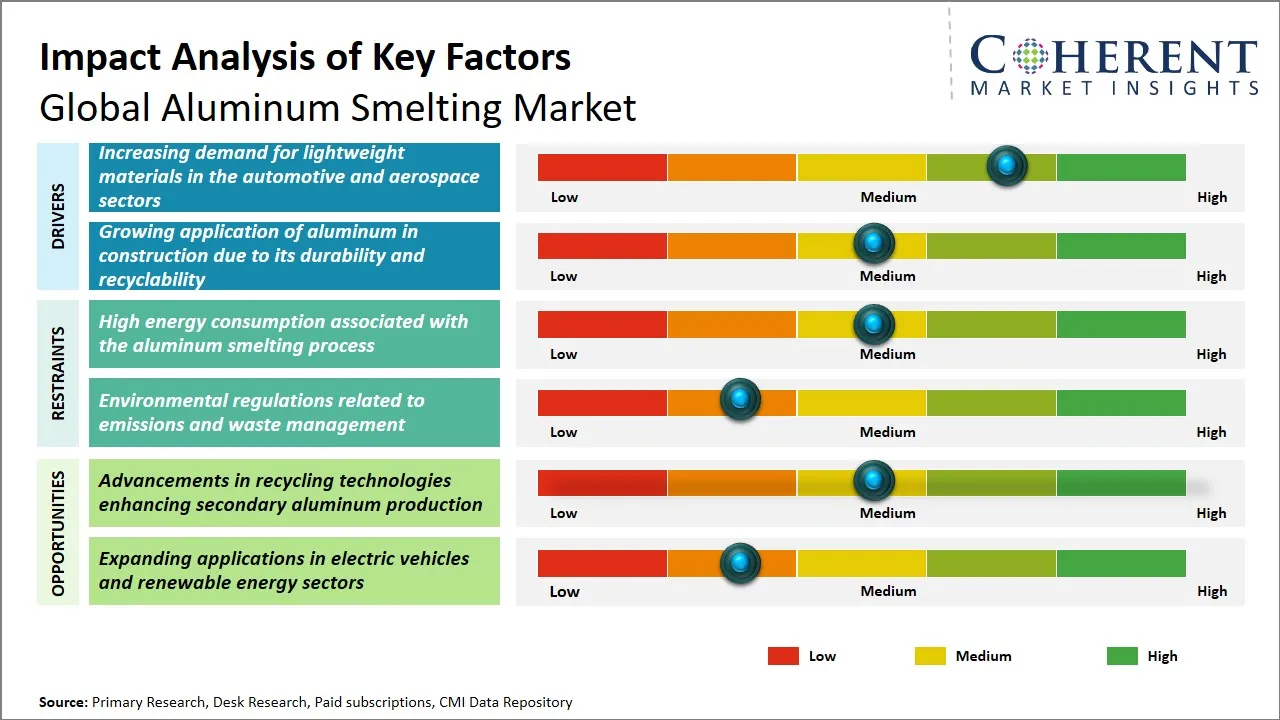
Aluminum Smelting Market Driver - Increasing Demand for Lightweight Materials in the Automotive and Aerospace Sectors
The increasing focus on fuel economy and the environmental sustainability has contributed largely to the popularity of lightweight materials, especially aluminum, in the automobile and aerospace industry. Manufacturers are turning towards using aluminum smelting production with the aim of producing parts that decrease the weight of the entire car without affecting power and performance. This trend is supported by the development of strict emission laws and the necessity to increase the fuel economy, which prompts the tendency towards the materials with the best strength-to-weight ratio. The importance of aluminums cannot be stressed in aerospace as there is an urgent need to enhance the performance of aircrafts, increase their range of flights, and minimize carbon footprints. The fact that it can withstand the rough conditions in which it operates and helps in weight reduction has rendered it essential in the building of the airframes and engines.
In May 2024, Athens Ford changed the F-150 pickup body to aluminum, losing 300 kg in the weight of the vehicle, increasing its fuel efficiency and carrying capacity. The aluminum alloys used in fuselages, wings, and structural parts of planes in the aerospace industry tend to make Airbus and Boeing highly dependable companies in terms of balance between strength, anti-corrosion capabilities, and weight.
(Source: https://www.athensford.com/aluminum-bodied-f-150-more-fuel-efficient/)
Aluminum Smelting Market Opportunity - Advancements in Recycling Technologies Enhancing Secondary Aluminum Production
The global aluminum smelting market is witnessing significant growth opportunities driven by advancements in recycling technologies, which are revolutionizing secondary aluminum production. Aluminum is recycled to form secondary aluminum that provides a viable substitute to primary aluminum made using bauxite ore that is eco-friendly and cost-effective. Developments in sorting, refining and remelting processes have helped the quality of the recycled metal aluminum to become highly efficient and quality, making it more competitive to primary aluminum in terms of performance and cost. The advanced sensor-based sorting systems and the enhanced technology of scrap preparation allow a higher level of purity that can minimize the contamination and energy used in the recycling process.
An example is a closed-loop recycling program with automotive OEMs, whereby production scrap is recycled into new automotive sheet through Novelis that has more than 90 percent of reduced carbon emissions compared to primary aluminum.
Analyst Opinion (Expert Opinion)
- The aluminum smelting market is experiencing a critical shift of a rising demand of lightweight materials in the automotive and aerospace industries coupled with the world subjecting to the importance. The publications of the International Aluminum Conference (2023) and the World Metal Congress (2022) presented some of the major progress, where companies such as Rio Tinto and Alcoa were the first to develop energy-saving smelting.
- Recent adoption of new smelting technology by Rio Tintos which uses renewable energy sources is a good example of how the industry is changing to minimal carbon emission and environmental impact. Debates during these conferences highlighted how smelters are urgently required to use cleaner technologies in light of increased regulatory demands and the imperative of achieving climate targets. But the variations in price of raw materials and recycling activities were more often mentioned as obstacles to expansion.
- It is quite possible that companies, which invest in innovative technologies and become involved in strategic partnerships that are oriented towards sustainability, will take an advantage. Finally, the development of the aluminum smelting market will rely on its capability to be innovative in a continuum as well as being able to keep up with the dynamic demands of efficient and sustainable production practices in an ever-environmentally-conscious world.
Speak to the analyst
Want personalized insights?
Take the findings above to one of our principal consultants, or have the report rebuilt around the segments, geographies and competitors you actually track.
Market Segmentation
- Product Type Insights (Revenue, USD Bn, 2021 - 2033)
- Primary Aluminum
- Secondary Aluminum
- Smelting Process Insights (Revenue, USD Bn, 2021 - 2033)
- Electrolytic Reduction
- Aluminothermic Reduction
- Application Insights (Revenue, USD Bn, 2021 - 2033)
- Automotive
- Construction
- Aerospace
- Packaging
- Electrical Equipment
- Others
- Regional Insights (Revenue, USD Bn, 2021 - 2033)
- North America
- U.S.
- Canada
- Latin America
- Brazil
- Argentina
- Mexico
- Rest of Latin America
- Europe
- Germany
- U.K.
- Spain
- France
- Italy
- Russia
- Rest of Europe
- Asia Pacific
- China
- India
- Japan
- Australia
- South Korea
- ASEAN
- Rest of Asia Pacific
- Middle East
- GCC Countries
- Israel
- Rest of Middle East
- Africa
- South Africa
- North Africa
- Central Africa
- North America
- Key Players Insights
- Alcoa Corporation
- Rio Tinto Group
- Rusal
- China Hongqiao Group Limited
- Constellium N.V.
- Kaiser Aluminum Corporation
- Aleris Corporation
- South32
- Mandela Metals
- Norsk Hydro ASA
- EMR Group
- Novelis Inc.
Sources
Primary Research Interviews
- CEO – Leading Aluminum Smelter (e.g., Alcoa or Rio Tinto equivalent)
- Supply Chain Director – Major Aluminum Producers Association
- Production Lead – Primary Aluminum Smelting Facility
- Sustainability Officer – Aluminium Stewardship Initiative
Stakeholders
- Manufacturers
- End-use Sectors
- Automotive Industry (EV frames, components)
- Construction & Building (extrusions, panels)
- Packaging Producers (cans, foils)
- Regulatory & Certification Bodies (e.g., EPA for emissions, EU ETS compliance)
- E-commerce Platforms and Retailers (Alibaba, Metal Supermarkets, specialty traders)
- Technology Integration Players: Inert anode developers and renewable-powered smelters
Databases
- UN Comtrade Database (aluminum trade flows)
- India Import Export (EXIM) Database
- USGS Mineral Commodity Summaries (Aluminum)
- Eurostat Trade Statistics for Metals
- Aluminum Association Statistics Portal
Magazines
- Light Metal Age Magazine – Aluminum smelting trends
- Aluminium International Today – Smelting innovations
- Aluminium Smelting Today – Process advancements
- Industrial Minerals – Aluminum market dynamics
- Modern Metals – Primary production updates
Journals
- Journal of Materials Processing Technology – Aluminum smelting efficiency
- Resources Policy – Global aluminum supply chains
- Journal of Cleaner Production – Environmental impacts of smelting
- Light Metals (TMS) – Smelter operations and anodes
- Minerals Engineering – Bauxite to aluminum refining
Newspapers
- The Wall Street Journal – Global aluminum demand
- Financial Times – Aluminum price volatility
- Business Standard (India) – Aluminum imports and capacity expansion
- Metal Bulletin – Smelting disruptions
- Reuters – Energy costs in aluminum production
Associations
- Aluminum Association (US)
- International Aluminium Institute
- Aluminium Association of India
- European Aluminium Association (EA)
- International Aluminium Stewardship Initiative (ASI)
- Conference of European Directors of Roads (CEREMA) – No, wait: Cefic equivalent for metals, but Aluminium-specific
Public Domain Sources
- EPA – Guidelines for aluminum smelting emissions
- European Commission – Carbon Border Adjustment Mechanism for aluminum
- World Health Organization – Occupational safety in smelting
- USGS – Aluminum production statistics
- OECD – Metal trade and sustainability reports
Proprietary Elements
- CMI Data Analytics Tool, Proprietary CMI Existing Repository of information for last 8 years.
Get access to 250+ pages report
Every segment, forecast, competitor profile and data table behind the analysis above — available for instant download.
- ESOMAR Member
- ISO 9001:2015 Certified
- D-U-N-S Registered
- GDPR & CCPA Compliant
Missing comfort of reading report in your local language? Find your preferred language:
Transform your Strategy with Exclusive Trending Reports
Frequently Asked Questions
The global aluminum smelting market is estimated to be valued at USD 122.47 Bn in 2026 and is expected to reach USD 182.94 Bn by 2033.
The CAGR of global aluminum smelting market is projected to be 5.9% from 2026 to 2033.
Increasing demand for lightweight materials in the automotive and aerospace sectors and growing application of aluminum in construction due to its durability and recyclability are the major factors driving the growth of the global aluminum smelting market.
Alumina, carbon anodes, cryolite-based electrolyte, and large amounts of electricity.
High energy consumption associated with the aluminum smelting process and environmental regulations related to emissions and waste management are the major factors hampering the growth of the global aluminum smelting market.
EVs increase aluminum intensity in structures, battery housings, and thermal systems.
In terms of product type, primary aluminum is estimated to dominate the market revenue share in 2026.