

Global Application Lifecycle Management Market Size and Forecast – 2026-2033
The Global Application Lifecycle Management Market is estimated to be valued at USD 5.67 Bn in 2026 and is expected to reach USD 9.97 Bn by 2033, growing at a compound annual growth rate (CAGR) of 8.4% from 2026 to 2033.
Key Takeaways of the Global Application Lifecycle Management Market
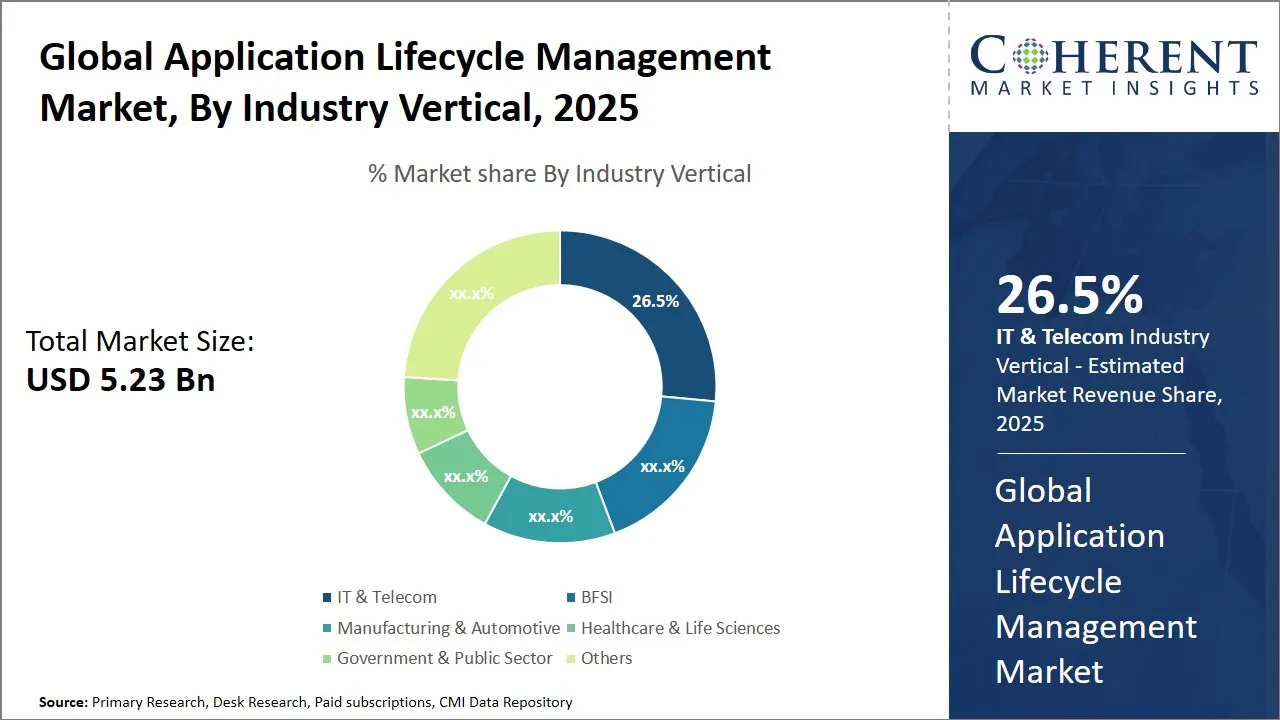
- The IT & Telecom segment leads the market holding an estimated share of 27.5% in 2026.
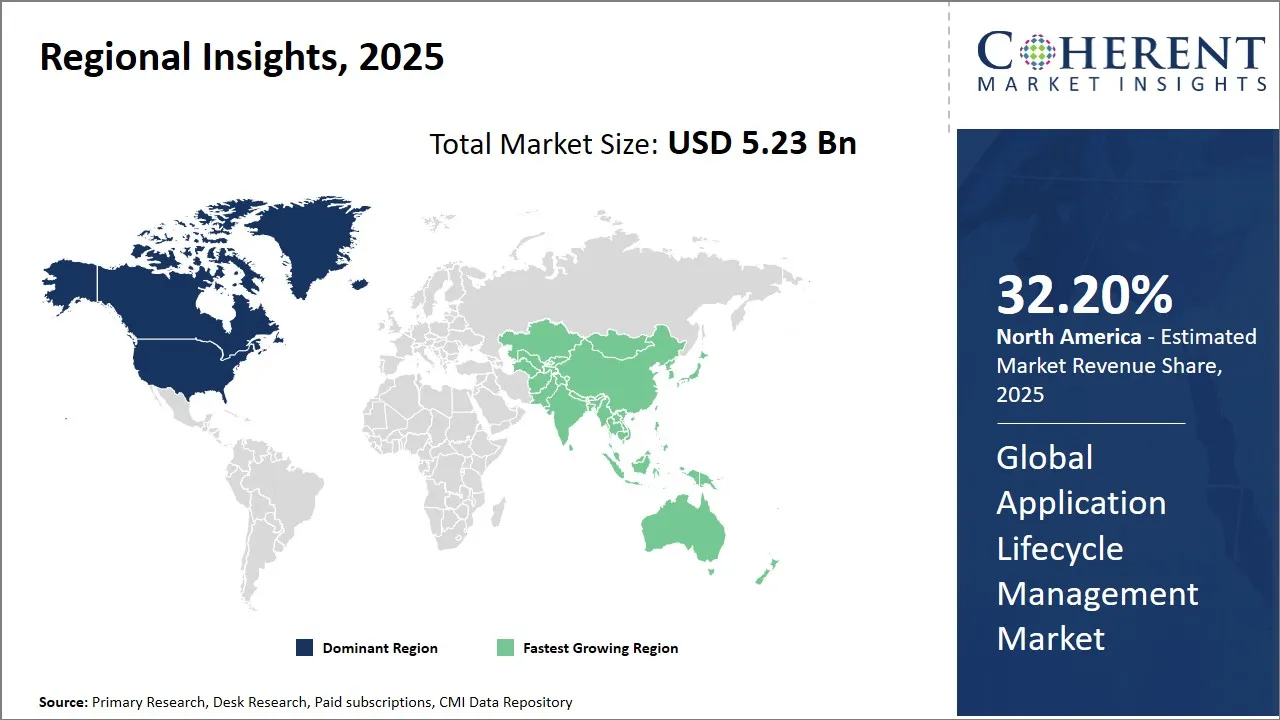
- North America is estimated to lead the market with a share of 32.2% in 2026.
- Asia Pacific, holding a share of 22.3% in 2026, is projected to be the fastest growing region.
Market Overview
The market is seeing the rising use of artificial intelligence and machine learning technologies to automate and optimize development workflows. Also, cloud-based ALM solutions are seeing a rise, making possible real-time updates and remote collaboration, meeting the changing demands of agile and DevOps methodologies. To add, growing focus on reducing time-to-market and improving software quality is making organizations adopt comprehensive ALM platforms that give end-to-end visibility and control.
Current Events and Its Impact
Current Events | Description and its impact |
Security & Compliance Focus |
|
AI-Driven Development Enhancements |
|
Cloud Platform Updates |
|
Segmental Insights
- Current Industry Events of 2026
- Market Size Estimation
- Regional Breakdown
- Competitive Landscape
- Customer Intelligence
- Segmental Analysis
- Pricing Analysis
- Key Market Drivers, Challenges & Future Trends
- Customized Insights Section
Global Application Lifecycle Management Market Insights by Industry Vertical – Digital Transformation and Connectivity Innovations Fuel IT & Telecom Segment Growth
IT & Telecom contributes the highest share of 27.5% in the market in 2026. The IT & Telecom sector is seeing a lot of adoption of application Lifecycle management tools to streamline the development, deployment, and maintenance of software applications critical for service delivery and operational efficiency. The high complexity of telecom networks, including the rollout of 5G technology, makes demand for application management systems to ensure seamless user experiences. Service providers are using these tools to monitor application performance, reduce downtime, and optimize resource allocation in real-time. Application Lifecycle management platforms allow organizations to automate workflows, manage cloud-native applications, and support continuous integration/continuous deployment (CI/CD) pipelines, which are important for agile product development and faster time-to-market.
Moreover, smartphones and connected devices have seen a lot of adoption, which has expanded the scope of applications. The IT & Telecom industry’s focus on customer-centric digital services drives investments in application performance monitoring and security management to meet stringent quality of service (QoS) standards. Also, growing concerns around data privacy and regulatory compliance in this sector adds to the adoption of lifecycle management solutions that include robust security protocols and risk mitigation measures. These applications help comply with evolving regulations and help safeguard sensitive information.
Verizon Communications has put in place Atlassian Jira and Broadcom Rally (Agile Central) across its software development and network operations teams to manage complex applications for its 5G rollout. By using ALM tools with CI/CD pipelines, Verizon can monitor application performance, automate workflows, and track issues in real-time.
Impact of AI on the Application Lifecycle Management Market
Artificial intelligence is automating complex development tasks and improving decision-making in the software delivery pipeline. AI-driven features like intelligent code completion, predictive defect detection, and automated test generation reduce manual effort and shorten release cycles, which improves productivity and quality. Vendors are using machine learning models to analyze historical project data, predict potential bottlenecks, and recommend process optimizations, giving teams real-time insights. As organizations adopt DevOps and Agile at scale, AI provides the adaptive analytics needed to manage increasingly distributed and fast-moving development environments.
GitLab’s “Duo Model Selection,” introduced with its 18.4 release on 18 September 2025, allows engineering teams to choose from different large language models for tasks such as code suggestion, issue summarization, and vulnerability detection within the GitLab platform.
Regional Insights
North America Application Lifecycle Management Analysis and Trends
North America, holding a share of 32.2% in 2026, dominates the global application lifecycle management market because of a mature technology ecosystem, high enterprise digitalization levels, and widespread adoption of agile and DevOps methodologies. The presence of key technology hubs such as Silicon Valley and strong IT infrastructure make a vibrant market environment. Government initiatives promoting innovation and cybersecurity also add to ALM adoption. Leading companies like Microsoft, IBM, and Atlassian have established strong footprints here, offering comprehensive ALM toolchains and platforms. Their continuous investment in R&D and strategic partnerships with enterprises make the region's commanding position stronger.
Asia Pacific Application Lifecycle Management Analysis and Trends
The Asia Pacific region, holding a share of 22.3% in 2026, exhibits the fastest growth in the application lifecycle management market because of fast digital transformation in emerging economies, increasing startup activities, and government policies adding to IT sector expansion. The growing presence of multinational IT firms and local vendors such as Huawei, Infosys, and Wipro play a big role in accelerating market growth. Also, rising cloud adoption and talent availability add a lot to the region’s dynamic landscape.
Global Application Lifecycle Management Market Outlook for Key Countries
U.S. Application Lifecycle Management Analysis and Trends
The U.S. is a leading market for ALM solutions because of its advanced technological infrastructure and high concentration of software development companies. Major players like Microsoft, IBM, and Atlassian are adding to innovation in ALM tools. Enterprises in finance, healthcare, and government sectors use these solutions to improve software quality and delivery speed. The country’s strong focus on secure and scalable software development also adds to the integration of ALM with DevSecOps practices.
Germany Application Lifecycle Management Analysis and Trends
Germany application lifecycle management market thrives because of its strong manufacturing and automotive industries, which need sophisticated software management tools for embedded systems and IoT integration. Local vendors such as SAP and Siemens complement global companies like Micro Focus and IBM to provide tailored ALM solutions. Government support for Industry 4.0 and digital manufacturing initiatives add to the adoption of lifecycle management practices. The country’s focus on strict quality standards adds to the demand for ALM toolchains.
India Application Lifecycle Management Analysis and Trends
India application lifecycle management market leads the Asia Pacific region with a strong IT services industry and growing software ecosystem. Major IT service providers, including Infosys, Wipro, and TCS, use ALM solutions and also develop customized offerings for domestic and global clients. Government initiatives like Digital India and Startup India add to digital transformation, leading to greater ALM adoption in SMEs and large enterprises. The availability of skilled software professionals and cost advantages also make India an important market and innovation hub.
China Application Lifecycle Management Analysis and Trends
China application lifecycle management market shows fast growth because of big investments in technology and digital infrastructure. Key players like Huawei and Alibaba offer integrated ALM suites aligned with cloud computing and AI capabilities. The government's focus on self-reliance in technology and digital economy initiatives add to the demand for scalable and secure ALM platforms. Also, strong industrial sectors, including telecom and manufacturing, need comprehensive lifecycle management to maintain competitiveness and compliance in China's evolving regulatory framework.
Japan Application Lifecycle Management Analysis and Trends
Japan application lifecycle management market sees demand from advanced automotive, electronics, and telecommunication sectors, which need precise software development processes to manage complex product lifecycles. Companies like Fujitsu and NEC join hands with global partners like Microsoft and IBM to deliver tailored ALM solutions. The focus on quality and reliability in software development, coupled with government incentives to foster digital innovation, makes sustained market demand. Increasing adoption of agile methodologies and cloud-based ALM platforms can also be seen in Japanese enterprises.
Market Players, Key Development, and Competitive Intelligence
Key Developments
- On September 22, 2025, Atlassian announced its acquisition of DX, a company specializing in engineering intelligence. DX aligns with Atlassian's System of Work vision and offers opportunities for development teams seeking greater visibility into their workflows.
- On September 22, 2025, Siemens announced the launch of Polarion X 2506, its latest release that builds upon the foundation of Polarion 2506. Polarion X 2506 introduces scheduled scripts, support of Nextedy apps, and Azure-based deployment.
- In March 2025, Perforce renamed Perforce Helix ALM to Perforce ALM to unify the company's portfolio.
- In December 2024, Broadcom announced the general availability of Rally Anywhere 1.0 for on-premise customers. This on-premise version of Rally can be deployed on any company's own Cloud or local platform leveraging Kubernetes, and is accessible through local intranet or virtual private network (VPN).
Top Strategies Followed by Application Lifecycle Management Market Players
- Established market leaders consistently invest substantial resources in research and development to drive innovation, aiming to offer high-performance, integrated ALM solutions that cater to complex organizational needs.
- Atlassian invests a lot in AI-driven engineering intelligence. Its acquisition of DX on September 22, 2025 makes Jira and Bitbucket stronger with advanced analytics and machine-learning capabilities, keeping Atlassian at the forefront of integrated ALM and DevOps innovation.
- Mid-level players in the application lifecycle management market adopt a more pragmatic approach by focusing on delivering cost-effective solutions that strike a balance between functionality and affordability.
- Perforce Software rebranded Helix ALM to Perforce ALM and released the 2025.1 update in March 2025 with performance improvements while maintaining competitive pricing. This strategy appeals to organizations seeking full-featured ALM without the premium costs associated with the largest vendors.
- Small-scale players in the application lifecycle management market employ niche-focused strategies to differentiate themselves amid intense competition.
- Jama Software continues to specialize in requirements management for safety-critical industries such as medical devices and aerospace. By focusing on high-assurance regulatory compliance, e.g., FDA, ISO 26262, Jama differentiates itself from broad-platform competitors and captures customers needing rigorous traceability.
Market Report Scope
Application Lifecycle Management Market Report Coverage
| Report Coverage | Details | ||
|---|---|---|---|
| Base Year: | 2025 | Market Size in 2026: | USD 5.67 Bn |
| Historical Data for: | 2020 To 2024 | Forecast Period: | 2026 To 2033 |
| Forecast Period 2026 to 2033 CAGR: | 8.4% | 2033 Value Projection: | USD 9.97 Bn |
| Geographies covered: |
| ||
| Segments covered: |
| ||
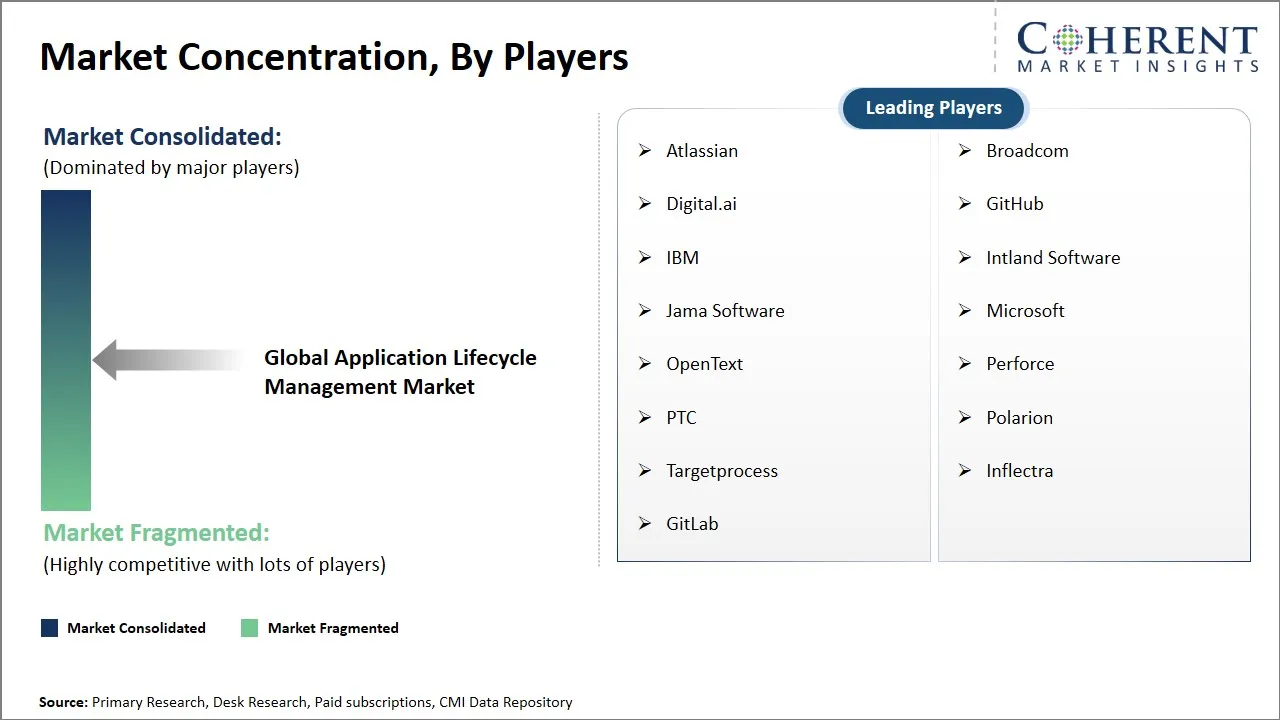
| Companies covered: | Atlassian, Broadcom, Digital.ai, GitHub, IBM, Intland Software, Jama Software, Microsoft, OpenText, Perforce, PTC, Polarion, Targetprocess, Inflectra, GitLab | ||
| Growth Drivers: |
| ||
| Restraints & Challenges: |
| ||
Market Dynamics
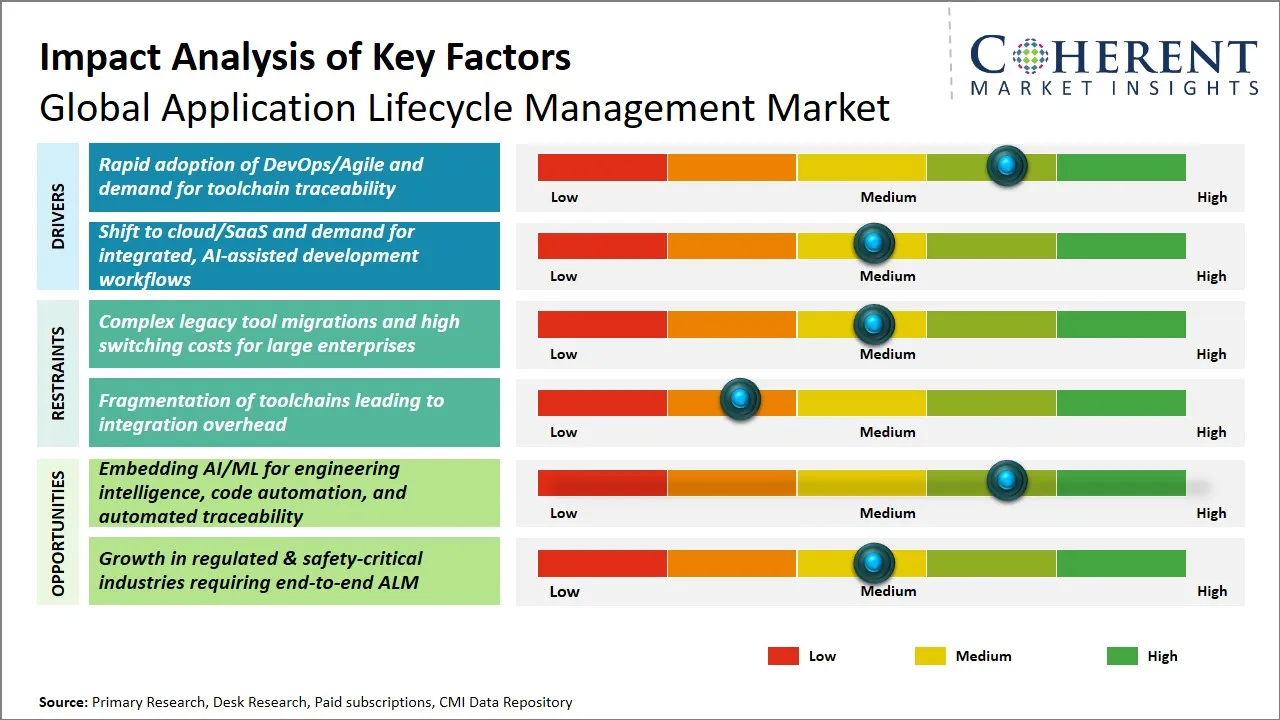
Global Application Lifecycle Management Market Driver – Rapid Adoption of DevOps/Agile and Demand for Toolchain Traceability
As organizations work on faster software delivery and improved collaboration between development and operations teams, there is a growing focus on integrating and automating different stages of the software development lifecycle. This shift makes demand for strong ALM solutions that provide seamless toolchain traceability, ensuring that every phase, from code development and testing to deployment and maintenance, is transparent and well-coordinated.
Broadcom’s Rally Software, Agile Central, is used by enterprises to get end-to-end visibility in their Agile projects, linking requirements, user stories, tasks, and defects. This makes possible faster decision-making and aligns with DevOps pipelines, helping organizations scale Agile practices efficiently. Also, with increased regulatory requirements and the need for compliance documentation in many industries, traceability features in ALM tools become very useful.
Global Application Lifecycle Management Market Opportunity – Embedding AI/ML for Engineering Intelligence, Code Automation, and Automated Traceability
As software development cycles get faster and more complex, using AI/ML can improve decision-making by providing predictive analytics, anomaly detection, and intelligent recommendations throughout the lifecycle stages. Automated code generation and refactoring by AI-driven algorithms also streamline repetitive development tasks, helping developers focus on high-value activities and innovation. GitLab’s Duo Model Selection, v18.4, allows developers to select different AI models for code suggestions, vulnerability detection, and issue summarization, automating key engineering tasks and improving traceability across the development lifecycle.
Also, automated traceability facilitated by AI ensures smooth linkage between requirements, design, implementation, and testing phases, improving compliance with regulatory standards and making possible more efficient impact analysis during change management. This increases operational efficiency and removes risks associated with manual errors and fragmented information flow.
Analyst Opinion (Expert Opinion)
- Embedding AI and machine learning into ALM platforms is becoming a key differentiator. Tools that provide predictive defect detection, intelligent code suggestions, and automated test generation will add to adoption.
- ALM solutions tightly integrated with DevOps pipelines and cloud-native environments are seeing a lot of traction. Emerging cloud-based ALM platforms make possible real-time collaboration, scalable testing, and seamless CI/CD workflows.
- There is a lot of demand for ALM platforms with advanced traceability, compliance, and verification features made for aerospace, automotive, and healthcare sectors.
Speak to the analyst
Want personalized insights?
Take the findings above to one of our principal consultants, or have the report rebuilt around the segments, geographies and competitors you actually track.
Market Segmentation
- Industry Vertical Insights (Revenue, USD Bn, 2021 - 2033)
- IT & Telecom
- BFSI
- Manufacturing & Automotive
- Healthcare & Life Sciences
- Government & Public Sector
- Other
- Regional Insights (Revenue, USD Bn, 2021 - 2033)
- North America
- U.S.
- Canada
- Latin America
- Brazil
- Argentina
- Mexico
- Rest of Latin America
- Europe
- Germany
- U.K.
- Spain
- France
- Italy
- Russia
- Rest of Europe
- Asia Pacific
- China
- India
- Japan
- Australia
- South Korea
- ASEAN
- Rest of Asia Pacific
- Middle East
- GCC Countries
- Israel
- Rest of Middle East
- Africa
- South Africa
- North Africa
- Central Africa
- North America
- Key Players Insights
- Atlassian
- Broadcom
- Digital.ai
- GitHub
- IBM
- Intland Software
- Jama Software
- Microsoft
- OpenText
- Perforce
- PTC
- Polarion
- Targetprocess
- Inflectra
- GitLab
Sources
Primary Research Interviews
Stakeholders
- Enterprise IT Departments and CIOs (e.g., IT Directors, Software Development Managers)
- ALM Software Vendors and Solution Providers (e.g., Atlassian, Broadcom, GitLab)
- DevOps Consultants and Systems Integrators
- Compliance & Quality Assurance Teams in Regulated Industries (e.g., healthcare, automotive, aerospace)
- Cloud Service Providers and SaaS Platform Managers
- AI & ML Experts in Software Engineering Automation
Databases
- GlobalTech Analytics Database
- Enterprise Software Insights (ESI)
- IT Industry Data Repository
- OECD Digital Economy Statistics
Magazines
- Enterprise DevOps Magazine
- Software Development Today
- Tech Innovation Monthly
- Agile & DevOps Journal
Journals
- Journal of Software Engineering and Applications
- International Journal of Software Process and ALM
- IEEE Transactions on Software Engineering
- Journal of Systems and Software
Newspapers
- TechCrunch
- The Financial Times (Technology Section)
- The Economic Times (IT & Telecom Section)
- The Verge
Associations
- Agile Alliance
- DevOps Institute
- International Association of Software Architects (IASA)
- Institute of Electrical and Electronics Engineers (IEEE) – Software Division
- Software Engineering Institute (SEI)
Public Domain Sources
- United Nations Conference on Trade and Development (UNCTAD) – Digital Economy Reports
- World Bank – Digital Development Indicators
- EUROSTAT – ICT and Digital Innovation Statistics
- U.S. Bureau of Labor Statistics – IT Employment Data
- ResearchGate – Peer-Reviewed ALM & DevOps Research
Proprietary Elements
- CMI Data Analytics Tool, Proprietary CMI Existing Repository of information for the last 8 years
Get access to 250+ pages report
Every segment, forecast, competitor profile and data table behind the analysis above — available for instant download.
- ESOMAR Member
- ISO 9001:2015 Certified
- D-U-N-S Registered
- GDPR & CCPA Compliant
Missing comfort of reading report in your local language? Find your preferred language:
Transform your Strategy with Exclusive Trending Reports
Frequently Asked Questions
The global application lifecycle management market is estimated to be valued at USD 5.67 billion in 2026 and is expected to reach USD 9.97 billion by 2033.
The CAGR of global application Lifecycle management market is projected to be 8.4% from 2026 to 2033.
Rapid adoption of DevOps/Agile and demand for toolchain traceability and Shift to cloud/SaaS and demand for integrated, AI-assisted development workflows are the major factor driving the growth of global application Lifecycle management market.
Complex legacy tool migrations and high switching costs for large enterprises and Fragmentation of toolchains leading to integration overhead are the major factor hampering the growth of global application Lifecycle management market.
In terms of Industry Vertical, IT & Telecom, estimated to dominate the market revenue share 2026.
ALM is the process of managing a software application’s entire lifecycle, from requirements and design to development, testing, deployment, and maintenance.
It ensures traceability, improves collaboration, reduces errors, and accelerates software delivery across development teams.