

Asia Pacific Adaptive Clothing Market Size and Forecast – 2026-2033
The Asia Pacific adaptive clothing market is estimated to be valued at USD 95,884.1 Mn in 2026 and is expected to reach USD 147,539.8 Mn by 2033, exhibiting a compound annual growth rate (CAGR) of 6.3% from 2026 to 2033.
Key Takeaways of the Asia Pacific Adaptive Clothing Market
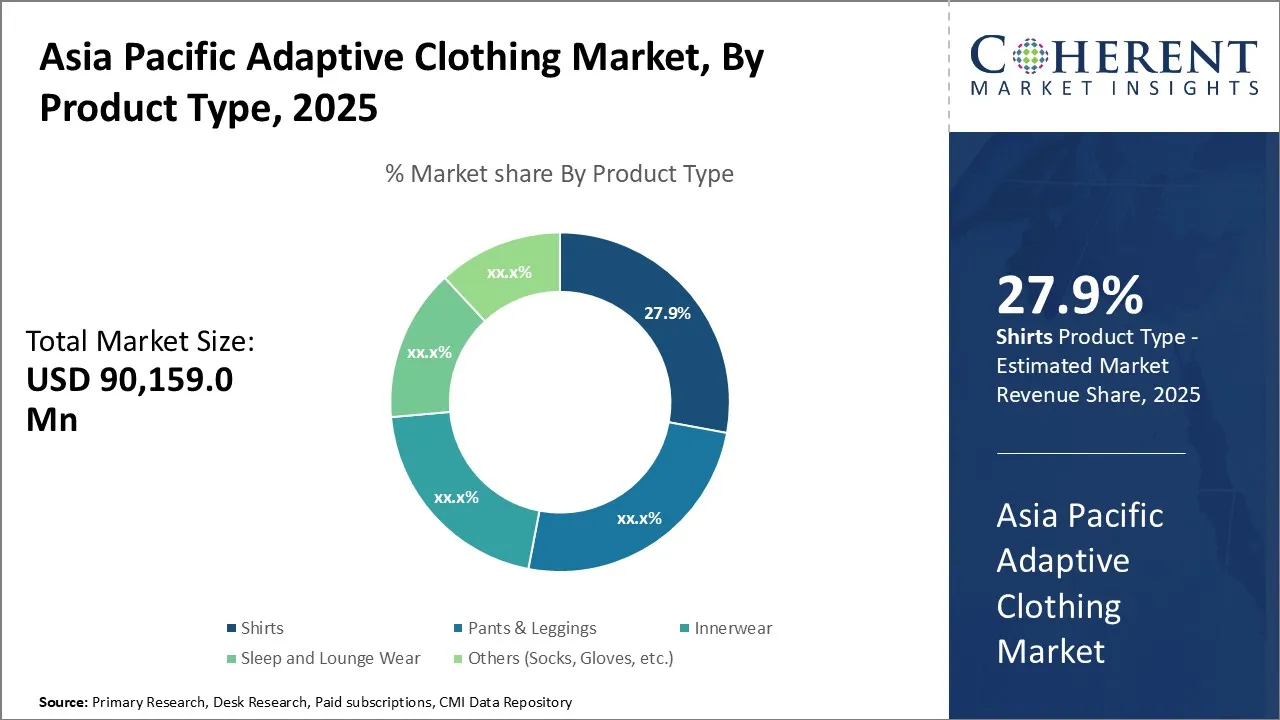
- The shirts segment is projected to account for 28.9 % of the Asia Pacific adaptive clothing market share in 2026.
- The above 60 years segment is expected to hold 39.1% of the market share in 2026.
- The female segment is projected to hold 50. 2% of the market share in 2026.
Market Overview
Market trends indicate a rising focus on inclusive fashion, as well as fast fashion with major brands integrating adaptive features such as magnetic closures, adjustable hems, and sensory-friendly fabrics. Technological advancements and increasing awareness about disability rights are driving product innovation and expanding consumer acceptance. Additionally, the growing elderly population and the prevalence of chronic conditions contribute to the demand, reshaping the Asia Pacific textile and apparel landscape by emphasizing accessibility, functionality, and style tailored to diverse consumer needs.
Current Events and Its Impact
Current Events | Description and its Impact |
Expansion of adaptive categories on major APAC marketplaces |
|
Aging demographics and home-care growth in East Asia |
|
Segmental Insights
- Current Industry Events of 2026
- Market Size Estimation
- Regional Breakdown
- Competitive Landscape
- Customer Intelligence
- Segmental Analysis
- Pricing Analysis
- Key Market Drivers, Challenges & Future Trends
- Customized Insights Section
Asia Pacific Adaptive Clothing Market Insights, by Product Type – Shirts Segment Dominates the Market due to Driving Growth Through Versatility and Ease of Use
The shirts segment is projected to account for 28.9% of market share in 2026, driven by their natural versatility and utility design for the needs of those needing adaptive clothing. Adaptive shirts offer features such as magnetic or Velcro fasteners, front or side openings, and adjustable sizing that accommodate the needs of individuals with limited mobility or disability and seniors. These adaptive features increase ease of dressing and undressing for all users in everyday convenience and indicates shirts will be the most common garment category for adaptive clothing.
For example, Marks & Spencer introduced adaptive shirts in Asia Pacific with magnetic fasteners and wider openings that were directly aimed at senior consumers in Japan. Consumers that struggle with buttoning shirts reported significantly improved adoption and preference for adaptive shirts once the challenge of use was directly addressed.
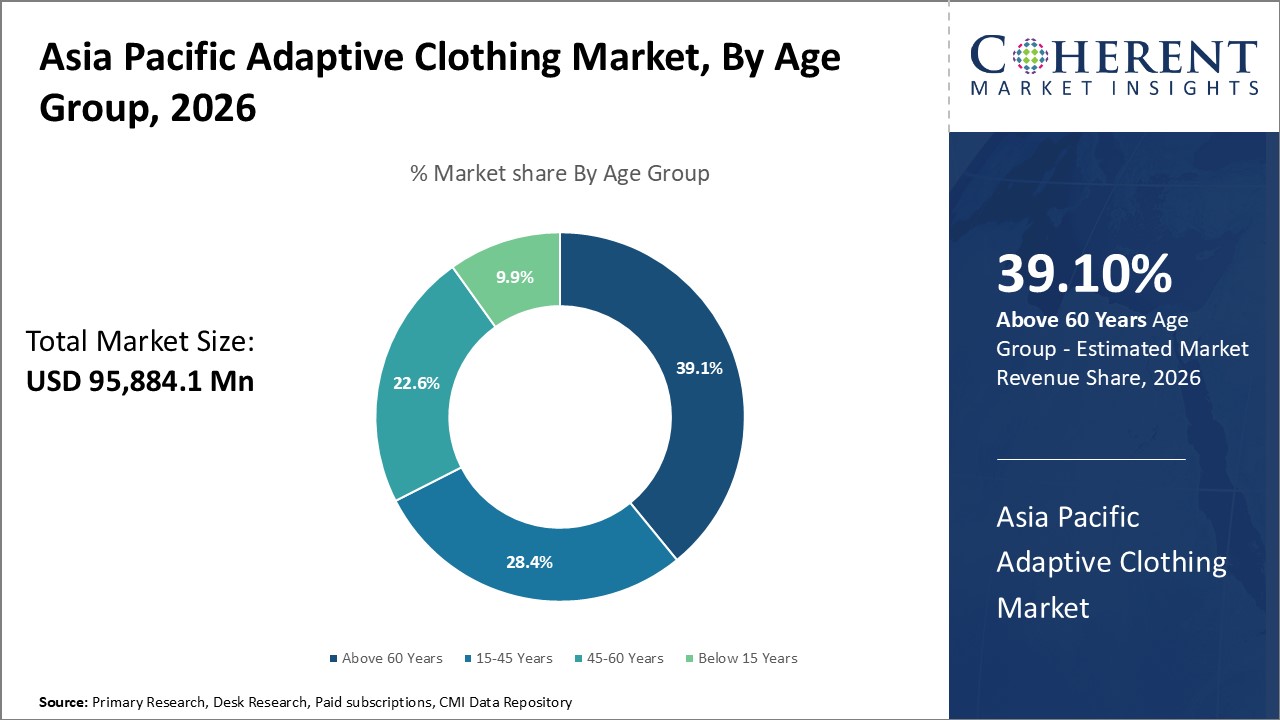
Asia Pacific Adaptive Clothing Market Insights, by Age Group - Above 60 Years Segment Dominates the Market Fueled by Aging Population and Health Concerns
The above 60 years segment is expected to lead the market in 2026 with a 39.1% share. This trend is closely related to the ongoing and rapid aging of the population in the region alongside increasing difficulties faced by older adults due to health-related issues. Aging causes changes such as loss of dexterity due to conditions like arthritis or other functional limitations that may affect mobility in certain clothing. Adaptive clothing for this population segment typically features closures that make getting dressed quicker and easier, incorporates stretchable materials, and has been ergonomically designed to simplify the dressing process and maximize independence and dignity in everyday living.
Asia Pacific Adaptive Clothing Market Insights, by Gender - Female Consumers Lead Market Share Due to Enhanced Caregiving and Fashion Sensitivity
The female segment is expected to capture 51.2% of the market share in 2026. This can be largely attributed to the dual role women often play as both end users and primary caregivers in many households. This can be mainly attributed to women often serving a dual purpose of both end user and primary caregiver in many households. Women's purchasing tendencies involve effectively improving comfort and utility for themselves or a family member by engaging in active processes of searching and inquiring about possible clothing options. In making purchasing decisions, style is often considered along with functionality, allowing for potential opportunities for manufacturers to increase market share by mixing adaptive features with women's fashion styles.
Consumer Buying Behavior Analysis
Key Behavior Patterns
- Rising demand is fueled by the growing elderly and disabled population who prioritize comfort, ease of dressing, and functional features such as magnetic closures, easy-access zippers, and stretchable fabrics.
- Consumers are increasingly seeking not only function but also stylish and dignified designs—modern adaptive clothing must align with current fashion trends while providing practical solutions.
- Awareness is a significant determinant: In regions where consumers are more aware of adaptive clothing options and inclusivity issues (often due to governmental or NGO campaigns), adoption rates are higher.
- Purchases are strongly influenced by recommendations from healthcare, rehabilitation centers, and caregivers, especially among older consumers and those with recent mobility limitations.
Influencing Trends
- The pandemic accelerated the adoption of online shopping channels, making adaptive clothing more accessible—online detailed descriptions and filtering options have reduced barriers for consumers with disabilities or limited mobility.
- The Asia Pacific region is the fastest-growing market, with adoption supported by rising disposable incomes, expanding middle-class segments, and increasing urbanization.
- In India and China, large and aging populations are driving expansion, along with governmental support and social campaigns that promote inclusivity and accessibility.
- Customization, digitized fitting solutions, and the integration of smart fabrics are gradually increasing, appealing to tech-savvy and urban consumers in the region.
Market Players, Key Development, and Competitive Intelligence
Key Development
- On September 10, 2025, Silverts, North America’s leading adaptive apparel brand with nearly a century of expertise in accessible fashion, announced the acquisition of IZ Adaptive, the award-winning adaptive clothing label founded by Canadian designer Izzy Camilleri. This merger unites two innovators in adaptive fashion to drive product innovation, broaden distribution channels, and deliver stylish, functional apparel to a wider consumer base across North America.
Top Strategies Followed by Asia Pacific Adaptive Clothing Market Players
- Established companies are dominant in the sector due to the significant investment in research and development, which allows them to innovate and produce high-performing adaptive apparel that is specifically designed for the unique preferences of consumers with disabilities or specific needs. By bringing together their expertise in technology and their ability to manufacture, established companies leverage expertise to continue reinforcing market leadership.
- For example, Tommy Hilfiger provides a case in point with their "Adaptive" line of products that contains products with magnetic closures, Velcro fastenings, and easy-open hems that target mobility-impaired consumers. Another example to consider is Nike's FlyEase line of products that includes easy-entry sneakers designed specifically for individuals with poor dexterity. These strategic endorsements demonstrate how the established companies meld technological development, design innovation, and global distribution to continue their market dominance.
- Mid-level players in the Asia Pacific adaptive clothing market, in contrast, leverage much more practical strategies based on price; they are primarily interested in securing a marginal return with acceptable quality. Their principle consideration is to entice price-sensitive consumers who wish to acquire functional adaptive clothing at price points that are much lower than established firms. Mid-level players are significantly concerned with the relative optimization of their manufacturing processes, sourcing efficient raw materials, and achieving a measured balance between price and durability.
- For example, Silverts strives for affordability through efficient sourcing and production in Asia and works with distributors in regions as a means to build on their expanded reach. Mid-tier organizations tend to work with contract manufacturers in countries such as Vietnam and Bangladesh to enhance the durability of their products while remaining competitively priced, allowing adaptive clothing solutions to be available to middle-income customers.
- Small players find a competitively different space, as they leverage specialized innovation and local knowledge to access niches in the Asia Pacific adaptive clothing market. These small players often focus on distinctive product features or a high-level of innovative design to address specific challenges, such as clothing for specific disabilities, and the use of smart textiles with sensors for improved comfort, and usability. Small players face pressure to compete on price and utilize innovative technologies, such as 3D knitting, and the inclusion of embedded health sensors, to stay competitive with mass-market products.
- Adaptive Clothing Australia creates apparel that is designed specifically for disability, including side-opening trousers for people who use wheelchairs. Some small innovators in Japan and South Korea use 3D knitting, and smart textiles that include sensors to improve comfort and capture health behaviors (e.g., posture, or body temperature, etc.).
Market Report Scope
Asia Pacific Adaptive Clothing Market Report Coverage
| Report Coverage | Details | ||
|---|---|---|---|
| Base Year: | 2025 | Market Size in 2026: | USD 95,884.1 Mn |
| Historical Data for: | 2020 To 2024 | Forecast Period: | 2026 To 2033 |
| Forecast Period 2026 to 2033 CAGR: | 6.3% | 2033 Value Projection: | USD 147,539.8 Mn |
| Segments covered: |
| ||
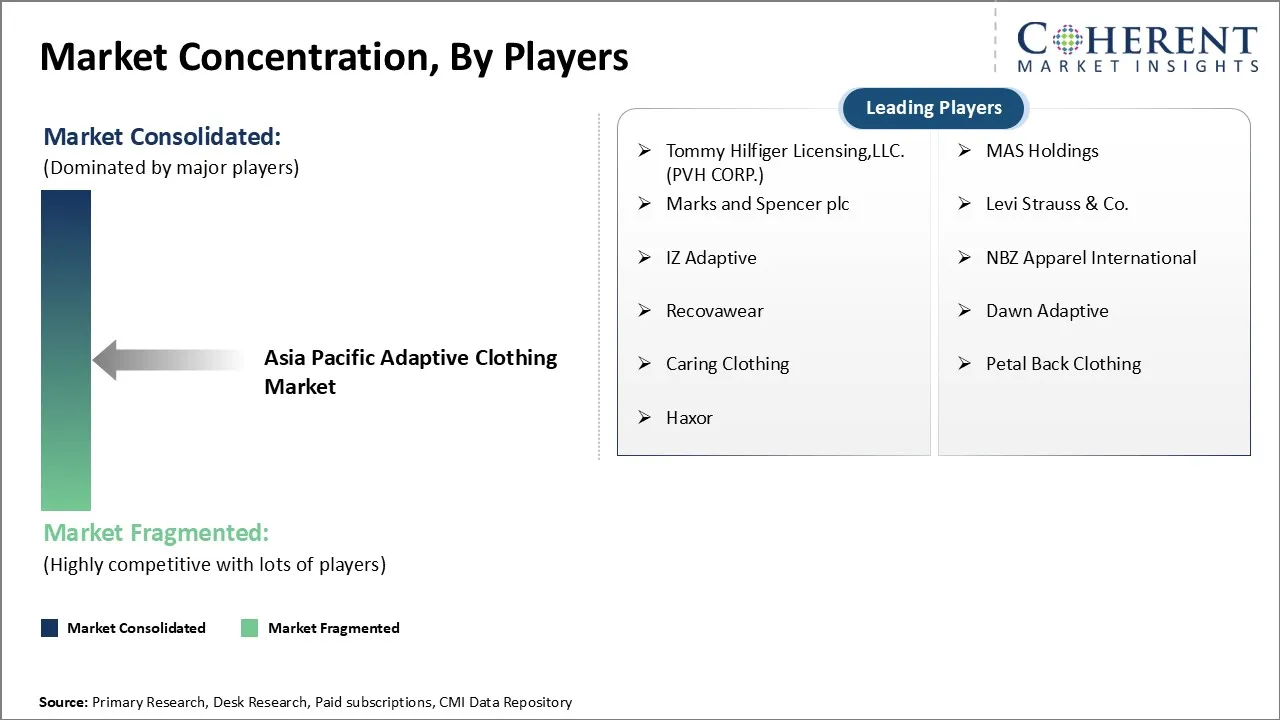
| Companies covered: | Tommy Hilfiger Licensing,LLC. (PVH CORP.), MAS Holdings, Marks and Spencer plc, Levi Strauss & Co., IZ Adaptive, NBZ Apparel International, Recovawear, Dawn Adaptive, Caring Clothing, Petal Back Clothing, and Haxor | ||
| Growth Drivers: |
| ||
| Restraints & Challenges: |
| ||
Asia Pacific Adaptive Clothing Market Dynamics
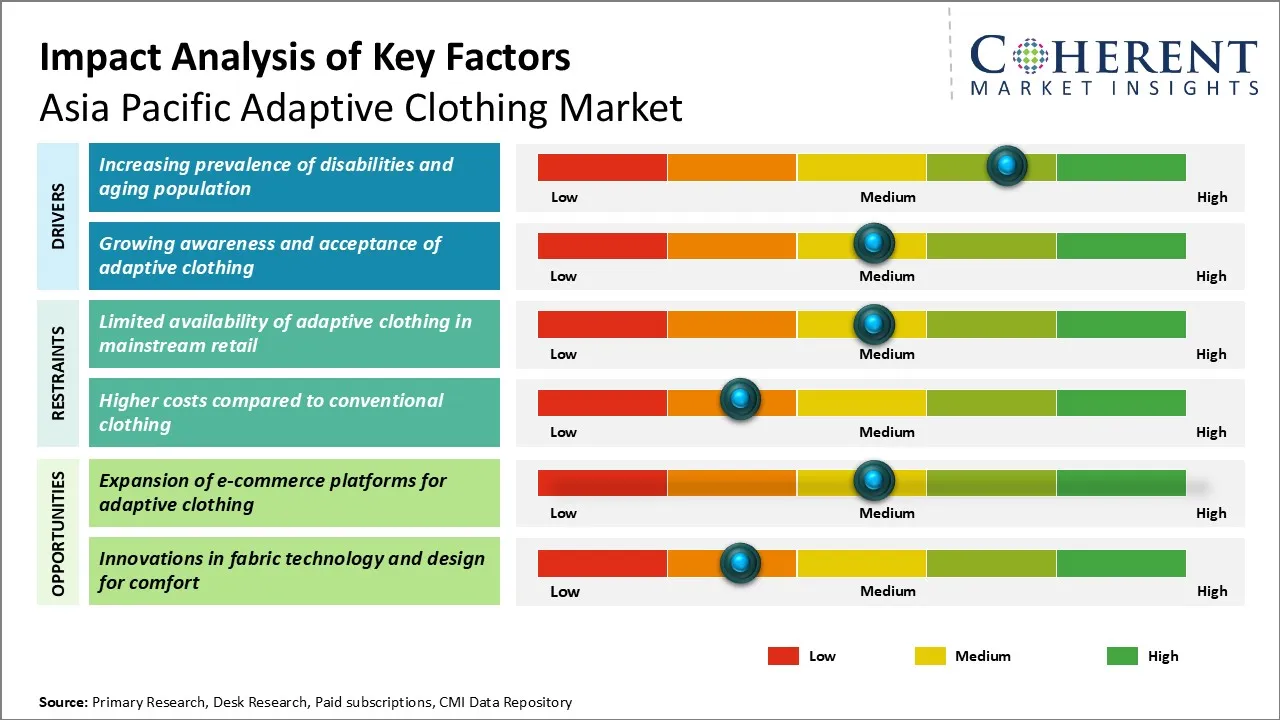
Asia Pacific Adaptive Clothing Market Driver - Increasing Prevalence of Disabilities and Aging Population
The rise in the incidence of disabilities and the rapidly aging population in the Asia Pacific region are important drivers of demand for adaptive clothing. The advances in healthcare enabling longer life spans mean that relatively more people are moving into older age brackets, with many more affected by mobility impairment, dexterity impairment, and other physical disabilities. The proportion of people living with these types of disabilities increases for people with congenital disabilities, disabilities acquired from injuries and those living with a chronic illness where their condition shrinks their abilities to move around (Omi, S., Furr, M., Fickwirth, L. (2020), Report on Adaptive Clothing). There is, therefore, an increasing demand for clothing that is easy to wear, comfortable to wear, and accessible; for children, these garments also prioritize independence and dignity in the dressing process.
For example, Japan, seen around 30% of its population aged 65 years and above by 2024 (World Bank, Statistics Bureau of Japan), and this increase in the aging population is accompanied by increased mobility challenges such as arthritis and reduced flexibility, as well as decreasing hand dexterity; these are all important factors driving demand for adaptive clothing, for example, those with magnetic closures and side openings.
Asia Pacific Adaptive Clothing Market Opportunity - Expansion of E-commerce Platforms for Adaptive Clothing
The adaptive clothing market in the Asia Pacific region will greatly benefit from the rapid growth of e-commerce platforms, offering significant opportunities for market players. Greater internet connectivity, an increased adoption of smartphones, and rising digital literacy across markets like China, India, Japan, and South East Asia have created the online shopping boom, giving consumers with disabilities or special needs access to both adaptive clothing and an alternative experience option. E-commerce retailers give brands the opportunity to connect with customer segments that are limited in reach or overall transport to a physical retail store.
For example, in India, Myntra collaborated with regional Indian adaptive clothing brands in 2024 to develop online collections that not only featured a focus on adaptive clothing, but also targeted customers who faced mobility challenges, especially in Tier-2 and Tier-3 cities, where physical retail is limited.
Analyst Opinion (Expert Opinion)
- The Asia Pacific adaptive clothing market is poised for significant expansion, driven by a growing awareness of inclusivity and the aging population. Insights from the Asia Pacific Fashion Summit (2023) and the Inclusive Design Conference (2022) underscored key innovations, with companies like Zalando and Uniqlo leading the charge in creating stylish and functional adaptive wear.
- Zalando’s recent launch of a dedicated adaptive clothing line demonstrates a strategic response to the increasing demand for fashionable yet practical options for individuals with disabilities. Discussions at these conferences highlighted the importance of user-centered design and the need for collaboration with healthcare professionals to ensure that products meet the specific needs of consumers.
- However, challenges such as limited market awareness and the need for education around adaptive clothing were often mentioned as barriers to growth. Brands that invest in marketing strategies that highlight the benefits and versatility of adaptive wear will likely capture a larger share of the market. Ultimately, the growth of the Asia Pacific adaptive clothing market will depend on its ability to innovate while addressing the unique requirements of diverse consumer segments in a rapidly evolving landscape.
Speak to the analyst
Want personalized insights?
Take the findings above to one of our principal consultants, or have the report rebuilt around the segments, geographies and competitors you actually track.
Market Segmentation
- Product Type Insights (Revenue, USD Mn, 2021 - 2033)
- Shirts
- Pants & Leggings
- Innerwear
- Sleep and Lounge Wear
- Others (Socks, Gloves, etc.)
- Age Group Insights (Revenue, USD Mn, 2021 - 2033)
- Above 60 Years
- 15-45 Years
- 45-60 Years
- Below 15 Years
- Gender Insights (Revenue, USD Mn, 2021 - 2033)
- Female
- Male
- Others
- Size Insights (Revenue, USD Mn, 2021 - 2033)
- Small & Extra Small
- Medium
- Large
- Others (XL, 2XL, etc.)
- Distribution Channel Insights (Revenue, USD Mn, 2021 - 2033)
- B2B
- B2C
- Online
- E-Commerce Websites
- Company/Brand-owned Websites
- Offline
- Specialty Stores
- Hypermarkets & Superstores
- Others (Adaptive Clothing Expo, etc.)
- Online
- Key Players Insights
- Tommy Hilfiger Licensing,LLC. (PVH CORP.)
- MAS Holdings
- Marks and Spencer plc
- Levi Strauss & Co.
- IZ Adaptive
- NBZ Apparel International
- Recovawear
- Dawn Adaptive
- Caring Clothing
- Petal Back Clothing
- Haxor
Sources
Primary Research Interviews
- Design Director – Leading Adaptive Clothing Manufacturer (APAC Region)
- Procurement Head – Major Apparel Retailer Specializing in Adaptive Wear (Asia Pacific)
- Marketing Lead – Disability Advocacy Organization Focused on Clothing Accessibility
- Sustainability Officer – Textile Certification Authority (APAC)
Stakeholders
- Manufacturers
- End Use Sectors:
- Elderly Care Facilities and Senior Living Centers
- Hospitals, Rehabilitation Centers, Home Healthcare Providers
- Disability and Special Needs Organizations
- Mainstream and Specialized Apparel Retailers, Online Marketplaces
- Regulatory & Certification Bodies (APAC Apparel Standard Organizations, Disability Rights Groups)
- Technology Providers (Wearable Textiles and Smart Clothing Development Firms)
Databases
- UN Comtrade Database
- India EXIM (Import Export) Database
- World Bank Open Data (Clothing & Disability Demographics)
Magazines
- Apparel Resources Asia – Trends in Adaptive and Inclusive Clothing
- Textile Today – Innovations in Adaptive Textiles
- Fashion Asia Journal – Regional Developments in Adaptive Fashion
- Healthcare Asia Magazine – Medical Wearables and Adaptive Garments
Journals
- Disability and Rehabilitation: Assistive Technology – Research on Adaptive Clothing
- Journal of Fashion Technology & Textile Engineering – Adaptive Garment Developments
- International Journal of Fashion Design, Technology and Education – Inclusive Clothing Studies
- Journal of Rehabilitation Medicine – Functional Clothing in Patient Recovery
Newspapers
- The Straits Times – Senior Care and Accessibility News in Southeast Asia
- South China Morning Post – China and Asia Market Updates on Accessibility Products
- Nikkei Asia – Business Trends in Textile and Adaptive Clothing
- The Hindu Business Line – Indian Adaptive Clothing Industry Developments
Associations
- Asia Fashion Federation
- Asia Pacific Assistive Technology Alliance
- International Society for Prosthetics and Orthotics (ISPO) – Asia Pacific Chapter
- Confederation of Indian Textile Industry
- Australasian Rehabilitation Outcomes Centre
Public Domain Sources
- World Health Organization – Disability and Health Reports for Asia Pacific
- United Nations ESCAP – Disability Inclusion and Accessibility Guidelines
- International Organization for Standardization (ISO) – Adaptive Clothing Standards
- Government Health Ministries (APAC Countries) – Consumer and Patient Care Guidelines
Proprietary Elements
- CMI Data Analytics Tool, Proprietary CMI Existing Repository of information for last 8 years.
Get access to 250+ pages report
Every segment, forecast, competitor profile and data table behind the analysis above — available for instant download.
- ESOMAR Member
- ISO 9001:2015 Certified
- D-U-N-S Registered
- GDPR & CCPA Compliant
Missing comfort of reading report in your local language? Find your preferred language:
Transform your Strategy with Exclusive Trending Reports
Frequently Asked Questions
The Asia Pacific adaptive clothing market is estimated to be valued at USD 95,884.1 Mn in 2026 and is expected to reach USD 147,539.8 Mn by 2033.
The CAGR of the Asia Pacific adaptive clothing market is projected to be 6.3% from 2026 to 2033.
Increasing prevalence of disabilities and aging population and growing awareness and acceptance of adaptive clothing are the major factors driving the growth of the Asia Pacific adaptive clothing market.
Limited availability of adaptive clothing in mainstream retail and higher costs compared to conventional clothing are the major factors hampering the growth of the Asia Pacific adaptive clothing market.
In terms of product type, the shirts segment is estimated to dominate the market revenue share in 2026.
Tommy Hilfiger Licensing,LLC. (PVH CORP.), MAS Holdings, Marks and Spencer plc, Levi Strauss & Co., IZ Adaptive, NBZ Apparel International, Recovawear, Dawn Adaptive, Caring Clothing, Petal Back Clothing, and Haxor are the major players.