

Asia Pacific Glyphosate Market Size and Forecast – 2026 To 2033
The Asia Pacific glyphosate market is expected to grow from USD 2.45 Bn in 2026 to USD 3.49 Bn by 2033, registering a compound annual growth rate (CAGR) of 5.2%. The market growth is primarily driven by the increasing adoption of genetically modified (GM) herbicide-tolerant crops, expansion of conservation/no-till farming practices, and rising global food demand amid shrinking arable land availability. Globally, GM crop acreage increased from nearly 187 million hectares in 2018 to over 209 million hectares in 2024, reflecting an increase of around 12%, which directly supports glyphosate consumption in weed management programs. (Source: nlm)
Key Takeaways of the Asia Pacific Glyphosate Market
- GM crops are projected to hold 67.5% share of the Asia Pacific glyphosate market in 2026, due to the widespread adoption of herbicide-tolerant crop systems such as cotton, soybean, and maize. These GM crops enable glyphosate to be applied directly and effectively for weed control, with increased yield efficiency and a reduced reliance on labor. China, India, and Australia are still enhancing biotech and high-yield farming practices increasing the use of glyphosate in large commercial farming systems. (Source: ScienceDirect)
- Solid segment is expected to hold 65.4% share of the Asia Pacific glyphosate market in 2026, due to their strong compatibility with the region’s agricultural structure, distribution systems, and climatic conditions. For instance, in India, the Ministry of Agriculture & Farmers Welfare (gov.in) supports pesticide and fertilizer access through state agriculture departments, cooperative societies, and regulated rural retail networks, ensuring last-mile delivery of agrochemicals even in remote farming areas.
- The agricultural segment is expected to account for 78.6% of the Asia Pacific glyphosate market in 2026. Glyphosate is widely applied in crops such as rice, wheat, maize, cotton, and soybeans, where weed competition significantly affects yield and productivity, particularly in densely cultivated farming systems across India, China, Vietnam, and Indonesia. In addition to staple crops, plantation agriculture also plays a crucial role in driving demand, particularly in Indonesia and Malaysia, where oil palm cultivation is a major agricultural activity. In these plantations, glyphosate-based herbicides are commonly used for inter-row and plantation floor weed control, helping reduce nutrient competition and improve overall plantation productivity under large-scale monocropping systems.
- Sustainable Weed Management Alignment: The increasing emphasis on precision agriculture and sustainable farming practices has been driving the adoption of glyphosate-based solutions that enhance weed control efficiency while optimizing resource utilization across Asia Pacific agricultural systems.
- Market Expansion Catalysts: Rising food security concerns, expanding mechanized farming, growing adoption of herbicide-tolerant crops, and government support for agricultural productivity improvement are accelerating the growth of the Asia Pacific glyphosate market
Segmental Insights
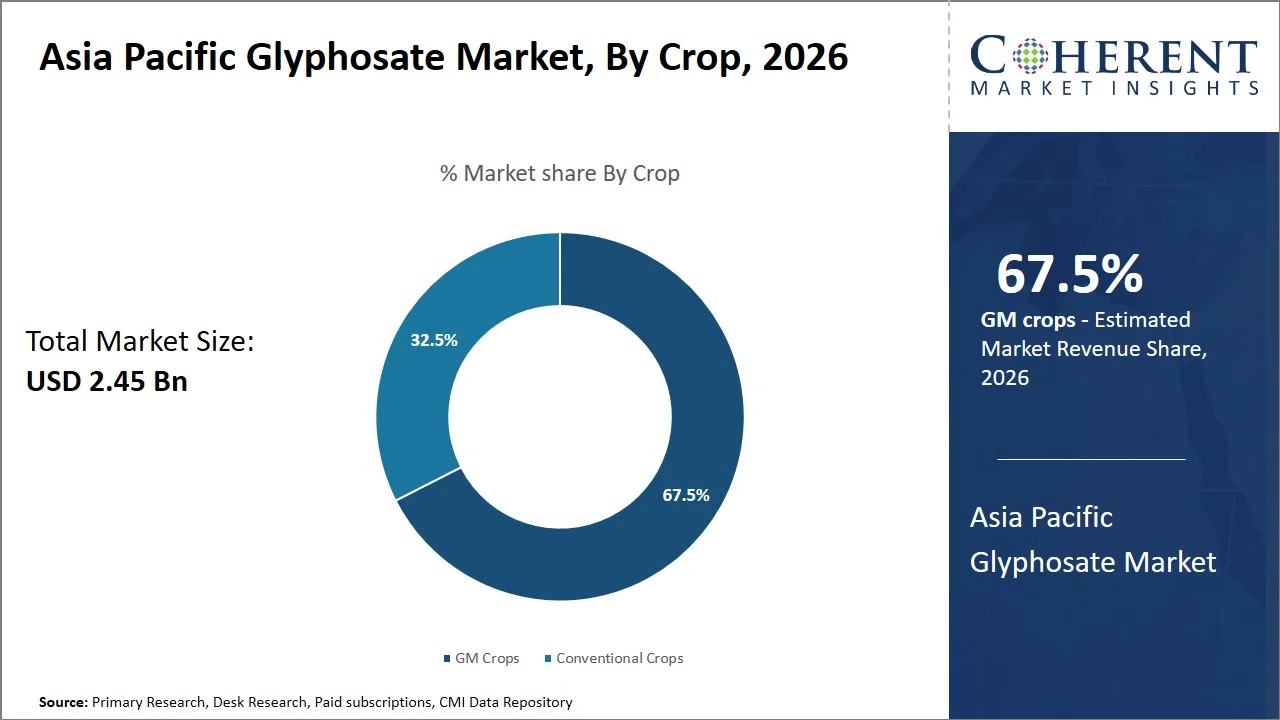
Why Does GM Crops Segment Dominate the Asia Pacific Glyphosate Market?
GM crops are favored due to their herbicide-resistant genes that enable farmers to spray glyphosate directly in fields to destroy weeds while leaving the crops unaffected. The segment is forecast to capture around 67.5% of the market share by 2026. This has significantly increased efficiency in agriculture especially during the mass cultivation of plants like soybean, cotton, and maize. Countries like China, India, and Australia have adopted genetically modified and herbicide-tolerant agricultural practices to reduce dependency on manual labor.
For example, India's high vegetated states like Maharashtra and Gujarat have started adopting GM or herbicide-resistant crops due to their benefits in regions where weeds exist and labor is costly. Enhanced food security through improved crop productivity and integrated weed management is one of the focus areas of the agricultural research institutions under the Ministry of Agriculture & Farmers Welfare (gov.in) which further contributes to the technology uptake. (Source: Indiagminfo.gov)
- Current Industry Events of 2026
- Market Size Estimation
- Regional Breakdown
- Competitive Landscape
- Customer Intelligence
- Segmental Analysis
- Pricing Analysis
- Key Market Drivers, Challenges & Future Trends
- Customized Insights Section
Why is Solid the Most Preferred Form of Glyphosate?
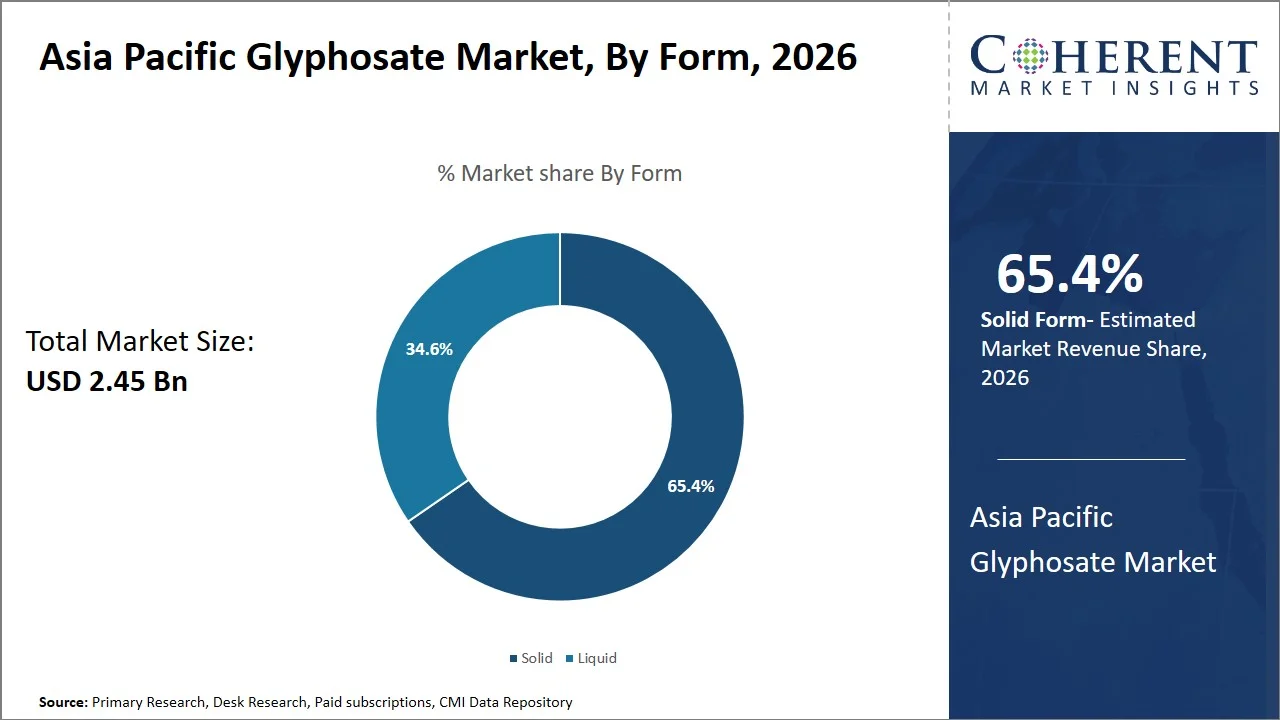
The solid segment is expected to hold a 65.4% share of the Asia Pacific glyphosate market in 2026, driven by its affordability, ease of storage, and suitability across diverse climatic conditions. Solid formulations offer better stability and longer shelf life compared to liquid forms, making them particularly advantageous in tropical and monsoon-prone countries such as India, Vietnam, and Indonesia, where high humidity can affect liquid product quality. Pre-measured sachets also simplify field application, reducing the risk of overdosing or misuse by farmers. Furthermore, government-supported agricultural distribution systems, such as India’s Department of Agriculture and Farmers Welfare initiatives, have improved the accessibility of agrochemicals in rural and remote farming regions.
For example, in smallholder farming regions of India, solid glyphosate sachets are commonly distributed through government and cooperative supply networks, enabling farmers to apply precise doses efficiently in rice and cotton fields while minimizing wastage and improving weed control consistency. According to Agriculture Today (The Natural Agriculture Magazine), India’s spend on crop protection chemicals is USD 2.5 billion, which is just 0.8 per cent of the total agrarian production. (Source: Agriculture Today)
Agricultural Segment Dominates the Asia Pacific Glyphosate Market
The agriculture segment is projected to hold a 78.6% market share in 2026. Glyphosate is widely used in crops such as rice, wheat, maize, cotton, and soybeans, where effective weed control is essential for maximizing yield. As the regional population continues to grow, farmers face increasing pressure to enhance productivity per hectare, making chemical weed management an integral part of modern farming practices.
In crops like soybeans in China and cotton in India, glyphosate is typically applied during the early growth stages at relatively high application rates to ensure effective weed suppression before weeds can compete with the crop for nutrients, water, and sunlight.
Currents Events and Their Impact
Current Events | Description and its Impact |
China’s continued expansion of glyphosate production capacity and export dominance (2025–2026) |
|
India imposing import restrictions and anti-dumping measures on herbicides (2025–2026) |
|
Asia Pacific Glyphosate Market Dynamics
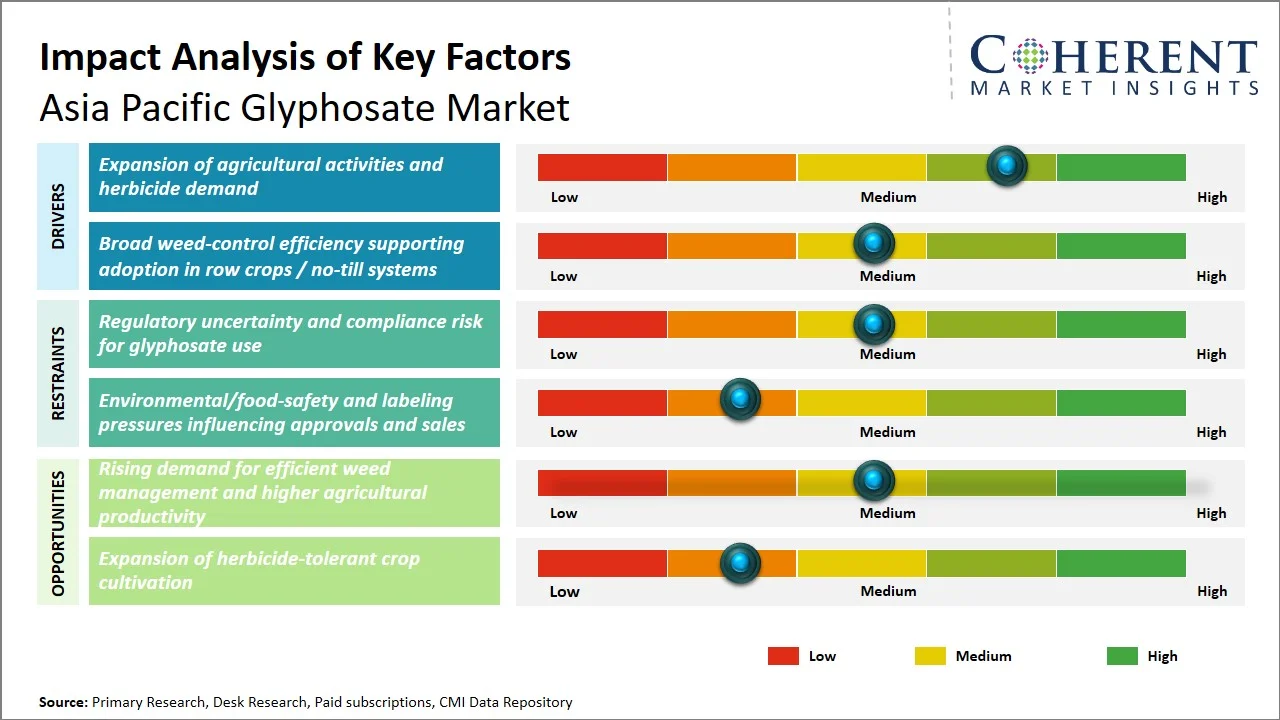
Market Drivers
- Expansion of agricultural activities and herbicide demand: The Asia Pacific glyphosate market is likely to be driven by the rise in the agricultural practice and demand for weed control. Over the last few years, the nations in Asia Pacific have been concentrating on enhancing their crop productivity to meet the growing population's demands and maintain food security. Moreover, increased pressure on farmers to produce more crops and reduce crop loss is pushing them to adopt herbicides such as glyphosate for commercial farming. The Ministry of Agriculture & Farmers Welfare reported that in 2023-2024, India's food grain production amounted to 332.98 million tons, whereas it was 329.69 million tons in 2022-2023. Moreover, foodgrains production also increased further to 357.73 million tons in 2024-2025, with an almost 8% increase in agricultural output. (Source: gov)
- Broad weed-control efficiency supporting adoption in row crops / no-till systems: One of the key drivers of glyphosate adoption in Asia Pacific is its broad-spectrum weed control capability. Glyphosate is used to control a broad spectrum of annual and perennial weeds and is a common herbicide for pre-planting land preparation, row crops, plantation crops and orchards. It is highly desirable in mechanized and conservation agriculture for minimizing labor and keeping fields weed free.
- India is also becoming a promising market for glyphosate in conservation agriculture especially for wheat and rice cultivation areas. The Government of India has encouraged Zero Tillage as a viable technology to enhance soil health and conserve water. This has led to a dramatic increase in the extent of zero tillage in the Indo-Gangetic Plains, where wheat is grown under reduced tillage over millions of hectares.
- In the Indo-Gangetic Plains, farmers of zero-till wheat commonly apply glyphosate in pre-sowing field preparation to kill existing weeds and crop residues which helps to conserve soil moisture and reduce production costs by eliminating the need for conventional ploughing for direct production costs. (Source: CGSpace)
Emerging Trends
- Shift Toward Precision and Sustainable Weed Management: Precision agriculture approaches are gaining traction as farmers in Asia Pacific strive to make better use of their fields, minimize chemical wastage, and maximize crop productivity by applying herbicides as targeted and precisely as possible.
- Rising Demand for Advanced and Low-Residue Formulations: The market is witnessing growing preference for high-performance liquid formulations, low-toxicity blends, and combination herbicides that improve weed resistance management while meeting tightening environmental and regulatory standards across the region.
Asia Pacific Glyphosate Resistance & Weed Mutation
Parameter | China | India | Australia |
Resistant weed species prevalence | High (multiple ALS, ACCase, EPSPS resistant weeds) | High (dominant in rice-wheat systems) | Very High (Lolium rigidum dominant) |
Resistance severity by crop | Rice: Very High | Rice: Very High | Wheat: Very High |
Multi-herbicide resistance emergence | Very High (ALS + ACCase + EPSPS stacking) | High | Very High |
How is the rising demand for efficient weed management and higher agricultural productivity creating new growth opportunities in the Asia Pacific glyphosate market?
With the growing demand for increased productivity and efficient weed control, the Asia Pacific glyphosate market is expected to witness substantial growth. Population growth, declining land availability per capita and increasing food security issues have compelled farmers in the region to squeeze as much production as possible from their lands and make their farms more efficient. Consequently, the use of herbicides like glyphosate is becoming more significant as these offer fast control of weeds, less competition for nutrients and water between the crop and the weeds, and a better overall agricultural productivity.
The Government of India has also been encouraging agricultural mechanization to boost productivity and decrease the labor dependence. The Ministry of Agriculture & Farmers Welfare reported that the mechanization status in India has improved from approximately 40% in 2014-2015 to almost 47% in recent years, with more mechanization in Punjab, Haryana and Uttar Pradesh.
(Source: agriwelfare.gov)
Market Players, Key Development, and Competitive Intelligence
Key Developments
- In March 2023, Albaugh, LLC acquired Corteva Agriscience's glyphosate business. This acquisition includes intangible assets such as formulations, trade names, regulatory data, registrations, patents, and know-how used worldwide in Corteva's straight-goods glyphosate business, except in Argentina.
Competitive Landscape
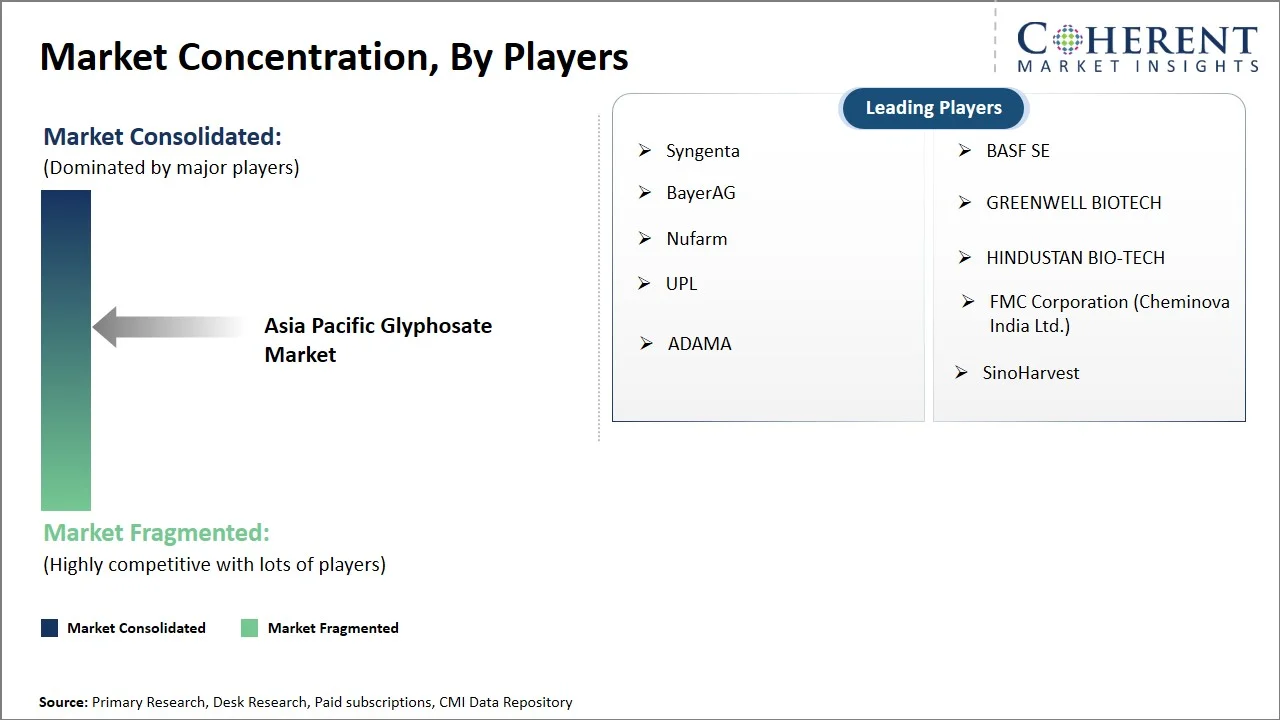
The Asia Pacific glyphosate market is highly competitive due to the strong presence of international agrochemical corporations along with big Chinese players and regional formulators. The competition within the industry depends on price, formulation, distribution, and regulations. Big companies utilize their production scale and strong network of dealerships, whereas smaller regional competitors rely on local distribution networks and economical products. Main priorities are
- Development of effective and minimal residue glyphosate formulations
- Increase in branded formulations and herbicide mixtures
- Expanding rural distribution networks and farmer interaction programs
- Collaboration with agri-retailers, co-operatives, and plantations
Market Report Scope
Asia Pacific Glyphosate Market Report Coverage
| Report Coverage | Details | ||
|---|---|---|---|
| Base Year: | 2025 | Market Size in 2026: | USD 2.45 Bn |
| Historical Data for: | 2020 To 2024 | Forecast Period: | 2026 To 2033 |
| Forecast Period 2026 to 2033 CAGR: | 5.2% | 2033 Value Projection: | USD 3.49 Bn |
| Segments covered: |
| ||
| Companies covered: | Syngenta, Bayer AG, Nufarm, UPL, ADAMA, BASF SE, GREENWELL BIOTECH, HINDUSTAN BIO-TECH, FMC Corporation (Cheminova India Ltd.), and SinoHarvest | ||
| Growth Drivers: |
| ||
| Restraints & Challenges: |
| ||
Analyst Opinion (Expert Opinion)
- The Asia Pacific region will continue to dominate in terms of volumes in the worldwide demand for glyphosate over the coming decade; however, the sector is shifting away from the simple economics-based consumption of herbicides towards efficiency-based and precision-based weed management. Future growth in demand will largely come from developing agricultural economies like India, Vietnam, Indonesia, and the Philippines – countries where penetration rates of herbicides per hectare are relatively lower while labor shortage issues in agriculture accelerate the adoption of machinery.
- India is considered as the most strategically attractive long-term investment opportunity in the region due to low penetration levels of glyphosate vis-a-vis the size of its agricultural sector. Some of the areas in which huge potential exists include non-selective weed elimination in plantations, cotton, sugarcane, tea, fruit-bearing plants, orchards, and pre-harvest preparations of fields. The largest business opportunity will be beyond the sale of products, but rather the education and agronomic advice-driven use of such products among farmers. States where farm mechanization and labor availability are growing at fast pace will witness a rapid rise in the use of glyphosate-based products.
Speak to the analyst
Want personalized insights?
Take the findings above to one of our principal consultants, or have the report rebuilt around the segments, geographies and competitors you actually track.
Market Segmentation
- Crop Insights (Revenue, USD Bn, 2021 - 2033)
- GM Crops
- Conventional Crops
- Form Insights (Revenue, USD Bn, 2021 - 2033)
- Solid
- Liquid
- Application Insights (Revenue, USD Bn, 2021 - 2033)
- Agricultural
- Grains & Cereals
- Oilseeds & Pulses
- Fruits & Vegetables
- Others
- Non-agricultural
- Agricultural
Sources
Primary Research Interviews
- Glyphosate manufacturer
- Supply Chain Director of agrochemical producer
- Crop protection specialist (e.g., herbicide formulator)
- Sustainability Officer of pesticide certification authority
Stakeholders
- Manufacturers of glyphosate and herbicides
- End-use Sectors
- Agricultural Farmers and Growers (e.g., rice, soybean producers in China/India)
- Plantation Owners (e.g., palm oil in Southeast Asia)
- Turf and Forestry Managers (e.g., Australian forestry)
- Regulatory & Certification Bodies: Ministry of Agriculture (China/India), APVMA (Australia), FAO/WHO JMPR, Asian Pacific Weed Science Society
- E-commerce Platforms and Retailers: Agrochemical distributors like IndiaMART, Alibaba, local suppliers in China/India
- Technology Integration Players: Innovators in GM crops and bio-herbicides (e.g., Corteva Agriscience, BASF)
Databases
- UN Comtrade Database (HS Code 3808.93 for herbicides, glyphosate-specific)
- India EXIM Database (glyphosate imports/exports)
- China Customs Trade Statistics
- Eurostat Trade Statistics for Agrochemicals (APAC focus)
- USITC DataWeb for herbicide imports from Asia Pacific
Magazines
- Crop Protection Magazine – Glyphosate trends in herbicides
- Food Safety Magazine – Regulatory updates on glyphosate
- Professional Farmer – Asia Pacific weed control applications
Journals
- Weed Biology and Management – Herbicide resistance in Asia-Pacific
- Asian Pacific Journal of Reproduction – Glyphosate effects studies (adapted for ag impacts)
- Journal of Weed Science – Glyphosate performance testing
Newspapers
- Business Standard (India) – Agrochemical demand and glyphosate imports
- South China Morning Post – China herbicide production
- The Australian – Glyphosate sustainability in farming
Associations
- Asian Pacific Weed Science Society (APWSS)
- Herbicide Resistance Action Committee (HRAC) Asia Pacific
- Australian Glyphosate Sustainability Working Group
- CropLife International (Asia division)
- National Association of Crop Protection (India/China equivalents)
Public Domain Sources
- FAO – Pesticide guidelines for Asia Pacific
- WHO JMPR – Glyphosate residue limits
- EPA equivalents (e.g., China's MEE) – Environmental standards for herbicides
- OECD – Agrochemical trade reports for sustainable farming
Proprietary Elements
- CMI Data Analytics Tool
- Proprietary CMI Existing Repository of information for last 10 years.
Get access to 250+ pages report
Every segment, forecast, competitor profile and data table behind the analysis above — available for instant download.
- ESOMAR Member
- ISO 9001:2015 Certified
- D-U-N-S Registered
- GDPR & CCPA Compliant
Missing comfort of reading report in your local language? Find your preferred language:
Transform your Strategy with Exclusive Trending Reports
Frequently Asked Questions
The Asia Pacific glyphosate market is estimated to be valued at USD 2.45 Bn in 2026 and is expected to reach USD 3.49 Bn by 2033.
The CAGR of Asia Pacific glyphosate market is projected to be 5.2% from 2026 to 2033.
Expansion of agricultural activities and herbicide demand and broad weed-control efficiency supporting adoption in row crops / no-till systems are the major factors driving the growth of the Asia Pacific glyphosate market.
Regulatory uncertainty and compliance risk for glyphosate use and environmental/food-safety and labeling pressures influencing approvals and sales are the major factors hampering the growth of the Asia Pacific glyphosate market.
In terms of crop, GM crops are estimated to dominate the market revenue share in 2026.
The market is expected to grow steadily due to increasing agricultural productivity needs and modernization across the region.
Farmers prefer glyphosate because it is affordable, effective against broad-spectrum weeds, and helps improve crop yields.