

Global Automotive Cybersecurity Market Size and Forecast – 2026-2033
The Global Automotive Cybersecurity Market is estimated to be valued at USD 1.22 Bn in 2026 and is expected to reach USD 3.14 Bn by 2033, exhibiting a compound annual growth rate (CAGR) of 14.4% from 2026 to 2033.
Key Takeaways of the Global Automotive Cybersecurity Market
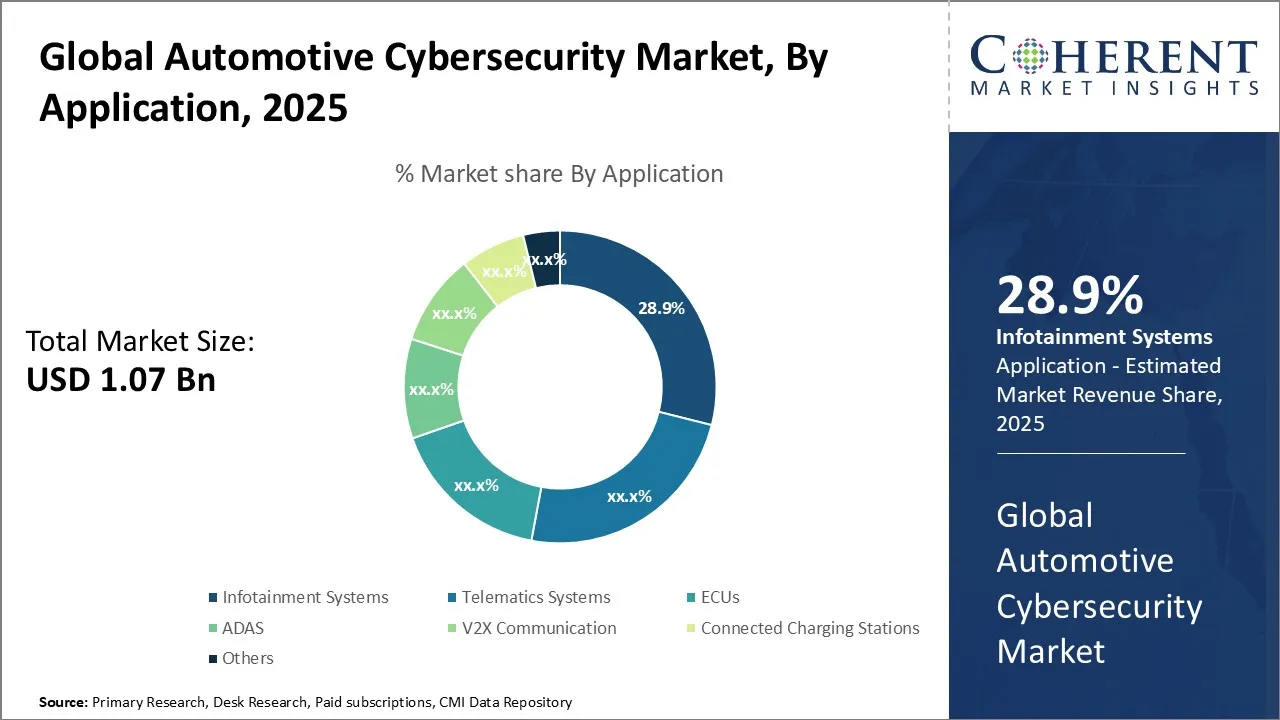
- The infotainment systems segment leads the market holding an estimated share of 29.9% in 2026.
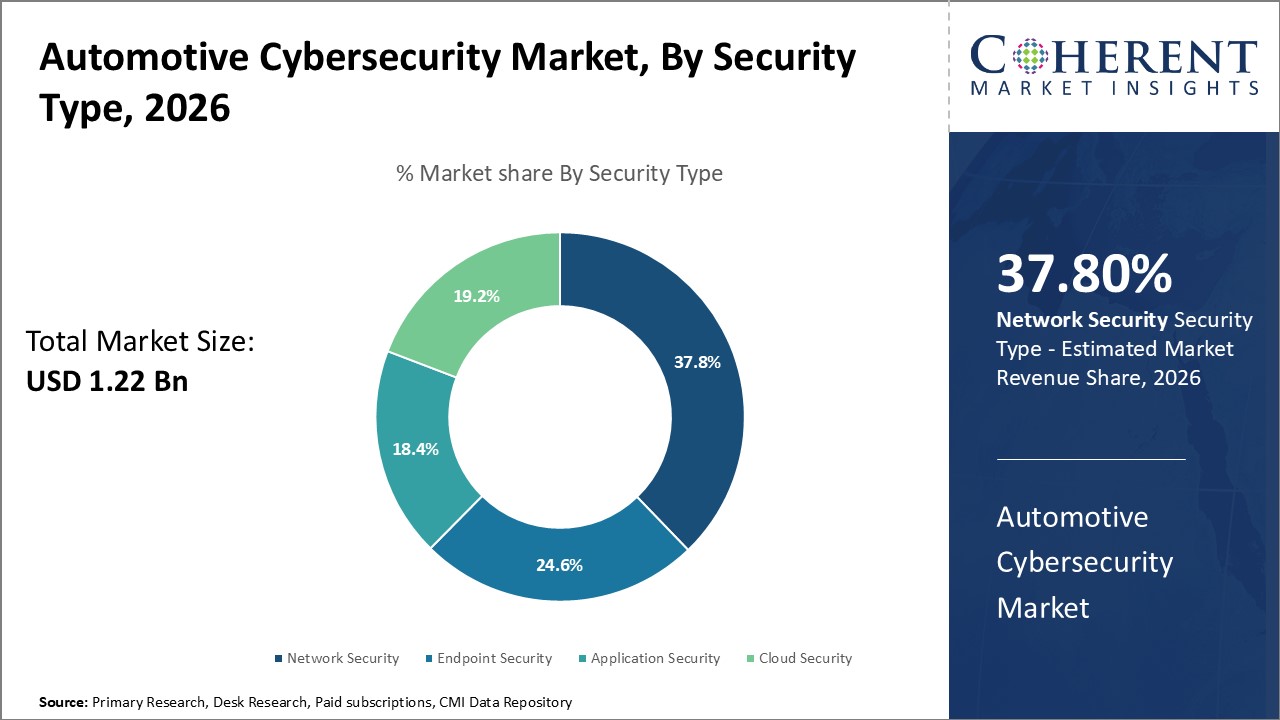
- The network security segment is projected to dominate with a share of 37.8% in 2026.
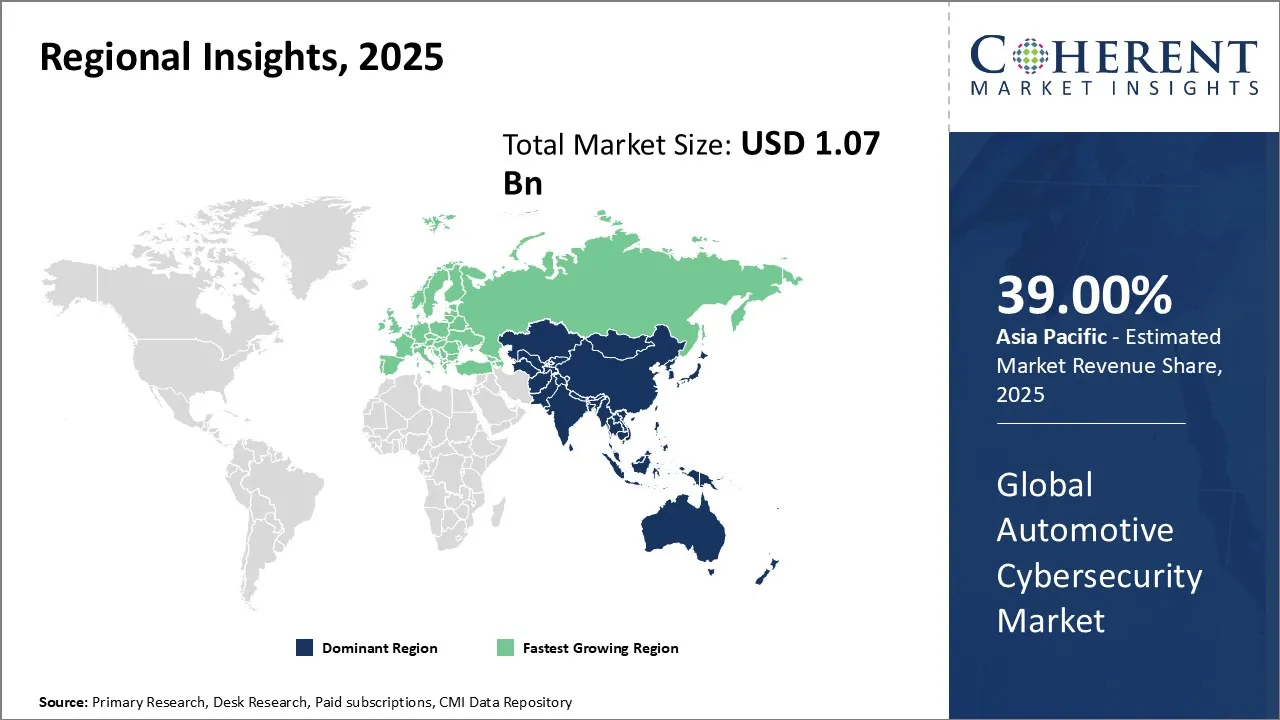
- Asia Pacific is estimated to lead the market with a share of 39% in 2026. Europe, holding a share of 25.1% in 2026, is projected to be the fastest growing region.
Market Overview
The market is seeing the growing use of Internet of Things (IoT) and connected car technologies, adding to vulnerability, thus making need for strong cybersecurity measures. The use of AI and machine learning in threat detection and response is also shaping the market, allowing real-time protection and predictive analysis to protect automotive networks.
Current Events and their Impact
Current Events | Description and its impact |
UNECE Regulation No. 155 (UN R155) becoming binding |
|
ISO/SAE 21434 adoption and compliance push (2024–2025) |
|
Jaguar Land Rover major cyber-attack and production disruption (Aug–Sep 2025) |
|
Segmental Insights
- Current Industry Events of 2026
- Market Size Estimation
- Regional Breakdown
- Competitive Landscape
- Customer Intelligence
- Segmental Analysis
- Pricing Analysis
- Key Market Drivers, Challenges & Future Trends
- Customized Insights Section
Global Automotive Cybersecurity Market Insights, by Application: Infotainment Systems Lead Because of Increasing Demand for Connected, Feature-Rich In-Vehicle Experiences
The infotainment systems segment is expected to hold a dominant position in the global automotive cybersecurity market, holding a share of 29.9% in 2026. Modern vehicles are increasingly equipped with sophisticated infotainment platforms that use navigation, media streaming, smartphone connectivity, voice recognition, and online services. This connectivity improves user convenience but also exposes vehicles to a big range of cyber threats, making robust cybersecurity measures necessary.
A primary driver for the growth of cybersecurity in infotainment systems is the heightened complexity and openness of these platforms. Infotainment systems often operate on sophisticated operating systems such as Android or Linux, and their connectivity to external networks —via Wi-Fi, Bluetooth, cellular networks, and USB interfaces— makes multiple entry points for cyberattacks. The use of third-party applications and continuous software updates add to vulnerability.
Consumer expectations for smooth integration with smartphones and cloud services have led automakers to make infotainment platforms. Protecting this data from breaches is very important. Also, regulatory focus on data privacy and secure communication in vehicles makes need for strict security controls in this segment.
Another big factor adding to cybersecurity investments in infotainment systems is the increasing deployment of over-the-air (OTA) updates, which help automakers remotely patch and upgrade software. While OTA improves functionality and vehicle safety, it also introduces new security challenges, as attackers may attempt to intercept or manipulate these updates. Securing the OTA process requires advanced cryptographic techniques and secure boot mechanisms tailored specifically for infotainment architectures.
Global Automotive Cybersecurity Market Insights, by Security Type: Network Security Dominates Because of the Critical Need to Safeguard Vehicle Communication and Data Exchange Channels
Network security is the leading segment in the global automotive cybersecurity market, holding an estimated share of 37.8% in 2026. This is because it plays a big role in protecting the communication networks of modern connected vehicles. Vehicles are greatly dependent a lot on networked systems for in-vehicle communication, vehicle-to-everything (V2X) connectivity, telematics, and external data exchange. These networks makes these vehicles very vulnerable, making security very important to prevent cyber intrusions.
The market is also seeing a move towards advanced driver assistance systems (ADAS) and autonomous driving, adding to the reliance on secure network communication. ADAS and autonomous functions need constant, precise data exchange between sensors, electronic control units (ECUs), and cloud services.
To add, the growing use of vehicle-to-vehicle (V2V) and vehicle-to-infrastructure (V2I) communication make new vulnerabilities that need better network security solutions. Cars have become an important part of smart transport ecosystems. These requirements push automakers and cybersecurity providers to innovate in cryptographic techniques.
Impact of Artificial Intelligence (AI) on the Automotive Cybersecurity Market
- Artificial Intelligence (AI) is making possible faster and more proactive detection and response to threats in connected vehicles. With millions of lines of code in modern cars, AI-driven anomaly detection systems can analyze in-vehicle communications, telematics data, and cloud interactions to find malicious patterns that human monitoring teams might miss.
- AI also plays a big role in predictive maintenance of cybersecurity defenses continuously learning from new attack vectors and feeding back into OEM and Tier-1 security systems. This helps manufacturers move from reactive patching toward adaptive, real-time defenses, which is important as vehicles become software-defined and connected to external networks like 5G and V2X.
- A real-world example came in 2023, when Upstream Security added AI-powered detection to its vehicle security operations center (vSOC). By applying machine learning to fleet-level data from connected cars, the company helped many OEMs and mobility providers detect abnormal telematics activity including unauthorized remote access attempts before they caused operational disruption.
Regional Insights
Asia Pacific Automotive Cybersecurity Market Analysis and Trends
The Asia Pacific region, holding a share of 39.0%, is expected to dominate the automotive cybersecurity market because of fast urbanization and a growing automotive manufacturing base. Countries like China, Japan, and South Korea are seeing a lot of adoption of connected vehicles and electric vehicles. Governments in the region focus on cybersecurity regulations and investments, supported by the presence of big semiconductor and automotive electronics manufacturers.
Companies like Huawei, NTT Data, and Denso make cybersecurity platforms and real-time threat mitigation systems for the different demands of the Asia Pacific region. Also, cross-border trade agreements and growing consumer awareness about vehicular safety add a lot to market growth.
Europe Automotive Cybersecurity Market Analysis and Trends
Europe, holding an estimated share of 25.1% in 2026, shows the fastest growth and is one of the most compliance-driven regions. The European Union has adopted UNECE WP.29 regulations (R155 and R156) and the ISO/SAE 21434 standard, which make cybersecurity and software update management a must for all new vehicles sold in member states.
The region has big automakers and suppliers like Volkswagen Group, BMW, Daimler (Mercedes-Benz), Continental AG, and Bosch (ESCRYPT), which are investing a lot in secure ECUs, over-the-air (OTA) update systems, and vehicle-to-everything (V2X) security frameworks. Strong collaboration between OEMs, Tier-1 suppliers, and specialized cybersecurity startups adds to innovation. Also, the presence of automotive hubs in Germany, France, Italy, and the U.K. adds to Europe’s position as a leader in standard-setting and technology adoption.
Global Automotive Cybersecurity Market Outlook for Key Countries
U.S. Automotive Cybersecurity Market Analysis and Trends
The U.S. sees a mature automotive industry with a lot of focus on adding innovative cybersecurity solutions to next-generation vehicles. Big players like General Motors and Ford are adding secure over-the-air update capabilities and intrusion detection systems. Collaborations with tech giants like Microsoft and Intel add to advancements in cloud-based vehicle security architectures. Also, the government's cybersecurity frameworks and incentives for electric and autonomous vehicle deployment add to the progressive nature of the market in the U.S.
Germany Automotive Cybersecurity Market Analysis and Trends
Germany continues to lead as Europe’s automotive cybersecurity hub, seeing renowned automobile manufacturers like Volkswagen, BMW, and Daimler. These companies invest a lot in protecting connected vehicle communication networks and making resilient software architectures. The German government supports the industry with strict cybersecurity standards and innovation funding, and trade policies with neighboring EU members push knowledge sharing and technology exchange. Bosch, headquartered in Germany, is a big contributor, offering comprehensive cybersecurity solutions for vehicle control systems.
China Automotive Cybersecurity Market Analysis and Trends
China’s fast growing automotive cybersecurity market grows because of its position as the world’s largest automobile manufacturing country and government initiatives supporting smart and connected vehicles. Chinese companies like Huawei and Tencent use their expertise in cybersecurity in automotive applications, focusing on secure telematics and cloud integration. Supportive policies for data security and automotive standards improve the ecosystem, and partnerships between domestic OEMs like Geely and international cybersecurity firms add to the deployment of strong protective measures.
Japan Automotive Cybersecurity Market Analysis and Trends
Japan sees technological innovation and early adoption of advanced automotive electronics. Big manufacturers like Toyota and Honda focus on vehicle cybersecurity as part of broader efforts to lead in autonomous driving technology. Collaboration with cybersecurity specialists like NTT Data helps make secure vehicle communication protocols and monitoring technologies. The government supports cybersecurity research with subsidies and strategic frameworks, adding to the nation’s push toward connected mobility and making a competitive market environment.
South Korea Automotive Cybersecurity Market Analysis and Trends
South Korea’s automotive cybersecurity landscape sees strong electronics industry and proactive government stance on digital security. Hyundai and Kia use cybersecurity defenses in the vehicle design level, working with tech companies like SK Telecom and LG Electronics to add AI-driven security systems. The government pushes innovation with regulatory frameworks and investment incentives.
Market Players, Key Development, and Competitive Intelligence
Key Developments
- In January 2025, QNX, a division of BlackBerry Limited, announced it is collaborating with Microsoft to make it easier for automakers to build, test, and refine software within the cloud, accelerating the development of Software-Defined Vehicles (SDVs).
- In July 2025, QNX, a division of BlackBerry Limited, and Vector signed a Memorandum of Understanding (MoU) to together develop and deliver a Foundational Vehicle Software Platform, a next-generation solution made to accelerate the development of software-defined vehicles (SDVs) and reduce the complexity of automotive software integration.
- In January 2025, Italian tech startup, Exein, agreed with Taiwan's MediaTek to provide cybersecurity systems to be embedded on the chipmaker's Genio platform.
- In December 2024, Funds advised by Triton signed an agreement to acquire the security and communications technology product business, from Bosch Group.
Top Strategies Followed by Automotive Cybersecurity Market Players
- Established market leaders invest a lot in research and development (R&D) to innovate advanced, high-performance cybersecurity solutions made for the increasingly complex and connected automotive ecosystem.
- Bosch’s subsidiary ESCRYPT has been investing in developing end-to-end cybersecurity solutions like in-vehicle intrusion detection systems and security operations center (vSOC) offerings.
- Mid-level companies in the automotive cybersecurity landscape offer cost-effective solutions that offer a balance between quality and affordability, targeting price-sensitive segments like small and mid-sized vehicle manufacturers or aftermarket service providers.
- Karamba Security offers VCode and embedded security platforms that make possible compliance at a relatively lower cost compared to larger Tier-1s.
- Small-scale companies focus on innovative and highly focused product offerings like solutions made for electric vehicles, connected car telematics security, or cybersecurity for autonomous driving systems.
- Upstream Security, a smaller but highly specialized vendor, focuses solely on cloud-based fleet cybersecurity and vSOC services.
Market Report Scope
Global Automotive Cybersecurity Market Report Coverage
| Report Coverage | Details | ||
|---|---|---|---|
| Base Year: | 2025 | Market Size in 2026: | USD 1.22 Bn |
| Historical Data for: | 2020 To 2024 | Forecast Period: | 2026 To 2033 |
| Forecast Period 2026 to 2033 CAGR: | 14.4% | 2033 Value Projection: | USD 3.14 Bn |
| Geographies covered: |
| ||
| Segments covered: |
| ||
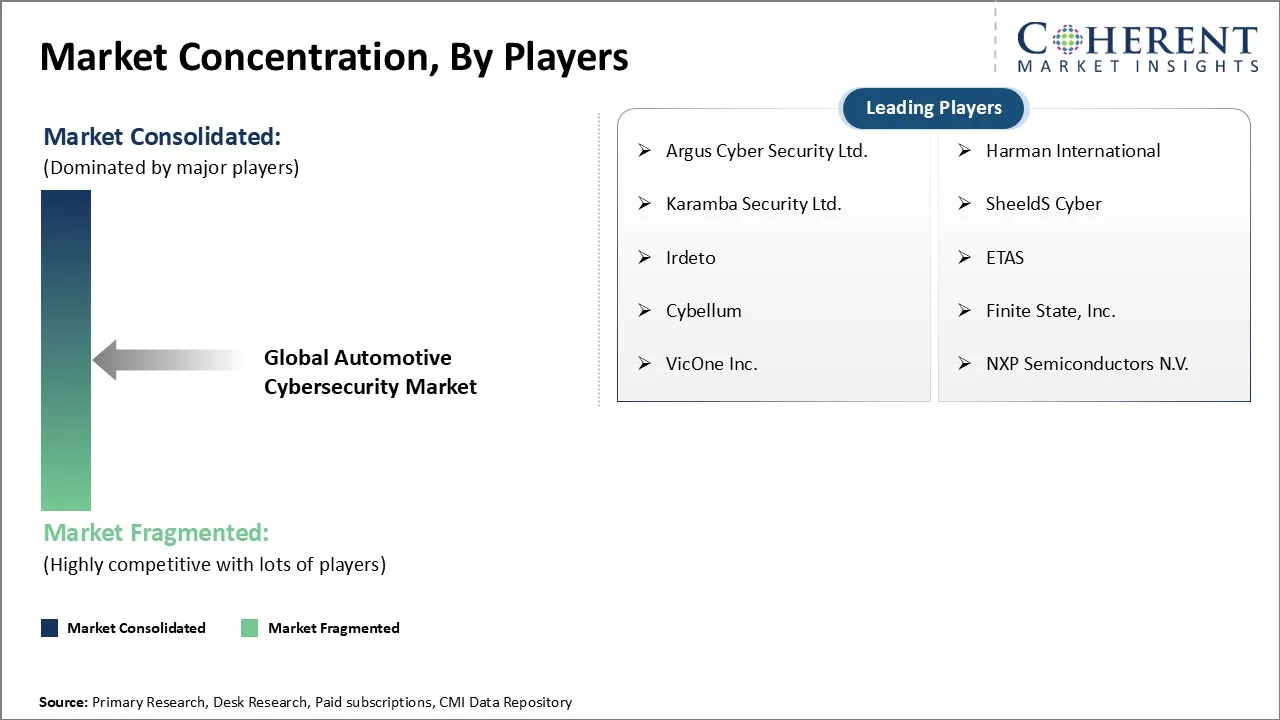
| Companies covered: | Argus Cyber Security Ltd., Harman International, Karamba Security Ltd., SheeldS Cyber, Irdeto, ETAS, Cybellum, Finite State, Inc., VicOne Inc., and NXP Semiconductors N.V. | ||
| Growth Drivers: |
| ||
| Restraints & Challenges: |
| ||
Market Dynamics
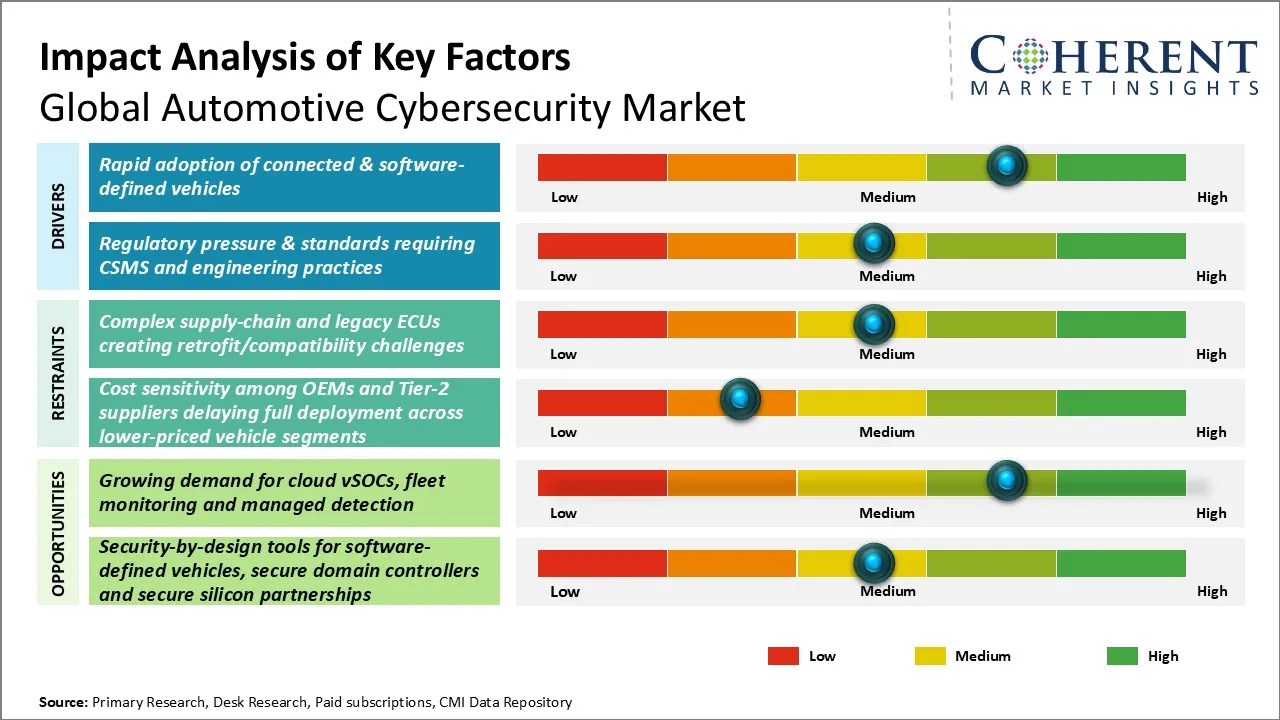
Global Automotive Cyber Security Market Driver - Rapid Adoption of Connected & Software-defined Vehicles
The accelerated integration of connected and software-defined vehicles is a pivotal driver propelling the automotive cybersecurity market forward. As vehicles rely more on advanced software platforms, connectivity features, and over-the-air updates, they become easier targets to cyber threats, making strong cybersecurity measures very necessary. The rise of vehicle-to-everything (V2X) communication, infotainment systems, and autonomous driving technologies have added a lot of entry points for potential cyberattacks.
Tesla’s OTA software update system allows Tesla vehicles to receive new features, performance improvements, and security patches remotely. Manufacturers are seeing the need to protect vehicle's internal networks and the external communication channels that connect vehicles to infrastructure, other vehicles, and cloud services.
Global Automotive Cyber Security Market Opportunity – Growing Demand for Cloud vSOCs, Fleet Monitoring, and Managed Detection
The rising complexity of connected vehicles and the popularity of autonomous driving technologies have made a lot of demand for advanced cybersecurity solutions. Cloud vSOCs allow automotive manufacturers and fleet operators to efficiently monitor and respond to cyber threats in real time.
This shift is because of the increasing connectivity of in-vehicle systems, which exposes vehicles to potential cyberattacks like data breaches and remote hacking risks. Fleet monitoring solutions further expand this opportunity by allowing operators to track and secure entire vehicle fleets, ensuring operational safety and regulatory compliance through real-time analytics and automated alerts on suspicious activities. Collectively, these evolving cybersecurity needs show a big growth avenue for vendors offering integrated cloud-based security operations, fleet-wide surveillance, and managed detection capabilities made for the automotive sector’s unique risk landscape.
Analyst Opinion (Expert Opinion)
- In North America, demand is made by strict compliance requirements, high EV penetration, and OEM investment in software-defined vehicles. Established Tier-1 suppliers and cybersecurity vendors see a lot of traction here because of regulatory pressure and the region’s focus on liability and safety.
- Europe’s demand is highly influenced by UNECE R155/ISO 21434 regulations and cross-border OEM collaboration. European automakers focus on cybersecurity-by-design, making demand for end-to-end security integration and partnerships with startups to address both compliance and innovation.
- Asia Pacific, particularly China, Japan, and South Korea, shows the highest growth rate because of huge EV production and fast adoption of connected car technologies.
Speak to the analyst
Want personalized insights?
Take the findings above to one of our principal consultants, or have the report rebuilt around the segments, geographies and competitors you actually track.
Market Segmentation
- Application Insights (Revenue, USD Bn, 2021 - 2033)
- Infotainment Systems
- Telematics Systems
- ECUs
- ADAS
- V2X Communication
- Connected Charging Stations
- Others
- Security Type Insights (Revenue, USD Bn, 2021 - 2033)
- Network Security
- Endpoint Security
- Application Security
- Cloud Security
- Regional Insights (Revenue, USD Bn, 2021 - 2033)
- North America
- U.S.
- Canada
- Latin America
- Brazil
- Argentina
- Mexico
- Rest of Latin America
- Europe
- Germany
- U.K.
- Spain
- France
- Italy
- Russia
- Rest of Europe
- Asia Pacific
- China
- India
- Japan
- Australia
- South Korea
- ASEAN
- Rest of Asia Pacific
- Middle East
- GCC Countries
- Israel
- Rest of Middle East
- Africa
- South Africa
- North Africa
- Central Africa
- North America
- Key Players Insights
- Argus Cyber Security Ltd.
- Harman International
- Karamba Security Ltd.
- SheeldS Cyber
- Irdeto
- ETAS
- Cybellum
- Finite State, Inc.
- VicOne Inc.
- NXP Semiconductors N.V.
Sources
Primary Research Interviews
Stakeholders
- Automotive OEMs (e.g., BMW, Ford, Toyota, BYD)
- Tier-1 Suppliers (e.g., Bosch, Continental, Aptiv)
- Cybersecurity Solution Providers (e.g., BlackBerry QNX, Karamba Security, Upstream Security)
- Semiconductor Companies (e.g., NXP, Infineon, Renesas)
- Fleet Operators and Mobility Service Providers (e.g., Uber, Didi, Daimler Trucks)
- Regulatory Experts on UNECE R155 and ISO/SAE 21434
- Automotive Software Engineers and Embedded Security Specialists
Databases
- Eurostat
- U.S. Department of Transportation (NHTSA Cybersecurity Reports)
- OECD Mobility Data
- Automotive World Database
- European Union Agency for Cybersecurity (ENISA)
Magazines
- Automotive News
- Cybersecurity Magazine
- Connected Car Magazine
- Telematics Wire
Journals
- IEEE Transactions on Intelligent Transportation Systems
- Journal of Automotive Software Engineering
- Transportation Cybersecurity Journal
- SAE International Journal of Connected and Automated Vehicles
- Computers & Security (Elsevier)
Newspapers
- The Wall Street Journal (US)
- Financial Times (UK)
- Nikkei Asia (Japan)
- The Economic Times (India)
- Automotive World Daily News
Associations
- Automotive Information Sharing and Analysis Center (Auto-ISAC)
- Society of Automotive Engineers (SAE International)
- European Automobile Manufacturers’ Association (ACEA)
- Japan Automobile Manufacturers Association (JAMA)
- International Organization of Motor Vehicle Manufacturers (OICA)
Public Domain Sources
- UNECE Regulations (R155, R156)
- U.S. Department of Homeland Security (Automotive Cybersecurity Alerts)
- European Union Agency for Cybersecurity (ENISA Reports)
- World Bank Mobility & Infrastructure Data
- ResearchGate (Automotive Cybersecurity Publications)
Proprietary Elements
- CMI Data Analytics Tool
- Proprietary CMI Existing Repository of information for last 8 years
Get access to 250+ pages report
Every segment, forecast, competitor profile and data table behind the analysis above — available for instant download.
- ESOMAR Member
- ISO 9001:2015 Certified
- D-U-N-S Registered
- GDPR & CCPA Compliant
Missing comfort of reading report in your local language? Find your preferred language:
Transform your Strategy with Exclusive Trending Reports
Frequently Asked Questions
The global automotive cybersecurity market is estimated to be valued at USD 1.22 Bn in 2026 and is expected to reach USD 3.14 Bn by 2033.
The CAGR of the global automotive cybersecurity market is projected to be 14.4% from 2026 to 2033.
Rapid adoption of connected & software-defined vehicles and regulatory pressure & standards requiring CSMS and engineering practices are the major factors driving the growth of the global automotive cybersecurity market.
Complex supply-chain and legacy ECUs creating retrofit/compatibility challenges and cost sensitivity among OEMs and Tier-2 suppliers delaying full deployment across lower-priced vehicle segments are the major factors hampering the growth of the global automotive cybersecurity market.
In terms of application, infotainment systems are estimated to dominate the market revenue share in 2026.
Argus Cyber Security Ltd., Harman International, Karamba Security Ltd., SheeldS Cyber, Irdeto, ETAS, Cybellum, Finite State, Inc., VicOne Inc., and NXP Semiconductors N.V. are the major players.
Asia Pacific is expected to lead the global automotive cybersecurity market in 2026.