

Global Automotive Engine Oil Market Size and Forecast: 2026-2033
The Global Automotive Engine Oil Market is estimated to be valued at USD 44.79 Bn in 2026 and is expected to reach USD 56.60 Bn by 2033, exhibiting a compound annual growth rate (CAGR) of 3.4% from 2026 to 2033.
Key Takeaways of the Automotive Engine Oil Market
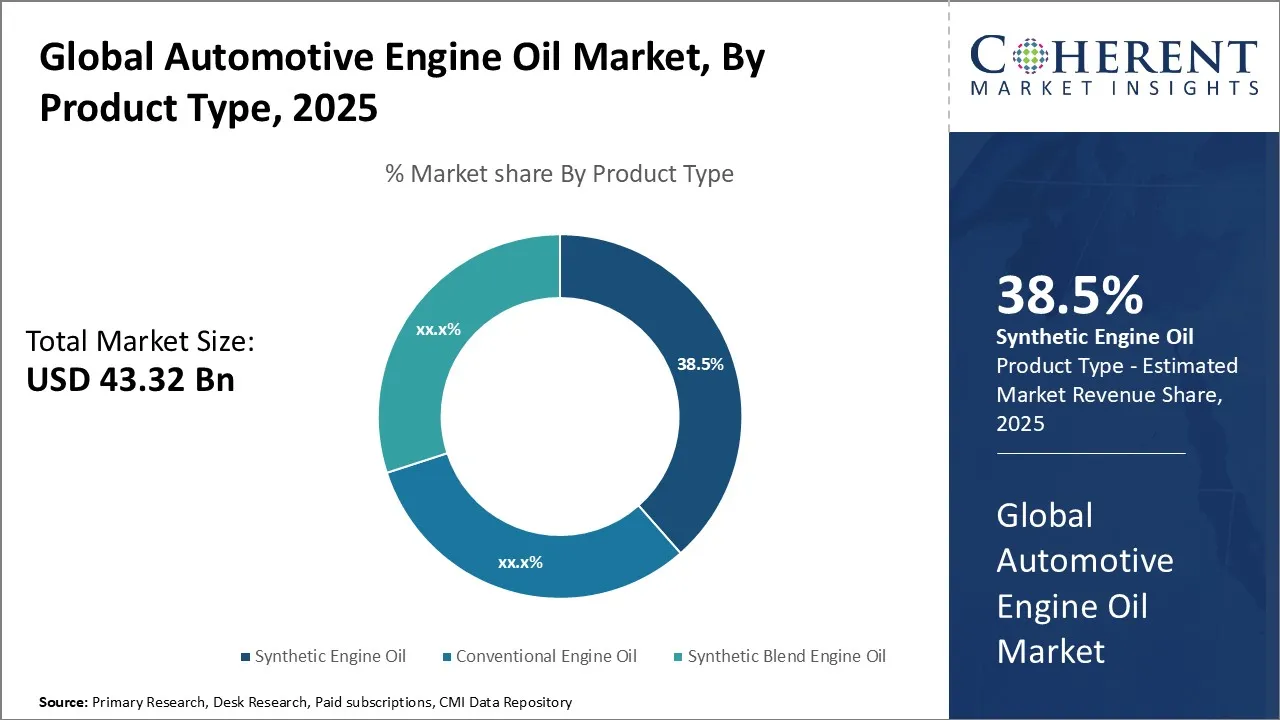
- The synthetic engine oil segment is expected to account for 39.5 % of the global automotive engine oil market in 2026.
- The SAE 0W-20 segment is projected to hold 22.7% market share in 2026.
- The passenger cars segment is expected to hold 45.6% of the market share in 2026.
- Asia Pacific is expected to dominate the global automotive engine oil market in 2026 with a 47. 8% share. North America, holding a 23.5% market share in 2026, will be the fastest-growing region.
Market Overview
Market trends indicate a significant shift towards synthetic and semi-synthetic engine oils due to their superior efficiency and environmental benefits compared to conventional oils. Additionally, stricter emission regulations and rising consumer consciousness regarding vehicle maintenance are encouraging manufacturers to innovate more durable and eco-friendly lubricant formulations. The growing adoption of electric and hybrid vehicles is also influencing engine oil market dynamics, pushing key players to diversify product portfolios to meet evolving automotive needs.
Currents Events and their Impact
Current Events | Description and its impact |
Stricter Global Emissions Regulations (2025 Onwards) |
|
Circular Economy and Bio-based Oil Initiatives |
|
Segmental Insights
- Current Industry Events of 2026
- Market Size Estimation
- Regional Breakdown
- Competitive Landscape
- Customer Intelligence
- Segmental Analysis
- Pricing Analysis
- Key Market Drivers, Challenges & Future Trends
- Customized Insights Section
Automotive Engine Oil Market Insights, By Product Type - Synthetic Engine Oil Segment Dominates Due to Its Advanced Performance and Longevity
Synthetic engine oil segment is expected to hold 39.5% share of the global automotive engine oil market in 2026. The dominance of synthetic engine oil is primarily driven by its superior performance characteristics and the increasing demand for enhanced engine protection and fuel efficiency. Synthetic oils are engineered using chemically modified petroleum components or entirely synthesized compounds that provide a more consistent molecular structure compared to conventional oils. This consistency translates into better thermal stability, reduced engine wear, and improved lubrication under extreme temperatures.
Automakers and consumers are increasingly favoring synthetic engine oils because of their ability to maintain optimal viscosity across a broader temperature range. This feature allows vehicles to start smoothly in cold climates while protecting the engine during intense operating conditions, such as prolonged high-speed driving or towing heavy loads. Additionally, synthetic oil’s resistance to oxidation prevents sludge build-up, thereby extending oil change intervals and reducing maintenance costs over time. This attribute appeals particularly to luxury and high-performance vehicle owners who prioritize engine health and longevity.
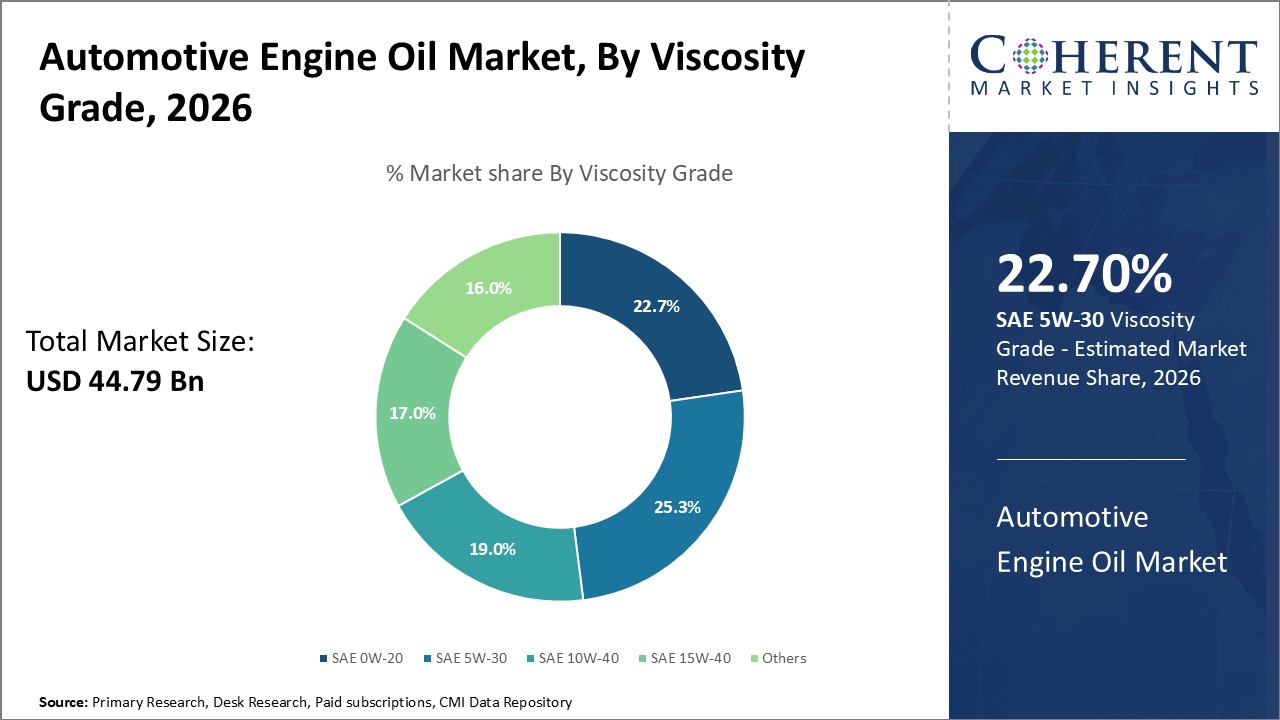
Automotive Engine Oil Market Insights, By Viscosity Grade - SAE 0W-20 Segment Dominates Due to Its Fuel Efficiency and Emission Standards
SAE 0W-20 segment is projected to command 22.7% of the market share in 2026. The increasing shift towards lower viscosity oils like SAE 0W-20 is primarily propelled by the automotive industry's objective to enhance fuel efficiency and adhere to strict emissions norms. Lower viscosity oils reduce the internal friction between engine components during operation, which directly improves fuel economy and minimizes energy loss.
SAE 0W-20 is especially designed to provide excellent cold-start performance, which is vital in regions experiencing cold temperatures. Its ability to maintain a low viscosity at low temperatures ensures quick lubrication upon engine startup, protecting vital engine parts from wear and improving engine responsiveness. As a result, this grade is widely recommended for modern vehicles equipped with advanced engine technologies, such as turbochargers and variable valve timing systems, which demand precise lubrication for optimal performance.
Automotive Engine Oil Market Insights, By Application - Passenger Cars Segment Dominates Due to Growing Urbanization and Rising Vehicle Ownership
Passenger cars segment is expected to represent 45.6% share of the market in 2026. This is significantly driven by rapid urbanization, increasing disposable incomes, and growing preference for personal mobility and comfort worldwide. As more middle-class consumers aspire towards vehicle ownership, the absolute number of passenger cars on the road continues to rise, propelling the demand for engine lubricants designed specifically for these vehicles.
Passenger cars impose unique requirements on engine oil due to their typical usage patterns, including frequent start-stop driving in urban traffic, varied road conditions, and demand for smooth operation. Engine oils tailored for passenger cars are formulated to handle such operational stresses by protecting against wear, reducing deposits, and ensuring fuel efficiency. Additionally, the trend toward vehicle light weighting and the integration of complex emission control technologies necessitate lubricants that can maintain performance while enhancing engine protection.
Regional Insights
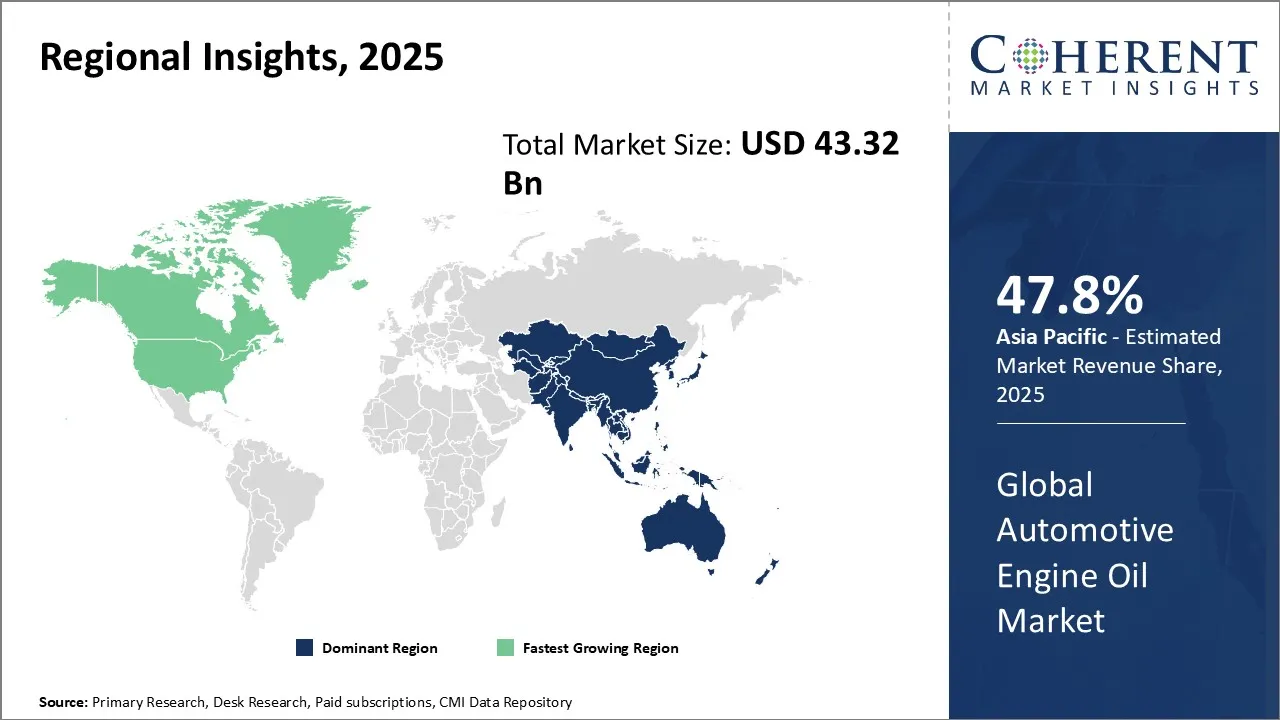
Asia Pacific Automotive Engine Oil Market Analysis and Trends
The Asia Pacific region is projected to lead the market with an estimated 47.8% share in 2026, driven by the region's expansive automotive manufacturing base and rapidly increasing vehicle production and sales. Countries such as China, India, and Japan host a vast network of automotive OEMs and aftermarket service providers, creating a robust demand ecosystem for engine oils. Government policies promoting stricter fuel efficiency norms and emission standards have accelerated the adoption of advanced synthetic and semi-synthetic engine oils.
Additionally, extensive urbanization and rising disposable incomes fuel vehicle ownership, further propelling the demand for high-performance lubricants. Leading companies like Shell, ExxonMobil, TotalEnergies, and Indian Oil Corporation have a strong presence, investing in localized production, innovation, and distribution networks to cater to diverse engine oil requirements across passenger and commercial vehicles.
North America Automotive Engine Oil Market Analysis and Trends
North America region is expected to exhibit the fastest growth in the market contributing 23.5% share in 2026, driven by high vehicle ownership, strict emission norms (EPA, CARB), and demand for premium synthetic oils. The U.S. and Canada dominate due to a mature aftermarket, consumer awareness, and OEM-driven preferences. Leading firms like ExxonMobil and Valvoline are expanding through R&D and digital channels. Trends such as extended drain intervals and EV-specific lubricants further boost market evolution.
Global Automotive Engine Oil Market Outlook for Key Countries
China Automotive Engine Oil Market Trends
China’s automotive engine oil market remains pivotal due to its status as the world’s largest automotive manufacturer and consumer. The country emphasizes reducing vehicular emissions and enhancing fuel economy, which has led to stringent regulations favoring the use of advanced engine oils consistent with new-generation engines. Major players such as Sinopec, Shell, and TotalEnergies are investing heavily in research and localized manufacturing to meet the requirements of a wide range of vehicles—from personal cars to commercial trucks—while focusing on sustainability and innovation.
India Automotive Engine Oil Market Trends
India’s automotive engine oil market is evolving rapidly as a result of growing vehicle penetration and government mandates under the Bharat Stage emission standards. Regulatory pressure and consumer awareness are steering demand towards synthetic and semi-synthetic engine oils, essential for modern engines used in passenger and commercial vehicles. Companies like Indian Oil Corporation, Bharat Petroleum, and global players such as Castrol and ExxonMobil have strengthened their distribution channels and product portfolios to capitalize on the market’s expansion and diversify offerings for two-wheelers and light vehicles prevalent in the region.
U.S. Automotive Engine Oil Market Trends
The U.S. continues to lead the automotive engine oil market with strong demand driven by both new vehicle sales and the substantial aftermarket segment. The market is characterized by high consumer preference for premium synthetic oils due to advanced engine technologies and environmental regulations enforced by the Environmental Protection Agency (EPA). Key industry contributors include ExxonMobil, Chevron, and Valvoline, who dominate with innovative product lines addressing fuel efficiency and extended oil change intervals. The presence of robust aftermarket services and strong retail networks also underpins market stability and growth.
Brazil Automotive Engine Oil Market Trends
Brazil represents the heart of the Latin America automotive engine oil market, driven by a large and diversified vehicle fleet ranging from passenger cars to heavy commercial vehicles. Government initiatives to align emission standards with international benchmarks are creating a favorable regulatory environment for new-generation lubricants. Petrobras, Shell, and Chevron are significant market players here, leveraging local manufacturing facilities and extensive dealer networks to meet the diverse demands of both OEM and aftermarket sectors. The growing trend toward synthetic engine oils to comply with newer emission norms further accelerates the market growth.
Germany Automotive Engine Oil Market Trends
Germany’s well-established automotive industry profoundly influences the Europe automotive engine oil market. With a dense network of premium car manufacturers such as Volkswagen, BMW, and Mercedes-Benz, the demand for cutting-edge engine oils that support high-performance engines is significant. Stricter European emission regulations and a strong focus on sustainability drive the adoption of synthetic blends designed for longevity and eco-friendliness. Noteworthy companies like TotalEnergies, Shell, and Fuchs Petrolub actively invest in collaborative innovation projects, providing highly engineered lubricants to meet the evolving needs of German automakers and consumers.
End User Feedback and Unmet Needs – Automotive Engine Oil Market
- Enhanced Engine Protection in High-Stress Environments: Fleet operators in the logistics sector have reported notable satisfaction with full-synthetic engine oils, particularly those featuring advanced additive packages designed to minimize engine wear under heavy-duty usage. The ability of the oil to maintain viscosity and thermal stability over extended operating periods under high-load conditions was cited as a critical performance differentiator. This not only improved operational efficiency but also reduced total cost of ownership—a key metric for cost-sensitive logistics operations.
- Technological Gaps: There remains a shortage of engine oils specifically formulated for hybrid or electric-assisted powertrains, where traditional lubricants may not address the unique thermal and mechanical requirements.
- Lack of Customization: End-users across industrial and municipal fleets often require engine oils tailored to specific duty cycles or regional climate conditions. However, off-the-shelf products rarely offer such customization, resulting in suboptimal performance.
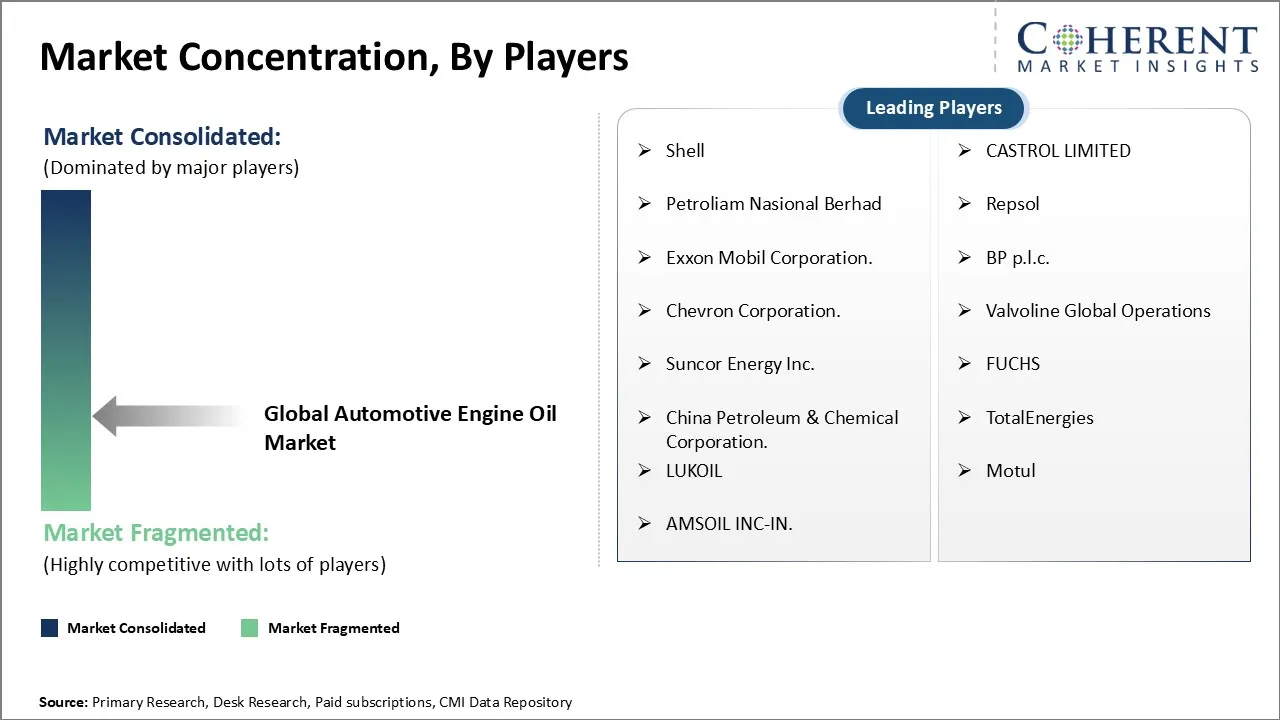
Market Players, Key Development, and Competitive Intelligence
Key Developments
- In April 2024, Shell introduced an upgraded range of Shell Advance motorcycle oils, featuring limited-edition packaging endorsed by brand ambassador Shahid Kapoor. The new lineup includes Shell Advance AX7 with Synthetic Technology, incorporating Flexi Molecule Technology for superior performance, and the premium mineral-based AX5, now enhanced with Active Cleansing Technology. This launch is part of Shell’s “Rukna Mushkil Hai” campaign, which honors the determination and passion of motorcycle riders across India.
- In May 2024, PETRONAS entered into a strategic collaboration with Sinopec to explore joint growth and innovation initiatives in the energy sector. The memorandum of understanding focuses on sustainable development across areas such as LNG trading, lubricants, and commodity and specialty chemicals. Building on a partnership that began in 1997, this alliance aims to advance decarbonization goals and strengthen energy resilience across the Asia Pacific region.
Top Strategies Followed by Global Automotive Engine Oil Market Players
- Established players dominate the market through substantial investments in research and development (R&D), which allows them to innovate and introduce high-performance engine oils that meet stringent regulatory standards and cater to the needs of modern engines. These companies enhance their competitive edge by forming strategic partnerships and alliances with original equipment manufacturers (OEMs) and major industry stakeholders, thereby securing long-term supply contracts and strengthening brand credibility.
- For example, Shell launched its next-generation Shell Helix Ultra with PurePlus Technology, a fully synthetic motor oil made from natural gas, offering superior engine cleanliness and wear protection.
- Mid-level players in the automotive engine oil market adopt a more focused approach by balancing product quality with affordability to attract price-sensitive consumers, especially in developing regions. Their key strategy lies in offering cost-effective solutions that do not compromise essential performance parameters, thereby positioning themselves as value-for-money alternatives to premium brands. To enhance their competitiveness, these mid-tier companies often engage in collaborations and joint ventures with technology providers or larger manufacturers, which help improve their production capabilities and accelerate product development.
- For example, Castrol, a brand under BP, has longstanding partnerships with Jaguar Land Rover and BMW, supplying factory-fill engine oils specifically designed for their engines.
- Small-scale players, meanwhile, focus on carving out niche segments within the highly competitive automotive engine oil market by emphasizing specialized or innovative product features that address specific customer needs. These firms frequently adopt cutting-edge technologies, such as synthetic base oils or eco-friendly additives, to differentiate themselves from larger competitors and appeal to environmentally conscious consumers or owners of high-performance vehicles.
- For instance, Liqui Moly specializes in additives and premium motor oils for high-performance and older engines, catering to automotive enthusiasts and mechanics who prioritize engine longevity.
Market Report Scope
Automotive Engine Oil Market Report Coverage
| Report Coverage | Details | ||
|---|---|---|---|
| Base Year: | 2025 | Market Size in 2026: | USD 44.79 Bn |
| Historical Data for: | 2020 To 2024 | Forecast Period: | 2026 To 2033 |
| Forecast Period 2026 to 2033 CAGR: | 3.4% | 2033 Value Projection: | USD 56.60 Bn |
| Geographies covered: |
| ||
| Segments covered: |
| ||
| Companies covered: | Shell, CASTROL LIMITED, Petroliam Nasional Berhad, Repsol, Exxon Mobil Corporation., BP p.l.c., Chevron Corporation., Valvoline Global Operations, Suncor Energy Inc., FUCHS, China Petroleum & Chemical Corporation., TotalEnergies, LUKOIL, Motul, and AMSOIL INC-IN. | ||
| Growth Drivers: |
| ||
| Restraints & Challenges: |
| ||
Automotive Engine Oil Market Dynamics
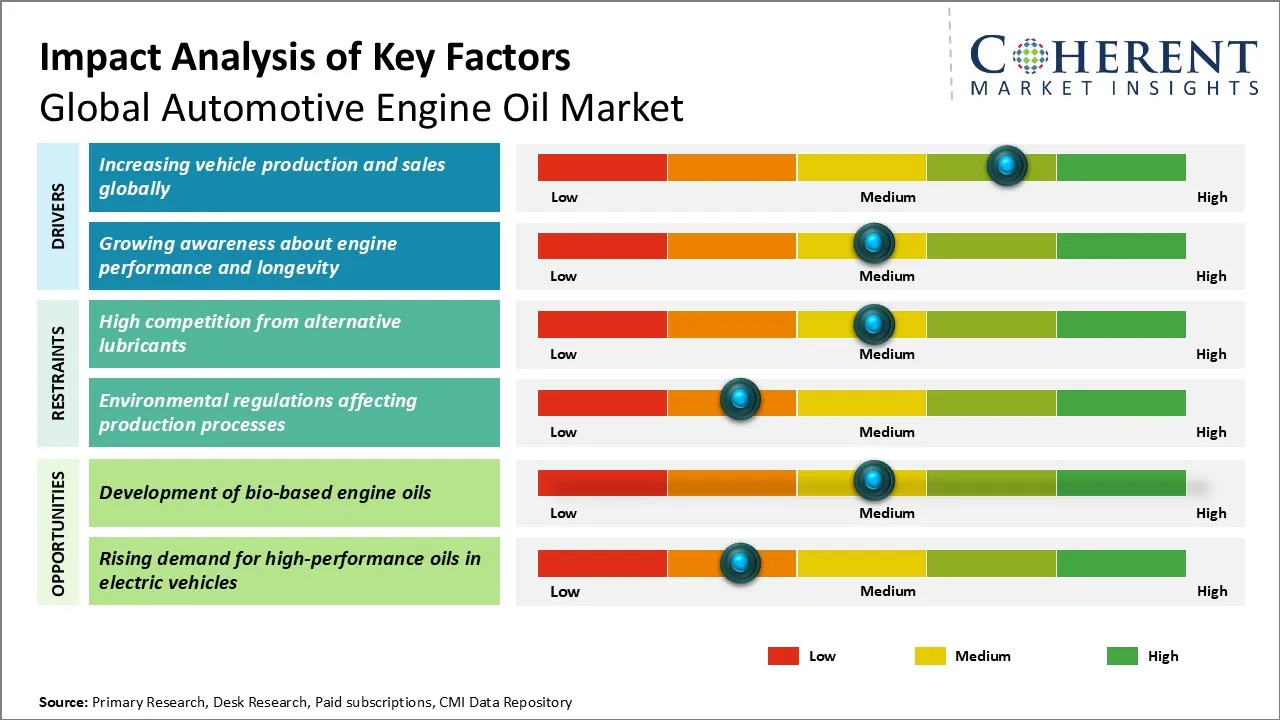
Automotive Engine Oil Market Driver - Increasing Vehicle Production and Sales Globally
The steady increase in vehicle production and sales worldwide is a significant driver propelling the demand for automotive engine oil. As automotive manufacturers ramp up production to meet growing consumer demand, especially in emerging economies where vehicle ownership is on the rise, the need for regular maintenance and replacement of engine lubricants correspondingly escalates. New and used vehicles alike require constant lubrication to maintain engine efficiency, reduce wear and tear, and ensure optimal performance over time. Additionally, the expansion of commercial vehicle fleets for logistics and transportation further boosts the consumption of engine oil.
As per the Society of Indian Automobile Manufacturers (SIAM), India’s domestic sales of passenger vehicles reached a record high of 4.1 million units in FY2023, showing a strong demand surge and maintenance-related lubricant usage.
Automotive Engine Oil Market Opportunity - Development of Bio-Based Engine Oils
The growing environmental concerns and stringent government regulations regarding carbon emissions and ecological sustainability present a significant opportunity for the global automotive engine oil market through the development of bio-based engine oils. These bio-based/biolubricants, derived from renewable resources such as vegetable oils, animal fats, and other biodegradable materials, offer an eco-friendly alternative to conventional mineral and synthetic engine oils. The rising consumer preference for green products and the automotive industry's increasing focus on reducing environmental footprints are driving investments and research into bio-based formulations that can deliver comparable or superior performance in terms of lubrication, engine protection, and fuel efficiency.
The U.S. Department of Agriculture (USDA) promotes certified bio-based engine oils under its BioPreferred program, which includes a growing number of engine oil brands certified for use in federal fleets and commercial applications.
Analyst Opinion (Expert Opinion)
- The global automotive engine oil market is at a pivotal crossroads, propelled by advancements in technology and shifting consumer preferences towards high-performance and environment-friendly products. Insights from the International Lubricants Conference (2023) and the Global Automotive Aftermarket Summit (2022) underscored the increasing demand for synthetic oils and formulations that enhance fuel efficiency. Companies like Castrol have responded by launching advanced engine oils that not only improve performance but also address sustainability concerns.
- For example, Castrol's recent initiative to produce oils from recycled materials demonstrates a proactive approach to reducing environmental impact, positioning the brand as a leader in green innovation. Additionally, discussions highlighted the growing role of electric vehicles (EVs) and hybrid technologies, which are reshaping lubrication needs and creating opportunities for tailored products.
- As automakers push for longer oil change intervals and improved engine protection, companies that invest in research and development will likely gain a competitive advantage. Ultimately, the future of the automotive engine oil market will be defined by innovation, sustainability, and the ability to adapt to the evolving landscape of the automotive industry.
Speak to the analyst
Want personalized insights?
Take the findings above to one of our principal consultants, or have the report rebuilt around the segments, geographies and competitors you actually track.
Market Segmentation
- Product Type Insights (Revenue, USD Bn, 2021 - 2033)
- Synthetic Engine Oil
- Conventional Engine Oil
- Synthetic Blend Engine Oil
- Viscosity Grade Insights (Revenue, USD Bn, 2021 - 2033)
- SAE 0W-20
- SAE 5W-30
- SAE 10W-40
- SAE 15W-40
- Others
- Application Insights (Revenue, USD Bn, 2021 - 2033)
- Passenger Cars
- Commercial Vehicles
- Motorcycles
- Distribution Channel Insights (Revenue, USD Bn, 2021 - 2033)
- Online Retail
- Offline Retail
- Auto Parts Stores
- Service Stations
- Others
- Regional Insights (Revenue, USD Bn, 2021 - 2033)
- North America
- U.S.
- Canada
- Latin America
- Brazil
- Argentina
- Mexico
- Rest of Latin America
- Europe
- Germany
- U.K.
- Spain
- France
- Italy
- Russia
- Rest of Europe
- Asia Pacific
- China
- India
- Japan
- Australia
- South Korea
- ASEAN
- Rest of Asia Pacific
- Middle East
- GCC Countries
- Israel
- Rest of Middle East
- Africa
- South Africa
- North Africa
- Central Africa
- North America
- Key Players Insights
- Shell
- CASTROL LIMITED
- Petroliam Nasional Berhad
- Repsol
- Exxon Mobil Corporation
- BP p.l.c.
- Chevron Corporation
- Valvoline Global Operations
- Suncor Energy Inc.
- FUCHS
- China Petroleum & Chemical Corporation
- TotalEnergies
- LUKOIL
- Motul
- AMSOIL INC-IN.
Sources
Primary Research Interviews
- R&D Directors from leading automotive engine oil manufacturers
- Product Development Managers from major lubricant brands
- Procurement Managers at automotive aftermarket retailers and service stations
- Technology and Innovation Heads from automotive OEMs collaborating with oil companies
Stakeholders
- Manufacturers
- End-Use Sectors
- Passenger Vehicles (OEMs and Aftermarket)
- Commercial Vehicles (Trucks, Buses, Heavy-duty Equipment)
- Two- and Three-Wheelers
- Agriculture, Construction, and Industrial Vehicles
- Regulatory and Certification Bodies
- Environmental Protection Agency (EPA, USA)
- National Highway Traffic Safety Administration (NHTSA, USA)
- European Union (EU) and ACEA (European Automobile Manufacturers' Association)
- API (American Petroleum Institute)
- Distributors, Service Garages, and Aftermarket Retailers
- E-commerce Platforms and Online Auto Parts Retailers
- Technology Integration Players (additive suppliers, digital diagnostics companies; connected vehicle service providers)
Databases
- International Organization of Motor Vehicle Manufacturers (OICA)
- UN Comtrade Database (for oil and lubricant exports/imports)
- India Import Export (EXIM) Database
- Society of Indian Automobile Manufacturers for India market size and vehicle registrations (SIAM)
- China Association of Automobile Manufacturers (CAAM)
Magazines
- Lubes’n’Greases – Trends and innovation in lubricants and oils
- Lubrication Management & Technology – Market updates and formulation trends
- Automotive World Magazine – Industry overviews, technology, and regulations
- SAE International Magazines – Engine technology and oil requirements
Journals
- SAE International Journals – Engine oil technology and testing
- Tribology International – Lubrication science and performance
- Energy & Fuels – Oil formulation, efficiency, and environmental impact
- Journal of Engine Research – Additive technologies and oil performance
- Journal of Cleaner Production – Eco-friendly lubricants and lifecycle analysis
Newspapers
- The Financial Times – Automotive industry and lubricant market growth
- The Wall Street Journal – Major oil company strategies and investments
- The Hindu BusinessLine/ET Auto (India) – Regional market growth, trends
- Nikkei Asia – Automotive production and oil sales in East Asia
Associations
- American Petroleum Institute (API)
- Society of Automotive Engineers (SAE)
- European Automobile Manufacturers’ Association (ACEA)
- Independent Lubricant Manufacturers Association (ILMA)
- Petroleum Additives Manufacturers in Europe (ATC EU)
- National Lubricating Grease Institute (NLGI)
Public Domain Sources
- U.S. Environmental Protection Agency (EPA) – Engine oil emission regulations, synthetic oil standards
- EU Commission – Euro 6/ACEA C6 standards for vehicle lubricants, chemical safety in oil formulations
- World Trade Organization (WTO) – Trade and standards for lubricants
- World Health Organization (WHO) – Environmental impact and occupational safety
Proprietary Elements
- CMI Data Analytics Tool, Proprietary CMI Existing Repository of information for last 8 years
Get access to 250+ pages report
Every segment, forecast, competitor profile and data table behind the analysis above — available for instant download.
- ESOMAR Member
- ISO 9001:2015 Certified
- D-U-N-S Registered
- GDPR & CCPA Compliant
Missing comfort of reading report in your local language? Find your preferred language:
Transform your Strategy with Exclusive Trending Reports
Frequently Asked Questions
The global automotive engine oil market is estimated to be valued at USD 44.79 Bn in 2026 and is expected to reach USD 56.60 Bn by 2033.
The CAGR of global automotive engine oil market is projected to be 3.4% from 2026 to 2033.
Increasing vehicle production and sales globally and growing awareness about engine performance and longevity are the major factors driving the growth of the global automotive engine oil market.
High competition from alternative lubricants and environmental regulations affecting production processes are the major factors hampering the growth of the global automotive engine oil market.
In terms of product type, synthetic engine oil is estimated to dominate the market revenue share in 2026.
Shell, CASTROL LIMITED, Petroliam Nasional Berhad, Repsol, Exxon Mobil Corporation., BP p.l.c., Chevron Corporation., Valvoline Global Operations, Suncor Energy Inc., FUCHS, China Petroleum & Chemical Corporation., TotalEnergies, LUKOIL, Motul, and AMSOIL INC-IN. are the major players.
Asia Pacific is expected to lead the global automotive engine oil market in 2026.