

Global Automotive Fuses Market Size and Forecast – 2026 To 2033
The global automotive fuses market is expected to grow from USD 31.50 Bn in 2026 to USD 51 Bn by 2033, registering a compound annual growth rate (CAGR) of 5.7% from 2026 to 2033. The global automotive fuses market is driven by growing adoption of advanced driver assistance systems (ADAS). On June 8, 2026, Lucid Group, Inc., maker of the world's most advanced software-defined vehicles and technologies, announced it has begun the rollout of its latest over-the-air software update for the Lucid Gravity SUV. The update introduces hands-free driving capabilities along with enhancements to navigation, charging experience, and everyday usability. (Source: Lucid Group)
Key Takeaways of the Global Automotive Fuses Market
- The Blade Fuses segment is expected to account for 34.0 % of the global automotive fuses market share in 2026. Introduction of stricter automotive safety regulations is a major factor driving the growth of the segment. On May 7, 2026, The U.S. Department of Transportation’s National Highway Traffic Safety Administration (NHTSA) announced that the later release 2026 Tesla Model Y is the first vehicle model to pass the agency’s new benchmark for vehicles with advanced driver assistance systems (ADAS). (Source: National Highway Traffic Safety Administration)
- The Passenger Vehicles segment is estimated to capture 58.0 % of the market share in 2026. Increasing vehicle connectivity and infotainment systems is driving the growth of the passenger vehicles segment. On April 30, 2026, Hyundai Motor Group unveiled Pleos Connect, a next-generation in-vehicle infotainment system designed to fundamentally transform the customer mobility experience. (Source: Hyundai Motor Group)
- The Powertrain Systems segment is estimated to capture 29.0 % of the market share in 2026. A steady growth in hybrid vehicle sales is a key factor for the growth of the segment. As of January 14, 2026, Toyota Motor Europe sold 1,299,038 Toyota and Lexus vehicles in 2025, a new record. Its mix of electrified vehicles grew to 77%, an increase of 5%. Within the electrified total, sales of battery electric vehicle were up by 46% and plug-in hybrids by 76%. (Source: Toyota)
- Asia Pacific is expected to dominate the automotive fuses market in 2026 with a market share of 41.0 %. Increasing development of autonomous vehicles in Asia Pacific is driving the growth of the regional market. On February 8, 2026, Pony AI Inc. announced that the first mass-produced seventh-generation bZ4X Robotaxi, developed in collaboration with Toyota Motor China and GAC Toyota, a joint venture between Guangzhou Automobile Group Corporation and Toyota Motor Corporation, has rolled off the production line. (Source: Pony AI)
- North America is expected to account for 28.0 % share in 2026 and is projected to record the fastest growth over the forecast period. Growing demand of connected car ecosystems in North America is driving the growth of the regional market. On April 28, 2026, General Motors announced plans to integrate Google’s Gemini AI into millions of linked automobiles through its infotainment platform and OnStar ecosystem. The enhanced AI assistant offers more advanced voice interaction, route planning, vehicle information and connected services, further underscoring that software-driven in-car experiences are becoming even more important in North America. (Source: General Motors)
- Rapid Adoption of High-Voltage Fuse Solutions for Electric Vehicles: As the world shifts from traditional internal combustion vehicles to battery electric vehicles and hybrid vehicles, there is a growing demand for high voltage fuses that can operate in 400V and 800V electrical designs. These sophisticated fuses are designed to protect battery packs, power electronics, inverters and charging systems against overloads and short circuits. As EV manufacturers push for faster charging speeds and better vehicle performance, there is more innovation in high-current and high-voltage circuit protection technology in the market.
- Growing Development of Smart and Intelligent Fuses: The automotive fuse manufacturers are investing more into smart fuse technologies which can conduct real-time monitoring, fault diagnosis and predictive maintenance. These smart gadgets can connect with car management systems to detect electrical irregularities before breakdowns occur, increasing the safety and reliability of the vehicle. The development is in line with the industry’s move towards software-defined and connected vehicles that require sophisticated diagnostics for system management.
Segmental Insights
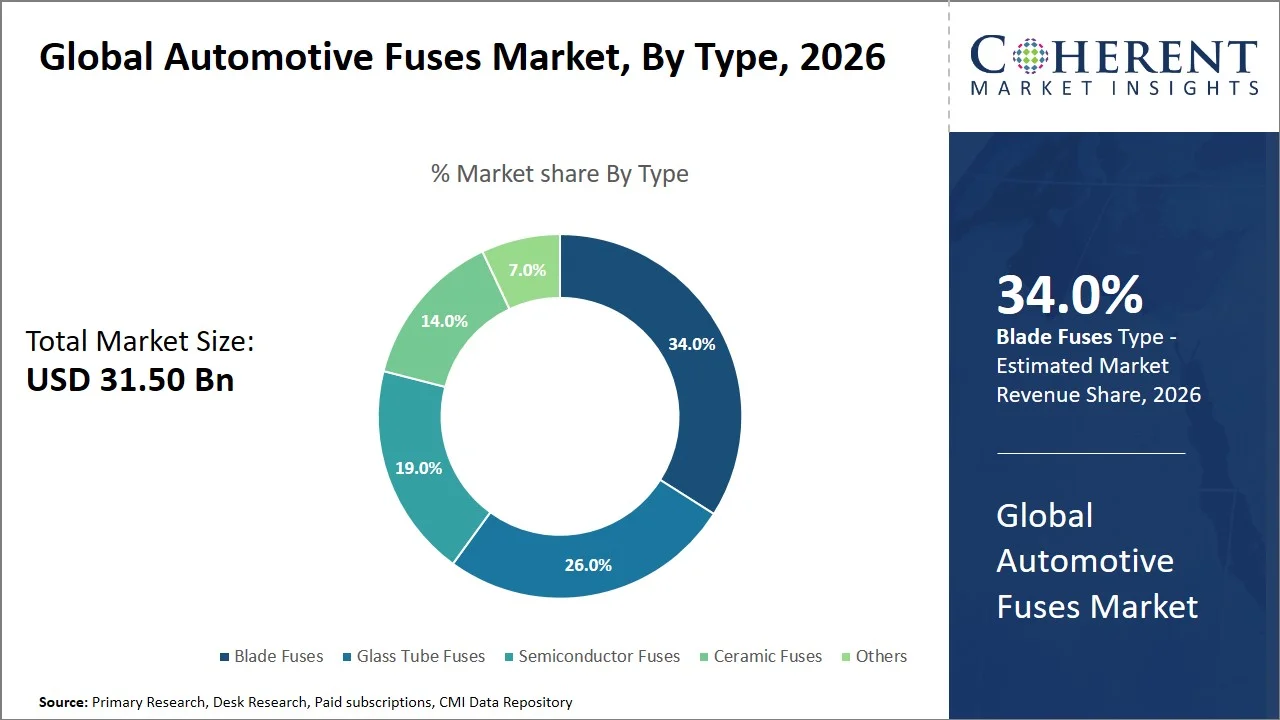
Why Does Blade Fuses Dominate the Global Automotive Fuses Market?
The blade fuses segment is expected to account for 34.0% of the global automotive fuses market share in 2026. Blade fuses are the most common type of automotive fuses in the worldwide automotive fuses market mainly because they have become the industry standard circuit protection solution in passenger cars, commercial vehicles, and light trucks. Thanks to their compact size, ease of installation, low replacement cost and compliance with standardized fuse boxes, they are the choice of vehicle manufacturers the world over. Most automotive electrical systems are based on blade fuse topologies that allow OEMs to cut down on production, maintenance and aftermarket servicing, and yet provide dependable protection for all types of electrical circuits. With this broad standardization, blade fuses are the most often used type of fuse in the automotive sector. For instance, Littelfuse launched blade fuse series for the automotive applications that require higher reliability and smaller packaging. Developed to accommodate increasingly sophisticated car electrical systems yet still compatible with existing automotive fuse box standards, the device further solidifies the continuous dominance of blade fuse technology in modern vehicles. (Source: Littlefuse)
- Current Industry Events of 2026
- Market Size Estimation
- Regional Breakdown
- Competitive Landscape
- Customer Intelligence
- Segmental Analysis
- Pricing Analysis
- Key Market Drivers, Challenges & Future Trends
- Customized Insights Section
Why are Passenger Vehicles the Most Popular Vehicle Type?
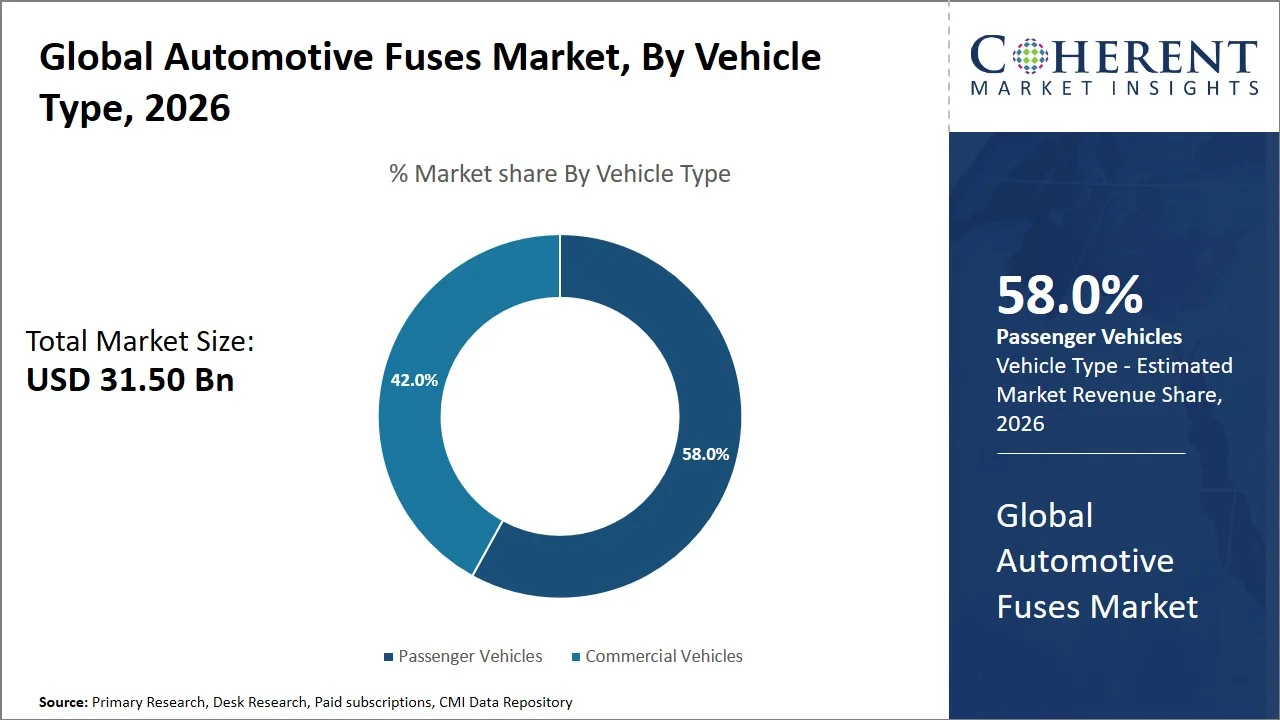
The passenger vehicles segment is expected to account for 58.0% of the global automotive fuses market share in 2026. Passenger vehicles are the largest category by vehicle type in the automotive fuses market since they comprise the majority of global vehicle production and ownership. In the big automotive markets like China, the U.S., India, Japan, and Europe millions of passenger automobiles are produced each year. Today’s passenger cars also include more and more electrical and electronic systems, including entertainment units, enhanced safety systems, lighting systems, climate controls, and connectivity modules, all of which require circuit protection. Automotive fuses are also seeing stronger growth in the passenger vehicle category than in commercial vehicles, due to the combination of high production numbers and rising electronic content per vehicle. On January 7, 2025, BMW revealed its Panoramic iDrive platform and Operating System X for future Neue Klasse passenger vehicles. The new architecture features huge digital displays, cloud connectivity, powerful driver assistance systems and software-defined vehicle capabilities, which substantially increases the complexity of the electrical system and its accompanying fuse requirements. (Source: BMW)
Powertrain Systems Dominate the Global Automotive Fuses Market
The powertrain systems segment is expected to account for 29.0% of the global automotive fuses market share in 2026. Powertrain systems capture the largest share in the global automotive fuses market due to the fact that it contains the most critical electrical circuits in the vehicle responsible for the propulsion and functioning of the vehicle. Constant and dependable circuit protection is needed for the engine control unit (ECU), transmission control, fuel injection systems, electric motors, inverters, and battery management systems to prevent electrical failures that may cause vehicle failure or safety issues. Automakers’ focus on preserving these mission-critical systems means powertrain applications account for the biggest share of automotive fuse demand. On May 18, 2026, XPeng began mass production of their Level 4 autonomous robotaxi platform with proprietary Turing AI chips, electric drive systems, battery management technologies and high-performance power electronics. (Source: XPeng)
Currents Events and their Impact
Current Events | Description and its Impact |
EU Batteries Regulation (EU) 2023/1542 |
|
UNECE Regulation R155 (Vehicle Cybersecurity Management System) |
|
(Source: European Union, UNECE)
Global Automotive Fuses Market - Average Fuse Count per Vehicle
The number of fuses per car varies greatly depending on the vehicle type, because of variances in electrical complexity, safety systems, entertainment features and powertrain architecture. Passenger cars typically have dozens of low-voltage blade and cartridge fuses to protect lighting, HVAC, infotainment, ADAS, and body electronics. Hybrid and battery-electric vehicles also have high-voltage fuses to protect battery packs, inverters, onboard chargers, and power distribution units. Growing vehicle electrification and connection are driving continued growth in the quantity and sophistication of fuse protection devices installed per vehicle. Key insights include:
- Entry-Level Passenger Car: 30-45 fuses/vehicle
- Mid-size Passenger Car: 45–70 fuses/vehicle
- Premium/Luxury Passenger Car 70-100+ fuses per car
- Hybrid Electric Vehicle (HEV): 80-120 fuses/vehicle
- Plug-in Hybrid Electric Vehicle (PHEV): 90-130 fuses/vehicle
- Battery Electric Vehicle (BEV): 100-150+ fuses per vehicle (including high voltage protection fuses)
- Light Commercial Vehicle (LCV): 60 to 90 fuses per vehicle
- Heavy Commercial Vehicle (HCV) — 90-140 fuses per vehicle
- Electric Bus — 150-250+ fuses per vehicle
- Autonomous/Robotaxi Vehicle: 180–300+ fuses per vehicle (extra sensors, computation units and redundant electrical systems)
Global Automotive Fuses Market - Automotive Electrical/Electronic (E/E) Architecture Content per Vehicle:
Automakers are integrating advanced driver assistance systems (ADAS), connectivity features, digital cockpits, electrified powertrains, and software-defined vehicle technologies, which are contributing to a major rise in the automotive electrical/electronic (E/E) architectural content per vehicle. Today’s vehicles are increasingly filled with electronic control units (ECUs), sensors, actuators, displays, communication networks and power distribution modules, all of which need circuit protection – and need it to be reliable. As car electronics become increasingly complex, the need for automotive fuses grows to protect essential electrical systems and maintain safe operation. Key insights include:
- Entry-level passenger car: 25-40 ECUs per vehicle
- Mid-Range Passenger Car: 40-70 ECUs/car
- Premium/Luxury Passenger Car: 80–150 ECU/vehicle
- Battery electric vehicle (BEV): 70 to 120 ECUs/car
- Autonomous Vehicle (Level 3-4): 120-200+ ECUs and computer units per vehicle
- Entry-Level Passenger Car: 1,000-1,500 semiconductor devices
- Premium / Luxury Vehicle: 3,000-5,000 semiconductor devices
- Battery Electric Vehicle: 3,500-10,000+ semiconductors
- Average Length of Wiring for Passenger Vehicles 2-4 km
- Average Premium Vehicle Wiring Length: 4-6 km
- Average Wiring Length in Electric Vehicle 5-7 Km
- ADAS Sensors per Mainstream Vehicle: 5-15 sensors
- ADAS Sensors per Premium Vehicle: 20-40+ sensors
- Autonomous Vehicle Sensor Count: 40 to 100+ sensors
- Number of Digital Displays per Vehicle (Global Average): 2 to 4 screens
- Premium Software-Defined Vehicle: 5 – 10+ Displays/Interfaces
- Connected Vehicles Penetration (New Vehicles, 2026): ~75-80%
- OTA Update Capable Vehicles: ~55-65% of new car manufacturing.
- Average Percentage of Vehicle Cost Electronics:
- Internal Combustion Engine (ICE) Vehicle: 30-35 per cent
- Hybrid Vehicle: 40-45%
- Battery Electric Vehicle (BEV): 45-55%
- Estimated Number of Protected Electrical Circuits:
- Conventional Passenger Vehicle: 60-100 circuits
- Premium Car: 100-180 circuits
- Battery Electric Vehicle: 120-250+ circuits
Automotive Fuses Market Dynamics
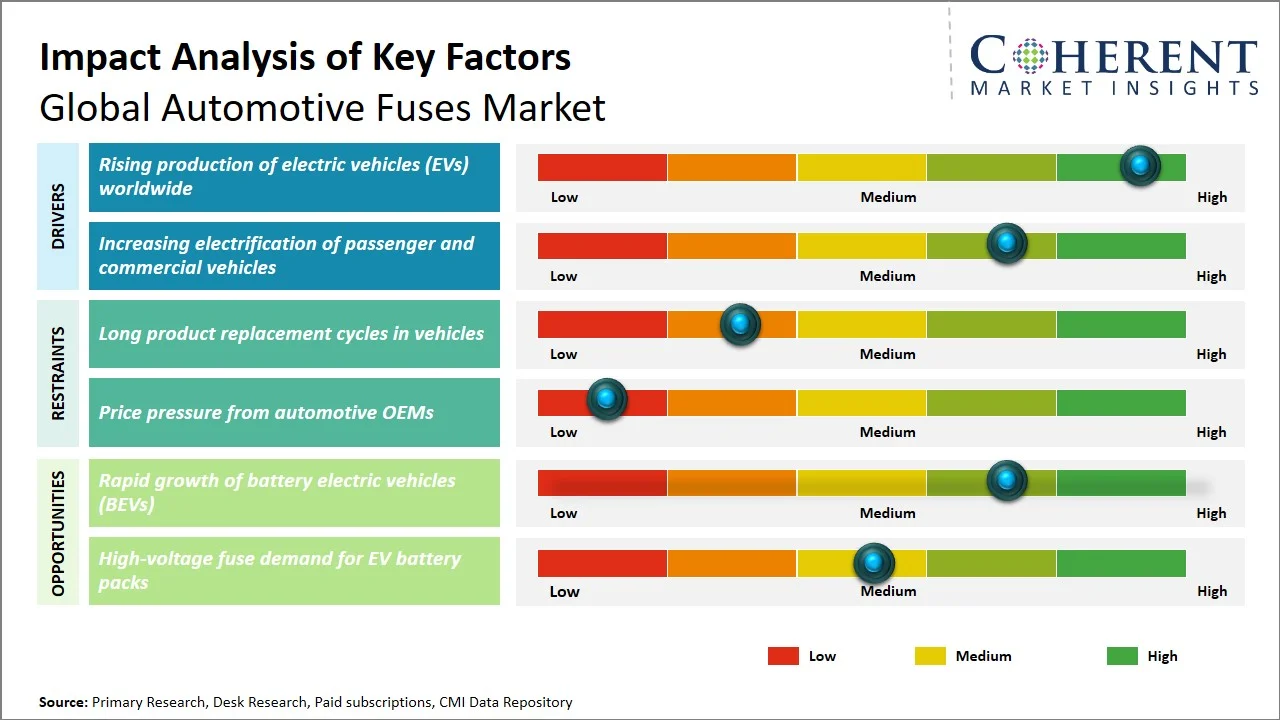
Market Drivers
Rising production of electric vehicles (EVs) worldwide
The increasing production of electric vehicles (EVs) globally is a key driver for growth of the global automotive fuses market. EVs require circuit protection that is significantly more advanced than conventional internal combustion engine vehicles. High-voltage battery packs, battery management systems, inverters, onboard chargers, DC-DC converters and electric drive systems are protected by specialized fuses against electrical failures, short circuits and thermal events. Governments are pushing for more electric cars and stronger emissions rules, and carmakers are quickly expanding their ability to produce EVs in places like China, Europe, the U.S. and India. Therefore, the growing adoption of high voltage electrical systems and battery-powered vehicles is generating considerable demand for reliable, high-performance automotive fuse solutions to improve safety, reliability, and system protection.
On November 25, 2025, Tata Motors announced the launch of the all-new Tata Sierra. Reimagined and recrafted for a new era, the Sierra retains its legendary heritage and distinctive DNA while embracing modernity, standing as a symbol of achievement, individuality, and the spirit of exploration. (Source: Tata Motors)
Increasing electrification of passenger and commercial vehicles
The increasing electrification of passenger and commercial vehicles is substantially driving the demand in the global automotive fuses market as modern vehicles are equipped with an increasing number of electrically powered systems and components. In addition to pure electric vehicles, electric power steering, electric brake systems, enhanced lighting, entertainment platforms, HVAC systems and many electronic control units are being embraced by conventional passenger cars, hybrid vehicles, buses, trucks and delivery fleets. This development complicates and demands more power from the vehicle’s electrical architecture, producing an increased need for effective circuit protection. Automotive fuses are vital to protect passenger and commercial vehicle systems from overloads and short circuits, with vehicle electrification being one of the primary drivers for the adoption of improved fuse technologies in these segments.
On June 9, 2026, Mercedes-Benz launched series manufacturing of new generation axial-flux electric motor at its Berlin factory for future Mercedes-AMG electric passenger cars. The lightweight, high-performance motor technology is a major milestone in the electrification of powertrain systems for luxury passenger vehicles and allows the company to migrate to all-electric vehicle architectures. (Source: Mercedes-Benz)
Emerging Trends
- Increasing Integration of ADAS and Vehicle Electronics: Increasingly, vehicles are being equipped with electronic systems such as Advanced Driver Assistance Systems (ADAS), infotainment systems, telematics modules, sensors, cameras and radar units. The proliferation of these electronic components is increasing the number of protected circuits in automobiles, which in turn is creating demand for specialized fuses with greater reliability and performance. This tendency is particularly evident in premium automobiles, and next generation autonomous mobility systems.
- Miniaturization and Lightweight Circuit Protection Components: Automakers remain focused on reducing weight and optimizing space within vehicles, with the goal of improving fuel efficiency and extending the driving range of EVs. Hence, the fuse producers are focusing on producing compact & lightweight and high-performance fuse designs that take less space while providing higher protection capabilities. Advances in materials engineering and fuse construction are allowing ever smaller form factors to fit into more complicated automobile electrical designs without compromising safety or longevity.
Global Automotive Fuses Market - Global Automotive High-Voltage Battery Production Capacity (GWh)
The global automotive high-voltage battery production capacity has been developing fast, as automakers and battery manufactures are building gigafactories to support the rising production of battery electric vehicles (BEVs), plug-in hybrid electric vehicles (PHEVs), electric buses and commercial EVs. The increasing production capacity of batteries directly fuels the demand for automotive fuses, especially high-voltage fuses, pyrofuses, battery disconnect units, and circuit protection systems used in battery packs, inverters, onboard chargers, and power distribution units. As global electrification levels rise, battery production capacity remains one of the more robust indications of future automotive fuse demand. Key insights include:
- By Region (2026)
- China: ~1,800–2,000 GWh
- Europe: ~550–650 GWh
- North America: ~450–550 GWh
- Asia Pacific (Excluding China): ~300–400 GWh
- Rest of World: ~80–120 GWh
- Major Battery Manufacturing Countries (2026)
- China: ~55–60% of global capacity
- U.S.: ~10–12%
- Germany: ~6–8%
- South Korea: ~5–7%
- Japan: ~3–5%
- India: ~2–3%
- Average Battery Capacity per Vehicle
- Hybrid Electric Vehicle (HEV): 1–3 kWh
- Plug-in Hybrid Electric Vehicle (PHEV): 10–25 kWh
- Passenger Battery Electric Vehicle (BEV): 50–90 kWh
- Premium/Luxury BEV: 90–120+ kWh
- Electric Bus: 250–600 kWh
- Electric Truck: 300–1,000+ kWh
- Gigafactory Development
- Operational Automotive Battery Gigafactories (2026): 220–250 facilities
- Gigafactories Announced or Under Construction: 120–150 facilities
- Average New Gigafactory Capacity: 20–60 GWh annually
- Leading Battery Manufacturers by Capacity
- CATL: ~650–750 GWh
- BYD: ~350–450 GWh
- LG Energy Solution: ~300–400 GWh
- SK On: ~180–250 GWh
- Panasonic Energy: ~120–180 GWh
- Automotive Fuse Demand Correlation
- High-Voltage Fuses per BEV: 5–15 units
- High-Voltage Fuses per Electric Bus: 15–30 units
- Battery Disconnect/Pyrofuse Units per EV: 1–3 units
- Annual High-Voltage Battery Pack Production (2026): ~35–40 million units globally
Regional Insights
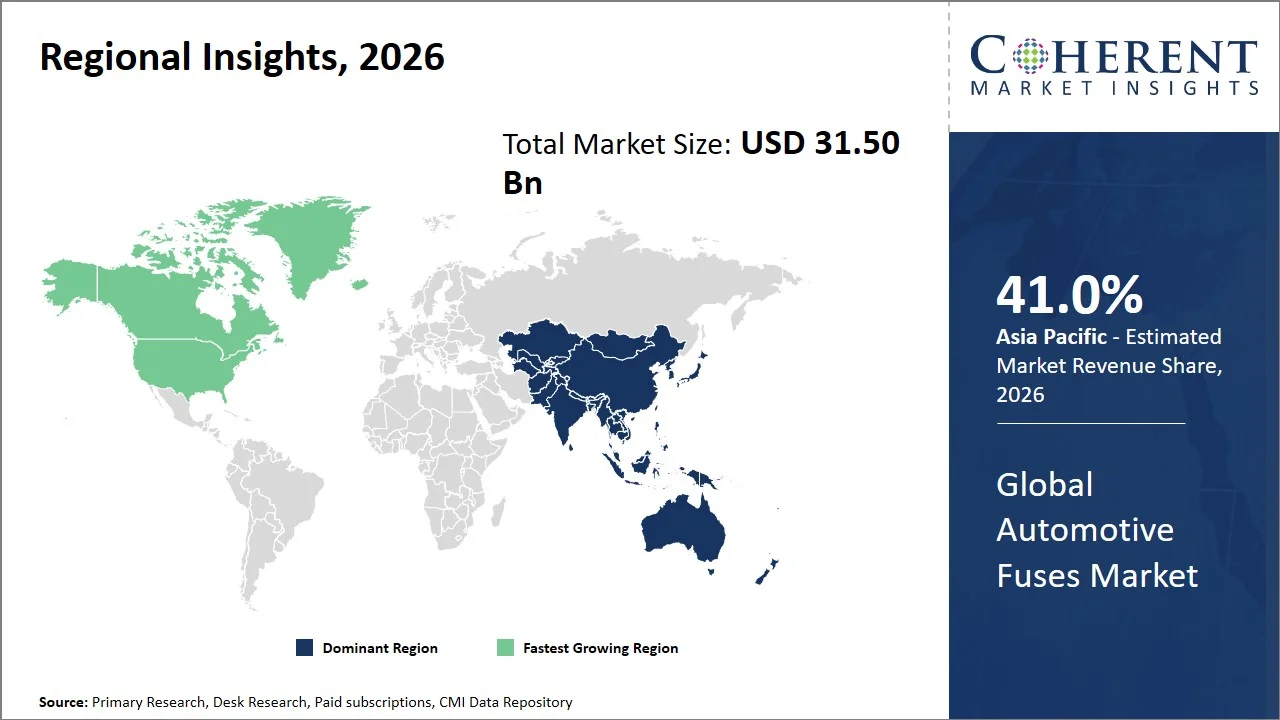
Why is Asia Pacific a Strong Market for Automotive Fuses?
Asia Pacific is expected to account for a market share of 41.0% in 2026. Asia Pacific is a leader in automotive fuse manufacturing owing to the concentration of car assembly plants, EV battery factories and automotive electronics suppliers. Chinese EV makers like BYD and NIO are adopting high voltage electrical architectures that require complex fuse protection for power distribution units and battery packs. Toyota Motor Corporation and Denso Corporation in Japan are growing their electrified vehicle platforms, while South Korea’s EV ecosystem headed by Hyundai Motor Company and Kia Corporation is raising demand for high-performance automotive circuit protection components. Regional investments in EV battery gigafactories and charging infrastructure are also driving the development of next-generation fuse technology. On March 27, 2024, KYOCERA AVX extended its Accu-Guard II Low-Current Fuses with new 0201 case sizes that deliver the industry’s lowest current ratings. Accu-Guard II Low-Current Fuses utilize thin-film technology to achieve precise control over the components’ physical and electrical characteristics, beyond what’s possible with standard fuse technologies, and deliver extremely low current ratings in compact 0603, 0402, and new 0201 packages. (Source: Kyocera)
Why Does North America Automotive Fuses Market Exhibit High Growth?
North America is projected to account for 28.0% of the global Automotive Fuses market and expected to register the fastest growth. Aggressive electrification initiatives adopted by leading car OEMs and expansion in domestic EV production propels the North America automotive fuses market growth. As Ford Motor Company and others ramp up production of electric pickup trucks and SUVs, and General Motors rolls out its Ultium battery architecture across a variety of vehicle types, demand for advanced battery protection fuses is on the rise. The region is also experiencing an increasing adoption of advanced driver assistance systems (ADAS), connected car technologies and over-the-air software architectures, all of which require reliable circuit protection. Additionally, the regional supply chain of automotive electrical protection solutions is strengthened by the presence of large fuse manufacturers like Littelfuse Inc. On September 18, 2025, Eaton announced the introduction of dozens of new electric vehicle (EV) fuses. With the acceleration of electrification across North America, the new fuse families were created to serve passenger EVs, plug-in hybrids, commercial vehicles and off-highway vehicles. (Source: Eaton)
Global Automotive Fuses Market Outlook for Key Countries
Why is China Emerging as a Major Hub in the Automotive Fuses Market?
China is still the dominant country in the automotive fuses business, owing to its leading position in electric car manufacturing and battery production. Automakers including BYD, Xpeng Inc. and Li Auto Inc. are rolling out more powerful battery systems and fast-charging technologies that need specialist high-voltage fuse protection. The increasing safety regulations for EV batteries and criteria for preventing thermal runaway are compelling manufacturers to include advanced fuse systems throughout vehicle electrical layouts. China’s massive rollout of charging infrastructure and domestic battery production ecosystem further supports significant demand for automotive fuse solutions.
Is U.S. the Next Growth Engine for the Automotive Fuses Market?
Investment in local EV production, battery manufacture and software-defined vehicle development is driving the U.S. automotive fuses industry. High voltage battery systems and advanced power electronics used by companies such as Tesla Inc. depend on specific fuse technologies for safety and reliability. Major automakers such as General Motors and Ford Motor Company are constructing new battery and assembly operations in a number of states to grow their electric vehicle offerings. The rising use of autonomous driving features, vehicle communication systems and high-power charging capabilities is raising the amount and complexity of protected electrical circuits in automobiles built in the U.S.
Germany Automotive Fuses Market Analysis and Trends
The German automotive fuse market is strongly influenced by the luxury automobile industry and the country's advanced car engineering. Automobile manufacturers such as Mercedes-Benz Group, BMW Group and Volkswagen AG are deploying new EV platforms built on high-voltage architectures that demand powerful circuit protection systems. Germany is a key hub for automotive electronics development, with suppliers like Robert Bosch GmbH and Continental AG working on advanced electrical and power management technology. The country’s focus on autonomous driving, luxury EVs and battery safety is driving constant innovation in automotive fuse applications.
India Automotive Fuses Market Analysis and Trends
India’s automotive fuses market is rising as the country has become a significant hub for automotive manufacture and exports. The need for battery and powertrain protection components is being driven by domestic automakers such as Tata Motors Limited and Mahindra & Mahindra Limited, which are growing the production of electric passenger vehicles and commercial EVs. Government policies that support the electrification of vehicles and local manufacture are driving investment in automotive electronics and component manufacturing. In addition, increased use of modern infotainment systems, linked car functionalities, and safety technologies in Indian automobiles is fueling the growth of the automotive fuses market in OEM and aftermarket applications.
Japan Automotive Fuses Market Analysis and Trends
Japan's automotive fuses industry is driven by the country's long-standing leadership in hybrid and electrified vehicle technology. Automakers such as Toyota Motor Corporation, Honda Motor Co., Ltd. and Nissan Motor Co., Ltd. are increasingly integrating complex electrical systems into hybrid and battery electric vehicles, which is driving need for reliable fuse protection. Japanese automotive vendors have developed a good reputation for small, reliable electronic components that could be utilized to produce smaller and more efficient fuse designs. The country’s focus on vehicle quality, safety and energy efficiency continues to drive demand for high-performance automotive circuit protection products. On June 2, 2025, PEC, a renowned Japan-based automotive fuse maker, introduced a revised lineup of EV Fuses and Pyrofuses to accommodate battery electric and hybrid vehicle applications. (Source: PECJ)
Global Automotive Fuses Market – Fuse Replacement Aftermarket Revenue
Region | Aftermarket Revenue (USD Million) |
Asia Pacific | 1,120 |
North America | 720 |
Europe | 560 |
Latin America | 160 |
Middle East & Africa | 100 |
Global Automotive Fuses Market – Fuse Failure Incidence Rate
Vehicle Type | Average Fuse Failure Incidents per 100 Vehicles per Year | Annual Fuse Replacement Frequency |
Entry-Level Passenger Cars | 12.5 | Every 8.0 Years |
Mid-Range Passenger Cars | 15.8 | Every 6.3 Years |
Premium/Luxury Vehicles | 22.4 | Every 4.5 Years |
Hybrid Electric Vehicles (HEVs) | 24.7 | Every 4.0 Years |
Plug-in Hybrid Vehicles (PHEVs) | 28.5 | Every 3.5 Years |
Battery Electric Vehicles (BEVs) | 31.8 | Every 3.1 Years |
Light Commercial Vehicles (LCVs) | 26.2 | Every 3.8 Years |
Heavy Commercial Vehicles (HCVs) | 39.6 | Every 2.5 Years |
Electric Buses | 44.1 | Every 2.2 Years |
Autonomous/Robotaxi Vehicles | 48.7 | Every 2.0 Years |
How is Rapid Growth of Battery Electric Vehicles (BEVs) Creating New Growth Opportunities in the Automotive Fuses Market?
The fast expansion of Battery Electric Vehicles (BEVs) is creating big growth potential in the automotive fuses market, since BEVs depend on complicated high-voltage electrical systems that need enhanced circuit protection at various places throughout the vehicle. BEVs are equipped with high-capacity batteries, battery management systems (BMS), inverters, onboard chargers, DC-DC converters, electric motors and fast-charging interfaces, whereas conventional vehicles require specialized high-voltage and high-current fuses to maintain operational safety and to prevent thermal runaway or electrical failures. As manufacturers continue to adopt 400V and 800V vehicle architectures for faster charging and better performance, there is increasing need for next-generation fuse technologies that offer higher interrupting capacity, thermal resistance and compact designs. Additionally, the increased use of electric buses, trucks, and commercial EV fleets is further driving potential for manufacturers to create application-specific fuse solutions for high-power electric mobility platforms.
On May 12, 2026, Tesla announced an additional investment of nearly USD 250 million in its Berlin facility to expand battery-cell manufacturing capacity from the previously planned 8 GWh to 18 GWh annually. The expansion supports higher BEV production volumes in Europe and reflects Tesla's continued commitment to scaling electric vehicle manufacturing.
Global Automotive Fuses Market – Future Fuse and Power Distribution Evolution
Vehicle Architecture Type | Share of New Vehicle Production (2026) | Average Fuse Count per Vehicle | Smart Fuse Penetration (%) |
Conventional Distributed Architecture | 58% | 65 | 5% |
Domain-Based Architecture | 30% | 90 | 20% |
Zonal Architecture | 12% | 120 | 45% |
Software-Defined Vehicle (SDV) Architecture | 6% | 140 | 60% |
Market Players, Key Development, and Competitive Intelligence

Key Developments
- On September 18, 2025, Littelfuse, Inc. announced the release of the 828 and 827 Series High Voltage Cartridge Fuses. These new fuses are the first AEC-Q200-compliant fuses rated at 1,000 VDC (828 Series) and 800 VDC (827 Series), offering a compact and reliable circuit protection solution for next-generation automotive electronics.
- On May 20, 2024, Eaton announced it is offering a portfolio of fuses for commercial electrified vehicles (EVs). Eaton Bussmann series fuses can handle up to 1,400 amps and 900 volts and can be tailored to customer specifications. Eaton can increase current capability by either design modifications or paralleling multiple fuses.
Competitive Landscape
Key players in the global automotive fuses market include established circuit protection manufacturers and specialist automotive component suppliers that are competing on the basis of product innovation, technological developments and strategic collaborations with automotive OEMs. Key players including Littelfuse Inc., Eaton Corporation, Mersen, Bel Fuse Inc., and Schurter Holding AG are working on the development of high voltage fuse solutions for electric vehicles and next-generation automotive electronics. Product reliability, adherence to developing safety requirements, downsizing capabilities and support for next-generation vehicle designs are becoming increasingly important for competitive differentiation. “Long-term supply agreements with car manufacturers and investments in regional manufacturing capabilities are also used to strengthen their market positions.
Market Report Scope
Automotive Fuses Market Report Coverage
| Report Coverage | Details | ||
|---|---|---|---|
| Base Year: | 2025 | Market Size in 2026: | USD 31.50 Bn |
| Historical Data for: | 2020 To 2024 | Forecast Period: | 2026 To 2033 |
| Forecast Period 2026 to 2033 CAGR: | 5.7% | 2033 Value Projection: | USD 51 Bn |
| Geographies covered: |
| ||
| Segments covered: |
| ||
| Companies covered: | Littelfuse Inc., Eaton Corporation, Mersen, Schurter Holding AG, Bel Fuse Inc., Pacific Engineering Corporation, SIBA GmbH, SOC, Corporation, Conquer Electronics Co., Ltd., Daewon Industry Co., Ltd., AEM Components, Bussmann, Autoliv Inc., MTA S.p.A. and Toyota Tsusho Corporation | ||
| Growth Drivers: |
| ||
| Restraints & Challenges: |
| ||
Analyst Opinion (Expert Opinion)
- Automotive fuses market is undergoing revolutionary transformation due to growing electrification of global automotive industry and increasing intricacy of vehicle electrical systems. High-performance fuse technologies are in greater demand as electric vehicles, innovative driver assistance systems, connected car platforms and high-voltage battery layouts are deployed. Pricing pressures and competition from alternative circuit protection technologies are being encountered within the market; however, sustained growth opportunities are expected to be generated through ongoing advancements in battery safety systems, vehicle automation technologies, and intelligent electrical protection solutions. Therefore, a high amount of investment is expected to be made in the direction of innovation and product development throughout the forecast period.
- The automotive fuse market is predicted to have strong growth due to the growth of electric vehicles, emergence of high-voltage vehicle platforms and the use of autonomous and connected vehicle applications. There is an increasing need for advanced fuse solutions supporting 400V and 800V battery systems, ultra-fast charging infrastructure and sophisticated power electronics. There are emerging prospects in smart fuses with real-time monitoring and diagnostic capabilities especially as software-defined vehicles become more ubiquitous. In addition, continued investments in EV manufacture, battery gigafactories, and charging networks in the key automotive markets are likely to drive continued demand for advanced automotive circuit protection devices in the years to come.
Speak to the analyst
Want personalized insights?
Take the findings above to one of our principal consultants, or have the report rebuilt around the segments, geographies and competitors you actually track.
Market Segmentation
- Type Insights (Revenue, USD Billion, 2021 - 2033)
- Blade Fuses
- Glass Tube Fuses
- Semiconductor Fuses
- Ceramic Fuses
- Others
- Vehicle Type Insights (Revenue, USD Billion, 2021 - 2033)
- Passenger Vehicles
- Commercial Vehicles
- Application Insights (Revenue, USD Billion, 2021 - 2033)
- Powertrain Systems
- Battery & Charging Systems
- Safety & ADAS Systems
- Body Electronics
- Infotainment Systems
- Auxiliary Circuits
- Voltage Insights (Revenue, USD Billion, 2021 - 2033)
- 12V–24V
- 24V–48V
- 49V–150V
- 151V–300V
- Above 300V
- Regional Insights (Revenue, USD Billion, 2021 - 2033)
- North America
- U.S.
- Canada
- Latin America
- Brazil
- Argentina
- Mexico
- Rest of Latin America
- Europe
- Germany
- U.K.
- Spain
- France
- Italy
- Russia
- Rest of Europe
- Asia Pacific
- China
- India
- Japan
- Australia
- South Korea
- ASEAN
- Rest of Asia Pacific
- Middle East
- GCC Countries
- Israel
- Rest of Middle East
- Africa
- South Africa
- North Africa
- Central Africa
- North America
- Key Players Insights
- Littelfuse Inc.
- Eaton Corporation
- Mersen
- Schurter Holding AG
- Bel Fuse Inc.
- Pacific Engineering Corporation
- SIBA GmbH
- SOC Corporation
- Conquer Electronics Co., Ltd.
- Daewon Industry Co., Ltd.
- AEM Components
- Bussmann
- Autoliv Inc.
- MTA S.p.A.
- Toyota Tsusho Corporation
Sources
Primary Research Interviews
- Automotive fuse manufacturers and suppliers
- Automotive OEMs and component buyers
- Distribution channel partners and aftermarket retailers
- Automotive electrical system engineers
Magazines
- Auto Electronics Magazine
- Component Manufacturing Magazine
- Automotive Industries Magazine
Journals
- IEEE Transactions on Vehicular Technology
- International Journal of Automotive Technology
- SAE International Journal of Commercial Vehicles
Associations
- Society of Automotive Engineers (SAE)
- Automotive Component Manufacturers Association (ACMA)
- Motor & Equipment Manufacturers Association (MEMA)
- International Organization of Motor Vehicle Manufacturers (OICA)
Public Domain Sources
- Government automotive industry reports
- Patent databases and filings
- Company annual reports and investor presentations
- Regulatory body publications
Proprietary Elements
- CMI Data Analytics Tool
- Proprietary CMI Existing Repository of information for last 10 years
Get access to 250+ pages report
Every segment, forecast, competitor profile and data table behind the analysis above — available for instant download.
- ESOMAR Member
- ISO 9001:2015 Certified
- D-U-N-S Registered
- GDPR & CCPA Compliant
Missing comfort of reading report in your local language? Find your preferred language:
Transform your Strategy with Exclusive Trending Reports
Frequently Asked Questions
The global automotive fuses market is expected to stand at USD 31.50 Bn in 2026 and is expected to reach USD 51 Bn by 2033.
The CAGR of the global automotive fuses market is projected to be 5.7% from 2026 to 2033.
High-voltage automotive fuses are specialized fuses designed to protect EV and hybrid vehicle electrical systems operating at elevated voltages.
Electric vehicles require multiple high-voltage fuses to protect batteries, power electronics, and charging systems.
In terms of type, blade fuses segment is estimated to dominate the market revenue share in 2026.
Long product replacement cycles in vehicles and price pressure from automotive OEMs are the major factors hampering the growth of the global automotive fuses market.
Rising production of electric vehicles (EVs) worldwide and increasing electrification of passenger and commercial vehicles are the major factors driving the growth of the global automotive fuses market.