

Global Automotive Plastics Market Size and Forecast – 2026-2033
The global automotive plastics market is estimated to be valued at USD 37,838.4 Mn in 2026 and is expected to reach USD 61,962.7 Mn by 2033, exhibiting a compound annual growth rate (CAGR) of 7.3% from 2026 to 2033.
Key Takeaways of the Automotive Plastics Market
- Polypropylene (PP) segment is expected to accounts for 30.9% of the global automotive plastics market share in 2026.
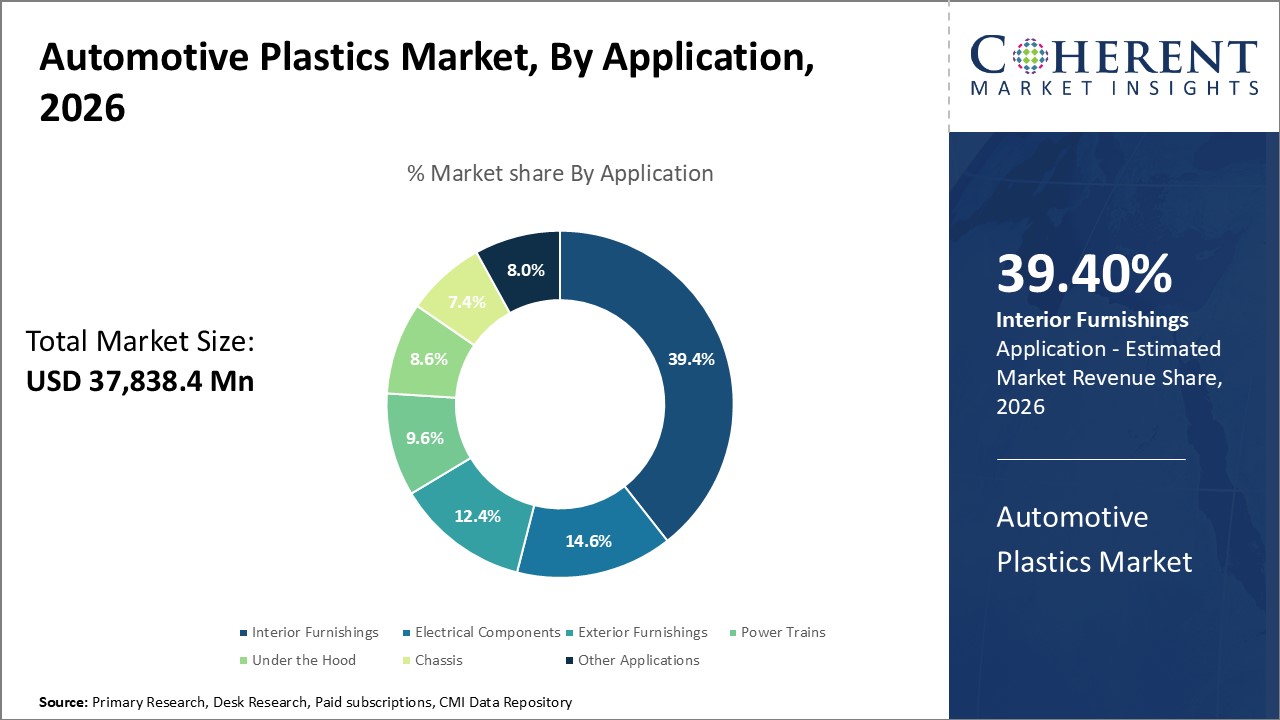
- The interior furnishings segment is projected to hold 39.4% of the market in 2026.
- Passenger cars segment is estimated to account for 83.3% of the automotive plastics market share in 2026.
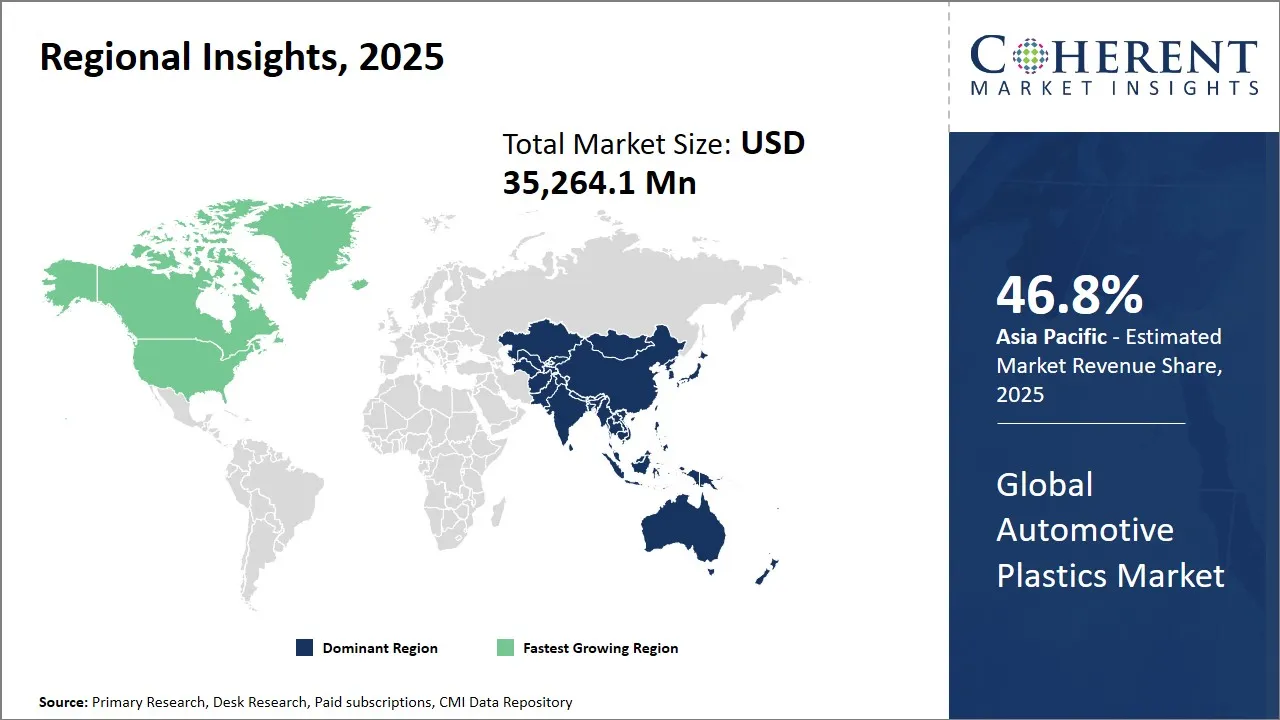
- Asia Pacific is set to lead the global automotive plastics market in 2026 with a 46.8% share. North America, with an estimated share of 18.8% in 2026, and it is projected to be the fastest-growing region.
Market Overview
A key factor driving the market is the increasing trend toward sustainable and recyclable automotive plastics, a result of strict ecological laws and consumer demand for environmentally friendly transportation. In turn, manufacturers are making massive investments in high-performance polymers that promise durability with a reduced environmental impact. Besides, development of bio-based plastics and plastic penetration in components such as battery casings and interior parts in electric vehicles is furthering the growth of the future automotive plastics landscape. This thrust on sustainability and innovation thus is likely to propel continued growth and transformation within the sector.
Current Events and Its Impact
Current Events | Description and its Impact |
Automakers scale recycled-plastic use in interiors and exteriors (Global, 2024–2025) |
|
Mercedes-Benz joins the Renewable Carbon Initiative and launches fossil-free plastics pilots (Global, 2025) |
|
Segmental Insights
- Current Industry Events of 2026
- Market Size Estimation
- Regional Breakdown
- Competitive Landscape
- Customer Intelligence
- Segmental Analysis
- Pricing Analysis
- Key Market Drivers, Challenges & Future Trends
- Customized Insights Section
Automotive Plastics Market Insights, By Product Type - Polypropylene (PP) Dominance Driven by Versatility and Cost-Effectiveness in Automotive Plastics
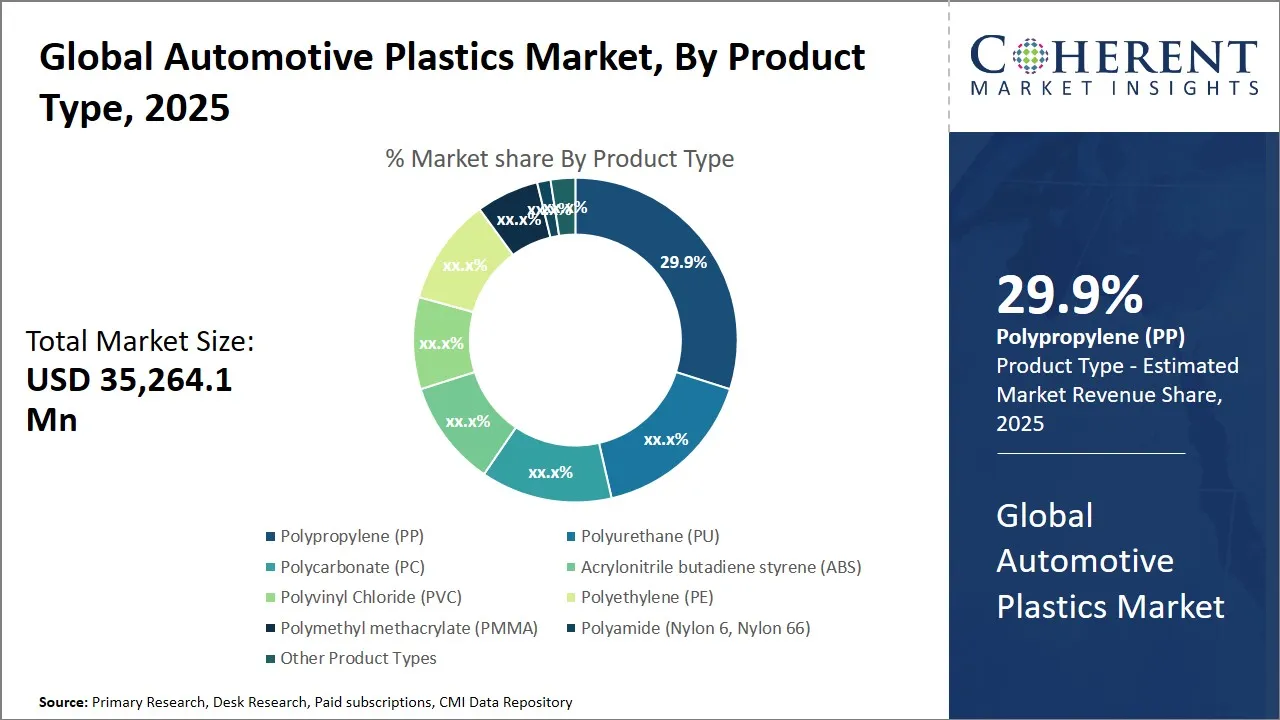
Polypropylene (PP) segment holds 30.9% of the global automotive plastics market share in 2026, driven primarily by the outstanding balance of properties, cost-effectiveness, and adaptability across countless automotive components. At the same time, PP is very light, which contributes significantly to vehicle weight reduction-one of the most critical factors nowadays in improving fuel efficiency and reducing emissions, major priorities for car manufacturers all over the world faced with toughening environmental legislation.
The material is extremely chemically resistant and has very good impact strength; therefore, it is very well suited for both interior and exterior automotive parts. PP will resist degradation from exposure to oils, fuels, and most environmental elements, thus providing very long life in the usually severe operational environments encountered in automotive applications. Its high thermal resistance also supports under-the-hood applications where temperature variations are extreme and frequent.
Automotive Plastics Market Insights, By Application - Interior Furnishings Segment Dominates the Market Fueled by Consumer Comfort and Safety Demand
The interior furnishings segment commands the 39.4% of the automotive plastics market share in 2026, because of growing focus on comfort, aesthetics, and safety of the vehicle cabin. Automotive interiors are evolving rapidly to reflect consumer expectations for ergonomics, luxury, and advanced functionalities-all of which are achievable through innovative plastic materials.
Plastics offer the design freedom necessary to make lightweight, durable dashboards, door panels, and consoles, as well as seating. The parts require materials that feature class-leading surface finish, color retention, and tactile appeal. More recently, these interior plastics have been increasingly combining soft-touch coatings for added driving comfort, furthering noise-absorption properties to minimize cabin noise.
Automotive Plastics Market Insights, By Vehicle Type - Passenger Cars Segment Dominates the Market Growth Supported by Lightweighting and Emission Reduction Initiatives
Passenger cars represent 83.3% of the market share in 2026, driven by increasing pressure on passenger vehicle manufacturers to meet stringent environmental norms and consumer demands for fuel-efficient, stylish vehicles. The need to reduce vehicle weight without compromising safety or performance propels plastics to the front in material selection for passenger car manufacture.
Passenger cars use plastic parts ranging from body panels and bumpers to electric housings and interior components. The versatility of plastics allows designers to optimize these components for weight savings, complex geometries, and enhanced durability properties difficult to combine efficiently in traditional metals. Lightweighting directly translates into reduced fuel consumption and lower greenhouse gas emissions, aligning well with global sustainability goals and regulatory frameworks.
Regional Insights
Asia Pacific Automotive Plastics Market Analysis and Trends
The Asia Pacific region is projected to lead the market with a 46.8% share in 2026, driven by a robust automotive manufacturing ecosystem, significant investments in research and innovation, and favorable government policies encouraging electric vehicles (EVs) and lightweight automotive components. Major automotive hubs within countries like China, Japan, South Korea, and India create considerable demand due to the inherent benefits of advanced plastics in decreasing vehicle weight and improving fuel efficiency.
Also, the trade dynamics go in favor of Asia Pacific due to well-established supply chains with export-oriented models of production. The leading companies, SABIC (Saudi BASF joint ventures), Sinopec, LG Chem, and Toray Industries, have extensive manufacturing operations and R&D facilities here with product emphasis on high-performance polymers and eco-friendly materials.
North America Automotive Plastics Market Analysis and Trends
North America is expected to show the fastest growth in the market, with an 18.8% share in 2026. This is due to the mature automotive industry of North America rapidly transitioning into electric and autonomous vehicles. The key propelling factors for lightweight plastic components incorporating fuel efficiency and reduced carbon footprints have been accelerated by the incentives offered by the U.S. government for cleaner technologies and strict emission regulations.
The presence of major players like Dow Inc., BASF Corporation, and Celanese, particularly in innovation related to bio-based and recycling-compatible plastics, along with huge investments, is working in favor of the market. In addition, strong demand for aftermarket goods in North America reinforces the momentum towards more innovations in automotive interior plastics and composites.
Global Automotive Plastics Market Outlook for Key Countries
China Automotive Plastics Market Analysis and Trends
The strong manufacturing base and government incentives related to electric vehicles and green mobility exert the most significant effect on the automotive plastics market in China. Major players, such as Sinopec and China National Bluestar, have significant research programs aimed at developing a range of advanced polymers for specific applications in EV components and lightweight body panels. The country’s large supplier networks and new material technologies investments make it a central point for global plastic innovation and production.
U.S. Automotive Plastics Market Analysis and Trends
The U.S. automotive plastics market is based on innovation as well as sustainable trends. The major players in the industry like Dow, Celanese, and PolyOne are leading the way in the development of highly functional, recyclable, and bio-based plastic solutions for electric vehicles and next-generation cars. Among the market's main influencers are strict environmental regulations and consumer preferences for fuel-efficient, lightweight cars, along with increasing cooperation between suppliers and car manufacturers, including General Motors and Ford.
Germany Automotive Plastics Market Analysis and Trends
Current Trends With a long-standing tradition of automotive engineering and an emphasis on luxury cars, Germany still remains the number one in the market for automotive plastics in Europe. Covestro and BASF are some of the companies that have supplied Volkswagen, BMW, and Mercedes-Benz, the German carmakers, with specialized plastics. The German government is pushing the initiative of making manufacturing more environmentally friendly and more focused on electrification, which quickly leads to the use of advanced material technology for making vehicles lighter and less polluting.
Japan Automotive Plastics Market Analysis and Trends
Japan automotive plastics market is characterized by emphasis on technological advancement and precision in production. Companies such as Toray Industries and Asahi Kasei greatly contribute to high-performance and functional plastics that improve safety, durability, and fuel efficiency in automotive applications. Japanese automakers' commitment to hybrid and electric vehicle development further stimulates the demand for lightweight and heat-resistant plastics.
India Automotive Plastics Market Analysis and Trends
Increasing vehicle production and shifting towards plastic-intensive components for improving fuel economy drive the growth of the automotive plastics market in India. The government's initiatives on electric vehicles and localization policies encourage various multinational companies to come forward and set up their manufacturing base, including SABIC and LyondellBasell. Coupled with the rapidly growing domestic automotive industry, the increasing two-wheeler and commercial vehicle segments present strong opportunities for plastics in interiors, exterior trims, and under-the-hood applications.
Technological Integration
- One of the main aspects of technological integration was the development of new plastic technologies, e.g., high-performance plastics which possess better mechanical properties, thermal stability, and flame retardancy, thus facilitating the use of plastic parts in different car components.
- 3D printing and additive manufacturing adoption rates are increasing in the automotive plastics market, with an example of Ford and HP who are using recycled materials from 3D printing to produce new parts.
- Environmentally friendly methods are practiced through the application of bio-based polymers, recycling materials, and sustainable plastics which are in line with the government's emission and eco-impact reduction campaigns.
- The production of electric vehicles (EVs) is one of the major forces driving the development of new automotive plastics, as companies such as Tesla and Volkswagen make use of advanced polymer composites and bio-based plastics to improve efficiency and cut down weight of the vehicles.
- The collaborations among the automotive sector and the plastic industry are enabling the production of durable, eco-friendly, and recyclable plastic car parts, e.g., BASF's partnership in biopolymer-based plastics for electric vehicle interiors.
- The automobile sector is using light materials, creative design, and cheap recycling technologies to not only comply with the stringent emissions regulations but also attract consumers who are environmentally friendly.
Market Players, Key Development, and Competitive Intelligence
Key Developments
- On May 2025, Vinmar signs a deal with Nigeria's Dangote refinery for the export of polypropylene. The Dangote Petroleum Refinery and Petrochemicals said it will partner with Vinmar Group, an international petrochemicals distribution company, to bring Dangote polypropylene to global markets. Dangote’s USD 2 billion Petrochemical Plant in Lagos with 830MT tonnes capacity, began producing polypropylene in March, in 25kg bags for the local market.
- In September 2023, Braskem Takes Polypropylene to the Next Level of Performance in Partnership with WEAV3D utilizing its Rebar for Plastics Lattice Technology. This solution combines Braskem's polypropylene sheets with WEAV3D lattice technology to address new structural and automotive applications requiring high-strength, lightweight material solutions.
- In June 2023, Borealis AG acquired Rialti S.p.A., a leading polypropylene (PP) compounding company specializing in recyclates in the Varese region of Italy. This strategic move enhances Borealis' position by adding substantial expertise and production capacity to its PP compounding business. The acquisition specifically emphasizes expanding the volume of PP compounds derived from mechanical recyclates. The increased capacity is expected to fortify Borealis' specialized and circular portfolios. This enables the company to respond effectively to growing market demands for an extensive array of sustainable and high-performance solutions.
- In May 2023, Lear, a leading automotive technology company, intends to establish a connection systems facility in Morocco dedicated to producing components for automakers, suppliers, and its E-Systems and seating units.
Top Strategies Followed by Global Automotive Plastics Market Players
- Established firms in the market enjoy dominance due to sizeable investments in research and development (R&D) to design innovative high-performance, lightweight, and sustainable plastic components that satisfy rigorous automotive specifications. Successful firms leverage their extensive technological capabilities to design advanced materials that include bio-based plastics, high-strength composites, and heat-resistant polymers to maintain their competitive technological edge in innovation.
- For instance, BASF’s Ultramid Advanced N series provides high strength and heat resistance for under-the-hood applications while allowing for metal replacement to reduce the weight of the vehicle.
- Mid-level automotive plastics market players take a distinctly pragmatic approach by focusing on cost-effective solutions that furnish the best balance of quality and value. Mid-level players acknowledge the price sensitivity of a significant share of the automotive market, particularly in emerging economies, and so provide manufacturers with reliable, but economical, plastic components. Mid-level players tend to emphasize the streamlining of production processes and economies of scale to produce and sell lower-cost products without sacrificing product standards.
- For instance, Covestro's modular polycarbonate systems enabled it to provide a robust yet economical material for headlamp housings and interior panels. Celanese utilizes its global compounding facilities to seek production efficiencies to create competitive price points for high-performance acetal and PBT resins.
- Some smaller players in the automotive plastics market focus their strategies narrowly as a way to establish identity and maintain presence in an environment with significant competition. Often, smaller competitors go down niche segments and develop products based around fundamentally niche product features or unique, innovative, and higher performing plastic materials made for unique automotive applications such automotive sensors, interior trims, or lightweight automobile safety components.
- They use innovation and flexibility to maintain their operational model; they frequently employ cutting-edge technologies, such as: 3D printing, nanocomposites, or polymer blends to develop new products for unique vehicles and others in their segments. Kingfa develops carbon-fiber-reinforced plastics specifically for their safety properties and durable nature, and they are increasingly being adopted into EV body structures.
Supply Chain & Circularity
- The automotive supply chain consists of multiple tiers: Tier 1 suppliers provide major subsystems, Tier 2 suppliers deliver parts and modules, and Tier 3 suppliers handle raw materials like plastics. Effective coordination ensures timely production and delivery.
- Parts and materials are moved by different transport modes such as truck, air, rail, and ocean shipping while supply chain visibility and disruption prevention are made possible by technologies like RFID, IoT, and AI.
- Circularity denotes the automotive supply chain's waste reduction and plastic reuse and recycling maximization principles which are pivotal to sustainability.
- The recycling of plastic materials used for packaging and dunnage (internal protective materials) is challenging due to the presence of mixed materials and difficult logistics for collection from different plant sites.
- The industry is aimed at improving the reusable packaging, creating products that are easy to recycle, and gathering plastic waste together to secure large-scale efficient recycling.
Market Report Scope
Automotive Plastics Market Report Coverage
| Report Coverage | Details | ||
|---|---|---|---|
| Base Year: | 2025 | Market Size in 2026: | USD 37,838.4 Mn |
| Historical Data for: | 2020 To 2024 | Forecast Period: | 2026 To 2033 |
| Forecast Period 2026 to 2033 CAGR: | 7.3% | 2033 Value Projection: | USD 61,962.7 Mn |
| Geographies covered: |
| ||
| Segments covered: |
| ||
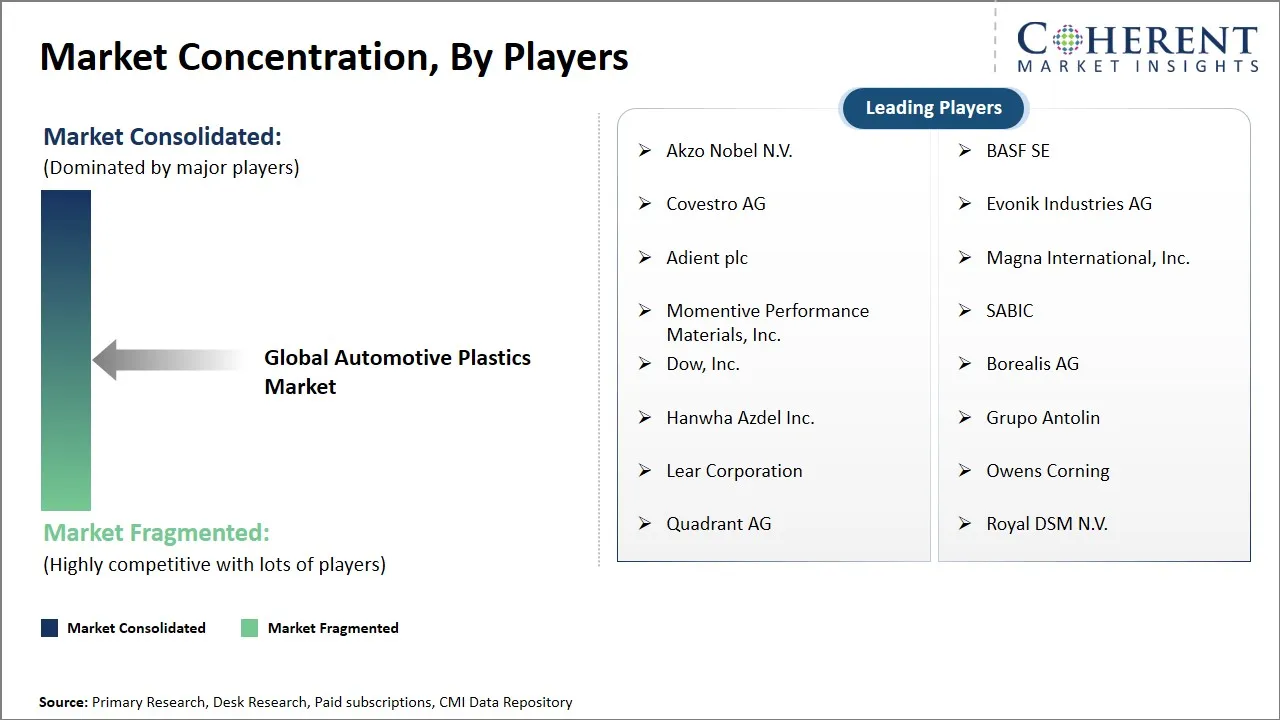
| Companies covered: | Akzo Nobel N.V., BASF SE, Covestro AG, Evonik Industries AG, Adient plc, Magna International, Inc., Momentive Performance Materials, Inc., SABIC, Dow, Inc., Borealis AG, Hanwha Azdel Inc., Grupo Antolin, Lear Corporation, Owens Corning, Quadrant AG, and Royal DSM N.V. | ||
| Growth Drivers: |
| ||
| Restraints & Challenges: |
| ||
Automotive Plastics Market Dynamics
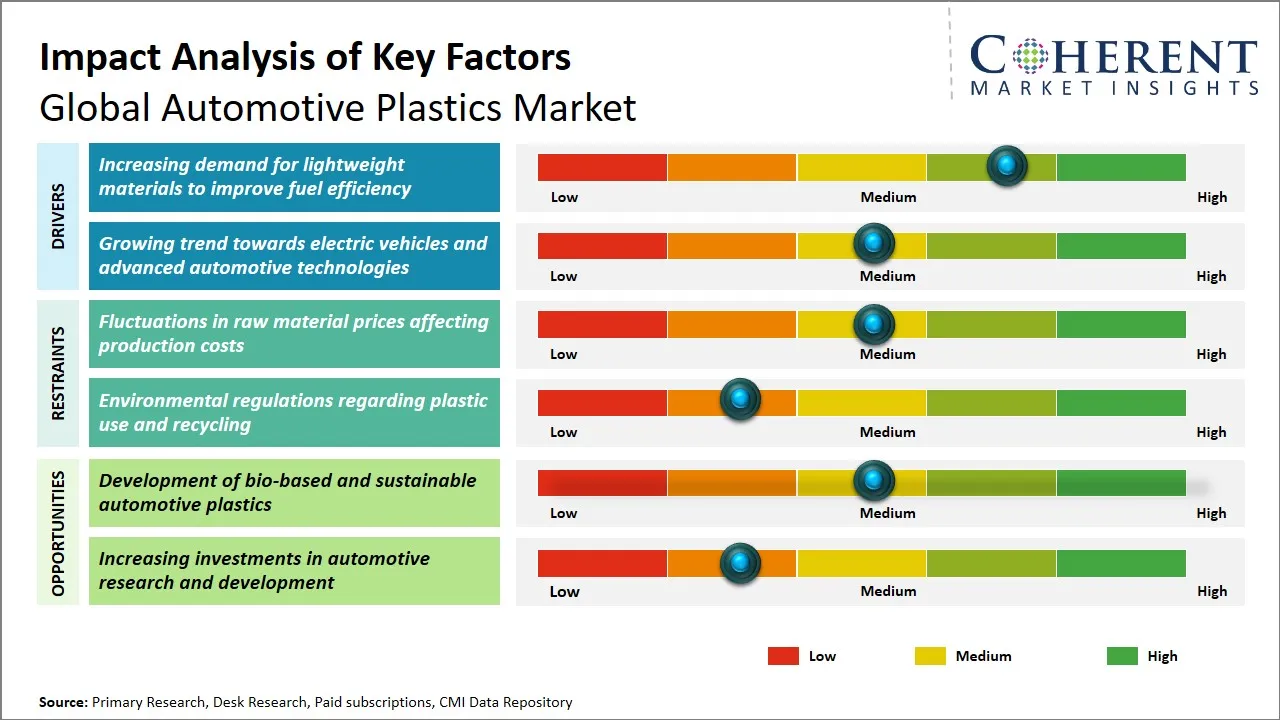
Automotive Plastics Market Driver - Increasing Demand for Lightweight Materials to Improve Fuel Efficiency
One of the leading drivers of the global automotive plastics market is the ever-increasing the demand for lightweight materials which is a result of strict fuel efficiency norms and the consumer's preference for eco-friendly cars. In order to meet the demand for lighter vehicles, the automotive industry is gradually resorting to replacing metals with plastics for certain parts due to the latter being able to provide a significant reduction in weight without compromising the structural integrity or safety. Besides, the energy required for operating lighter vehicles is less, hence fuel economy is improved and carbon emissions cut, thus, the measures supporting global environmental sustainability are being adhered to.
For instance, Tesla's Model 3 incorporates a sophisticated combination of high-strength plastics and composites in the dashboard, bumpers, and underbody components to achieve weight savings that are considerable as compared to conventional sedans.
Automotive Plastics Market Opportunity - Development of Bio-based and Sustainable Automotive Plastics
The increasing environmental concerns and stringent regulations regarding vehicle emissions and waste management are driving significant opportunities in the development of bio-based and sustainable automotive plastics. As the automotive industry aims to reduce its carbon footprint, manufacturers are actively seeking alternatives to conventional petroleum-based plastics, which are often non-biodegradable and contribute to environmental pollution. Bio-based plastics, bioplastics, derived from renewable resources such as corn starch, sugarcane, and cellulose, provide a promising pathway to enhance sustainability without compromising material performance.
For instance, Toyota’s “Bio-PET” and “Bio-PP” materials are now used in multiple hybrid models, cutting reliance on petroleum-based polymers and reducing lifecycle CO₂ emissions.
Analyst Opinion (Expert Opinion)
- The Automotive Plastics Summit (2023) and International Plastics Exhibition (2022) pointed together towards the future with the presentation of sustainable plastic innovations by companies like BASF and Covestro.
- To illustrate, BASF introduced a biopolymer made from renewable resources for car interiors, which reflects the trends of the company to deal with ecological problems through eco-friendly production, and finally, the creation of materials for the market. The conference mentioned that the automotive sector would not be able to comply with the stringent safety and performance standards without advanced polymer technologies.
- Moreover, challenges such as unstable prices of raw materials and the lack of common standards in the industry were unanimously recognized as obstacles to the growth of the market. It seems certain that companies that increase R&D to improve products with new, lightweight, recyclable materials along with collaborating with the automotive industry should do well in the market.
Speak to the analyst
Want personalized insights?
Take the findings above to one of our principal consultants, or have the report rebuilt around the segments, geographies and competitors you actually track.
Market Segmentation
- Product Type Insights (Revenue, USD Mn, 2021 - 2033)
- Polypropylene (PP)
- Polyurethane (PU)
- Polycarbonate (PC)
- Acrylonitrile butadiene styrene (ABS)
- Polyvinyl Chloride (PVC)
- Polyethylene (PE)
- Polymethyl methacrylate (PMMA)
- Polyamide (Nylon 6, Nylon 66)
- Other Product Types
- Application Insights (Revenue, USD Mn, 2021 - 2033)
- Interior Furnishings
- Electrical Components
- Exterior Furnishings
- Power Trains
- Under the Hood
- Chassis
- Other Applications
- Vehicle Type Insights (Revenue, USD, 2021 - 2033)
- Passenger Cars
- Light Commercial Vehicles
- Medium & Heavy Commercial Vehicles
- Regional Insights (Revenue, USD Mn, 2021 - 2033)
- North America
- U.S.
- Canada
- Latin America
- Brazil
- Argentina
- Mexico
- Rest of Latin America
- Europe
- Germany
- U.K.
- Spain
- France
- Italy
- Russia
- Rest of Europe
- Asia Pacific
- China
- India
- Japan
- Australia
- South Korea
- ASEAN
- Rest of Asia Pacific
- Middle East
- GCC Countries
- Israel
- Rest of Middle East
- Africa
- South Africa
- North Africa
- Central Africa
- North America
- Key Players Insights
- Akzo Nobel N.V.
- BASF SE
- Covestro AG
- Evonik Industries AG
- Adient plc
- Magna International, Inc.
- Momentive Performance Materials, Inc.
- SABIC
- Dow, Inc.
- Borealis AG
- Hanwha Azdel Inc.
- Grupo Antolin
- Lear Corporation
- Owens Corning
- Quadrant AG
- Royal DSM N.V.
Sources
Primary Research Interviews
- R&D Director – Leading Automotive Plastics Manufacturer
- Procurement Manager – Major Automotive OEM Supplier
- Product Development Head – Well-Known Automotive Parts Brand
- Sustainability Manager – Automotive Plastics Certification Body
Stakeholders
- Manufacturers of automotive plastics and polymer composites
- End-use Sectors
- Automotive OEMs (Original Equipment Manufacturers)
- Aftermarket automotive parts suppliers
- Electric vehicle manufacturers focusing on lightweight materials
- Regulatory & Certification Bodies for automotive materials
- Automotive OEMs and Tier 1 suppliers
- Technology Integration Players: Advanced materials and AI-driven design providers
Databases
- UN Comtrade Database
- India Import Export (EXIM) Database
Magazines
- Automotive World – Innovations in automotive plastics and composites
- Plastics Technology – Trends in polymer use in automotive applications
- Automotive News – Market updates on automotive materials
- Polymer Solutions – Advances in automotive-grade plastics
Journals
- Journal of Applied Polymer Science – Automotive plastics formulations
- Polymer Composites Journal – Lightweight materials in automotive design
- International Journal of Automotive Technology – Impact of plastics on vehicle performance
- Journal of Cleaner Production – Sustainability in automotive materials
- Materials Science and Engineering – Automotive polymer developments
Newspapers
- The Financial Times – Market growth of automotive plastics
- The Guardian – Sustainability initiatives in automotive manufacturing
- Asia Automotive News – Automotive plastics market in Asia-Pacific
- European Automotive News – Regulatory updates on automotive materials
- The New York Times – Trends in lightweight vehicle materials
Associations
- Society of Plastics Engineers (SPE)
- Automotive Industry Action Group (AIAG)
- Plastics Industry Association (PLASTICS)
- European Plastics Converters (EuPC)
- International Association for Automotive Compliance (IAAC)
Public Domain Sources
- U.S. Environmental Protection Agency (EPA) – Guidelines on automotive materials sustainability
- European Commission – Automotive plastics regulations and standards
- World Economic Forum – Initiatives for circular economy in automotive plastics
- OECD – Environmental assessments for automotive materials
Proprietary Elements
- CMI Data Analytics Tool, Proprietary CMI Existing Repository of information for last 8 years.
Get access to 250+ pages report
Every segment, forecast, competitor profile and data table behind the analysis above — available for instant download.
- ESOMAR Member
- ISO 9001:2015 Certified
- D-U-N-S Registered
- GDPR & CCPA Compliant
Missing comfort of reading report in your local language? Find your preferred language:
Transform your Strategy with Exclusive Trending Reports
Frequently Asked Questions
The global automotive plastics market is estimated to be valued at USD 37,838.4 Mn in 2026 and is expected to reach USD 61,962.7 Mn by 2033.
The CAGR of the global automotive plastics market is projected to be 7.3% from 2026 to 2033.
Increasing demand for lightweight materials to improve fuel efficiency and growing trend towards electric vehicles and advanced automotive technologies are the major factors driving the growth of the global automotive plastics market.
Fluctuations in raw material prices affecting production costs and environmental regulations regarding plastic use and recycling are the major factors hampering the growth of the global automotive plastics market.
In terms of product type, the Polypropylene (PP) segment is estimated to dominate the market revenue share in 2026.
Akzo Nobel N.V., BASF SE, Covestro AG, Evonik Industries AG, Adient plc, Magna International, Inc., Momentive Performance Materials, Inc., SABIC, Dow, Inc., Borealis AG, Hanwha Azdel Inc., Grupo Antolin, Lear Corporation, Owens Corning, Quadrant AG, and Royal DSM N.V. are the major players.
Asia Pacific is expected to lead the global automotive plastics market in 2026.