

Global Automotive Suspension Market Size and Forecast – 2026-2033
The global automotive suspension market is estimated to be valued at USD 53.37 Bn in 2026 and is expected to reach USD 92.06 Bn by 2033, exhibiting a compound annual growth rate (CAGR) of 8.1% from 2026 to 2033.
Key Takeaways of the Global Automotive Suspension Market
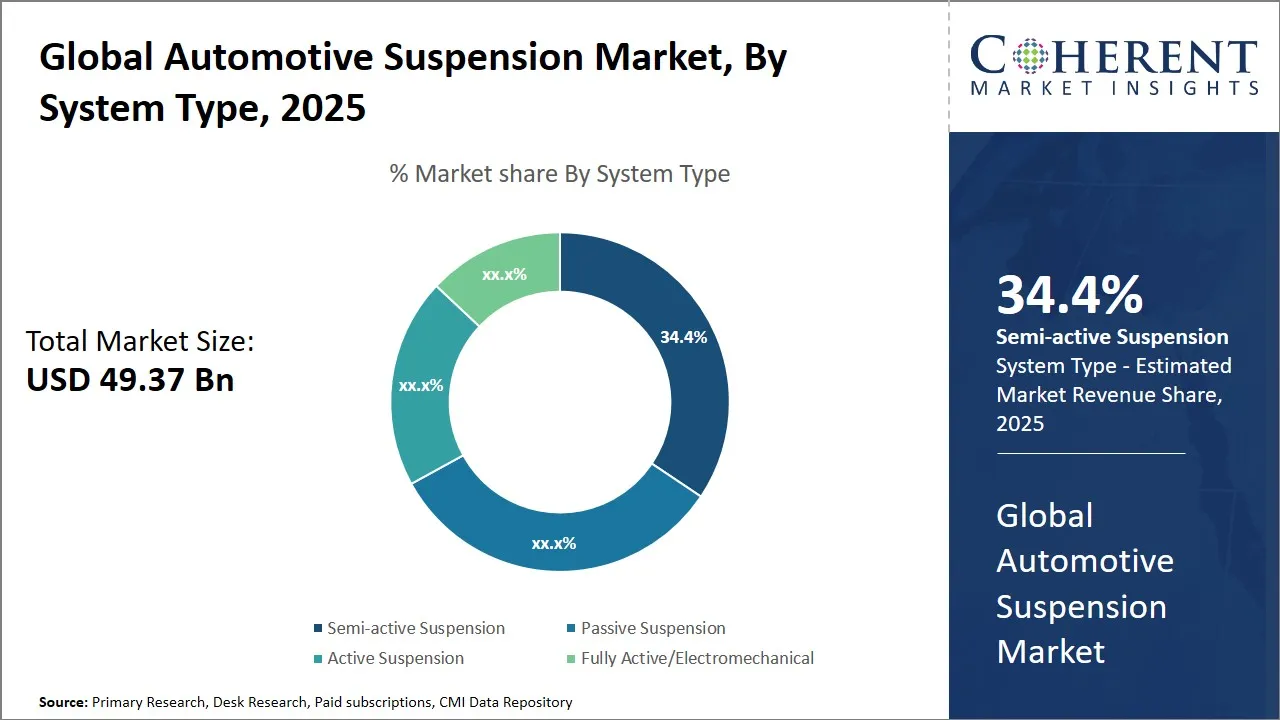
- The semi-active suspension segment leads the market holding an estimated share of 35.4% in 2026.
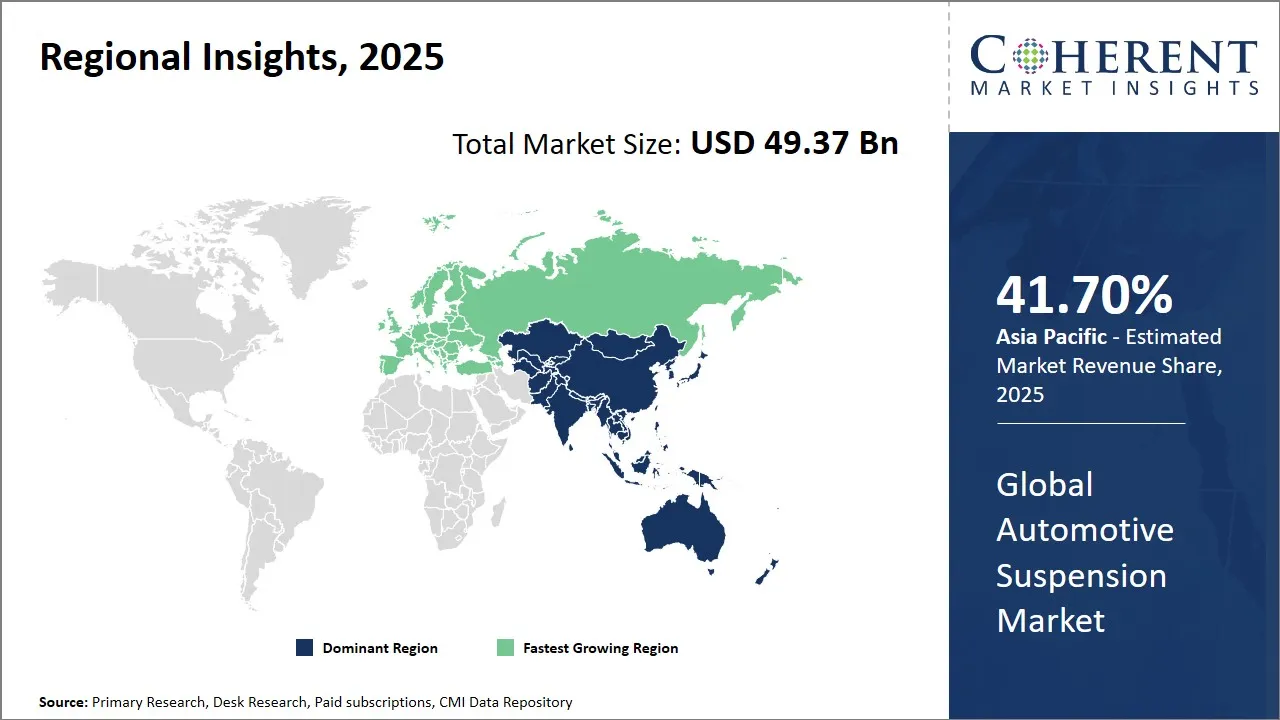
- Asia Pacific is estimated to lead the market with a share of 41.7% in 2026.
- Europe, holding a share of 24.3 % in 2026, is projected to be the fastest growing region.
Market Overview
Key trends in the automotive suspension market include the rapid adoption of electronic and semi-active suspension systems, which offer enhanced adaptability and improved vehicle handling. Additionally, the shift towards Electric Vehicles (EVs) is prompting manufacturers to innovate suspension designs that optimize battery placement and vehicle weight, further fueling market expansion. Increasing investments in research and development to reduce vehicle emissions and enhance energy efficiency are also shaping the future landscape of the automotive suspension industry.
Current Events and their Impact
Current Events | Description and its impact |
Brembo Acquires Öhlins Racing for USD 405 Million |
|
Continental Plans to List Automotive Unit in Frankfurt |
|
Porsche Partners with ClearMotion for Active Suspension Technology |
|
Segmental Insights
- Current Industry Events of 2026
- Market Size Estimation
- Regional Breakdown
- Competitive Landscape
- Customer Intelligence
- Segmental Analysis
- Pricing Analysis
- Key Market Drivers, Challenges & Future Trends
- Customized Insights Section
Global Automotive Suspension Market Insights, by System Type - Advanced Control Systems are Enhancing Ride Comfort and Safety
The semi-active suspension segment is expected to contribute the highest share of 35.4% in the market in 2026. Semi-active suspension systems dynamically adjust the damping force in response to road conditions and driving behavior using electronically controlled valves or adjustable dampers. One of the primary factors driving the growth of the semi-active suspension segment is the increased demand for enhanced passenger comfort and vehicle stability across diverse driving environments. Semi-active suspensions provide a balanced solution by reducing body roll, pitch, and vibrations, thereby improving overall ride quality and safety.
Moreover, semi-active suspension systems benefit from easier integration with existing vehicle electronics and reduced maintenance requirements. Unlike fully active or electromechanical suspensions, semi-active systems consume significantly less energy since they do not actively inject power to control suspension movement but rather modulate damping forces in real-time. This energy efficiency aligns with the automotive industry's focus on sustainability and fuel economy, especially amid rising regulatory pressure to lower emissions. The increasing adoption of semi-active suspension is also supported by advancements in sensors, microcontrollers, and actuator technologies, which have become more affordable and reliable.
End User Feedback and Unmet Needs in the Global Automotive Suspension Market
- Many end users, particularly in premium and electric vehicles, have expressed dissatisfaction with the limitations of traditional passive suspension systems, citing discomfort over uneven roads, potholes, and highway vibrations. Feedback indicates that while semi-active and active suspensions improve handling, there is still a gap in providing adaptive comfort that can seamlessly adjust in real-time to varying road conditions, payloads, and driving modes. This unmet need highlights opportunities for manufacturers to develop more intelligent, predictive suspension solutions that use advanced sensors and AI-based control algorithms to continuously optimize ride quality.
- Vehicle owners increasingly expect suspension systems to work in harmony with ADAS features such as adaptive cruise control, lane-keeping assist, and autonomous driving capabilities. Current systems often operate in isolation, leading to suboptimal vehicle performance in scenarios like emergency braking, cornering, or high-speed maneuvers. End-user feedback points to the need for suspensions that are fully integrated with vehicle sensors and control systems, providing a smoother, safer, and more responsive driving experience—especially in EVs where ride dynamics and battery efficiency are critical.
- While active and semi-active suspensions deliver superior performance, many consumers—especially in emerging markets—report that costs remain prohibitive. Additionally, aftermarket options for upgrading suspensions on existing vehicles are limited, with few solutions providing reliable performance without professional calibration or high costs. Users are seeking more affordable, modular, and easily upgradable suspension solutions that allow customization for comfort, off-road capability, or sporty performance without requiring full vehicle replacement or expensive retrofitting.
Regional Insights
Asia Pacific Automotive Suspension Market Analysis and Trends
Asia Pacific holds the dominant position, holding an estimated share of 41.7% in 2026, due to its vast automotive manufacturing ecosystem and strong presence of both original equipment manufacturers (OEMs) and aftermarket suppliers. Countries like Japan, China, South Korea, and India play a pivotal role in driving demand for advanced suspension systems fueled by rapid industrialization, increasing vehicle production, and expanding consumer base.
Government initiatives promoting electric vehicles (EVs) and stricter safety and emission regulations have accelerated technological innovation in suspension systems. Furthermore, Asia Pacific is home to major suspension component manufacturers such as Tokico, KYB Corporation, and Mando Corporation, who invest heavily in research and development to enhance ride comfort and vehicle stability. The region’s well-established supply chain, cost-effectiveness, and access to raw materials further consolidate its leading role.
Europe Automotive Suspension Market Analysis and Trends
Europe, holding a share of 24.3% in 2026, is expected to exhibit the fastest growth in the global automotive suspension market. The growth is driven by strong adoption of advanced suspension technologies, including semi-active and fully active systems, particularly in premium and electric vehicles. Stringent government regulations on vehicle safety, emissions, and ride comfort are accelerating the integration of intelligent suspension solutions in new models.
The market is supported by a robust automotive ecosystem, with leading players such as ZF Friedrichshafen, Continental AG, and BWI Group actively investing in R&D and strategic partnerships to develop smart and energy-efficient suspension systems. Furthermore, Europe’s emphasis on electrification of vehicles, autonomous driving technologies, and urban mobility solutions provides significant opportunities for suspension innovations. Trade agreements, skilled labor availability, and close collaboration between OEMs and technology suppliers further enhance the region’s technological adoption and market growth.
Global Automotive Suspension Market Outlook for Key Countries
U.S. Automotive Suspension Market Analysis and Trends
The U.S. automotive suspension market is characterized by strong innovation driven by consumer demand for enhanced safety, comfort, and performance. Major industry players such as Tenneco and Dana Incorporated focus on advanced adaptive and semi-active suspension technologies, crucial for the rising number of SUVs and electric vehicles in the market. Government mandates on vehicle safety and fuel economy are propelling investments in lightweight suspension components and electronically controlled systems. The country’s extensive R&D infrastructure and significant aftermarket presence ensure continued leadership in suspension technology development.
China Automotive Suspension Market Analysis and Trends
China automotive suspension market is propelled by the world’s largest vehicle manufacturing base and fast-growing urban population incentivizing new vehicle sales. Key manufacturers including Mando Corporation and KYB have expanded production facilities to cater to both domestic and export demands. The Chinese government supports the automotive sector with policies promoting electric and autonomous vehicles, which require advanced suspension solutions to enhance stability and passenger comfort. Additionally, increasing localization of parts manufacturing and improved supply chain logistics make China a critical hub in the suspension market’s growth trajectory.
Japan Automotive Suspension Market Analysis and Trends
Japan continues to lead the market through innovation with a focus on precision engineering and reliability in suspension systems. Renowned companies such as Tokico and Showa Corporation are pioneers in shock absorber and suspension strut technology, often supplying to premium automotive brands globally. Japan’s automotive industry prioritizes lightweight materials and electronic suspension to meet stringent environmental and safety regulations domestically and abroad. Government incentives fostering technological development and export competitiveness strengthen the country’s impact on the global suspension market.
Germany Automotive Suspension Market Analysis and Trends
Germany automotive suspension market reflects the country’s position as a global engineering powerhouse with leading OEMs like BMW, Mercedes-Benz, and Volkswagen driving demand for advanced suspension solutions. Suppliers such as ZF Friedrichshafen and Bilstein focus on active and semi-active suspension technologies, prioritizing performance and safety in luxury and high-performance vehicles. German government policies supporting innovation through subsidies and stringent regulatory frameworks encourage continuous development of sophisticated suspension systems. The country’s strong export orientation ensures its global influence remains significant within the market.
India Automotive Suspension Market Analysis and Trends
India automotive suspension market is evolving rapidly, supported by expanding passenger and commercial vehicle segments. Homegrown companies along with international players are investing in cost-effective, durable suspension components tailored to challenging road conditions prevalent in the country. Government initiatives encouraging electric vehicle adoption and infrastructure development are creating new opportunities for technologically advanced and robust suspension systems. Key market participants like Motherson Sumi Systems and TVS Group leverage India’s growing automotive manufacturing ecosystem to strengthen their foothold in both domestic and international markets.
Market Players, Key Development, and Competitive Intelligence
Key Developments
- In June 2025, ZF’s Commercial Vehicle Solutions (CVS) division announced the series production of the latest, fifth generation of its market leading Electronically Controlled Air Suspension (ECAS) technology OptiRide ECAS for Hyundai Motor Company (HMC).
- In April 2025, Marelli received a 2025 Automotive News PACEpilot Award for its Fully Active Electromechanical Suspension, during a ceremony held on April 15, 2025 in Detroit, U.S. This award honors innovations by automotive suppliers that have not yet been commercialized but have the potential to revolutionize the future of mobility.
- In October 2024, Brembo, an Italian automotive parts manufacturer, signed an agreement to acquire Öhlins Racing, a high-performance suspension technology company, for USD 405 million
- In April 2024, German luxury automaker, Porsche, partnered with ClearMotion to validate the U.S. startup's active suspension technology and road-reading software and has signed a licensing agreement for its technology.
Top Strategies Followed by Automotive Suspension Market Players
- Established players, often large multinational corporations with substantial resources, lead the innovation race by investing heavily in research and development (R&D).
- ZF launched its sMOTION active chassis system and continues to expand its R&D facilities in Germany and the U.S. to integrate advanced sensor-driven suspension systems.
- Mid-level players in the automotive suspension market adopt a different set of strategies focused primarily on delivering cost-effective yet reliable solutions.
- Mando focuses on providing reliable, affordable suspension systems for mainstream vehicles while maintaining quality standards.
- Meanwhile, small-scale players in the suspension market carve out niche opportunities by concentrating on specialized features or innovative products that address specific customer needs or emerging trends.
- Öhlins continues to supply advanced dampers and shock absorbers for racing and luxury vehicles, differentiating itself with precision engineering and customization options.
Market Report Scope
Automotive Suspension Market Report Coverage
| Report Coverage | Details | ||
|---|---|---|---|
| Base Year: | 2025 | Market Size in 2026: | USD 53.37 Bn |
| Historical Data for: | 2020 To 2024 | Forecast Period: | 2026 To 2033 |
| Forecast Period 2026 to 2033 CAGR: | 8.1% | 2033 Value Projection: | USD 92.06 Bn |
| Geographies covered: |
| ||
| Segments covered: |
| ||
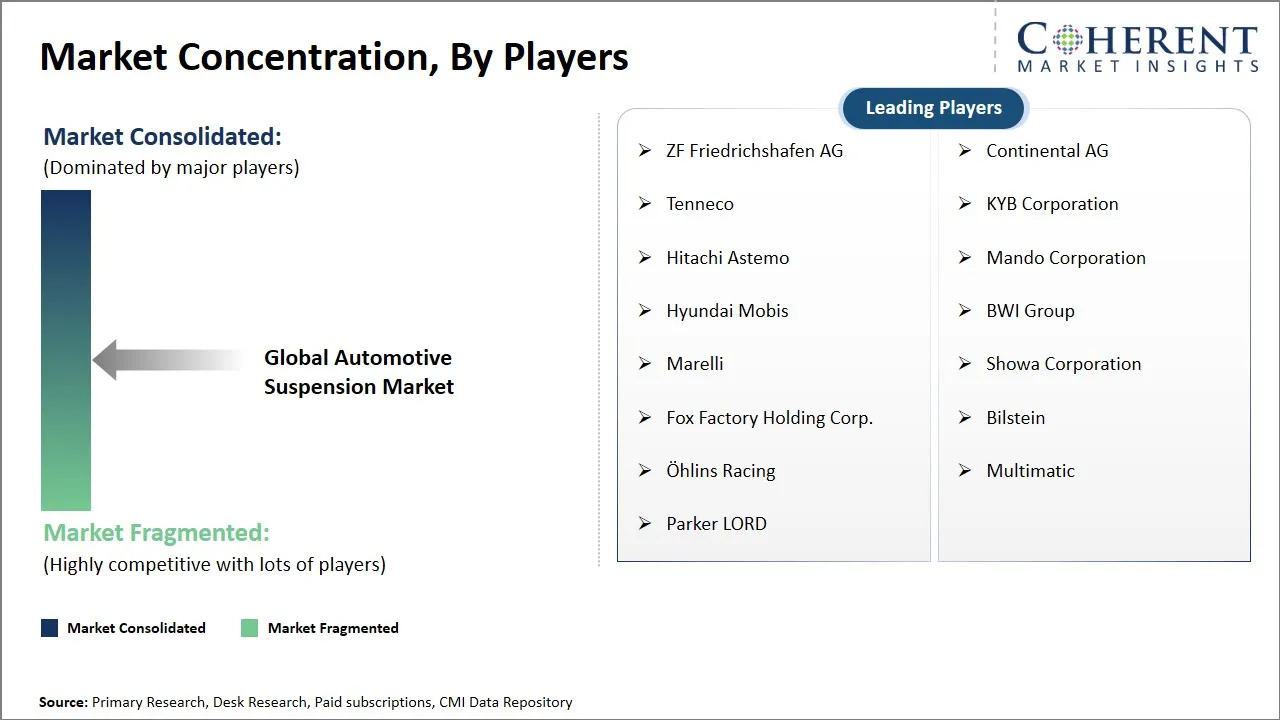
| Companies covered: | ZF Friedrichshafen AG, Continental AG, Tenneco, KYB Corporation, Hitachi Astemo, Mando Corporation, Hyundai Mobis, BWI Group, Marelli, Showa Corporation, Fox Factory Holding Corp., Bilstein, Öhlins Racing, Multimatic, and Parker LORD | ||
| Growth Drivers: |
| ||
| Restraints & Challenges: |
| ||
Market Dynamics
Global Automotive Suspension Market Driver - Increased EV Adoption and Demand for Ride Comfort & Energy-efficient Active Systems
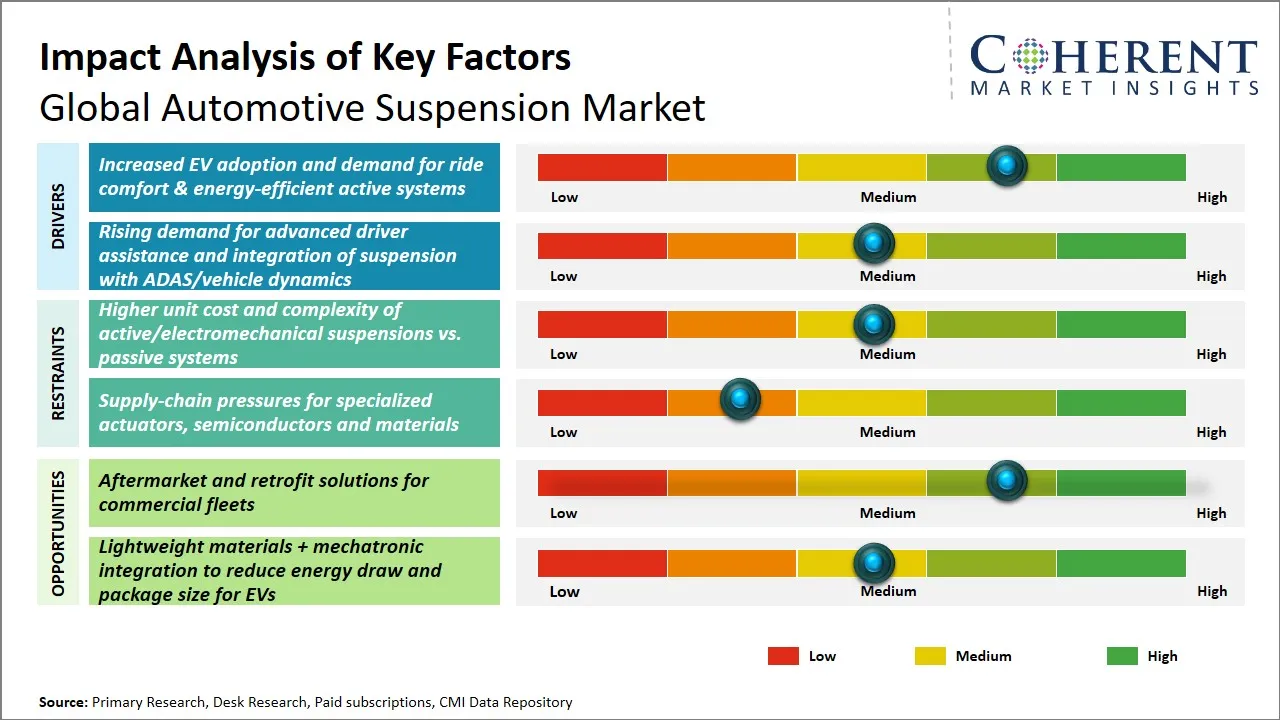
The accelerating adoption of electric vehicles (EVs) is significantly influencing the dynamics of the automotive suspension market. As EVs become more mainstream, manufacturers are prioritizing advancements in suspension technologies to complement the unique characteristics of electric drivetrains, such as increased battery weight and altered weight distribution. This evolution has led to a heightened demand for sophisticated suspension systems that can not only enhance ride comfort but also optimize energy efficiency.
Active suspension systems, which intelligently adjust damping and stiffness in real time, are gaining prominence due to their ability to reduce energy consumption and improve vehicle handling. The integration of these advanced systems enables smoother rides despite the additional mass of EV batteries, ultimately fostering a superior driving experience. Consequently, the interplay between the rising prevalence of EVs and the pursuit of ride comfort and energy-efficient suspension solutions is a key driver propelling innovation and adoption within the global automotive suspension landscape.
Global Automotive Suspension Market Opportunity – Aftermarket and Retrofit Solutions for Commercial Fleets
The aftermarket and retrofit segment within the global automotive suspension market presents a significant growth opportunity, particularly for commercial fleets operating under demanding conditions. As commercial vehicles endure extensive wear and tear due to heavy loads, rough terrains, and continuous usage, fleet operators increasingly seek cost-effective and efficient suspension upgrades to enhance vehicle performance and longevity. Retrofitting existing trucks, buses, and specialty vehicles with advanced suspension systems—such as air suspensions or electronically controlled dampers—not only improves ride comfort and handling but also reduces maintenance costs and downtime, which are critical for fleet efficiency.
Additionally, the rising adoption of telematics and IoT technologies facilitates predictive maintenance, making aftermarket suspension solutions more attractive by enabling timely replacements or upgrades tailored to vehicle usage patterns. Regulatory pressures around safety and emissions standards further incentivize fleet owners to invest in suspension retrofits that support weight optimization and fuel efficiency. Furthermore, emerging economies witnessing rapid industrialization and urbanization offer a burgeoning customer base for aftermarket suppliers, as aging commercial vehicles are prevalent and require modernization.
Analyst Opinion (Expert Opinion)
- The industry is increasingly shifting from passive suspensions to semi-active and fully active systems. These technologies use sensors, actuators, and AI-based control algorithms to continuously adapt damping and ride dynamics in real time. This not only improves comfort and handling but also enhances energy efficiency, particularly in electric vehicles where reducing drivetrain losses is critical.
- Experts emphasize that the next generation of suspension systems will be tightly integrated with Advanced Driver Assistance Systems (ADAS) and vehicle-to-everything (V2X) connectivity. Predictive suspension technologies can anticipate road conditions via cameras, radar, or cloud data, adjusting the system proactively. Analysts suggest this integration will be a key differentiator for OEMs in premium and EV segments.
- There is a trend toward mechatronic suspensions, combining mechanical components with electronic controls for improved performance, as well as the use of lightweight materials like aluminum alloys and composites. These innovations reduce overall vehicle weight, improve fuel efficiency (or EV range), and allow suspensions to support higher loads without compromising ride comfort.
Speak to the analyst
Want personalized insights?
Take the findings above to one of our principal consultants, or have the report rebuilt around the segments, geographies and competitors you actually track.
Market Segmentation
- System Type Insights (Revenue, USD Bn, 2021 - 2033)
- Semi-active Suspension
- Passive Suspension
- Active Suspension
- Fully Active/Electromechanical
- Regional Insights (Revenue, USD Bn, 2021 - 2033)
- North America
- U.S.
- Canada
- Latin America
- Brazil
- Argentina
- Mexico
- Rest of Latin America
- Europe
- Germany
- U.K.
- Spain
- France
- Italy
- Russia
- Rest of Europe
- Asia Pacific
- China
- India
- Japan
- Australia
- South Korea
- ASEAN
- Rest of Asia Pacific
- Middle East
- GCC Countries
- Israel
- Rest of Middle East
- Africa
- South Africa
- North Africa
- Central Africa
- North America
- Key Players Insights
- ZF Friedrichshafen AG
- Continental AG
- Tenneco
- KYB Corporation
- Hitachi Astemo
- Mando Corporation
- Hyundai Mobis
- BWI Group
- Marelli
- Showa Corporation
- Fox Factory Holding Corp.
- Bilstein
- Ohlins Racing
- Multimatic
- Parker LORD
Sources
Primary Research Interviews
Stakeholders
- Automotive OEMs and Tier-1 Suppliers (e.g., ZF Friedrichshafen, KYB, Continental, Brembo)
- Suspension Component Manufacturers and Electronics Suppliers (e.g., Mando, Hitachi Astemo, Marelli)
- Fleet Operators and Commercial Vehicle Managers
- Automotive Aftermarket Companies specializing in suspension retrofits
- EV Manufacturers and Technology Integrators
- Vehicle Safety and Ride Comfort Consultants
Databases
- International Organization of Motor Vehicle Manufacturers (OICA) Database
- Automotive Component Industry Reports (ACI Data Repository)
- EuroAutoStat
- OECD Transport and Automotive Statistics
Magazines
- Automotive Engineering Today
- Car Tech & Innovations Magazine
- Vehicle Dynamics & Performance Journal
- Suspension Systems Monthly
Journals
- Journal of Vehicle Dynamics and Control
- International Journal of Automotive Technology
- Mechatronics in Mobility Journal
- Journal of Automotive Engineering and Innovation
Newspapers
- Automotive News Europe
- The Motor Report (U.K.)
- Auto Industry Times (India)
- The Financial Express (Automotive Section)
Associations
- Society of Automotive Engineers (SAE International)
- Automotive Components Manufacturers Association (India)
- European Association of Automotive Suppliers (CLEPA)
- International Federation of Automotive Engineering Societies (FISITA)
- International Automotive Suspension Society (IASS)
Public Domain Sources
- United Nations Economic Commission for Europe (UNECE) Transport Statistics
- World Bank – Automotive Industry Reports
- U.S. Department of Transportation – Vehicle Safety Data
- Eurostat – Motor Vehicle Production and Trade Statistics
- ResearchGate – Vehicle Suspension Research Publications
Proprietary Elements
- CMI Data Analytics Tool
- Proprietary CMI Existing Repository of automotive suspension information for the last 8 years
Get access to 250+ pages report
Every segment, forecast, competitor profile and data table behind the analysis above — available for instant download.
- ESOMAR Member
- ISO 9001:2015 Certified
- D-U-N-S Registered
- GDPR & CCPA Compliant
Missing comfort of reading report in your local language? Find your preferred language:
Transform your Strategy with Exclusive Trending Reports
Frequently Asked Questions
The global automotive suspension market is estimated to be valued at USD 53.37 billion in 2026 and is expected to reach USD 92.06 billion by 2033.
The CAGR of global automotive suspension market is projected to be 8.1% from 2026 to 2033.
Increased EV adoption and demand for ride comfort & energy-efficient active systems and rising demand for advanced driver assistance and integration of suspension with ADAS/vehicle dynamics are the major factors driving the growth of the global automotive suspension market.
Higher unit cost and complexity of active/electromechanical suspensions vs. passive systems and supply-chain pressures for specialized actuators, semiconductors and materials are the major factors hampering the growth of the global automotive suspension market.
In terms of system type, the semi-active suspension segment is estimated to dominate the market revenue share in 2026.
ZF Friedrichshafen AG, Continental AG, Tenneco, KYB Corporation, Hitachi Astemo, Mando Corporation, Hyundai Mobis, BWI Group, Marelli, Showa Corporation, Fox Factory Holding Corp., Bilstein, Öhlins Racing, Multimatic, and Parker LORD are the major players.
Asia Pacific is expected to lead the global automotive suspension market in 2026.