

Global Balsa Wood Market Size and Forecast – 2026-2033
The global balsa wood market is estimated to be valued at USD 245.6 Mn in 2026 and is expected to reach USD 384.2 Mn by 2033 exhibiting a compound annual growth rate (CAGR) of 6.6% from 2026 to 2033.
Key Takeaways of the Balsa Wood Market
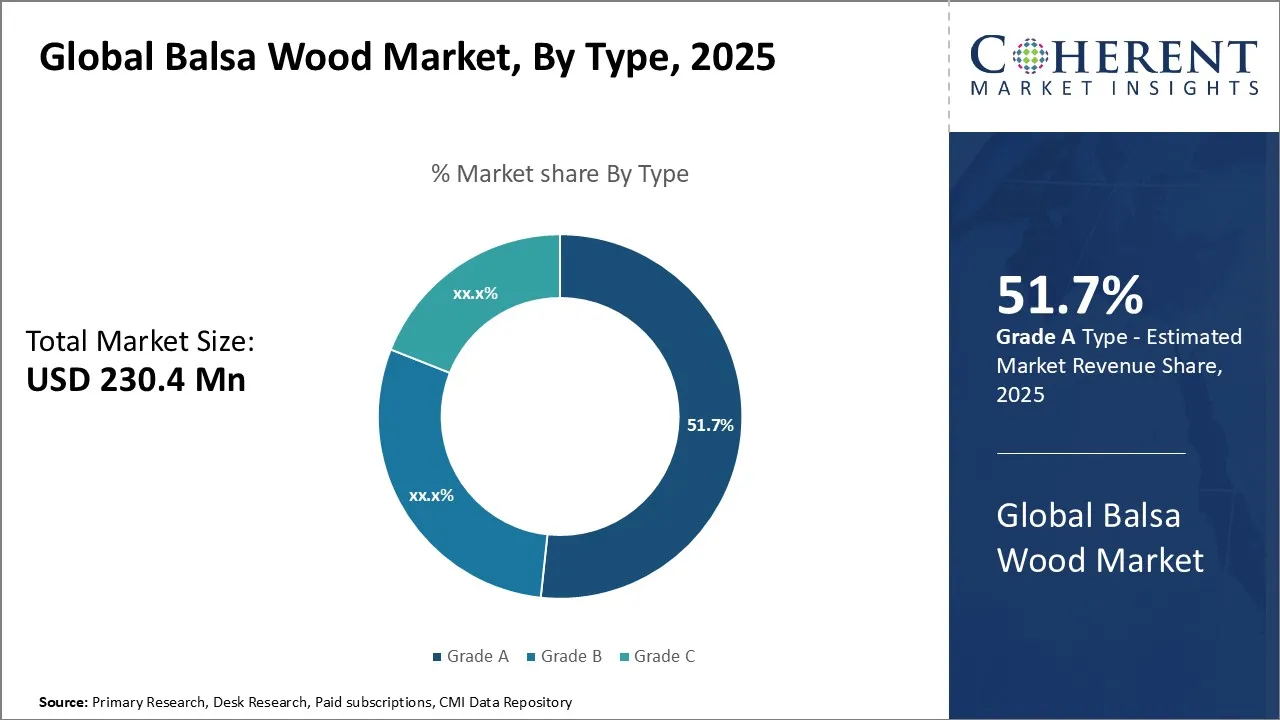
- The grade A segment is projected to capture 52.7% of the market share in 2026.
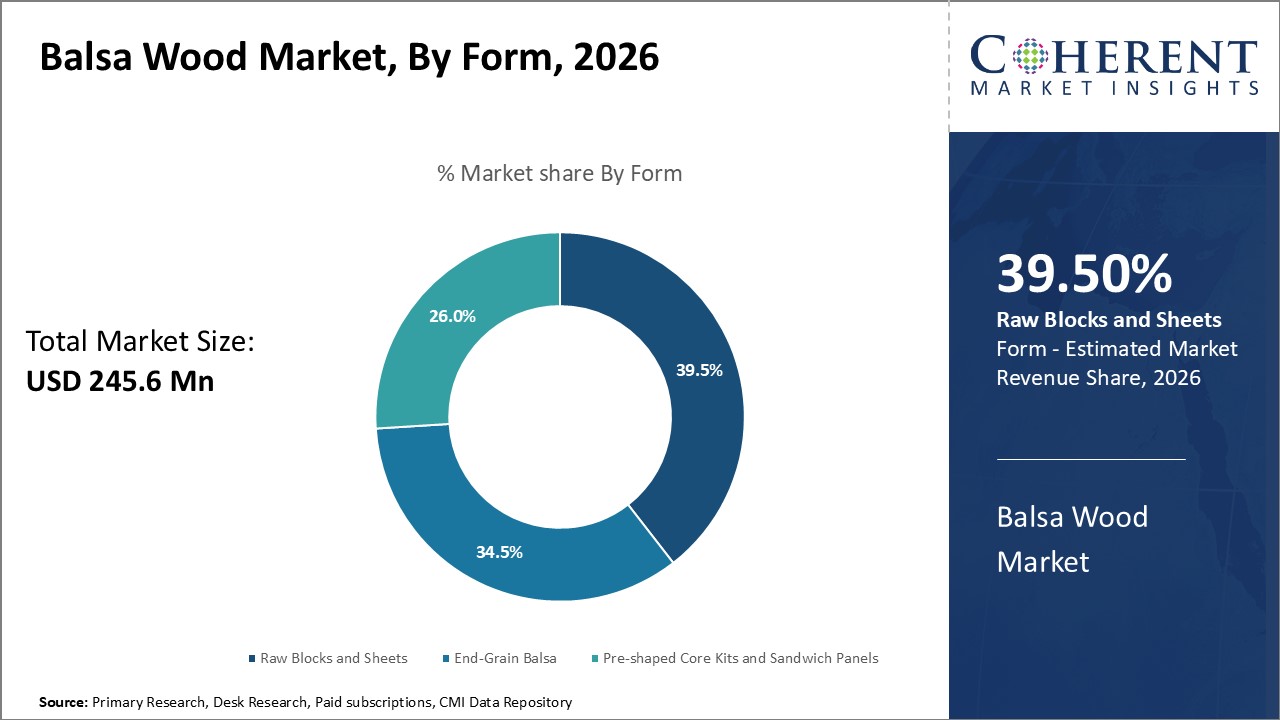
- The raw blocks and sheets segment is expected to account for 39.5 % of the market share in 2026.
- The aerospace & defense segment is projected to account for 43.7 % of the market share in 2026.
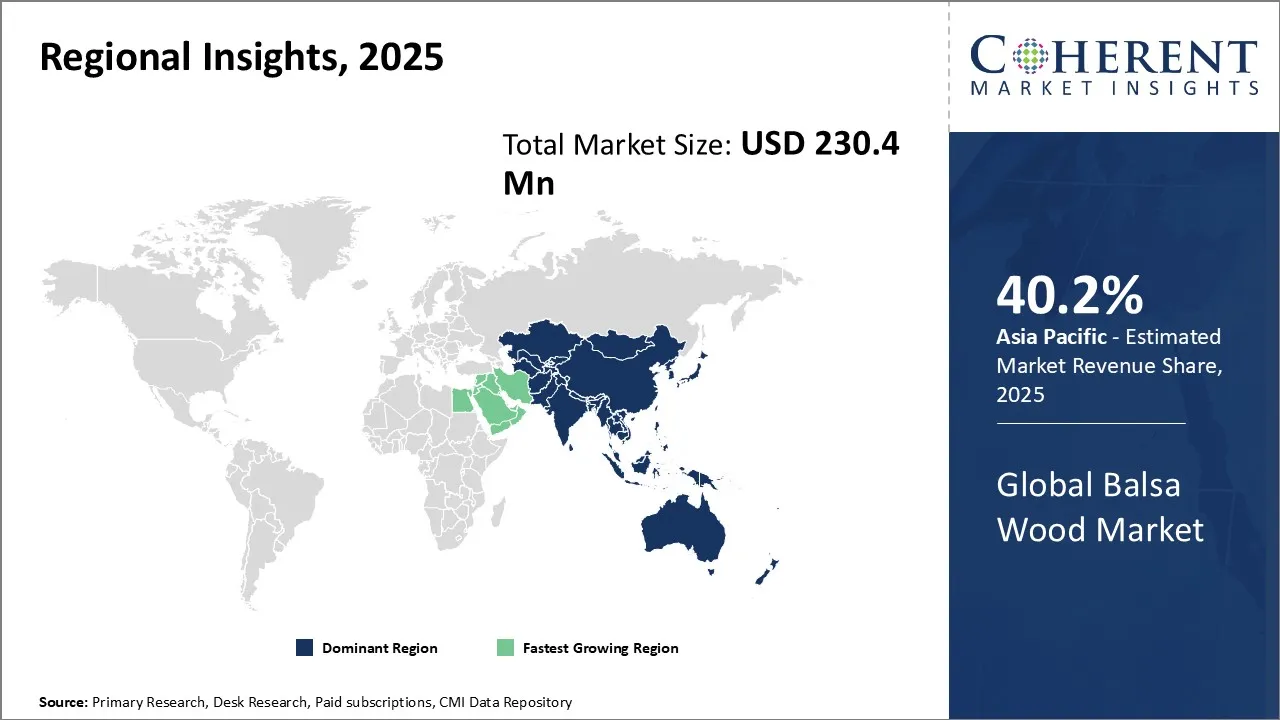
- Asia Pacific is projected to dominate the global balsa wood market in 2026 with a 40.2 % share. The Middle East is projected to hold 15.5% share in 2026, and it is expected to be the fastest-growing region.
Market Overview
A key market trend in the balsa wood industry is the growing emphasis on eco-friendly and renewable materials, sustainable materials. As environmental regulations tighten and sustainability becomes a priority, manufacturers are increasingly adopting balsa wood as a viable substitute for synthetic composites and metals. Additionally, innovations in wood treatment and hybrid materials are enhancing balsa wood’s durability and versatility, thereby broadening its application scope. This trend towards green building materials and lightweight composites is likely to sustain the market’s upward trajectory in the coming years.
Current Events and Its Impact
Current Events | Description and its Impact |
Adoption of Smart Manufacturing and Processing Technology |
|
Introduction of Environmental Regulations and Sustainability Certification Requirements |
|
Segmental Insights
- Current Industry Events of 2026
- Market Size Estimation
- Regional Breakdown
- Competitive Landscape
- Customer Intelligence
- Segmental Analysis
- Pricing Analysis
- Key Market Drivers, Challenges & Future Trends
- Customized Insights Section
Balsa Wood Market Insights, by Type – Grade A Segment Dominates Due to Premium Quality and Structural Superiority
The grade A segment is projected to account for 52.7% share in 2026, driven by its superior quality and enhanced mechanical properties. This top-tier grade is distinguished by its very low density, uniform cell structure, and exceptional strength-to-weight ratio, making it the preferred choice in applications that require lightweight yet sturdy materials. The inherent characteristics of grade A balsa allow manufacturers and engineers to achieve optimal performance without compromising on durability or rigidity, which is especially crucial in high-performance and precision-demanding sectors.
Balsa Wood Market Insights, by Form - Raw Blocks and Sheets Segment Dominates Due to Versatility and Core Performance
Raw Blocks and Sheets segment is expected to capture 39.5% share in 2026, driven by its adaptability and favorable mechanical properties that cater to diverse industrial needs. Raw blocks and sheets serve as the essential foundational material, offering flexibility for further customization and enabling precision in crafting bespoke components. This form allows manufacturers to optimize shapes, sizes, and thickness specifications according to application requirements, providing unparalleled design freedom.
Balsa Wood Market Insights, by Application - Aerospace & Defense Segment Dominates Due to Propels Growth Through Demand for Lightweight Strength
The aerospace & defense segment is projected to hold 43.7% share in 2026, fueled by the sector’s continual pursuit of materials that deliver a blend of lightweight properties, structural strength, and sustainability. The balsa wood’s unmatched strength-to-weight ratio makes it an ideal core material in aircraft components, missile systems, and other defense-related structures where maximizing fuel efficiency, speed, and load capacities are mission-critical.
Regional Insights
Asia Pacific Balsa Wood Market Analysis and Trends
The Asia Pacific region is projected to lead the market with a 40.2% share in 2026, driven by the region’s abundant natural resources, favorable climate, and well-established forestry practices, particularly in countries like Ecuador—although geographically in South America, its export role impacts Asia Pacific greatly—and several Southeast Asian nations that participate actively in the supply chain. The presence of a robust industry ecosystem including plantations, processing units, and exporters contributes significantly to the regional leadership.
Government policies promoting sustainable forestry and export incentives have bolstered production and international trade. Furthermore, the growing manufacturing sectors in Asia Pacific, such as aerospace, automotive, and construction, increase the regional demand for lightweight, high-strength balsa wood materials. Noteworthy companies such as Gurit Holdings (with manufacturing bases spread across Asia Pacific) and local plantation firms play pivotal roles in maintaining supply and meeting global demand.
Middle East Balsa Wood Market Analysis and Trends
The Middle East region is expected to exhibit the fastest growth in the market contributing 15.5% share in 2026, driven by its expanding construction, packaging, and renewable energy sectors. While the region does not possess native balsa forests, its market is fueled by import dependence, with supplies sourced primarily from Ecuador and other Latin America exporters. Rising investments in sustainable construction materials—particularly in the Gulf Cooperation Council (GCC) countries—are bolstering demand, as governments emphasize green building standards and eco-friendly alternatives in mega infrastructure projects.
The region’s wind energy sector also offers potential, as countries like Saudi Arabia and the U.A.E. invest heavily in renewable energy, where lightweight composites such as balsa wood play a key role in turbine blade manufacturing. Additionally, growing adoption of sustainable packaging solutions across consumer goods and logistics hubs (such as Dubai and Jeddah) is reinforcing the demand outlook.
Balsa Wood Market Outlook for Key Countries
Ecuador Balsa Wood Market Analysis and Trends
Ecuador remains the global leader in balsa wood production, driven by its ideal climatic conditions and expansive natural balsa tree plantations. The country’s robust regulatory framework encourages sustainable harvesting practices, helping preserve balsa forests. Ecuadorian exporters benefit from strong trade relationships with Asia Pacific and Europe, underpinning its dominance in the supply chain. Companies like Maderera Tropical and Exportadora Agrícola play a critical role in advancing production techniques and ensuring high-quality wood supply for global buyers in industries like aerospace and marine manufacturing.
U.S. Balsa Wood Market Analysis and Trends
The U.S. serves primarily as a major consumer market with a significant demand from industries requiring lightweight structural materials—such as aerospace and composites manufacturing. While domestic balsa wood production is limited, the country imports extensively from Latin America and Asia Pacific. Government support for sustainable and innovative material use, particularly within renewable energy and automotive sectors, propels the demand. Key players like Gurit Holdings and core manufacturing firms actively invest in supply chain partnerships and alternative composite materials leveraging balsa wood, driving market sophistication.
Germany Balsa Wood Market Analysis and Trends
Germany balsa wood market is distinguished by high demand from engineering-driven sectors like aerospace, automotive, and wind energy, which utilize balsa wood for its lightweight properties. Strong governmental support for renewable energy and eco-friendly building materials boosts balsa wood consumption. Germany also leads in advanced wood processing technologies and composite manufacturing. International cooperations with Latin American producers ensure steady imports while German companies such as Voith Group and local manufacturers contribute significantly to value addition through specialized composite solutions.
China Balsa Wood Market Analysis and Trends
As the world’s largest manufacturing hub, China exhibits rapidly increasing consumption of balsa wood in composites, packaging, and furniture sectors, supported by expanding industrial capacity and urbanization. The Chinese government’s policies encouraging innovation in lightweight materials and focus on environmental sustainability drive demand growth. Although China imports the majority of its balsa wood, domestic processing capabilities are rapidly improving. Major enterprises like Shandong Yulong Wood Industry actively engage in import and processing operations, bridging supply with extensive manufacturing needs.
Brazil Balsa Wood Market Analysis and Trends
Brazil stands out as an emerging player in balsa wood production with expanding plantation projects and a growing forestry sector aligned with sustainability objectives. The country’s vast arable land and government initiatives to diversify exports fuel production scale-up. Brazil’s proximity to major Latin America markets and ports facilitates efficient export logistics. Companies such as Madeireira Amazonia increasingly contribute to supply chain efficiency, exporting to key markets in Asia Pacific and Europe, and capitalizing on rising demand for eco-friendly raw materials worldwide.
Macro and Micro Economic Factors Impacting on Balsa Wood Market Growth
Macro-Economic Factors
- Industry Demand: Major drivers include wind energy infrastructure growth (due to balsa's use in turbine blades), expansion in aerospace and marine industries, and the trend toward lightweight, fuel-efficient transportation. These trends are globally influenced.
- Trade and Supply Chain Globalization: Expanding trade/movement of balsa wood products across regions, integration of new logistics routes, and access to new markets have boosted industry growth but also increased sensitivity to trade regulations, freight costs, and shipping challenges.
- Environmental Regulations: Increasing demands for sustainable sourcing, certification, and compliance with forestry regulations due to concerns about deforestation and ecological impact influence costs and limit availability.
- Currency Fluctuations and Price Volatility: Changes in currency exchange rates, inflation, and international commodity price shifts can make balsa either cheaper or costlier in various markets, affecting profitability.
Micro Economic Factors
- Limited Geographic Supply: Most high-quality balsa wood is sourced from Ecuador and a few South American regions, creating supply chain fragility and making the market vulnerable to local disruptions, climate events, or political instability.
- End Use Industry Concentration: High dependency on wind energy, aerospace, and hobby/model-making means any industry-specific demand shock can disproportionately impact the balsa wood market.
- Processing and Innovation: Technological improvements in drying, preservation, and composite manufacturing increase competitiveness, but innovation is otherwise limited for this natural material.
- Quality Variability and Substitute Competition: Variability in balsa quality due to traditional harvesting practices can lead to production delays and waste, while substitute materials (PVC, PET foams) present cost, durability, and standardization advantages for some applications.
- Cost and Distribution Channel Efficiency: Distribution models (online and direct sales), freight costs, and export barriers determine market accessibility and final consumer prices.
Market Players, Key Development, and Competitive Intelligence
Key Developments
- In February 2025, Gurit reported USD 537.9 Mn in net sales for 2024 and announced a multi-market diversification strategy.
- In December 2024, a study published in MDPI compared balsa with Rohacell and Nomex, highlighting the superior mechanical performance of balsa.
- In November 2024, Scientists at Empa’s Cellulose and Wood Materials laboratory in Switzerland created “luminous wood,” a glow-in-the-dark balsa composite designed for technical applications, designer furniture, and jewelry.
- July 2024, Bougainville, Papua New Guinea, completed its first commercial balsa wood export under the oversight of the Autonomous Bougainville Government (ABG), broadening the geographic diversity of global balsa supply.
- In April 2023, 3A Composites Core Materials launched its new product line, Engicore Core Materials, with a focus on the North America balsa wood markets. This introduction is part of the company’s strategy to broaden its product portfolio by offering customizable solutions that allow customers to quickly align with diverse manufacturing processes and evolving standard requirements.
Top Strategies Followed by Global Balsa Wood Market Players
- Established companies in this sector heavily invest in research and development (R&D) to innovate and enhance the performance of balsa wood products. These market leaders focus on developing high-quality, durable, and specialized balsa wood variants that meet the evolving demands of industries such as aerospace, automotive, construction, and crafts. Furthermore, global expansion remains a priority, with established firms broadening their distribution networks across emerging markets in Asia Pacific, Latin America, and Africa.
- For instance, 3A Composites has developed advanced Airex and Baltek balsa core materials that are widely used in the aerospace and wind energy sectors for structural efficiency. These companies not only prioritize quality but also work on eco-certified harvesting practices to ensure sustainability.
- Mid-level players in the balsa wood market typically adopt a different strategic stance centered on offering cost-effective solutions that blend quality with affordability. Recognizing a substantial consumer base that is price-sensitive yet unwilling to compromise significantly on material performance, these companies position themselves as reliable providers of balanced products. By focusing on optimizing production costs and streamlining supply chains, mid-tier firms can provide competitive pricing without sacrificing essential quality parameters.
- For instance, CoreLite specializes in cost-effective balsa and foam core solutions tailored for marine and transportation industries, where weight reduction is vital but cost sensitivity remains high.
- Small-scale players in the global balsa wood market thrive by carving out specialized niches through innovation and localized strategies. They typically focus on developing unique product features or customized applications tailored to specific customer needs or niche sectors. By adopting cutting-edge technologies such as CNC machining, digital manufacturing, or sustainable harvesting techniques, these smaller companies remain competitive despite limited scale. Their agility allows them to rapidly respond to the market trends and customer feedback, often outperforming larger firms in niche categories.
- For example, Balsa Ecuador emphasizes custom-cut, CNC-machined balsa components for crafts and hobbyists, catering to highly specific customer demands. Similarly, boutique firms in Papua New Guinea leverage sustainable harvesting techniques to target eco-conscious buyers in Europe and North America.
Market Report Scope
Balsa Wood Market Report Coverage
| Report Coverage | Details | ||
|---|---|---|---|
| Base Year: | 2025 | Market Size in 2026: | USD 245.6 Mn |
| Historical Data for: | 2020 To 2024 | Forecast Period: | 2026 To 2033 |
| Forecast Period 2026 to 2033 CAGR: | 6.6% | 2033 Value Projection: | USD 384.2 Mn |
| Geographies covered: |
| ||
| Segments covered: |
| ||
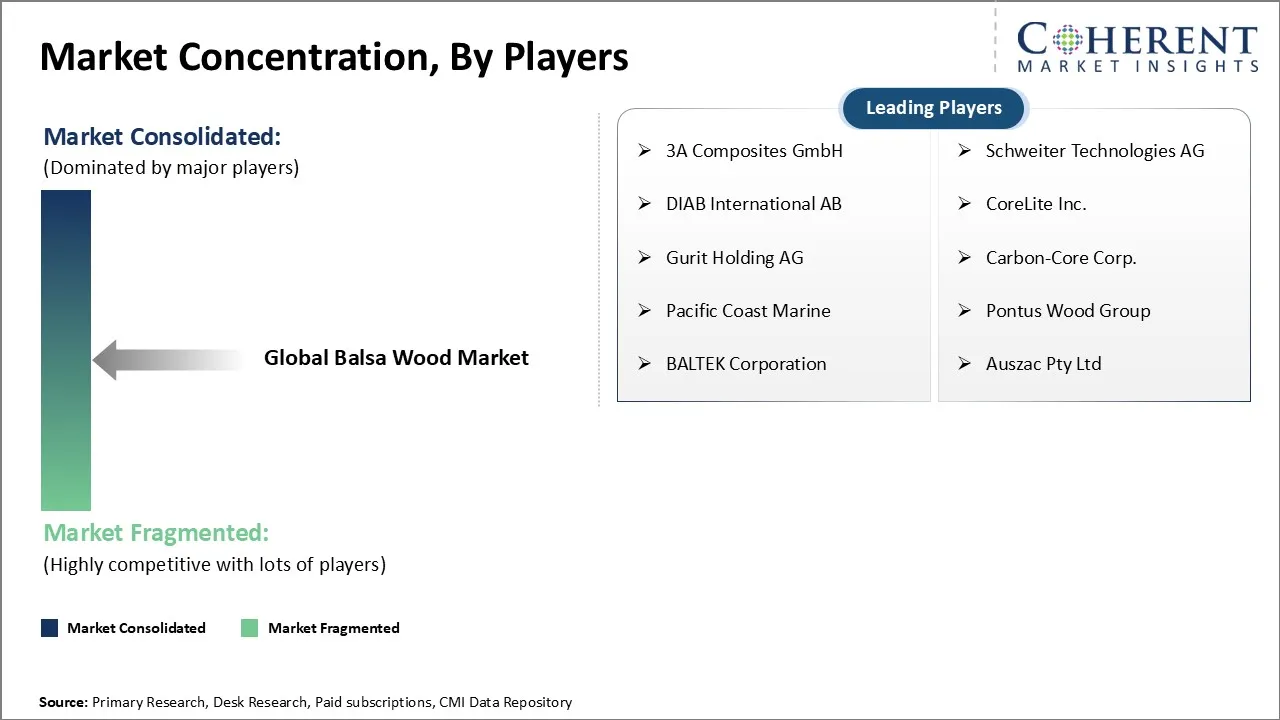
| Companies covered: | 3A Composites GmbH, Schweiter Technologies AG, DIAB International AB, CoreLite Inc., Gurit Holding AG, Carbon-Core Corp., Pacific Coast Marine, Pontus Wood Group, BALTEK Corporation, and Auszac Pty Ltd | ||
| Growth Drivers: |
| ||
| Restraints & Challenges: |
| ||
Balsa Wood Market Dynamics
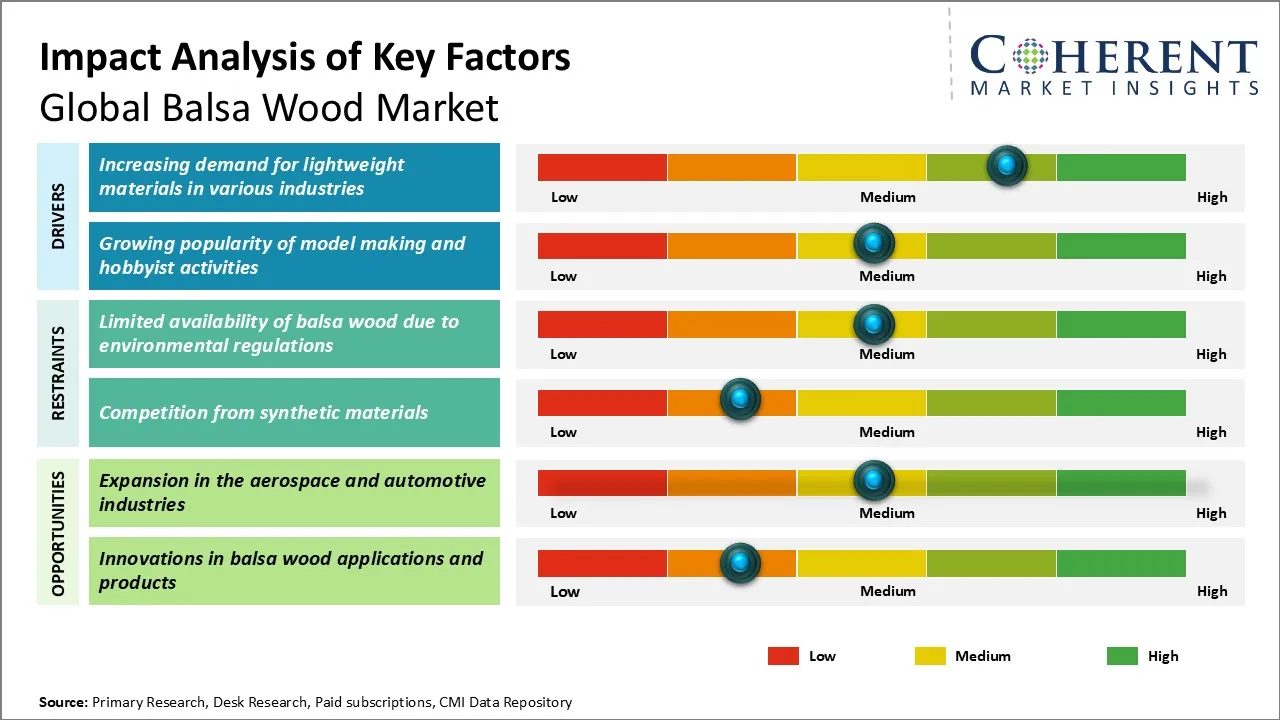
Balsa Wood Market Driver - Increasing Demand for Lightweight Materials in Various Industries
The escalating demand for lightweight materials in sectors such as automotive, aerospace, construction, and consumer goods are significantly driving the growth of the global balsa wood market. Balsa wood’s unique combination of low density, high strength-to-weight ratio, and excellent insulating properties makes it an ideal choice for manufacturers aiming to improve fuel efficiency, reduce overall product weight, and enhance performance without compromising durability. In the automotive industry, for instance, balsa wood is increasingly utilized in composite panels and interior components to meet stringent emission regulations and consumer preferences for eco-friendly vehicles.
For instance, in the automotive industry, leading manufacturers are incorporating balsa wood in composite sandwich panels for electric vehicle (EV) battery enclosures and interior components, helping reduce vehicle mass while meeting stringent emission and sustainability regulations. BMW and Volkswagen have explored lightweight composites, including balsa wood cores, to cut carbon emissions and extend driving range.
Balsa Wood Market Opportunity - Expansion in the Aerospace and Automotive Industries
The global balsa wood market is poised to benefit significantly from the expanding applications of balsa wood in the aerospace and automotive industries. Balsa wood is highly valued in these sectors due to its exceptional strength-to-weight ratio, lightweight nature, and excellent energy-absorbing properties, making it an ideal core material for composite structures. In aerospace, manufacturers are increasingly adopting balsa wood in sandwich composites for aircraft interiors, industrial flooring, and structural components to enhance fuel efficiency through weight reduction, a critical factor in reducing operational costs and carbon emissions. Similarly, the automotive industry is witnessing a rising demand for lightweight and sustainable materials to meet stringent fuel economy and emission regulations globally.
For example, Airbus has employed lightweight balsa-core composites in cabin flooring and interior panels, which contributes to fuel savings of up to 20% in certain aircraft models by reducing overall weight. Similarly, research collaborations such as those at NASA Langley Research Center have tested natural fiber and wood-based composites, including balsa cores, to advance sustainable aerospace materials while maintaining stringent safety standards.
Analyst Opinion (Expert Opinion)
- The global balsa wood market is experiencing a surge in demand, driven by its lightweight properties and versatility in various applications, particularly in the aerospace and construction industries. Insights from the International Balsa Wood Conference (2023) and the Sustainable Materials Expo (2022) underscored significant innovations, with companies like Balsa USA and Pacific Balsa leading the way in sustainable sourcing and processing techniques.
- Balsa USA's recent initiatives to promote plantation-grown balsa highlight a commitment to environmental sustainability while meeting growing market needs. Discussions at these events emphasized the importance of developing composite materials that leverage balsa wood’s unique properties, which can enhance structural performance while reducing overall weight. However, challenges such as competition from synthetic alternatives and the need for consistent supply chains were noted as potential hurdles.
- Companies investing in R&D to explore new applications and improve processing efficiency will likely secure a competitive advantage. Furthermore, collaboration with manufacturers in high-demand sectors can enhance market penetration. Ultimately, the balsa wood market's future will depend on its ability to innovate while addressing sustainability and supply chain challenges.
Speak to the analyst
Want personalized insights?
Take the findings above to one of our principal consultants, or have the report rebuilt around the segments, geographies and competitors you actually track.
Market Segmentation
- Type Insights (Revenue, USD Mn, 2021 - 2033)
- Grade A
- Grade B
- Grade C
- Form Insights (Revenue, USD Mn, 2021 - 2033)
- Raw Blocks and Sheets
- End-Grain Balsa
- Pre-shaped Core Kits and Sandwich Panels
- Application Insights (Revenue, USD Mn, 2021 - 2033)
- Aerospace & Defense
- Marine
- Wind Energy
- Other Application
- Regional Insights (Revenue, USD Mn, 2021 - 2033)
- North America
- U.S.
- Canada
- Latin America
- Brazil
- Argentina
- Mexico
- Rest of Latin America
- Europe
- Germany
- U.K.
- Spain
- France
- Italy
- Russia
- Rest of Europe
- Asia Pacific
- China
- India
- Japan
- Australia
- South Korea
- ASEAN
- Rest of Asia Pacific
- Middle East
- GCC Countries
- Israel
- Rest of Middle East
- Africa
- South Africa
- North Africa
- Central Africa
- North America
- Key Players Insights
- 3A Composites GmbH
- Schweiter Technologies AG
- DIAB International AB
- CoreLite Inc.
- Gurit Holding AG
- Carbon-Core Corp.
- Pacific Coast Marine
- Pontus Wood Group
- BALTEK Corporation
- Auszac Pty Ltd
Sources
Primary Research Interviews
- Export Manager – Major Balsa Wood Plantation Ecuador
- Procurement Analyst – Leading Balsa Distributor in Asia
- Sustainability Director – International Timber Certification Body
- Product Innovation Lead – Aerospace Manufacturer Using Balsa
Stakeholders
- Manufacturers: Balsa wood plantations, sawmills, processing facilities
- End-use Sectors:
- Aerospace and Aviation (core materials for lightweight composites)
- Wind Energy (turbine blade cores)
- Marine and Boating (hull construction, insulation)
- Model Making, Crafts, and Furniture
- Regulatory & Certification Bodies: FSC, PEFC, Rainforest Alliance
- E-commerce Platforms & Retailers: Alibaba, Amazon, Woodcraft
- Technology Integration Players: Composite manufacturing firms
Databases
- UN Comtrade Database (global trade flows of balsa wood, HS code: 440729)
- India Import Export (EXIM) Database (regional import/export trends)
- FAO Forest Products Statistics (production and consumption data)
Magazines
- Woodworking Network – Market and usage trends in balsa wood
- Timber Trades Journal – International timber industry updates
- Composites World – Balsa uses in wind energy and aerospace sectors
- Marine Industry News – Balsa wood applications in boating and marine
- Forestry & Timber Business – Global balsa wood supply chain insights
Journals
- International Journal of Nutrition – Nutritional benefits and absorption of liquid vitamins
- Journal of Food Science & Technology – Formulation trends in vitamin products
- Journal of Dietary Supplements – Effects of liquid supplementation on health
- Journal of Applied Nutrition – Benefits of liquid vitamins in nutrition
- Food Research International – Nutrient bioavailability in liquid supplements
Newspapers
- Journal of Composite Materials – Mechanical properties of balsa composites
- International Journal of Forestry Research – Sustainability in balsa cultivation
- Materials Science and Engineering – Innovations in lightweight wood materials
- Bioresources Journal – Processing technologies for balsa wood
Associations
- The Financial Times – Market outlook for specialty woods, including balsa
- The Guardian – Deforestation and sustainability issues of balsa production
- Asia Business Times – Balsa wood trade in the Asia-Pacific region
- Latin America News Desk – Ecuador’s balsa export trends
- The New York Times – Balsa wood innovation in aerospace
Public Domain Sources
- International Wood Products Association (IWPA)
- American Forest & Paper Association (AF&PA)
- Forest Stewardship Council (FSC)
- Programme for the Endorsement of Forest Certification (PEFC)
Proprietary Elements
- CMI Data Analytics Tool, Proprietary CMI Existing Repository of information for last 8 years.
Get access to 250+ pages report
Every segment, forecast, competitor profile and data table behind the analysis above — available for instant download.
- ESOMAR Member
- ISO 9001:2015 Certified
- D-U-N-S Registered
- GDPR & CCPA Compliant
Missing comfort of reading report in your local language? Find your preferred language:
Transform your Strategy with Exclusive Trending Reports
Frequently Asked Questions
The global balsa wood market is estimated to be valued at USD 245.6 Mn in 2026 and is expected to reach USD 384.2 Mn by 2033.
The CAGR of the global balsa wood market is projected to be 6.6% from 2026 to 2033.
Increasing demand for lightweight materials in various industries and growing popularity of model making and hobbyist activities are the major factors driving the growth of the global balsa wood market.
Limited availability of balsa wood due to environmental regulations and competition from synthetic materials are the major factors hampering the growth of the global balsa wood market.
In terms of type, the grade A segment is estimated to dominate the market revenue share in 2026.
3A Composites GmbH, Schweiter Technologies AG, DIAB International AB, CoreLite Inc., Gurit Holding AG, Carbon-Core Corp., Pacific Coast Marine, Pontus Wood Group, BALTEK Corporation, and Auszac Pty Ltd are the major players.
Asia Pacific is expected to lead the global balsa wood market in 2026.