

Global Blank Apparel Market Size and Forecast – (2026-2033)
According to Coherent Market Insights, the global blank apparel market is estimated to be valued at USD 16.45 Bn in 2026 and is expected to reach USD 24.25 Bn by 2033, expanding at a compound annual growth rate (CAGR) of 5.7% from 2026 to 2033.
Key Takeaways of the Blank Apparel Market
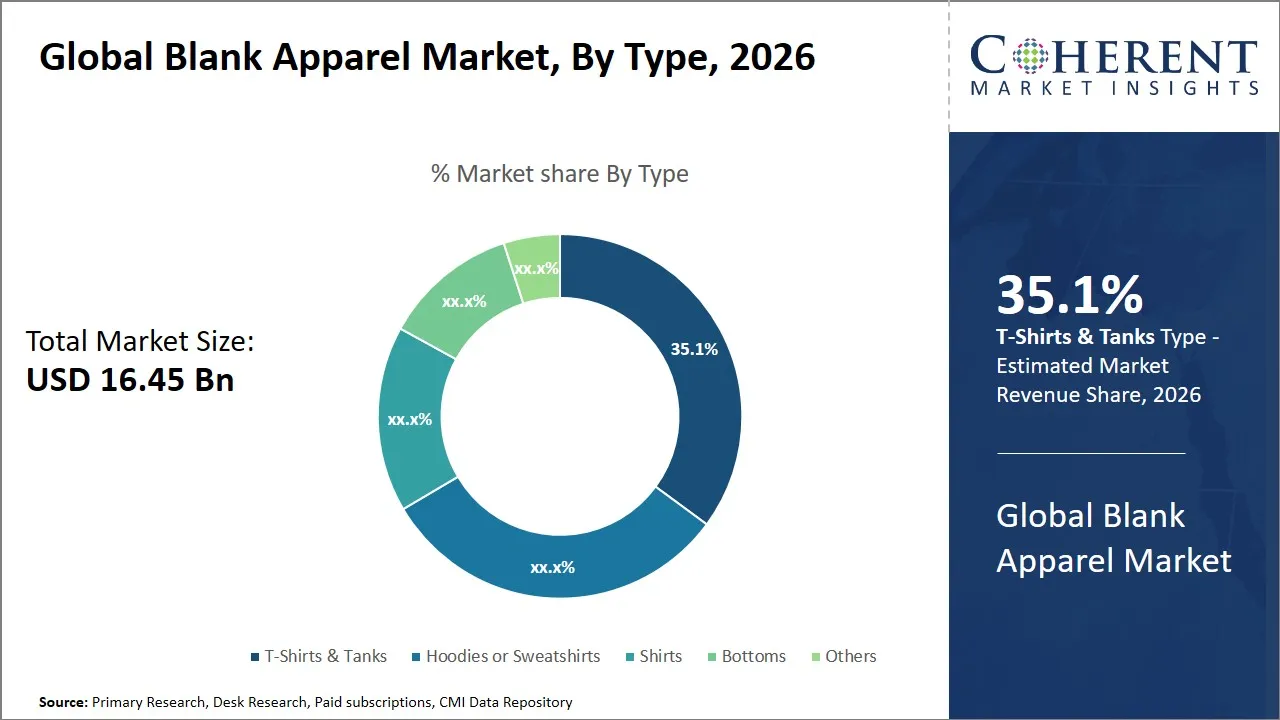
- The t-shirts & tanks segment is expected to capture 35.1 % of the global blank apparel market share in 2026.
- The Business to Business (B2B) segment is projected to dominate the global blank apparel market with a 67.9 % share in 2026.
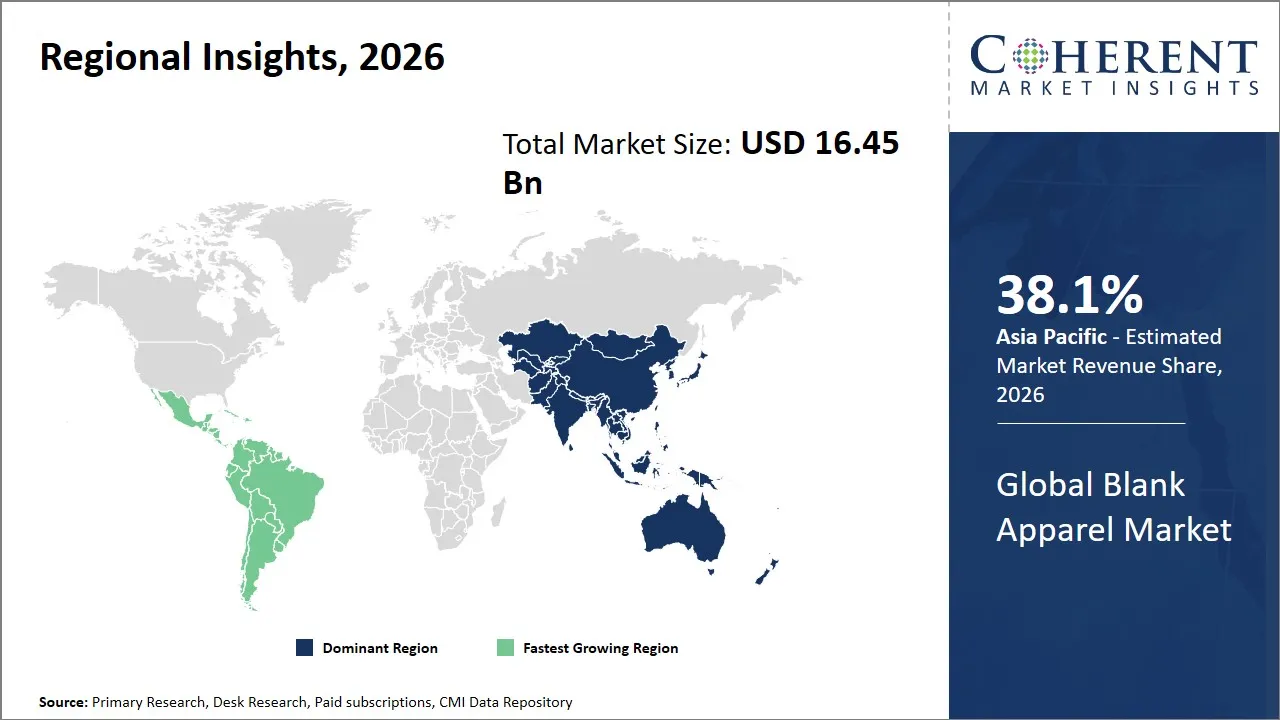
- The Asia Pacific region is expected to dominate the market with a 38.1 % share in 2026.
- The Latin America region is forecasted to experience the fastest growth in the market, capturing a 15.3 % share in 2026.
Market Overview
- Current trends in the blank apparel market emphasize sustainability, with manufacturers adopting eco-friendly materials and production techniques to meet growing environmental concerns.
- Additionally, digitalization and advancements in e-commerce platforms are enhancing consumer access and personalization options.
- The integration of innovative fabrics and expansion into athleisure and casual active wear segments further fuel market growth, positioning blank apparel as a fundamental component in fashion customization and branding strategies across diverse industries.
Currents Events and Its Impact
Current Events | Description and its Impact |
Macroeconomic Slowdown & Consumer Sentiment Shift |
|
Global Trade Policy Shifts & Tariffs |
|
Segmental Insights
- Current Industry Events of 2026
- Market Size Estimation
- Regional Breakdown
- Competitive Landscape
- Customer Intelligence
- Segmental Analysis
- Pricing Analysis
- Key Market Drivers, Challenges & Future Trends
- Customized Insights Section
Why Does the T-Shirts & Tanks Dominate the Blank Apparel Market in 2026?
The t-shirts & tanks segment is expected to hold 35.1% of the global blank apparel market share in 2026, because of its incredible adaptability across diverse consumer groups and multiple end-use applications. The major factors contributing to the development of this segment are that it is universal and comfortable, can be customized on a wide range of parameters, and reaches a wide audience. T-shirts and tanks are unique products in the sense that they are style and functional and therefore are essential items in the wardrobe of both men and women of all ages.
For example, companies like Printful and Custom Ink saw significant growth due to the rise in demand for custom-designed T-shirts and tanks. These products are being widely adopted by various consumer groups, from sports teams and corporate employees seeking branded apparel to individuals creating their own fashion statements.
Business to Business (B2B) Dominates the Global Blank Apparel Market
The Business to Business (B2B) segment is projected to hold 67.9% of the global blank apparel market share in 2026, as it caters extensively to wholesale buyers who leverage blank apparel for further processing and resale. The key in the rise of this segment is the strong demand of all vocational industries like corporate branding, promotional events, apparel manufacturers, and retail businesses, which need large quantities of blank garment to be customized or resold.
Economies of scale are one of the basic growth initiation drivers of the B2B channel. Volume discounts and simplified supply chains can be used by businesses as they usually buy blank apparel in large quantities to reduce the production costs. This is what makes B2B an appealing alternative to any of the entities in the printing shops and embroidery business as well as wholesalers and retailers that can integrate blank clothing into their product lines.
B2B distribution is driven by a significant catalyst, i.e. customization services. Since companies are more and more in search of branded merchandise to use as a promotional tool, an employee uniform, or a special event, they turn to a high-quality blank apparel which can be tailored easily. Other services that are usually complementary to the business by the B2B suppliers include flexible order sizes, variety of fabrics and fast restocking, which is critical in business so that they can meet the changes in demand.
Regional Insights
Asia Pacific Blank Apparel Market Analysis and Trends
The Asia Pacific region is projected to lead the market with a 38.1% share in 2026, due to its well-established textile and garment manufacturing ecosystem. The fact that there is plenty of raw materials, there is a talented workforce and production facilities are cost-efficient also play in the favor of the region. The countries that have been of major contribution include China, India, Bangladesh and Vietnam and they are backed by the government policies in supporting exports, improving infrastructure and increasing innovation in textile technologies.
The high level of vertically integrated supply chains and mass manufacturers gives the companies of the Asia Pacific a competitive advantage in the production of quality blank apparel in large quantities. These major companies like the Shenzhou International (China), Arvind Limited (India), and Epyllion Group (Bangladesh) have contributed to the market in a significant manner in providing a variety of blank apparel that meets the requirements of world in an effective manner. Additionally, regional trade agreements and the agreements with key countries of importing apparel make the export even easier, which further supports the domination of the Asian Pacific market.
Latin America Blank Apparel Market Analysis and Trends
The Latin America region is expected to exhibit the fastest growth in the market contributing 15.3% share in 2026, by increasing consumer demand, expanding domestic manufacturing capabilities, and improving trade infrastructures. The increasing part of investments in textile and apparel production is observed in such countries as Mexico, Brazil, and Colombia in the context of serving both local and export markets. Government programs like subsidies on the use of technology and export promotion programs play a vital role in the creation of competitive manufacturing centers.
The comparatively cheaper labor in the region as compared to the North American market in addition to the closeness to major markets such as the United States encourages development in the region. Such prominent players include Grupo Kaltex (Mexico) and Hering (Brazil) who play a significant role by continually streamlining their production lines by making them comply with international quality standards as well as streamlining their supply chain efficiencies. This trend in growth is also promoted by trade alliances like USMCA, which increases the supply and demand of trade between North and Latin America.
Global Blank Apparel Market Outlook for Key Countries
China Blank Apparel Market Trends
The China blank apparel market remains the leading market in the world because of its large manufacturing base and the incorporation of technology. China has a high potential of providing competitive and high quality blank apparel due to the high government support in promoting textile innovation and sustainable practices. The major players such as the Shenzhou International are utilizing large production capacities and robust export relationships. The entire supply chain of fiber to the finished garments in China is a source of the competitive advantage as it allows China to be responsive to the demand and fashion trends around the world.
India Blank Apparel Market Trends
India’s blank apparel market benefits from a rich heritage in textiles combined with growing investment in modern garment manufacturing. Government initiatives like “Make in India” promote domestic production and export enhancement, spurring growth in blank apparel supply. Distinguished companies such as Arvind Limited and Raymond have expanded capacities with an emphasis on innovation and sustainable textile solutions. India’s diverse raw material base and increasing skilled workforce facilitate its prominent role, especially targeting eco-friendly and organic apparel segments.
Why is the U.S. Blank Apparel Market Driven by Premium Products and Innovation?
The U.S. blank apparel market is marked with high demand of premium products and tailored products supported by robust retailing and fashioning sector. Domestic companies like Gildan Americas and American Apparel concentrate on quality, innovation and brand supply. Trade and quality control regulations by government take care of the competitive operations, and increased awareness concerning sustainability affects the production methodologies. This strategic import dependence of the U.S. keeps the market vibrant and varied with the increase of onshore production that meets the turnaround times.
Mexico Blank Apparel Market Trends
The apparel manufacturing industry of Mexico enjoys favorable trade agreements such as the USMCA making it an essential supply chain hub of North America. The market is being led by companies like Grupo Kaltex which sell blank apparel at competitively lower prices with shorter lead times to U.S. customers. Export-oriented manufacturing industry and investments in technology rewards by the government also improve the productivity, which makes Mexico grow rapidly in the Latin America region. The presence of international trade with the U.S. market is supported by its geographical location.
Why is Brazil's Blank Apparel Market Gaining Momentum in Latin America?
Brazil’s blank apparel market is expanding within Latin America, supported by a robust domestic textile industry and government policies encouraging local production and export diversification. Leading firms such as Hering combine traditional craftsmanship with modern manufacturing processes to meet the rising demand for blank apparel. Though challenged by higher input costs, Brazil’s focus on sustainable fibers and value-added product ranges appeals to both local and international consumers, contributing to the market’s growing prominence.
Supply Chain Responsiveness & Lead-Time Metrics
Metrics | Current Performance | Target Benchmark | Implications for Blank Apparel Market |
Lead Time (Order to Delivery) | 7-10 days | 5-7 days | Shorter lead times enhance customer satisfaction and sales. |
Response Time to Market Changes | 3-4 days | 1-3 days | Responsiveness allows better handling of seasonality. |
Order Fulfillment Accuracy | 98% | 99% | Higher accuracy reduces returns and increases customer trust. |
Market Players, Key Development, and Competitive Intelligence
Key Developments
- In February 2024, Lane Seven Apparel took a major leap toward direct-to-consumer (DTC) sales with the debut of its e-commerce retail platform. The brand's new retail line enables it to establish a direct connection with the end consumer. The retail collection featured a variety of unisex pieces crafted from high-quality fabrics, such as three-end fleece, signature vintage, and 100% combed ringspun cotton, with prices ranging from USD 18 to USD 42.
- In January 2024, Stanley/Stella took a step toward sustainability with the launch of its Spring/Summer 2024 collection. The collection not only brings innovation to popular styles but also revitalizes its women's t-shirt line. With a focus on lightweight materials and attention to detail, this collection was developed to offer even better quality and options for printing or embroidery.
Top Strategies Followed by Global Blank Apparel Market Players
Player Type | Strategic Focus | Example |
Established Market Leaders | Heavy investment in R&D and innovation | For example, Gildan has gone a long way in developing sustainable fabrics and environmentally friendly manufacturing procedures. They are using high-performance apparel with an environmental and social responsibility focus, which, through programs such as the Gildans Made with Respect, provides them with differentiation in a highly saturated market. |
Mid-Level Players | Cost-effective solutions with balanced quality | Bella+Canvas which also aims at high-quality blank clothes at a fair price but with the promise of ethical production and fair labor practices. They choose to be cheap but high-quality substitutes by emphasizing sustainability, high-quality fabrics. |
Small-Scale Players | Niche specialization & innovative variants | For example, Threadless, an online store offering blank apparel, can be distinguished as offering a community-based brand by offering an avenue through which independent artists can sell their work on blank apparel in their unique ways. Threadless also applies the latest technology of direct-to-garment (DTG) printing to provide custom and small-batch design. |
Market Report Scope
Blank Apparel Market Report Coverage
| Report Coverage | Details | ||
|---|---|---|---|
| Base Year: | 2024 | Market Size in 2025: | USD 16.45 Bn |
| Historical Data for: | 2020 To 2024 | Forecast Period: | 2025 To 2032 |
| Forecast Period 2025 to 2032 CAGR: | 5.7% | 2032 Value Projection: | USD 24.25 Bn |
| Geographies covered: |
| ||
| Segments covered: |
| ||
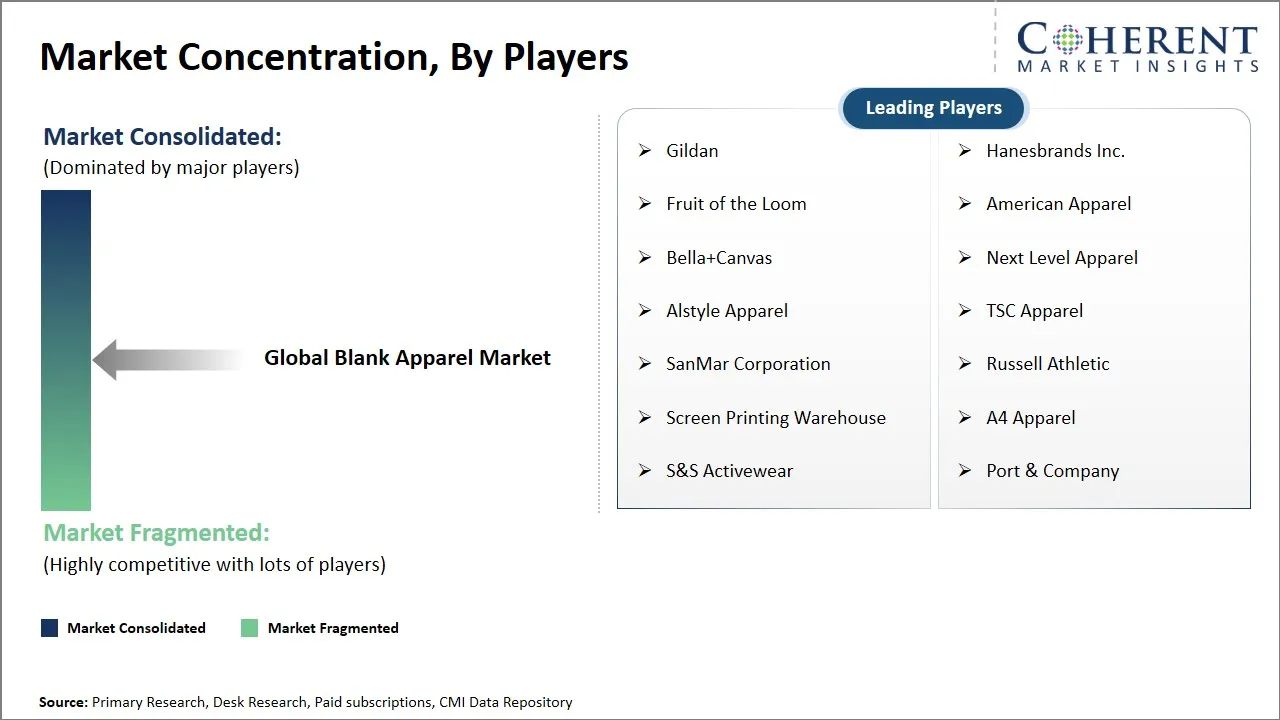
| Companies covered: | Gildan, Hanesbrands Inc., Fruit of the Loom, American Apparel, Bella+Canvas, Next Level Apparel, Alstyle Apparel, TSC Apparel, SanMar Corporation, Russell Athletic, Screen-Printing Warehouse, A4 Apparel, S&S Activewear, and Port & Company | ||
| Growth Drivers: |
| ||
| Restraints & Challenges: |
| ||
Blank Apparel Market Dynamics
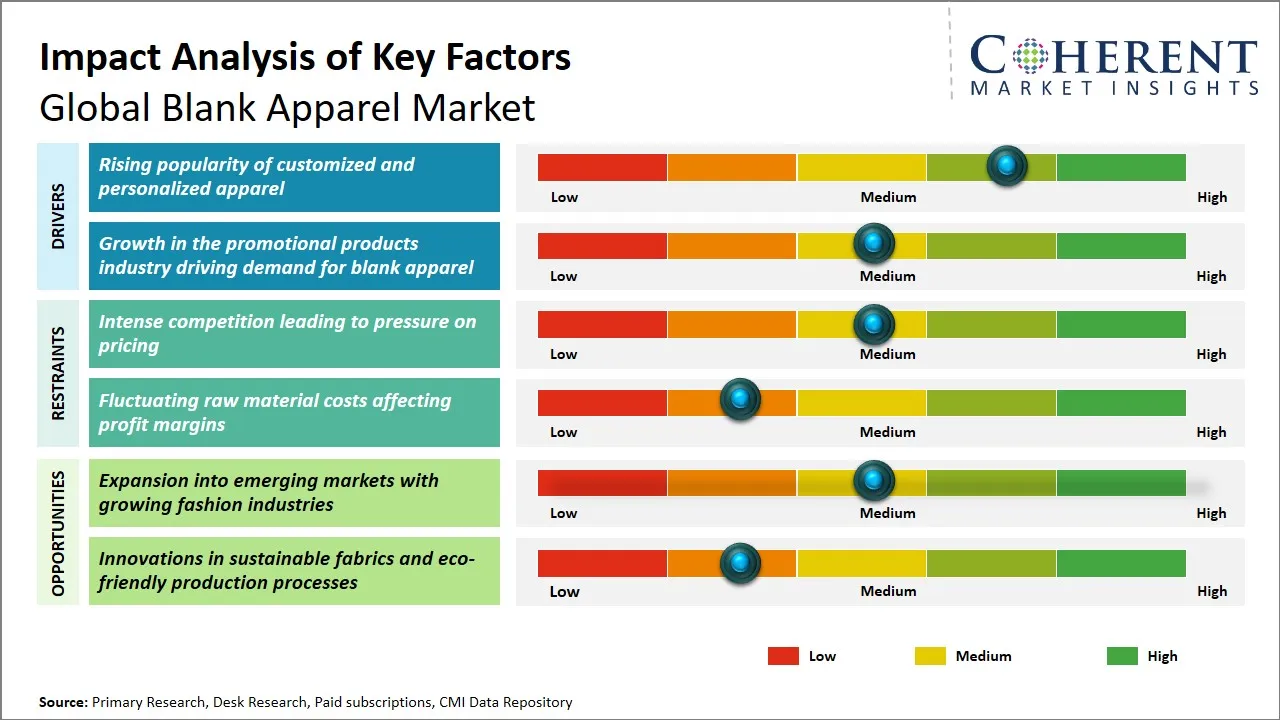
Blank Apparel Market Driver - Rising Popularity of Customized and Personalized Apparel
The increased consumer demand of specialized and customized garments has also played a major role in driving the boom of the blank apparel market around the world. With more customers desiring to show their personal style and identity with fast fashion, blank apparel is a blank canvas that can be widely customized by printing, embroidering, and other ornamentation methods. This tendency is driven by the emergence of digital printing tools and on-demand production systems, which allow rapid and affordable customization to address the needs of individual consumers and business organizations that want to produce branded products.
For example, Custom Ink, a well-known online custom t-shirt printing service, the growing need and demand of personalized clothes have been leveraged. The company provides customers with the opportunity to create their own clothes through a convenient online service, where it is possible to digital print, embroider and use other types of customizations.
(Source: https://www.customink.com/)
Blank Apparel Market Opportunity - Expansion into Emerging Markets with Growing Fashion Industries
The global blank apparel market offers a good growth potential in the form of penetration in emerging markets in which the rising fashion industry is creating a large demand. The fast rate of urbanization in countries in these regions like southeast Asia, Latin America and Africa, increasing disposable income and a young growing population who are more inclined towards fashion is being experienced. Such aspects lead to the rise of middle classes that are keen on following the shift towards modern fashion, thus increasing the consumption of blank clothes as an adaptable foundation of customization and branding by local designers and small to medium-sized enterprises (SMEs).
For example, Hanesbrands increased its blank apparel business in Southeast Asia to meet the rising demand of casual wears and tailoring. Their investment in localized manufacturing and distribution channels to address the demands of the fashion-conscience youth is a testimony to how the companies are committed to the region. As the cities of Southeast Asia became rapidly urbanized and the disposable income was on the increase, Hanesbrands took advantage of the situation and offered blank apparel to custom printing companies and home fashion designers.
Analyst Opinion (Expert Opinion)
- The blank apparel market is expanding to serve both businesses and consumers. The comments made at the International Textile and Apparel Trade Show (2023) and the Custom Apparel Conference (2022) focused on the most important tendencies, and such companies as Bella Canvas and Gildan are on the forefront of creating high-quality and sustainable blank apparel.
- The recent launch of an environmentally friendly line by Bella Canvass underlines the increased consumer preference of practices that are sustainable in the world of fashion. At these conferences, it was found that there was growing interest in the field of fabric innovation such as moisture-wicking and organic cotton which acts as a response to a growing trend of more practical and responsible decisions among customers.
- The issues like inventory control and foreign competitor pricing came out as obstacles to expansion. Firms that are successful in applying digital marketing tools and using e-commerce solutions to reach the end users are likely to have competitive advantage. Finally, the future development of the blank apparel market will depend on the capacity to be continuously innovative and adjust to the changing requirements of quality, sustainability, and customized fashion in the highly competitive environment
Speak to the analyst
Want personalized insights?
Take the findings above to one of our principal consultants, or have the report rebuilt around the segments, geographies and competitors you actually track.
Market Segmentation
- Type Insights (Revenue, USD Bn, 2021 - 2033)
- T-Shirts & Tanks
- Hoodies or Sweatshirts
- Shirts
- Bottoms
- Others
- Distribution Channel Insights (Revenue, USD Bn, 2021 - 2033)
- Business to Business (B2B)
- Business to Consumers (B2C)
- Regional Insights (Revenue, USD Bn, 2021 - 2033)
- North America
- U.S.
- Canada
- Latin America
- Brazil
- Argentina
- Mexico
- Rest of Latin America
- Europe
- Germany
- U.K.
- Spain
- France
- Italy
- Russia
- Rest of Europe
- Asia Pacific
- China
- India
- Japan
- Australia
- South Korea
- ASEAN
- Rest of Asia Pacific
- Middle East
- GCC Countries
- Israel
- Rest of Middle East
- Africa
- South Africa
- North Africa
- Central Africa
- North America
- Key Players Insights
- Gildan
- Hanesbrands Inc.
- Fruit of the Loom
- American Apparel
- Bella+Canvas
- Next Level Apparel
- Alstyle Apparel
- TSC Apparel
- SanMar Corporation
- Russell Athletic
- Screen Printing Warehouse
- A4 Apparel
- S&S Activewear
- Port & Company
Sources
Primary Research Interviews
- CEO – Leading Blank Apparel Manufacturer (e.g., Gildan or BELLA+CANVAS equivalent)
- Supply Chain Director – Major Apparel Wholesaler and Distributor
- Production Lead – Print-on-Demand and Customization Service Provider
- Sustainability Officer – Ethical Apparel Certification Authority (e.g., GOTS/GRS for organic blanks)
Stakeholders
- Manufacturers
- End-use Sectors:
- Customization and Print-on-Demand Businesses
- Promotional Products and Corporate Merchandise
- E-commerce Retailers and Streetwear Brands
- Regulatory & Certification Bodies (e.g., GOTS, GRS for sustainable textiles, REACH compliance in EU for apparel chemicals)
- E-commerce Platforms and Retailers (Alibaba, SanMar, AS Color online stores)
- Technology Integration Players: Digital printing and embroidery technology providers for blanks
Databases
- UN Comtrade Database (HS Chapters 61-62 for apparel and clothing)
- India Import Export (EXIM) Database (textile and garment imports/exports)
- USITC DataWeb (U.S. apparel trade statistics)
- Eurostat Trade Statistics for Textiles and Apparel
- ITC Trade Map (global apparel trade flows)
Magazines
- Apparel Views – Trends in apparel manufacturing and blanks
- International Apparel Journal – Technology and design in blank apparel
- Textiles Magazine (The Textile Institute) – Supply chain dynamics for blanks
- Knitting Views – Innovations in blank knits and sweatshirts
- Apparel Resources – Global blank apparel market insights
Journals
- Research Journal of Textile and Apparel – Sustainability in blank production
- Journal of Fashion Marketing and Management – Consumer trends in customizable apparel
- Textile Research Journal – Material innovations for blank apparel durability
- International Journal of Clothing Science and Technology – Printing techniques on blanks
Newspapers
- The Wall Street Journal – Global apparel demand and blank apparel market growth
- Business Standard (India) – Textile imports and blank apparel in Asia
- Reuters – Supply chain disruptions in apparel manufacturing
- The Guardian – Sustainability challenges in textile and blank production
Associations
- International Apparel Federation (IAF)
- Clothing Manufacturers Association of India (CMAI)
- Confederation of Indian Textile Industry (CITI)
- Textile Association of India (TAI)
- The Textile Institute
Public Domain Sources
- EPA – Guidelines for textile chemical handling in apparel
- European Commission – REACH regulations on textile dyes and finishes
- World Health Organization – Safety standards for apparel production exposure
- USGS – Mineral commodities in textile fibers (e.g., cotton statistics)
- OECD – Textile trade and sustainability reports
Proprietary Elements
- CMI Data Analytics Tool
- Proprietary CMI Existing Repository of information for last 8 years.
Get access to 250+ pages report
Every segment, forecast, competitor profile and data table behind the analysis above — available for instant download.
- ESOMAR Member
- ISO 9001:2015 Certified
- D-U-N-S Registered
- GDPR & CCPA Compliant
Missing comfort of reading report in your local language? Find your preferred language:
Transform your Strategy with Exclusive Trending Reports
Frequently Asked Questions
The global blank apparel market is estimated to be valued at USD 16.45 Bn in 2026 and is expected to reach USD 24.25 Bn by 2033.
The CAGR of global blank apparel market is projected to be 5.7% from 2026 to 2033.
Rising popularity of customized and personalized apparel and growth in the promotional products industry driving demand for blank apparel are the major factors driving the growth of the global blank apparel market
Intense competition leading to pressure on pricing and fluctuating raw material costs affecting profit margins are the major factors hampering the growth of the global blank apparel market.
In terms of type, t-shirts & tanks are estimated to dominate the market revenue share in 2026.
Gildan, Hanesbrands Inc., Fruit of the Loom, American Apparel, Bella+Canvas, Next Level Apparel, Alstyle Apparel, TSC Apparel, SanMar Corporation, Russell Athletic, Screen Printing Warehouse, A4 Apparel, S&S Activewear, and Port & Company are the major players.
Asia Pacific is expected to lead the global blank apparel market in 2026.