

Global Blue Economy Market Size and Forecast – 2026 to 2033
The global blue economy market is estimated to be valued at USD 2,462.06 Bn in 2026 and is expected to reach USD 3,902.09 Bn by 2033, exhibiting a compound annual growth rate (CAGR) of 6.8% from 2026 to 2033.
Key Takeaways of the Blue Economy Market
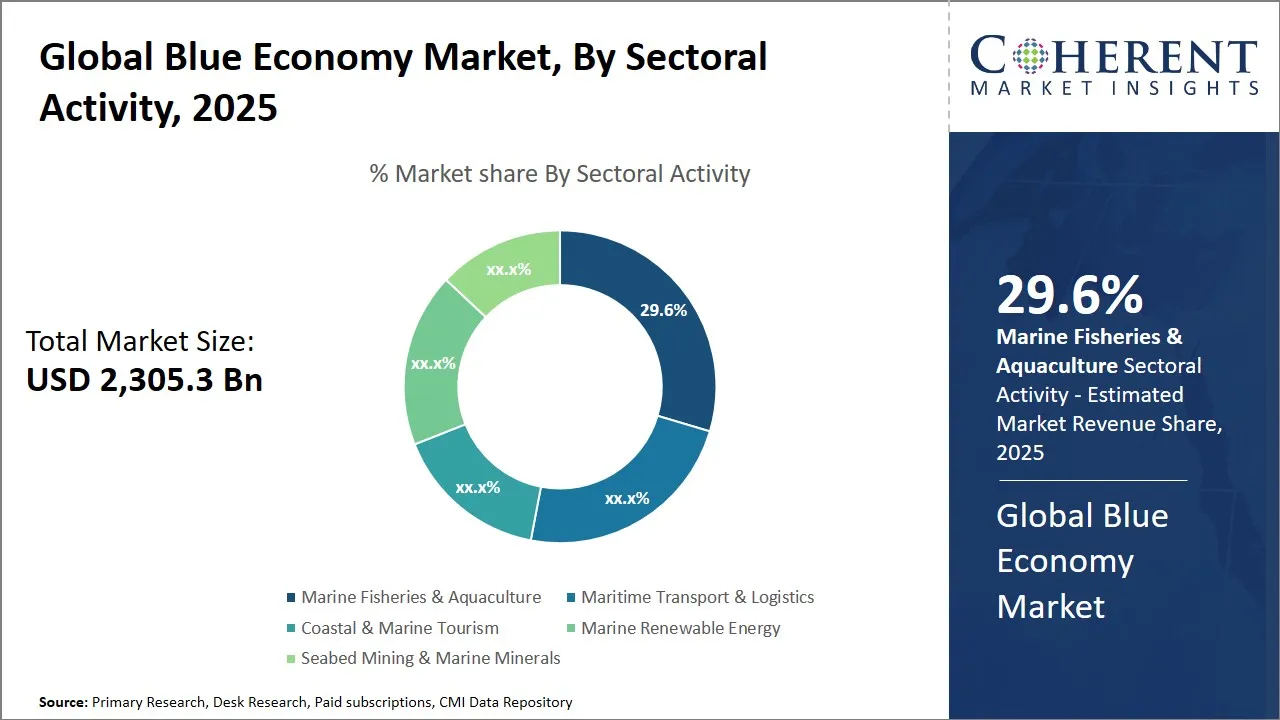
- The marine fisheries & aquaculture segment is expected to account for 30.6% of the global blue economy market share in 2026.
- The living resources segment is projected to represent 33.7% of the global blue economy market share in 2026.
- The food & nutrition segment is expected to capture 29.9% of the blue economy market in 2026.
- Asia Pacific is projected to lead the global blue economy market in 2026 with a 33.1% share. North America, with a share of 23.7% in 2026, is expected to be the fastest-growing region.
Market Overview
The market trend highlights a robust shift towards integrating sustainability with economic development in marine industries. Key drivers include advancements in marine resource management technologies, growing governmental regulations aimed at conserving marine ecosystems, and expanding the demand for eco-friendly maritime products and services. Additionally, the focus on harnessing ocean energy and biotechnological applications is fostering new avenues for growth, making the blue economy a pivotal contributor to global economic resilience and environmental sustainability.
Currents Events and their Impact
Current Events | Description and its Impact |
Global Offshore Wind Expansion Initiatives |
|
Rise of Remote Ocean Monitoring Technologies (2025) |
|
Segmental Insights
- Current Industry Events of 2026
- Market Size Estimation
- Regional Breakdown
- Competitive Landscape
- Customer Intelligence
- Segmental Analysis
- Pricing Analysis
- Key Market Drivers, Challenges & Future Trends
- Customized Insights Section
Blue Economy Market Insights, By Sectoral Activity - Marine Fisheries & Aquaculture Segment Dominates the Market due to Growth in Sustainable Seafood Production
The marine fisheries & aquaculture segment is expected to hold the 30.6% of the global blue economy market share in 2026, driven by the escalating global demand for sustainable seafood and protein sources. The rising consumer consciousness in regard to health and nutrition has raised the intake of fish and seafood products which has made this industry a strategic food security provider. Also, there is the increasing population and urbanization in the coastal and inland areas which increase the demand of a reliable and sustainable source of aquatic food, further enhancing the aquaculture activities around the world.
The important role in improving the sustainability and productivity in this segment is through technology. Recirculating Aquaculture System (RAS), innovative feeding solutions, and the use of selective breeding have led to high yield efficiency and fewer environmental effects. Such technologies help to reduce the problem of overfishing that used to pose a threat to wild fisheries in the past and contribute to responsible resource management. In addition, the ability of aquacultures to diversify species that are reared such as finfish, shellfish and seaweed provides new opportunities in economic growth and nutritional value.
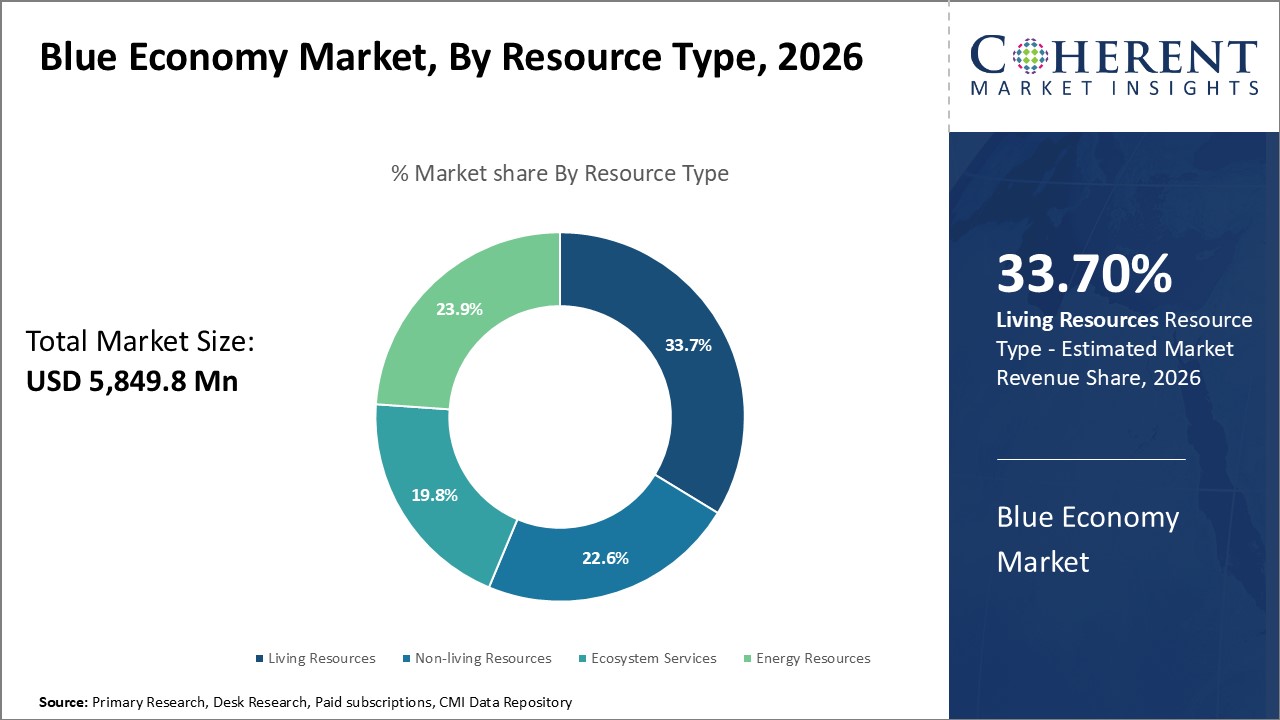
Blue Economy Market Insights, By Resource Type - Living Resources Segment Dominates the Primary Engine of Blue Economy Expansion via Biodiverse Marine Assets
The living resources segment is estimated to account for the 33.7% of the market share in 2026, due to its fundamental role in supplying a wide variety of biologically derived products and services. The marine organisms included in this segment include fish, crustaceans, mollusks, seaweed, and other aquatic species that underlie food industries, biotechnological developments and the wellbeing of the ecosystems.
This is because the rising global dependence on marine biodiversity due to various other reasons other than traditional fisheries, greatly stimulates the growth in the living resources. The use of marine biological assets has evolved particularly in food products, nutraceuticals, biofuels and sustainable packaging materials as seaweed cultivation has increased at a high rate, as an example. Moreover, there is the motivation to natural and organic products, which increases the attractiveness of marine-derived bioactive compounds which are essential components in pharmaceutics, cosmetic and biotechnology industries.
Blue Economy Market Insights, By End-use Application - Food & Nutrition Segment Dominates the Market Powered by Rising Marine-Derived Nutritional Demand
The food & nutrition segment is projected to account for 29.9% share of the blue economy market in 2026, reflecting the critical role that marine-based foods play in global dietary frameworks. The increasing global demand of nutritious and high-quality protein sources is one of the major drivers that drive theconsumption of fish and other marine products. This is further enhanced by the increasing health awareness, which employs the superiority of omega-3 fatty acids, vitamins, and minerals that are rich in seafood, and strengthens the market leadership segments.
The demand is also enhanced by the consumer pattern where people are taking a trend of moving more towards the diversification of food products with a focus on sustainable foods and ethically produced foods. The seafood industry reacts to it through increased aquaculture production, improved supply chains, and adoption of certifications which guarantee environmental and social responsibility. This enhances the reputation of the food sectors drawing the health-conscious consumers and improving penetration in the market.
Regional Insights
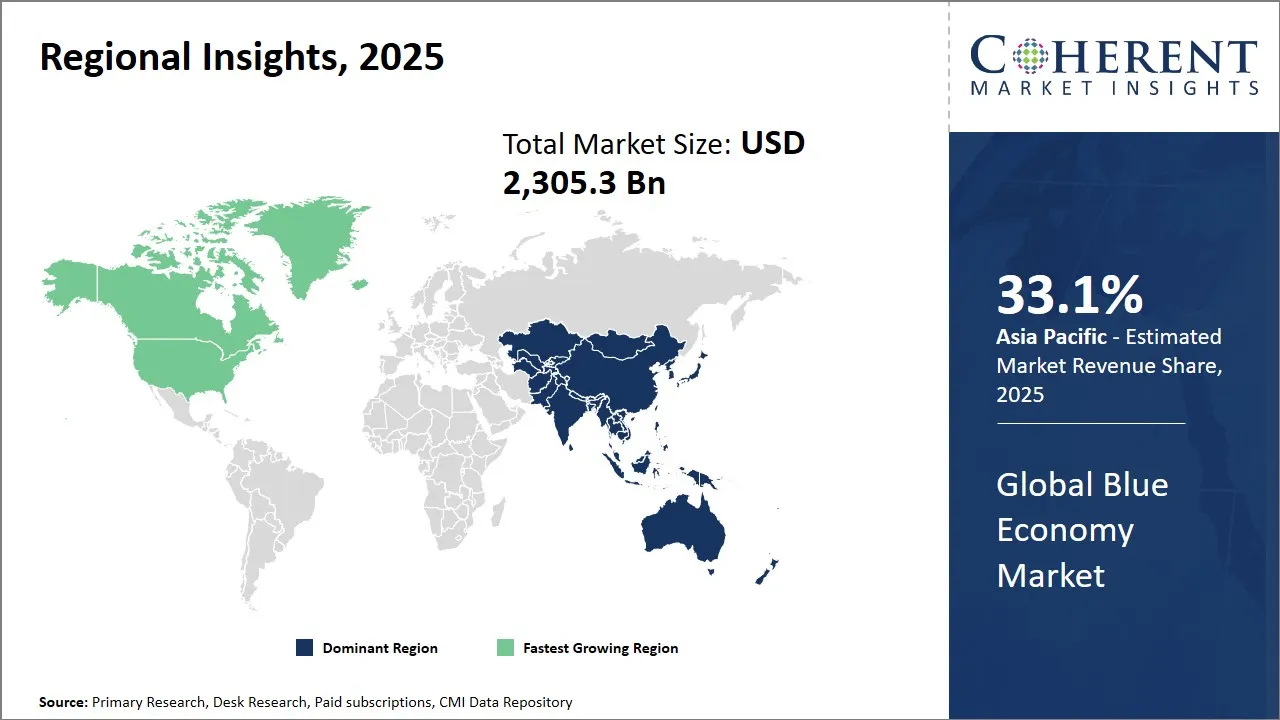
Asia Pacific Blue Economy Market Analysis and Trends
The Asia Pacific region is projected to lead the market with a 33.1% share in 2026, due to the high rate of economic growth, ascending coastal urbanization, and growing government efforts aimed to exploit the marine resources in a sustainable manner. Countries like China, India and Australia have been investing heavily in off-shore renewable energy works, modernization of ports and sustainable fisheries. The increase is encouraged by the policies of decreasing the marine pollution and promoting the development of maritime transport and aquaculture technologies.
The information on the enormous coastline and strategic position of Asia Pacific in world maritime trade routes enhances the importance of the area in shipping and logistics and marine resource exploitation. China COSCO Shipping Corporation, Suzlon Energy (India), and Fortescue Metals Group (Australia) are the key players in the market that are heavily fueling developments in shipping, offshore wind and exploration of marine minerals. The vibrant market ecosystem and heavy policy backing supports the fast growth of blue economy in Asia Pacific’s.
North America Blue Economy Market Analysis and Trends
The North America region is expected to exhibit the fastest growth in the market contributing 23.7% share in 2026, due to its long coastline, well-developed port infrastructure and great investments in marine innovation. The U.S. and Canada are the main stakeholders because they have strategic policies that facilitate ocean sustainability, marine renewable energy, and resilience of the coastlines. The efforts and strategies of the U.S. Department of Energy’s to develop offshore wind, marine ecosystem management programs of NOAAA, and the Canadas Blue Economy Strategy 2030 have enhanced the growth of the region.
Outlying trends include offshore renewable, marine biotechnology, and carbon capture technologies that are based in the ocean. Its ability to keep innovating is supported by the presence of a strong R&D ecosystem in the regions along with the relations between the government agencies, universities, and the private companies. Large stakeholders, which include General Electric (U.S.), ExxonMobil (U.S.), and Ocean Infinity (U.K./U.S. operations) are putting major investments in offshore energy, ocean data analytics, and subsea robotics.
Global Blue Economy Market Outlook for Key Countries
Norway Blue Economy Market Analysis and Trends
The blue economy of Norway enjoys the advantage of its long coastline and the forefront in offshore oil and gas extraction, and new offshore wind projects. The nation pays much attention to sustainable aquaculture and marine biotechnology, which are provided with the help of government-sponsored innovation clusters (like the Norwegian Seafood Council). Other companies such as Equinor and Kongsberg Gruppen contribute a lot as they are the ones that develop offshore energy technology and maritime automation systems, which make Norway a blue wealth innovator around the world.
China Blue Economy Market Analysis and Trends
China blue economy market is typified with massive investments in maritime infrastructures, massive shipping arms, and rapid offshore wind farms constructions. The policies of the government give preference to the inclusion of the blue economy principles in the plans of the coastal cities and pollution control. China COSCO Shipping and China State Shipbuilding Corporation, which simplify maritime trade and naval technology innovations, and other companies, including MingYang Smart Energy, which lead the way in offshore renewable energy projects, cement the role of sustainable maritime development as a strategic priority of Chinas development.
Australia Blue Economy Market Analysis and Trends
Australia takes advantage of the huge exclusive economic zone to be developed with offshore renewable energy, fisheries and marine science research. The marine spatial planning and environmental protection statutes are examples of government assistance to sustainable blue economy initiatives, which promotes the formation of public-private collaborations. The investments in green hydrogen and offshore renewable by Fortescue Metals Group and the development of sustainable aquaculture by such companies as Tassal and Clean Seas Seafood contribute to the idea of balanced ocean resource management and innovation in Australia efforts.
Netherlands Blue Economy Market Analysis and Trends
The Netherlands continues to lead as a maritime innovation hub with a strong focus on port operations, maritime logistics, and offshore engineering. With one of the world’s largest ports in Rotterdam, it serves as a critical node in global shipping. Dutch companies such as Boskalis and Damen Shipyards are influential in dredging, offshore construction, and shipbuilding industries. The Dutch government’s proactive maritime spatial planning and coastal defense strategies further bolster the Blue Economy’s development, emphasizing resilience and sustainability.
India Blue Economy Market Analysis and Trends
India blue economy market is rapidly evolving with significant government emphasis on port expansion, fisheries modernization, and offshore wind energy development. Strategic initiatives like Sagarmala aim to enhance maritime infrastructure and boost maritime trade competitiveness. Industry leaders like Suzlon Energy and Adani Group play vital roles in offshore renewable energy and port operations respectively. With its vast coastline and growing maritime workforce, India positions itself as a key emerging player, balancing economic growth with marine ecosystem conservation.
Macro-Economic Factors Impacting on Blue Economy Market Growth
Key Macro Economic Factors
- Trade and Transport: More than 80 percent of the world trade passes through the sea thus maritime transport is a key component of the blue economy. The changes in world demand, logistics chains, or geopolitics may have direct effects on the market growth particularly in the coastal tourism, fisheries as well as shipping.
- Climate Change and Environmental Risks: The increase in sea level, ocean acidification and occurrence of extreme weather events impact resources availability, infrastructure safety, and insurance, making it complex and risky to investors and asset holders. Climate change financially risks the systemically, and offers restrictions and opportunities of sustainable blue growth.
- Investment and Finance: Blue economy sectors are seeing more and more investment with venture funding growing at a fast rate (but still significantly smaller than climate tech as a whole). Nevertheless, there is a noticeable gap in the level of investment in the sector, which is further increased by the perception of risk and uncertainty in regulation. This financing gap is seen to be important in terms of long-term resilience.
- Regulatory Policy and Sustainable Development: Policies on sustainable use of resources, green shipping and also coastal development dominate on a great scale on national or international level. The transition to sustainable management is stimulating the introduction of climate-sensitive practices and nature-based solutions and investing in green marine sectors and promoting compliance.
- Coastal Urbanization and Tourism: Expansion of urban areas and tourism infrastructure along coastlines amplifies both economic prospects and ecological sensitivities. Coastal tourism is the single largest contributor to blue economy employment and gross value added in regions like the EU.
Market Players, Key Development, and Competitive Intelligence
Key Developments
- In January 2025, Ørsted strengthened its financial position for upcoming renewable energy projects by selling a 12.45% minority stake in four U.K. offshore wind farms to Brookfield for USD 2.34 Bn.
- In December 2024, DP World introduced the world’s first MENA Blue Bond—a USD 100 million initiative aimed at advancing sustainable marine transport, port infrastructure, and ocean-positive development—setting a new benchmark for ocean-focused finance in the region.
Top Strategies Followed by Global Blue Economy Market Players
- Established players dominate the industry by heavily investing in research and development (R&D) to drive innovation and produce high-performance, technologically advanced products. This devotion towards R&D also helps them to remain the lead in a fast-evolving market constantly improving product efficiency and sustainability which are of crucial importance in the blue economy industry.
- For example, Ørsted and Shell plc have invested quite a lot in offshore wind and marine energy research and development to enhance the efficiency of their turbines and increase the amount of renewable power generated by ocean resources. The cooperation of Ørsted with Eversource in offshore projects in the U.S., like Revolution Wind, demonstrates how strategic cooperation could be used to ensure regional supremacy.
- The players of the middle tier in the blue economy market follow a slightly different strategy and their priority is mostly to provide cost-effective solutions which are based on finding a balance between quality and prices. Price-sensitive consumers who are interested in reliable but cost-efficient products are the target audience of these companies, and value-based products will be one of the primary distinguishing factors of this audience. With proper control of production costs and maximization of supply chain efficiencies, it is possible to have mid-level players keeping competitively priced without the need to substantially undermine product performance.
- For example, Ocean Rainforest (Faroe Islands), the company specializes in the mass production of bio-based products (cosmetics and food) through large-scale seaweed cultivation using economically-efficient farming methods.
- Small-scale players have themselves special challenges but have a tendency to succeed by creating special niche markets within the larger blue economy market. They concentrate on designing innovative or highly specialized products to meet selected customer needs or where geographical conditions dictate them which is not as generalized as other products of larger players. In order to be competitive, small-scale firms often follow the latest technologies, including digital technologies or environmentally friendly production, which allows them to develop new solutions in a short time and with high efficiency.
- For example, Finless Foods and BlueNalu specialize in cultured seafood, with disruptive technologies that transform the concept of sustainable production of marine proteins. They can quickly adapt and deploy innovations like AI-powered ocean surveillance, drone coral restoration, and recycling of circular fishing equipment due to their agility.
Market Report Scope
Blue Economy Market Report Coverage
| Report Coverage | Details | ||
|---|---|---|---|
| Base Year: | 2025 | Market Size in 2026: | USD 2,462.06 Bn |
| Historical Data for: | 2020 To 2024 | Forecast Period: | 2026 To 2033 |
| Forecast Period 2026 to 2033 CAGR: | 6.8% | 2033 Value Projection: | USD 3,902.09 Bn |
| Geographies covered: |
| ||
| Segments covered: |
| ||
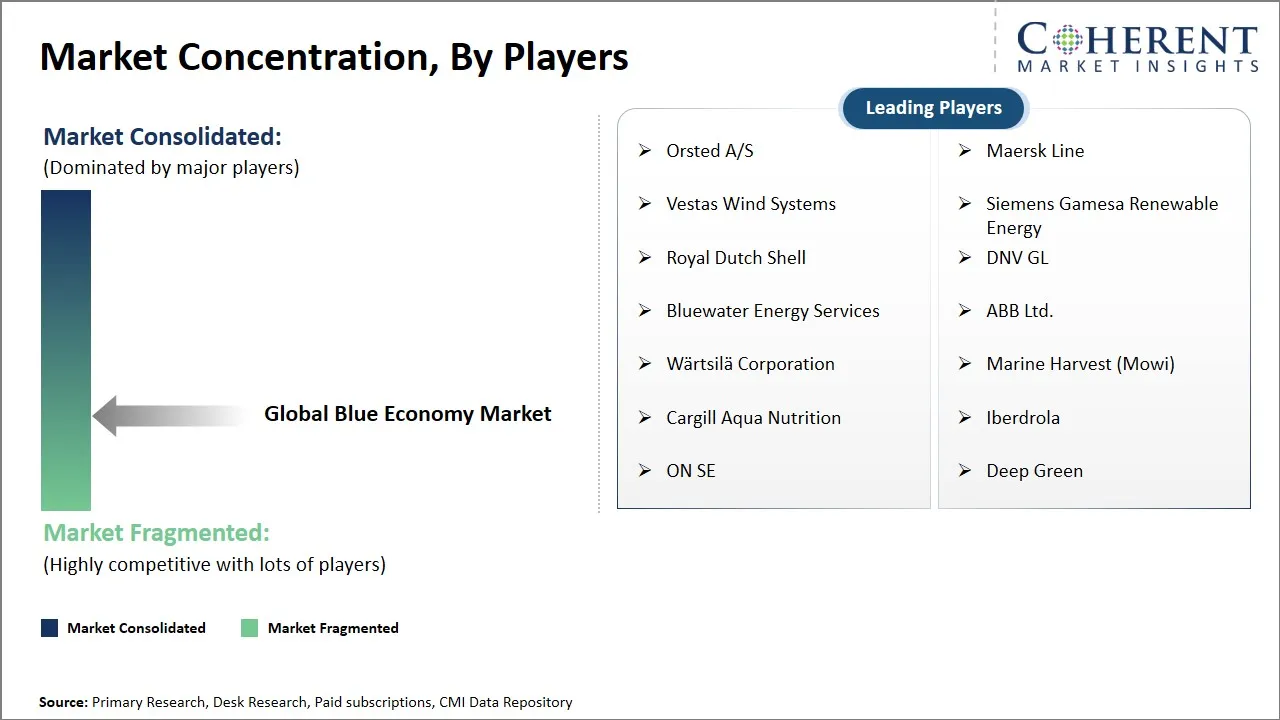
| Companies covered: | Orsted A/S, Maersk Line, Vestas Wind Systems, Siemens Gamesa Renewable Energy, Royal Dutch Shell, DNV GL, Bluewater Energy Services, ABB Ltd., Wärtsilä Corporation, Marine Harvest (Mowi), Cargill Aqua Nutrition, Iberdrola, ON SE, and Deep Green | ||
| Growth Drivers: |
| ||
| Restraints & Challenges: |
| ||
Blue Economy Market Dynamics
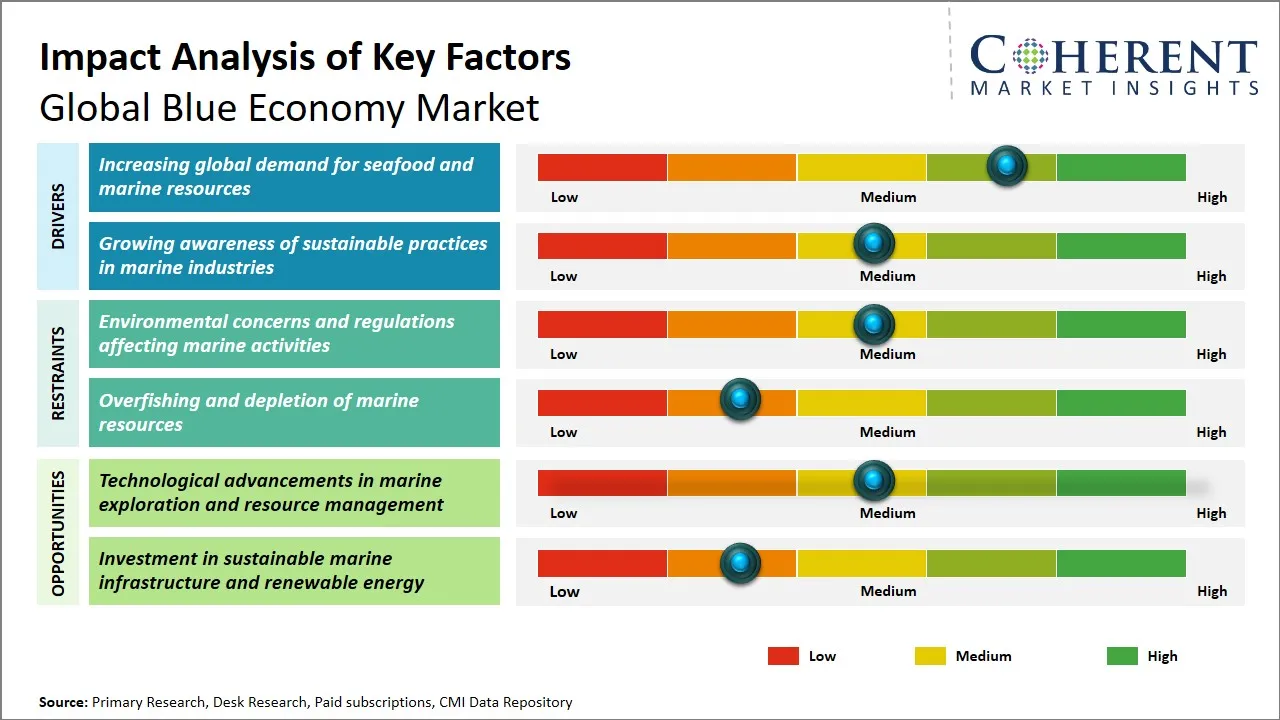
Blue Economy Market Driver - Increasing Global Demand for Seafood and Marine Resources
The growing demand of seafood and marine resources worldwide is a leading factor that contributes to the growth of the blue economy market. With consumers becoming increasingly conscious about their eating habits and the need to cut down on harmful food consumption, the role of seafood as a nutritional source has become quite important, which in turn has led to the development of more sustainable fishing, aquaculture and marine biotechnology. Also, increasing consciousness on the benefits of omega-3 fatty acids and other nutrients in marine products has only increased the demand in various markets such as pharmaceutical, nutraceutical and food industries.
In case, the example of Japanese conglomerate Maruha Nichiro starting massive investments in marine biotechnology and value-added marine processing of seafood to provide high-end protein products to the nutraceutical industry. This action is an indication of the merging between the traditional fisheries with the modern-day bioprocessing to take advantage of the ever-increasing consumer-driven demand of the sea products of health orientation.
Blue Economy Market Opportunity - Technological Advancements in Marine Exploration and Resource Management
The introduction of technological progress in the sphere of marine exploration and resource control could be taken as a great opportunity to develop the global blue economy market. A new technology like the underwater robotics, Autonomous Underwater Vehicles (AUVs), and the advanced technology of remote sensing, has radically enhanced the capability of probing and examining marine ecosystems with a higher degree of precision and effectiveness. The technologies allow marine resources, such as fisheries, marine minerals and green energy sources, such as offshore wind and tidal energy, to be identified and extracted sustainably.
Indicatively, the European Marine Observation and Data Network (EMODnet), extended its digital infrastructure to include AI-based tools of satellite remote sensing to provide real-time access to the health and resource use of oceans. This illustrates how technology-based platforms increase sustainability in management and economic prospects in the blue economy.
Analyst Opinion (Expert Opinion)
- The global market for blue economy is in its upward trend which has been fueled by the growing awareness of the power of marine resources in enhancing sustainable growth. The reflections on the Ocean Business Conference (2023) and the Blue Economy Summit (2022) helped to observe the evolutionary trends in a business where such companies as Vard Group and Ocean Infinity led the changes in adopting sustainable technologies in the marine sphere.
- The recent creation of eco-efficient vessels at Vard Group can be seen as an expression of the company’s desire to minimize the environmental impact of its maritime activities. At these conferences, it was noted that public-private partnerships are important in advancing investment and innovation in marine renewable energy and sustainable fishing practices. Nevertheless, obstacles like the regulatory issues and the necessity to have solid information about the marine biodiversity were often mentioned as the obstacles to its development.
- The firms that pay attention to the integration of the sustainable practices with the cutting-edge technologies, including the AI as the resource management one, are likely to achieve higher results compared to the rivals. Also, it is necessary to involve local communities and stakeholders in the process of decision-making to attain success in the long run. Finally, the expansion of the global blue economy market will depend on its capacity to address economic growth and environmental stewardship to guarantee the health of the ocean ecosystems to the future generations.
Speak to the analyst
Want personalized insights?
Take the findings above to one of our principal consultants, or have the report rebuilt around the segments, geographies and competitors you actually track.
Market Segmentation
- Sectoral Activity Insights (Revenue, USD Bn, 2021 - 2033)
- Marine Fisheries & Aquaculture
- Maritime Transport & Logistics
- Coastal & Marine Tourism
- Marine Renewable Energy
- Seabed Mining & Marine Minerals
- Resource Type Insights (Revenue, USD Bn, 2021 - 2033)
- Living Resources
- Non-living Resources
- Ecosystem Services
- Energy Resources
- End-use Application Insights (Revenue, USD Bn, 2021 - 2033)
- Food & Nutrition
- Energy & Power Generation
- Transportation & Trade
- Tourism & Recreation
- Pharmaceuticals & Biotechnology
- Regional Insights (Revenue, USD Bn, 2021 - 2033)
- North America
- U.S.
- Canada
- Latin America
- Brazil
- Argentina
- Mexico
- Rest of Latin America
- Europe
- Germany
- U.K.
- Spain
- France
- Italy
- Russia
- Rest of Europe
- Asia Pacific
- China
- India
- Japan
- Australia
- South Korea
- ASEAN
- Rest of Asia Pacific
- Middle East
- GCC Countries
- Israel
- Rest of Middle East
- Africa
- South Africa
- North Africa
- Central Africa
- North America
- Key Players Insights
- Orsted A/S
- Maersk Line
- Vestas Wind Systems
- Siemens Gamesa Renewable Energy
- Royal Dutch Shell
- DNV GL
- Bluewater Energy Services
- ABB Ltd.
- Wartsila Corporation
- Marine Harvest (Mowi)
- Cargill Aqua Nutrition
- Iberdrola
- ON SE
- Deep Green
Sources
Primary Research Interviews
- Sustainability Director – Major Marine Technology Firm
- Strategy Lead – Leading Ocean Renewable Energy Company
- Aquaculture Operations Manager – Global Seafood Producer
- Senior Analyst – International Maritime Organization (IMO) affiliated body
Stakeholders
- Maritime Technology Providers
- End-use Sectors
- Marine Renewable Energy (offshore wind, tidal)
- Fisheries & Aquaculture (wild catch and farmed seafood)
- Port & Shipping Firms
- Coastal Tourism & Recreational Enterprises
- Regulatory & Certification Bodies
- E-commerce and Trade Platforms (for blue economy products)
- Ocean Conservation Technology Startups
Databases
- UN Comtrade Database (marine and seafood trade statistics)
- World Bank Blue Economy Initiative Resources
- India Marine Exports Dashboard (Ministry of Commerce & Industry)
- FAO Fisheries & Aquaculture Global Database
Magazines
- Marine Policy & Business Magazine – Trends and investments in blue economy sectors
- Offshore Energy Today – Innovations in marine renewable energy
- Ocean Economy Review – Blue growth, climate solutions, and policy drivers
- Aquaculture Asia Pacific – Market updates for marine farming
Journals
- Marine Policy Journal – Regulatory and policy trends in blue economy
- Journal of Ocean & Coastal Economics – Market analysis and ecosystem services
- Aquaculture Reports – Advances in sustainable aquaculture
- Marine Technology Society Journal – Technological integration in blue economy sectors
Newspapers
- Financial Times – Blue economy investments and global trade news
- Reuters – Ocean industry developments and sustainability
- Asia-Pacific News Journal – Growth and innovation in regional blue economy
- The Guardian – Coverage of ocean sustainability and climate adaptation markets
Associations
- World Ocean Council
- Global Ocean Forum
- Pacific Community (SPC) – Blue economy data for Pacific region
- International Chamber of Shipping
Public Domain Sources
- United Nations Environment Programme (UNEP) – Blue Economy Reports
- World Bank – Blue Economy Guidelines and Reports
- OECD – Ocean Economy and Sustainability Working Papers
- European Commission – Blue Growth and Blue Economy Publications
Proprietary Elements
- CMI Data Analytics Tool, Proprietary CMI Existing Repository of information for last 8 years.
Get access to 250+ pages report
Every segment, forecast, competitor profile and data table behind the analysis above — available for instant download.
- ESOMAR Member
- ISO 9001:2015 Certified
- D-U-N-S Registered
- GDPR & CCPA Compliant
Missing comfort of reading report in your local language? Find your preferred language:
Transform your Strategy with Exclusive Trending Reports
Frequently Asked Questions
The global blue economy market is estimated to be valued at USD 2,462.06 Bn in 2026 and is expected to reach USD 3,902.09 Bn by 2033.
The CAGR of the global blue economy market is projected to be 6.8% from 2026 to 2033.
Increasing global demand for seafood and marine resources and growing awareness of sustainable practices in marine industries are the major factors driving the growth of the global blue economy market.
Environmental concerns and regulations affecting marine activities and overfishing and depletion of marine resources are the major factors hampering the growth of the global blue economy market.
In terms of sectoral activity, the marine fisheries & aquaculture is estimated to dominate the market revenue share in 2026.
Orsted A/S, Maersk Line, Vestas Wind Systems, Siemens Gamesa Renewable Energy, Royal Dutch Shell, DNV GL, Bluewater Energy Services, ABB Ltd., Wärtsilä Corporation, Marine Harvest (Mowi), Cargill Aqua Nutrition, Iberdrola, ON SE, and Deep Green are the major players.
Asia Pacific is expected to lead the global blue economy market in 2026.