

Global Bread Mix Market Size and Forecast – 2026 To 2033
The Global Bread Mix Market is estimated to be valued at USD 4,621.8 Mn in 2026 and is expected to reach USD 7,088.3 Mn by 2033, exhibiting a compound annual growth rate (CAGR) of 6.3% from 2026 to 2033. This steady growth is driven by increasing consumer demand for convenient, time-saving, and easy-to-prepare baking solutions, along with the rising preference for homemade-style bread products with consistent taste and texture.
The market is also benefiting from stronger retail penetration of dry mixes, expanding bakery aisles, and product innovation focused on flavor, convenience, and multi-use baking applications. In May 2026, General Mills launched Bisquick Cinnamon Toast Crunch Pancake and Baking Mix as a permanent addition to its Betty Crocker portfolio, with nationwide U.S. retail availability.
Key Takeaways of the Global Bread Mix Market
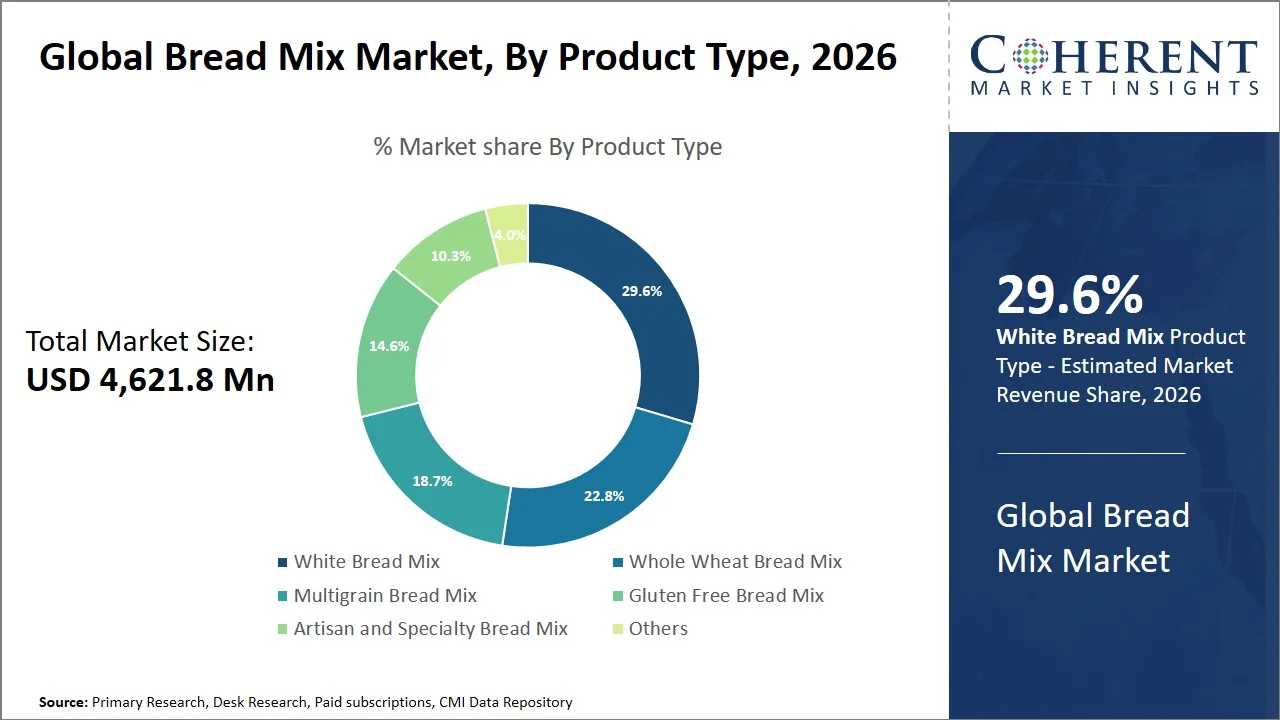
- White bread mix is expected to dominate by product type, holding 29.6 % of the market share in 2026, supported by its affordability, neutral taste profile, and wide usage in household and bakery applications. In December 2022, British Bakels launched its Ta-Da! home baking range, including White Bread Mix that requires only water, reinforcing convenience-led retail demand.
- Dry mix is expected to lead by form, holding 76.8 % of the market share in 2026, as it offers longer shelf life, easier storage, lower logistics complexity, and higher suitability for retail and B2B bakery formats. In March 2024, King Arthur Baking launched Savory Bread Mix Kits designed for simple, quick home preparation, strengthening dry mix adoption.
- The conventional segment is expected to remain the dominant segment by nature, holding 78.4 % of the market share in 2026, as mainstream consumers and commercial bakeries prioritize cost efficiency, scalable sourcing, and consistent formulation performance. In February 2025, USDA ERS highlighted organic price premiums versus conventional commodities, indicating why conventional mixes retain stronger volume penetration in price-sensitive channels.
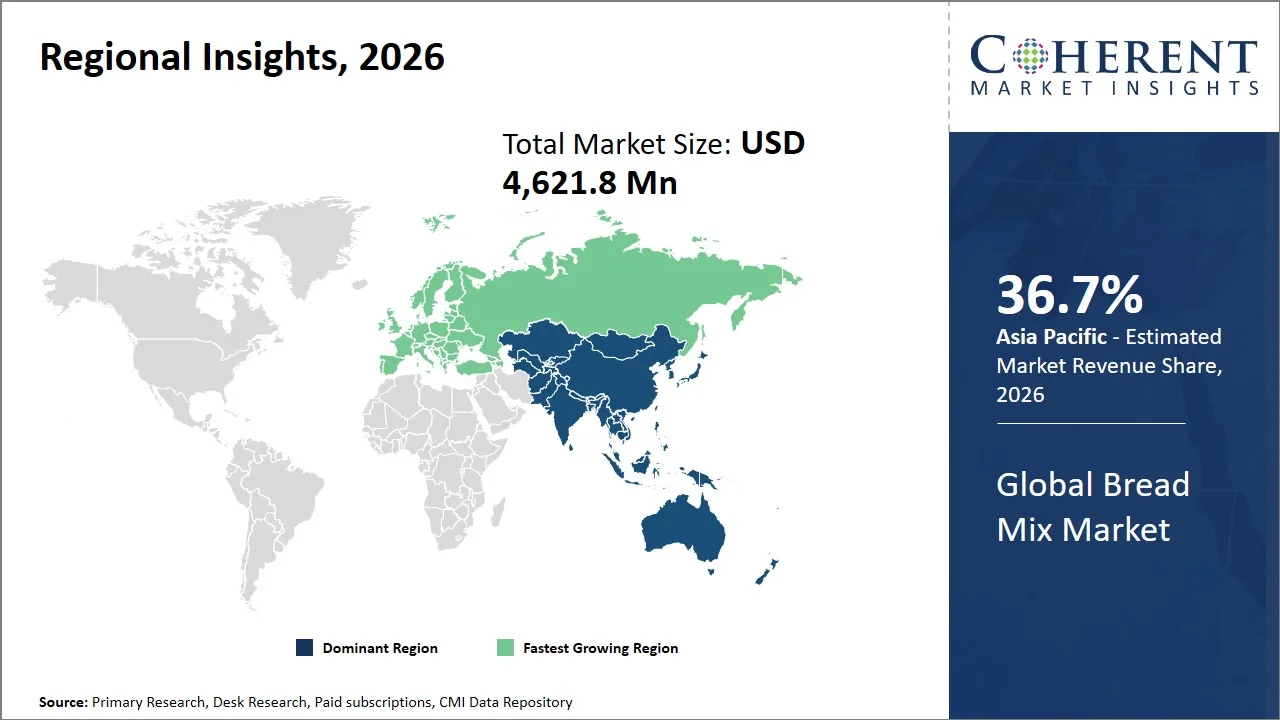
- Asia Pacific is expected to remain the dominant region with 36.7 % share in 2026, supported by expanding bakery consumption, rising urban households, growing café and bakery chains, and stronger adoption of convenient baking ingredients across China, India, and Southeast Asia. The region continues to benefit from increasing demand for packaged and ready-to-bake products, along with rising disposable incomes and evolving consumer preferences toward convenience foods.
- Europe is expected to be the fastest-growing region with 27.6 % share in 2026, supported by premium bakery culture, clean-label reformulation, artisan bread demand, and strong bakery ingredient innovation. In January 2025, Fedima unveiled its manifesto for EU policymakers to support sustainable growth, innovation, and competitiveness in Europe’s bakery ingredients sector, strengthening the region’s long-term bread mix opportunity.
- Clean-Label and Functional Reformulation: Bread mix manufacturers are increasingly aligning formulations with clean-label, high-fiber, protein-enriched, and additive-conscious positioning. This trend improves premiumization potential, supports differentiation in crowded retail shelves, and allows brands to address both indulgence and wellness without moving away from familiar bread formats.
- Convenience-Led Omnichannel Expansion: The market is shifting toward easy-to-prepare, portion-controlled, and digitally discoverable bread mix formats. Retailers and manufacturers are using supermarkets, online stores, subscriptions, and specialty bakery channels to expand consumer reach, while B2B suppliers benefit from standardized mixes that reduce labor dependency and improve production consistency.
Segmental Insights
Why Does White Bread Mix Dominate the Global Bread Mix Market?
White bread mix is expected to dominate the global bread mix market with 29.6% share in 2026, as it serves the widest consumption base across household baking, sandwich preparation, retail bakery shelves, and institutional foodservice. Its leadership is supported by familiar taste, soft crumb texture, faster consumer acceptance, and strong suitability for everyday breads, rolls, buns, and toast-style products. From the supply side, white bread mix benefits from standardized refined wheat flour inputs, predictable dough performance, easier fortification, and compatibility with bread machines, industrial mixers, and automated bakery lines. It is strongly adopted by bakeries and foodservice operators that require consistent volume, softness, and low formulation complexity. In June 2026, Flowers Foods expanded the distribution of its Nature’s Own white bread products across additional U.S. retail channels, highlighting continued strong demand for mainstream white bread offerings.
- Current Industry Events of 2026
- Market Size Estimation
- Regional Breakdown
- Competitive Landscape
- Customer Intelligence
- Segmental Analysis
- Pricing Analysis
- Key Market Drivers, Challenges & Future Trends
- Customized Insights Section
Why Does Dry Mix Represent the Largest Form Segment in the Global Bread Mix Market?
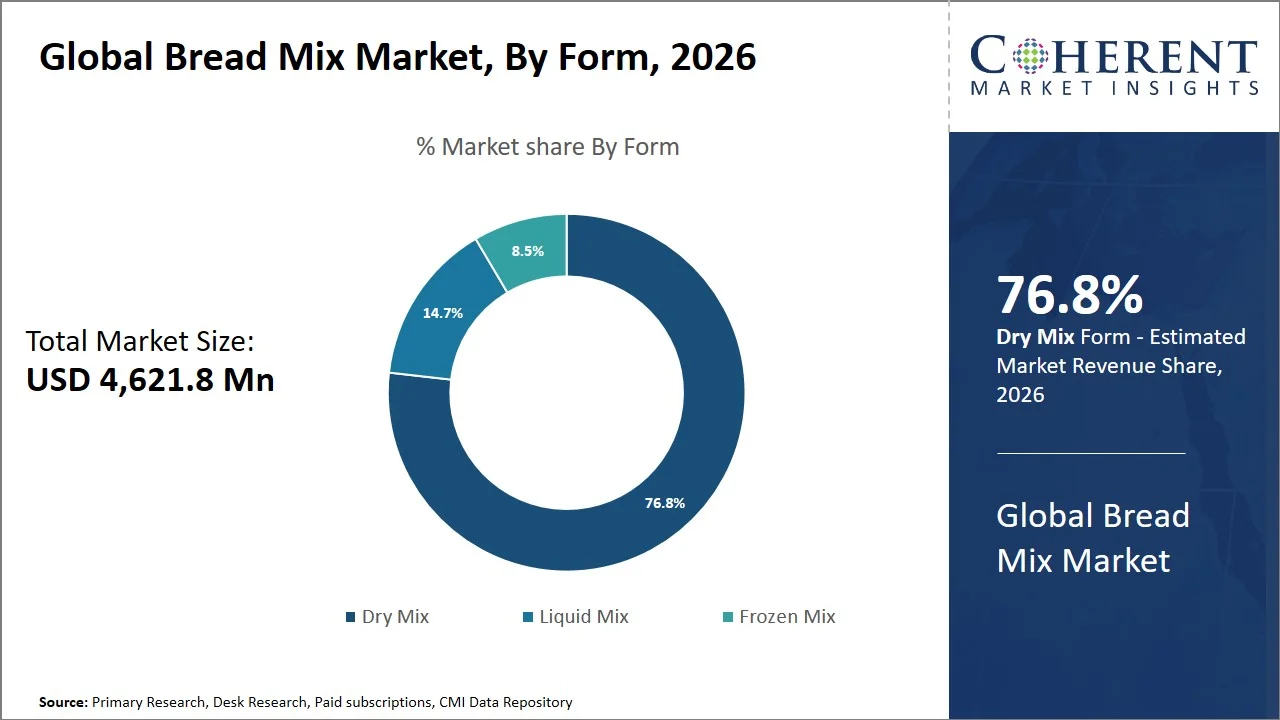
Dry mix is expected to represent the largest form segment with 76.8% share in 2026, owing to its superior storage stability, lower transportation cost, easy inventory handling, and high suitability for both retail packs and industrial bakery operations. Compared with liquid or frozen formats, dry mixes allow manufacturers to standardize flour, yeast-supporting ingredients, improvers, enzymes, and flavor components while giving bakeries flexibility to add water, fats, seeds, or toppings according to product positioning. Demand is strongest among households, bakery shops, large-scale retailers, and foodservice operators seeking consistent results with reduced preparation errors. Supply-side adoption is also supported by ambient warehousing and compatibility with automated dosing systems. In February 2025, GoodMills Innovation introduced Pinsa 100%, a process-safe dry flour mix designed for bakeries, large-scale retailers, and foodservice operators, supporting consistent preparation, flexible topping, freezing, and final baking applications. (Source: The Plant Base)
Why Does Conventional Dominate the Global Bread Mix Market?
The conventional segment is expected to dominate the global bread mix market with 78.4% share in 2026, as price-sensitive consumers, commercial bakeries, and foodservice operators continue to prioritize affordability, dependable ingredient supply, and scalable production economics. The segment benefits from established wheat procurement systems, wider availability of conventional flour, mature milling infrastructure, and lower formulation costs compared with organic alternatives. Demand remains strong in everyday household baking, mass-market bakery products, quick-service foodservice, and private-label retail formats where volume, cost control, and consistent dough behavior are critical. Supply chains for conventional mixes are also easier to manage across regions due to broader raw material sourcing. In August 2026, the International Grains Council reported stable global wheat supply outlooks supported by strong harvests in key producing regions, reinforcing availability for conventional bakery production. (Source: International Grains Council)
Global Bread Mix Market Dynamics
Key Market Drivers
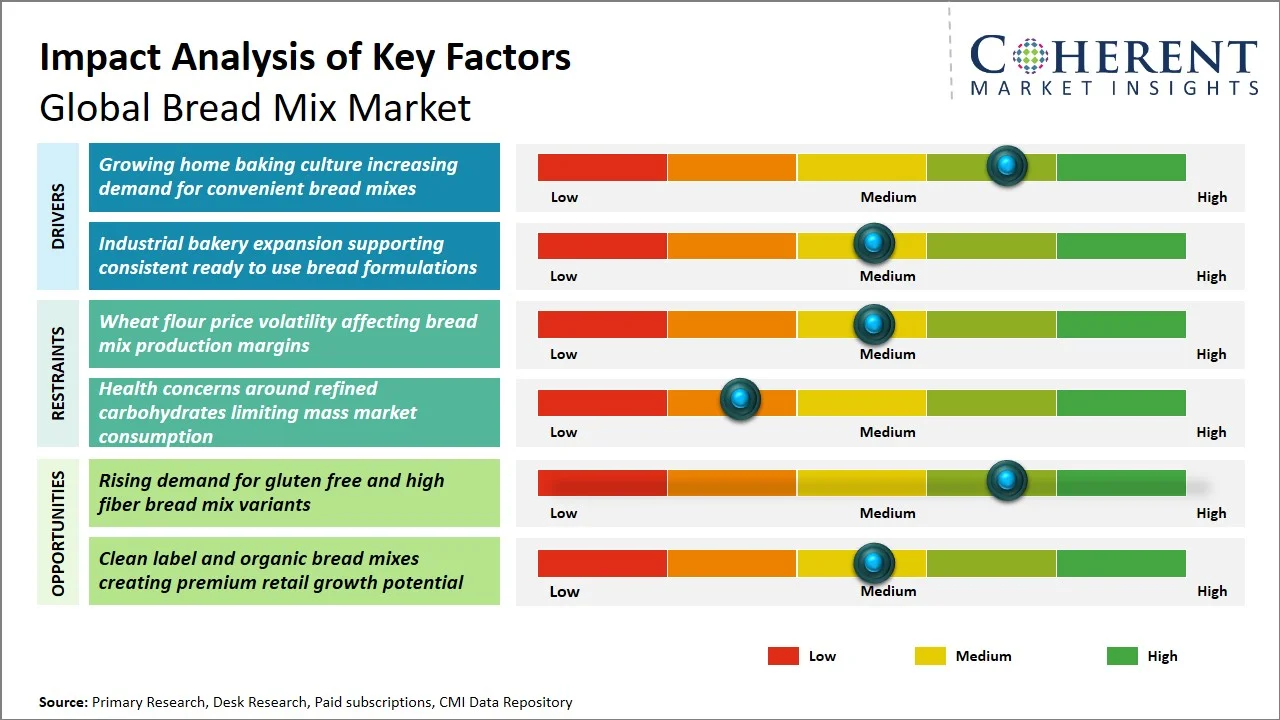
- Home Baking Convenience is Expanding Retail Bread Mix Demand: Growth in the culture of home baking is expanding the retail demand for bread mixes that make it easier to prepare bread but still achieve fresh baked results. With consumers increasingly seeking breads as breakfast foods, lunch box foods, snacks, and weekend baked goods, their repeat purchases are providing opportunities in the supermarket, online grocery and specialty retail channels. Manufacturers may use this to enable smaller pack innovation, flavor extensions, premium ingredient positioning, and increased shelf velocity compared to scratch-baking ingredients. Bread mixes also make for less time and skill dependency, which is a plus for busy consumers and young households. Organic Chocolate Chip and Organic Blueberry Quick Bread and Muffin Mixes were launched in March 2025 and sold through Walmart, Kroger banners, Sprouts and on-line platforms with ease, utilizing eggs, milk and oil to get the prepare going.
- Industrial Bakery Expansion is Supporting Standardized Ready-to-Use Formulations: Industrial bakery expansion is helping to standardize formulations by using bakery bases and bread mixes to better ensure batch consistency, minimize ingredient handling mistakes and streamline procurement in high volume production lines. Whether in retail, foodservice, or private label, bakeries are growing in size and scope and need to manage dough performance, hydration, texture, proofing characteristics, and product quality. In retail, foodservice, and private label, bakeries are expanding in size and scope, and require control over dough performance, hydration, texture, proofing behavior, and finished product quality. This driver is particularly important for buns, rolls, sandwich breads, brioche bases and potato roll applications where uniformity is commercially important. Reliability of B2B bread mix solutions is enhanced by investments in the supply side in the areas of dry blending, flexible packaging, and customized formulation. During April 2025, Farinart launched a new production facility in Quebec, dedicated to baking mixes, with industrial dry blending and flexible packaging lines, offering customized baking mixes such as brioche bun bases and potato roll bases.
Emerging Market Trends
- Clean-Label Bread Mixes are Moving From Niche to Mainstream Formulation Strategy: Clean-label positioning is emerging as a key product development trend in the bread mix market as consumers increasingly check ingredient lists for information, and retailers look for products to stand out on the shelf. Manufacturers are creating reformulated mixes that contain identifiable grains, fewer artificial ingredients, natural flavor systems and clean ingredient listings while maintaining dough tolerance and finished bread quality. This trend is significant from a commercial perspective as bread mix consumers expect convenience without sacrificing their perception of freshness, health or authenticity. Clean-label mixes are also aiding bakeries to deliver quick responses to retailer or private label specifications for B2B users. The change is anticipated to help drive premium pricing, decrease brand substitution risk, and spur innovation in whole grain, multigrain, seed-based, sourdough-style and allergen-conscious bread mix variants.
- Channel Diversification is Reshaping Bread Mix Sales Models: The bread mix market has evolved from a grocery-centric sales approach to a diversified channel framework that incorporates e-commerce, direct-to-consumer packs, bakery supply sales to B2B foodservice customers, specialty stores, and foodservice procurement channels. This provides manufacturers the opportunity to create specific product formats for specific market needs, such as small household packs, bulk bakery bags, private label mixes, and specially formulated for industrial use. Online retail helps people to discover gluten free, organic, artisan, and specialty mixes; and B2B direct sales enables the ingredient supplier to offer technical support in making customized mixes for recipes. It helps to diversify markets, lowers reliance on a single retail channel, and helps to increase the value of the product sold, when the formulation support is more important than the commodity price, as is the case for higher margin product categories, and in which the channel flexibility of packaging the product and the channel positioning of the product are of greater importance.
Current Events and their Impact
Current Events | Description and its Impact |
April 2025 – U.S. FDA Updated “Healthy” Nutrient Content Claim Rule |
|
January 2026 – Canada Front-of-Package Nutrition Symbol Requirement |
|
February 2025 / August 2026 – EU Packaging and Packaging Waste Regulation |
|
Regional Insights
Why Does Asia Pacific Dominate the Global Bread Mix Market?
Asia Pacific is expected to dominate the global bread mix market with 36.7% share in 2026, supported by rising bakery consumption, expanding urban retail formats, and increasing adoption of convenient baking ingredients across China, India, Southeast Asia, and developed Asian markets. The region benefits from large population clusters, fast-growing café and bakery chains, and a shift from unpackaged bakery products toward standardized packaged and semi-prepared formats. Bread mixes are gaining stronger relevance among industrial bakeries and retail bakers that need consistent dough performance, faster preparation, and scalable ingredient systems. In November 2025, U.S. Department of Agriculture (USDA) Foreign Agricultural Service (FAS) reported that Thailand’s bakery market was growing steadily, supported by convenience foods, health-conscious bakery options, and demand for bread, cakes, and pastries, reflecting broader Asia Pacific bakery ingredient momentum. (Source: USDA FAS)
Why is Europe Emerging as the Fastest-Growing Region in the Global Bread Mix Market?
Europe is expected to emerge as the fastest-growing region in the global bread mix market with 27.6% share in 2026, supported by strong bakery traditions, premium bread culture, sustainability-led reformulation, and demand for clean-label, whole grain, gluten-free, and artisan-style bread formats. European bakeries are increasingly using ready-to-use and semi-prepared mixes to manage labor shortages, maintain product consistency, and offer differentiated bread varieties across retail and foodservice. The region’s regulatory direction also favors recyclable packaging, transparent labeling, and quality-driven formulations, encouraging manufacturers to upgrade product standards. In February 2025, the EU Packaging and Packaging Waste Regulation entered into force, creating stronger pressure on packaged bread mix suppliers to redesign pouches, cartons, and flexible packaging for recyclability and compliance. (Source: European Commission)
Bread Mix Market Outlook for Key Countries
Why is the U.S. a Key Market for the Global Bread Mix Market?
The U.S. is a key market for the global bread mix market due to its well-established home baking culture, large grocery retail base, strong industrial bakery network, and high consumer acceptance of packaged baking solutions. Bread mixes benefit from the country’s demand for convenience, recipe experimentation, private-label bakery products, and specialty formats such as sourdough, multigrain, gluten-free, and quick bread mixes. The presence of large retailers and broad e-commerce access also allows brands to scale new bread mix formats rapidly. On the supply side, the U.S. has mature flour milling, ingredient blending, food safety, and packaged food distribution infrastructure. The American Bakers Association notes that the U.S. baking industry operates across all states and generates significant employment, wages, and economic impact, supporting a deep bakery ingredient ecosystem.
Why is India Important in the Global Bread Mix Market?
India is important in the global bread mix market because of its expanding bakery consumption, rising urban households, growing modern retail penetration, and increasing acceptance of convenient packaged food products. Bread mixes are relevant for Indian bakery shops, quick-service foodservice outlets, cafés, and households that require consistent results without complex scratch preparation. The market also benefits from a strong domestic wheat base, which supports flour availability for conventional, whole wheat, and multigrain bread mix formulations. India’s bakery demand is broadening beyond basic bread into buns, rolls, pizza bases, muffins, and other Western-style baked products. In 2025, FAO GIEWS reported that India’s wheat production was officially estimated at a record 117.9 million tons, strengthening the raw material base for flour-led bakery and bread mix production.
Why Does China Support Growth in the Global Bread Mix Market?
China supports growth in the global bread mix market through its large bakery retail base, rapid urban consumption shift, and expanding café, tea shop, and convenience bakery formats. Bread mixes are commercially relevant in China because bakeries need scalable ingredient solutions that can support consistent product texture, flavor adaptation, and fast production across dense urban locations. The country also offers opportunity for Western-style bread, soft bread, sandwich bread, filled breads, and premium bakery formats, particularly among younger consumers. On the supply side, China’s large bakery outlet network encourages demand for standardized baking ingredients and premixes. In January 2026, USDA FAS reported that China was the world’s second-largest bakery market, with its baked food retail market estimated between US$ 50 billion and US$ 83 billion in 2025, and more than 338,000 bakery outlets nationwide as of April 2025.
Why is Germany a Strategic Country in the Global Bread Mix Market?
Germany is a strategic country in the global bread mix market because it combines deep bread culture with advanced bakery manufacturing, strong artisan expertise, and high demand for quality-controlled flour-based formulations. German consumers have strong preference for diverse breads, including rye, mixed grain, sourdough, seed-based, and whole grain varieties, which supports demand for specialty and performance-oriented bread mixes. The country is also important for B2B bakery ingredient suppliers because bakeries require reliable dough behavior, texture consistency, and compliance with strict quality expectations. Germany’s role as a European bakery technology and trade hub further strengthens product innovation. In January 2025, industry data reported that the German baking industry comprised over 9,200 bakeries, around 240,000 employees, and approximately US$ 18,954.0 Mn in turnover, highlighting Germany’s strong bakery ecosystem and strategic importance in the global bread mix market.
Why is Brazil an Important Growth Market for the Global Bread Mix Market?
Brazil is an important growth market for the global bread mix market due to its large urban consumer base, mature bakery culture, and strong role as a regional food processing hub in Latin America. Bread mixes are relevant for Brazilian bakeries, supermarkets, cafés, and foodservice operators that need cost-effective preparation, consistent quality, and flexible formulations for bread, rolls, buns, and specialty bakery products. The country’s food processing sector supports demand for imported and domestic bakery ingredients, while regional distribution channels help scale packaged mixes across urban and semi-urban markets. Brazil also offers opportunities for value-added bakery formulations as consumers seek convenience and variety. In March 2026, USDA FAS reported that Brazil’s food processing sector revenue reached about US$ 248 billion in 2025, growing 8% from the previous year, supporting ingredient-led bakery expansion.
Technology Adoption Landscape in the Global Bread Mix Market
Technology | Adoption Level | Key Application Area | Business Impact |
Automated Dry Blending Systems | High | Uniform mixing of flour, yeast-supporting ingredients, improvers, fibers, seeds, and flavor components | Improves batch consistency, reduces manual errors, and supports scalable production |
Precision Dosing and Weighing Systems | High | Ingredient measurement in industrial and B2B bread mix manufacturing | Reduces formulation variance, controls cost, and improves finished bread quality |
Enzyme and Dough Conditioner Technology | High | Texture improvement, dough tolerance, softness, and shelf-life support | Helps manufacturers deliver consistent performance across white, wheat, and specialty bread mixes |
Modified Atmosphere and Barrier Packaging | Medium | Retail packs and bulk bread mix packaging | Extends shelf life, protects moisture-sensitive ingredients, and reduces spoilage risk |
Allergen Segregation and Traceability Systems | Medium | Gluten-free, nut-free, soy-free, and specialty bread mix production | Supports regulatory compliance, premium positioning, and access to restricted-diet consumers |
Digital Quality Control and Batch Traceability | Medium | Production monitoring, batch documentation, and supplier quality tracking | Improves recall readiness, customer confidence, and B2B specification compliance |
How are Clean-Label Formulations and B2B Customization Creating New Growth Opportunities in the Global Bread Mix Market?
Clean-label formulation and B2B customization represent a strong growth opportunity for bread mix manufacturers because they address both consumer-facing and industrial bakery needs. Retail consumers are looking for bread mixes that combine convenience with recognizable ingredients, better nutrition, and specialty positioning, while commercial bakeries require formulations that reduce process complexity and improve repeatability. Suppliers that can offer modular bases for white bread, whole wheat, multigrain, gluten-free, brioche-style, and artisan formats can capture higher-value demand across household, bakery shop, foodservice, and industrial bakery applications. Customization also supports private-label growth, allowing retailers and bakeries to differentiate through flavor, grain profile, clean-label claims, pack size, and preparation format. Commercially, this opportunity improves margin potential because buyers are not only purchasing ingredients but also formulation reliability, technical support, compliance readiness, and faster product development cycles.
Market Players, Key Development, and Competitive Landscape
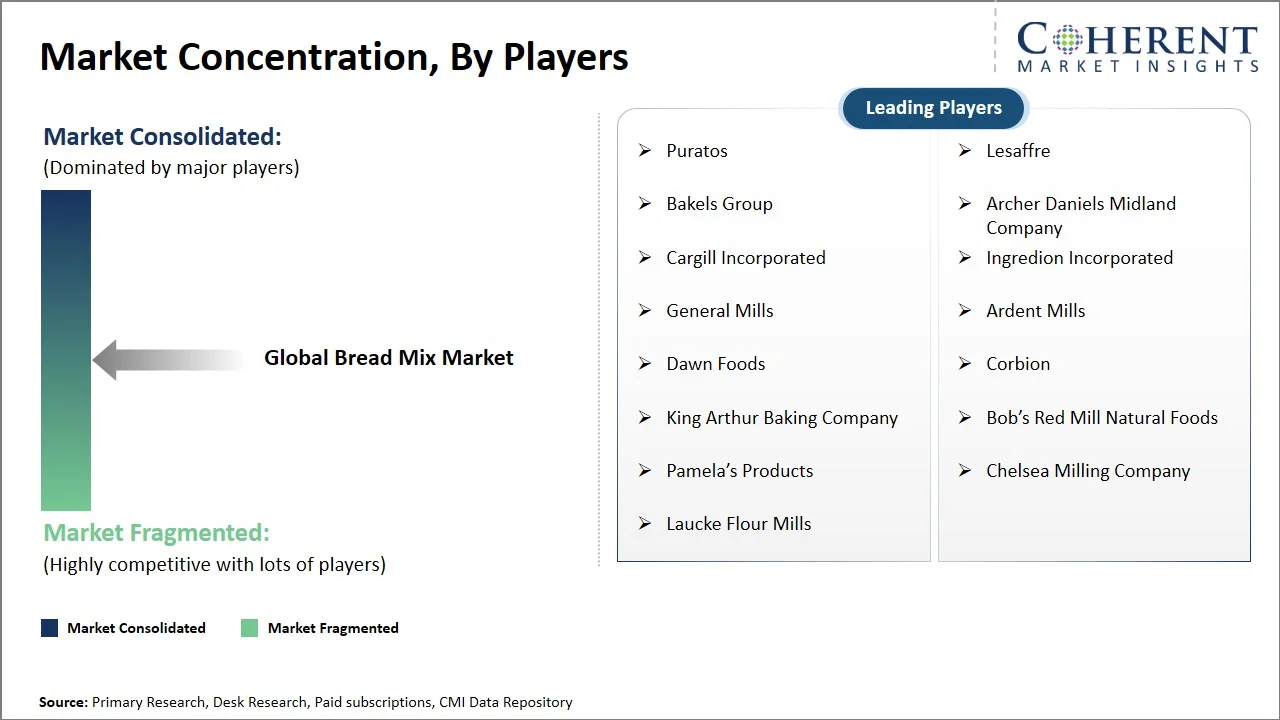
Key Developments
- In September 2025, Pillsbury launched a limited-edition Funfetti Sourdough Bread Mix, combining sourdough bread mix, yeast, and rainbow sprinkles for online-only sales through Funfetti.com. This development highlights how mainstream baking mix brands are using social-led product concepts and novelty flavors to convert home baking interest into premium, limited-drop demand.
- In May 2025, Arabian Mills launched its premium Master Mills brand, targeting both commercial and consumer bakery users. The initial range included specialty flours, bread mixes, and baking solutions, positioning the company to serve convenience-led bakery demand in Saudi Arabia and broader regional foodservice channels.
Competitive Landscape
The global bread mix industry is moderately fragmented and is characterized by the presence of large bakery ingredient suppliers, regional flour processors, private-label manufacturers, specialty mix brands and B2B formulation companies. Competition is measured by consistency, quality of ingredients, price competitiveness, customization, distribution, and retail and industrial bakery trade.
Key focus areas include
- Product quality and differentiation through white, whole wheat, multigrain, gluten-free, artisan, and specialty bread mix variants
- Technology adoption and process efficiency through automated blending, precision dosing, and batch traceability systems
- Pricing and cost competitiveness supported by wheat sourcing, scale procurement, and efficient dry mix manufacturing
- Capacity expansion and supply reliability for large bakery chains, retailers, and foodservice buyers requiring stable deliveries
- Certifications, compliance, and quality control including food safety systems, allergen management, organic certification, and clean-label validation
- Distribution network and customer reach across supermarkets, online retail, specialty stores, B2B direct sales, and industrial bakery supply
- Format and specification differentiation through retail packs, bulk bags, private-label blends, and ready-to-use bakery bases
- Specialty positioning around organic, sustainable, high-fiber, seed-based, gluten-free, and premium artisan-style bread mixes
Market Report Scope
Bread Mix Market Report Coverage
| Report Coverage | Details | ||
|---|---|---|---|
| Base Year: | 2025 | Market Size in 2026: | USD 4,621.8 Mn |
| Historical Data for: | 2020 To 2024 | Forecast Period: | 2026 To 2033 |
| Forecast Period 2026 to 2033 CAGR: | 6.3% | 2033 Value Projection: | USD 7,088.3 Mn |
| Geographies covered: |
| ||
| Segments covered: |
| ||
| Companies covered: | Puratos, Lesaffre, Bakels Group, Archer Daniels Midland Company, Cargill Incorporated, Ingredion Incorporated, General Mills, Ardent Mills, Dawn Foods, Corbion, King Arthur Baking Company, Bob’s Red Mill Natural Foods, Pamela’s Products, Chelsea Milling Company, and Laucke Flour Mills | ||
| Growth Drivers: |
| ||
| Restraints & Challenges: |
| ||
Analyst Opinion (Expert Opinion)
- The global bread mix market is expected to maintain steady growth over the forecast period as convenience baking, retail-ready formats, and industrial bakery standardization continue to support adoption. Dry mixes, conventional mixes, and white bread mixes will remain volume anchors, while premiumization will increasingly come from multigrain, organic, gluten-free, and artisan-style formulations.
- The strongest growth pockets are expected in household baking, online retail, bakery shops, and B2B direct sales to industrial bakeries. Europe will remain structurally strong due to bakery culture and ingredient expertise, while North America offers attractive upside from convenience-led consumption, premium mixes, and health-oriented product innovation.
- Key risks include wheat price volatility, clean-label reformulation complexity, sodium and sugar labeling pressure, allergen cross-contamination concerns, and competition from ready-to-eat bakery products. Market players should focus on consistent formulation performance, recyclable packaging, private-label partnerships, technical support for bakeries, and differentiated mixes that combine convenience, nutrition, and reliable baking outcomes.
Speak to the analyst
Want personalized insights?
Take the findings above to one of our principal consultants, or have the report rebuilt around the segments, geographies and competitors you actually track.
Market Segmentation
- Product Type Insights (Revenue, USD Mn, 2021 - 2033)
- White Bread Mix
- Whole Wheat Bread Mix
- Multigrain Bread Mix
- Gluten Free Bread Mix
- Artisan and Specialty Bread Mix
- Others
- Form Insights (Revenue, USD Mn, 2021 - 2033)
- Dry Mix
- Liquid Mix
- Frozen Mix
- Nature Insights (Revenue, USD Mn, 2021 - 2033)
- Conventional
- Organic
- Application Insights (Revenue, USD Mn, 2021 - 2033)
- Household Baking
- Industrial Bakeries
- Bakery Shops
- Foodservice
- Others
- Distribution Channel Insights (Revenue, USD Mn, 2021 - 2033)
- Supermarkets and Hypermarkets
- B2B Direct Sales
- Online Retail
- Specialty Stores
- Others
- Regional Insights (Revenue, USD Mn, 2021 - 2033)
- North America
- U.S.
- Canada
- Latin America
- Brazil
- Argentina
- Mexico
- Rest of Latin America
- Europe
- Germany
- U.K.
- Spain
- France
- Italy
- Russia
- Rest of Europe
- Asia Pacific
- China
- India
- Japan
- Australia
- South Korea
- ASEAN
- Rest of Asia Pacific
- Middle East
- GCC Countries
- Israel
- Rest of Middle East
- Africa
- South Africa
- North Africa
- Central Africa
- North America
- Key Players Insights
- Puratos
- Lesaffre
- Bakels Group
- Archer Daniels Midland Company
- Cargill Incorporated
- Ingredion Incorporated
- General Mills
- Ardent Mills
- Dawn Foods
- Corbion
- King Arthur Baking Company
- Bob’s Red Mill Natural Foods
- Pamela’s Products
- Chelsea Milling Company
- Laucke Flour Mills
Source
Primary Research Interviews
- Bread mix manufacturers producing white bread mix, whole wheat bread mix, multigrain bread mix, gluten-free bread mix, artisan bread mix, specialty bread mix, and customized bakery premixes
- Bakery ingredient suppliers offering flour blends, yeast, dough conditioners, enzymes, emulsifiers, fibers, seeds, grains, sweeteners, and bakery improvers
- Flour millers, wheat processors, grain suppliers, and dry blending companies supplying ingredients for retail and industrial bread mix production
- Industrial bakeries, commercial bakery chains, in-store bakery operators, and bakery shops using ready-to-use bread formulations
- Household baking mix brands, private-label baking mix manufacturers, and packaged food companies offering retail bread mix products
- Foodservice operators, cafés, quick-service restaurants, hotels, and institutional kitchens using bread mixes for consistent bakery preparation
- Gluten-free, organic, clean-label, high-fiber, and specialty bakery formulation experts
- Packaging suppliers providing pouches, cartons, bulk bags, barrier packaging, and sustainable packaging solutions for dry bread mixes
- Supermarkets, hypermarkets, online grocery platforms, specialty stores, bakery ingredient distributors, and B2B food ingredient suppliers
- Food safety consultants, certification agencies, regulatory experts, bakery technologists, and quality testing laboratories
Stakeholders
- Bread mix and bakery ingredient manufacturers: Puratos, Lesaffre, Bakels Group, Archer Daniels Midland Company, Cargill Incorporated, Ingredion Incorporated, General Mills, Ardent Mills, Dawn Foods, Corbion, King Arthur Baking Company, Bob’s Red Mill Natural Foods, Pamela’s Products, Chelsea Milling Company, Laucke Flour Mills, GoodMills Group, IREKS, AB Mauri, Angel Yeast
- Flour millers and grain processors: wheat flour producers, whole wheat flour suppliers, multigrain flour processors, specialty flour manufacturers, and gluten-free flour suppliers
- Ingredient suppliers: yeast producers, enzyme suppliers, emulsifier manufacturers, dough improver companies, fiber suppliers, seed and grain suppliers, sugar and sweetener suppliers, and flavor ingredient suppliers
- Retail and packaged food ecosystem: supermarket chains, hypermarkets, private-label retailers, online grocery platforms, specialty baking stores, and household baking brands
- Industrial and commercial end users: industrial bakeries, bakery chains, foodservice operators, cafés, quick-service restaurants, hotels, institutional kitchens, and contract food manufacturers
- Packaging and logistics ecosystem: flexible packaging manufacturers, carton suppliers, bulk bag suppliers, food-grade packaging companies, cold chain providers for frozen mixes, and warehousing companies
- Certification and regulatory ecosystem: food safety certification agencies, organic certification bodies, gluten-free certification organizations, labeling consultants, and food testing laboratories
Databases
- FAOSTAT – wheat production, cereal supply, crop utilization, and agricultural raw material data
- USDA Foreign Agricultural Service – bakery ingredient trends, wheat trade, food processing, and country-level bakery market reports
- USDA Economic Research Service – wheat prices, food expenditure, packaged food trends, and consumer food demand indicators
- UN Comtrade Database – import/export analysis for wheat flour, bakery mixes, baking preparations, cereal-based mixes, and related food ingredients
- ITC Trade Map – country-wise trade flows, export dependency, import dependency, and supplier concentration for bakery ingredients and prepared baking mixes
- Eurostat – European bakery production, food manufacturing, trade, and consumer price data
- U.S. Census Bureau – U.S. food manufacturing, bakery product manufacturing, and retail sales data
- U.S. Bureau of Labor Statistics – food price inflation, bakery product prices, and consumer expenditure data
- World Bank Commodity Markets – wheat, cereal, energy, and agricultural commodity price trends
- Food and Agriculture Organization – cereal production, food supply, and wheat utilization statistics
- Company annual reports, investor presentations, sustainability reports, product brochures, and technical specification sheets of key bread mix and bakery ingredient manufacturers
Magazines / Industry Publications
- Baking Business
- British Baker
- Bakery and Snacks
- Food Business News
- Food Ingredients First
- FoodNavigator
- Prepared Foods
- Milling and Grain
- World Grain
- International Bakery
- Bake Magazine
- Snack Food & Wholesale Bakery
- Modern Baking
- European Baker & Biscuit
- Food Processing
- Food Manufacture
- Packaging World
- Packaging Europe
- Retail Bakery
- The Grocer
Journals
- Journal of Cereal Science
- Cereal Chemistry
- Food Chemistry
- LWT – Food Science and Technology
- Food Research International
- Journal of Food Science
- International Journal of Food Science & Technology
- Trends in Food Science & Technology
- Food Hydrocolloids
- Journal of Texture Studies
- Foods
- Applied Food Research
- Journal of Food Processing and Preservation
- Journal of Stored Products Research
- Journal of Agricultural and Food Chemistry
- Journal of Cleaner Production
- Sustainability
- International Journal of Gastronomy and Food Science
- Food Packaging and Shelf Life
- Comprehensive Reviews in Food Science and Food Safety
Credible News Sources
- Financial Times – food ingredient pricing, consumer goods strategy, retail food trends, and supply-chain developments
- The Wall Street Journal – packaged food demand, grocery retail, inflation, and consumer food behavior
- CNBC – consumer goods, food inflation, retail trends, and commodity market updates
- Food Business News – bakery product launches, baking ingredient developments, and packaged food company strategies
- Baking Business – bakery industry, bread mix launches, ingredient innovation, and manufacturer developments
- FoodNavigator – food regulation, nutrition labeling, ingredient reformulation, and European bakery trends
- World Grain – wheat, milling, flour, and bakery ingredient supply developments
- The Grocer – retail bakery, baking mixes, private-label, and grocery channel trends
Associations
- American Bakers Association
- International Association of Operative Millers
- Grain Foods Foundation
- North American Millers’ Association
- U.S. Wheat Associates
- International Association for Cereal Science and Technology
- AIB International
- Federation of Bakers
- Fedima – Federation of European Manufacturers and Suppliers of Ingredients to the Bakery, Confectionery and Patisserie Industries
- European Flour Millers
- British Baking Industry Association
- Craft Bakers Association
- Canadian National Millers Association
- Australian Baking Industry Association
- International Grains Council
- Organic Trade Association
- Gluten-Free Certification Organization
- Global Food Safety Initiative
- Institute of Food Technologists
- Specialty Food Association
Public Domain Sources
- FAO – wheat production, cereal supply, crop outlook, and global food balance data
- USDA FAS – country-level bakery ingredients, food processing, wheat trade, and packaged food reports
- USDA ERS – food prices, wheat market outlook, food consumption, and consumer expenditure data
- U.S. FDA – food labeling, nutrition claims, allergen labeling, and food safety requirements
- Health Canada – front-of-package labeling, nutrition standards, and food safety rules
- European Commission – food labeling, food safety, packaging, sustainability, and circular economy regulations
- EFSA – food ingredient safety assessments and nutrition-related scientific opinions
- Codex Alimentarius – international food standards, labeling guidelines, and food safety principles
- UK Food Standards Agency – food safety, allergen labeling, and packaged food compliance guidance
- Food Safety and Standards Authority of India – bakery product standards, labeling rules, and food additive regulations
- China National Health Commission / SAMR – food safety standards and packaged food regulation
- Japan Ministry of Agriculture, Forestry and Fisheries – food processing, wheat, and bakery sector data
- UN Comtrade – trade flows for bakery mixes, wheat flour, cereal preparations, and related ingredients
- ITC Trade Map – country-level bakery ingredient imports, exports, and supplier concentration
- Eurostat – European food manufacturing, bakery production, and trade data
- World Bank Commodity Markets – wheat and agricultural commodity price trends
Proprietary Elements
- CMI Data Analytics Tool, Proprietary CMI Existing Repository of information for last 10 years.
Get access to 250+ pages report
Every segment, forecast, competitor profile and data table behind the analysis above — available for instant download.
- ESOMAR Member
- ISO 9001:2015 Certified
- D-U-N-S Registered
- GDPR & CCPA Compliant
Missing comfort of reading report in your local language? Find your preferred language:
Transform your Strategy with Exclusive Trending Reports
Frequently Asked Questions
The CAGR of the global bread mix market is projected to be 6.3% from 2026 to 2033.
The global bread mix market is estimated to be valued at USD 4,621.8 million in 2026 and is expected to reach USD 7,088.3 million by 2033.
Clean-label formulations, gluten-free options, multigrain mixes, artisan-style bread mixes, and convenient ready-to-use formats are key trends shaping the global bread mix market.
Bread mixes are widely used in household baking, industrial bakeries, bakery shops, foodservice outlets, cafés, and quick-service restaurants for preparing consistent bread products with reduced preparation time.
Growing home baking culture increasing demand for convenient bread mixes and industrial bakery expansion supporting consistent ready to use bread formulations are the major factors driving the growth of the global bread mix market.
Wheat flour price volatility affecting bread mix production margins and health concerns around refined carbohydrates limiting mass market consumption are the major factors hampering the growth of the global bread mix market.
In terms of product type, white bread mix is estimated to dominate the market revenue share in 2026.