

Global Bubble Wrap Market Size and Forecast – 2026 To 2033
The global bubble wrap market size is expected to grow from USD 6,310.2 Mn in 2026 to USD 9,741.7 Mn by 2033 registering a compound annual growth rate (CAGR) of 6.4% from 2026 to 2033. The market growth can be attributed to the growing demand for protective packaging solutions in the e-commerce, electronics, and automotive sectors, where safeguarding goods against damage and loss during transportation and handling is critical. The use of bubble wraps is still common today due to its cost-effective void filling, surface protection, and impact absorption properties for safeguarding fragile and high value items.
For instance, U.S. retail ecommerce sales rose by 9.7% YoY in Q1 2026, representing 16.8% of retail sales, showing robust e-commerce shipment volumes which directly drive the demand for protective packaging. For Example, Sealed Air offers its protective packaging solutions to high value electronics, medical equipment, industrial parts and e-commerce orders, thus emphasizing the wide applications of bubble wrap products. (Source: Census Bureau of the Department of Commerce)
Key Takeaways of the Global Bubble Wrap Market
- The bubble wrap rolls segment is the leading product type segment, accounting for an estimated 54.6 % market share in 2026. It is popular because rolls provide flexible cushioning for goods of varying shapes and sizes across bulk packing, warehousing, industrial shipment, electronics packaging, and e-commerce fulfillment applications. Rolls are preferred over pre-sized formats because they can be cut, wrapped, layered, or converted based on product dimensions, helping packaging teams reduce material wastage and simplify inventory. For instance, Pregis states that bubble cushioning is available in multiple bubble heights, roll sizes, and performance types, and can also be converted into different bag or pouch sizes, supporting its use from demanding industrial applications to smaller moving and shipping needs. (Source: Pregis)
- The Polyethylene (PE) segment dominates with an estimated 72.4 % market share in 2026 due to its lightweight, flexible, durable, and cost-effective properties. PE is highly suitable for producing bubble wrap rolls, sheets, bags, and inflatable cushioning used in e-commerce, logistics, electronics, healthcare, and industrial packaging. Its low density reduces shipping costs, while its resilience provides effective shock absorption and surface protection for fragile goods. Unlike other materials, PE can be easily heat-sealed, laminated, or downgauged without losing protective performance, making it ideal for large-scale fulfillment and industrial operations. For instance, ExxonMobil Chemical highlights that LDPE and LLDPE films are extensively used for flexible packaging and protective cushioning, providing puncture resistance, clarity, and recyclability options, which are critical for both conventional and sustainable bubble wrap formats (Source: Exxonmobil Chemical)
- Asia Pacific is expected to be the dominant regional market with an expected market share 32.8 % in 2026. Growth is supported by rapid expansion of online retail, electronics manufacturing, consumer goods shipments, and organized logistics across India, China, and Southeast Asia. India’s e-commerce market is projected to grow from US$ 125 billion in 2024 to US$ 345 billion by 2030, largely driven by tier-2 and tier-3 city adoption, creating strong demand for low-cost protective packaging materials such as bubble wrap. (Source: India Brand Equity Foundation)
- North America is expected to be the key region with an expected market share of 28.4 % in 2026 and is projected to remain the fastest growing region in market for bubble wraps. The region benefits from mature e-commerce infrastructure, strong parcel delivery networks, high adoption of protective packaging in electronics and healthcare, and the presence of major packaging companies. In 2024, Americans shipped 22.37 billion parcels, while Amazon alone delivered 6.3 billion parcels, highlighting the scale of protective packaging consumption in the U.S. delivery ecosystem. (Source: Reuters)
- Shift Toward Sustainable Cushioning Formats: Brands and packaging converters are moving toward recycled-content, curbside-recyclable, and paper-based cushioning alternatives as regulations and customer sustainability expectations increase. For instance, Sealed Air launched BUBBLE WRAP brand Ready-To-Roll Embossed Paper in August 2024 as a curbside-recyclable protective packaging solution.
- Rising Adoption of Automated Damage-Reduction Packaging: E-commerce warehouses and logistics companies are increasingly looking for packaging materials that improve packing speed, reduce product returns, and optimize void-fill usage. Storopack’s Fillpak system automates paper and air-based cushioning, enhancing speed, minimizing damage, and supporting sustainable packaging initiatives. These developments indicate a surge in demand for advanced, automated, and efficient protective packaging systems across high-volume e-commerce and logistics operations.
Segmental Insights
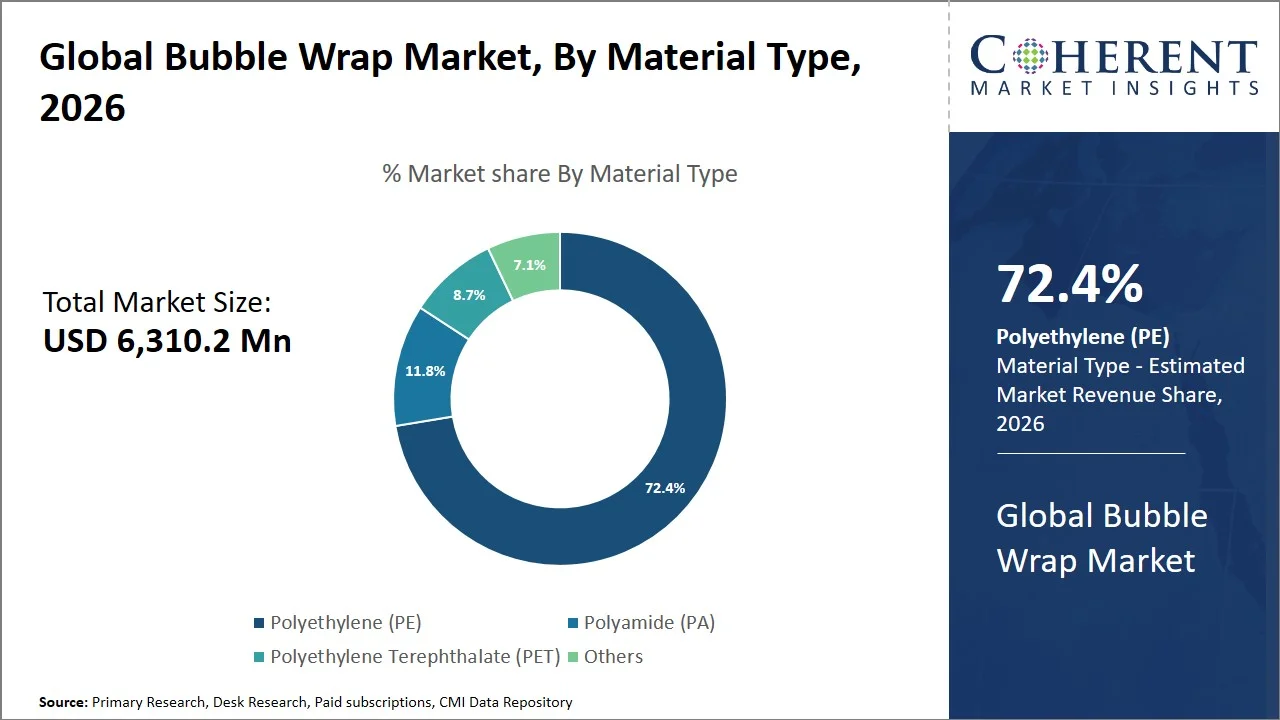
Why Does the Polyethylene (PE) Segment Dominate the Global Bubble Wrap Market?
The Polyethylene (PE) segment is expected to account for 72.4% share in 2026 because PE, especially Low-Density Polyethylene (LDPE) based film, offers the right balance of low weight, flexibility, sealability, cushioning strength, moisture resistance, and cost efficiency. The qualities are ideal for mass production of bubble wrap rolls, bags, mailers and sheets for e-commerce, electronics, logistics, and consumer goods packaging. Additionally, reducing overall weight of shipment is beneficial for parcel-based logistics, where the weight of the shipment can have a significant impact on the cost. According to Dow, LDPE is a flexible and lightweight material that is suitable for use in food packaging, industrial packaging and medical packaging. (Source: Dow)
- Current Industry Events of 2026
- Market Size Estimation
- Regional Breakdown
- Competitive Landscape
- Customer Intelligence
- Segmental Analysis
- Pricing Analysis
- Key Market Drivers, Challenges & Future Trends
- Customized Insights Section
Why do Bubble Wrap Rolls Dominate the Global Bubble Wrap Market?
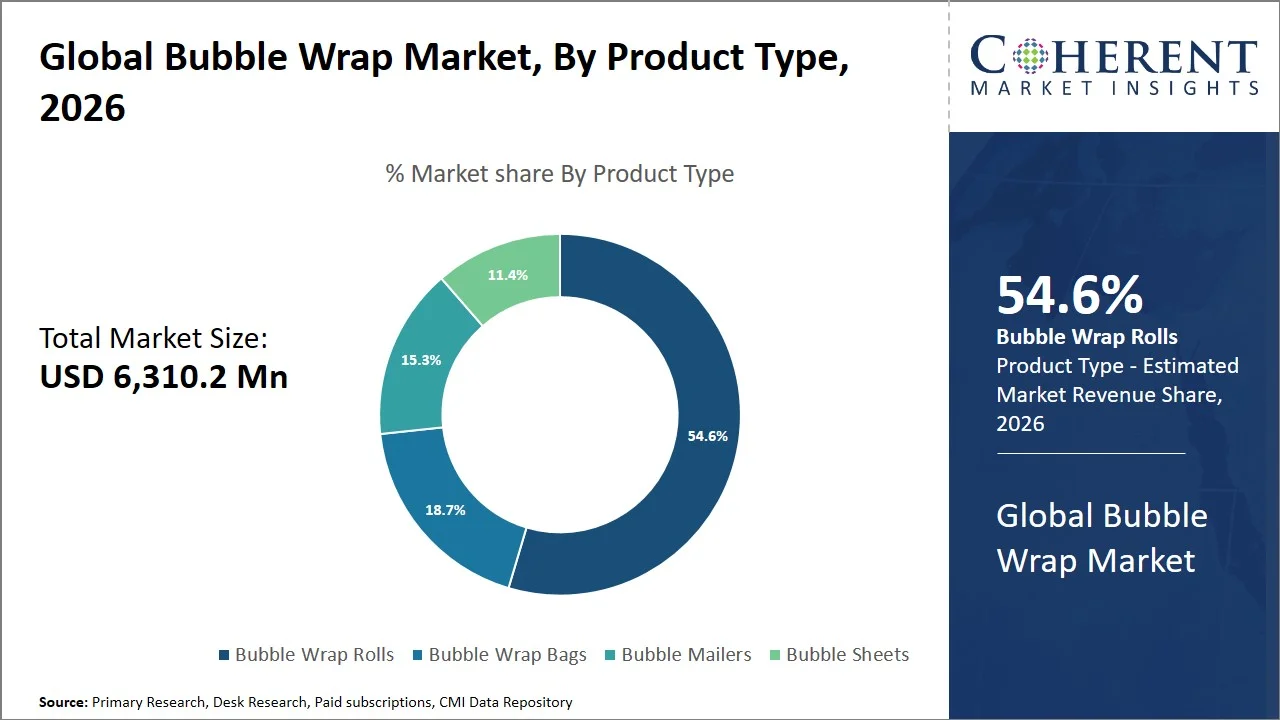
Bubble wrap rolls dominate the market and the segment is anticipated hold 54.6% of the market share in 2026 due to its flexibility and cost-effectiveness in bulk packaging operations. Rolls can be used to pack products in the required length for irregular shaped products, fragile products, industrial products, electronics, and packing stations in warehouses. Rolls provide superior material control, inventory management and are used on a greater multitude of B2B packaging lines as compared to pre-made bags or mailers. For instance, Storopack’s AIRplus cushioning films are supplied as roll-based films for on-demand cushioning at packing stations, allowing users to adapt cushioning shapes to product requirements while saving storage space. This supports why roll formats are preferred in warehouses and fulfillment centers, as they reduce pre-made packaging inventory and allow flexible protection for different product sizes. (Source: Storopack Hans Reichenecker GmbH)
Why is E-commerce the Most Crucial Application in the Global Bubble Wrap Market?
The e-commerce segment is the leading application, projected to account for 37.8% of the market share in 2026, driven by the need to protect high-volume small-parcel shipments from damage, scratches, returns, and customer dissatisfaction. Bubble wrap made from LDPE is widely preferred in e-commerce packaging because it is lightweight, flexible, moisture-resistant, and offers effective cushioning without significantly increasing parcel weight. According to the U.S. Census Bureau, e-commerce sales accounted for 16.1% of total U.S. retail sales in 2024, supporting the growing need for lightweight LDPE bubble wrap in mixed-SKU shipments across electronics, cosmetics, fragile goods, accessories, and D2C parcels. (U.S. Census Bureau)
Currents Events and their Impact
Current Events | Description and its Impact |
EU Packaging and Packaging Waste Regulation pushes recyclable packaging design |
|
California SB 54 strengthens packaging producer responsibility |
|
(Source: European Commission, CalRecycle)
Bubble Wrap Market Dynamics
Market Drivers
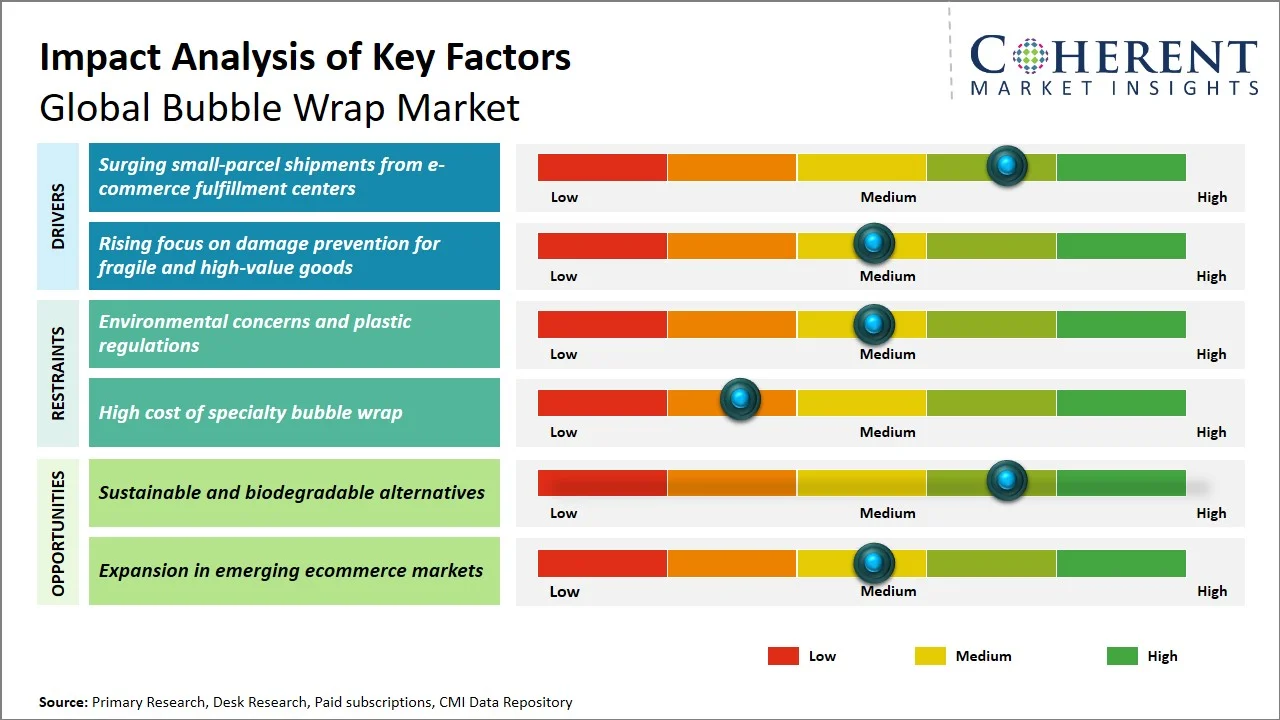
- Surging small-parcel shipments from e-commerce fulfillment centers: The growth in parcel-based retail, direct-to-consumer brands, marketplace sellers and cross-border shipping is driving the demand for lightweight protective packaging like bubble wraps. Many businesses use bubble wraps due to the cushioning properties it provides for parcels without adding up much weight to the package, which makes it ideal for high volume fulfillment centers and couriers. For example, U.S. parcel shipments reached 22.4 billion in 2024, marking a 3.4% increase over the previous year, highlighting the sustained growth in parcel delivery and the resulting demand for protective packaging materials.(Source: Pitney Bowes Inc)
- Rising Focus on Damage Prevention for Fragile and High-Value Goods: Preventing product damage during handling, sorting, warehousing, and last-mile delivery is a primary reason for using bubble wrap. Fragile goods such as electronics, glassware, cosmetics, healthcare products, spare parts, and premium consumer items require effective shock absorption, surface protection, and void filling during transit. For example, research shows that in the U.K., 53% of respondents reported receiving damaged goods from online orders in the 12 months preceding 2024, and a total of 85 million parcels were damaged in the same period. This underlines why retailers and logistics providers continue to invest in protective cushioning solutions like bubble wrap to reduce returns, replacement costs, and customer dissatisfaction. (Source: DS Smith)
Emerging Trends
- Shift Toward Recyclable and Paper-Based Cushioning: Bubble wrap manufacturers are expanding into recyclable, recycled-content, and paper-based cushioning formats as brands reduce plastic usage and respond to packaging regulations. For instance, Sealed Air, for example, introduced BUBBLE WRAP brand Ready-To-Roll Embossed Paper in 2024, highlighting the rebranding of traditional plastic bubble wrap to eco-friendly options. (Source: Sealed Air)
- Rise of On-Demand and Automated Protective Packaging: On-demand inflatable and automated cushioning systems in warehouses and ecommerce fulfillment centers are helping to decrease storage space, increase packing speed, and decrease product damage. For example, Pregis has on-demand inflatable packaging systems, from ship-from-store to full-scale distribution centers, which will make air pillows or patterns that can be wrapped in air pillows or hybrid cushioning depending on the shipping requirement. (Source: Pregis LLC.)
Regional Insights
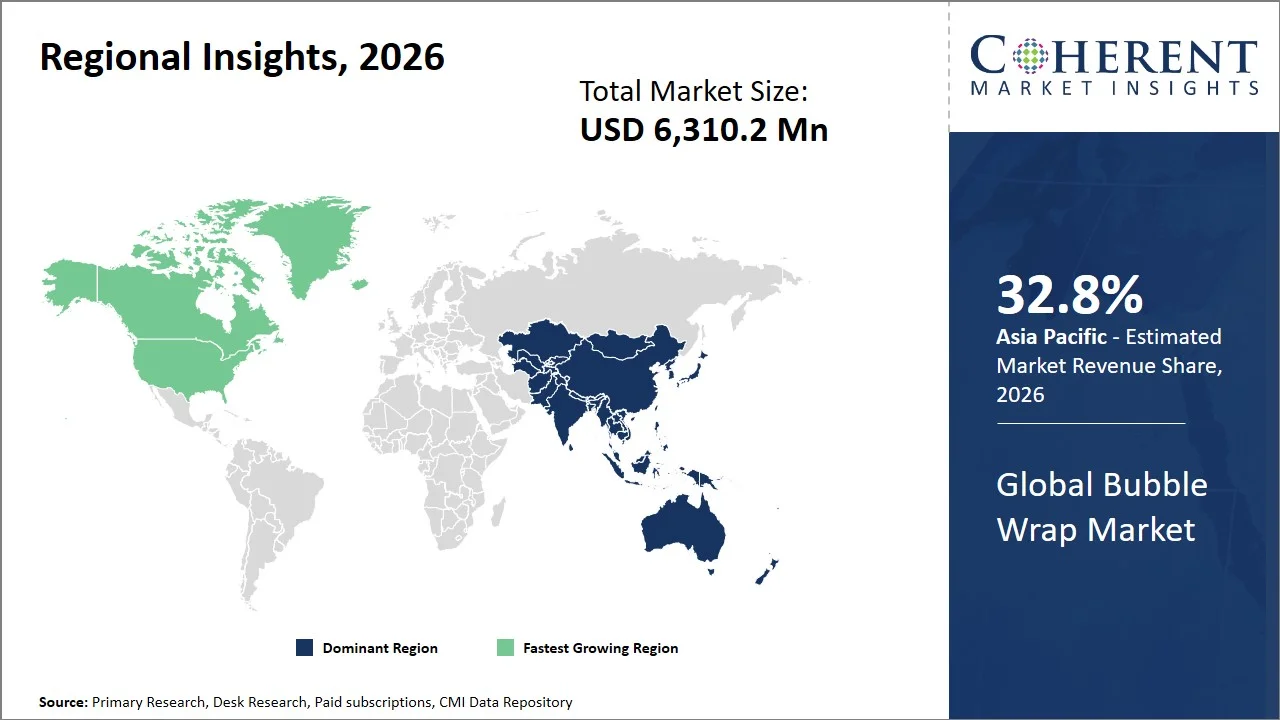
Why Does Asia Pacific Dominate the Global Bubble Wrap Market?
Asia Pacific is expected to dominate the global bubble wrap market with 32.8% share in 2026, supported by its large e-commerce base, strong electronics manufacturing ecosystem, expanding third-party logistics networks, and high-volume consumer goods exports. Countries such as China, India, Japan, South Korea, and Southeast Asian economies generate significant demand for lightweight protective packaging used in parcel shipping, electronics handling, FMCG distribution, and cross-border trade. China remains a major demand center, as its online retail sales reached US$ 2,354.50 billion in 2025, while online retail sales of physical goods accounted for 26.1% of total retail sales of consumer goods. This high share of physical-goods e-commerce directly increases the requirement for cushioning materials such as bubble wrap, bubble mailers, and protective rolls. India is also strengthening regional demand, with its e-commerce industry valued at US$ 125 billion in 2024 and projected to reach US$ 345 billion by 2030, supporting higher consumption of protective packaging across fulfillment centers and seller networks.
Why is North America the Fastest-growing Region in the Global Bubble Wrap Market?
North America is expected to account for 28.4% share in 2026 and is projected to be the fastest-growing region in the global bubble wrap market, supported by rising home-delivery volumes, strong e-commerce fulfillment, high-value product shipments, and increasing use of protective packaging in electronics, healthcare, retail, and consumer goods. The region’s growth is also supported by parcel carriers expanding deferred, economy, and residential delivery services, where lightweight cushioning materials such as bubble wrap help reduce shipment damage without adding significant package weight. For instance, FedEx reported that its U.S. ground home delivery/economy package volume increased 5% in fiscal 2025, primarily due to strong growth in e-commerce, while U.S. deferred package volume also increased due to a shift toward deferred services. This indicates rising parcel movement across cost-sensitive delivery channels, supporting demand for economical protective packaging formats such as bubble wrap, bubble mailers, and inflatable cushioning. (Source: FedEx Corporation)
Global Bubble Wrap Market Outlook for Key Countries
Why is China a Leading Country in the Global Bubble Wrap Market?
China is one of the major demand centers in the global bubble wrap market as it has a wide network of express delivery services, a well-established manufacturing sector and a large online retail market. Bubble wrap is essential for electronics, consumer goods and accessories, toys, home products and parcels shipped abroad from Chinese manufacturing centers. China's shipment intensity has remained robust with the total volume of parcels shipped reaching 18.76 billion pieces in Q1 2026, a 17.24 billion pieces of express mail, which grew 3.5% year-on-year. This massive shipment drive keeps pace with ongoing demand for inexpensive protective packaging solutions like bubble wrap rolls, bubble mailers, and cushioning sheets. (Source: State Council of China)
Why is the U.S. a Key Growth Market in the Global Bubble Wrap Market?
The U.S. is a key growth market for bubble wraps due to its high parcel-delivery density, large e-commerce fulfillment network, and strong demand from electronics, healthcare, home goods, and small business shipping Bubble wrap also plays a significant role in the U.S. as it is a type of lightweight material which provides cushioning to products without adding too much to freight costs and remains in use as sellers and logistics companies look to protect their products. For example, the U.S. Postal Service reported 6.8 billion shipping and package volume in FY25, reflecting the volume of parcel shipments that are protected by packaging materials. (Source: United States Postal Service).
Why is India an Emerging High-growth Country in the Global Bubble Wrap Market?
India is emerging as a high-growth country in the global bubble wrap market due to rapid expansion in e-commerce, D2C brands, quick commerce, electronics retail, and organized logistics. With the rise in the number of small sellers, MSMEs and consumer goods brands sending their products online on different platforms and through couriers, there is growing demand to use bubble wraps. This demand drives the greater packaging ecosystem, too, with India's packaging industry forecasted to grow from a 2024 value of US$ 84 billion to US$ 143 billion by 2029. Its growing market base presents significant opportunities for protective packaging products such as bubble wrap, bubble bags, and mailers.(Source: India Brand Equity Foundation)
Why is Brazil a key Latin American Country in the Global Bubble Wrap Market?
The global bubble wrap market is a key market in Brazil due to its consumer goods and e-commerce market being one of the largest in Latin America. New demands for protective packaging are growing for cosmetics, electronics, fashion accessories, home products and small appliances, as more and more people buy items online, rely on delivery networks in urban areas, and are shipping goods cross country. In 2025, e-commerce in Brazil is projected to generate US$ 36.3 billion in revenue, and 94 million Brazilians will be making online purchases. An increasing number of online shoppers leads to increased consumption of bubble wrap and other parcel cushioning materials.
Why is Germany a key European market in the Global Bubble Wrap Market?
Germany is among the most important markets in Europe for bubble wraps due to its well-developed e-commerce market, the extensive parcel logistics system, and the high demand for packaged consumer goods. Protective packaging is widely used in e-commerce, industrial supply, electronics retailing and export to minimize the risk of damage during transit and enhance the reliability of deliveries. Germany’s e-commerce revenue was estimated at US$ 100.6 billion in 2024, while the number of e-commerce users is expected to increase from 47.68 million in 2025 to 51.77 million by 2029. In addition, Germany’s parcel market is highly organized, with six major providers handling about 98% of domestic and cross-border parcels, supporting stable demand for standardized protective packaging. (Source: International Trade Administration)
Regulatory Incentives for Insulation Efficiency
Region / Country | Regulation / Standard | Impact on Bubble Wrap Market |
European Union | Packaging and Packaging Waste Regulation (PPWR) | Pushes bubble wrap suppliers toward recyclable, reusable, lightweight, and recycled-content protective packaging formats. |
U.S. – California | SB 54 Packaging Extended Producer Responsibility | Increases compliance pressure on plastic protective packaging and encourages recyclable bubble wrap, paper cushioning, and recycled-content films. |
U.S. – Multiple States | State-level Packaging EPR Programs | Requires packaging producers and brand owners to manage reporting, recycling responsibility, and end-of-life packaging compliance. |
U.K. | Extended Producer Responsibility for Packaging | Increases packaging data reporting, recycling fees, and demand for lightweight and recyclable cushioning materials. |
India | Plastic Waste Management Rules and EPR for Plastic Packaging | Requires producers, importers, and brand owners to register and meet plastic packaging recycling obligations. |
Canada | Federal Plastics Registry | Strengthens reporting requirements for plastic packaging placed on the market, including flexible PE protective packaging. |
Australia | National Packaging Targets | Promotes reusable, recyclable, compostable, and recycled-content packaging, supporting sustainable bubble wrap alternatives. |
Market Players, Key Development, and Competitive Intelligence
Key Developments
- In November 2025, Sealed Air Corporation announced a definitive transaction to be acquired by Clayton, Dubilier & Rice (CD&R) for an approximate USD 10.3 billion. This development will further bolster Sealed Air's financial support and provide opportunities for continued investment in the development of protective packaging innovation, manufacturing growth, packaging automation and sustainable cushioning solutions, such as its BUBBLE WRAP portfolio of products.
- In May 2025, Pregis LLC expanded to its sustainable protective packaging product offering by introducing more new curbside-recyclable and paper packaging cushioning solutions, such as EasyPack GeoTerra paper in white. This move strengthened Pregis' leadership in eco-friendly protective packaging and contributed to the growing need of the e-commerce, retail, cosmetics, glassware and fragile goods shippers for recyclable cushioning solutions.
- In January 2025, Smurfit Westrock strengthened its protective packaging capabilities by integrating packaging operations and product portfolios following the merger of Smurfit Kappa and WestRock. The move expanded the company's market presence, bolstered its customer base in the international market, and enhanced the cross-selling possibilities in the industrial, logistics, retail and e-commerce protective packaging market.
Competitive Landscape
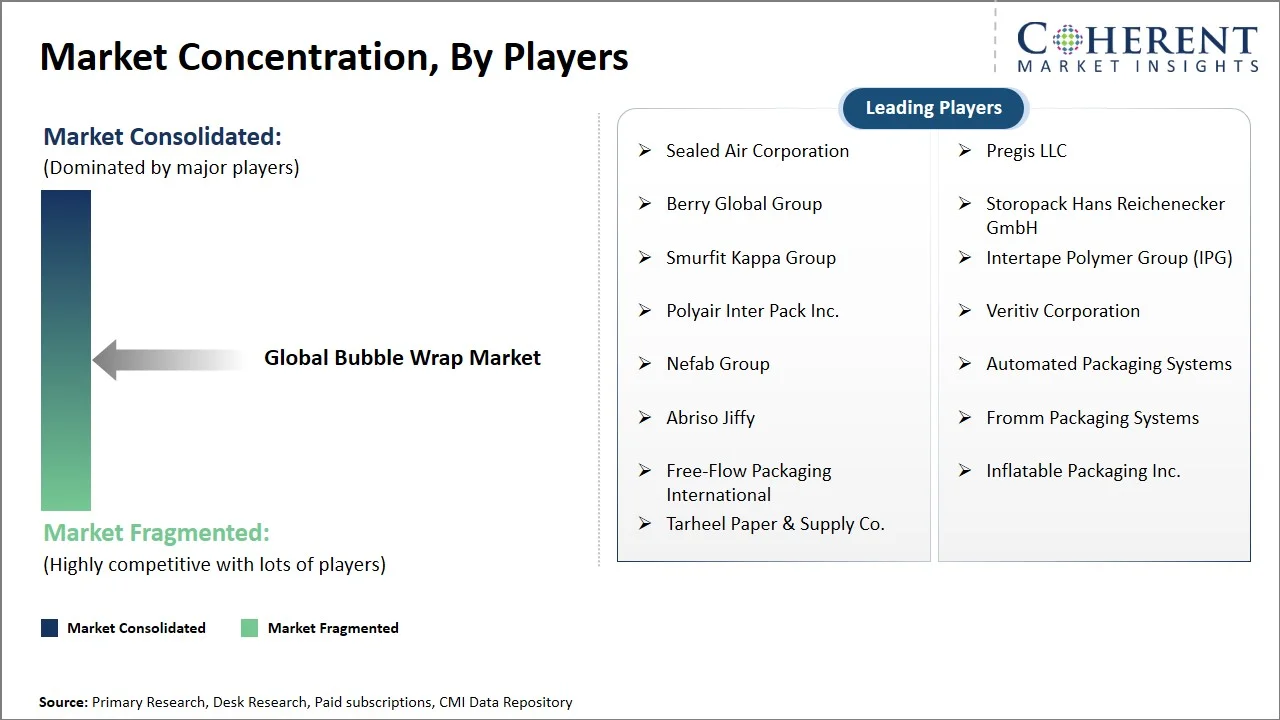
The global bubble wrap market is moderately competitive with the major packaging companies and regional converters competing on e-commerce, logistics, electronics, healthcare and industrial packaging applications. The key players include Sealed Air Corporation, Pregis LLC, Berry Global Group, Smurfit Westrock, Storopack, Intertape Polymer Group, Nefab, Polyair, Veritiv, Abriso Jiffy, and Fromm Packaging Systems which are differentiated on the basis of cushioning performance, product customization, recyclable formats, automation-ready solutions, and reliable bulk supply.
Key focus areas include
- Sustainable Packaging: Recycled content bubble wrap, mono-material PE formats and paper-based cushioning.
- Damage Reduction: Enhanced shock absorption, puncture resistance, and protection of surfaces.
- E-commerce Customization: Bubble rolls, bags, sheets and mailers for high volume fulfillment.
- B2B Supply Reliability: Bulk availability, regional warehousing, stable pricing, and customized supply contracts.
Market Report Scope
Bubble Wrap Market Report Coverage
| Report Coverage | Details | ||
|---|---|---|---|
| Base Year: | 2025 | Market Size in 2026: | USD 6,310.2 Mn |
| Historical Data for: | 2020 To 2024 | Forecast Period: | 2026 To 2033 |
| Forecast Period 2026 to 2033 CAGR: | 6.4% | 2033 Value Projection: | USD 9,741.7 Mn |
| Geographies covered: |
| ||
| Segments covered: |
| ||
| Companies covered: | Sealed Air Corporation, Pregis LLC, Berry Global Group, Storopack Hans Reichenecker GmbH, Smurfit Kappa Group, Intertape Polymer Group (IPG), Polyair Inter Pack Inc., Veritiv Corporation, Nefab Group, Automated Packaging Systems, Abriso Jiffy, Fromm Packaging Systems, Free-Flow Packaging International, Inflatable Packaging Inc., and Tarheel Paper & Supply Co. | ||
| Growth Drivers: |
| ||
| Restraints & Challenges: |
| ||
Analyst Opinion (Expert Opinion)
- The global bubble wrap market is expected to move toward performance-led and sustainability-led growth, rather than only volume-based expansion. demand will continue rising across e-commerce, logistics, electronics, healthcare, consumer goods, and industrial packaging. The strong 72.4% share of the Polyethylene (PE) segment in 2026 indicates that cost-effective, lightweight, and flexible cushioning materials will remain central to market demand.
- The maximum opportunity is expected in PE-based Bubble Wrap Rolls for E-commerce Applications in Asia Pacific. Asia Pacific holds the leading regional share of 2026, supported by large parcel volumes, electronics manufacturing, online retail expansion, and export-oriented packaging demand. Bubble wrap rolls remain the most preferred product format with share, as they offer flexibility for bulk packaging, custom wrapping, void filling, and protection of irregular-sized products.
- Moving forward, the market’s competitive advantage will depend on recyclability, damage-reduction performance, automation compatibility, and bulk supply reliability. Suppliers that can offer recycled-content bubble wrap, paper-based cushioning alternatives, mono-material PE formats, and on-demand protective packaging systems will be better positioned with e-commerce, electronics, healthcare, and logistics buyers. The strongest growth opportunities are expected in sustainable cushioning, automated fulfillment packaging, bubble mailers for small parcels, and high-performance protective formats for fragile and high-value goods.
Speak to the analyst
Want personalized insights?
Take the findings above to one of our principal consultants, or have the report rebuilt around the segments, geographies and competitors you actually track.
Market Segmentation
- Product Type Insights (Revenue, USD Mn, 2021 - 2033)
- Bubble Wrap Rolls
- Bubble Wrap Bags
- Bubble Mailers
- Bubble Sheets
- Material Type Insights (Revenue, USD Mn, 2021 - 2033)
- Polyethylene (PE)
- Polyamide (PA)
- Polyethylene Terephthalate (PET)
- Others
- Application Insights (Revenue, USD Mn, 2021 - 2033)
- E commerce
- Shipping & Logistics
- Electronics
- Healthcare
- Consumer Goods
- Others
- Distribution Channel Insights (Revenue, USD Mn, 2021 - 2033)
- B2B
- B2C
- Regional Insights (Revenue, USD Mn, 2021 - 2033)
- North America
- U.S.
- Canada
- Latin America
- Brazil
- Argentina
- Mexico
- Rest of Latin America
- Europe
- Germany
- U.K.
- Spain
- France
- Italy
- Russia
- Rest of Europe
- Asia Pacific
- China
- India
- Japan
- Australia
- South Korea
- ASEAN
- Rest of Asia Pacific
- Middle East
- GCC Countries
- Israel
- Rest of Middle East
- Africa
- South Africa
- North Africa
- Central Africa
- North America
- Key Players Insights
- Sealed Air Corporation
- Pregis LLC
- Berry Global Group
- Storopack Hans Reichenecker GmbH
- Smurfit Kappa Group
- Intertape Polymer Group (IPG)
- Polyair Inter Pack Inc.
- Veritiv Corporation
- Nefab Group
- Automated Packaging Systems
- Abriso Jiffy
- Fromm Packaging Systems
- Free-Flow Packaging International
- Inflatable Packaging Inc.
- Tarheel Paper & Supply Co.
Sources
Primary Research Interviews
- Bubble wrap manufacturers and protective packaging converters
- Polyethylene (PE) resin suppliers and film extrusion companies
- Packaging procurement heads of e-commerce and retail companies
- Warehouse and fulfillment center packaging managers
- Logistics, courier, and 3PL packaging operations heads
- Electronics and fragile-goods packaging engineers
- Healthcare and medical device packaging managers
- Sustainability managers of packaging companies and brand owners
- Packaging automation system providers
- Plastic recycling, EPR, and packaging compliance experts
Stakeholders
- Bubble wrap and protective packaging manufacturers: Sealed Air Corporation, Pregis LLC, Berry Global Group, Storopack Hans Reichenecker GmbH, Smurfit Westrock, Intertape Polymer Group, Polyair Inter Pack Inc., Nefab Group, Abriso Jiffy, Fromm Packaging Systems, Inflatable Packaging Inc.
- Packaging distributors and suppliers: Veritiv Corporation, Tarheel Paper & Supply Co., Uline, Grainger, Packaging Corporation distributors, regional packaging wholesalers
- Raw material suppliers: Dow, ExxonMobil Chemical, LyondellBasell, SABIC, Borealis, INEOS, Braskem, Formosa Plastics
- End-use sectors
- E-commerce companies using bubble wrap for small-parcel protection, void fill, and fragile product shipping
- Electronics manufacturers and distributors using cushioning for devices, components, and accessories
- Healthcare and medical device companies using protective packaging for sensitive products
- Consumer goods and retail brands using bubble wrap for home goods, cosmetics, glassware, toys, and appliances
- Industrial manufacturers using bubble wrap for spare parts, machinery components, and export packaging
- Logistics and parcel delivery companies: FedEx, UPS, DHL, USPS, Royal Mail, India Post, Blue Dart, Delhivery, SF Express
- E-commerce platforms and retailers: Amazon, Walmart, Flipkart, Alibaba, JD.com, Shopify merchants, eBay, Target, Best Buy
- Regulatory and certification bodies: European Commission, U.S. Environmental Protection Agency, CalRecycle, ASTM International, ISO, Sustainable Packaging Coalition, Association of Plastic Recyclers
- Testing and certification providers: SGS, Intertek, Bureau Veritas, TÜV SÜD, UL Solutions, Eurofins
Databases
- UN Comtrade Database – HS Code 3923 for plastic articles used for packing or conveyance of goods
- UN Comtrade Database – HS Code 392321 for sacks and bags of polymers of ethylene
- UN Comtrade Database – HS Code 392390 for other plastic packing articles
- UN Comtrade Database – HS Code 392119 for cellular plastic sheets, plates, film, foil, and strip
- ITC Trade Map – plastic packaging and flexible packaging import-export analysis
- World Bank WITS Trade Database – country-level plastic packaging trade flows
- Eurostat International Trade Database – European plastic packaging imports and exports
- U.S. Census Bureau – e-commerce retail sales and shipment-related indicators
- U.S. International Trade Commission DataWeb – U.S. imports and exports of plastic packaging products
- OECD Data – plastics use, recycling, and packaging waste indicators
- Statistisches Bundesamt Germany – packaging, e-commerce, and trade data
- India DGCI&S Export Import Data Bank – plastic packaging import-export data
- China National Bureau of Statistics – online retail and parcel-related economic indicators
Magazines
- Packaging World – protective packaging, e-commerce packaging, and automation trends
- Packaging Europe – sustainable packaging, EU regulation, and circular packaging updates
- Packaging Digest – protective packaging innovation and material trends
- Packaging Strategies – flexible packaging and shipping packaging trends
- Plastics News – resin, film, recycling, and packaging industry developments
- Flexible Packaging Magazine – film, PE packaging, and converter trends
- Packaging News – retail, logistics, and sustainable packaging developments
- Parcel and Postal Technology International – parcel logistics and shipping packaging trends
Journals
- Packaging Technology and Science
- Journal of Applied Packaging Research
- Journal of Cleaner Production
- Resources, Conservation and Recycling
- Waste Management
- Polymer Testing
- Journal of Polymers and the Environment
- Polymer Engineering & Science
- International Journal of Life Cycle Assessment
- Sustainable Production and Consumption
Newspapers
- Financial Times – packaging regulations, sustainability, and supply chain trends
- The Wall Street Journal – retail, parcel delivery, e-commerce, and logistics updates
- The Economic Times – India e-commerce, packaging, and logistics sector updates
- Business Standard – plastic packaging, trade, and manufacturing updates
Associations
- Flexible Packaging Association
- Sustainable Packaging Coalition
- Association of Plastic Recyclers
- Plastics Industry Association
- Plastics Europe
- AMERIPEN – American Institute for Packaging and the Environment
- International Safe Transit Association
- Institute of Packaging Professionals
- World Packaging Organisation
- European Organization for Packaging and the Environment
- RecyClass
- Flexible Packaging Europe
Public Domain Sources
- U.S. Environmental Protection Agency – packaging waste and plastic recycling references
- European Commission – Packaging and Packaging Waste Regulation and circular economy policies
- CalRecycle – SB 54 packaging EPR and plastic pollution prevention references
- U.S. Census Bureau – retail e-commerce sales data
- OECD – plastics lifecycle, recycling, and packaging waste references
- UNEP – plastic pollution and packaging sustainability references
- U.S. International Trade Administration – country e-commerce and logistics market guides
- Eurostat – packaging waste, plastic waste, and e-commerce-related datasets
- National Bureau of Statistics of China – online retail and consumer goods data
- India Brand Equity Foundation – e-commerce, packaging, and logistics industry references
- USPS, FedEx, UPS, and DHL public reports – parcel shipment and logistics trend references
- ASTM International and ISO – packaging testing, film, and transit packaging standards
Proprietary Elements
- CMI Data Analytics Tool, Proprietary CMI Existing Repository of information for last 10 years.
Get access to 250+ pages report
Every segment, forecast, competitor profile and data table behind the analysis above — available for instant download.
- ESOMAR Member
- ISO 9001:2015 Certified
- D-U-N-S Registered
- GDPR & CCPA Compliant
Missing comfort of reading report in your local language? Find your preferred language:
Transform your Strategy with Exclusive Trending Reports
Frequently Asked Questions
The CAGR of the global bubble wrap market is projected to be 6.4% from 2026 to 2033.
The global bubble wrap market is estimated to be valued at USD 6,310.2 Mn in 2026 and is projected to reach USD 9,741.7 Mn in 2033.
Another common name for bubble wrap is air bubble packaging.
Yes, the bubble wrap market can be profitable, as demand from e-commerce, logistics, electronics, and healthcare packaging supports steady B2B volume, though margins depend on resin costs, scale, and product differentiation.
China is the top producer of bubble wrap worldwide, supplying the largest share of manufacturing output for protective packaging used across e-commerce, logistics, electronics, and industrial applications.
Growth in e-commerce and shipping and need for product protection are the major factors driving the growth of the global bubble wrap market.
Environmental concerns and plastic regulations and high cost of specialty bubble wrap are the major factors hampering the growth of the global bubble wrap market.