

Global Cache Server Market Size and Forecast – 2026-203.153
The global cache server market is estimated to be valued at USD 1.60 Bn in 2026 and is expected to reach USD 3.15 Bn by 2033, reflecting a compound annual growth rate (CAGR) of 10.2% from 2026 to 2033.
Key Takeaways of the Cache Server Market
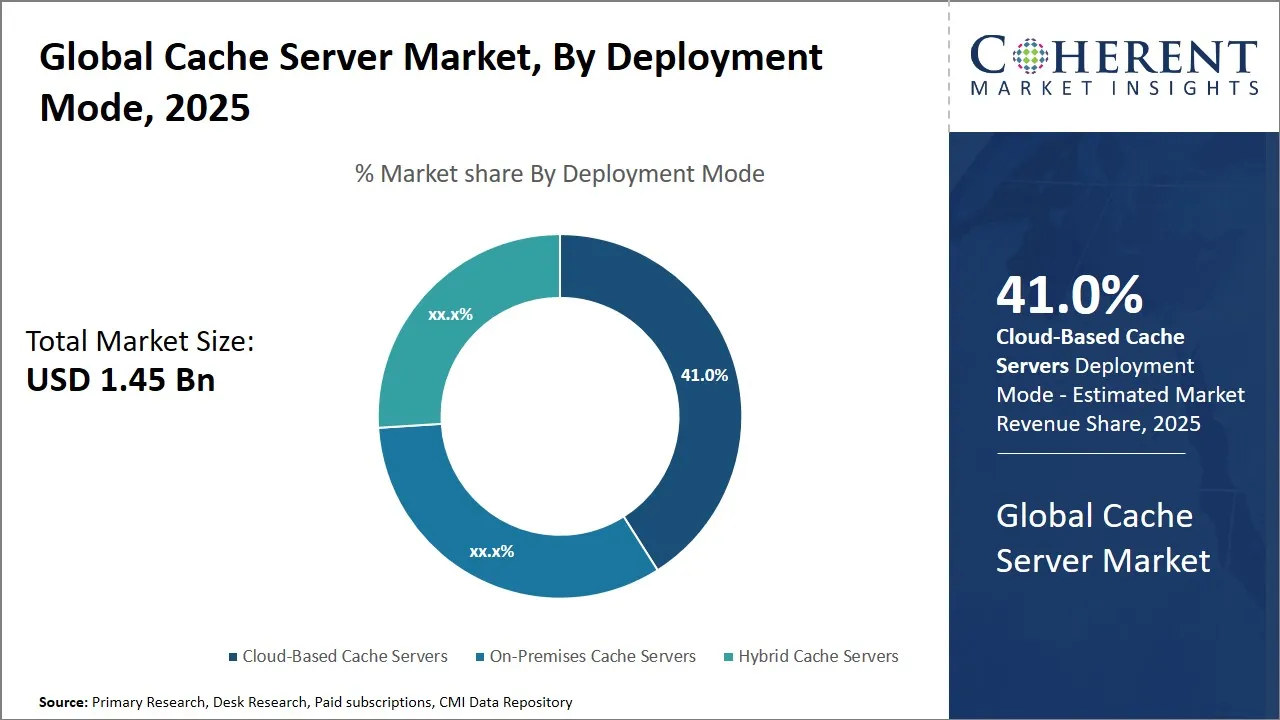
- The cloud-based cache servers segment is expected to account for 42% of the cache server market share in 2026.
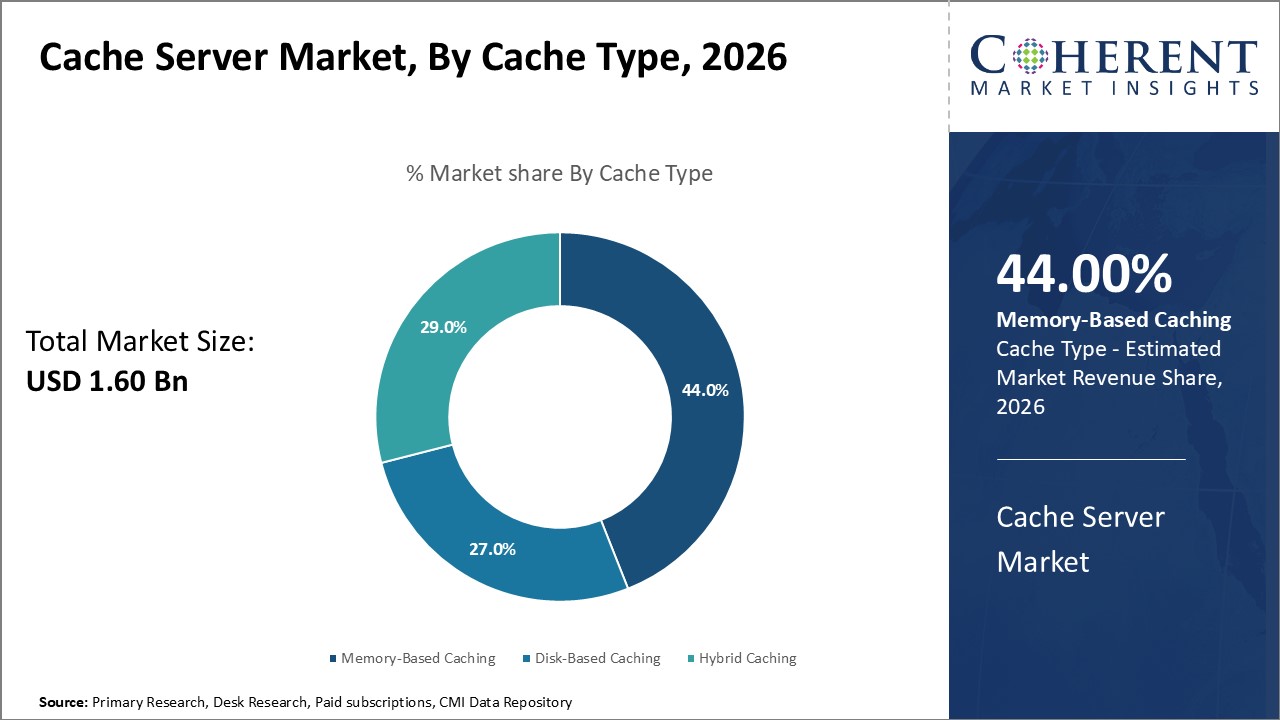
- The memory-based caching segment is projected to capture 44% of the market share in 2026.
- The web content delivery segment is expected to command 36% share in 2026.
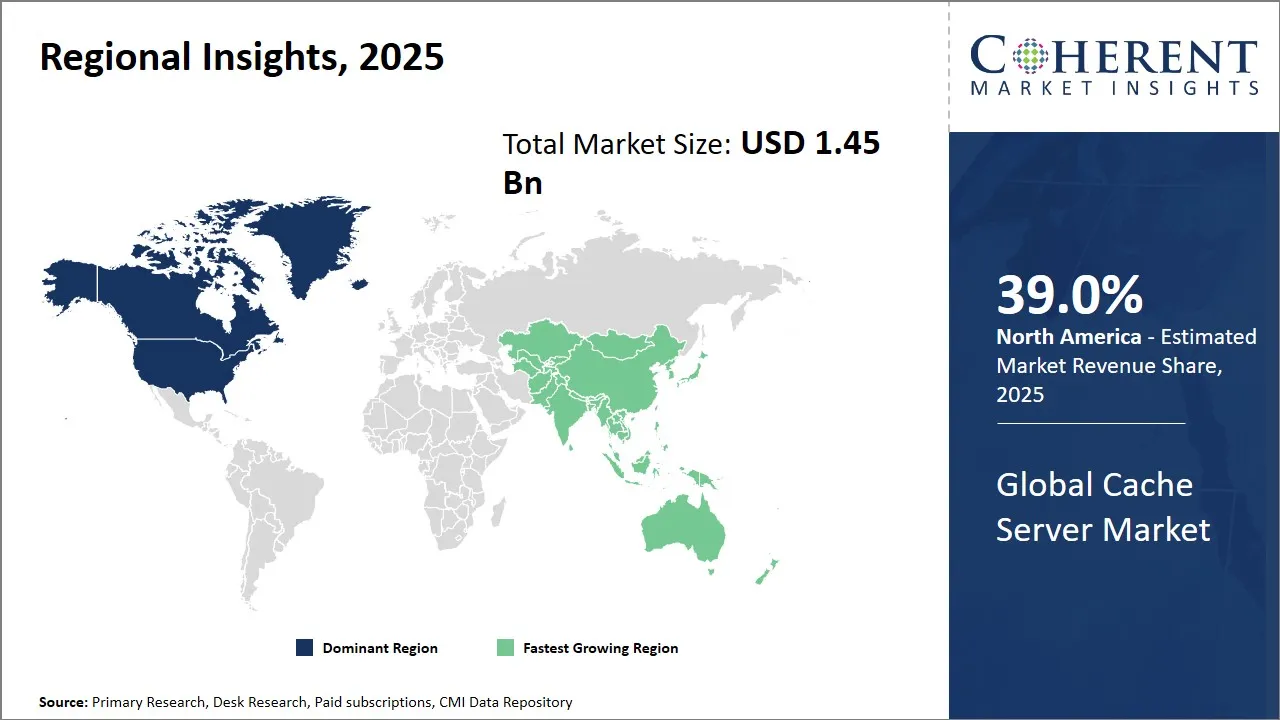
- North America will dominate the cache server market in 2026 with an estimated 39%
- Asia Pacific will hold 26% share in 2026 and record the fastest growth.
Current Events and Its Impact
Current Events | Description and its Impact |
Launch of AWS Graviton5 |
|
Segmental Insights
- Current Industry Events of 2026
- Market Size Estimation
- Regional Breakdown
- Competitive Landscape
- Customer Intelligence
- Segmental Analysis
- Pricing Analysis
- Key Market Drivers, Challenges & Future Trends
- Customized Insights Section
Why Does Cloud-Based Cache Servers Dominate the Global Cache Server Market in 2026?
The cloud-based segment is expected to hold 42% of the global cache server market share in 2026. The rise is due to their natural ability to scale easily, stay accessible, yet keep costs low. Firms now use cloud setups more often - to handle shifting performance needs - so cached systems in the cloud fit well here. Rather than legacy local setups demanding high initial spending and constant upkeep, hosted caching lets companies adapt capacity as usage changes, without big investments in equipment.
The rise of cloud-hosted caching systems stems from wider use of cloud-optimized apps along with modular service designs. Such setups require fast, affordable ways to fetch data, easily deployed and adjusted anywhere. These caches usually work smoothly within leading cloud platforms, boosting speed almost instantly while cutting delays for users worldwide. Their capacity to maintain steady response times regardless of region leads directly to smoother interactions in apps needing quick information flow.
Memory-Based Caching Segment Dominates the Global Cache Server Market
The memory-based caching segment is expected to holds 44% of the cache server market share in 2026. The expansion comes mainly from fast data handling with almost no delay. Memory caches use fast RAM instead of disks to store frequently used data, so responses come faster. Due to their quick performance, they fit best in areas needing immediate output - such as online games, financial trading platforms, or personalized video streams.
Because apps are getting faster, memory caching remains top - not due to capacity, yet thanks to quick response. As firms handle more data, even minor delays impact performance together with how users feel. Storing frequent info close by helps caches cut down retrieval delay. Results get better since main systems face less strain.
Why is Web Content Delivery the Most Widespread Application in the Cache Server Market?
The web content delivery segment is expected to hold 36% of the market share in 2026. The rise in online activity, better access to top-tier content, or growing demand for smooth web navigation has strengthened how caching works within CDNs. In addition to delivering dynamic or static data quicker via local edge nodes, performance improves - reducing lag while enhancing speed.
The growing number of smartphone users, combined with expectations for fast site performance, shows why smart caching matters more today. Pages that load slowly often lose traffic, which hurts revenue; as a result, businesses must improve how they store information. Saving frequent items like images, scripts, or page details locally reduces server pressure; meanwhile, it boosts speed during sudden spikes in usage.
Edge vs Core Cache Deployment
Metric | Edge Cache Deployment | Core Cache Deployment |
Average Latency Reduction | 40–70% | 20–35% |
Average Cache Hit Ratio | 65–85% | 55–70% |
Cost per GB (USD) | 0.90-1.30 | 0.50-0.80 |
Regional Insights
North America Cache Server Market Analysis and Trends
North America is expected to dominate the market contributing 39% share in 2026. The expansion relies heavily on sophisticated tech setups plus widespread use of cloud and edge systems. A well-established IT framework, paired with major funding for data facilities and better connectivity, boosts the area's leading role. Public policies promoting digital improvements together with better cybersecurity, while upholding clear intellectual property standards - help newer caching systems grow.
Major tech hubs in the U.S. along Canada attract global vendors and data experts, which speeds innovation. Leading firms like Cisco Systems, IBM, and NetApp play a big part through modern caching tools; meanwhile, regional startups advance CDN methods and mixed-model caches, helping North America maintain its top spot.
Asia Pacific Cache Server Market Analysis and Trends
The Asia Pacific region is projected to register fastest growth with a 26% share in 2026. The growth is linked to fast digital shifts in developing nations - alongside wider internet access, plus stronger needs from areas like online retail, gaming, or video platforms. Various economies in the area have seen more government push toward better tech networks and urban digitization, leading cities to adopt caching systems that manage heavy data flows effectively. On top of this, international cloud firms working near homegrown names such as Huawei, Alibaba Cloud, or Tata Communications help drive market momentum. Trade changes, along with cross-border partnerships or shared regional centers, help reduce wait times while improving delivery methods. In countries such as India or China, revised regulations promote local oversight of information together with emerging tools, increasing opportunities for expansion across Asia Pacific.
Global Cache Server Market Outlook for Key Countries:
Why is U.S. Emerging as a Major Hub in the Cache Server Market?
The U.S. remains ahead in cache server development thanks to strong infrastructure along with modern cloud systems. Firms like AWS, Microsoft Azure, or Google Cloud pour resources into edge caching - speed improves across numerous apps. Government efforts that support technology upgrades as well as better security help expand adoption of high-performance caching tools. Competition between service suppliers pushes ongoing upgrades; particularly through machine learning techniques which keeps U.S. competitive in this market.
Is China the Next Growth Engine for the Cache Server Market?
China’s cache server sector benefits greatly from state initiatives backing cloud expansion, including efforts like “Digital China.” Rather than depending on overseas solutions, domestic players such as Huawei Cloud and Alibaba Cloud advance caching tech by boosting regional capacity along with performance. Due to a vast number of online users plus booming e-commerce activity, fast caching is essential to cut delays and keep people active. Despite strict rules affecting data sharing and storage abroad, rising numbers of data centers help spread new technologies faster throughout the sector.
Germany Cache Server Market Analysis and Trends
Germany plays a major role in Europe, known for advanced industry technology and strict rules on data protection. Firms aim to use cache systems in production, car-making, or banking and this improves live data handling through smoother workflows. Companies such as Deutsche Telekom and IBM Germany deliver secure, adaptable caching tools that meet national regulations. Because of its push in Industry 4.0 projects, there's growing need here for modern server setups supporting reliable digital networks.
India Cache Server Market Analysis and Trends
India's fast-growing internet use fuels more cache servers. As digital activity rises, so does the need for better data handling. Startups are booming, pushing demand for faster content delivery. Major firms like Tata Communications and Reliance Jio focus on edge tech to boost efficiency. These improvements serve industries from finance to media and telecom. Digital India initiatives help expand access nationwide. Policies aim at stronger networks in both cities and villages.
Brazil Cache Server Market Analysis and Trends
Brazil is a key player in Latin America owing to more people going online and better digital systems. Rising use of streaming sites or shopping websites boosts need for cache servers. Firms like Vivo (Telefônica Brasil) alongside IBM set up local caches because delays happen across large areas where internet access varies. Public support for tech upgrades plus stronger data centers pushes further spending on modern caching solutions.
Memory Tiering Strategies in Cache Servers
Memory Tier | Typical Latency | Cost per GB (USD) |
DRAM | 100 ns | 4-6 |
Persistent Memory | 300 ns | 2.50-3.50 |
NVMe SSD | 50–100 µs | 0.12-0.20 |
SATA SSD | 200–500 µs | 0.08-0.12 |
Market Players, Key Development, and Competitive Intelligence
Key Developments
- On September 17, 2025, BytePlus VOD launched a new VOD region in Johor, Asia Pacific, offering full media delivery, storage, processing, and acceleration capabilities. The expansion is aimed at meeting the rapidly rising demand for smooth video delivery and low-latency streaming experiences. The move highlights the rising demand for low-latency video solutions in the Asia Pacific.
Top Strategies Followed by Global Cache Server Market Players
Player Type | Strategic Focus | Example |
Established Market Leaders | AWS Trainium 3 Launch | On December 2, 2025, AWS launched Trainium3 Ultra Servers optimized for high-throughput AI and caching workloads. |
Mid-Level Players | Launch of EPYC Embedded 4005 by AMD | On September 16, 2025, AMD announced the EPYC Embedded 4005 Series processors, purpose-built to address rising demand for real-time compute performance, optimized system costs and extended deployment lifecycles in network security appliances and entry-level industrial edge servers. |
Small-Scale Players | Global Acclaim | On April 3, 2025, Varnish Software announced the launch of Ora Streaming, a fully managed private CDN-as-a-service designed for video streaming platforms. The service is tailored to enhance scalability, efficiency, and reliability in delivering high-quality video content across the region. This launch strengthens Varnish's position in the fast-expanding streaming infrastructure market. |
Market Report Scope
Cache Server Market Report Coverage
| Report Coverage | Details | ||
|---|---|---|---|
| Base Year: | 2025 | Market Size in 2026: | USD 1.60 Bn |
| Historical Data for: | 2020 To 2024 | Forecast Period: | 2026 To 2033 |
| Forecast Period 2026 to 2033 CAGR: | 10.2% | 2033 Value Projection: | USD 3.15 Bn |
| Geographies covered: |
| ||
| Segments covered: |
| ||
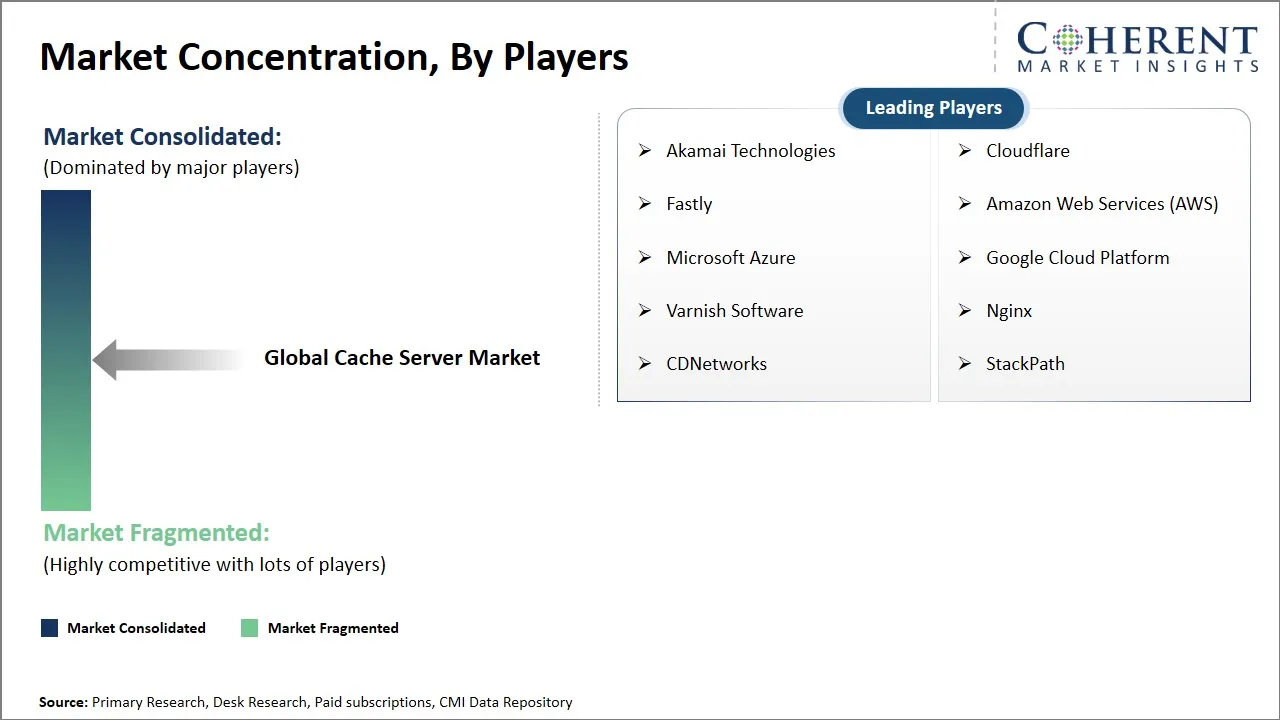
| Companies covered: | Akamai Technologies, Cloudflare, Fastly, Amazon Web Services (AWS), Microsoft Azure, Google Cloud Platform, Varnish Software, Nginx, CDNetworks, and StackPath | ||
| Growth Drivers: |
| ||
| Restraints & Challenges: |
| ||
Global Cache Server Market Dynamics
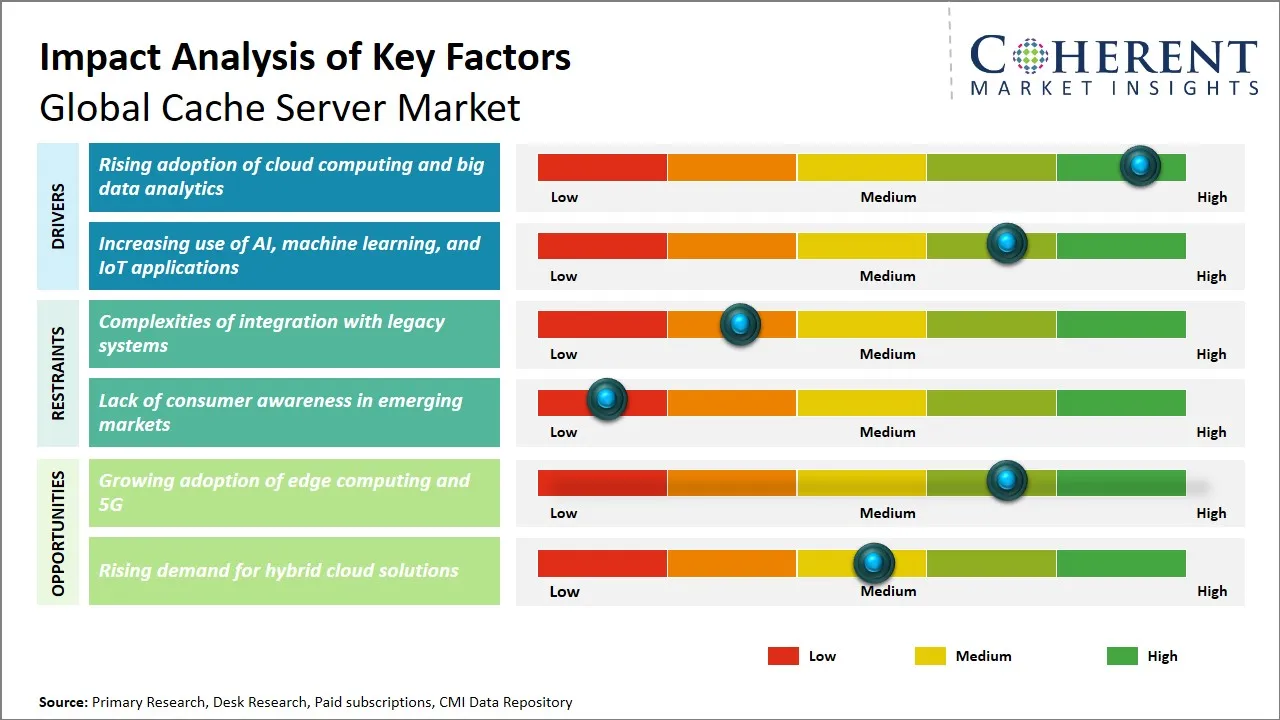
Global Cache Server Market Driver - Rising Adoption of Cloud Computing and Big Data Analytics
The growing use of cloud services along with data analysis tools has boosted need for worldwide caching solutions in many fields. As businesses generate vast volumes of data, fast retrieval and minimal delays have become essential and performance is now a top priority. These buffers act as short-term holding areas, placing frequently used details closer to applications or people, boosting both pace and reaction times. In cloud environments, spread-out systems often lead to congestion; in such cases, caching reduces downtime by limiting repeated calls to central storage.
Big data analytics requires rapid processing of massive datasets at once and this depends on caching technology to speed up access to critical chunks. With businesses shifting toward cloud setups, their analytics capabilities expand; such moves fuel need for more advanced cache solutions. Organizations focus on improving efficiency, yet ensure responsive, seamless user interactions.
Global Cache Server Market Opportunity - Growing Adoption of Edge Computing and 5G
The global cache server market gains strong momentum from growing edge computing use alongside expanding 5G adoption in multiple sectors. Since data output from IoT gadgets, intelligent apps, or live analysis keeps rising rapidly; conventional central hubs struggle with delays, traffic load, and computation pressure. Instead of relying on distant facilities, processing information nearer its origin cuts down lag while boosting responsiveness - this shift increases demand for local caching units. At the same time, wider 5G availability improves transmission rates, consistency, plus link stability, pushing systems toward distributed setups even faster.
Deploying caches near access points helps streamline content flow, ease gridlock risks, yet support smooth interactions particularly within driverless transport, immersive digital environments, and connected urban infrastructures. The link between edge computing and 5G enables smoother handling of rising data demands, with cache servers playing a key role. As a result, makers and suppliers of these systems can develop new solutions focused on fast response times and strong performance at the network’s edge, driving expansion in areas where speed matters most.
Analyst Opinion (Expert Opinion)
- The global cache server market evolves due to rising AI demands, growth in edge systems, or advances in cloud-based designs. Experts note interest now stems less from basic website speed, instead focusing on fast AI responses, instant user customization, live video flow, or heavy-duty business software needs. Major technology platforms and delivery networks boost influence using specialized chips, smart caching methods powered by machine learning, or tighter links with threat protection and trusted access controls. At the same time, companies treat caching tools as essential to cut spending in cloud environments and ease pressure on core infrastructure.
- Experts see distinct strategy splits based on company size. Larger firms prioritize scaling, automated systems using artificial intelligence, while building tightly integrated networks. Mid-sized companies set themselves apart via localized setups, hands-on service models, also tailored offerings for sectors like online video, interactive games, digital retail. Smaller entrants push innovation through freely available code bases, flexible software-based buffering methods, along with specialized applications at network edges.
Speak to the analyst
Want personalized insights?
Take the findings above to one of our principal consultants, or have the report rebuilt around the segments, geographies and competitors you actually track.
Market Segmentation
- Deployment Mode Insights (Revenue, USD Billion, 2021 - 2033)
- Cloud-Based Cache Servers
- On-Premises Cache Servers
- Hybrid Cache Servers
- Cache Type Insights (Revenue, USD Billion, 2021 - 2033)
- Memory-Based Caching
- Disk-Based Caching
- Hybrid Caching
- Application Insights (Revenue, USD Billion, 2021 - 2033)
- Web Content Delivery
- Video Streaming
- Software Distribution
- Database Query Caching
- Edge Computing
- Regional Insights (Revenue, USD Billion, 2021 - 2033)
- North America
- U.S.
- Canada
- Latin America
- Brazil
- Argentina
- Mexico
- Rest of Latin America
- Europe
- Germany
- U.K.
- Spain
- France
- Italy
- Russia
- Rest of Europe
- Asia Pacific
- China
- India
- Japan
- Australia
- South Korea
- ASEAN
- Rest of Asia Pacific
- Middle East
- GCC Countries
- Israel
- Rest of Middle East
- Africa
- South Africa
- North Africa
- Central Africa
- North America
- Key Players Insights
- Akamai Technologies
- Cloudflare
- Fastly
- Amazon Web Services (AWS)
- Microsoft Azure
- Google Cloud Platform
- Varnish Software
- Nginx
- CDNetworks
- StackPath
Sources
Primary Research Interviews
- Content Delivery Network (CDN) Service Providers
- Cache Server Hardware Manufacturers
- Enterprise IT Infrastructure Managers
- Cloud Service Providers
Databases
- IDC Worldwide Server Market Database
- Bloomberg Terminal Database
Magazines
- Data Center Knowledge Magazine
- Network World Magazine
- InfoWorld Technology Magazine
- CIO Magazine
Journals
- IEEE Transactions on Network and Service Management
- ACM Computing Surveys
- Journal of Network and Computer Applications
Newspapers
- The Wall Street Journal Technology Section
- Financial Times Technology News
- Reuters Technology News
- TechCrunch Industry Reports
Associations
- Content Delivery & Security Association (CDSA)
- Storage Networking Industry Association (SNIA)
- Internet Society (ISOC)
- Cloud Security Alliance (CSA)
Public Domain Sources
- U.S. Patent and Trademark Office (USPTO) Database
- Federal Communications Commission (FCC) Reports
- Internet Engineering Task Force (IETF) Publications
- Open Source Cache Server Project Documentation
Proprietary Elements
- CMI Data Analytics Tool
- Proprietary CMI Existing Repository of information for last 8 years
Get access to 250+ pages report
Every segment, forecast, competitor profile and data table behind the analysis above — available for instant download.
- ESOMAR Member
- ISO 9001:2015 Certified
- D-U-N-S Registered
- GDPR & CCPA Compliant
Missing comfort of reading report in your local language? Find your preferred language:
Transform your Strategy with Exclusive Trending Reports
Frequently Asked Questions
The global cache server market is estimated to be valued at USD 1.60 Bn in 2026 and is expected to reach USD 3.15 Bn by 2033.
The CAGR of global cache server market is projected to be 10.2% from 2026 to 2033.
Rising adoption of cloud computing and big data analytics and increasing use of AI, machine learning, and IoT applications are the major factors driving the growth of the global cache server market.
Complexities of integration with legacy systems and lack of consumer awareness in emerging markets are the major factors hampering the growth of the global cache server market.
In terms of deployment mode, the cloud-based cache servers segment is estimated to dominate the market revenue share in 2026.
High-capacity memory, NVMe storage, and cache-optimized CPUs are key hardware drivers.
They lower data transfer and compute costs by minimizing repeated backend processing.