

Global Chip Antenna Market Size and Forecast – 2026 To 2033
The global chip antenna market is expected to grow from USD 4.25 Bn in 2026 to USD 11.70 Bn by 2033, registering a compound annual growth rate (CAGR) of 10.4% from 2026 to 2033. The global chip antenna market is primarily driven by a substantial rise in 5G connectivity across the globe. On May 14, 2025, Vi (Vodafone Idea) announced the launch of 5G services in Delhi NCR, India in partnership with Ericsson. Vi has deployed Ericsson’s high-performing Massive MIMO radios to launch its 5G service.
(Source: Ericsson)
Key Takeaways of the Global Chip Antenna Market
- The LTCC chip antenna segment is expected to account for 54.0% of the global chip antenna market share in 2026. LTCC chip antennas offer exceptional reliability and integration efficiency which are critical for electronic devices and automotive applications. Murata Manufacturing Co., Ltd. added a high cutoff frequency 1 product to its lineup of noise suppression components, the 0504-inch size (1.25 x1.0mm) chip common mode choke coils DLM11C_HH2 Series, suitable for automotive high-speed differential interfaces such as LVDS, SerDes, USB, and HDMI. (Source: Murata)
- The WLAN and Wi-Fi segment is estimated to capture 36.0% of the market share in 2026. The use of Wi-Fi is rapidly increasing with growth in hybrid work models, online lectures and media consumption. On May 11, 2026, Coursera, Inc. announced the completion of its combination with Udemy, Inc. The transaction strengthens the combined company’s ability to accelerate AI-powered innovation and shape how skills are discovered, developed, and verified at a pivotal moment in global talent transformation. (Source: Coursera)
- The consumer electronics segment is estimated to capture 29.0% of the market share in 2026. The production of advanced consumer electronic products requires improved chip antennas. On May 12, 2026, Garmin introduced the Forerunner 70 and Forerunner 170. These purpose-built running smartwatches are easy-to-use and loaded with features to kick-start a running journey or help dial in training. (Source: Garmin)
- North America is expected to dominate the global chip antenna market in 2026 with a market share of 38.0%. Growing use of chip antennas for 5G applications is driving the market in North America. Qualcomm Technologies, Inc. announced the launch of Snapdragon X80 5G Modem-RF System, the seventh generation of its 5G modem-to-antenna solution. (Source: Qualcomm)
- Asia Pacific is expected to account for 24.0% share in 2026 and is projected to record the fastest growth over the forecast period. The growing use of miniature hardware is driving the regional market. On January 23, 2025, KDDI Corporation and Kyocera announced that for the first time in the world, they had developed a new wireless relay technology that dramatically expands the millimeter-wave (28GHz band) coverage in urban field testing, significantly enhancing the potential of 5G communications. (Source: Kyocera)
- Integration with 5G-Advanced and Early 6G Research: As the world moves to 5G infrastructure and early 6G research, there is a growing need for high-frequency chip antennas that can operate in millimeter-wave and sub-terahertz frequencies.
- Rise of Multi-band and Multi-protocol Antennas: The wireless industry is witnessing a major shift toward multi-band and multi-protocol chip antennas as modern electronic devices increasingly require simultaneous support for several communication technologies such as Wi-Fi 6, Bluetooth, GPS/GNSS, LTE, NB-IoT, UWB, and 5G.
Segmental Insights
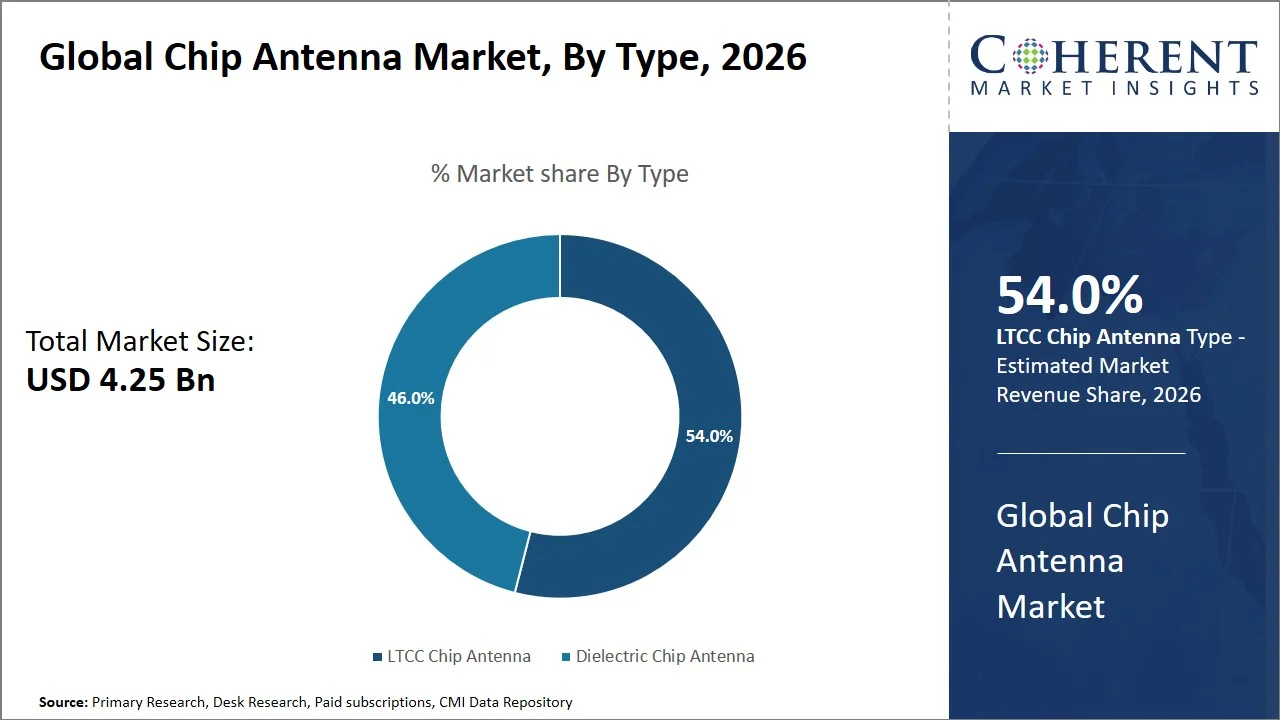
Why Does the LTCC Chip Antenna Segment Dominate the Global Chip Antenna Market?
The LTCC chip antenna segment is expected to account for 54.0% of the global chip antenna market share in 2026. LTCC chip antennas account for the major share in the global chip antenna market, which is attributed to their superior electrical performance, high stability and strong downsizing capabilities in compact electronic devices. This is primarily because they are capable of supporting multi-band and high frequency applications with minimal signal loss and stable performance in harsh settings like metal-rich or compact device designs.
On September 16, 2025, Johanson Technology announced the release of two new AEC-Q200 qualified LTCC passive components optimized for automotive Ultra-Wideband (UWB) systems. These compact, high-reliability devices support precise RF performance in space-constrained automotive environments. (Source: Johanson Technology)
- Current Industry Events of 2026
- Market Size Estimation
- Regional Breakdown
- Competitive Landscape
- Customer Intelligence
- Segmental Analysis
- Pricing Analysis
- Key Market Drivers, Challenges & Future Trends
- Customized Insights Section
Why is WLAN and Wi-Fi the Most Widespread Application?
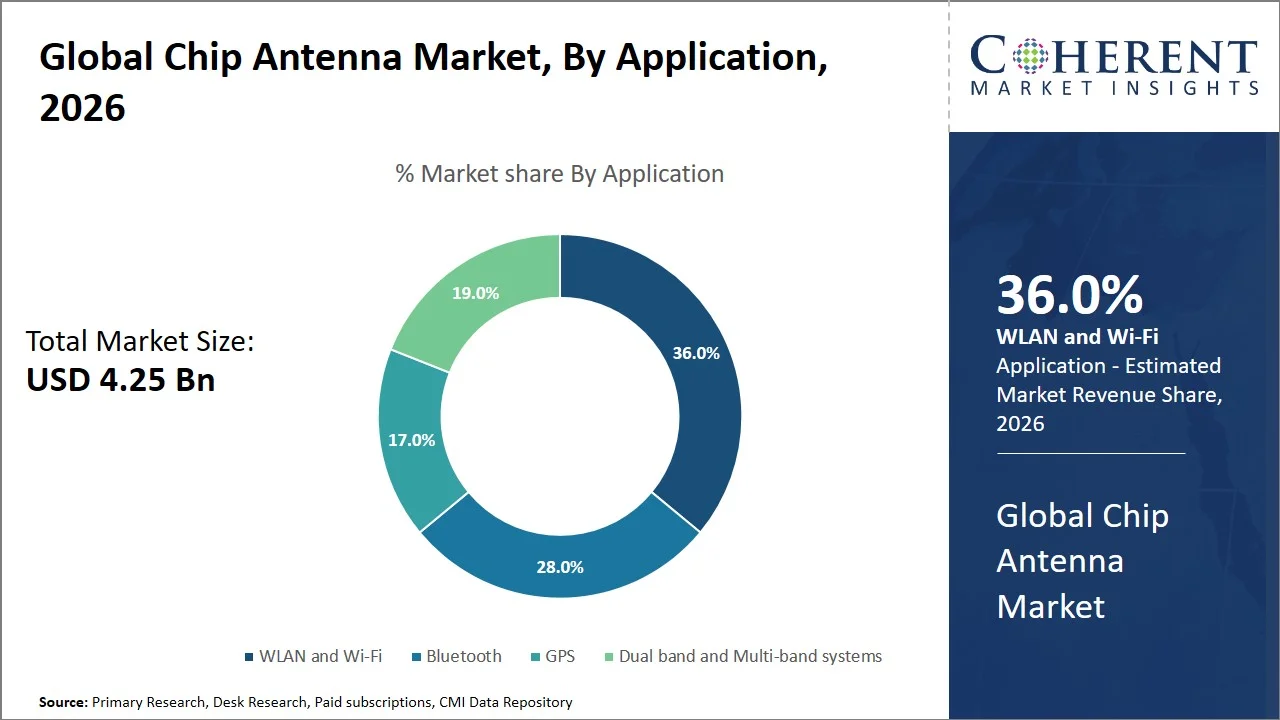
The WLAN and Wi-Fi segment is expected to account for 36.0% of the global chip antenna market share in 2026. The main driver is the global move to high-speed, always-on internet access in homes, businesses and public spaces, where Wi-Fi is the preferred and least expensive communications standard relative to cellular options. On December 11, 2025, AT&T launched AT&T Connected Life, the only solution to deliver smart home capabilities from Google Home featuring Google Nest devices with professional monitoring from Abode, all backed by AT&T’s super-fast and reliable connection. (Source: AT&T)
Consumer Electronics Segment Dominates the Global Chip Antenna Market
The consumer electronics segment is expected to account for 29.0% of the global chip antenna market share in 2026. The consumer electronics segment is the leading category in the global chip antenna market because to the large-scale production and ongoing innovation in devices such as smartphones, tablets, laptops, wearables, and smart home devices, which need compact and high-performance wireless communication solutions. On July 10, 2025, Samsung expanded its premium device portfolio in 2025 with launches like the Galaxy Z Fold7 and Z Flip7, focusing on thinner designs, improved durability, and advanced AI-driven camera systems. It also introduced the Galaxy S25 FE, designed to bring flagship-level Galaxy AI features to a more affordable segment, reflecting Samsung’s strategy of scaling innovation across both premium and mass-market devices. (Source: Samsung)
Currents Events and their Impact
Current Events | Description and its Impact |
EU Data Act |
|
India Digital Personal Data Protection (DPDP) Rules, 2025 |
|
(Source: European Commission, Press Information Bureau)
Global Chip Antenna Market Dynamics
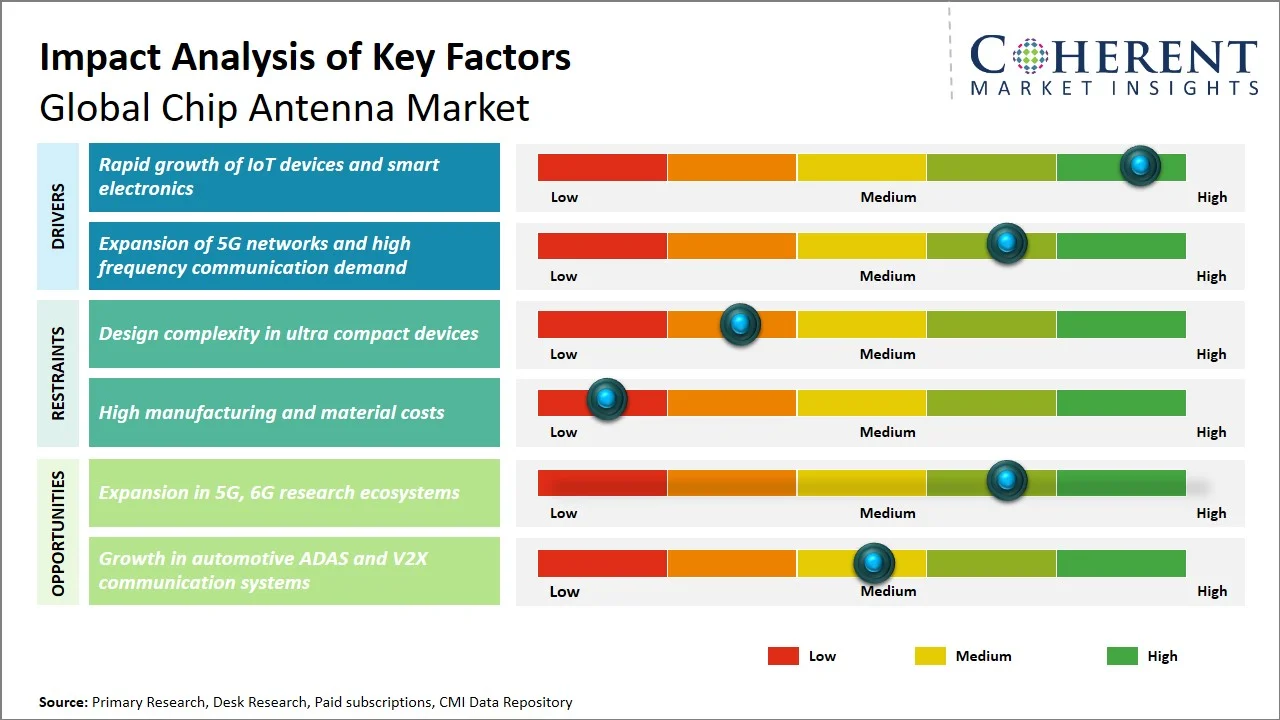
Market Drivers
Rapid growth of IoT devices and smart electronics
The rapid rise of IoT devices and smart electronics is revolutionizing connectivity across industries by enabling seamless communication between ordinary things, industrial systems and consumer gadgets. From smart household gadgets like connected thermostats and security cameras to industrial sensors used for predictive maintenance and automation, the growing ecosystem of IoT relies on tiny and efficient wireless components to operate properly. Smart electronics are also a vital aspect of modern digital infrastructure, driven by developments in low-power networking technologies and the increasing demand for real-time data collecting and remote monitoring.
On January 7, 2026, Samsung Electronics outlined its vision for Digital Appliances (DA) Business to enable better living, as well as the key strategies driving this initiative, during its Deep Dive session at CES 2026 in Nevada, U.S. The outline for the company’s vision comes at a time in which home appliances navigates the growing importance of AI in connected living. (Source: Samsung)
Expansion of 5G networks and high frequency communication demand
The deployment of 5G networks are driving the need for high-frequency communication systems that can deliver faster data rates, ultra-low latency, and huge device connection. As 5G expands into higher bands like millimeter-wave bands, it demands more sophisticated antenna and RF solutions that are capable of providing steady performance in challenging conditions like crowded urban regions and high-mobility applications. The development of innovative, multi-band, and ultra-efficient components to provide dependable connectivity for smartphones, linked cars, industrial automation systems, and nascent edge computing networks is being driven by this change.
On May 19, 2026, Bharti Airtel announced the launch of Priority Postpaid, a new service that leverages 5G slicing technology to deliver superior and more consistent experience to customers on postpaid. This service is specially built for busy customers who depend on uninterrupted connectivity for work, entertainment, or online collaboration. (Source: Airtel)
Emerging Trends
- Growth of LTCC and Miniaturized Ceramic-Based Designs: Low Temperature Co-fired Ceramic (LTCC) technology is becoming more popular in antenna design due to its tiny size, thermal stability and good RF performance.
- Expansion of Connected Ecosystems: The rapid expansion of IoT devices, wearables and smart home systems is pushing the widespread deployment of chip antennas in everyday gadgets.
Regional Insights
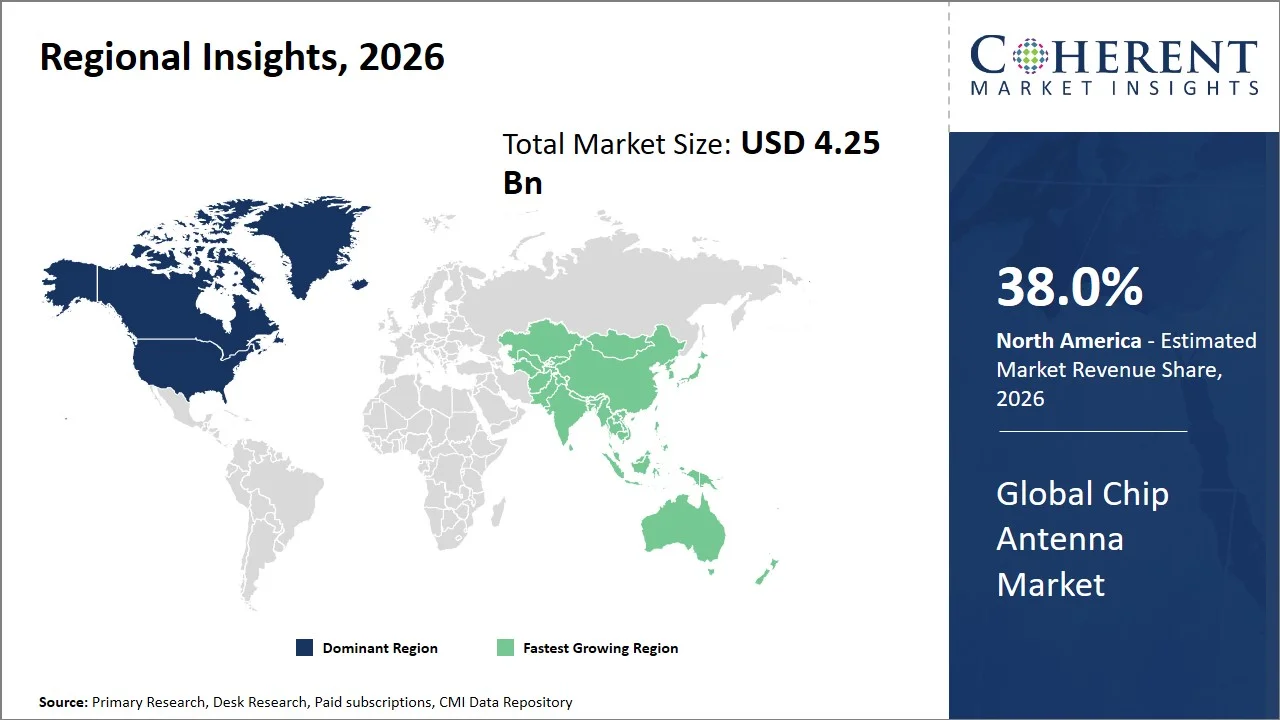
Why is North America a Strong Market for Chip Antennas?
North America is expected to account for a market share of 38.0% in 2026. North America chip antenna market is driven by fast adoption of improved connectivity in automotive (autonomous vehicles), defense electronics and industrial IoT. U.S. and Canadian businesses focus on high-performance RF designs to handle difficult situations. For example, automotive original equipment manufacturers (OEMs) (General Motors and Ford Chrysler) integrating advanced driver-assistance systems (ADAS) rely on multi-band chip antennas to enable V2X communications and radar coordination, while U.S. technology companies designing smart home ecosystems need small antennas that can provide consistent Wi-Fi 6E and Bluetooth Low Energy performance in crowded device scenarios.
Why Does the Asia Pacific Chip Antenna Market Exhibit High Growth?
Asia Pacific is projected to account for 24.0% of the global chip antenna market and expected to register the fastest growth. Asia Pacific is leading the pack in terms of manufacturing intensity and fast adoption of consumer electronics. Countries such as South Korea, Japan, China and Taiwan are leading the wide scale deployment of chip antennas in smartphones, wearables and IoT modules. South Korea and China’s top smartphone makers combine several chip antennas in flagship models that enable simultaneous 5G, NFC and GPS functionalities, and Japan’s enterprises specialize in highly reliable antennas for robotics and industrial automation systems. The region also has a robust electronics supply chain that supports rapid prototyping and high-volume manufacturing, making it a vital center for innovation in miniaturized antenna design and low-cost RF components.
Global Chip Antenna Market Outlook for Key Countries
Why is the U.S. Emerging as a Major Hub in the Chip Antenna Market?
The main demand drivers in the U.S. for chip antennas are advanced computing, defense applications and high-end consumer electronics, especially in products that require strong communication in harsh environments. Companies building AR/VR headsets, like those in California’s tech sector, need tiny multi-band antennas to sustain low-latency wireless communications for immersive applications. Rugged chip antennas are also used by defense contractors in secure communication equipment and unmanned systems, where reliability is crucial in the face of electromagnetic interference. Also, the U.S. is conducting early stage research on the antenna architecture of the millimeter-wave and sub-THz bands for future 6G applications.
Is China the Next Growth Engine for the Chip Antenna Market?
The China chip antenna market is driven by the huge volume of smartphone manufacturing, the rollout of IoT devices, and the aggressive 5G infrastructure build-out with strong government support, while homegrown companies like Xiaomi and Huawei are embedding sophisticated antenna systems in their high-volume products. For example, flagship smartphones typically employ many chip antennas to maximize the signal switching between urban dense networks and rural coverage areas. Moreover, the fast growth of smart manufacturing and industrial IoT systems in China has created an increasing demand for small antennas in sensors, robots, and surveillance equipment, supported by a highly integrated local semiconductor and printed circuit board manufacturing ecosystem.
Germany Chip Antenna Market Analysis and Trends
The chip antenna market in Germany is intimately associated with the country’s preeminence in automotive engineering, with firms including as BMW, Mercedes-Benz, and Volkswagen implementing sophisticated antenna systems into connected and autonomous car platforms. Chip antennas are widely utilized in car telematics, infotainment systems and V2X communication modules in high-speed mobility environment to establish robust connectivity. German industrial automation companies are also using small antennas in smart factory systems where precise communication between sensors and control units is crucial, typically with tight electromagnetic compatibility constraints.
With increased penetration of smartphones, adoption of IoT in smart cities and increasing deployment of 4G/5G infrastructure by telecom operators, the chip antenna industry is growing fast in India. For example, chip antennas are included in budget and mid-range smartphones by domestic smartphone assembly units and global OEM manufacturing facilities in states such as Tamil Nadu and Uttar Pradesh to facilitate multi-network connection. Moreover, the increased ubiquity of connected devices in fintech-enabled payment systems, logistics monitoring and affordable wearable health monitors is driving demand for small, low-cost antenna solutions that satisfy the needs of high-volume consumer applications.
Global Chip Antenna Market - Device Miniaturization & PCB Space Utilization
Device Miniaturization & PCB Space Utilization Trend | Specific Industry Data |
PCB Area Reduction Trends | Advanced HDI and substrate-like PCB technologies are enabling up to 40% smaller device footprints in wearables and IoT electronics through microvias, ultra-fine routing, and embedded components. |
Ultra-Compact Device Penetration | Smartwatch PCB designs now integrate processors, sensors, batteries, and RF modules inside areas as small as 30mm × 30mm, with some designs achieving 80% space compression. |
Wearable Form-Factor Evolution | Wearable electronics increasingly use rigid-flex PCBs below 0.2 mm thickness with embedded passive components and microvias to support thinner smartwatches, fitness bands, and medical patches. |
System-in-Package (SiP) Adoption | SiP packaging can reduce PCB footprint by up to 40%, while advanced wearable SiP modules now integrate more than 300 components within ~29 mm² packages. |
High-Density RF Module Integration | Modern wearables and IoT devices increasingly integrate RF, memory, processing, and sensors into compact heterogeneous packages with below 2-micron redistribution layers. |
Miniaturization in IoT PCB Architectures | Emerging IoT PCB designs now use ultra-HDI structures with sub-75 μm features, stacked microvias, and embedded active/passive components for space optimization. |
How is Expansion in 5G, 6G Research Ecosystems Creating New Growth Opportunities in the Chip Antenna Market?
The increasing rollout of 5G networks and rising investments in 6G research ecosystems are creating huge development potential in the chip antenna market by pushing the demand for improved, high-frequency and highly efficient antenna solutions. With 5G delivering greater data speeds and lower latency, and 6G likely to go into even higher frequency bands such as sub-terahertz, devices require more compact, multi-band, and beamforming-capable chip antennas to tackle complicated signal environments. This is fueling innovation in antenna-in-package designs, improved materials and integrated RF modules, leading to greater adoption of chip antennas for smartphones, IoT devices, automotive systems and next-generation communication infrastructure.
On October 28, 2025, NVIDIA and Nokia announced a strategic partnership to add NVIDIA-powered, commercial-grade AI-RAN products to Nokia’s industry-leading RAN portfolio, enabling communication service providers to launch AI-native 5G-Advanced and 6G networks on NVIDIA platforms. NVIDIA will also invest USD 1 billion in Nokia. (Source: NVIDIA)
Market Players, Key Development, and Competitive Intelligence
Key Developments
- On May 27, 2025, STMicroelectronics released a set of antenna-matching companion chips for STM32WL33 wireless microcontrollers (MCUs) to simplify the development of IoT, smart-metering, and remote-monitoring applications.
- In March 2025, Antenova launched the “Latona” lamiiANT chip antenna for NB-IoT applications, designed for smart metering and industrial IoT with ultra-compact PCB integration and improved signal stability for dense deployments.
Competitive Landscape
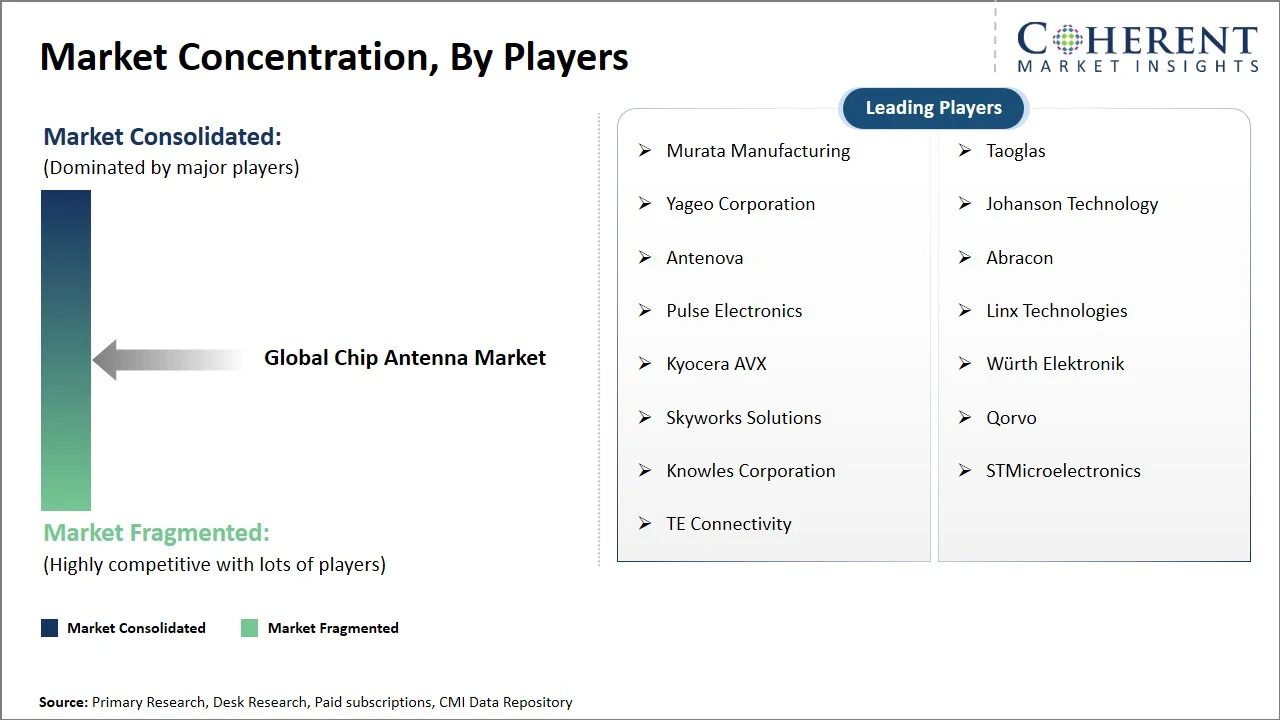
The global chip antenna industry is rather fragmented with a mix of global electronic giants and specialized RF component manufacturers competing on innovation, performance and cost effectiveness. Top companies like as Vishay Intertechnology, INPAQ Technology, Antenova, Johanson Technology and TDK Corporation are placing a lot of emphasis on ceramic design knowledge, multi-band capability and miniaturization to cater demand from smartphones, IoT devices and automotive systems. Integration trends are affecting competition more and more. Semiconductor companies are integrating antenna functionalities into their packages, which puts more pressure on independent antenna manufacturers.
Market Report Scope
Chip Antenna Market Report Coverage
| Report Coverage | Details | ||
|---|---|---|---|
| Base Year: | 2025 | Market Size in 2026: | USD 4.25 Bn |
| Historical Data for: | 2020 To 2024 | Forecast Period: | 2026 To 2033 |
| Forecast Period 2026 to 2033 CAGR: | 10.4% | 2033 Value Projection: | USD 11.70 Bn |
| Geographies covered: |
| ||
| Segments covered: |
| ||
| Companies covered: | Murata Manufacturing, Taoglas, Yageo Corporation, Johanson Technology, Antenova, Abracon, Pulse Electronics, Linx Technologies, Kyocera AVX, Würth Elektronik, Skyworks Solutions, Qorvo, Knowles Corporation, STMicroelectronics, and TE Connectivity | ||
| Growth Drivers: |
| ||
| Restraints & Challenges: |
| ||
Analyst Opinion (Expert Opinion)
- The global chip antenna market is a high growth industry, driven by the rapid expansion of IoT ecosystems, 5G deployment and linked automotive platforms. With billions of linked endpoints requiring reliable wireless connection, and devices becoming smaller yet more complicated, the demand for compact, multi-band, and high-efficiency antennas is predicted to gradually grow. But it may be also observed that ongoing technical hurdles, including signal loss, tuning complexity and performance trade-offs in metal-rich or space-constrained situations, continue to drive innovation in materials and RF design.
- The future of the chip antenna market is likely to be characterized by more downsizing, higher frequency operation and closer integration with the semiconductor systems. Growth will be fueled by increasing applications in 5G-Advanced networks, driverless vehicles, wearable health devices, and industrial IoT, where the demand for compact and dependable wireless modules continues to rise. In the future, new technologies such as antenna-in-package (AiP) and advanced ceramic materials are expected to offer better performance and size reduction to allow for more efficient multi-protocol connectivity.
Speak to the analyst
Want personalized insights?
Take the findings above to one of our principal consultants, or have the report rebuilt around the segments, geographies and competitors you actually track.
Market Segmentation
- Type Insights (Revenue, USD Bn, 2021 - 2033)
- LTCC Chip Antenna
- Dielectric Chip Antenna
- Application Insights (Revenue, USD Bn, 2021 - 2033)
- WLAN and Wi-Fi
- Bluetooth
- GPS
- Dual band and Multi band systems
- End User Insights (Revenue, USD Bn, 2021 - 2033)
- Consumer Electronics
- Automotive
- Telecommunications
- Healthcare
- Industrial IoT
- Defense and Aerospace
- Regional Insights (Revenue, USD Bn, 2021 - 2033)
- North America
- U.S.
- Canada
- Latin America
- Brazil
- Argentina
- Mexico
- Rest of Latin America
- Europe
- Germany
- U.K.
- Spain
- France
- Italy
- Russia
- Rest of Europe
- Asia Pacific
- China
- India
- Japan
- Australia
- South Korea
- ASEAN
- Rest of Asia Pacific
- Middle East
- GCC Countries
- Israel
- Rest of Middle East
- Africa
- South Africa
- North Africa
- Central Africa
- North America
- Key Players Insights
- Murata Manufacturing
- Taoglas
- Yageo Corporation
- Johanson Technology
- Antenova
- Abracon
- Pulse Electronics
- Linx Technologies
- Kyocera AVX
- Würth Elektronik
- Skyworks Solutions
- Qorvo
- Knowles Corporation
- STMicroelectronics
- TE Connectivity
Sources
Primary Research Interviews
- Chip Antenna Manufacturers and Suppliers
- IoT Device Integrators and OEMs
- Telecommunications Equipment Providers
- Wireless Technology Solution Providers
Magazines
- RF World Magazine
- Microwave & RF Magazine
- Electronic Design Magazine
- Wireless Design & Development Magazine
- EE Times Magazine
Journals
- IEEE Transactions on Antennas and Propagation
- International Journal of Antennas and Propagation
- Progress in Electromagnetics Research
Associations
- Institute of Electrical and Electronics Engineers (IEEE)
- International Association of Engineers (IAENG)
- Antenna Measurement Techniques Association (AMTA)
- Global System for Mobile Communications Association (GSMA)
- Semiconductor Industry Association (SIA)
Public Domain Sources
- Federal Communications Commission (FCC) Database
- European Telecommunications Standards Institute (ETSI)
- International Telecommunication Union (ITU) Publications
- Patent databases (USPTO, EPO)
- Government technology research publications
Proprietary Elements
- CMI Data Analytics Tool
- Proprietary CMI Existing Repository of information for last 10 years
Get access to 250+ pages report
Every segment, forecast, competitor profile and data table behind the analysis above — available for instant download.
- ESOMAR Member
- ISO 9001:2015 Certified
- D-U-N-S Registered
- GDPR & CCPA Compliant
Missing comfort of reading report in your local language? Find your preferred language:
Transform your Strategy with Exclusive Trending Reports
Frequently Asked Questions
The global chip antenna market is expected to stand at USD 4.25 Bn in 2026 and is expected to reach USD 11.70 Bn by 2033.
The CAGR of the global chip antenna market is projected to be 10.4% from 2026 to 2033.
Rapid growth of IoT devices and smart electronics and expansion of 5G networks and high frequency communication demand are the major factors driving the growth of the global chip antenna market.
Design complexity in ultra compact devices and high manufacturing and material costs are the major factors hampering the growth of the global chip antenna market.
In terms of type, the LTCC chip antenna segment is estimated to dominate the market revenue share in 2026.
They are preferred because they are small, efficient, and easy to integrate into compact devices.
Yes, advanced chip antennas are designed to support certain 5G frequency bands.