

Global Chip Resistor Market Size and Forecast – 2026 to 2033
Coherent Market Insights estimates that the global chip resistor market is expected to reach USD 2.05 Bn in 2026 and will expand to USD 4.50 Bn by 2033, registering a CAGR of 10% between 2026 and 2033.
Key Takeaways of the Chip Resistor Market
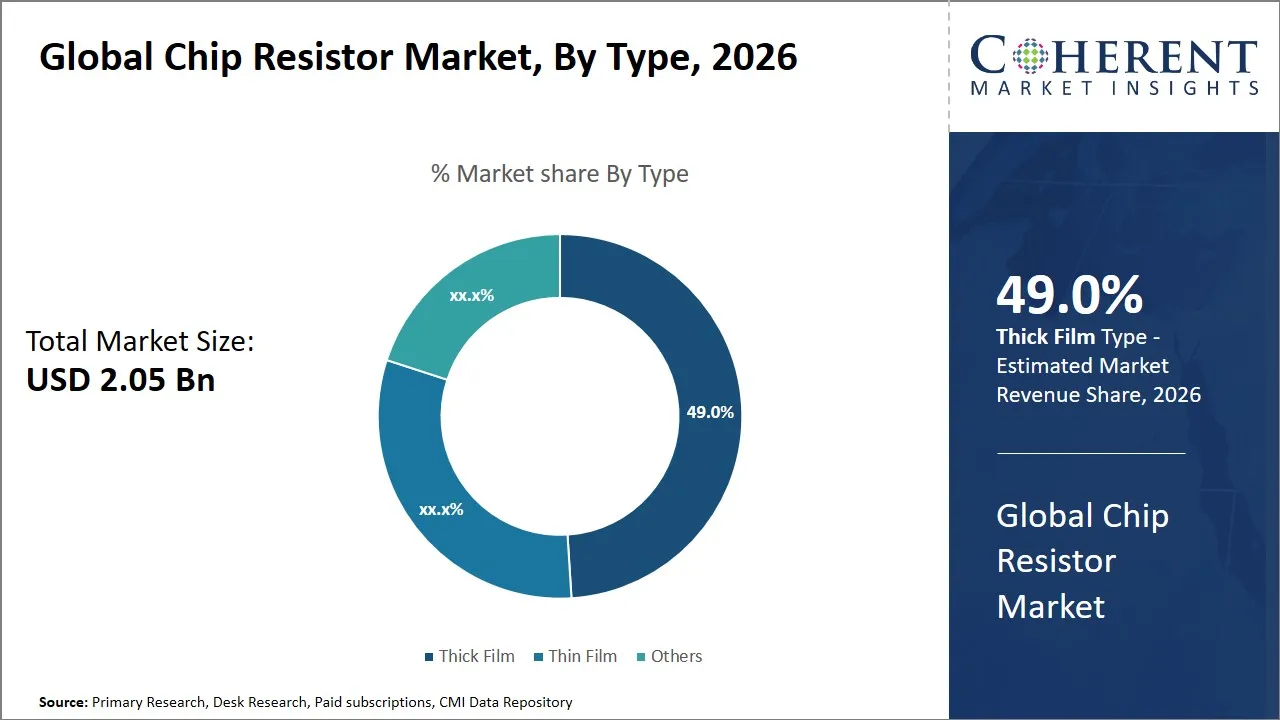
- The thick film segment is expected to account for 49% of the chip resistor market share in 2026.
- The consumer electronics segment is projected to capture 33% of the market share in 2026.
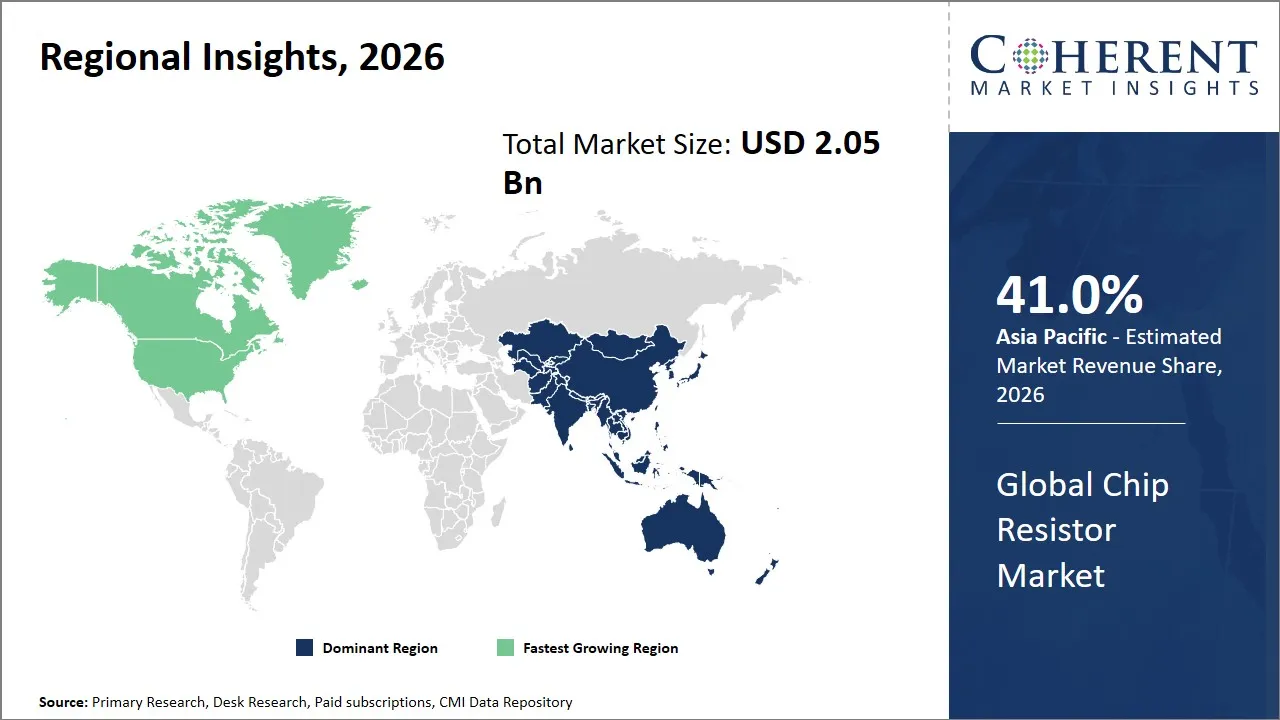
- Asia Pacific is projected to dominate the chip resistor market in 2026 with a 41%
- North America is expected to hold 33% share in 2026 and is expected to record the fastest growth over the forecast period.
Currents Events and Its Impacts
Current Events | Description and its Impact |
KOA CORPORATION publication of IEC60115-8 Edition 3 |
|
Segmental Insights
- Current Industry Events of 2026
- Market Size Estimation
- Regional Breakdown
- Competitive Landscape
- Customer Intelligence
- Segmental Analysis
- Pricing Analysis
- Key Market Drivers, Challenges & Future Trends
- Customized Insights Section
Why Does the Thick Film Segment Dominate the Global Chip Resistor Market in 2026?
The thick film segment is expected to account for 49.0% of the global chip resistor market share in 2026. A key reason thick film chip resistors see rising demand lies in how quickly they can be made. Instead of complex steps, a mixture of ceramic and resistance material gets coated on a base, followed by heating at intense heat. As this method uses fewer resources than Thin Film methods, output increases while still working well. With budgets tight in sectors like home devices or factory systems, lower prices become highly favorable. Efficiency here shapes decisions more than advanced features ever could.
Consumer Electronics Segment Dominates the Global Chip Resistor Market
The consumer electronics segment is expected to account for 33.0% of the global chip resistor market share in 2026. Smaller gadgets appear because technology favors lightness, minimal bulk, space-saving design. Compact devices like phones, wearables, tablets use smaller chips; their inner parts adjust just the same, working completely even when space is tight. Instead of adding more functions, designers focus on smaller structures that support circuitry across systems. Within such setups, miniature resistive units regulate current movement, working unobtrusively amid crowded board arrangements.
For instance, on February 12, 2025, ROHM expanded its portfolio of general-purpose chip resistors with the MCRx family. It is designed to achieve greater miniaturization and enhanced performance across a variety of applications. The new lineup includes the high-power MCRS series and low-resistance, high-power MCRL series.
Global Chip Resistor Market - Impact of 5G/6G & IoT Rollouts
Metric | Numerical Data |
Smartphones per year | ~1.4–1.5+ billion units |
Increase in resistor count per phone due to 5G | ~25–30% |
5G connections | ~1.9 billion |
Forecast 5G connections by 2027 | ~6.8 billion |
IoT device | ~25.1 billion devices |
Resistors per 5G base station | ~2,000–3,000 |
Installed 5G base stations (global) | ~10+ million |
EV resistor content per vehicle | ~>5,000 chip resistors |
Min. resistor content in Smartphones | ~1,200–1,800 |
Thin-film resistor tolerance demand (5G use) | ±0.1 Ω or better |
Regional Insights
Asia Pacific Chip Resistor Market Analysis and Trends
The Asia Pacific region is projected to lead the market with a 41% in 2026. Despite varied national approaches, steady expansion stems from well-established electronics production frameworks across the area. Where industry direction meets innovation, production expands smoothly due to tightly woven supply chains. Japan, China, and South Korea stand prominent - each fostering vast manufacturing while advancing know-how steadily. Inside their regions, networks of chip plants, part makers, and assembly hubs sustain steady demand for tiny resistors. Since rules frequently support international movement, companies worldwide and local players grow involvement gradually. Samsung Electro-Mechanics, Murata Manufacturing, and Yageo pursue intense R&D, delivering parts common in cars, phones, and communication setups.
For instance, on January 28, 2026, Taiwanese manufacturer, Ta‑i Technology notified customers of chip resistor price increases starting February 2026 due to cost pressures, with competitors Walsin Technology Corporation and YAGEO Group also initiating hikes.
North America Chip Resistor Market Analysis and Trends
The North America region is expected to exhibit the fastest growth in the market contributing 33% share in 2026. Driven by increasing need for advanced electronic systems, expansion appears across aerospace, defense, and vehicle industries. Across labs and markets, U.S. progress grows where research support meets strong protection for inventive work. Clarity arises beyond well-known entities - Vishay Intertechnology, KEMETO Corporation, TE Connectivity, all focused on resilience amid stress.
Newer players advance, backed by increasing investment in modern manufacturing techniques. Despite size differences, legacy and startup alike define circuit limits. Changes in commerce flows, marked by wider sourcing channels and efforts to bring output closer to home, deepen regional financial activity. These adjustments respond directly to demands for consistent performance and dependable logistics frameworks.
Global Chip Resistor Market Outlook for Key Countries
Why is China Emerging as a Major Hub in the Chip Resistor Market?
Backed by steady state support, China advances its electronics sector through expanded homegrown chip output. With emphasis placed on component independence, resistor fabrication sees notable upward movement recently. Firms such as Tianjin Jinli Circuit Components together with Kunshan Haoxin Electronic Materials progress amid measures favoring internal development and facility upgrades. Amid shifting international commerce flows, adaptation occurs via tighter collaboration alongside reduced logistical spans. While foreign-facing centers continue operating, internal alignment grows under revised national planning.
Japan Chip Resistor Market Analysis and Trends
Innovation in chip resistors moves forward in Japan, driven by exactness combined with fresh methods. Not only do firms like Murata Manufacturing and TDK Corporation introduce upgraded parts, but their output also reaches producers worldwide. As local electronics and semiconductor fields remain strong, national policies increasingly link universities with industrial partners. Though subtle, these shifts shape long-term capability beneath global supply chains. Though often unseen, these elements shape outcomes in vehicles and healthcare technology alike.
Is U.S. the Next Growth Engine for the Chip Resistor Market?
Even with broad automation, U.S. industries depend more each year on finely tuned chip resistors developed via ongoing research. Far beyond mere economic currents, advancement often follows paths shaped by state-backed initiatives, particularly efforts aimed at relocating essential components domestically. Companies such as Vishay Intertechnology adhere to rigorous benchmarks required by aerospace and military frameworks. With policy evolution comes transformation in how tech infrastructures must operate. These changes alter how much gets made, woven into larger moves across industry sparked by growing links between devices. What drives output now is less isolated choice, more systemic pressure.
South Korea Chip Resistor Market Analysis and Trends
South Korea stands out globally due to its strength in chip technology. From handheld devices to automated production lines, components supplied by firms like LG Innotek serve multiple high-tech sectors. As national policies emphasize digital advancement, methods for producing technology shift rapidly throughout the region. Due to international agreements and export-driven economic activity, the country occupies key points within global supply chains. Innovation thrives where policy meets advanced electronic manufacturing capabilities.
Germany Chip Resistor Market Analysis and Trends
In Germany, precision in chip resistors gains importance because of requirements from car production along with automated manufacturing systems. Standards for performance carry significant weight, where companies like Würth Elektronik and Vishay Electronic GmbH emphasize adherence together with strict validation processes. As goals tied to Industry 4.0 unfold slowly, intelligent production sites appear, integrating advanced passive components so operational stability improves. Positioned centrally within Europe, the country connects varied regions, fostering joint progress due to its location benefits.
Market Players, Key Development, and Competitive Intelligence
Key Development
- On February 14, 2025, Ruselectronics has developed a unique material fabrication technique for chip resistors free of precious metals. Unlike traditional components based on gold, platinum, etc., the new products feature low cost while offering all necessary performance specifications.
Top Strategies Followed by Global Chip Resistor Market Players
- Within the worldwide chip resistor market, varied firms help define how things unfold. Innovation drives major participants, who commit substantial resources into R&D to craft components fitting tight electronic demands like compact size, durability, because consistency under heat changes matters greatly. Where partnerships form between major suppliers and OEMs, inclusion of key players in electronics helps extend influence through emerging solutions. Connection grows when shared efforts cross industry boundaries, opening access beyond traditional limits. Joint movement appears where supply chains meet innovation paths, drawing strength from combined expertise. Expansion follows alignment among entities that shape electronic advancements together.
- Mid-level companies distinguish themselves by redefining competition - not via high costs, yet through deliberate compromises in design. Rather than aiming for peak performance, focus turns to consistent operation at lower cost. Consumer sensitivity to price influences many decisions, steering development toward economical results. From this mindset come chip resistors - effective in key areas, minimal where possible. Steady demand appears in everyday gadgets along with widespread systems. As growth reaches a tipping point, partnerships gain weight - combined work overtakes individual pushes.
- A route emerges, different from the usual, where small players in the chip resistor field turn toward unique traits or novel steps shaped by specific needs. As scale is limited, advanced techniques become central and precision manufacturing find their prominence. Distinction forms slowly, built not on volume but on careful execution. Only through these ways does noticeable difference arise. Alliances form quietly but firmly alongside emerging tech ventures, assembly units, local producers across particular zones or fields. Entry gains strength this way, presence grows within narrowly defined areas. Visibility rises without broad reach.
Market Report Scope
Chip Resistor Market Report Coverage
| Report Coverage | Details | ||
|---|---|---|---|
| Base Year: | 2025 | Market Size in 2026: | USD 2.05 Bn |
| Historical Data for: | 2020 To 2024 | Forecast Period: | 2026 To 2033 |
| Forecast Period 2026 to 2033 CAGR: | 10% | 2033 Value Projection: | USD 4.50 Bn |
| Geographies covered: |
| ||
| Segments covered: |
| ||
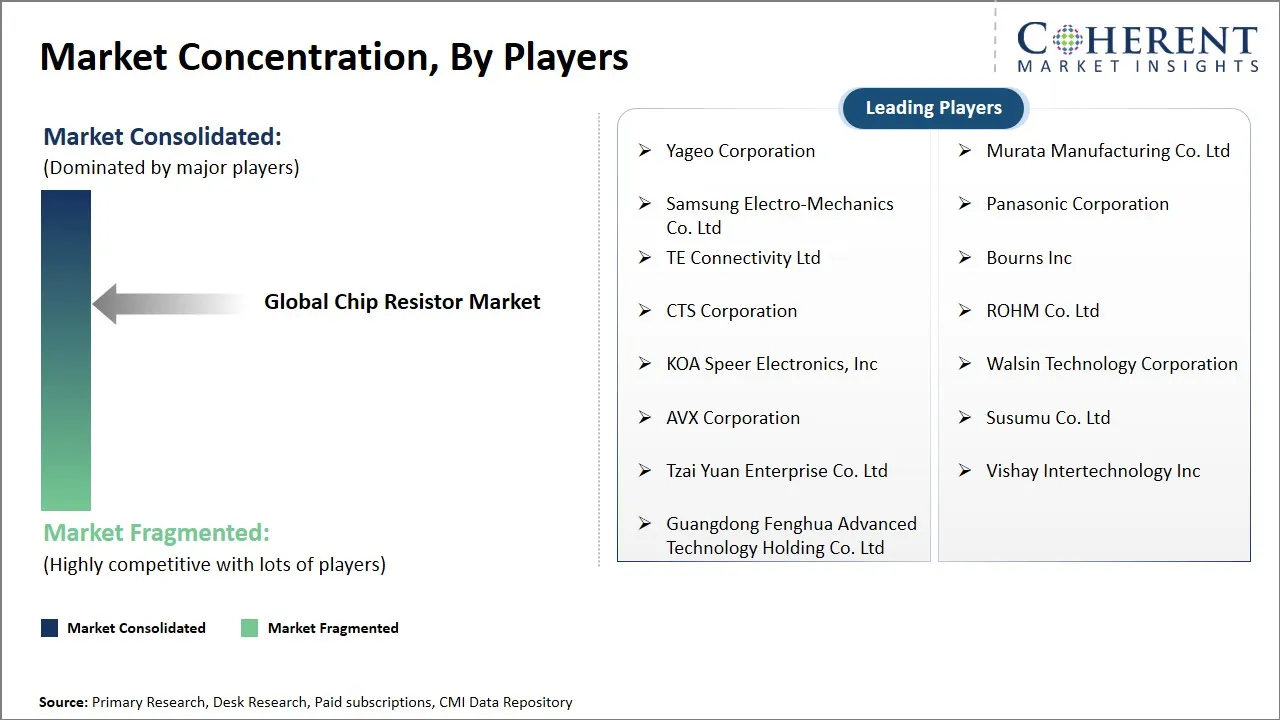
| Companies covered: | Yageo Corporation, Murata Manufacturing Co. Ltd, Samsung Electro‑Mechanics Co. Ltd, Panasonic Corporation, TE Connectivity Ltd, Bourns Inc, CTS Corporation, ROHM Co. Ltd, KOA Speer Electronics, Inc, Walsin Technology Corporation, AVX Corporation, Susumu Co. Ltd, Tzai Yuan Enterprise Co. Ltd, Vishay Intertechnology Inc, and Guangdong Fenghua Advanced Technology Holding Co. Ltd | ||
| Growth Drivers: |
| ||
| Restraints & Challenges: |
| ||
Global Chip Resistor Market Dynamics
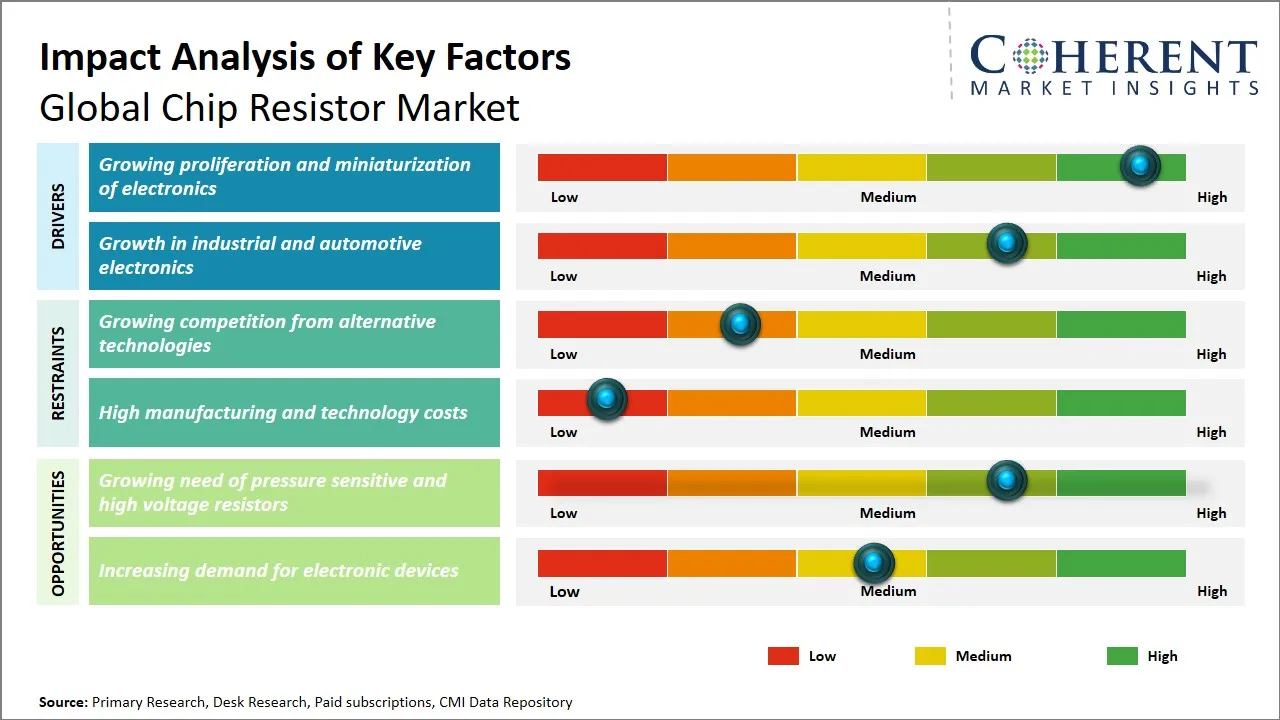
Global Chip Resistor Market Driver - Growing Proliferation and Miniaturization of Electronics
Growth in small, mobile gadgets pushes global need for chip resistors. With smartphones, smartwatches, tablets, and connected tools growing more advanced, makers focus on shrinking parts yet keeping output steady. As designs get tighter, engineers require miniature resistors, durable ones, that fit narrow spaces but still work well. Shrinking circuits means these components must be both compact and dependable across real-world uses.
For instance, on May 13, 2025, Samsung Electronics revealed the full specifications of the Galaxy S25 Edge, a category-defining slim smartphone joining the Galaxy S series. Crafted with style and strength in mind, Galaxy S25 Edge strikes a new balance of premium, pro-level performance in a resilient titanium body only 5.8mm thick. S25 Edge delivers on the S series legacy, integrating an iconic Galaxy AI-enabled camera and unleashing a new realm of creativity in an effortlessly portable device.
Global Chip Resistor Market Opportunity - Growing Need of Pressure Sensitive and High Voltage Resistors
Significant growth appears within the global chip resistor market, supported by increasing requirements for pressure responsive and high voltage variants. Because of progress in vehicle technologies, factory equipment, and household gadgets, new demands emerge. Compactness and complexity in modern electronics push performance limits, requiring components capable of stable operation under intense electrical loads. Rising interest follows devices that detect force precisely; uses span car tire sensors, health tools, machine feedback loops. This specific need builds a distinct pathway inside broader component trends.
For instance, on February 12, 2025, Murata Manufacturing Co., Ltd. announced the launch and mass production of its multilayer ceramic capacitor (MLCC) featuring a capacitance of 15nF, a rated voltage of 1.25kV, and C0G characteristics in the compact 1210-inch (3.2mm x 2.5mm) size. This product delivers highly efficient power conversion and stable performance under high-voltage conditions, making it suitable for onboard chargers (OBCs) in electric vehicles (EVs) and power supply circuits in high-performance consumer devices.
Analyst Opinion (Expert Opinion)
- Shifts in structure drive expansion of the worldwide chip resistor market more than brief changes in electronic devices. Thick-film components lead uptake, followed closely by those made of metal foil, due to tighter tolerances. Meanwhile, basic versions endure shrinking returns as output scales widen across regions. Firms that balance scale with precise production control tend to stand apart. As specialization supports resilience, margins remain steady under pressure.
- Gradually, dominance shifts toward top-tier Asian and Japanese manufacturers, yet openings persist for specialists in extreme-condition electronics. Owing to past supply issues, companies now emphasize local sourcing and stronger logistics networks when planning new facilities. Stability defines the current phase, modest upward trends appear, driven by tailored engineering rather than broad-market plays. Innovation, particularly in unique usage scenarios, increasingly separates enduring firms from the rest. The path forward hinges less on scale, more on precision adaptation.
Speak to the analyst
Want personalized insights?
Take the findings above to one of our principal consultants, or have the report rebuilt around the segments, geographies and competitors you actually track.
Market Segmentation
- Type Insights (Revenue, USD Bn, 2021 - 2033)
- Thick Film
- Thin Film
- Others
- Application Insights (Revenue, USD Bn, 2021 - 2033)
- Consumer Electronics
- Automotive
- Industrial
- Aerospace and Defense
- Healthcare
- Others
- Regional Insights (Revenue, USD Bn, 2021 - 2033)
- North America
- U.S.
- Canada
- Latin America
- Brazil
- Argentina
- Mexico
- Rest of Latin America
- Europe
- Germany
- U.K.
- Spain
- France
- Italy
- Russia
- Rest of Europe
- Asia Pacific
- China
- India
- Japan
- Australia
- South Korea
- ASEAN
- Rest of Asia Pacific
- Middle East
- GCC Countries
- Israel
- Rest of Middle East
- Africa
- South Africa
- North Africa
- Central Africa
- North America
- Key Players Insights
- Yageo Corporation
- Murata Manufacturing Co. Ltd
- Samsung Electro‑Mechanics Co. Ltd
- Panasonic Corporation
- TE Connectivity Ltd
- Bourns Inc
- CTS Corporation
- ROHM Co. Ltd
- KOA Speer Electronics, Inc
- Walsin Technology Corporation
- AVX Corporation
- Susumu Co. Ltd
- Tzai Yuan Enterprise Co. Ltd
- Vishay Intertechnology Inc
- Guangdong Fenghua Advanced Technology Holding Co. Ltd
Sources
Primary Research Interviews
- Chip resistor manufacturers and suppliers
- Electronic component distributors and retailers
- Electronics OEMs and system integrators
- Technology researchers and R&D professionals
- Others
Magazines
- Electronic Design Magazine
- EDN (Electronic Design News)
- Electronics Weekly
- EE Times (Electronic Engineering Times)
Journals
- IEEE Transactions on Components, Packaging and Manufacturing Technology
- Journal of Electronic Materials
- Microelectronics Reliability
Newspapers
- Financial Times
- The Wall Street Journal
- Nikkei Asia
- Electronics360
Associations
- Electronic Components Industry Association (ECIA)
- Resistor Manufacturers Association (RMA)
- Institute of Electrical and Electronics Engineers (IEEE)
- International Electronics Manufacturing Initiative (iNEMI)
Public Domain Sources
- U.S. Securities and Exchange Commission (SEC) filings
- Company annual reports and investor presentations
- Government statistical offices and trade departments
- World Trade Organization (WTO) trade statistics
Proprietary Elements
- CMI Data Analytics Tool
- Proprietary CMI Existing Repository of information for last 8 years
Get access to 250+ pages report
Every segment, forecast, competitor profile and data table behind the analysis above — available for instant download.
- ESOMAR Member
- ISO 9001:2015 Certified
- D-U-N-S Registered
- GDPR & CCPA Compliant
Missing comfort of reading report in your local language? Find your preferred language:
Transform your Strategy with Exclusive Trending Reports
Frequently Asked Questions
The global chip resistor market is expected to stand at USD 2.05 Bn in 2026 and is expected to reach USD 4.50 Bn by 2033.
The CAGR of global chip resistor market is projected to be 10% from 2026 to 2033.
Growing proliferation and miniaturization of electronics and growth in industrial and automotive electronics are the major factors driving the growth of the global chip resistor market.
Growing competition from alternative technologies and high manufacturing and technology costs are the major factors hampering the growth of the global chip resistor market.
In terms of type, thick film is estimated to dominate the market revenue share in 2026.
Electric vehicles significantly increase demand for high-reliability and high-power chip resistors.
Miniaturization drives demand for ultra-small chip resistors used in compact and wearable devices.