

Global Chiplet Market Size and Forecast
The Global Chiplet Market is estimated to be valued at USD 19.27 Bn in 2026 and is expected to reach USD 816.98 Bn by 2033, exhibiting a compound annual growth rate (CAGR) of 70.8% from 2026 to 2033.
Key Takeaways of the Chiplet Market
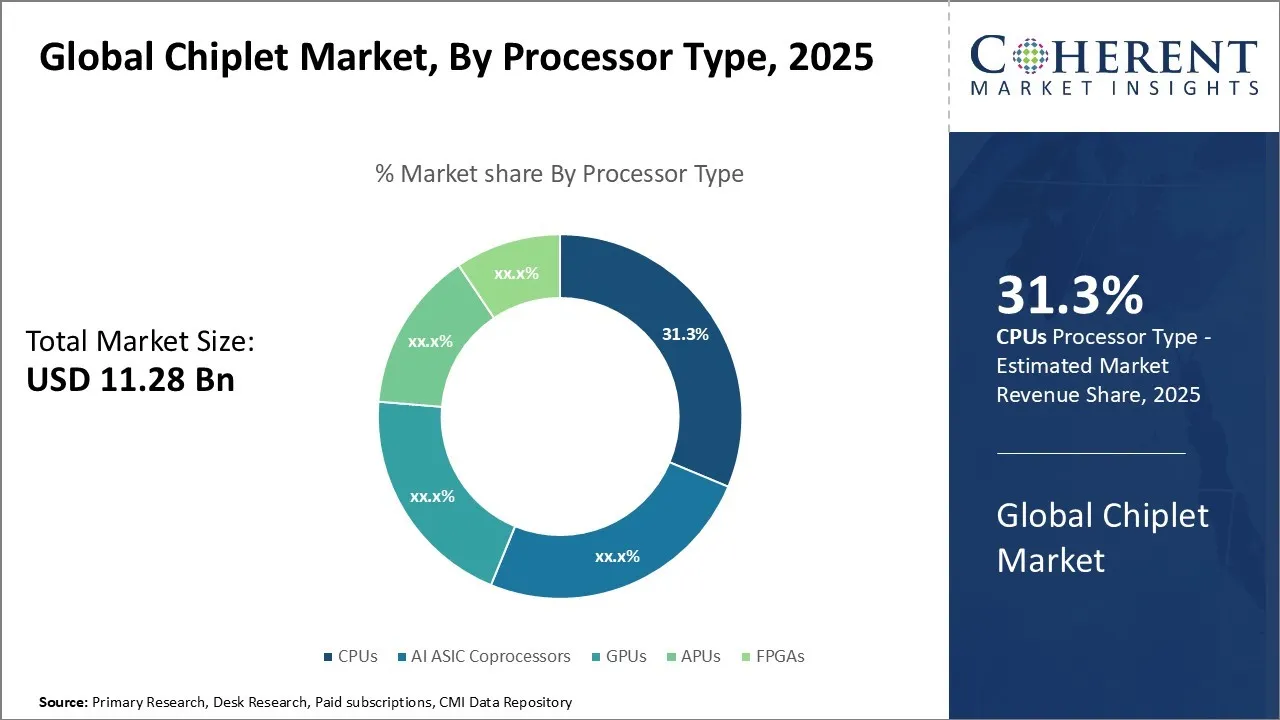
- The CPUs segment leads the market, holding an estimated share of 32.3% in 2026.
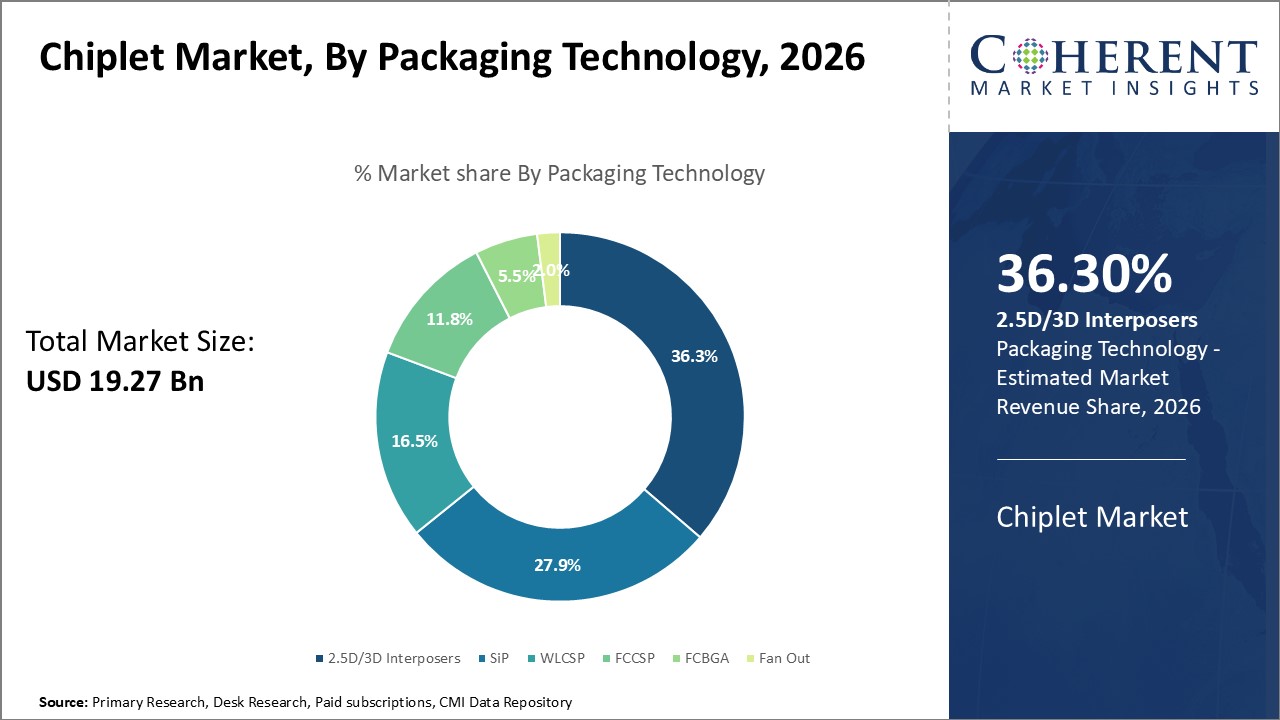
- The 2.5D/3D interposers segment leads the market, holding an estimated share of 36.3% in 2026.
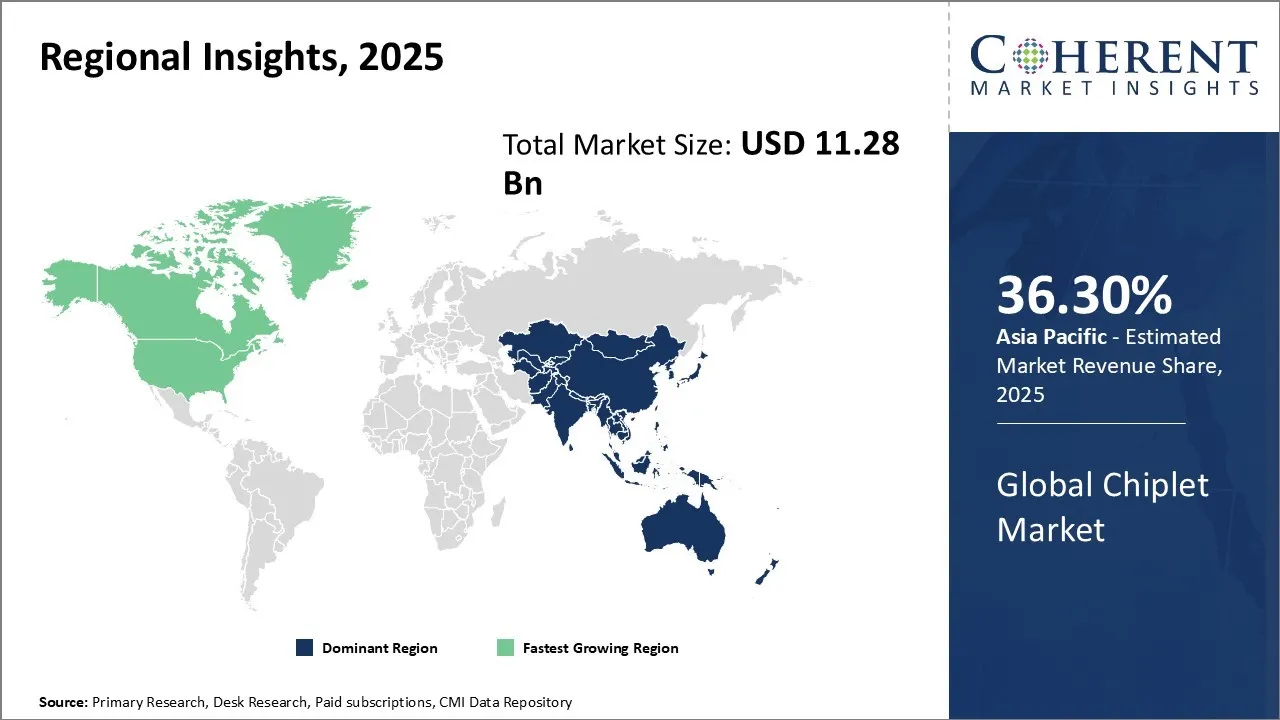
- Asia Pacific is estimated to lead the market with a share of 36.3% in 2026.
- North America, holding a share of 30.2% in 2026, is projected to be the fastest growing region.
Market Overview
The market is witnessing a shift towards heterogeneous integration, where multiple chiplets with different functionalities are combined to create highly customizable and powerful systems. This makes faster innovation cycles possible and addresses limitations of monolithic chip designs. Also, growing investments in AI, 5G infrastructure, and high-performance computing are greatly adding to chiplet adoption, facilitating advancements in miniaturization, power efficiency, and processing capabilities.
Current Events and their Impact:
Current Events | Description and its impact |
Geopolitical and Trade Dynamics |
|
Technological Advancements in Semiconductor Packaging |
|
Segmental Insights
- Current Industry Events of 2026
- Market Size Estimation
- Regional Breakdown
- Competitive Landscape
- Customer Intelligence
- Segmental Analysis
- Pricing Analysis
- Key Market Drivers, Challenges & Future Trends
- Customized Insights Section
Global Chiplet Market Insights, by Processor Type - CPUs Lead Owing to Increasing Demand for High-Performance and Energy-Efficient Computing
The dominance of CPUs, holding an estimated share of 32.3% in 2026, is primarily driven by their central role in almost all computing devices, from consumer electronics to enterprise-grade servers. CPUs act as the brain of computing systems, and the ongoing demand for improved processing power and energy efficiency adds to the adoption of chiplet-based CPU architectures. The chiplet approach allows CPU manufacturers to overcome traditional monolithic chip design limitations, enabling better yields, scalability, and faster time-to-market.
The CPUs segment is greatly driven by the increasing complexity of modern workloads, which need multi-core and heterogeneous processing capabilities. Chiplets enable modular CPU designs, where different components such as cores, cache, and I/O can be fabricated independently and integrated at the package level. This modularity enhances performance optimization by mixing different process nodes and specialized IP blocks, allowing manufacturers to improve power efficiency and computational throughput without redesigning entire chips.
Additionally, the rise of edge computing and data centers necessitates CPUs that can handle massive data processing with minimal latency. Chiplet architectures help meet these needs by supporting greater die-to-die communication speeds and reducing overall package size, which is critical for space-constrained, high-density server environments. The ability to integrate specialized accelerators alongside CPUs within chiplet packages also amplifies their utility in artificial intelligence, machine learning, and data analytics tasks.
Global Chiplet Market Insights, by Packaging Technology - 2.5D/3D Interposers Lead, Driven by Superior Interconnect Density and Integration Capabilities
The 2.5D/3D interposers segment dominates the market, holding an estimated share of 36.3% in the global chiplet market in 2026, due to their ability to facilitate ultra-high bandwidth and energy-efficient inter-chip communication. These packaging methods enable multiple heterogeneous chiplets to be integrated within a single package with minimal latency and power consumption, which traditional packaging approaches struggle to achieve.
A major growth factor for 2.5D/3D interposers lies in their capability to support the growing complexity and miniaturization demands of advanced semiconductor designs. By providing an interposer layer—typically silicon or organic—that acts as a high-density interconnect substrate, these packaging technologies allow chiplets to communicate over very short distances with significantly improved signal integrity compared to standard printed circuit boards.
Moreover, 3D interposer technology leverages vertical stacking, enabling multiple dies to be placed on top of each other. This vertical integration results in a dramatic reduction in package footprint while increasing the inter-chip connection density. In applications like high-performance computing, artificial intelligence, and networking, these attributes are essential to meet the increasing data throughput requirements and energy efficiency targets.
In addition, thermal management improvements are another critical advantage that boosts the adoption of 2.5D/3D interposer packaging. By separating components physically and using advanced cooling methods facilitated by the interposer substrate, thermal hotspots are minimized, supporting higher performance and reliability.
Impact of Artificial Intelligence ( AI) on the Chiplet Market
The rapid advancement of Artificial Intelligence (AI) is significantly accelerating the adoption of chiplet-based architectures. As AI workloads—especially in large language models (LLMs), computer vision, and edge inference—become more complex and data-intensive, traditional monolithic chips face limitations in scalability, performance, and power efficiency. Chiplets allow manufacturers to mix and match specialized processing units (like AI accelerators, memory, and I/O modules) within a single package, optimizing system performance while reducing development time and cost. This modularity is especially vital in AI systems that demand high bandwidth, low latency, and parallel computing capabilities.
AMD’s Instinct MI300X is a chiplet-based GPU designed specifically for AI and high-performance computing. Launched in late 2023, the MI300X uses a 3D chiplet architecture that integrates CPU, GPU, and HBM memory dies within one package, drastically increasing throughput for generative AI workloads.
Regional Insights
Asia Pacific Chiplet Market Analysis and Trends
Asia Pacific, holding a share of 36.30% in 2026, is expected to dominate the global chiplet market, propelled by rapid industrialization, increasing semiconductor fabrication capacity, and aggressive government initiatives to strengthen local semiconductor ecosystems. Countries such as China, South Korea, and Taiwan are investing heavily in advanced packaging and chiplet technology to reduce dependence on Western semiconductor suppliers and to capture higher value segments within the semiconductor value chain.
The expansion of foundries like TSMC and Samsung, coupled with the rise of innovative fabless companies focusing on chiplet architectures, has created a vibrant market environment. For instance, Huawei has made significant strides with its Ascend 910B AI processor, reportedly featuring a quad-chiplet design. This innovation integrates multiple AI compute cores using advanced chip packaging technologies.
North America Chiplet Market Analysis and Trends
North America, holding a share of 30.2% in 2026, is expected to exhibit the fastest growth in the global chiplet market, driven by a robust semiconductor ecosystem, strong government support, and an established presence of leading technology companies. The region benefits from a well-developed research & development (R&D) infrastructure, abundant venture capital funding, and favorable intellectual property regulations that foster innovation in chiplet design and integration.
Key players, such as Intel, AMD, and NVIDIA, have significantly contributed to technological advancements in heterogenous integration and modular chip architectures, fueling the demand for chiplets. Moreover, collaborative efforts between academia, startups, and large enterprises have accelerated the adoption of chiplet technology in high-performance computing, data centers, and AI applications. Trade policies and supply chain resilience efforts in the U.S. and Canada further reinforce North America’s leading position by securing access to critical materials and manufacturing capabilities.
Global Chiplet Market Outlook for Key Countries
U.S. Chiplet Market Analysis and Trends
The U.S. continues to lead the chiplet market through the presence of industry giants like Intel, AMD, and Micron Technology. These companies are pioneering chiplet designs for CPUs, GPUs, and memory devices, integrating heterogeneous components to overcome scaling challenges in traditional silicon fabrication. Significant government investments in semiconductor research, such as through the CHIPS Act, aim to enhance domestic manufacturing and innovation. Additionally, the U.S. ecosystem’s strength in software and hardware co-design enables accelerated development cycles and deployment, bolstering the market’s growth and technological leadership.
China Chiplet Market Analysis and Trends
China chiplet market is rapidly evolving due to a national imperative to build self-reliance in semiconductor technologies. Leading firms such as Semiconductor Manufacturing International Corporation (SMIC) and HiSilicon are aggressively developing chiplet-enabled solutions to enhance performance and reduce costs. The government’s robust subsidies, talent development programs, and strategic partnerships with global companies provide strong momentum.
Taiwan Chiplet Market Analysis and Trends
Taiwan remains a critical player in the global chiplet market, leveraging its dominant position in semiconductor fabrication through companies like TSMC. The island has become a global hub for advanced packaging technologies essential for chiplet assembly and interconnects. Taiwanese firms are investing heavily in 3D stacking and interposer technologies that complement chiplet designs. The advanced manufacturing ecosystem, combined with government support for high-tech exports and R&D subsidies, sustains Taiwan’s pivotal role in the market by bridging chiplet innovation with wafer fabrication excellence.
South Korea Chiplet Market Analysis and Trends
South Korea chiplet market is strongly influenced by the presence of Samsung and SK Hynix, which are integrating chiplet technology to enhance the performance of DRAM, NAND flash, and logic chips. The country’s focus on semiconductor innovation, backed by strategic government initiatives and significant funding for advanced packaging research, accelerates adoption. South Korea’s robust supply chain infrastructure and collaborative models between manufacturers and research institutions position the market for expansion in areas such as AI hardware and mobile computing.
Germany Chiplet Market Analysis and Trends
Germany leads the Europe chiplet market, driven by its advanced automotive and industrial electronics sectors that demand innovative semiconductor solutions. Companies like Infineon Technologies and Bosch are incorporating chiplet designs to improve energy efficiency and system integration in complex applications. The German government’s Industry 4.0 strategy supports semiconductor innovation through funding and international collaborations. Additionally, Europe’s focus on establishing a semiconductor ecosystem resilient to global supply chain disruptions enhances the market prospects for chiplet technology in the region.
Market Players, Key Development, and Competitive Intelligence
Key Developments
- In June 2025, Huawei filed a patent for a quad-chiplet design that may be used for its next-generation AI accelerator known as the Ascend 910D.
- In April 2025, Amkor Technology entered a strategic partnership with Intel focused on Embedded Multi-Die Interconnect Bridge (EMIB) assembly. This collaboration aims to enhance the availability of the EMIB technology ecosystem and significantly expand Advanced Packaging capacity in Korea, Portugal and the U.S.
- In June 2024, Rapidus Corporation, a manufacturer of advanced logic semiconductors, and multinational technology company, IBM, announced a joint development partnership aimed at establishing mass production technologies for chiplet packages. Through this agreement, Rapidus received packaging technology from IBM for high-performance semiconductors, and the two companies collaborated with the aim to further innovate in this space.
- In February 2022, AMD acquired Xilinx in an all-stock transaction. The acquisition, originally announced on October 27, 2020, created the industry’s high-performance and adaptive computing leader with significantly expanded scale and the strongest portfolio of leadership computing, graphics and adaptive SoC products.
Top Strategies Followed by Global Chiplet Market Players
- Established industry leaders heavily invest in research and development (R&D) to innovate and deliver high-performance chiplet products that meet the increasing demands of advanced computing, AI, and data center applications.
- Intel has invested over USD 20 billion into its Arizona and Ohio facilities and continues to develop Foveros Direct hybrid bonding and Glass Core Substrates, enabling ultra-high bandwidth interconnects between chiplets.
- Mid-level players in the chiplet market adopt a distinct strategy centered on providing cost-effective solutions that maintain a balance between quality and affordability. These companies target price-sensitive segments, including small and medium enterprises and value-conscious OEMs, offering chiplets that are competitively priced yet reliable enough to meet standard performance requirements.
- Achronix Semiconductor offers Speedster7t FPGAs with chiplet-based interfaces using TSMC’s packaging, providing high performance at lower cost for 5G and networking applications.
- Small-scale players in the global chiplet market carve out specialized niches by concentrating on innovative or highly specialized chiplet features that differentiate them from larger competitors.
- Ranovus, a Canada-based startup, specializes in chiplet-based photonic interconnects for AI workloads, integrating optical I/O chiplets to drastically reduce power and latency in data centers.
Market Report Scope
Chiplet Market Report Coverage
| Report Coverage | Details | ||
|---|---|---|---|
| Base Year: | 2025 | Market Size in 2026: | USD 19.27 Bn |
| Historical Data for: | 2020 To 2024 | Forecast Period: | 2026 To 2033 |
| Forecast Period 2026 to 2033 CAGR: | 70.8% | 2033 Value Projection: | USD 816.98 Bn |
| Geographies covered: |
| ||
| Segments covered: |
| ||
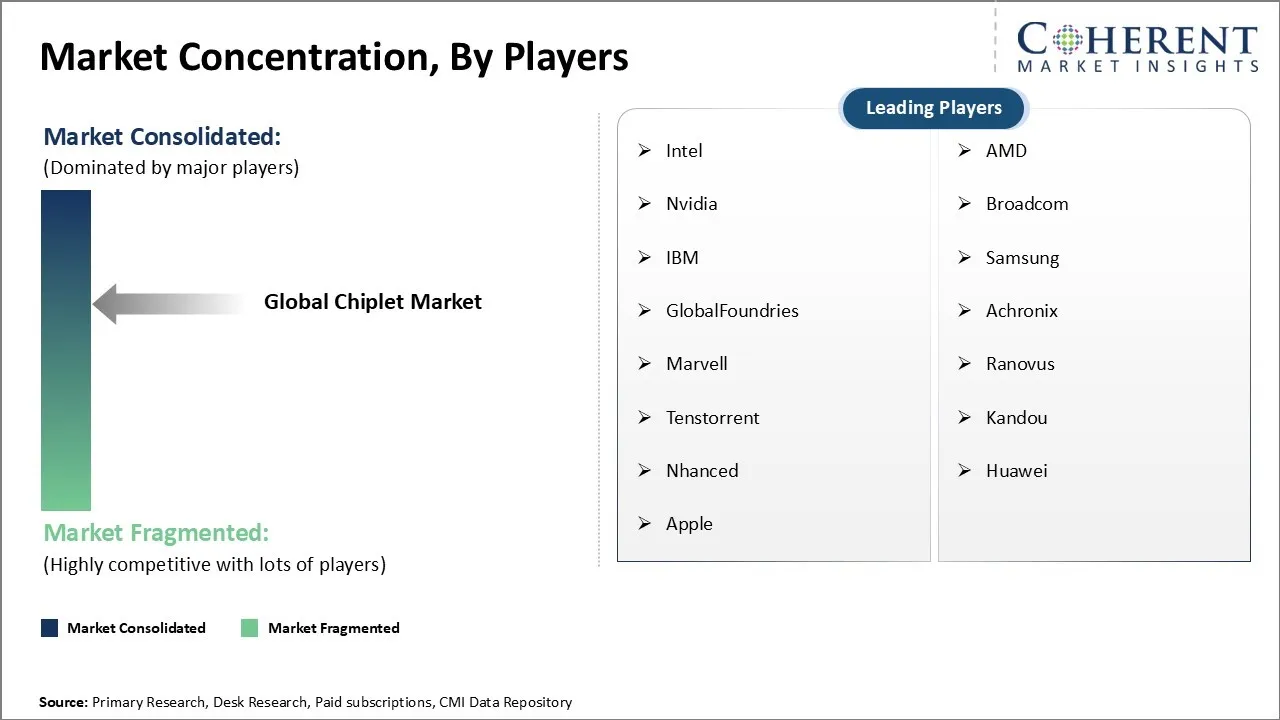
| Companies covered: | Intel, AMD, Nvidia, Broadcom, IBM, Samsung, GlobalFoundries, Achronix, and Marvell, Ranovus, Tenstorrent, Kandou, Nhanced, Huawei, and Apple | ||
| Growth Drivers: |
| ||
| Restraints & Challenges: |
| ||
Market Dynamics
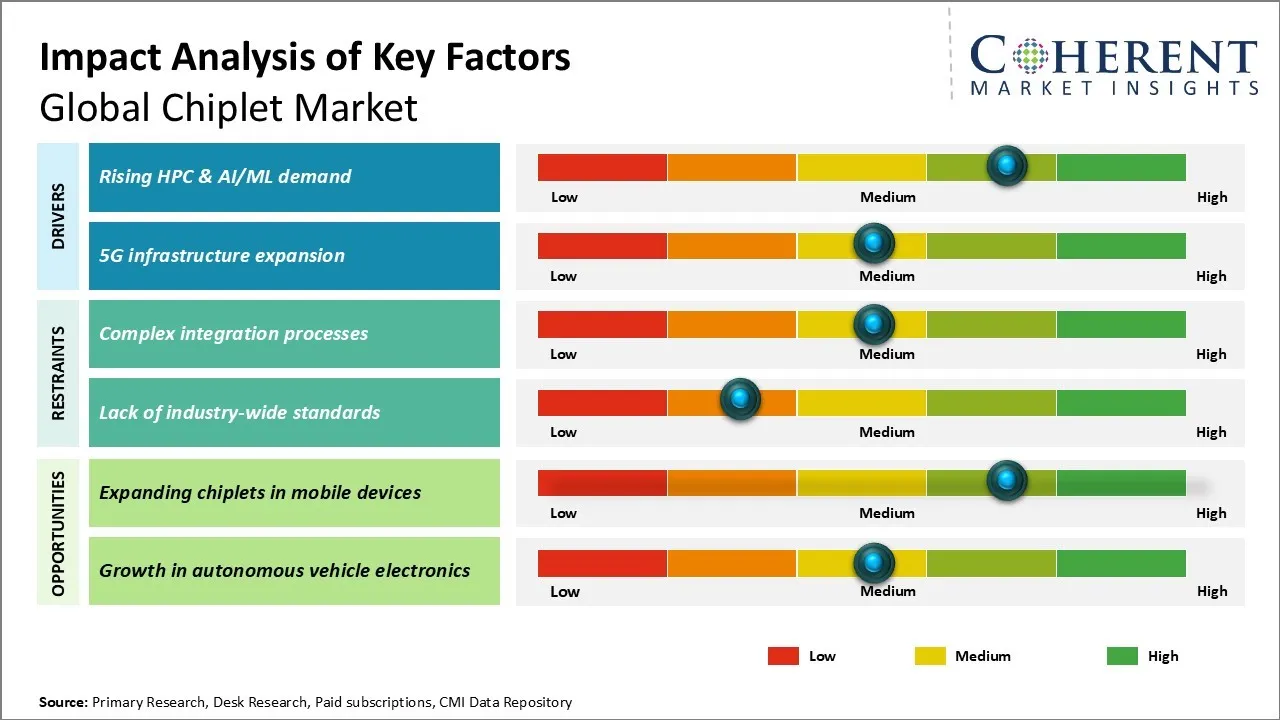
Global Chiplet Market Driver - Rising HPC & AI/ML Demand
The surging demand for high-performance computing (HPC) capabilities alongside rapid advancements in artificial intelligence (AI) and machine learning (ML) technologies is significantly propelling the adoption of chiplet architectures in the semiconductor industry. As computational workloads become increasingly complex, traditional monolithic chip designs struggle to balance performance, power efficiency, and cost-effectiveness. Chiplet-based designs offer a modular approach, enabling the integration of heterogeneous components optimized for specific AI and HPC tasks, thereby enhancing processing efficiency and scalability. This is especially critical for AI/ML applications that require massive parallel processing, memory bandwidth, and specialized accelerators, often achievable through a combination of diverse chiplets working seamlessly. Additionally, the need for rapid innovation and shorter product cycles in AI and HPC markets incentivizes the use of chiplets to improve time-to-market and flexibility in chip design. Consequently, the rising computational demands in AI and HPC sectors are acting as a primary driver for the expanded adoption of chiplet technologies globally.
Global Chiplet Opportunity - Expanding Chiplets in Mobile Devices
The growing adoption of chiplet technology in mobile devices presents a significant opportunity within the global chiplet market. As mobile devices continue to demand higher performance, improved energy efficiency, and enhanced customization, chiplets offer a modular approach that enables manufacturers to integrate diverse functionalities into smaller form factors. This modularity allows for the combination of specialized dies such as processors, memory, and connectivity chips, each optimized for specific tasks, thereby overcoming limitations associated with monolithic chip design.
Furthermore, chiplets facilitate faster time-to-market and cost efficiencies by enabling reuse of proven components, which is critical in the highly competitive and rapidly evolving mobile sector. With trends toward 5G adoption, AI capabilities, and augmented reality applications on smartphones and tablets, chiplets provide scalable solutions that can be tailored to these advanced requirements. Mobile OEMs are increasingly investing in chiplet architectures to enhance device differentiation while managing power consumption and thermal constraints effectively. Additionally, advancements in chiplet interconnect standards and packaging technologies are accelerating the integration of heterogeneous components, expanding the scope of chiplet applications in mobile platforms.
Analyst Opinion (Expert Opinion)
- Technologies like Foveros Direct (Intel) and TSMC’s SoIC are redefining chiplet interconnects by enabling sub-10µm copper-to-copper bonding, reducing latency and power loss. These innovations make chiplet-based systems nearly equivalent in performance to monolithic chips while offering greater modularity and scalability—critical for advanced AI and HPC workloads.
- At the same time, optical I/O chiplets, developed by players like Ranovus and Ayar Labs, are emerging as game-changers for AI data centers. By replacing electrical interconnects with photonics, these chiplets enable ultra-high bandwidth and significantly lower power consumption. As AI models grow larger and demand faster data movement, photonic chiplets will become essential to support the next generation of compute infrastructure.
- The rise of domain-specific AI accelerators from companies like AMD, Tenstorrent, and Marvell is accelerating the demand for customizable chiplet architectures. These allow designers to quickly mix and match compute, memory, and I/O modules based on specific performance needs. This modular approach is lowering barriers to entry, fostering greater innovation across the ecosystem, and shifting the semiconductor industry toward a more open and competitive landscape.
Speak to the analyst
Want personalized insights?
Take the findings above to one of our principal consultants, or have the report rebuilt around the segments, geographies and competitors you actually track.
Market Segmentation
- Processor Type Insights (Revenue, USD Bn, 2021 - 2033)
- CPUs
- AI ASIC Coprocessors
- GPUs
- APUs
- FPGAs
- Packaging Technology Insights (Revenue, USD Bn, 2021 - 2033)
- 5D/3D Interposers
- SiP
- WLCSP
- FCCSP
- FCBGA
- Fan Out
- Regional Insights (Revenue, USD Bn, 2021 - 2033)
- North America
- U.S.
- Canada
- Latin America
- Brazil
- Argentina
- Mexico
- Rest of Latin America
- Europe
- Germany
- U.K.
- Spain
- France
- Italy
- Russia
- Rest of Europe
- Asia Pacific
- China
- India
- Japan
- Australia
- South Korea
- ASEAN
- Rest of Asia Pacific
- Middle East
- GCC Countries
- Israel
- Rest of Middle East
- Africa
- South Africa
- North Africa
- Central Africa
- North America
- Key Players Insights
- Intel
- AMD
- Nvidia
- Broadcom
- IBM
- Samsung
- GlobalFoundries
- Achronix
- Marvell
- Ranovus
- Tenstorrent
- Kandou
- Nhanced
- Huawei
- Apple
Sources
Primary Research Interviews
Stakeholders
- Semiconductor Manufacturers and Fabricators (e.g., Intel, TSMC, Samsung)
- AI Hardware and HPC System Integrators
- IC Packaging and OSAT Service Providers (e.g., ASE Group, Amkor Technology)
- EDA Tool Developers (e.g., Synopsys, Cadence)
- Advanced Materials Suppliers for Interposers and Substrates
- Tech Startups and Research Labs in Photonics and Chiplet Design
Databases
- Eurostat
- U.S. Census
- OECD Semiconductor Statistics Portal
Magazines
- Semiconductor Today
- Chip Integration Monthly
- Electronic Design Weekly
- Advanced Packaging Insight
Journals
- Journal of Microelectronics and Packaging
- IEEE Transactions on Components, Packaging and Manufacturing Technology
- AI Hardware & Systems Journal
- Journal of Advanced Semiconductor Technology
Newspapers
- Tech Times Asia
- Electronics Business Daily
- The Silicon Review Global
- Financial Tech Tribune
Associations
- International Semiconductor Consortium (ISC)
- Chiplet Design Alliance (CDA)
- Open Compute Project (OCP)
- Institute of Electrical and Electronics Engineers (IEEE)
- Global Semiconductor Packaging Association (GSPA)
Public Domain Sources
- U.S. Census Bureau
- EUROSTAT
- United Nations Economic Commission for Europe (UNECE)
- World Bank
- ResearchGate
Proprietary Elements
- CMI Data Analytics Tool, Proprietary CMI Existing Repository of Information for the Last 8 Years
Get access to 250+ pages report
Every segment, forecast, competitor profile and data table behind the analysis above — available for instant download.
- ESOMAR Member
- ISO 9001:2015 Certified
- D-U-N-S Registered
- GDPR & CCPA Compliant
Missing comfort of reading report in your local language? Find your preferred language:
Transform your Strategy with Exclusive Trending Reports
Frequently Asked Questions
The global chiplet market is estimated to be valued at USD 19.27 Bn in 2026 and is expected to reach USD 816.98 Bn by 2033.
The CAGR of the global chiplet market is projected to be 70.8% from 2026 to 2033.
Rising HPC & AI/ML demand and 5G infrastructure expansion are the major factors driving the growth of the global chiplet market.
Complex integration processes and lack of industry-wide standards are the major factors hampering the growth of the global chiplet market.
In terms of processor type, the CPUs segment is estimated to dominate the market revenue share in 2026.
Intel, AMD, Nvidia, Broadcom, IBM, Samsung, Global Foundries, Achronix, Marvell, Ranovus, Tenstorrent, Kandou, Nhanced, Huawei, and Apple are the major players in the global chipset market.
Asia Pacific is expected to lead the global chiplet market in 2026.