

Global Class 7 Truck Market Size and Forecast – 2026-2033
The global Class 7 truck market is estimated to be valued at USD 35.16 Bn in 2026 and is expected to reach USD 46.27 Bn by 2033, exhibiting a compound annual growth rate (CAGR) of 4.0% from 2026 to 2033.
Key Takeaways of the Class 7 Truck Market:
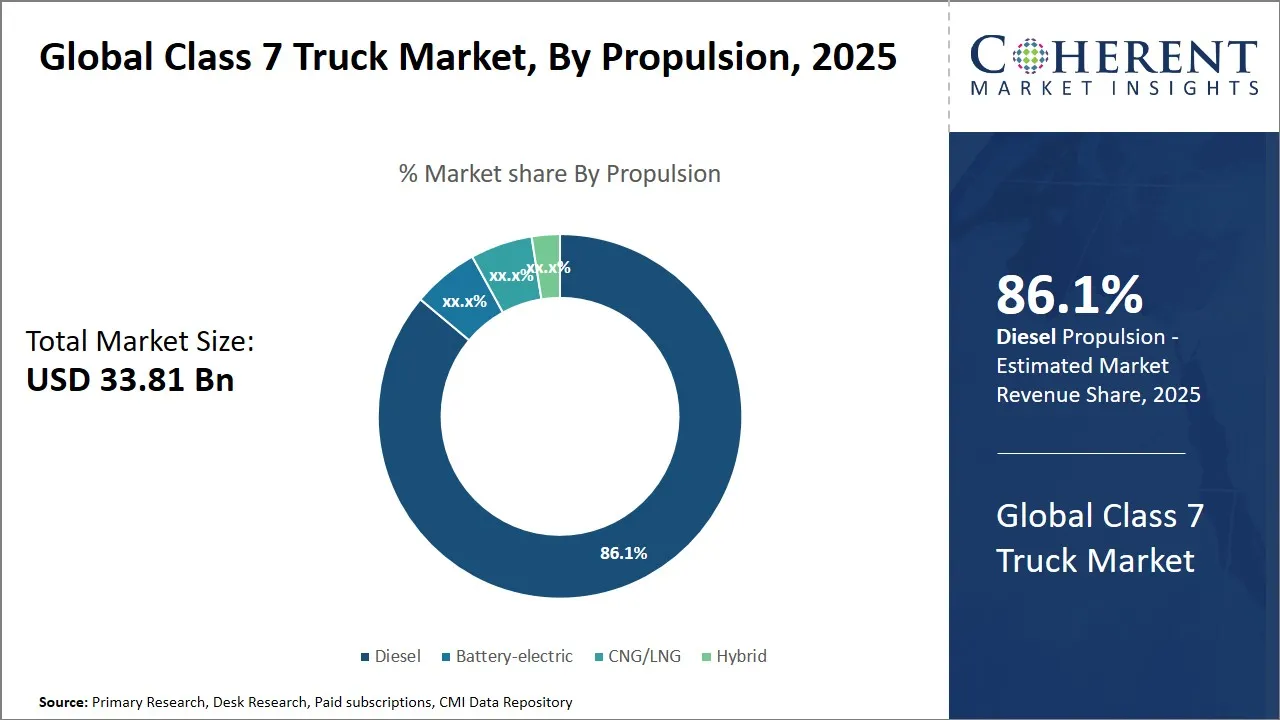
- The diesel segment leads the market holding an estimated share of 87.1% in 2026.
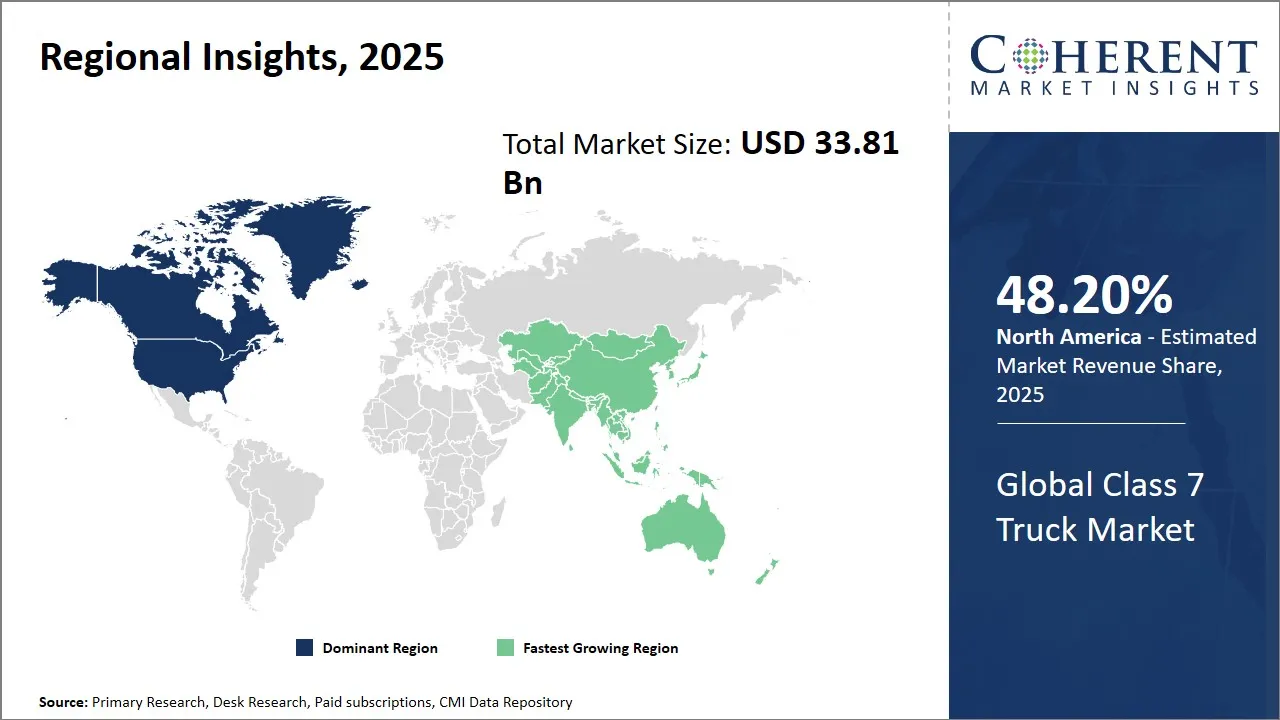
- North America is estimated to lead the market with a share of 48. 2% in 2026.
- Asia Pacific is expected to hold a share of 32. 8% in 2026, and it is projected to be the fastest growing region.
Market Overview
The market is seeing a growing focus on sustainability and fuel efficiency, with manufacturers adopting alternative fuel technologies, such as electric and hybrid engines, in Class 7 trucks. Also, the use of connected vehicle technologies and telematics is transforming fleet management, making possible improved route optimization and maintenance scheduling.
Current Events and Its Impact
Current Events | Description and its impact |
Geopolitical and Trade Developments |
|
Economic and Infrastructure Trends |
|
Segmental Insights
- Current Industry Events of 2026
- Market Size Estimation
- Regional Breakdown
- Competitive Landscape
- Customer Intelligence
- Segmental Analysis
- Pricing Analysis
- Key Market Drivers, Challenges & Future Trends
- Customized Insights Section
Global Class 7 Truck Market Insights, by Propulsion – Diesel Segment Leads Owing to its Operational Efficiency and Established Infrastructure
Diesel segment is expected to hold a share of 87.1% in 2026. Diesel engines offer superior fuel efficiency and torque output, which are important for heavy-duty applications needing reliable power and performance over long hauls. Diesel also benefits from an extensive and widely accessible network of fueling stations, ensuring minimal downtime and greater route flexibility for Class 7 truck operators.
Isuzu Commercial Truck of America introduced the 2022 F-Series (Class 6–7) lineup in North America, featuring the Cummins B6.7 diesel engine rated at 260 hp and 660 lb-ft torque. Technological advancements in diesel engine design have also added to sustaining the segment’s dominance. Improvements in emission control technologies, such as Selective Catalytic Reduction (SCR) and Diesel Particulate Filters (DPF), have enabled diesel engines to meet stricter environmental regulations without compromising performance.
Pricing Analysis of the Class 7 Truck Market
Segment/Configuration (2025) | Price (USD) — Typical Range |
New Class 7 Diesel — Cab & Chassis (base spec) | USD 80,000 – USD 140,000 |
New Class 7 Diesel — 24–26 ft Box (Straight) Truck | USD 100,000 – USD 130,000 |
New Class 7 BEV — Straight/Box (before incentives) | USD 190,000 – USD 330,000 |
New Class 7 BEV — Effective in California after HVIP | USD 105,000 – USD 245,000 |
Used Class 7 Diesel — 3–6 yrs, 24–26 ft Box | USD 45,000 – USD 115,000 |
Regional Insights
North America Class 7 Truck Market Analysis and Trends
North America is estimated to lead the market with a share of 48.2% in 2026 because of technological advancements, stringent emissions regulations, and increasing adoption of electric and alternative fuel trucks. The market growth is seeing strong government regulations promoting sustainability and safety standards, alongside incentives for eco-friendly vehicle purchases. The U.S. and Canada, with well-established supply chains and advanced highway infrastructure, provide a good environment for growth. Major players like Navistar International, Freightliner, and PACCAR are innovating through electrification and connectivity features, adding to the market growth.
Asia Pacific Class 7 Truck Market Analysis and Trends
Asia Pacific, holding an estimated share of 32.8% in 2026, stands as the fastest growing region because of its extensive industrial base, fast expanding logistics sector, and supportive government initiatives aimed at upgrading transportation infrastructure. Countries like China, India, and Japan add to market demand through burgeoning e-commerce, infrastructure development, and rising urbanization.
The region's robust manufacturing ecosystem benefits from the presence of leading truck manufacturers such as Tata Motors, Ashok Leyland, and Hino Motors, which offer a broad portfolio of class 7 trucks tailored for diverse applications. Additionally, favorable trade policies and investments in smart transportation systems contribute to the dominance of Asia Pacific by improving operational efficiency and cost-effectiveness for fleet operators.
Class 7 Truck Market Outlook for Key Countries
U.S. Class 7 Truck Market Analysis and Trends
The U.S. Class 7 truck market is influenced by stringent Environmental Protection Agency (EPA) regulations and rising demand for energy-efficient vehicles. The country benefits from an extensive logistics infrastructure supporting freight and distribution networks. Industry leaders such as Freightliner and Navistar lead through continuous innovation in electric and hybrid truck technologies, strengthening their market position. Moreover, the growing e-commerce sector and last-mile delivery services intensify demand for Class 7 trucks optimized for urban and regional applications, ensuring sustained the market advancement.
China Class 7 Truck Market Analysis and Trends
China is seeing strong government policies including subsidies for new energy vehicles and extensive investments in infrastructure development. Domestic manufacturers like Dongfeng Motor Corporation and FAW Group have a strong presence, using large-scale production capabilities to serve both domestic and export markets. The government’s focus on reducing emissions and promoting green logistics has added to the adoption of electric and CNG-powered Class 7 trucks.
India Class 7 Truck Market Analysis and Trends
India Class 7 truck market sees fast urbanization and growing industrial activities, especially in logistics, mining, and construction segments. Players like Tata Motors and Ashok Leyland are leading, providing vehicles that are tailored to the country’s terrain and load requirements. Government initiatives, such as the Faster Adoption and Manufacturing of Hybrid and Electric Vehicles (FAME) scheme, create a lot of demand for efficient and eco-friendly trucks.
Germany Class 7 Truck Market Analysis and Trends
Germany is seeing a strong presence of advanced manufacturers like Mercedes-Benz and MAN Truck & Bus, that are working on innovations in fuel efficiency and digitization. The country’s strict emissions standards and focus on environmental sustainability push manufacturers to introduce electric and hydrogen-powered Class 7 trucks. Germany’s industrial backbone, including automotive, manufacturing, and logistics sectors, is responsible for the consistent demand seen in the country.
Market Players, Key Development, and Competitive Intelligence
Key Developments
- In April 2025, Peterbilt showcased a broad range of zero emission solutions, including the Next-Generation Model 579EV and the All-New Model 567EV, the industry’s first electric heavy duty conventional vocational truck, during ACT Expo at the Anaheim Convention Center in Anaheim, U.S.
- In January 2025, Red Bull North America become the first customer for Isuzu’s new NRR-EV Class 5 electric box truck.
- In March 2024, Daimler Truck North America LLC (DTNA) announced the delivery of its first battery-electric Freightliner eM2 trucks.
- In June 2023, Mack Trucks announced that its Mack MD Electric model is approved to be a part of California’s Hybrid and Zero-Emission Truck and Bus Voucher Incentive Project (HVIP). HVIP can help accelerate the commercialization of zero-emission trucks by offering point-of-sale vouchers to increase the affordability of advanced technologies.
Top Strategies Followed by Class 7 Truck Market Players
- Established manufacturers dominate the sector through significant investments in research and development, striving to innovate high-performance, fuel-efficient, and technologically advanced trucks.
- Daimler Truck North America (Freightliner) launched the eM2 battery-electric Class 7 truck in 2024 after years of R&D investment in zero-emission drivetrains and digital platforms. The truck integrates advanced telematics (Detroit Connect) and fast-charging capabilities to maintain its technological lead.
- Mid-level competitors in the Class 7 truck market emphasize providing cost-effective solutions that offer an optimal balance between quality and affordability, aiming to attract price-sensitive customers such as small and medium-sized enterprises and fleet operators with constrained budgets.
- Ashok Leyland (India) expanded its AVTR modular truck platform into the medium-duty/Class 7 equivalent range in 2024. By using modularity, common parts, and locally sourced components, the company delivers cost-efficient trucks tailored for price-sensitive markets without sacrificing durability.
- Small-scale players in the Class 7 truck market carve out their presence by focusing on niche market needs and innovative product differentiation.
- Lion Electric (Canada) focuses on electric medium-duty vocational and school buses, including Class 7 urban trucks, carving out a specialized EV niche instead of competing directly on volume with larger OEMs.
Market Report Scope
Class 7 Truck Market Report Coverage
| Report Coverage | Details | ||
|---|---|---|---|
| Base Year: | 2025 | Market Size in 2026: | USD 35.16 Bn |
| Historical Data for: | 2020 To 2024 | Forecast Period: | 2026 To 2033 |
| Forecast Period 2026 to 2033 CAGR: | 4.0% | 2033 Value Projection: | USD 46.27 Bn |
| Geographies covered: |
| ||
| Segments covered: |
| ||
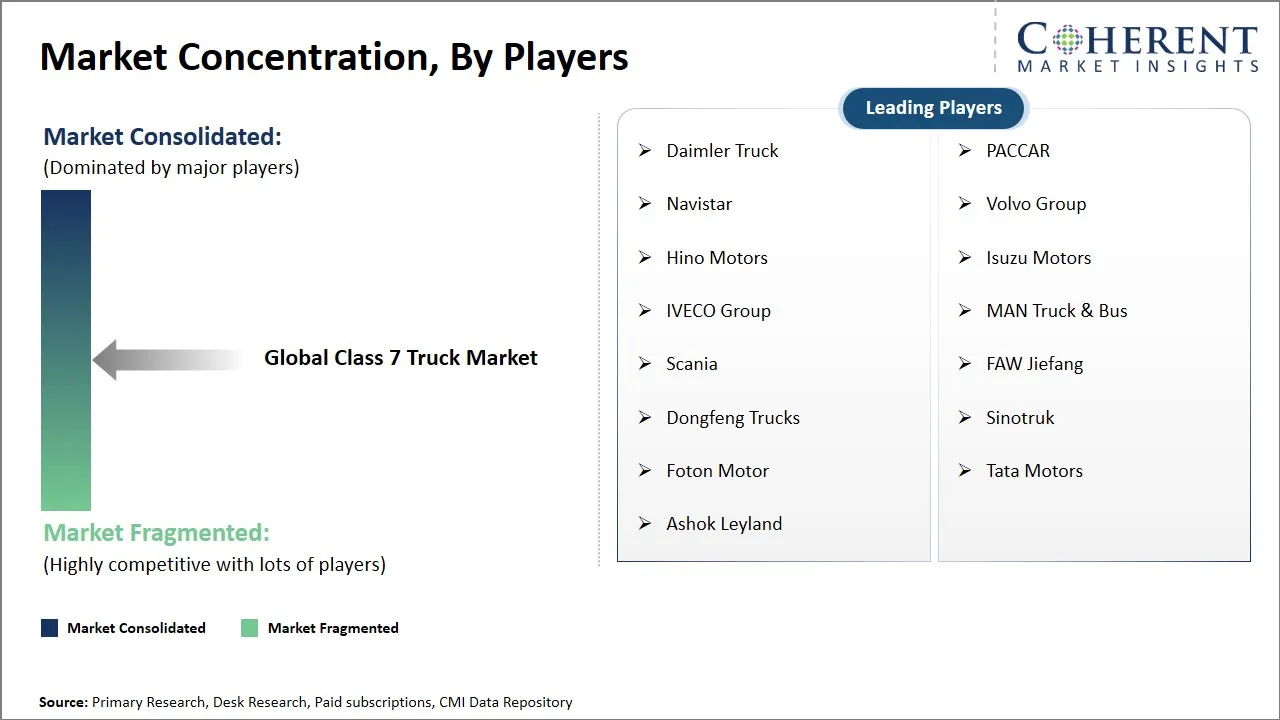
| Companies covered: | Daimler Truck, PACCAR, Navistar, Volvo Group, Hino Motors, Isuzu Motors, IVECO Group, MAN Truck & Bus, Scania, FAW Jiefang, Dongfeng Trucks, Sinotruk, Foton Motor, Tata Motors, and Ashok Leyland | ||
| Growth Drivers: |
| ||
| Restraints & Challenges: |
| ||
Market Dynamics
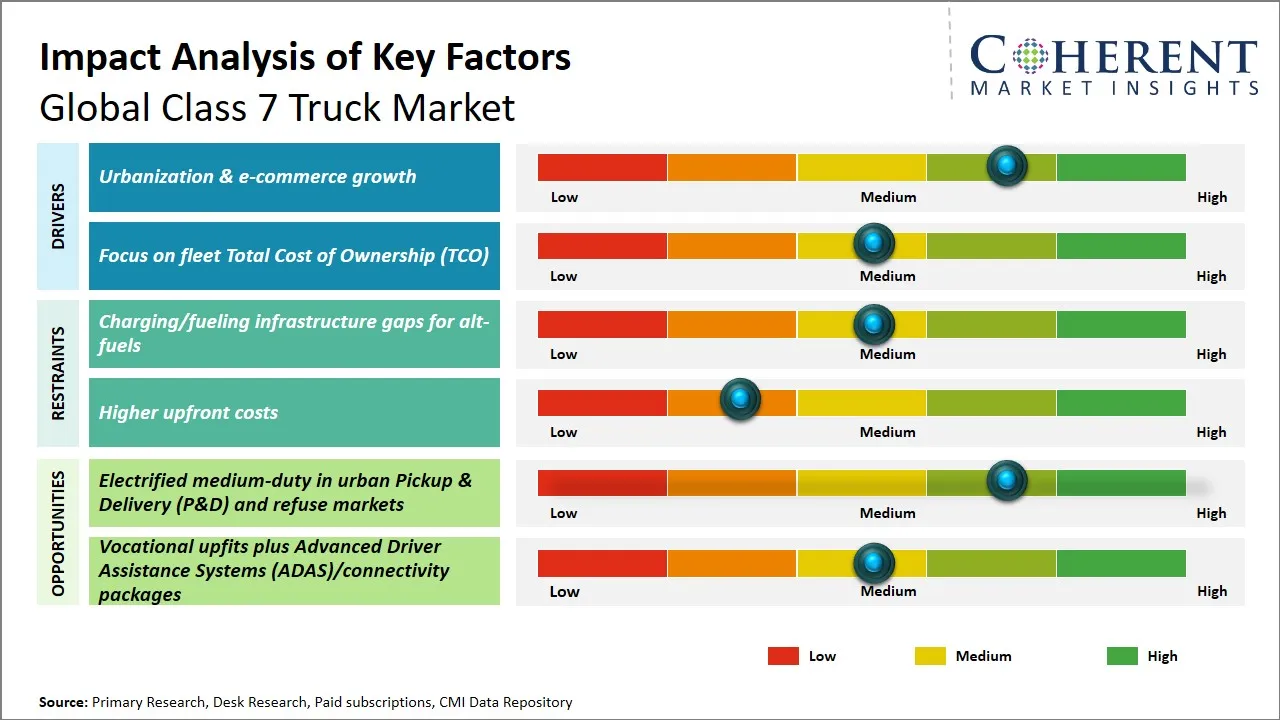
Global Class 7 Truck Market Driver - Urbanization & E-Commerce Growth
As metropolitan areas continue to expand, consumer expectations for faster delivery times and broader product availability are putting increased pressure on logistics providers to optimize their fleets. The Class 7 trucks, with their moderate size and substantial payload capacity, offer the perfect balance for navigating congested urban environments while handling heavier loads than smaller delivery vehicles. Additionally, the surge in online shopping has led to higher shipping volumes and more frequent deliveries, necessitating versatile trucks that can meet varying transportation needs.
Amazon has significantly expanded its medium-duty fleet in North America to keep pace with e-commerce growth and urban delivery needs. The company operates thousands of Freightliner M2 (Class 6–7) box trucks through its Delivery Service Partners (DSP) network to move goods between fulfillment centers and local delivery stations.
Global Class 7 Truck Market Opportunity – Electrified Medium-Duty Trucks in Urban Pickup & Delivery and Refuse Markets
The rising demand for sustainable transportation solutions presents a significant opportunity in the global Class 7 truck market through the electrification of medium-duty trucks, particularly in urban pickup and delivery (P&D) as well as refuse collection segments. Urban P&D operations are characterized by short travel distances, frequent stops, and low average speeds, making electric Class 7 trucks an ideal fit due to their ability to leverage regenerative braking and reduced energy consumption in stop-and-go traffic.
Republic Services, one of the largest U.S. waste management companies, placed an order for hundreds of Oshkosh/McNeilus Volterra ZSL electric refuse trucks in 2024 after pilot deployments proved successful. These Class 7–equivalent electric refuse trucks are designed for urban stop-and-go duty cycles, benefiting from regenerative braking, quiet operation, and zero tailpipe emissions.
Additionally, municipalities and private operators responsible for refuse collection are increasingly under regulatory pressure to reduce emissions and noise pollution, creating a growing market for electric refuse trucks. Advancements in battery technology and charging infrastructure, coupled with declining total cost of ownership compared to diesel counterparts, are further accelerating adoption. Governments across North America, Europe, and Asia Pacific are incentivizing fleet electrification through subsidies, stricter emission standards, and low-emission zones, propelling fleet operators to transition to electric medium-duty trucks.
Analyst Opinion (Expert Opinion)
- Class 7 trucks are seeing a lot of demand for construction, utilities, and municipal applications as they offer the ideal balance of payload and maneuverability for dump, bucket, and service configurations. Government-funded infrastructure projects and public works programs are expected to keep these segments resilient.
- Pickup & delivery (P&D), food & beverage logistics, and reefer applications are seeing strong growth, fueled by rapid urbanization and the surge in e-commerce. Fleets increasingly view Class 7 box trucks as a cost-effective bridge between light-duty vans and heavy-duty rigs for dense last-mile and regional routes.
- The refuse and recycling sector is showing early, concentrated adoption of battery-electric Class 7 trucks due to predictable urban duty cycles and regulatory incentives. This niche is expected to lead broader electrification adoption, gradually influencing other end use categories like urban P&D.
Speak to the analyst
Want personalized insights?
Take the findings above to one of our principal consultants, or have the report rebuilt around the segments, geographies and competitors you actually track.
Market Segmentation
- Propulsion Insights (Revenue, USD Bn, 2021 - 2033)
- Diesel
- Battery-electric
- CNG/LNG
- Hybrid
- Regional Insights (Revenue, USD Bn, 2021 - 2033)
- North America
- U.S.
- Canada
- Latin America
- Brazil
- Argentina
- Mexico
- Rest of Latin America
- Europe
- Germany
- U.K.
- Spain
- France
- Italy
- Russia
- Rest of Europe
- Asia Pacific
- China
- India
- Japan
- Australia
- South Korea
- ASEAN
- Rest of Asia Pacific
- Middle East
- GCC Countries
- Israel
- Rest of Middle East
- Africa
- South Africa
- North Africa
- Central Africa
- North America
- Key Players Insights
- Daimler Truck
- PACCAR
- Navistar
- Volvo Group
- Hino Motors
- Isuzu Motors
- IVECO Group
- MAN Truck & Bus
- Scania
- FAW Jiefang
- Dongfeng Trucks
- Sinotruk
- Foton Motor
- Tata Motors
- Ashok Leyland
Sources
Primary Research Interviews
Stakeholders
- Fleet Operators and Logistics Companies
- Vocational Equipment Integrators
- Municipal Procurement Officers (Public Works & Sanitation Departments)
- Truck Dealership Networks and Leasing Firms
- Battery and Powertrain Component Suppliers (for BEV Class 7 trucks)
- Sustainability Consultants and Emission Compliance Experts
Databases
- U.S. Department of Transportation (DOT) Data
- Eurostat
- Organisation for Economic Co-operation and Development (OECD) Transport Statistics
- U.S. Census – Vehicle Inventory and Use Survey (VIUS)
- Fleet Owner Data Portal
Magazines
- Heavy Duty Trucking (HDT)
- Fleet Owner Magazine
- Transport Topics
- Commercial Carrier Journal (CCJ)
Journals
- SAE International Journal of Commercial Vehicles
- Journal of Transportation Engineering
- International Journal of Heavy Vehicle Systems
- Journal of Cleaner Production (for sustainable truck technologies)
Newspapers
- The Wall Street Journal (U.S.)
- The Economic Times (India)
- Nikkei Asia (Japan)
- The Guardian (UK)
- Transport News International
Associations
- American Trucking Associations (ATA)
- North American Council for Freight Efficiency (NACFE)
- Society of Automotive Engineers (SAE)
- Japan Trucking Association (JTA)
- European Automobile Manufacturers’ Association (ACEA)
Public Domain Sources
- U.S. Census Bureau
- EUROSTAT
- World Bank – Transport Indicators
- International Energy Agency (IEA)
- United Nations Economic Commission for Europe (UNECE)
- ResearchGate
Proprietary Elements
- CMI Data Analytics Tool
- Proprietary CMI Existing Repository of Information for Last 8 Years
Get access to 250+ pages report
Every segment, forecast, competitor profile and data table behind the analysis above — available for instant download.
- ESOMAR Member
- ISO 9001:2015 Certified
- D-U-N-S Registered
- GDPR & CCPA Compliant
Missing comfort of reading report in your local language? Find your preferred language:
Transform your Strategy with Exclusive Trending Reports
Frequently Asked Questions
The global Class 7 truck market is estimated to be valued at USD 35.16 billion in 2026 and is expected to reach USD 46.27 billion by 2033.
The CAGR of the global Class 7 truck market is projected to be 4.0% from 2026 to 2033.
Urbanization & e-commerce growth and focus on fleet Total Cost of Ownership (TCO) are the major factors driving the growth of the global Class 7 truck market.
Charging/fueling infrastructure gaps for alt-fuels and higher upfront costs are the major factors hampering the growth of the global Class 7 truck market.
In terms of propulsion, the diesel segment is estimated to dominate the market revenue share in 2026.
A Class 7 truck is a medium-heavy-duty vehicle with a Gross Vehicle Weight Rating (GVWR) of 26,001–33,000 lbs. Typical examples include city delivery trucks, refuse trucks, and utility/service vehicles.
A Class 8 truck is a heavy-duty vehicle with a GVWR above 33,000 lbs. This class covers tractor-trailers, cement mixers, and dump trucks—vehicles commonly used for long-haul freight and heavy vocational applications.