

Global Class D Audio Amplifier Market Size and Forecast – 2026 To 2033
The global Class D audio amplifier market is expected to grow from USD 4 Bn in 2026 to USD 8 Bn by 2033, registering a compound annual growth rate (CAGR) of 8% from 2026 to 2033. The global Class D audio amplifier market is driven by increasing audio enhancements in home entertainment systems. On June 24, 2026, Sony announced the expansion of its BRAVIA Theatre portfolio with the launch of the Flagship model BRAVIA Theatre Trio alongside the BRAVIA Theatre Bar 7, BRAVIA Theatre Bar 5, BRAVIA Theatre Sub 9, BRAVIA Theatre Sub 8, BRAVIA Theatre Rear 9 and Rear 8.
Key Takeaways of the Global Class D Audio Amplifier Market
- The mono channel segment is expected to account for 34.0% of the global Class D audio amplifier market share in 2026. Advancements in semiconductor manufacturing technologies is driving the growth of the segment. On April 23, 2026, TSMC debuted its latest innovation in its most advanced process technology, the A13 process, at the company’s 2026 North America Technology Symposium.
- The consumer electronics segment is estimated to capture 29.0% of the market share in 2026. Growing miniaturization of consumer electronic products is majorly driving the growth of the segment. On January 6, 2026, Lenovo introduced the Legion Pro Rollable concept laptop at CES 2026, incorporating a rollable OLED display and compact internal architecture to reduce device footprint while expanding screen size on demand, reflecting the industry's move toward highly miniaturized consumer electronics.
- Asia Pacific is expected to dominate the Class D audio amplifier market in 2026 with a market share of 42.0%. Expansion of IoT-enabled smart home devices in Asia Pacific is driving the growth of the regional market. On May 21, 2026, Xiaomi announced strong expansion of its "Human × Car × Home" ecosystem, with its AIoT platform surpassing one billion connected devices and continued rollout of interconnected smart home products.
- North America is expected to account for 27.0% share in 2026 and is projected to record the fastest growth over the forecast period. Rising demand for compact medical and industrial audio equipment in North America is driving the growth of the regional market. In January 2026, Eko Health gained U.S. FDA authorization for its CORE 500 Digital Stethoscope, which has AI-assisted cardiac assessment, built-in digital audio processing and improved acoustic performance for compact point-of-care diagnostics.
- Increasing integration of AI-enabled audio processing: Manufacturers are integrating Class D amplifiers with AI-driven digital signal processing to enable adaptive sound optimization, voice enhancement, intelligent noise reduction and personalized listening experiences across smart speakers, televisions and automotive infotainment
- Growing adoption in electric and software defined vehicles: Automotive OEMs are using high-efficiency Class D amplifiers to create immersive multi-speaker audio systems with reduced power consumption and enhanced electric car operating range.
Segmental Insights
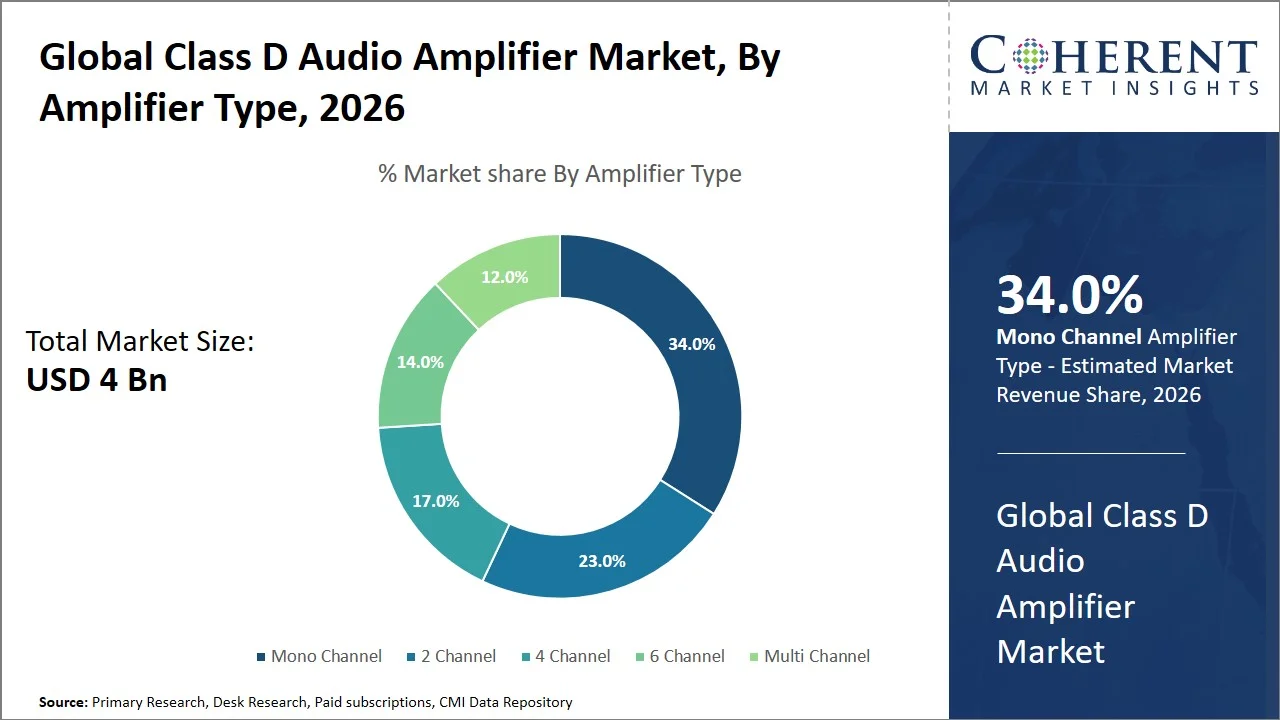
Why Does Mono Channel Dominate the Global Class D Audio Amplifier Market?
The mono channel segment is expected to account for 34.0% of the global Class D audio amplifier market share in 2026. Mono channel Class D audio amplifiers are widely used because of the growing popularity of portable and battery powered consumer gadgets. Smartphones, Bluetooth speakers, smart home gadgets, wearable electronics and compact audio products demand extremely efficient amplification with low power consumption, minimal heat output and small footprint. Mono channel Class D amplifiers meet these requirements while reducing component counts and manufacturing costs, making them the ideal choice for high volume consumer electronic applications where energy efficiency and compact design are crucial. On January 6, 2026, JLab debuted the JBuds Mini ANC at CES 2026, expanding its ultra-compact true wireless earbud range with active noise cancellation and better battery efficiency, underscoring the industry's continuous focus on downsized, power-efficient audio electronics.
- Current Industry Events of 2026
- Market Size Estimation
- Regional Breakdown
- Competitive Landscape
- Customer Intelligence
- Segmental Analysis
- Pricing Analysis
- Key Market Drivers, Challenges & Future Trends
- Customized Insights Section
Why is Consumer Electronics the Most Crucial End User?
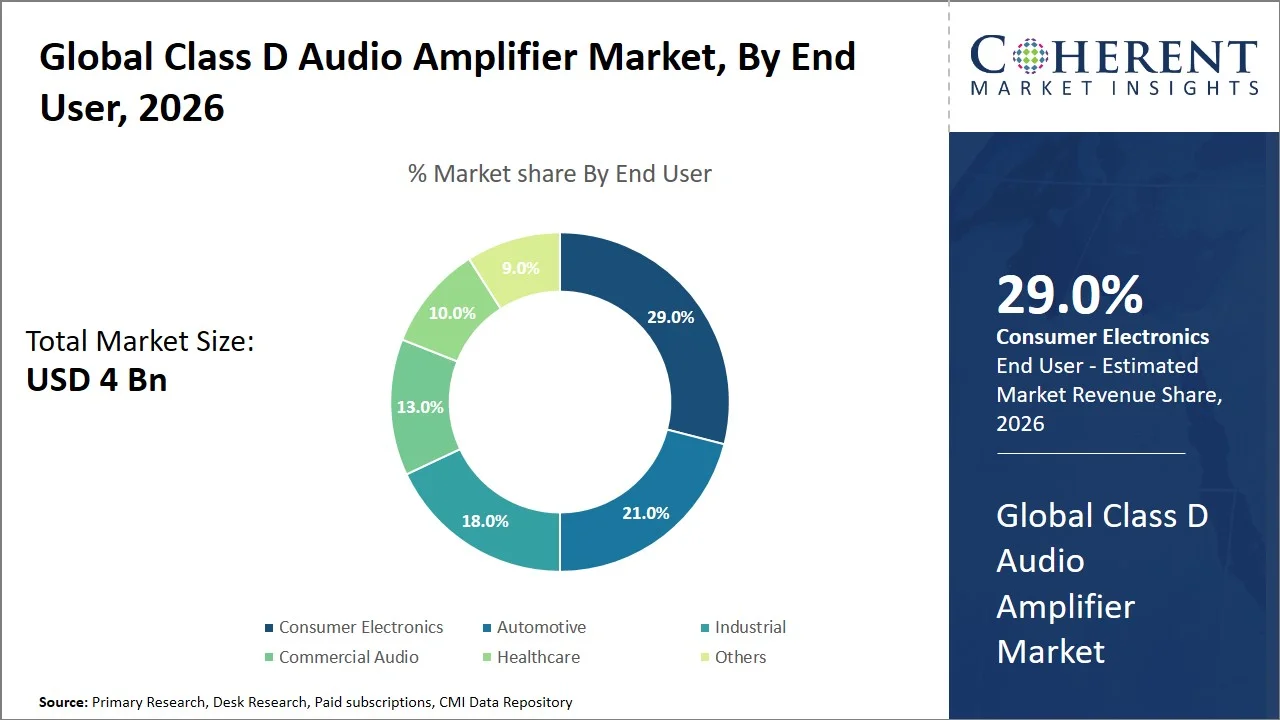
The consumer electronics segment is expected to account for 29.0% of the global Class D audio amplifier market share in 2026. Consumer electronics is the most important end user category in the Class D audio amplifier market, driven by the rapid increase in the number of smart and connected consumer products. The growing need for smartphones, smart speakers, wireless earbuds, televisions, laptops and portable audio systems has increased the demand for amplifiers with high sound quality, low power consumption and compact designs. Class D audio amplifiers are well suited to meet these needs, providing improved energy efficiency, decreased heat generation, and smaller form factors, to allow manufacturers to integrate powerful audio capabilities into space constrained and battery powered consumer electronic devices. On January 23, 2025, Samsung announced that customers can pre-order its latest Galaxy S25 Ultra, Galaxy S25+ and Galaxy S25 smartphones.
Currents Events and their Impact
Current Events | Description and its Impact |
European Union Ecodesign for Sustainable Products Regulation (ESPR) (EU) 2024/1781) |
|
European Union Right to Repair Directive (Directive (EU) 2024/1799) |
|
Class D Audio Amplifier Market Dynamics
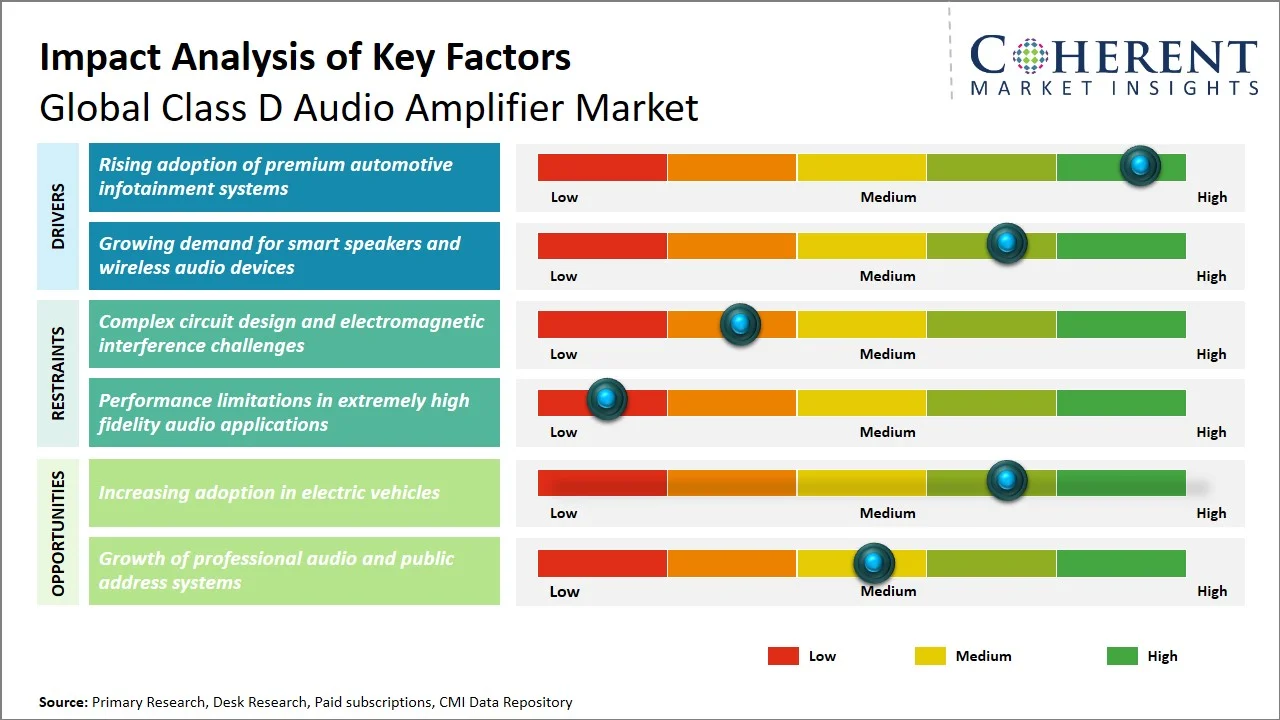
Market Drivers
Rising adoption of premium automotive infotainment systems
Automotive manufacturers are equipping vehicles with multi-channel surround sound systems, immersive in-cabin entertainment, active noise cancellation, and improved voice assistant features that require small, highly efficient amplification solutions. Class D amps are perfect for the modern automobile since they can put out lots of power with little heat and less energy. This becomes particularly significant in electric vehicles as power efficiency can translate directly to battery performance and driving range. On January 6, 2025, Pioneer Corporation showcased an immersive in-vehicle listening experience that combines Apple CarPlay, which now includes support for Spatial Audio and Dolby Atmos, with a 4-channel solution applicable to many vehicles, including the majority of automobiles in use.
Growing demand for smart speakers and wireless audio devices
The surging popularity of smart speakers, wireless earbuds, Bluetooth speakers and connected home audio systems is fueling wide use of Class D audio amplifiers. Consumers want high quality sound, long battery life and seamless wireless connectivity from tiny devices and manufacturers are progressively adopting extremely efficient amplifier technology. Class D amplifiers provide better audio performance, lower power consumption, lower heat output and smaller product sizes, enabling manufacturers to build feature-rich wireless audio products that meet changing consumer expectations. On June 17, 2026, Google released the first Google Home Speaker in six years, with Gemini-powered voice assistance, 360-degree audio, Matter controller capabilities and Thread border router support, expanding its smart home audio ecosystem.
Emerging Trends
Expansion of premium wireless and high resolution audio products
Consumer electronics companies are launching advanced Bluetooth speakers, wireless headphones and home entertainment systems with high resolution Class D amplifiers for higher sound quality in smaller containers.
Advancements in gallium nitride and silicon carbide power technologies
Semiconductor manufacturers are using wide bandgap materials to develop next-generation Class D amplifiers with faster switching frequencies, better thermal efficiency, less electromagnetic interference and greater power density for professional and industrial audio applications.
Regional Insights
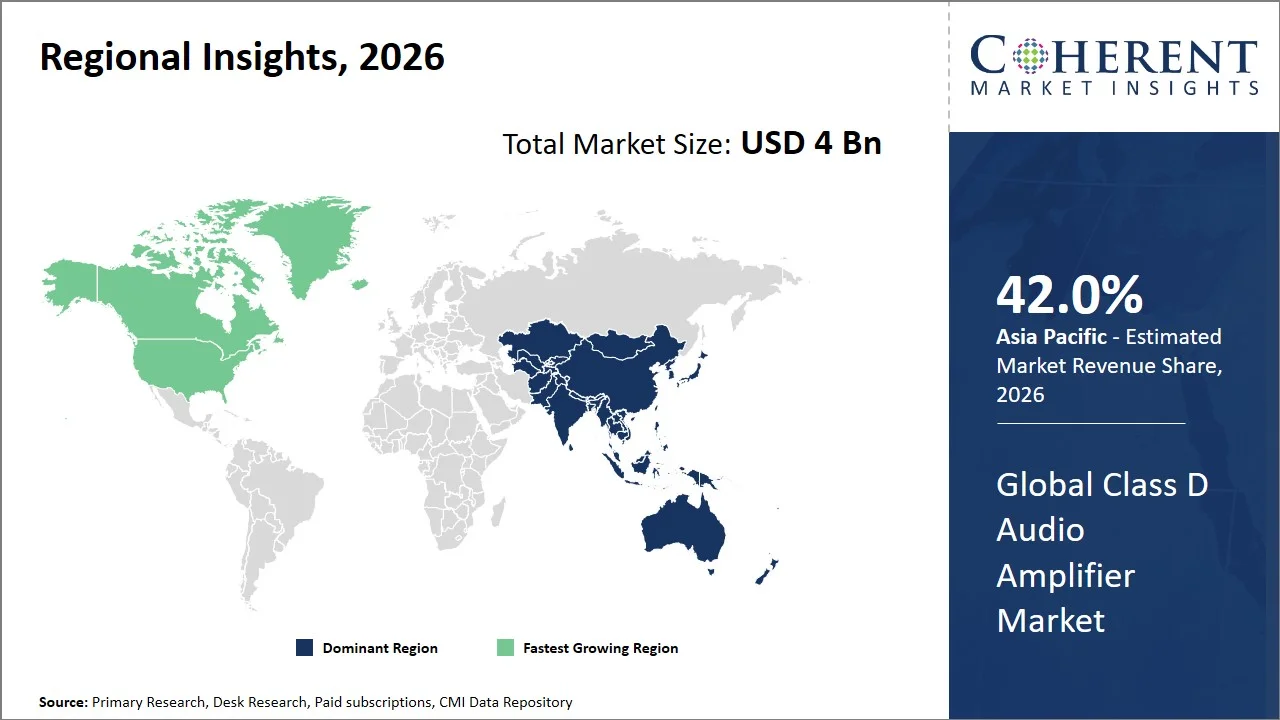
Why is Asia Pacific a Strong Market for Class D Audio Amplifiers?
Asia Pacific is expected to account for a market share of 42.0% in 2026. Asia Pacific remains the primary manufacturing hub for Class D audio amplifiers because of its concentration of consumer electronics production and semiconductor packaging facilities. China, Japan and South Korea host major manufacturing operations for brands such as Samsung, Sony, LG Electronics and Xiaomi, while Taiwanese foundries support integrated circuit production for amplifier suppliers. The rapid expansion of electric vehicle production by BYD, Hyundai and Toyota is also increasing demand for compact high efficiency audio amplifiers used in advanced in vehicle infotainment systems.
Why Does the North America Class D Audio Amplifier Market Exhibit High Growth?
North America is projected to account for 27.0% of the global Class D audio amplifier market and expected to register the fastest growth. North America is characterized by strong demand for premium consumer audio products, automotive infotainment and professional sound systems. Consistently, prominent semiconductor developers such as Texas Instruments, Analog Devices, Cirrus Logic and Monolithic Power Systems are releasing new Class D amplifier integrated circuits for automotive, industrial and consumer applications. The region is also seeing an increasing adoption of immersive home theater systems, smart speakers and connected audio platforms from the likes of Sonos and Bose.
Global Class D Audio Amplifier Market Outlook for Key Countries
Why is China Emerging as a Major Hub in the Class D Audio Amplifier Market?
China serves as the world's largest production base for smartphones, televisions, Bluetooth speakers and smart home devices, creating sustained demand for Class D audio amplifiers. Domestic manufacturers including Huawei, Xiaomi, TCL and Hisense continue integrating efficient amplifier solutions into connected consumer electronics, while electric vehicle manufacturers such as BYD, Geely and XPeng are deploying multi speaker premium audio systems that rely on high efficiency Class D amplifier architectures to reduce vehicle power consumption.
Is the U.S. the Next Growth Engine for the Class D Audio Amplifier Market?
The U.S. benefits from a strong ecosystem of semiconductor innovation and premium audio technology development. Texas Instruments continues expanding its automotive and industrial Class D amplifier portfolio, while Analog Devices and Cirrus Logic supply advanced amplifier solutions for high performance consumer electronics and automotive applications. Demand is further supported by increasing deployment of premium infotainment systems in vehicles manufactured by Tesla, General Motors and Ford, along with expanding sales of smart home audio products.
Germany Class D Audio Amplifier Market Analysis and Trends
Germany represents a key European market because of its leadership in automotive engineering and premium audio integration. Vehicle manufacturers including BMW, Mercedes Benz, Audi and Porsche increasingly incorporate sophisticated multi-channel audio systems developed with suppliers such as Harman, Bose and Burmester, driving the demand for highly efficient Class D amplifiers. The country's strong industrial electronics sector also supports adoption in commercial sound systems and professional audio equipment.
Japan Class D Audio Amplifier Market Analysis and Trends
Japan maintains a strong position through its advanced consumer electronics and automotive industries. Companies such as Sony, Yamaha, Panasonic and Pioneer continue developing premium home entertainment products, wireless audio systems and automotive infotainment platforms that require compact and energy efficient amplifier technologies. Automotive manufacturers including Toyota, Honda and Nissan are also integrating high quality digital audio systems into next generation hybrid and electric vehicles.
South Korea Class D Audio Amplifier Market Analysis and Trends
South Korea is a major innovation center for premium consumer electronics and semiconductor technologies. Samsung Electronics and LG Electronics continue expanding their portfolios of televisions, soundbars, wireless speakers and smart appliances equipped with advanced Class D amplification, while semiconductor manufacturers strengthen the regional supply chain for audio integrated circuits. Hyundai and Kia are also increasing deployment of immersive in vehicle entertainment systems, supporting the demand for high efficiency amplifier solutions in electric and connected vehicles.
Global Class D Audio Amplifier Market - Bluetooth Speaker Production And Adoption Trends (2025)
Country | Estimated Bluetooth Speaker Production (Million Units) | Domestic Adoption Rate (%) |
China | 185 | 42 |
Vietnam | 46 | 18 |
India | 28 | 24 |
U.S. | 12 | 48 |
Japan | 10 | 37 |
South Korea | 9 | 41 |
Germany | 6 | 39 |
Taiwan | 8 | 31 |
Mexico | 7 | 26 |
Indonesia | 5 | 22 |
How is Increasing Adoption in Electric Vehicles Creating New Growth Opportunities in the Class D Audio Amplifier Market?
The development opportunities in the Class D audio amplifier market are increasing with the rise in use of electric vehicles as auto manufacturers are focused on energy efficient electrical components consuming less battery power without compromising on audio performance. Class D amplifiers are very power-efficient, generate low heat, and come in compact form factors, making them perfect for today’s electric vehicle infotainment systems with numerous speakers, active noise cancellation, voice assistants, and immersive surround sound technologies. The demand for high performance Class D amplifier solutions is expected to grow in both the mass market and luxury vehicle segments with automobile manufacturers launching premium connected EVs with advanced digital cockpits. On July 7, 2026, Volvo Cars announced an over-the-air software update that brings Apple Music with Dolby Atmos and Spatial Audio to certain EX90 and ES90 electrified vehicles with Bowers & Wilkins premium audio systems.
Market Players, Key Development, and Competitive Intelligence
Key Developments
- On January 8, 2025, Texas Instruments unveiled the TAS6754-Q1 automotive Class D audio amplifier at CES 2025, strengthening its automotive audio portfolio with an integrated amplifier solution engineered for next-generation digital cockpits, premium in-vehicle infotainment systems and electric vehicles.
- On March 20, 2024, Powersoft, a world leader in audio amplification, acoustic signal processing, and transducer systems for the pro-audio industry, announced plans for a new headquarter in Florence, Italy, termed as the Powersoft Human Audio Experience Center.
Competitive Landscape
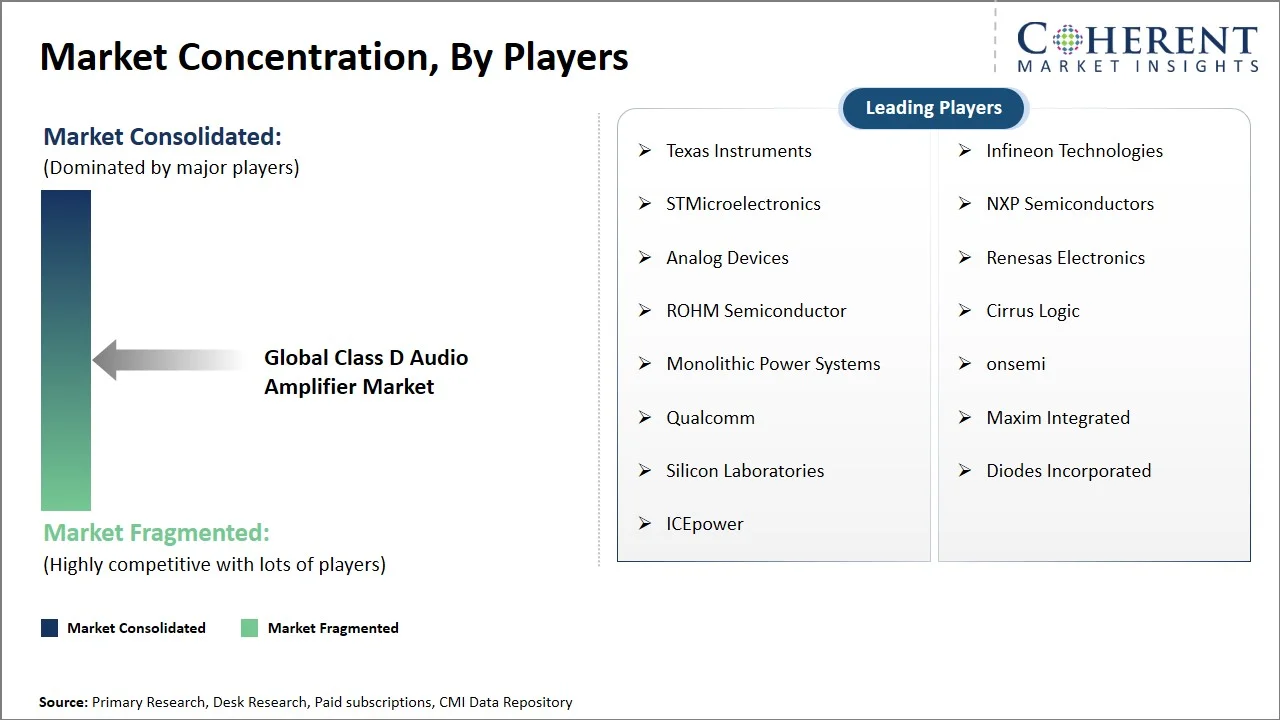
The global Class D audio amplifier market is characterized by intense competition among semiconductor manufacturers, analog integrated circuit developers and specialized audio technology providers competing on efficiency, audio fidelity, integration capabilities and automotive qualification. Texas Instruments, Infineon Technologies, STMicroelectronics, Analog Devices, NXP Semiconductors and ROHM Semiconductor continue expanding highly integrated amplifier portfolios with digital signal processing, diagnostics and low electromagnetic interference features for automotive and consumer electronics applications. Cirrus Logic and Monolithic Power Systems are enhancing their positions with diminutive amplifier solutions for smartphones, smart speakers and portable devices while ICEpower and ESS Technology are targeting high-end home audio and professional sound applications.
Market Report Scope
Class D Audio Amplifier Market Report Coverage
| Report Coverage | Details | ||
|---|---|---|---|
| Base Year: | 2025 | Market Size in 2026: | USD 4 Bn |
| Historical Data for: | 2020 To 2024 | Forecast Period: | 2026 To 2033 |
| Forecast Period 2026 to 2033 CAGR: | 8% | 2033 Value Projection: | USD 8 Bn |
| Geographies covered: |
| ||
| Segments covered: |
| ||
| Companies covered: | Texas Instruments, Infineon Technologies, STMicroelectronics, NXP Semiconductors, Analog Devices, Renesas Electronics, ROHM Semiconductor, Cirrus Logic, Monolithic Power Systems, onsemi, Qualcomm, Maxim Integrated, Silicon Laboratories, Diodes Incorporated, and ICEpower | ||
| Growth Drivers: |
| ||
| Restraints & Challenges: |
| ||
Analyst Opinion (Expert Opinion)
- The market is expected to be shaped by increasing integration rather than higher output power alone, with amplifier solutions being designed as complete audio platforms that combine digital signal processing, diagnostics, power management and wireless connectivity within a single integrated circuit. Greater emphasis is anticipated to be placed on automotive grade reliability, electromagnetic compatibility and software configurable audio functions as vehicle architectures become increasingly software defined. Competitive differentiation is likely to be driven by improvements in audio quality, thermal efficiency and system level integration instead of conventional price based competition, while suppliers with strong mixed signal semiconductor capabilities are expected to strengthen their market positions.
- Amplifiers are likely to be a key integrated component of linked digital platforms and not just a piece of standalone hardware, and this is expected to be a key driver of market growth in the future, especially with the move to intelligent audio ecosystems in vehicles, smart homes and portable gadgets. Increased usage of gallium nitride based power technologies, artificial intelligence (AI) assisted audio optimization and sophisticated digital interfaces are expected to increase efficiency, minimize electromagnetic interference and enable higher power density in compact devices. Product development will also be geared towards scalable amplifier platforms, which can be quickly tailored for automotive, consumer and industrial applications. This will enable manufacturers to shorten development times while meeting more varied end-use requirements.
Speak to the analyst
Want personalized insights?
Take the findings above to one of our principal consultants, or have the report rebuilt around the segments, geographies and competitors you actually track.
Market Segmentation
- Amplifier Type Insights (Revenue, USD Billion, 2021 - 2033)
- Mono Channel
- 2 Channel
- 4 Channel
- 6 Channel
- Multi Channel
- End User Insights (Revenue, USD Billion, 2021 - 2033)
- Consumer Electronics
- Automotive
- Industrial
- Commercial Audio
- Healthcare
- Others
- Regional Insights (Revenue, USD Billion, 2021 - 2033)
- North America
- U.S.
- Canada
- Latin America
- Brazil
- Argentina
- Mexico
- Rest of Latin America
- Europe
- Germany
- U.K.
- Spain
- France
- Italy
- Russia
- Rest of Europe
- Asia Pacific
- China
- India
- Japan
- Australia
- South Korea
- ASEAN
- Rest of Asia Pacific
- Middle East
- GCC Countries
- Israel
- Rest of Middle East
- Africa
- South Africa
- North Africa
- Central Africa
- North America
Sources
Primary Research Interviews
- Audio Equipment Manufacturers
- Semiconductor & IC Component Suppliers
- Consumer Electronics OEMs & ODMs
- Professional Audio System Integrators
Magazines
- Electronic Design Magazine
- Sound & Communications Magazine
- AV Technology Magazine
- EDN Network (Electronics Design News)
Journals
- IEEE Transactions on Power Electronics
- Journal of Audio Engineering Society (JAES)
- International Journal of Electronics and Communications
Associations
- Audio Engineering Society (AES)
- Consumer Technology Association (CTA)
- International Electrotechnical Commission (IEC)
- Electronic Components Industry Association (ECIA)
Public Domain Sources
- U.S. International Trade Commission (USITC)
- World Trade Organization (WTO) – Trade Statistics
- European Commission – Electronics Industry Reports
- U.S. Patent and Trademark Office (USPTO) – Patent Filings
Proprietary Elements
- CMI Data Analytics Tool
- Proprietary CMI Existing Repository of Information for the Last 10 Years
Get access to 250+ pages report
Every segment, forecast, competitor profile and data table behind the analysis above — available for instant download.
- ESOMAR Member
- ISO 9001:2015 Certified
- D-U-N-S Registered
- GDPR & CCPA Compliant
Missing comfort of reading report in your local language? Find your preferred language:
Transform your Strategy with Exclusive Trending Reports
Frequently Asked Questions
The global Class D audio amplifier market is expected to stand at USD 4 Bn in 2026 and is expected to reach USD 8 Bn by 2033.
The CAGR of the global Class D audio amplifier market is projected to be 8% from 2026 to 2033.
Rising adoption of premium automotive infotainment systems and growing demand for smart speakers and wireless audio devices are the major factors driving the growth of the global Class D audio amplifier market.
Complex circuit design and electromagnetic interference challenges and performance limitations in extremely high fidelity audio applications are the major factors hampering the growth of the global Class D audio amplifier market.
In terms of amplifier type, the mono channel segment is estimated to dominate the market revenue share in 2026.
Class D audio amplifiers are high efficiency electronic amplifiers that use switching technology to amplify audio signals with minimal power loss.
Yes, modern premium home audio systems increasingly use advanced Class D amplifier technologies.