

CLOUD ORCHESTRATION MARKET SIZE AND SHARE ANALYSIS - GROWTH TRENDS AND FORECASTS (2026 - 2033)
The global cloud orchestration market is estimated to be valued at USD 24.60 Bn in 2026 and is expected to reach USD 92.14 Bn by 2033, exhibiting a compound annual growth rate (CAGR) of 20.8% from 2026 to 2033.
Key Takeaways
- By Solution, The Configuration Segment is projected to dominate the global cloud orchestration market with a 35.6% share in 2026.
- By Deployment Mode, The Private Deployment Segment is expected to lead the global cloud orchestration market in 2026, with a 42.2% share.
- By Region, North America is anticipated to dominate the global cloud orchestration market in 2026, accounting for a 41.3% share.
Market Overview
The global Cloud Orchestration Market is experiencing significant growth, fuelled by increasing adoption of multi-cloud environments and rising demand for automated IT operations. Organizations are leveraging orchestration tools to streamline processes, enhance scalability, and improve resource utilization. The configuration segment leads due to its automation capabilities, while private deployment dominates amid data security concerns.
Current Events and Its Impact
Current Event | Description and its impact |
Technological Advancements in Automation and AI Integration |
|
Shifting Enterprise Preferences toward Security and Compliance |
|
Evolving Regulatory Landscape and Vendor Ecosystem |
|
Pricing Analysis: Cloud Orchestration Market
The pricing dynamics in the global cloud orchestration market are shaped by a combination of deployment complexity, subscription models, feature sets, and vendor competition. In 2025, pricing structures are becoming increasingly nuanced, with vendors offering tiered packages based on usage volume, number of nodes, integration capabilities, and levels of automation. The move toward Software-as-a-Service (SaaS) delivery models is standardizing monthly or annual subscription pricing, enabling predictable cost structures for enterprises.
However, implementation costs can vary significantly, especially for large-scale, hybrid, or multi-cloud environments. Enterprises often face higher expenses for premium features like AI-based workload optimization, real-time monitoring, and compliance automation. Additionally, costs for consulting, integration, and staff training can contribute to total ownership cost.
Despite these challenges, competitive pressures are driving vendors to bundle orchestration tools with broader cloud management platforms. Open-source solutions and modular pricing models are also offering cost-effective alternatives. Ultimately, while advanced orchestration capabilities command premium pricing, growing automation, scalability, and centralized control offer strong ROI, helping justify the long-term investment for enterprises.
- Current Industry Events of 2026
- Market Size Estimation
- Regional Breakdown
- Competitive Landscape
- Customer Intelligence
- Segmental Analysis
- Pricing Analysis
- Key Market Drivers, Challenges & Future Trends
- Customized Insights Section
Technological Advancement: Cloud orchestration market
The cloud orchestration market is undergoing rapid technological transformation, driven by the rising need for seamless management of complex, multi-cloud environments. One of the most significant advancements is the integration of AI and machine learning into orchestration platforms, enabling predictive analytics, intelligent workload distribution, and automated remediation of system errors. This enhances decision-making and reduces manual intervention, significantly improving operational efficiency.
Moreover, the adoption of Infrastructure as Code (IaC) and container orchestration tools like Kubernetes has revolutionized resource provisioning and application deployment, allowing organizations to achieve higher scalability and agility. Cloud orchestration platforms are also evolving to support hybrid and edge computing environments, offering centralized control over distributed resources.
Enhanced API integrations, microservices-based architectures, and real-time monitoring capabilities further strengthen orchestration solutions. As digital transformation accelerates, these innovations empower enterprises to manage increasingly complex IT ecosystems with greater speed, consistency, and cost-efficiency, positioning cloud orchestration as a strategic enabler of modern IT operations.
Cloud Orchestration Market Trends
- Increasing complexity of cloud environments
As organizations continue to adopt more advanced cloud technologies at an accelerated pace, the complexity of managing cloud resources and applications across different platforms has increased tremendously. With more and more workload being shifted to public clouds, private clouds, multi-clouds, and hybrid clouds, the infrastructure landscape has become highly dynamic, distributed, and complex.
Traditional methods of managing resources and applications manually or through basic orchestration tools is no longer feasible given the scale and diverse nature of modern cloud environments. Keeping track of all the moving pieces such as containers, microservices, APIs, VMs, and other cloud resources deployed in different clouds has become a challenging task.
Outages and application failures are also more difficult to troubleshoot and resolve fast as the underlying infrastructure is distributed, dynamic, and spans across multiple administrative domains. This rising complexity has stretched the capabilities of existing IT teams and created a need for more sophisticated solutions that can provide a centralized view and abstract the complexity.
Cloud orchestration platforms are helping organizations address this challenge by enabling automation of processes, application deployment patterns, and provisioning of infrastructure from a single console. Orchestrators empower IT teams to model and visualize complex, hybrid cloud topologies.
In June 9, 2025, Maharashtra’s Information Technology Corporation (MahaIT) became the primary cloud service provider for state government departments. The move, ordered by the Bombay High Court, shifts data migration from private vendors to MahaIT’s in‑house cloud orchestration platform under the 2018 public cloud policy—creating a ₹200 crore opportunity
Challenges In the Cloud Orchestration Market
- Concerns regarding data security and privacy
One of the key challenges hindering the growth of the global cloud orchestration market is concerns regarding data centre security and privacy. As organizations increasingly store critical data and workloads in public clouds, there are growing fears about unauthorized access to sensitive information and potential privacy breaches.
Hackers and cybercriminals are exploiting vulnerabilities in cloud platforms to steal valuable customer and enterprise data. Maintaining robust security controls to protect data in the cloud while it is in transit or at rest is also a complex task. Ensuring compliance with stringent data privacy regulations such as GDPR further increases the operational challenges for cloud service providers.
Many enterprises remain wary of public clouds due to the risk of losing control over their data. Establishing trust that cloud providers can offer highest standards of security will be crucial to address this challenge and accelerate market adoption.
Opportunities in the cloud orchestration market
- Integration with edge computing and IoT
The integration of cloud orchestration platforms with edge computing and internet of things (IoT) devices and systems offers a major market opportunity. As digital transformation initiatives involve the proliferation of connected devices, sensors and networks generating huge volumes of data, there is a growing need to process, store and manage this data in an efficient manner.
Edge and IoT technologies allow extracting valuable insights from real-time data close to its source. Partnering with edge infrastructure and IoT solution providers allows cloud orchestration vendors to expand their value proposition and better serve industries with latency-sensitive applications such as manufacturing, healthcare, transportation, etc.
This convergence of cloud, edge, and IoT creates opportunities for developing innovative solutions that optimize resources and facilitate distributed application development across multiple environments.
Segmental Insights
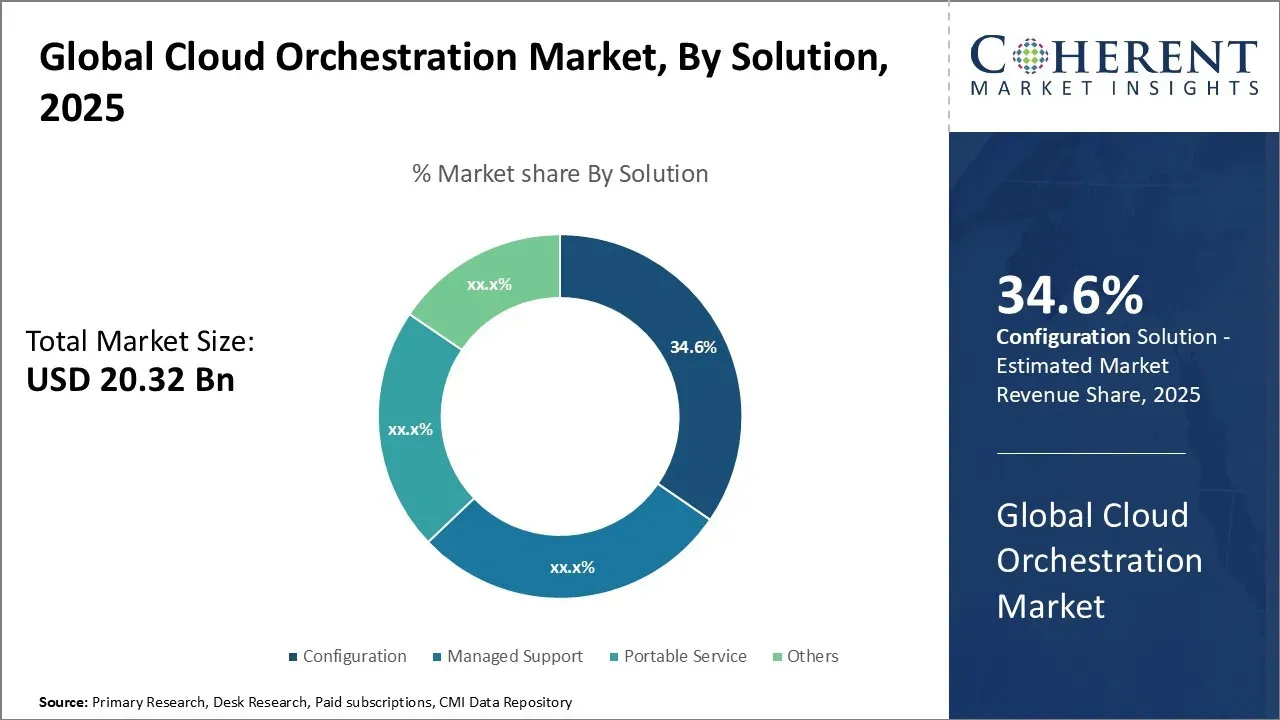
Cloud Orchestration Market Insights, By Solution
The configuration segment is projected to dominate the global cloud orchestration market, commanding a 35.6% share in 2026. This leadership is driven by the rising demand for automation across complex IT environments, as enterprises aim to reduce manual intervention and enhance operational efficiency.
Configuration-based orchestration tools enable seamless resource provisioning, workload balancing, and infrastructure standardization across hybrid and multi-cloud deployments. This flexibility makes them essential for businesses pursuing agile digital transformation. Other segments such as provisioning and monitoring continue to play critical roles, supporting comprehensive orchestration frameworks that ensure responsiveness, scalability, and governance across cloud ecosystems.
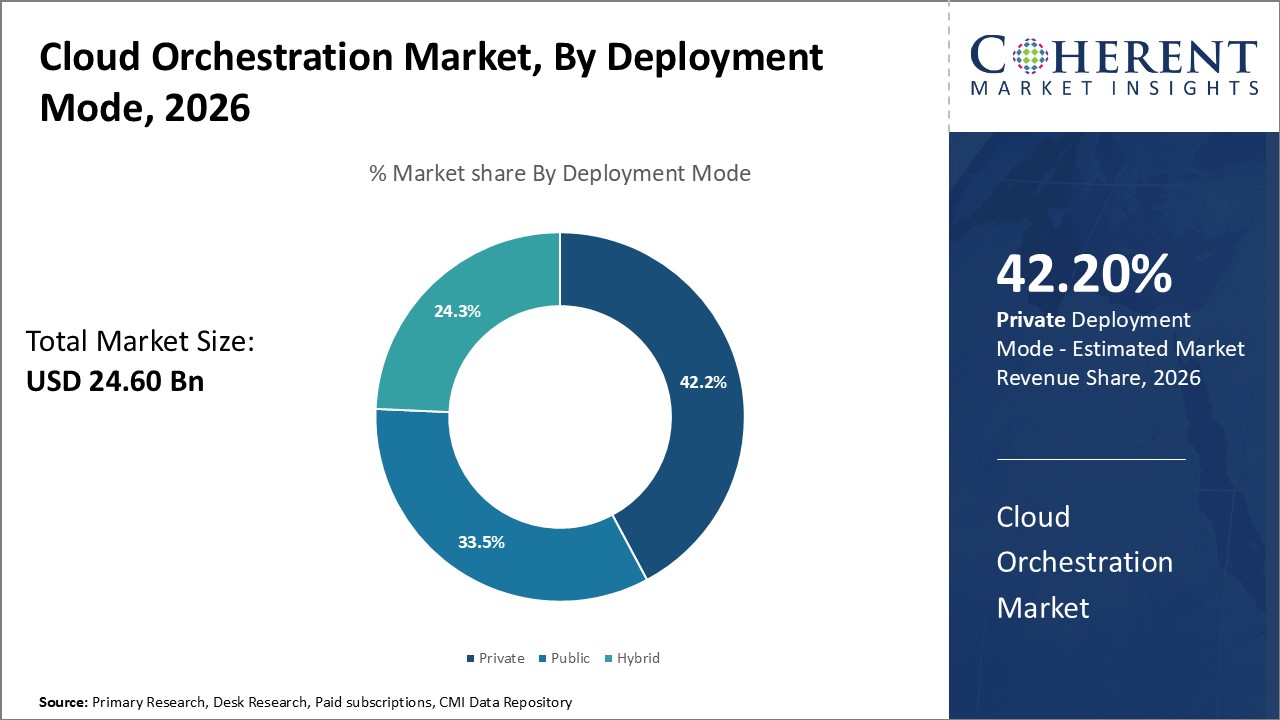
Cloud Orchestration Market Insights, By Deployment Mode
The private deployment segment is expected to lead the global cloud orchestration market in 2026, holding a 42.2% share. This dominance stems from increasing concerns over data security, regulatory compliance, and governance, particularly within sectors like healthcare, finance, and government.
Organizations prefer private cloud orchestration to maintain tighter control over infrastructure and sensitive information, ensuring adherence to industry-specific standards. While public and hybrid deployment models are gaining traction due to their cost efficiency and scalability, the private model remains preferred among enterprises prioritizing secure, customized IT environments with full ownership over orchestration policies and resources.
Cloud orchestration market: Regional Insight
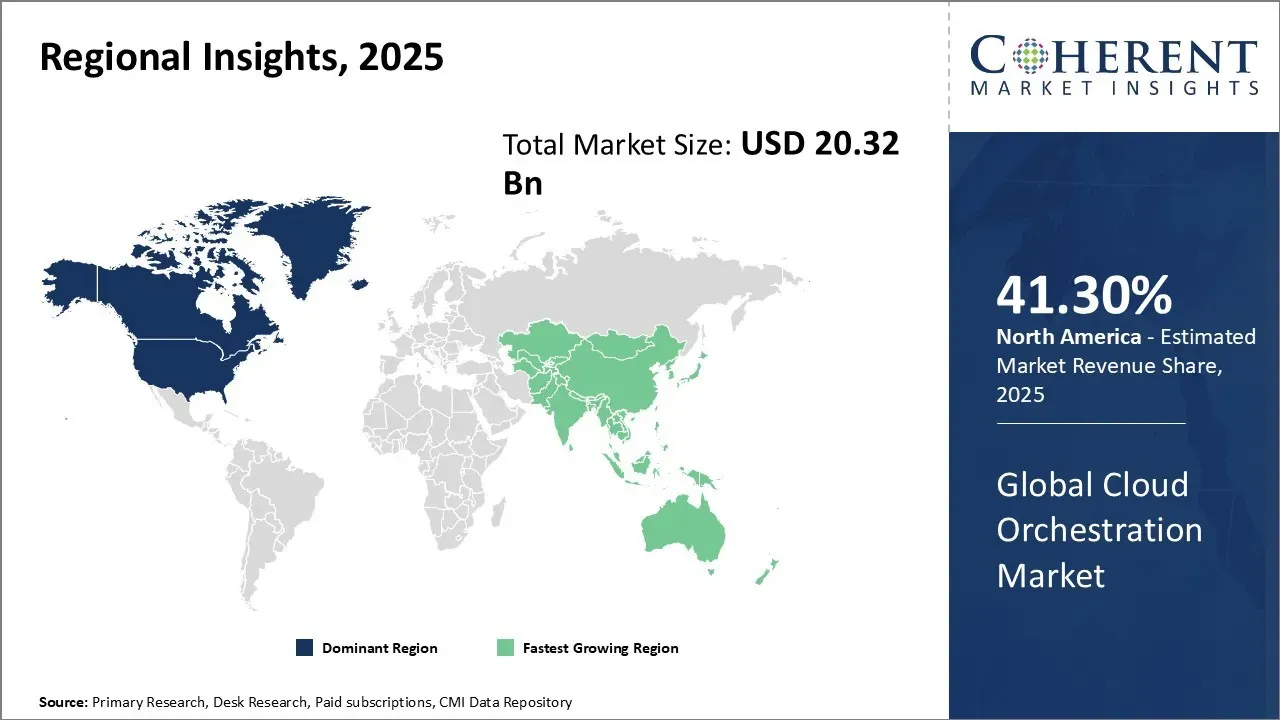
North America Cloud Orchestration Market Trends and Analysis
North America is anticipated to retain a dominant position in the global cloud orchestration market, accounting for a 41.3% share in 2025. This regional leadership is fuelled by the presence of top-tier cloud service providers, advanced enterprise IT infrastructure, and widespread adoption of digital technologies across sectors.
High demand for DevOps, multi-cloud management, and cloud-native applications is driving innovation in orchestration tools. With strong investments in automation, cyber security, and AI-driven cloud solutions, the region offers a mature and highly competitive environment for cloud orchestration vendors.
Europe Cloud Orchestration Market Trends and Analysis
Europe follows as a major contributor to the global cloud orchestration market, supported by increasing digital transformation initiatives and stringent regulatory frameworks such as GDPR.
Countries like Germany, the UK, and France are investing in secure and automated cloud environments, pushing enterprises toward orchestration solutions that ensure compliance and agility. The region’s emphasis on hybrid cloud models and government-backed cloud adoption programs is fostering robust market expansion, particularly in industries like finance, healthcare, and public administration.
Cloud orchestration market Dominating Countries:
United States and Canada
The United States leads the North American cloud orchestration market, propelled by robust enterprise adoption of cloud computing and the presence of leading cloud providers such as Amazon Web Services, Microsoft Azure, and Google Cloud.
The country benefits from widespread digital transformation across sectors, a mature IT infrastructure, and significant investment in DevOps, automation, and AI-driven orchestration tools. Enterprises are increasingly prioritizing hybrid and multi-cloud strategies, prompting strong demand for orchestration platforms that enhance visibility, reduce manual tasks, and ensure compliance.
Canada, while smaller in market size, plays a strategic role in the regional landscape. The country's growing digital economy, strict data sovereignty laws, and rising cloud adoption among public and private sectors are driving demand for orchestration solutions.
Canadian enterprises are embracing private and hybrid cloud models, fostering adoption of automation platforms for resource provisioning, cost optimization, and secure data handling, making North America a global leader in cloud orchestration.
Market Report Scope
Cloud Orchestration Market Report Coverage
| Report Coverage | Details | ||
|---|---|---|---|
| Base Year: | 2025 | Market Size in 2026: | USD 24.60 Bn |
| Historical Data for: | 2020 To 2024 | Forecast Period: | 2026 To 2033 |
| Forecast Period 2026 to 2033 CAGR: | 20.8% | 2033 Value Projection: | USD 92.14 Bn |
| Geographies covered: |
| ||
| Segments covered: |
| ||
| Companies covered: | Amazon Web Services (AWS), Microsoft Corporation, Google Cloud Platform (GCP), IBM Corporation, Oracle Corporation, VMware Inc., Cisco Systems Inc., BMC Software Inc., Red Hat Inc., Hewlett Packard Enterprise (HPE), Rackspace Technology, Flexera Software, Turbonomic, CloudBolt Software, and Morpheus Data LLC | ||
| Growth Drivers: |
| ||
| Restraints & Challenges: |
| ||
Analyst Viewpoint – Cloud Orchestration Market
- Analysts maintain a highly optimistic outlook for the global cloud orchestration market, driven by enterprises’ urgent need to streamline complex IT operations across hybrid and multi-cloud environments. They highlight that the increasing reliance on digital infrastructure, especially post-pandemic, has significantly elevated the demand for agile, automated, and scalable orchestration solutions. The ability of orchestration tools to reduce manual intervention and ensure consistency across deployments is seen as a game-changer for IT teams seeking operational efficiency.
- Experts emphasize technological innovation—particularly the integration of AI, ML, and Infrastructure as Code (IaC)—as pivotal in enhancing automation, reducing downtime, and optimizing resource utilization. Cloud orchestration is increasingly seen as critical to successful DevOps implementation and continuous delivery models.
- Regionally, North America leads due to early cloud adoption and robust enterprise IT infrastructure. However, Asia Pacific is projected as the fastest-growing region, fueled by rapid digitization, supportive government cloud policies, and expanding SME cloud adoption.
Speak to the analyst
Want personalized insights?
Take the findings above to one of our principal consultants, or have the report rebuilt around the segments, geographies and competitors you actually track.
Cloud Orchestration Market: Key Development
- In May 2025: CAST AI announced the completion of a $108 million Series C funding round led by G2 Venture Partners. The capital will be used to further develop CAST AI’s Kubernetes automation platform that reduces cloud costs by up to 60%. This advancement reflects growing enterprise demand for cost-effective and automated multi-cloud orchestration tools.
- In April 2025: HashiCorp unveiled major upgrades to its Terraform Cloud platform, enhancing support for infrastructure as code automation in multi-cloud environments. The improvements include predictive scaling, compliance enforcement using AI, and streamlined integrations with AWS, Azure, and GCP, demonstrating an industry-wide shift toward policy-as-code for orchestrated infrastructure.
- In February 2025: VMware announced Project Nautilus, a new initiative aimed at integrating AI-powered observability and orchestration into its Tanzu cloud management suite. This project seeks to simplify application lifecycle management and boost performance optimization across hybrid cloud deployments.
- In December 2024: Microsoft Azure introduced Azure Automanage for Linux, expanding its orchestration capabilities by enabling automated operations for Linux VMs. This development underscores Azure’s push for broader automation and orchestration support across different OS environments.
- In November 2024: IBM launched a new version of its Cloud Pak for Multi-Cloud Management, featuring enhanced Kubernetes governance and AI-driven workload placement tools. These innovations are designed to improve enterprise agility and resilience amid increasing cloud complexity.
Market Segmentation
- Solution Insights (Revenue, USD Bn, 2021 - 2033)
- Configuration
- Managed Support
- Portable Service
- Others
- Deployment Mode Insights (Revenue, USD Bn, 2021 - 2033)
- Private
- Public
- Hybrid
- Regional Insights (Revenue, USD Bn, 2021 - 2033)
- North America
- U.S.
- Canada
- Latin America
- Brazil
- Argentina
- Mexico
- Rest of Latin America
- Europe
- Germany
- U.K.
- Spain
- France
- Italy
- Russia
- Rest of Europe
- Asia Pacific
- China
- India
- Japan
- Australia
- South Korea
- ASEAN
- Rest of Asia Pacific
- Middle East
- GCC Countries
- Israel
- Rest of Middle East
- Africa
- South Africa
- North Africa
- Central Africa
- North America
- Key Players Insights
- Amazon Web Services (AWS)
- Microsoft Corporation
- Google Cloud Platform (GCP)
- IBM Corporation
- Oracle Corporation
- VMware Inc.
- Cisco Systems Inc.
- BMC Software Inc.
- Red Hat Inc.
- Hewlett Packard Enterprise (HPE)
- Rackspace Technology
- Flexera Software
- Turbonomic
- CloudBolt Software
- Morpheus Data LLC
Sources
The Stakeholders Consulted
- Cloud infrastructure architects and IT operations managers
- CTOs and DevOps leads from enterprises and managed service providers
- Cloud service integrators and automation solution providers
- CIOs and enterprise architects from BFSI, telecom, healthcare, and manufacturing sectors
- Regulatory and compliance experts on data sovereignty and cloud standards
- Government agencies involved in digital transformation and smart infrastructure
- Academic researchers and technologists focused on cloud-native technologies, Kubernetes, and AI-driven orchestration
Databases Opened
- U.S. National Institute of Standards and Technology (NIST) – Cloud Computing Reference Architecture
- International Telecommunication Union (ITU) – ICT Infrastructure and Cloud Statistics
- Ministry of Electronics and Information Technology (India) – Cloud Adoption and Digital Infrastructure Reports
- World Bank Open Data – Digital Economy Indicators
Magazines & Trade Publications
- Cloud Computing Magazine
- Data Center Knowledge
- Network World – Cloud Infrastructure Section
- CIO Review – Cloud and DevOps Insight
- TechRepublic – Cloud Deployment and Automation Features
Scientific and Industry Journals
- Journal of Cloud Computing: Advances, Systems and Applications
- ACM Transactions on Internet Technology
- Future Generation Computer Systems
- International Journal of Cloud Computing
- Journal of Systems and Software
Newspapers & Media Outlets
- The Wall Street Journal – Tech & Cloud Services
- Bloomberg – Enterprise Technology and Cloud Business Coverage
- Reuters – Digital Infrastructure and Cloud Ecosystem Updates
- The Economic Times – Tech and Cloud Startups Section
- Business Standard – Cloud Transformation and Automation Features
Associations and Regulatory Bodies
- National Institute of Standards and Technology (NIST)
- Cloud Security Alliance (CSA)
- Open Infrastructure Foundation (OpenStack)
- Institute of Electrical and Electronics Engineers (IEEE)
- Internet Engineering Task Force (IETF)
Public Domain Sources
- U.S. General Services Administration – Cloud Smart Strategy
- European Commission – EU Cloud Strategy and Digital Services Act
- World Bank – ICT Infrastructure and Cloud Readiness Reports
- International Telecommunication Union (ITU) – Digital Transformation Insights
- OECD – Cloud Computing and Digital Economy Statistics
Proprietary Research Elements
- CMI Data Analytics Tool
- Proprietary CMI Repository of Market Data (covering past 8 years)
- CMI Expert Interviews and Transcripts (focused on multi-cloud strategies, orchestration platforms, and DevOps integration trends)
Get access to 250+ pages report
Every segment, forecast, competitor profile and data table behind the analysis above — available for instant download.
- ESOMAR Member
- ISO 9001:2015 Certified
- D-U-N-S Registered
- GDPR & CCPA Compliant
Missing comfort of reading report in your local language? Find your preferred language:
Transform your Strategy with Exclusive Trending Reports
Frequently Asked Questions
The global cloud orchestration market size is estimated to be valued at USD 20.32 billion in 2025 and is expected to reach USD 75.39 billion by 2032.
The CAGR of the global market is projected to be 20.6% from 2025 to 2032.
Increasing complexity of cloud environments and growing demand for automation and efficiency are the major factors driving the growth of the global market.
Concerns regarding data security and privacy and high initial investment and integration challenges are the major factors hampering the growth of the global cloud orchestration industry.
In terms of solution, the configuration segment is estimated to dominate the market revenue share in 2025.
Amazon Web Services (AWS), Microsoft Corporation, Google Cloud Platform (GCP), IBM Corporation, Oracle Corporation, VMware Inc., Cisco Systems Inc., BMC Software Inc., Red Hat Inc., Hewlett Packard Enterprise (HPE), Rackspace Technology, Flexera Software, Turbonomic, CloudBolt Software, and Morpheus Data LLC are the major players.
North America is expected to lead the global market in 2025, holding a share of 41.3%.