

Global Trade Management Software Market Size and Share Analysis- 2026-2033
The global trade management software market is estimated to be valued at USD 3.10 Bn in 2026 and is expected to reach USD 6.36 Bn by 2033, exhibiting a compound annual growth rate (CAGR) of 10.8% from 2026 to 2033.
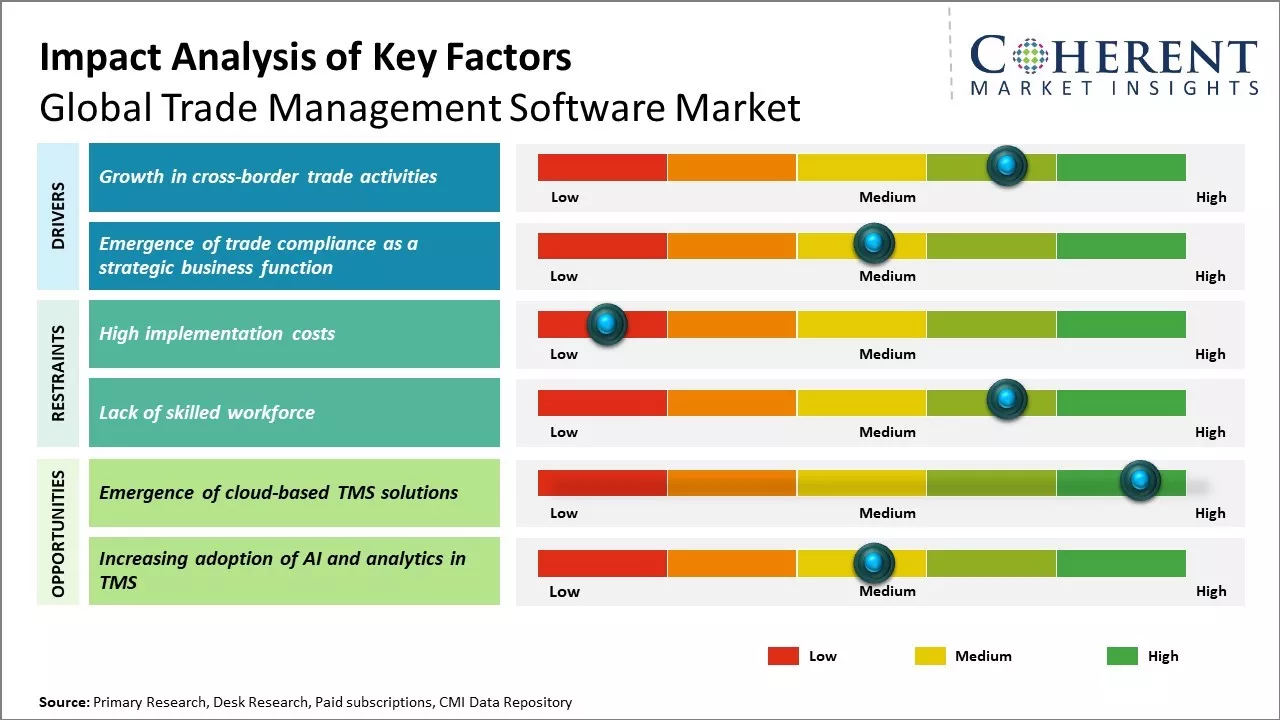
Key Takeaways
- In terms of Component, The Services Segment is expected to contribute 60.6% share of the market in 2026.
- In terms of Deployment, The Cloud-Based Segment is expected to contribute 62.7% share of the market.
- In terms of End-Use Industry, The Pharmaceuticals Segment is expected to contribute 40.2% of the market share. This is due to the stringent regulatory compliance it entails.
- The North American region continues to dominate the global trade management software market with 37.0% of the market share in 2026.
Market Overview
The global trade management software market is expected witness significant growth over the forecast period. Enterprises are increasingly adopting trade management software to centralize trade operations and increase supply chain visibility. The software ensures organizations remain compliant with dynamic trade regulations. Additionally, trade management solutions help reduce operational costs and improve customer experience by streamlining trade processes. Key players are focusing on incorporating advanced technologies like artificial intelligence, machine learning and internet of things in their software.
Current Events and Its Impact on Trade Management Software Market
Current Events | Description and its impact |
Traydstream's AI-Driven Compliance Torrent
|
|
iCustoms Launches Intelligent AI ICS2 Compliance Platform
|
|
Integration of Upcoming Technologies in the Trade Administration Software Market
Trade administration is rapidly changing with the implementation of new technologies such as robotic process automation (RPA), blockchain, the Internet of Things (IoT), machine learning (ML), and artificial intelligence (AI). With the upcoming technologies, companies are revolutionizing the way they perform complex global trade operations, improve supply chain visibility, and ensure regulatory compliance.
AI and ML are at the forefront, assisting with predictive analytics, demand forecasting, and decision-making automation. Risk detection, shipping route optimization, and processing large volumes of data in real-time to speed up customs clearance are facilitated by ML and AI. Some of these include automatic response to trade inquiry while handling customer service through AI-based chatbots, and prevention and detection of fraud and monitoring of trade compliance through ML algorithm-based solutions.
IoT sensors are increasingly being employed to monitor real-time data from shipments, warehouses, and trucking fleets. They track temperature, humidity, and location to allow reliable tracking and instant response to reduce delays and losses. Merging IoT insights with trade management platforms provides vast end-to-end supply chain visibility and improved inventory management.
Blockchain is gaining momentum with the offering of safe, open, and tamper-free records of transactions that reduce paper work, forgery, and conflicts in international trade. Smart contracts allow payments and check for compliance to be executed automatically, increasing the speed of the trade cycle and decreasing expenses.
- Current Industry Events of 2026
- Market Size Estimation
- Regional Breakdown
- Competitive Landscape
- Customer Intelligence
- Segmental Analysis
- Pricing Analysis
- Key Market Drivers, Challenges & Future Trends
- Customized Insights Section
Consumer Feedback and Unmet Demand in the Trade Management Software Market
Trade management software users from small and medium-sized enterprises to large multinationals will typically appreciate the higher efficiency, compliance assurance, and greater visibility these solutions provide. Automation of workflow complexities, reduced errors through documentation, and quicker customs clearance are typically the most commonly cited advantages by most users. ERP and supply chain systems integration is also typically well-defined, which enables end-to-end smooth flows.
A few unfulfilled needs and issues articulated through customer feedback. Perhaps the most prevalent complaint is the level of complexity and amount of training needed by many of the solutions, especially for small business that lack trade compliance groups. Customers request improved user interfaces and simpler-to-use interfaces and more onboard support to reduce the training time and elevate the adoption rate.
The second most important unmet need is for greater customization and flexibility. Most companies do business in many markets with unique regulation requirements, and off-the-shelf software packages sometimes are not capable of providing special local compliance information or industry-specific business practices. Customers typically request module-based solutions that can be customized without significant costs in customization.
Cost remains of most concern to SMEs, with business firms reporting that pricing models, particularly user-based or transaction-based subscription fees, become highly expensive as the firm expands. There is a growing requirement for more cost-efficient and more scalable pricing models that are able to sustain business expansion. In addition, customers also say that they want extended real-time visibility and predictive analytics functionality. While dashboards are offered by most solutions, they need more actionable AI-driven insights to forecast disruptions, automate logistics, and respond quickly to regulatory changes.
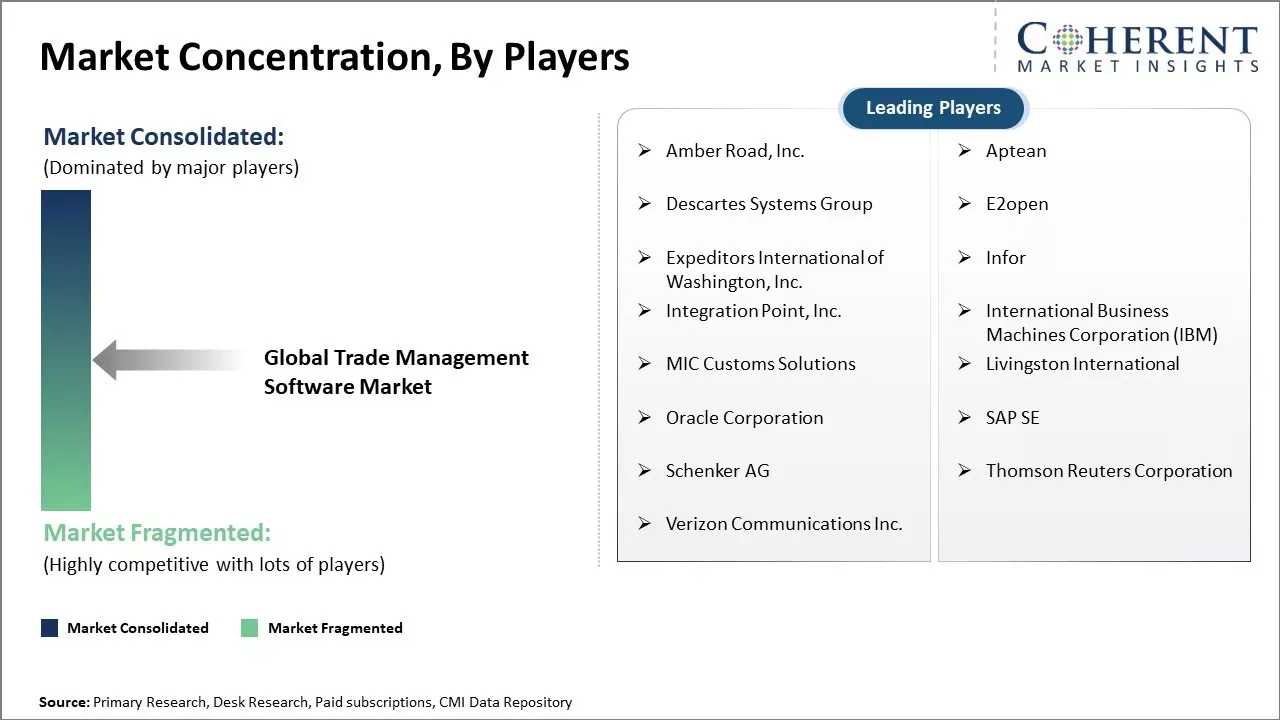
Market Concentration and Competitive Landscape
Segmental Insights
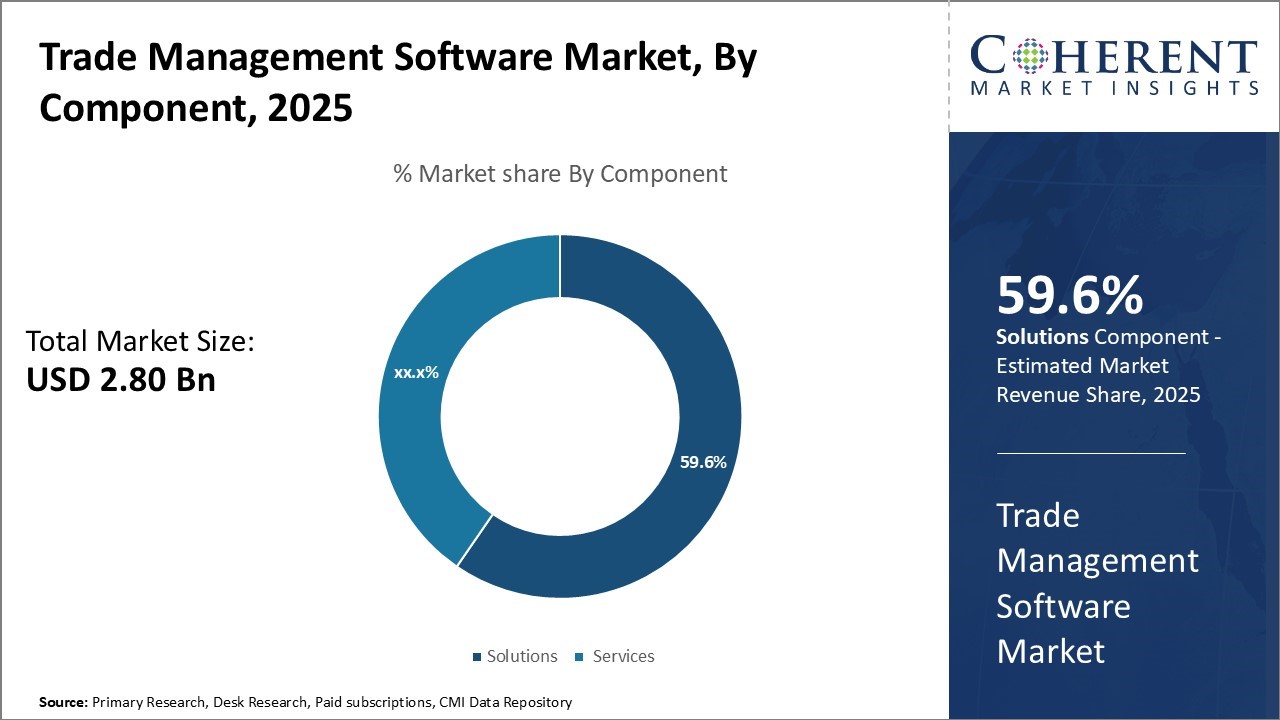
Trade Management Software Market Insights, By Component
In terms of component, the Services segment is expected to contribute 60.6% share of the market owing to the rising demand for digital transformation across industries. With growing global trade and complex supply chains, companies are under increasing pressure to optimize trade processes. The solutions segment addresses this need by offering software tools that help automate trade compliance, risk management, and visibility across commercial activities.
Features like supplier information management, import-export documentation preparation, customs management and duty calculation have wide applicability. Moreover, cloud-based delivery models have further accelerated the adoption of trade management services as they provide flexibility and scalability without large upfront investments. New companies especially favor the operational efficiencies and cost benefits unlocked by software services.
Their growing market presence has amplified demand. Additionally, services help reduce errors and fulfill compliance requirements more easily, minimizing risks of delays, penalties or trade barriers. This drives organizations across verticals to invest in automating trade operations, which spurs the services segment.
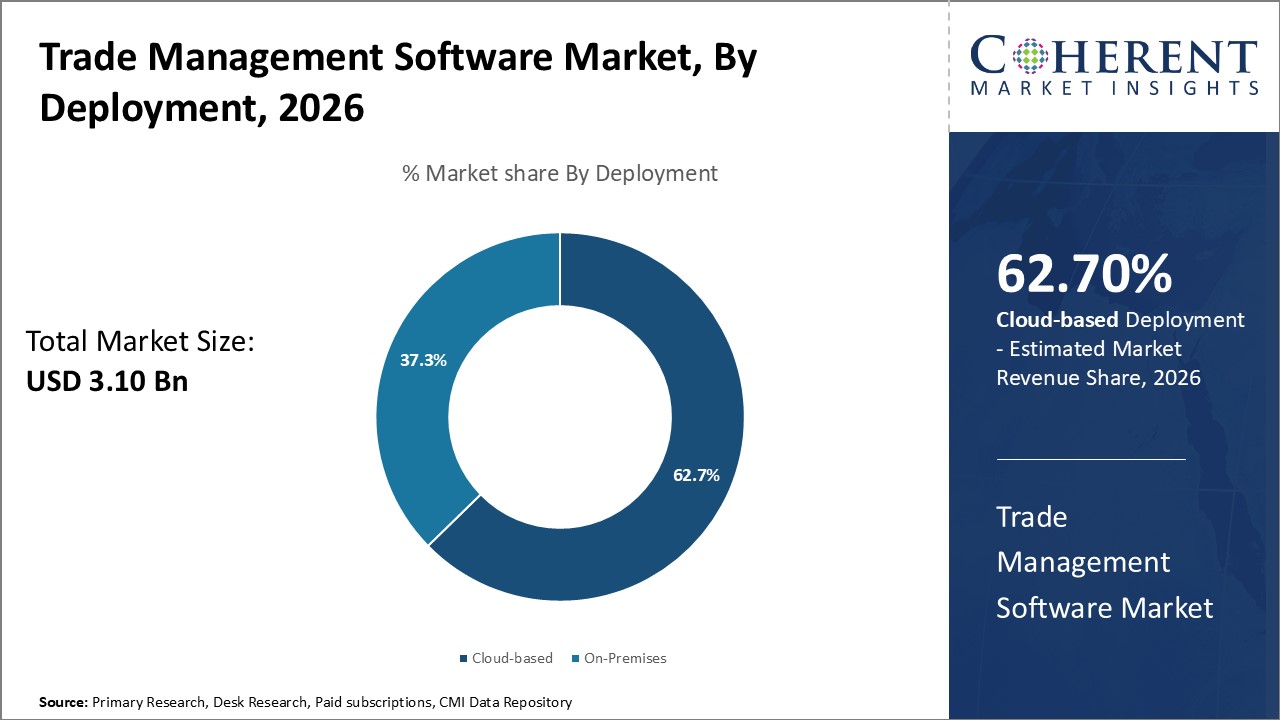
Trade Management Software Market Insights, By Deployment
In terms of deployment, the cloud-based segment is expected to contribute 62.7% share of the market due to the accelerated migration of enterprises to cloud-based software and services. Cloud deployment simplifies trade management without huge infrastructure requirements. It allows tracking activities from anywhere using an internet connection. This provides the agility benefitted during pandemic-induced disruptions.
Cloud also delivers operational cost advantages through pay-as-you-go pricing. With rising digitalization, companies now prefer cloud-hosted tools integrated with other business applications via APIs. The ease of updates, upgrades and maintenance has increased cloud popularity compared to on-premise models needing IT staff.
Trade Management Software Market Insights, By End use Industry
In terms of end-use industry, the pharmaceuticals segment is expected to contribute 40.2% of the market share due to the stringent regulatory compliance it entails. International trade of drugs involves compliance with myriad import-export rules and safety standards set by regulatory bodies. Any non-adherence can disrupt supplies or invite penalties.
However, being a sensitive sector with human lives at stake, supply chain reliability is critical. This makes trade management software highly relevant. Features for documentation preparation, license management, batch tracking, and quality certifications help maintain compliances seamlessly across markets. Digital solutions also promote visibility and real-time collaboration in global supply networks. Their automated validation and AI-driven risk analysis capabilities are valuable assets.
Moreover, the industry has capitalized on data-driven trade intelligence provided. This assists with monitoring policy changes proactively and ensuring undisrupted supplies. Overall, the urgent need for compliance combined with benefits of technology have majorly contributed to the pharmaceutical industry leading software adoption.
Regional Insights
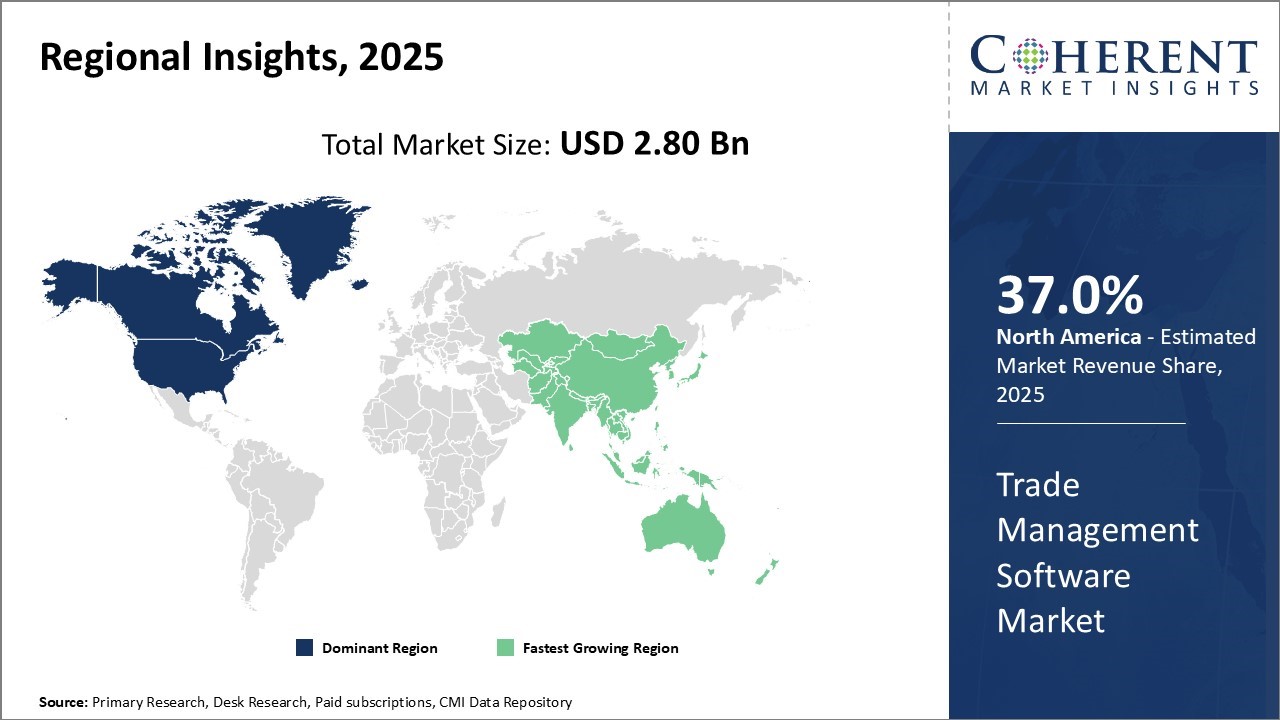
North America Trade Management Software Market Analysis and Trends
North American continues to dominate the global trade management software market. The region is expected to account for 37.0% of the market share in 2026. The large presence of multinational corporations headquartered in the U.S. drives significant demand for trade software to manage import-export operations across multiple countries.
Furthermore, the U.S. being one of the largest trading nations globally in terms of import-export volumes adds to the attractiveness of the region. Major trade management software vendors also have their largest R&D and sales centers located in the U.S., allowing them to closely work with customers and better understand their needs.
Asia Pacific has emerged as the fastest growing market for trade management software in recent years. Countries such as China, India, and Japan account for a sizeable share of global trade and have witnessed rapid growth in trade volumes over the past decade. Multiple trade agreements between Asia Pacific nations have further boosted intra-regional trade.
The growing international footprint of large corporations based in the Asia Pacific creates demand for software that can provide end-to-end visibility and control over global supply chains. Governments in the region have also undertaken initiatives like ‘Digital India’ and ‘Made in China 2026’ focusing on enhancing supply chain efficiencies through technology adoption, thus benefitting the Trade Management Software market.
Trade Management Software Market Dominating Countries
United States Trade Management Software Market Analysis and Trend
United States leads the market for trade management software due to its vast coverage of international trade activities and highly developed technology infrastructure. Predominance of large players in the software space and incessant innovation in AI and IoT connectivity drives high penetration in sectors such as manufacturing, retail, and logistics. Compliance requirements enforced by the regulatory environment also led companies to adopt advanced trade management software in effective operations.
China Trade Management Software Market Analysis and Trend
China as a world manufacturing hub and the world's largest exporter creates robust demand for trade management software. With its growing highlighted digitalization of supply chains and trade in government, Chinese companies are adopting even more software solutions to counter complex customs procedures, suppress costs, and increase supply chain visibility. Expansion of cross-border and e-commerce further pushes adoption.
Germany Trade Management Software Market Analysis and Trend
Germany's advanced manufacturing foundation and strongly export-oriented economy both facilitate its dominance of the trade management software market. German enterprises are especially eager to meet stringent EU trade regulation and environmental standards, fueling demand for high-quality software with accuracy and efficiency. Industry 4.0 emphasis in the nation also fuels adoption of smart technologies into trade processes.
Market Report Scope
Trade Management Software Market Report Coverage
| Report Coverage | Details | ||
|---|---|---|---|
| Base Year: | 2025 | Market Size in 2026: | USD 3.10 Bn |
| Historical Data for: | 2020 To 2024 | Forecast Period: | 2026 To 2033 |
| Forecast Period 2026 to 2033 CAGR: | 10.8% | 2033 Value Projection: | USD 6.36 Bn |
| Geographies covered: |
| ||
| Segments covered: |
| ||
| Companies covered: | Amber Road, Inc., Aptean, Descartes Systems Group, E2open, Expeditors International of Washington, Inc., Infor, Integration Point, Inc., International Business Machines Corporation (IBM), MIC Customs Solutions, Livingston International, Oracle Corporation, SAP SE, Schenker AG, Thomson Reuters Corporation, and Verizon Communications Inc. | ||
| Growth Drivers: |
| ||
| Restraints & Challenges: |
| ||
Trade Management Software Market Driver
- Growth in cross-border trade activities
With the ongoing globalization and expansion of businesses overseas, international trade activities have witnessed a significant rise over the past few decades. Various factors such as reduced trade barriers, growing foreign investments, advancements in transportation and logistics infrastructure have all contributed to greater global connectivity and inter-dependence between countries. This has translated into a massive surge in cross-border shipments of goods, services and increased complexities for international trade compliance.
Managing international trade affairs for businesses engaged in global supply chain and shipping operations is becoming more challenging than ever. Trade managers and logistics teams need to stay on top of constantly changing trade regulations, compliance norms, tariffs, and documentation requirements across multiple countries.
Paper-based and manual processes are unable to handle the scale and speed required for handling complex international shipping needs. This is where trade management software has proved extremely beneficial for organizations. The intuitive interfaces and powerful automation provided by such solutions allow businesses to digitally manage all import/export shipments and associated tasks with ease.
- Emergence of trade compliance as a strategic business function
With tightening of regulations and increasing penalties for non-compliance in many countries and regions, maintaining adherence to complex international trade laws has become a key business priority. Any instance of non-tariff barriers, incorrect declarations or supply chain disruptions can significantly hurt brand reputation and revenue apart from steep fines. As a result, more firms are recognizing trade management and monitoring compliance as an important boardroom agenda.
Previously considered merely an operational or back-office task, the function of global trade is now being viewed strategically by senior executives at large multinationals. Ensuring continuous compliance, mitigating regulatory risks, and optimizing worldwide supply chain costs through trade agreements are business imperatives.
Trade Management Software Market Opportunities
Emergence of cloud-based TMS solutions
The emergence of cloud-based Transportation Management Systems (TMS) is reshaping the Trade Management Software Market, offering scalable, flexible, and cost-effective solutions for global trade operations. These cloud-native platforms enable real-time data access, seamless integration with ERP systems, and automated compliance workflows, making them increasingly attractive to businesses navigating complex international logistics. According to recent Trade Management Software Market forecast reports, the market is expected to grow significantly over the next decade, driven by the rising adoption of cloud technologies, digital transformation initiatives, and the need for agile supply chain management. Cloud-based TMS solutions are particularly favored for their ability to support remote operations, reduce IT overhead, and provide enhanced visibility across trade networks. As companies seek to optimize cross-border transactions and respond to evolving regulatory requirements, cloud-based trade management software is becoming a strategic asset, fueling market expansion and innovation.
Trade Management Software Industry News
- In February 2024, Oracle, a global provider of enterprise cloud computing solutions, announced that Oracle Fusion Cloud Supply Chain & Manufacturing (SCM), part of the Oracle Fusion Cloud Applications Suite, has added new business intelligence capabilities to optimize logistics and transportation management.
- In April 2024, Coupa unveiled Coupa Navi, their new generative AI assistant designed to support real-time business queries. Integrated into the Coupa platform, Navi helps users with tasks like contract intelligence, supplier risk analysis, and procurement guidance through natural language interaction.
Key Takeaways from Analyst
- One of the key drivers for this market is the increasing complexity in global trade processes. As cross-border trade regulations continue to evolve frequently, compliance is becoming more difficult without automation. Trade management software helps organizations streamline workflows and ensures adherence to complicated regulations. Additionally, software solutions are helping companies gain real-time visibility across global supply chains, enabling them to make informed logistics decisions.
- However, high initial costs remain a major restraint for small and medium enterprises adopting trade management tools. Many SMBs rely on manual processes as software subscriptions add to their operating expenses. Another challenge is the lack of integration between disparate trade platforms within large corporations, which causes inconsistencies in trade data. Vendors are focusing on building solutions that integrate seamlessly with ERP and other systems.
- North America currently holds the largest share of the trade management software market owing to competitive trade landscape and early technology adoption. But the Asia Pacific region is expected to grow at the fastest pace due to rising exports from China, India, and other economies. Organizations across Southeast Asia and Latin America are also increasingly recognizing the value of streamlining international trade compliance and logistics using software. Overall, the market is set to rapidly expand driven by future trade deals and evolving cross-border compliance rules.
Market Segmentation
- Component Insights (Revenue, USD Bn, 2026 - 2033)
- Solutions
- Services
- Deployment Insights (Revenue, USD Bn, 2026 - 2033)
- Cloud-based
- On-Premises
- End-use Industry Insights (Revenue, USD Bn, 2026 - 2033)
- Defense
- Pharmaceuticals
- Energy
- Transportation and Logistics
- Consumer Goods
- Others
- Regional Insights (Revenue, USD Bn, 2026 - 2033)
- North America
- U.S.
- Canada
- Latin America
- Brazil
- Argentina
- Mexico
- Rest of Latin America
- Europe
- Germany
- U.K.
- Spain
- France
- Italy
- Russia
- Rest of Europe
- Asia Pacific
- China
- India
- Japan
- Australia
- South Korea
- ASEAN
- Rest of Asia Pacific
- Middle East & Africa
- GCC Countries
- Israel
- South Africa
- Rest of Middle East & Africa
- Key Players Insights
- Amber Road, Inc.
- Aptean
- Descartes Systems Group
- E2open
- Expeditors International of Washington, Inc.
- Infor
- Integration Point, Inc.
- International Business Machines Corporation (IBM)
- MIC Customs Solutions
- Livingston International
- Oracle Corporation
- SAP SE
- Schenker AG
- Thomson Reuters Corporation
- Verizon Communications Inc.
Sources
Primary Research Interviews
- Software Development Companies and Trade Management Platform Providers
- Import/Export Companies and International Trading Firms
- Supply Chain and Logistics Service Providers
- Trade Finance and Banking Institutions
- Others
Databases
- Bloomberg Terminal Trade and Market Data
- Refinitiv (formerly Thomson Reuters) Trade Analytics
- S&P Capital IQ Platform
- TradeMap International Trade Statistics Database
- Others
Magazines
- Supply Chain Management Review
- International Trade Today
- Global Trade Magazine
- Logistics Management Magazine
- Others
Journals
- Journal of International Trade & Economic Development
- International Journal of Logistics Management
- Journal of Business Research
- Others
Newspapers
- Financial Times
- The Wall Street Journal
- Reuters Business News
- Trade Finance Global News
- Others
Associations
- International Trade Centre (ITC)
- World Trade Organization (WTO)
- International Chamber of Commerce (ICC)
- National Association of Foreign Trade Zones (NAFTZ)
- Others
Public Domain Sources
- World Bank Trade Data and Statistics
- UN Comtrade Database
- International Monetary Fund (IMF) Trade Statistics
- Government Trade Department Publications
- Others
Proprietary Elements
- CMI Data Analytics Tool
- Proprietary CMI Existing Repository of Information for Last 8 Years
Get access to 250+ pages report
Every segment, forecast, competitor profile and data table behind the analysis above — available for instant download.
- ESOMAR Member
- ISO 9001:2015 Certified
- D-U-N-S Registered
- GDPR & CCPA Compliant
Missing comfort of reading report in your local language? Find your preferred language:
Transform your Strategy with Exclusive Trending Reports
Frequently Asked Questions
The Trade Management Software Market size is estimated to be valued at USD 3.10 Bn in 2026, and is expected to reach USD 6.36 Bn by 2033.
The CAGR of the global Market is projected to be 10.8% from 2026 to 2033.
Growth in cross-border trade activities and emergence of trade compliance as a strategic business function are the major factor driving the growth of the global trade management software industry.
High implementation costs and lack of skilled workforce are the major factors hampering the growth of the global trade management software industry.
In terms of component, services are estimated to dominate the market revenue share in 2026.
Amber Road, Inc., Aptean, Descartes Systems Group, E2open, Expeditors International of Washington, Inc., Infor, Integration Point, Inc., International Business Machines Corporation (IBM), MIC Customs Solutions, Livingston International, Oracle Corporation, SAP SE, Schenker AG, Thomson Reuters Corporation, and Verizon Communications Inc. are the major players.
North America is expected to lead the global trade management software industry in 2026.