

Commercial Solar PV Market Size and Forecast – 2026 to 2033
According to Coherent Market Insights, the global commercial solar PV market is estimated to be valued at USD 32.45 Bn in 2026 and is expected to reach USD 51.77 Bn by 2033, exhibiting a compound annual growth rate (CAGR) of 6.9% from 2026 to 2033.
Key Takeaways of the Commercial Solar PV Market
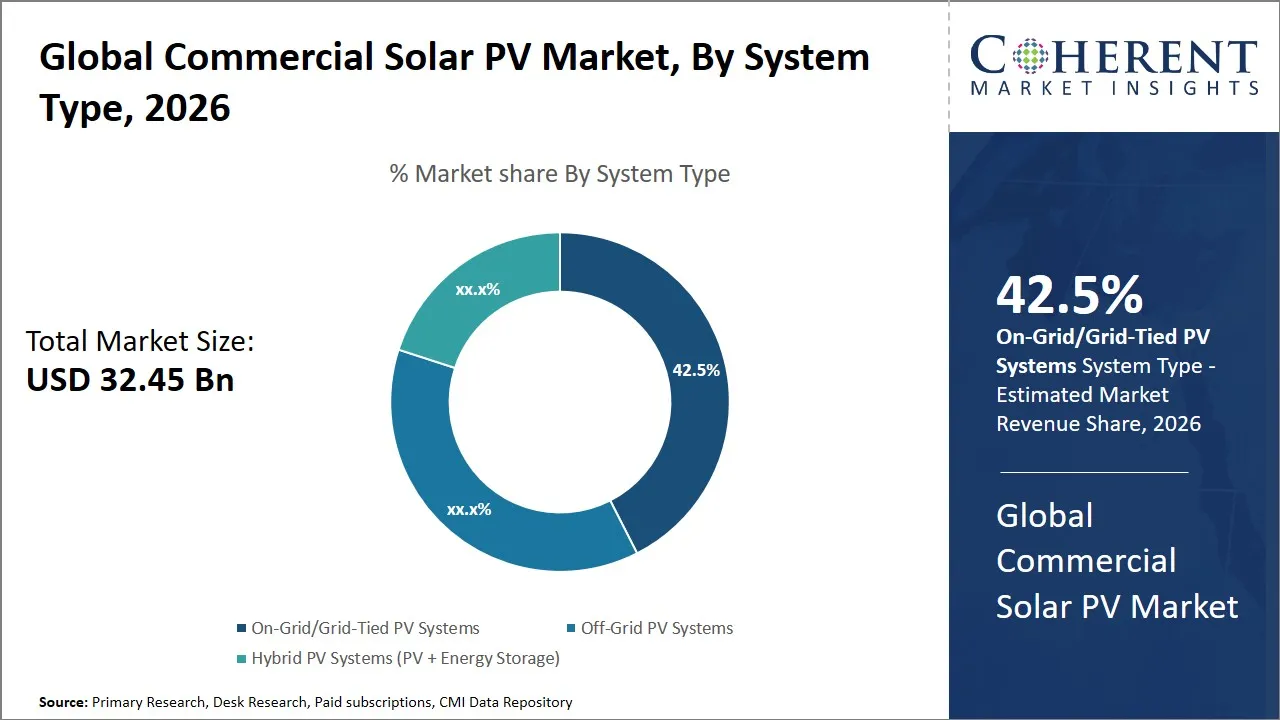
- The on-grid/grid-tied PV systems segment is projected to account for 42.5% of the global commercial solar PV market share in 2026.
- The solar modules (monocrystalline, polycrystalline, thin-film) segment is expected to command 45.9% of the market share in 2026.
- The crystalline silicon PV (Mono-Si, Poly-Si) segment is projected to command 38.8% of the commercial solar PV market share in 2026.
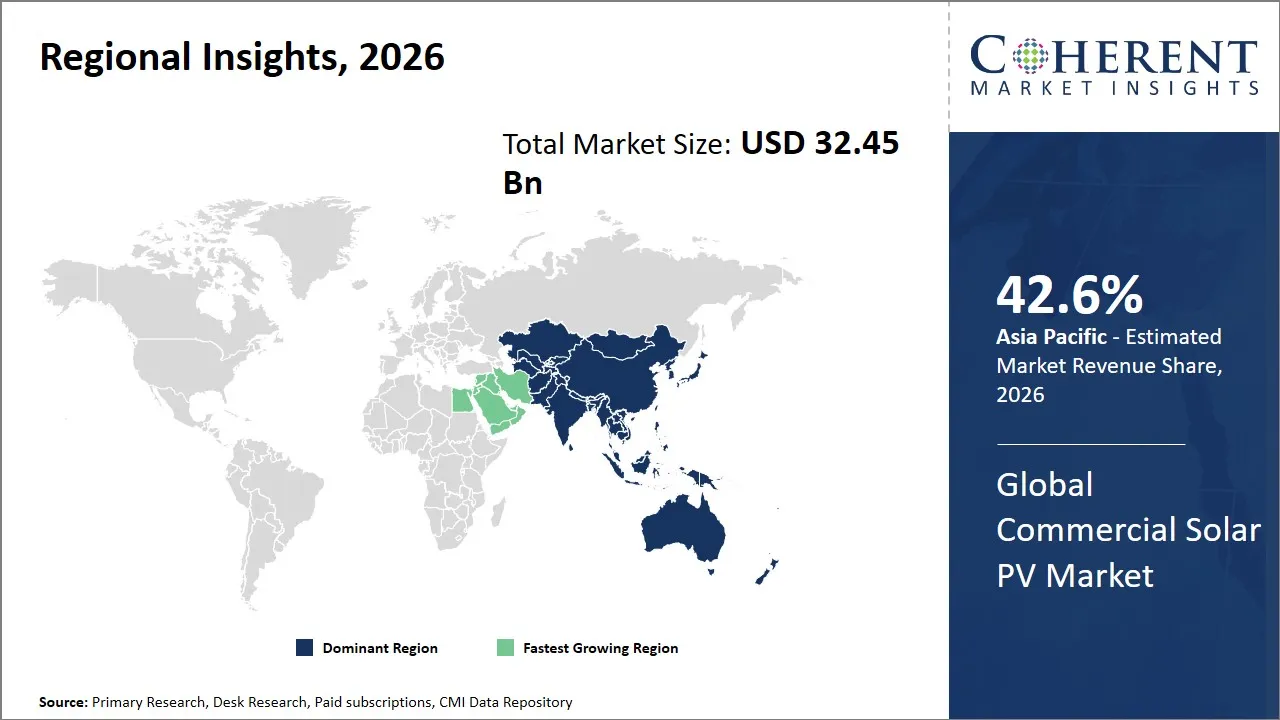
- The Asia Pacific will dominate the commercial solar PV market in 2026 with an estimated 42.6% share.
- The Middle East will hold 17. 3% share in 2026 and record the fastest growth.
Market Overview
- Market trends indicate a significant shift towards integrating advanced technologies such as smart grid data analytics systems and energy storage solutions with commercial solar PV installations.
- There is also a growing emphasis on sustainability and corporate social responsibility, prompting businesses to invest more heavily in green energy
- Additionally, emerging markets are witnessing accelerated deployment due to supportive regulatory frameworks and rising energy demands, positioning the commercial solar PV market for continued innovation and growth globally.
Currents Events and Its Impacts
Current Events | Description and its Impact |
EU Net-Zero Industry Act (NZIA) implementation push (2024–2025) |
|
China: tighter rules shaping commercial & industrial PV export behavior (May 2025) |
|
Segmental Insights
- Current Industry Events of 2025
- Market Size Estimation
- Regional Breakdown
- Competitive Landscape
- Customer Intelligence
- Segmental Analysis
- Pricing Analysis
- Key Market Drivers, Challenges & Future Trends
- Customized Insights Section
Why Does the On-Grid/Grid-Tied PV Systems Segment Dominate the Commercial Solar PV Market in 2026?
On-grid/grid-tied PV systems segment is expected to capture 42.5% of the commercial solar PV market share in 2026. This superiority is mainly fueled by an increased need to achieve a smooth fusion between solar energy and the current electricity systems especially in business setting where reliability of energy and economical management is imperative. On-grid systems get linked to the utility grid so that business may utilize solar energy and rely on the grid when solar production is inadequate.
Moreover, the increase in the commercial electricity rates, along with the policies promoting the use of renewable energy, reinforces the popularity of the on-grid systems. The fact that these systems are able to save electricity bills by counteracting the use of grids compels business enterprises to invest in grid-tied systems, which is in line with sustainable objectives and business continuity.
Large retail and logistics operators such as Walmart extensively deploy on-grid rooftop solar PV across stores and distribution centers. These systems directly offset daytime grid consumption while maintaining grid connectivity to ensure uninterrupted operations, illustrating why grid-tied PV dominates commercial adoption.
Why Do Solar Modules (Monocrystalline, Polycrystalline, Thin-Film) Dominate Component Growth in the Commercial Solar PV Market?
Solar modules (monocrystalline, polycrystalline, thin-film) segment is expected to hold 45.9% of the market share in 2026. The leading position of the solar modules is explained by the fact that these modules are considered the main units of energy conversion in the solar installation and ongoing technological progress towards enhancing their efficiency, reliability and cost-effectiveness. Of all types of modules, monocrystalline panels have been more widely accepted in the commercial applications due to their good efficiency, longevity, and ability to perform well in small space conditions.
The trend toward increased commercialization in energy output per square foot is the factor that contributes to the necessity to acquire highly efficient solar modules with high power density. The development of the manufacturing process modules improves the energy production and the stability of the modules, thus lowering the Levelized Cost of Energy (LCOE) of commercial users. The scalability of the solar panels with its modular features also enables businesses to expand their installation according to changing energy needs with comparatively minimal complexity involved.
Crystalline Silicon PV (Mono-Si, Poly-Si) Segment Dominates the Global Commercial Solar PV Market
Crystalline silicon PV (Mono-si, poly-Si) segment is projected to command 38.8% of the global commercial solar PV market share in 2026. The broad usage of crystalline silicon PV is supported by the fact that it has had a long history of good efficiency, strength, and an established manufacturing ecosystem. Monocrystalline silicon, whose crystal formations are made up of high purity silicon, are found to produce high energy conversion efficiency, and therefore they are best suited in commercial applications where the unit area output is a big factor. Polycrystalline cells made of silicon crystalline are a bit lower in efficiency but cheaper to manufacture, and they give good consistent performance, offering a fair price to performance ratio to most of the commercial stakeholders.
The prevailing power of the crystalline silicon technology is also enhanced by decades of research and development through optimizing the design of their cells, manufacturing yields, and the installation practice. This level of maturity has led to standard quality measures and wide supply chains that have lowered procurement risks of commercial buyers.
Regional Insights
Asia Pacific Commercial Solar PV Market Analysis and Trends
The Asia Pacific region is projected to lead the market with a 42.6% share in 2026, because of robust government backing, expansive pool of sunshine, and a mature manufacturing ecosystem. Other nations such as China, India, Japan and South Korea are critical players because of their solid solar policies, ambitious renewable energy goals and strong solar infrastructure investments. China, specially, is the leading country in the production capacity of photovoltaic and has dominated the world module manufacturing and supply networks. Feed-in tariffs, tax incentives and fast-tracked approvals are governmental incentives that have prompted adoption in commercial areas.
Middle East Commercial Solar PV Market Analysis and Trends
The Middle East region is expected to exhibit the fastest growth in the market contributing 17.3% share in 2026, driven by national decarbonization agendas, high solar irradiance, and falling system costs. Vision 2030 and Net Zero 2050 are the most advanced adoption in Saudi Arabia and the U.A.E with the assistance of net metering, PPAs, and large C&I rooftops. Business centers like malls, logistics parks, airports and industrial areas are adopting solar in an attempt to reduce energy expenses, and dependency on the grid. EPC-driven, solar-plus-store and turnkey commercial offerings by players such as ACWA Power, Masdar, and First Solar are crashing the market.
Global Commercial Solar PV Market Outlook for Key Countries
China Commercial Solar PV Market Trends
The market for commercial solar PV in China is marked by the leadership in the scale of manufacturing and the government-promoting solar development goals. The commercial solar industry in the country enjoys state subsidies in favor of distributed generation projects and grid parity projects. Other companies such as LONGi and JA Solar have contributed significantly with high efficiency module manufacturing and introduction of bifacial technology. The applications of solar to the domestic industrial need and smart city plans of Chinas form the basis of its enduring market leadership.
U.S. Commercial Solar PV Market Trends
The U.S. is rapidly expanding its commercial solar PV capacity, driven by a mix of supportive policies, corporate green mandates, and improvements in solar technology. Innovation is promoted by the existence of innovative companies, including First Solar, SunPower, and Tesla (with solar roof offerings) and enables large-scale commercial implementation of projects. The emphasis on the solar PV integration with energy storage and grid management solutions makes the U.S. markets more solid in the international arena as a high-potential region.
Why is India Emerging as a High-Growth Market for Commercial Solar PV?
India remains at the forefront in building-up its commercial solar footprints, supported by challenging national renewable energy targets, as well as growing commercial and industry interest. The Solar Park Scheme and incentives on roof-top solar installations by the government are spurring the growth. The major local and foreign vendors like Tata Power Solar, Adani Solar, and Huawei are essential in offering an overall incorporation of solar products and increased capacity in industries and business centers.
Germany Commercial Solar PV Market Trends
The commercial solar PV market in Germany flourishes due to the favorable regulatory environment, a history of investing in renewable energy and an established industrial foundation. Legislations like Renewable Energy Sources Act (EEG) allow commercial consumers to use feed-in tariffs and self-consumption programmes. Other companies such as SMA Solar technology provide more sophisticated inverters and system parts that make commercial solar installation more efficient. The mature market of Germany has the advantage of integration with energy storage and the solar PV ecosystem is very efficient and sustainable.
Why is Brazil Emerging as a Key Commercial Solar PV Market in Latin America?
Brazil’s commercial solar PV market gains strong momentum propelled by increasing energy demand and favorable regulatory reforms encouraging distributed solar generation. The government’s net metering policies and auction mechanisms foster investments in commercial solar projects. Companies such as Canadian Solar and local players like Solstar Energia contribute significantly by delivering tailored solutions suitable for the commercial sector’s diverse climatic and economic environments. Brazil’s expanding solar infrastructure underlines the country’s role as a key player in Latin America’s renewable energy transition.
Electricity Tariff Offset Potential Mapping
Commercial Consumer Type | Avg Grid Tariff (USD/kWh) | Typical Solar LCOE (USD/kWh) | Offset Potential (%) | Market Interpretation |
Warehouses & Logistics Parks | 0.10–0.12 | 0.045–0.055 | 45–55% | Large rooftops + day-time load makes solar highly effective |
IT Parks & Data Centers | 0.12–0.15 | 0.05–0.06 | 40–50% | Partial offset due to 24×7 load profile |
Retail Malls & Commercial Complexes | 0.14–0.18 | 0.05–0.06 | 50–65% | HVAC and lighting loads favor solar |
On-Site vs. Off-Site (Open Access) Adoption Economics
Parameter | On-Site (Rooftop/Captive) Solar PV | Off-Site (Open Access/Group Captive) Solar PV |
Primary Objective | Cost reduction + self-consumption | Deep tariff arbitrage at scale |
Avg Grid Tariff Offset (%) | 30 – 60% | 70 – 90% |
CAPEX Requirement | Medium | High |
Market Players, Key Development, and Competitive Intelligence
Key Developments
- In August 2025, Mission Solar introduced new residential and commercial PV modules with a 435-Watt N-type panel design for rooftop projects in Las Vegas at the event of RE + trade show. The lineup includes its 435 W n-type 108HC, a rooftop solar module with 22.8% efficiency, a 30-year power warranty, and 6.2% domestic content.
- In August 2025, Tongwei, a leading solar manufacturer in China, introduced its perovskite R&D team, which has published new research in the journal ACS Energy Letters about crystallization modulation of wide-bandgap perovskite on textured silicon for tandem solar cells. The study examines the crystallization control mechanism of wide-bandgap perovskites on textured silicon substrates and proposes a method to improve tandem solar cell performance.
Top Strategies Followed by Global Commercial Solar PV Market Players
Player Type | Strategic Focus | Example |
Established Market Leaders | Heavy investment in R&D and innovation | JinkoSolar and Trina Solar are constantly launching high-efficiency TOPCon and bifacial modules that are designed to fit large commercial rooftops and ground-mount systems. The cadmium telluride (CdTe) thin-film technology used by First Solar is differentiated and improves in high-temperature commercial locations like the Middle East and India. |
Mid-Level Players | Cost-effective solutions with balanced quality | REC Group offers high-quality but cost-efficient modules to commercial and industrial rooftops in Europe and Asia. |
Small-Scale Players | Niche specialization & innovative variants | EPC-bearing manufacturers in Southeast Asia and the Middle East combine smart inverters, energy management software and customized mounting solutions with commercial buyers who have either space or grid constraints. They have an advantage of speed, flexibility and localized solutions as opposed to scale. |
Market Report Scope
Commercial Solar PV Market Report Coverage
| Report Coverage | Details | ||
|---|---|---|---|
| Base Year: | 2025 | Market Size in 2026: | USD 32.45 Bn |
| Historical Data for: | 2020 To 2024 | Forecast Period: | 2026 To 2033 |
| Forecast Period 2026 to 2033 CAGR: | 6.9% | 2033 Value Projection: | USD 51.77 Bn |
| Geographies covered: |
| ||
| Segments covered: |
| ||
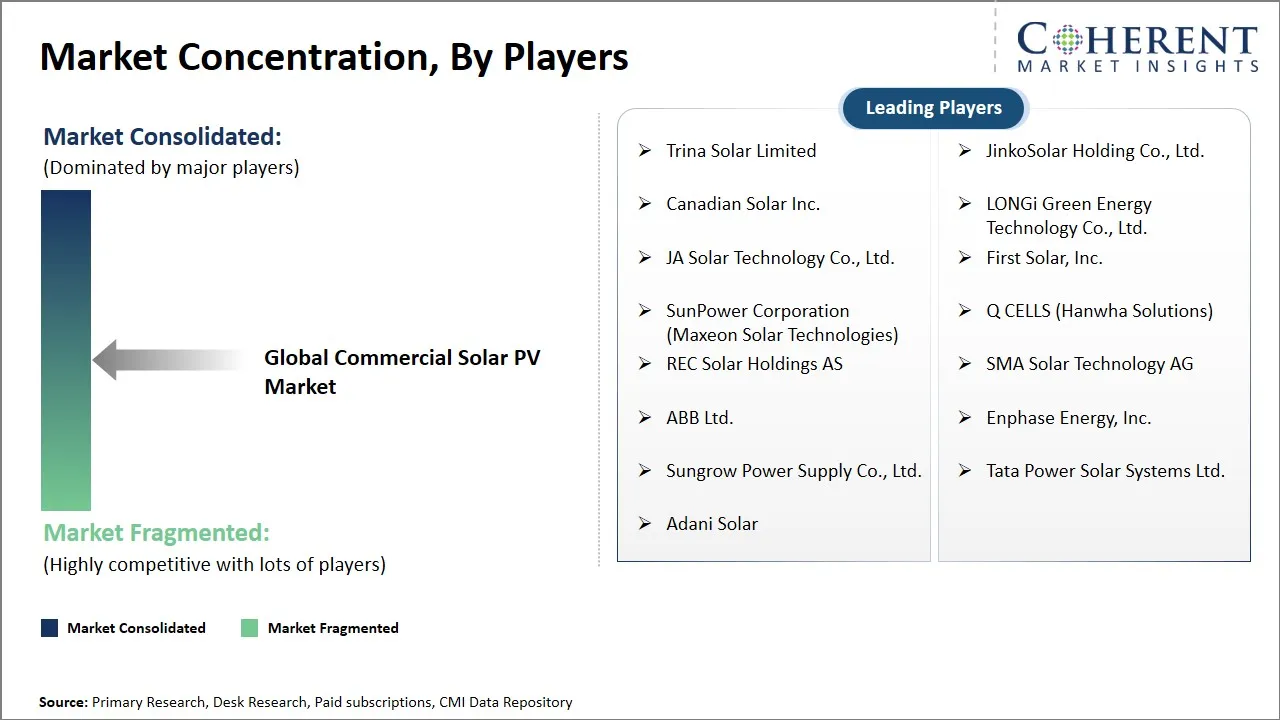
| Companies covered: | Trina Solar Limited, JinkoSolar Holding Co., Ltd., Canadian Solar Inc., LONGi Green Energy Technology Co., Ltd., JA Solar Technology Co., Ltd., First Solar, Inc., SunPower Corporation (Maxeon Solar Technologies), Q CELLS (Hanwha Solutions), REC Solar Holdings AS, SMA Solar Technology AG, ABB Ltd., Enphase Energy, Inc., Sungrow Power Supply Co., Ltd., Tata Power Solar Systems Ltd., and Adani Solar | ||
| Growth Drivers: |
| ||
| Restraints & Challenges: |
| ||
Commercial Solar PV Market Dynamics
Commercial Solar PV Market Driver - Increasing Focus on Renewable Energy Sources and Carbon Footprint Reduction
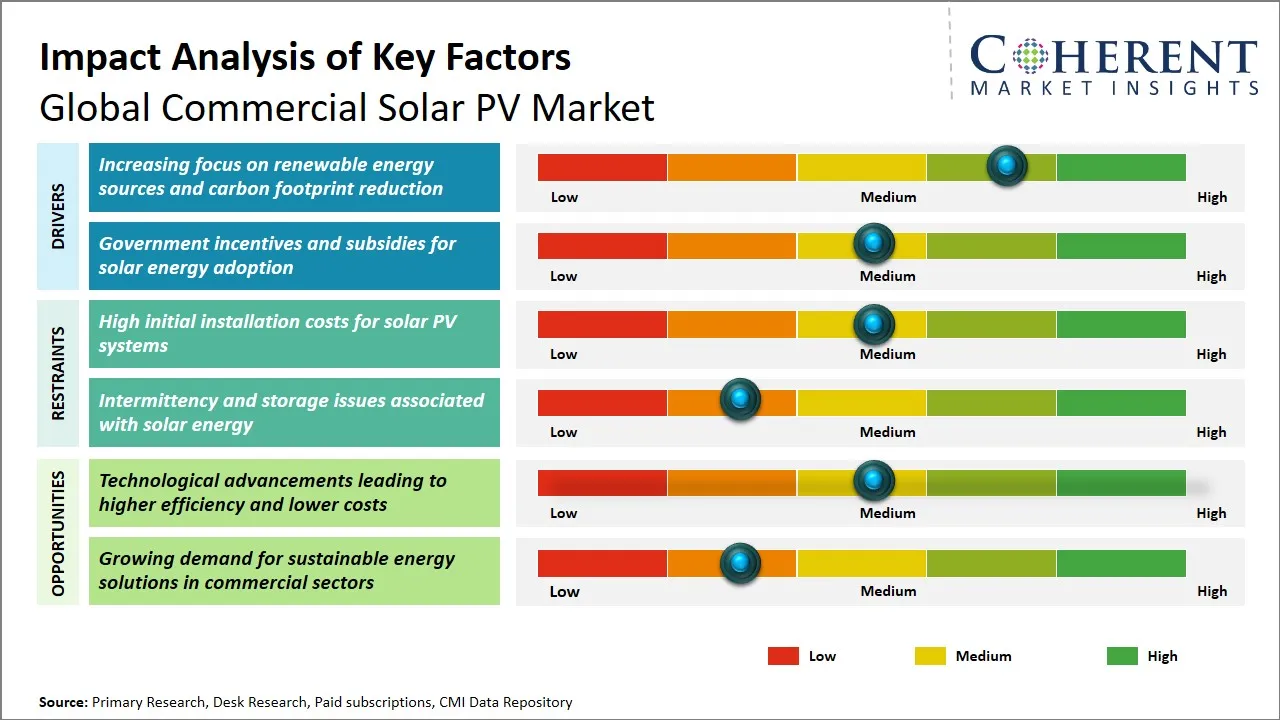
The growing global emphasis on renewable energy adoption and the urgent need to curb green gas emissions are significantly propelling the commercial solar PV market. Governments, corporations, and consumers are increasingly prioritizing sustainability initiatives as environmental concerns intensify, driving investments in clean energy infrastructure. As the issue of environmental concern continues to grow, governments, corporations, and the consumer are paying more attention to sustainability programs, and investments in clean energy infrastructure are being made. Solar PV systems are being embraced by many commercial organizations not only to satisfy the regulatory regulations and to enjoy the incentives but also to pursue the corporate social responsibility, which seeks to cut its carbon footprints. International climate commitments and increased awareness among the people about the effects of the long-term consumption of fossil fuels support this shift.
For example, large commercial real estate owners and retailers are deploying rooftop and on-site solar PV across warehouses and retail stores. The objective is to cut Scope-2 emissions, hedge against grid electricity price volatility, and meet science-based net-zero targets. This shift is converting sustainability commitments into large-scale commercial solar installations.
Commercial Solar PV Market Opportunity - Technological Advancements Driving Efficiency and Cost Reduction
The commercial solar PV market is on the brink of a great expansion which is largely due to the constant technological developments that not only increase the efficiency of the modules but also reduce the general costs of the system. Recent advancements in materials science, e.g. developing perovskite-based solar cells and bifacial panels, are providing an increased energy conversion rate than the more traditional silicon-based modules, thus making the most out of small rooftop or ground area in business applications.
For example, LONGi and Trina Solar are supplying higher-wattage solar modules that deliver more power per square meter. This enables factories, malls, and logistics parks with space constraints to achieve higher energy generation. As a result, project payback periods shorten, accelerating the adoption of commercial solar PV systems.
Analyst Opinion (Expert Opinion)
- Rapid growth of the commercial solar PV market is being triggered by the desperate demand of businesses to use renewable energy sources with the increase in the cost of energy and regulation requirements. The Solar Power International Conference (2023) and the International Renewable Energy Conference (2022) provided a framework of insights touching on the noteworthy innovations, with companies such as Sunnova and First Solar leading in the scaling of solar solutions in commercial use.
- In 2024, Sunnova proposed of the all-inclusive financing model by Sunnovas, which allows businesses to install solar PV systems at minimal initial costs, can be explained by the fact that access to and affordability of solar energy is a priority among the industry members. At these conferences, further development of energy independence was discussed because businesses aimed to reduce risks related to changes in energy prices. But there were such obstacles to entry as the disruption of the supply chain and the complexity of meeting regulatory requirements that were often mentioned.
- Traditionally, the companies that are focused on technological progress and establish a strategic relationship with local authorities and utilities will be able to achieve a competitive advantage. Finally, the development of the commercial solar PV market will require its capacity to become innovative and constantly adapt to the changing requirements of sustainable and economical energy sources in the ever more competitive business environment.
Speak to the analyst
Want personalized insights?
Take the findings above to one of our principal consultants, or have the report rebuilt around the segments, geographies and competitors you actually track.
Market Segmentation
- System Type Insights (Revenue, USD Bn, 2021 - 2033)
- On-Grid/Grid-Tied PV Systems
- Off-Grid PV Systems
- Hybrid PV Systems (PV + Energy Storage)
- Component Insights (Revenue, USD Bn, 2021 - 2033)
- Solar Modules (monocrystalline, polycrystalline, thin-film)
- Inverters (string, central, micro-inverters)
- Mounting Structures (fixed-tilt, tracking)
- Monitoring and Control Systems
- Technology Insights (Revenue, USD Bn, 2021 - 2033)
- Crystalline Silicon PV (Mono-Si, Poly-Si)
- Thin-Film PV (CdTe, CIGS, a-Si)
- Perovskite Solar PV
- Concentrated Photovoltaics (CPV)
- Deployment Type Insights (Revenue, USD Bn, 2021 - 2033)
- Rooftop Solar PV
- Ground-Mounted Solar PV
- Building-Integrated Photovoltaics (BIPV)
- Application Insights (Revenue, USD Bn, 2021 - 2033)
- Office Buildings and Corporate Campuses
- Shopping Malls, Retail Complexes, and Warehouses
- Manufacturing Facilities and Industrial Units
- Hospitals and Healthcare Facilities
- Educational Institutions and Universities
- Regional Insights (Revenue, USD Bn, 2021 - 2033)
- North America
- U.S.
- Canada
- Latin America
- Brazil
- Argentina
- Mexico
- Rest of Latin America
- Europe
- Germany
- U.K.
- Spain
- France
- Italy
- Russia
- Rest of Europe
- Asia Pacific
- China
- India
- Japan
- Australia
- South Korea
- ASEAN
- Rest of Asia Pacific
- Middle East
- GCC Countries
- Israel
- Rest of Middle East
- Africa
- South Africa
- North Africa
- Central Africa
- North America
- Key Players Insights
- Trina Solar Limited
- JinkoSolar Holding Co., Ltd.
- Canadian Solar Inc.
- LONGi Green Energy Technology Co., Ltd.
- JA Solar Technology Co., Ltd.
- First Solar, Inc.
- SunPower Corporation (Maxeon Solar Technologies)
- Q CELLS (Hanwha Solutions)
- REC Solar Holdings AS
- SMA Solar Technology AG
- ABB Ltd.
- Enphase Energy, Inc.
- Sungrow Power Supply Co., Ltd.
- Tata Power Solar Systems Ltd.
- Adani Solar
Sources
Primary Research Interviews
- CEO – Leading Solar PV Module Manufacturer (e.g., JinkoSolar or First Solar equivalent)
- Supply Chain Director – Major Solar Panel Distributor
- Production Lead – Polysilicon and Wafer Producer
- Sustainability Officer – Solar PV Certification Authority (e.g., IECRE or equivalent)
Stakeholders
- Manufacturers
- End-use Sectors
- Utility-Scale Solar Developers
- Commercial & Industrial Installers
- Residential Solar Providers
- Regulatory & Certification Bodies (e.g., EPA for solar panel waste, IEC standards)
- E-commerce Platforms and Retailers (Alibaba, Industrial Suppliers, Sigma-Aldrich equivalents for PV components)
- Technology Integration Players: Inverter manufacturers and energy storage integrators
Databases
- UN Comtrade Database (solar PV trade flows)
- India Import Export (EXIM) Database
- USGS Large-Scale Solar PV Database
- Eurostat Trade Statistics for Renewables
- IEA-PVPS Global PV Markets Snapshot
Magazines
- PV Magazine – Solar PV market trends and innovations
- Solar Power World – Utility-scale PV developments
- Saur Energy International – India solar market growth
- Solar Quarter – Manufacturing and policy insights
- pv tech – Technology and supply chain news
Journals
- Renewable and Sustainable Energy Reviews – Solar PV supply chain analysis
- Energy Policy – Global solar deployment trends
- Solar Energy – PV technology advancements
- Journal of Cleaner Production – ESG in solar manufacturing
- Progress in Photovoltaics – Module efficiency research
Newspapers
- The Wall Street Journal – Solar energy market updates
- Reuters – Solar industry news and tariffs
- Business Standard (India) – Domestic solar growth
- Financial Times – Global PV supply dynamics
Associations
- SolarPower Europe
- Solar Energy Industries Association (SEIA)
- International Renewable Energy Agency (IRENA)
- Global Solar Council
- International Energy Agency Photovoltaic Power Systems (IEA-PVPS)
- American Solar Energy Society (ASES)
Public Domain Sources
- EPA – End-of-life solar panels regulations
- European Commission – REACH and solar PV compliance
- International Electrotechnical Commission (IEC) – PV standards
- USGS – Solar PV facility statistics
- IEA – Solar PV global supply chains
- IRENA – Renewable capacity and trade reports
Proprietary Elements
- CMI Data Analytics Tool
- Proprietary CMI Existing Repository of information for last 8 years.
Get access to 250+ pages report
Every segment, forecast, competitor profile and data table behind the analysis above — available for instant download.
- ESOMAR Member
- ISO 9001:2015 Certified
- D-U-N-S Registered
- GDPR & CCPA Compliant
Missing comfort of reading report in your local language? Find your preferred language:
Transform your Strategy with Exclusive Trending Reports
Frequently Asked Questions
The global commercial solar PV market is estimated to be valued at USD 32.45 Bn in 2026 and is expected to reach USD 51.77 Bn by 2033.
The CAGR of global commercial solar PV market is projected to be 6.9% from 2026 to 2033.
Increasing focus on renewable energy sources and carbon footprint reduction and government incentives and subsidies for solar energy adoption are the major factors driving the growth of the global commercial solar PV market.
High initial installation costs for solar PV systems and intermittency and storage issues associated with solar energy are the major factors hampering the growth of the global commercial solar PV market.
Project finance green bonds PPAs and ESG-linked loans are commonly used.
Asia Pacific is expected to lead the global commercial solar PV market in 2026.
Trina Solar Limited, JinkoSolar Holding Co., Ltd., Canadian Solar Inc., LONGi Green Energy Technology Co., Ltd., JA Solar Technology Co., Ltd., First Solar, Inc., SunPower Corporation (Maxeon Solar Technologies), Q CELLS (Hanwha Solutions), REC Solar Holdings AS, SMA Solar Technology AG, ABB Ltd., Enphase Energy, Inc., Sungrow Power Supply Co., Ltd., Tata Power Solar Systems Ltd., and Adani Solar are the major players.