

Global Computer Aided Engineering Market Size and Forecast – 2026-2033
The Global Computer Aided Engineering Market is estimated to be valued at USD 10.86 billion in 2026 and is expected to reach USD 23.41 billion by 2033, exhibiting a compound annual growth rate (CAGR) of 11.6% from 2026 to 2033.
Key Takeaways of the Global Computer Aided Engineering Market:
- The finite element analysis segment dominates the market holding an estimated share of 52.2% in 2026.
- North America is estimated to lead the market with a share of 33.2% in 2026.
- Asia Pacific, accounting for a market share of 28.7% in 2026, is projected to be the fastest growing region.
Market Overview:
The market trend for the computer aided engineering market is characterized by the increasing adoption of advanced technologies, such as artificial intelligence, machine learning, and cloud computing, which are driving the demand for more sophisticated and efficient engineering solutions. Also, as product designs are becoming more complex and businesses are striving for faster times-to-market, the demand for computer aided engineering will keep growing.
Current Events and their Impact:
Current Events | Description and its impact |
Geopolitical Tensions and Trade Policy Changes |
|
Economic Trends & Industry Shifts Post-Pandemic |
|
Segmental Analysis
- Current Industry Events of 2026
- Market Size Estimation
- Regional Breakdown
- Competitive Landscape
- Customer Intelligence
- Segmental Analysis
- Pricing Analysis
- Key Market Drivers, Challenges & Future Trends
- Customized Insights Section
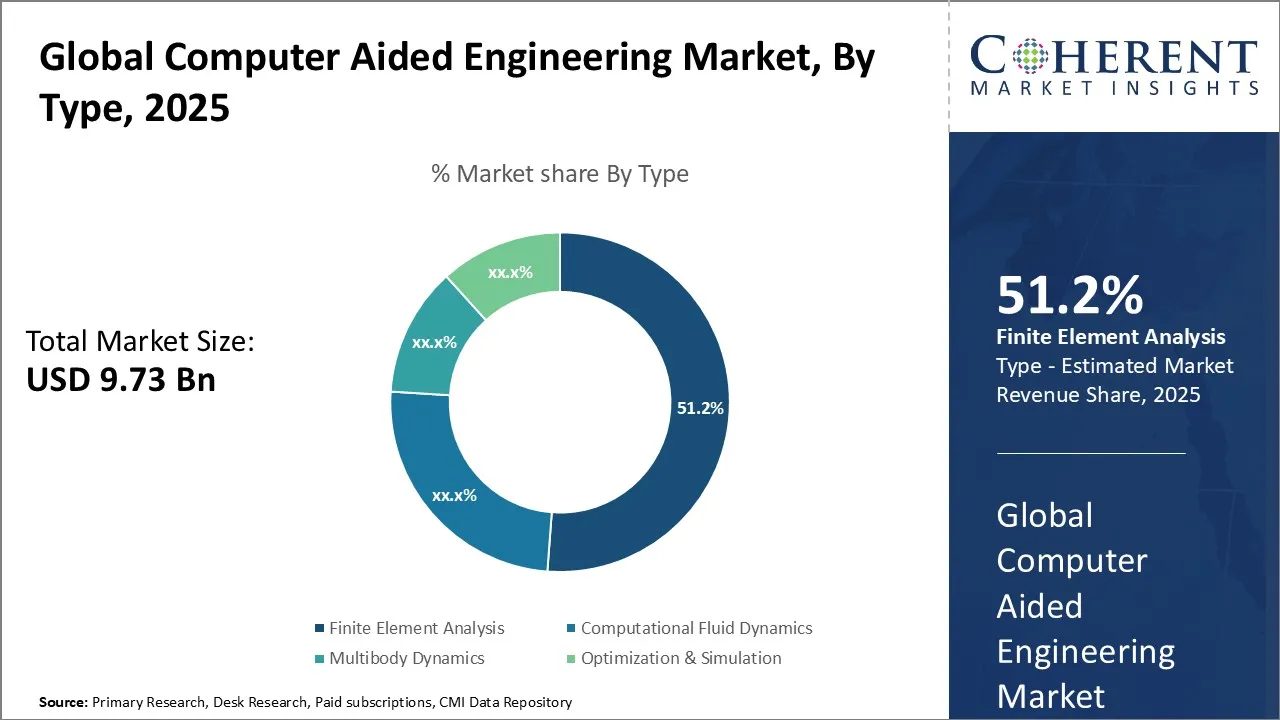
Global Computer Aided Engineering Market Insights, by Type - Finite Element Analysis Segment Dominates owing to its Complex Problem-solving Ability
The finite element analysis segment is projected to contribute 52.2% share in the market in 2026. Finite Element Analysis (FEA) is a numerical method that helps in solving complex engineering problems by dividing the problem into smaller, simpler parts called finite elements. This technique is commonly used in the design and development of products, as it lets engineers simulate and analyze the behavior of a product under different conditions needing any physical prototypes.
With FEA, engineers can make virtual models of their products and test them under different loads and stresses. This way, they can identify if any weaknesses are present and optimize the design accordingly. This technology is seeing adoption in different industries, such as automotive, aerospace, and construction, to design complex systems and components, such as aircraft wings, car chassis, and building structures
Role of Artificial Intelligence (AI) in the Global Computer Aided Engineering Market:
Artificial Intelligence (AI) is fundamentally transforming the CAE landscape by enabling faster, smarter, and more predictive simulations. Traditional CAE processes require intensive manual input and computational resources; AI dramatically shortens these cycles through data-driven automation and machine learning. By analyzing historical simulation data, AI algorithms can predict outcomes, optimize geometries, and detect design flaws even before full-scale simulations are run.
A notable example is Ansys’ collaboration with NVIDIA, where AI models are integrated into Ansys’ simulation platform to accelerate product development. Using NVIDIA’s accelerated computing and AI tools, Ansys can now deliver real-time feedback during design changes, allowing engineers to simulate performance as they build models.
Regional Insights
North America Computer Aided Engineering Market Analysis and Trends
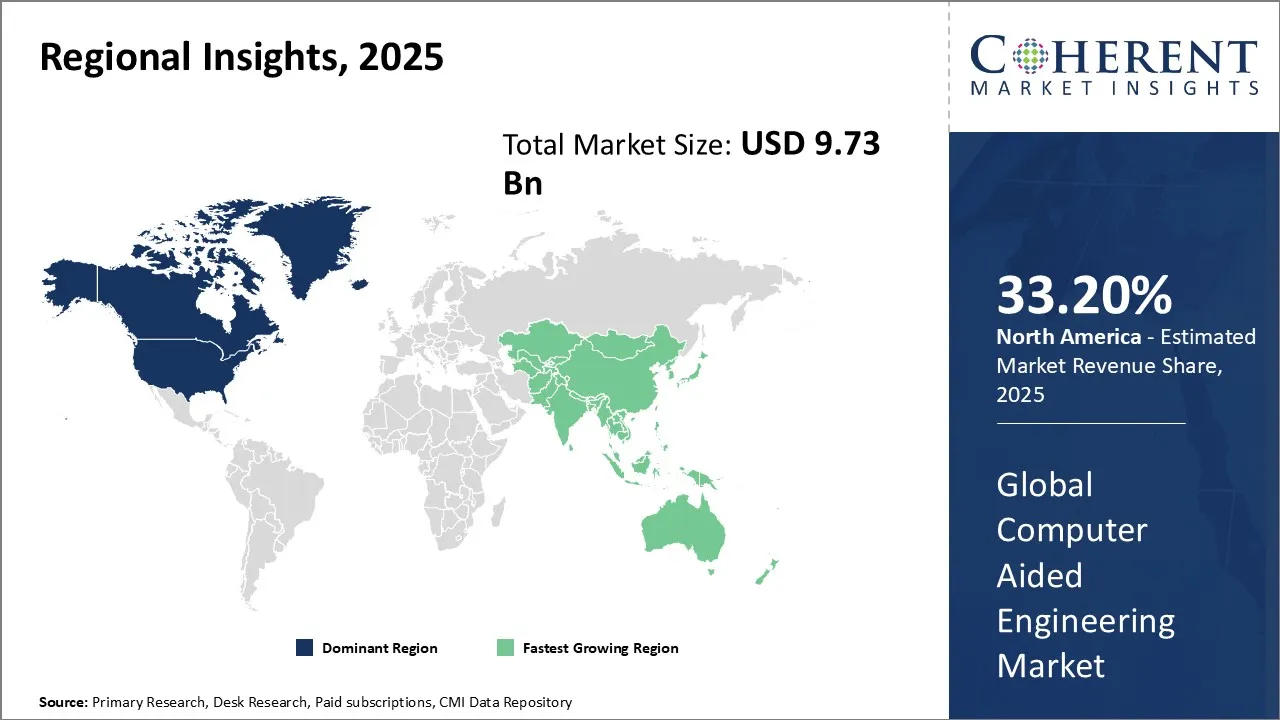
North America, holding a share of 33.2% in 2026, is expected to dominate the global computer aided engineering market. The region boasts a well-established market ecosystem, with a strong presence of key industry players and a robust technological infrastructure. Additionally, the presence of numerous multinational corporations and their increasing reliance on computer-aided engineering tools to optimize product design and manufacturing processes have significantly contributed to the region's market dominance.
Notable companies in North America, such as Autodesk, Inc., Dassault Systèmes, and Siemens PLM Software, have played a crucial role in driving the market growth. These companies have continuously invested in developing cutting-edge computer-aided engineering software and have established strong partnerships with industry stakeholders to expand their market reach.
Asia Pacific Computer Aided Engineering Market Analysis and Trends
The Asia Pacific region, holding a share of 28.7% in 2026, is projected to exhibit the fastest growth in the global computer aided engineering market. The rapid industrialization and increasing adoption of advanced manufacturing technologies in countries like China, India, and South Korea have been the primary drivers of market growth in this region. The Asia Pacific region has also witnessed a significant increase in the number of small and medium-sized enterprises (SMEs) adopting computer-aided engineering tools. The availability of cost-effective solutions and the growing awareness about the benefits of these tools have made them more accessible to SMEs, further fueling market growth.
Moreover, the presence of a large pool of skilled engineers and the increasing collaboration between academic institutions and industry players have fostered innovation and knowledge sharing in the region. Companies, such as Hexagon AB, Altair Engineering, Inc., and ESI Group, have established a strong presence in the Asia Pacific computer aided engineering market, catering to the growing demand for computer-aided engineering solutions across various industries.
Global Computer Aided Engineering Market Outlook for Key Countries:
U.S. Computer Aided Engineering Market Analysis and Trends
The U.S. computer aided engineering market is characterized by its maturity and technological advancements. The country is home to numerous industry giants and has a strong ecosystem for innovation and research. The adoption of computer-aided engineering solutions is widespread across various sectors including aerospace, automotive, and manufacturing. Key players such as Autodesk, Inc., Dassault Systèmes, and Siemens PLM Software have a significant impact on the market, driving growth through their extensive product portfolios and strategic partnerships.
China Computer Aided Engineering Market Analysis and Trends
China computer aided engineering market is experiencing rapid growth, driven by the country's industrial expansion and government initiatives promoting advanced manufacturing. The increasing adoption of automation and digitalization in industries, such as automotive, aerospace, and electronics, has fueled the demand for computer-aided engineering solutions. Local companies, as well as international players, are actively participating in the market, with notable contributions from companies like Siemens PLM Software, Altair Engineering, Inc., and ESI Group.
Germany Computer Aided Engineering Market Analysis and Trends
Germany continues to lead the Europe computer aided engineering market, owing to its strong industrial base and technological prowess. The country's automotive and aerospace industries are significant adopters of computer-aided engineering tools, leveraging them for product design, simulation, and optimization. German companies, such as Dassault Systèmes and Siemens PLM Software, have a strong presence in the market, offering advanced solutions and collaborating with industry stakeholders to drive innovation.
India Computer Aided Engineering Market Analysis and Trends
India computer aided engineering market is experiencing significant growth, driven by the increasing demand from the manufacturing and automotive sectors. The government's initiatives, such as "Make in India" and "Digital India," have encouraged the adoption of advanced technologies and attracted foreign investments. The country's large pool of skilled engineers and the presence of global engineering service providers have further contributed to the market's growth. Companies like Tata Technologies, Altair Engineering, Inc., and ANSYS, Inc. have a notable presence in India.
Market Players, Key Development, and Competitive Intelligence
Key Developments:
- In March 2025, Rescale, a cloud high performance computing (HPC) platform for AI-accelerated modeling and simulation, announced the expansion of its global network of cloud service providers to include NVIDIA DGX Cloud via the NVIDIA Cloud Partner network, enabling customers to leverage the leading-edge architectures from NVIDIA in more locations with greater access to capacity.
- In November 2024, IonQ, a leader in the quantum computing industry, and Ansys joined forces to integrate quantum computing into the computer-aided engineering (CAE) industry. Together, IonQ and Ansys aim to accelerate simulation, expand high-fidelity design exploration, and reduce product development timelines
- In March 2024, Ansys announced a collaboration with NVIDIA to develop next-generation simulation solutions powered by accelerated computing and generative AI. The expanded collaboration fused cutting-edge technologies to advance 6G technologies, supercharge Ansys solvers via NVIDIA GPUs, integrate NVIDIA AI into Ansys software offerings, develop physics-based digital twins, and customize large language models (LLMs) developed with NVIDIA AI foundry services.
- In March 2024, Cadence Design Systems, Inc. acquired BETA CAE Systems International AG, a system analysis platform provider of multi-domain, engineering solutions. The addition of BETA CAE's technologies accelerated Cadence's Intelligent System Design strategy by expanding its multiphysics system analysis portfolio.
Top Strategies Followed by Global Computer Aided Engineering Market Players
- Established players are focusing on extensive research and development (R&D) investments to innovate high-performance products.
- Ansys Inc. allocated over USD 350 million in R&D spending in 2023, focusing on next-generation multiphysics simulation, AI-driven optimization, and digital twin technologies.
- Mid-level players are adopting strategies focused on delivering cost-effective solutions to target price-sensitive consumers.
- SimScale, a Germany-based cloud-native CAE provider, offers low-cost, browser-based simulation tools.
- Small-scale players are targeting niche markets with unique features or innovative products to differentiate themselves from larger competitors and capture a loyal customer base.
- BETA CAE Systems specializes in pre- and post-processing tools for structural and crash analysis, serving high-end clients in automotive and motorsports.
Market Report Scope
Computer Aided Engineering Market Report Coverage
| Report Coverage | Details | ||
|---|---|---|---|
| Base Year: | 2025 | Market Size in 2026: | USD 10.86 Bn |
| Historical Data for: | 2020 To 2024 | Forecast Period: | 2026 To 2033 |
| Forecast Period 2026 to 2033 CAGR: | 11.6% | 2033 Value Projection: | USD 23.41 Bn |
| Geographies covered: |
| ||
| Segments covered: |
| ||
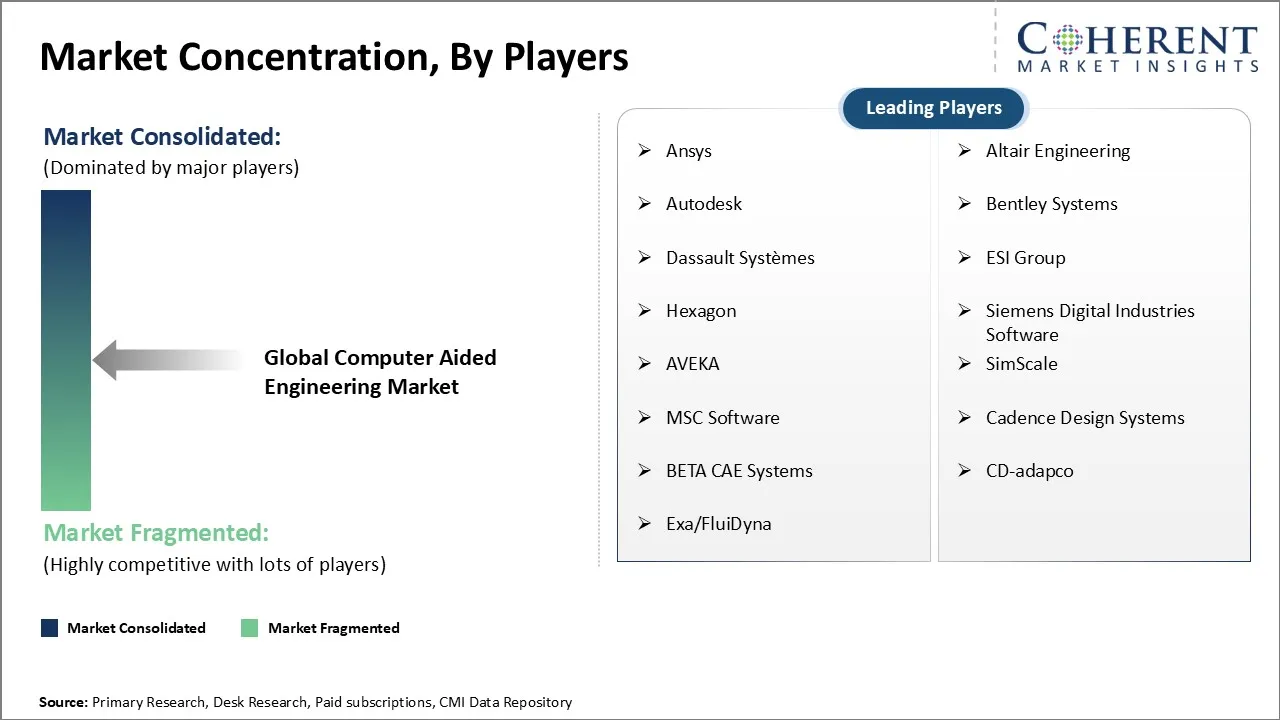
| Companies covered: | Ansys, Altair Engineering, Autodesk, Bentley Systems, Dassault Systèmes, ESI Group, Hexagon, Siemens Digital Industries Software, AVEKA, SimScale, MSC Software, Cadence Design Systems, BETA CAE Systems, CD-adapco, and Exa/FluiDyna | ||
| Growth Drivers: |
| ||
| Restraints & Challenges: |
| ||
Market Dynamics
Global Computer Aided Engineering Market Driver - Technological Advancements in Simulation Software
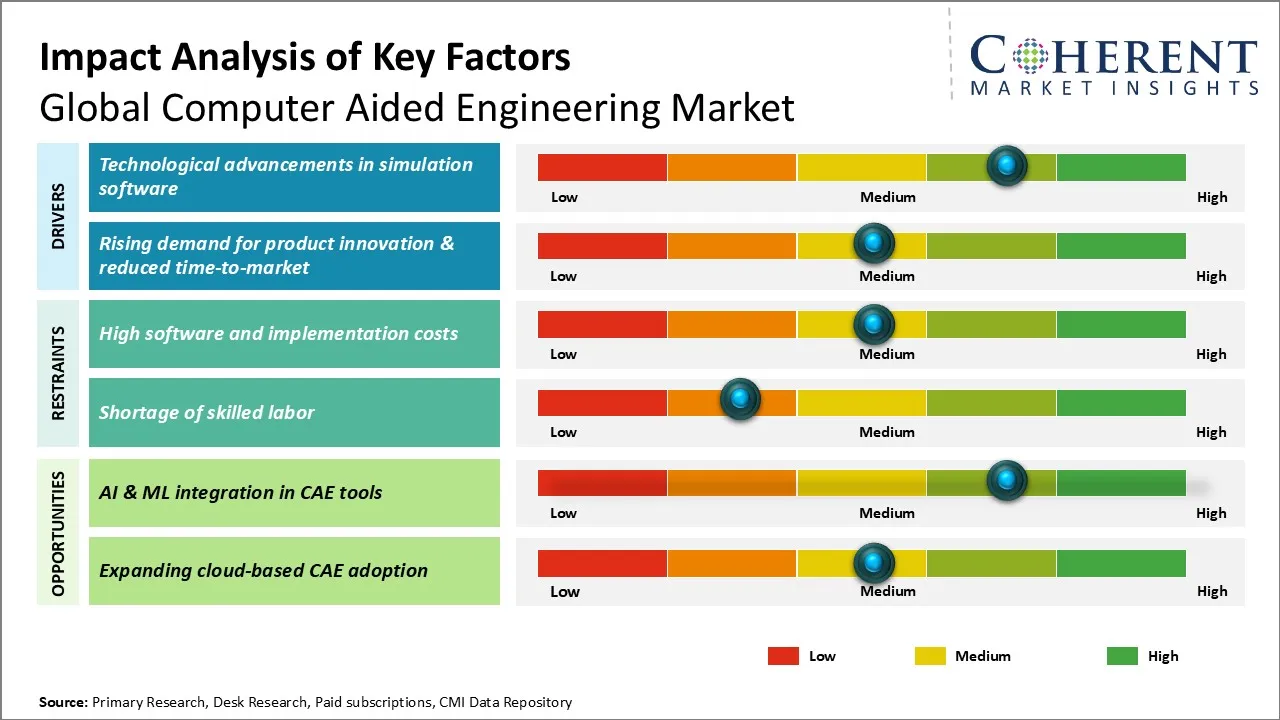
As industries become increasingly complex and competitive, the demand for sophisticated CAE tools has skyrocketed. These advanced simulation software solutions enable engineers and designers to create, analyze, and optimize products and processes in a virtual environment, reducing the need for physical prototypes and saving both time and costs. The integration of cutting-edge technologies such as artificial intelligence, machine learning, and cloud computing has further enhanced the capabilities of CAE software, allowing for more accurate and efficient simulations. Moreover, the advent of user-friendly interfaces and automation features has made these tools accessible to a wider range of users, expanding the adoption of CAE across various industry verticals.
Dassault Systèmes has significantly enhanced its SIMULIA platform by integrating high-performance computing and real-time simulation features. Its 3DEXPERIENCE platform allows collaborative engineering with advanced simulation capabilities—spanning structural, fluid, and electromagnetic analysis.
Global Computer Aided Engineering Market Opportunity - AI & ML Integration in CAE Tools
By leveraging AI and ML algorithms, CAE software can become more intelligent, efficient, and automated. These advanced technologies can enable CAE tools to analyze vast amounts of data, identify patterns, and make accurate predictions, thereby optimizing the design and simulation processes. AI and ML can also help in reducing the computational time required for complex simulations, allowing engineers to iterate and refine designs more quickly. Furthermore, the integration of AI and ML can facilitate the development of predictive maintenance models, enabling companies to anticipate and prevent potential failures in their products or systems. This proactive approach can lead to significant cost savings and improved product reliability.
Altair Engineering has embedded machine learning capabilities into its Altair HyperWorks suite through the Altair Knowledge Studio. This integration allows users to leverage ML algorithms for simulation result prediction, design optimization, and anomaly detection.
Analyst Opinion (Expert Opinion):
- The integration of artificial intelligence and machine learning into CAE tools is revolutionizing simulation workflows by enabling generative design, real-time performance prediction, and intelligent error detection—drastically reducing product development cycles.
- As industries adopt hybrid work models, cloud-based CAE platforms are gaining traction. These tools allow global engineering teams to collaborate on complex simulations in real time, driving faster innovation across sectors like aerospace, automotive, and electronics.
- CAE is evolving beyond design to support end-to-end product lifecycle management through digital twins. This is particularly transformative in smart manufacturing and predictive maintenance, where continuous simulation feeds optimize performance and minimize downtime.
Speak to the analyst
Want personalized insights?
Take the findings above to one of our principal consultants, or have the report rebuilt around the segments, geographies and competitors you actually track.
Market Segmentation
- Type Insights (Revenue, USD Bn, 2021 - 2033)
- Finite Element Analysis
- Computational Fluid Dynamics
- Multibody Dynamics
- Optimization & Simulation
- Regional Insights (Revenue, USD Bn, 2021 - 2033)
- North America
- U.S.
- Canada
- Latin America
- Brazil
- Argentina
- Mexico
- Rest of Latin America
- Europe
- Germany
- U.K.
- Spain
- France
- Italy
- Russia
- Rest of Europe
- Asia Pacific
- China
- India
- Japan
- Australia
- South Korea
- ASEAN
- Rest of Asia Pacific
- Middle East
- GCC Countries
- Israel
- Rest of Middle East
- Africa
- South Africa
- North Africa
- Central Africa
- North America
- Key Players Insights
- Ansys
- Altair Engineering
- Autodesk
- Bentley Systems
- Dassault Systèmes
- ESI Group
- Hexagon
- Siemens Digital Industries Software
- AVEKA
- SimScale
- MSC Software
- Cadence Design Systems
- BETA CAE Systems
- CD-adapco
- Exa/FluiDyna
Sources
Primary Research Interviews:
Stakeholders:
- CAE Software Developers and Engineers (e.g., Simulation Architects, FEA/CFD Specialists)
- Automotive and Aerospace OEMs (e.g., Design Engineers, Testing Managers)
- Product Lifecycle Management (PLM) Consultants
- Engineering Services Providers and Systems Integrators
- Academicians and Researchers from Mechanical & Aerospace Engineering Departments
- Cloud Computing Solution Architects specializing in Engineering Simulations
Databases:
- Eurostat
- U.S. Census
- Technology & Engineering Outlook Database
- OECD
- International Innovation Database (IINDB)
Magazines:
- Engineering Simulation Review
- CAD & CAE Today
- Digital Engineering Magazine
- Product Innovation Weekly
Journals:
- Journal of Computer-Aided Engineering & Simulation
- International Journal of Multiphysics Modeling
- CAE Systems and Applications Journal
- Journal of Digital Product Engineering
Newspapers:
- Tech Manufacturing Times
- Engineering Business Daily
- Mechanical Insight News
- The Economic Times (India)
Associations:
- International Association for Engineering Simulation (IAES)
- CAE Industry Forum (Europe)
- National Society of Engineering Analysts (NSEA)
- Cloud Simulation Consortium (CSC)
- American Society of Mechanical Engineers (ASME)
Public Domain Sources:
- U.S. Census Bureau
- EUROSTAT
- United Nations Economic Commission for Europe (UNECE)
- World Bank
- ResearchGate
Proprietary Elements:
- CMI Data Analytics Tool, Proprietary CMI Existing Repository of Information for Last 8 Years
Get access to 250+ pages report
Every segment, forecast, competitor profile and data table behind the analysis above — available for instant download.
- ESOMAR Member
- ISO 9001:2015 Certified
- D-U-N-S Registered
- GDPR & CCPA Compliant
Missing comfort of reading report in your local language? Find your preferred language:
Transform your Strategy with Exclusive Trending Reports
Frequently Asked Questions
The global computer aided engineering market is estimated to be valued at USD 10.86 billion in 2026 and is expected to reach USD 23.41 billion by 2033.
The CAGR of the global computer aided engineering market is projected to be 11.6% from 2026 to 2033.
Technological advancements in simulation software and rising demand for product innovation & reduced time-to-market are the major factors driving the growth of the global computer aided engineering market.
High software and implementation costs and shortage of skilled labor are the major factors hampering the growth of the global computer aided engineering market.
In terms of type, finite element analysis is estimated to dominate the market revenue share in 2026.
Ansys, Altair Engineering, Autodesk, Bentley Systems, Dassault Systèmes, ESI Group, Hexagon, Siemens Digital Industries Software, AVEKA, SimScale, MSC Software, Cadence Design Systems, BETA CAE Systems, CD-adapco, and Exa/FluiDyna are the major players.
North America is expected to lead the global computer aided engineering market in 2026.