

Global Concrete Mixer Market Size and Forecast – 2026-2033
The global concrete mixer market is estimated to be valued at USD 5.17 Bn in 2026 and is expected to reach USD 8.15 Bn by 2033, reflecting a compound annual growth rate (CAGR) of 6.7% from 2026 to 2033.
Key Takeaways of the Concrete Mixer Market
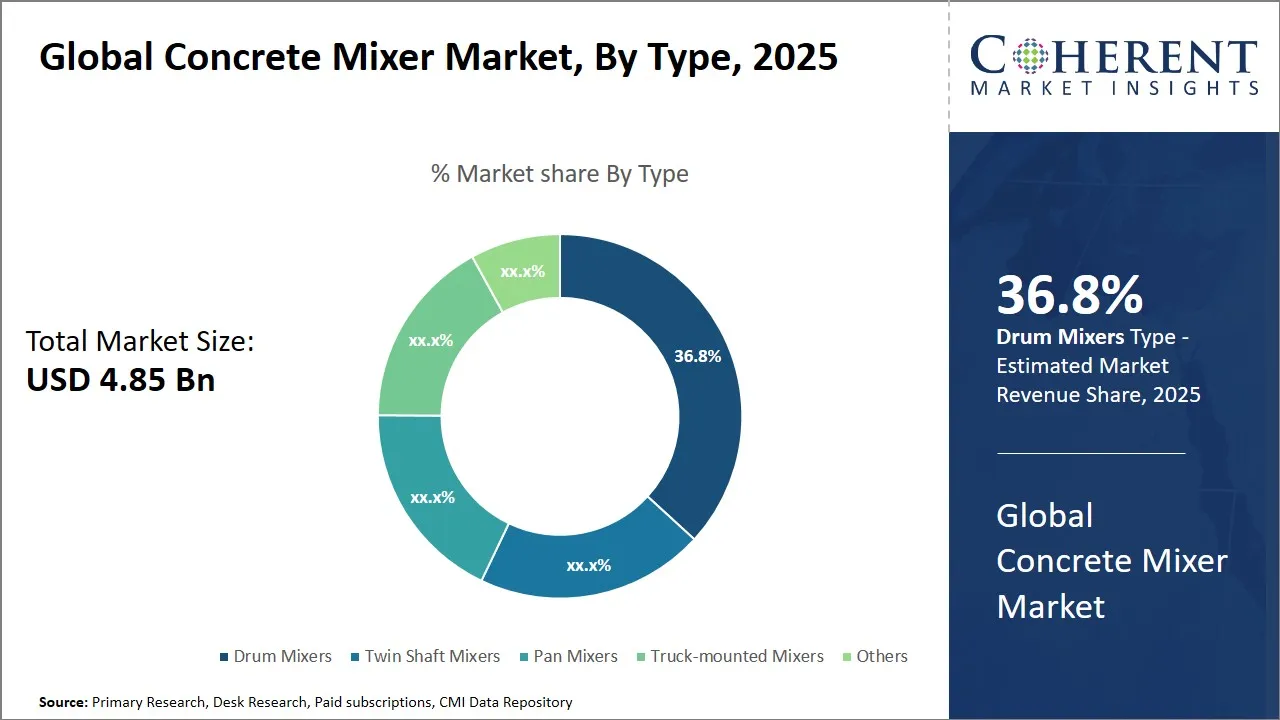
- The drum mixers segment is expected to account for 37.8 % of the concrete mixer market share in 2026.
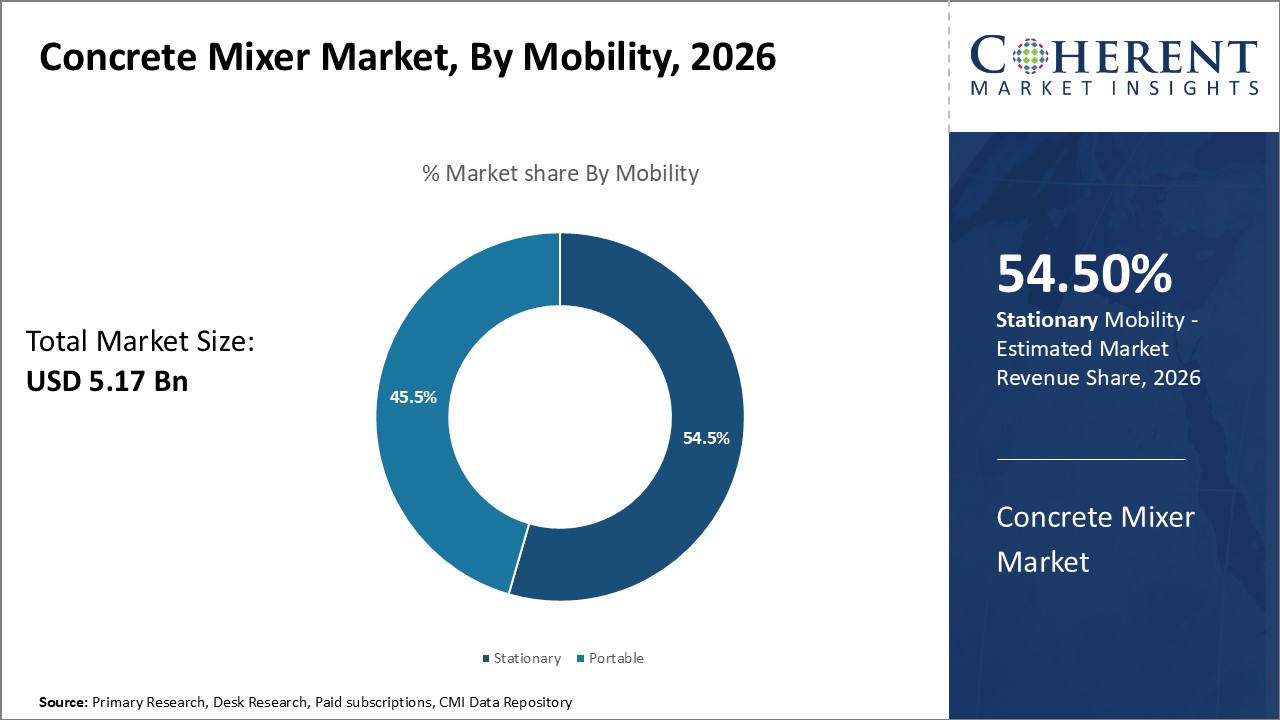
- The stationary segment is projected to captures 54.5 % of the market share in 2026.
- The infrastructure projects segment is expected to command 45.5 % share in 2026.
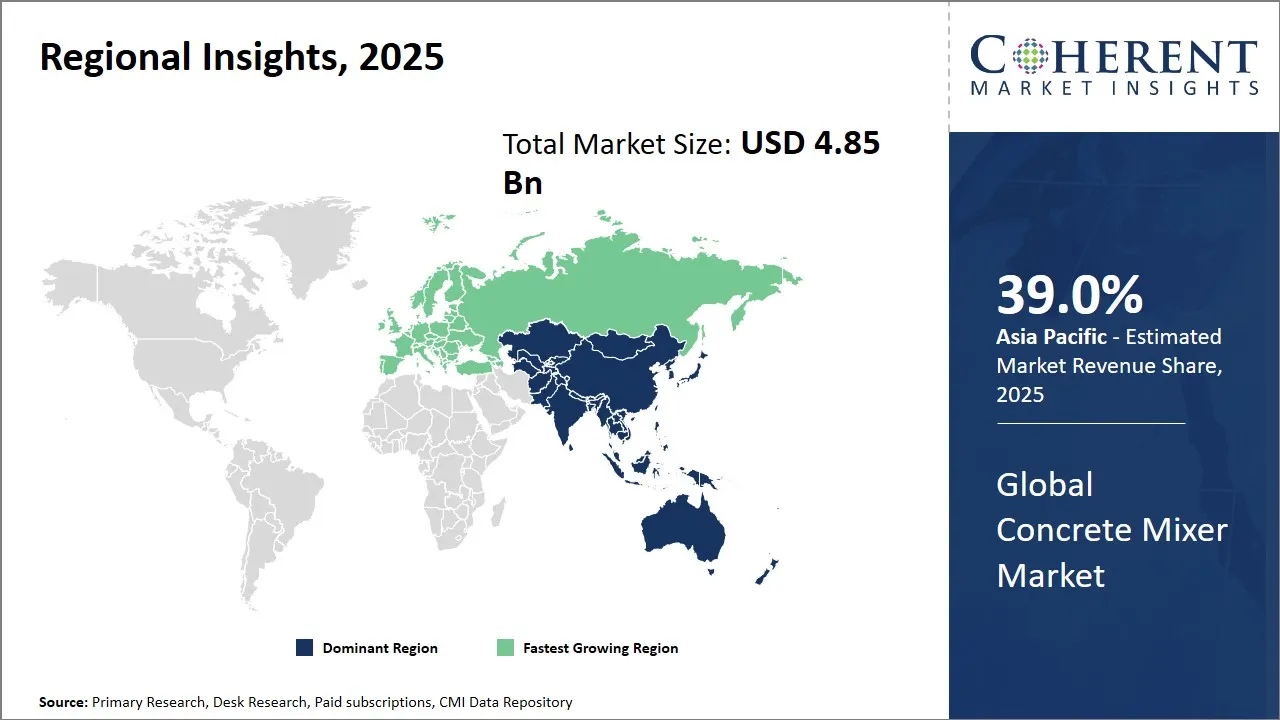
- Asia Pacific will dominate the concrete mixer market in 2026 with an estimated 39%
- Europe will hold 22% share in 2026 and record the fastest growth.
Current Events and Its Impact
Current Events | Description and its Impact |
Increase in Production |
|
Segmental Insights
- Current Industry Events of 2026
- Market Size Estimation
- Regional Breakdown
- Competitive Landscape
- Customer Intelligence
- Segmental Analysis
- Pricing Analysis
- Key Market Drivers, Challenges & Future Trends
- Customized Insights Section
Why Does Drum Mixers Dominate the Concrete Mixer Market in 2026?
The drum mixers segment is expected to hold 37.8% of the global concrete mixer market share in 2026. The leading role of drum mixers comes down to their basic structure combined with smooth operation, which explains why they’re commonly used on many building sites. These machines are preferred thanks to steady performance under high-volume demands, delivering consistent results that satisfy essential durability requirements. Their mixing process minimizes irregular blending, avoiding flaws that might weaken the final build.
For instance, on April 24, 2026, Menegotti introduced a fresh model, Infinity 400L, featuring a plastic drum instead of metal. This shift targets common problems seen with steel versions. Maintenance becomes simpler because the material resists rust better than conventional alternatives.
Stationary Segment Dominates the Concrete Mixer Market
The stationary segment is predicted to dominate the market with a 54.5% share in 2026. The expansion comes from their ability to handle tough demands in big construction projects. As they are not mobile, these units usually stay at permanent batch facilities where lots of concrete must be made regularly. Their fixed position increases strength and steady performance, allowing nonstop operation whenever reliable output matters most.
One key benefit of stationary mixers lies in consistent output through accurate measurement processes. Due to built-in mechanisms handling ingredient delivery and blending, they generate even mixes meeting tight technical standards which minimizes excess material use. Their static setup supports advanced features like automatic feed controls or real-time location, as a result, performance improves noticeably.
Why is Infrastructure Projects the Biggest End User for Concrete Mixers?
The infrastructure projects segment is projected to dominate the market with a 45.5% share in 2026. The ongoing growth in transport networks, including highways, rail lines, viaducts, runways, and barriers, drives need for substantial volumes of durable and precast concrete, increasing reliance on steady batching tools. Because such developments depend on resilient and strong materials, efficient mixers become essential parts of construction workflows.
A key reason for expansion in this area is governments’ focus on improving public facilities to keep up with city growth and economic progress. Because of these projects, there’s demand for mixers that create steady concrete mixes meeting safety and eco standards. Where high output matters, fixed and drum models are widely used - thanks to stable blending conditions that help maintain even results.
Global & Regional Construction Pipeline Projects
Project Type | Region | Approx. Pipeline Value (USD) |
Industrial Construction Projects
| North America | 1.2 trillion |
North-East Asia | 986.1 billion | |
South Asia | 629.2 billion | |
Sub-Saharan Africa | 146.5 billion | |
Road Construction Projects | North-East Asia | 1.0 trillion |
South Asia | 571 billion | |
South-East Asia | 502 billion | |
North America | 405 billion | |
Port Construction Projects | South-East Asia | 113.1 billion |
South Asia | 81.0 billion | |
Middle East & North Africa | 76.3 billion | |
Sub-Saharan Africa | 58.6 billion |
Regional Insights
Asia Pacific Concrete Mixer Market Analysis and Trends
The Asia Pacific region is projected to lead the market with a 39% share in 2026. Asia Pacific’s leading position in the global concrete mixer market comes from widespread building work, linked to fast city growth, factory expansion, and upgraded public works. Instead of just one factor, it's rapid development across multiple areas that keeps activity high. Nations including China, India, Japan, or South Korea support a broad network of ongoing builds - homes, offices, transport systems - all needing mixing equipment. Rather than isolated efforts, national programs like China’s Belt and Road or India’s Smart Cities push have sharply raised need for these machines.
Major firms such as Zoomlion based in China or JCB operating in India run local production units, which helps adapt products to fit specific conditions on the ground. Beyond domestic output, exchange patterns within the region allow easier access to affordable parts through cross-border trade, helping sustain competitive advantage.
Europe Concrete Mixer Market Analysis and Trends
Europe is expected to exhibit the fastest growth in the market contributing 22% share in 2026. Europe still ranks among the world’s top three regional centers. In this region, established economies such as Germany, France, Italy, or Spain drive most of the demand and supply - with Germany notably ahead in use and industrial activity. A key trait of the European market is a clear focus on eco-friendly practices, meeting rules, also using modern tech. Tougher pollution limits - alongside rising interest in cleaner building methods - are leading companies to pick fuel-saving mixers, vehicles with fewer fumes, or models built for special concrete made with less carbon or reused materials.
Global Concrete Mixer Market Outlook for Key Countries
Why is China Emerging as a Major Producer of Concrete Mixers?
China’s concrete mixer market relies heavily on state-driven infrastructure and city development plans. Yet local firms like Zoomlion and SANY maintain leadership via continuous improvements alongside widespread sales channels, improving access to concrete mixers both in cities and remote regions. While the established industry framework allows diverse models - from vehicle-based units to fixed systems - tailored for major building operations. Also, official measures encouraging greener methods together with tech upgrades fuel expansion.
India Concrete Mixer Market Analysis and Trends
India's concrete mixer market keeps growing because of steady infrastructure growth, backed by state programs such as the Smart Cities initiative and rural power projects. Key firms like JCB India and Schwing Stetter India meet varied builder demands with reliable, high-performance mixing equipment. Growth in smaller construction businesses is increasing interest in portable mixers, adding momentum to sector gains. Local production thrives due to supportive import policies and public-sector rewards that encourage home-based output.
U.S. Concrete Mixer Market Analysis and Trends
The U.S. maintains its position owing to an established market shaped by technological advances and strict rules centered on safety, low emissions, and performance. Firms such as Caterpillar, Oshkosh Corporation, or McNeilus deliver sophisticated concrete mixers equipped with automated systems and remote monitoring. Renewal projects along with rising homebuilding keep demand stable. In addition, an extensive network of dealers plus maintenance services boosts after-sales engagement and loyalty.
Is Germany the Next Growth Engine for the Concrete Mixer Market?
Germany shows solid market strength owing to skilled engineering and modern production facilities. Firms like Liebherr or Schwing are key suppliers of reliable concrete mixers meeting EU safety and emissions rules. Urban renewal efforts alongside industrial builds keep orders steady across sectors. Public investment in transport networks also supports ongoing activity. A push toward greener solutions encourages use of hybrid models, along with units running on biofuels or electricity.
U.A.E. Concrete Mixer Market Analysis and Trends
The U.A.E.'s concrete mixer market is growing fast, driven by major infrastructure upgrades that match its goals for a more diverse economy and better cities. Companies such as Schwing and Liebherr play an important role, offering durable concrete mixers designed for extreme heat and big construction jobs. Support from authorities - through simpler rules and efficient trade systems at top logistics centers like Jebel Ali - helps businesses enter the region smoothly. Spending on digital building tools along with portable modular units also pushes up demand steadily.
Rental vs. Owned Concrete Mixer Fleet Demand
Region | Approx. Owned Units | Approx. Rented Units |
North America | 260 | 180 |
Europe | 220 | 150 |
Asia Pacific | 300 | 210 |
Latin America | 95 | 70 |
Middle East & Africa | 85 | 55 |
Market Players, Key Development, and Competitive Intelligence
Key Developments
- On April 7, 2025, CIFA launched the Magnum MK35H concrete mixer-pump. The unit appears first at Bauma 2025, a global event for construction machinery held in Munich.
- On March 24, 2024, CIFA introduced the new ENERGYA E10 electric mixer during Bauma 2025; it arrives alongside the updated Mercedes-Benz eArocs 400 truck. The unit - crafted together with Daimler experts - delivers fully emission-free performance. Instead of diesel power, this model relies solely on battery energy. While designed for urban sites, its range supports regional hauling too.
Top Strategies Followed by Global Concrete Mixer Market Players
Player Type | Strategic Focus | Example |
Established Market Leaders | Heavy investments on R&D | On February 10, 2025, Volvo Trucks delivered CEMEX’s first fully electric, no-emission heavy-duty mixer vehicle. This battery-powered model follows a 2021 deal, aimed at worldwide joint efforts toward lower carbon output and better efficiency. |
Mid-Level Players | Development of New Products | In January 2024, SANY Putzmeister introduced an entirely electric iONTRON eMixer. Featuring a 9 m³ drum, it operates up to eight hours in city conditions. This unit supports projects across the West Midlands - specifically aiding HS2 work near Coleshil and Kingsbury Road.
|
Small-Scale Players | Expansion of Portfolio | In August 2025, Ajax Engineering expanded its portfolio to batching plants, transit mixers, along with boom pumps and 3D concrete printers. With a solid dealer setup - 52 dealers, 114 service locations, plus 28 global distributors - it extends coverage while building lasting client trust. |
Market Report Scope
Concrete Mixer Market Report Coverage
| Report Coverage | Details | ||
|---|---|---|---|
| Base Year: | 2025 | Market Size in 2026: | USD 5.17 Bn |
| Historical Data for: | 2020 To 2024 | Forecast Period: | 2026 To 2033 |
| Forecast Period 2026 to 2033 CAGR: | 6.7% | 2033 Value Projection: | USD 8.15 Bn |
| Geographies covered: |
| ||
| Segments covered: |
| ||
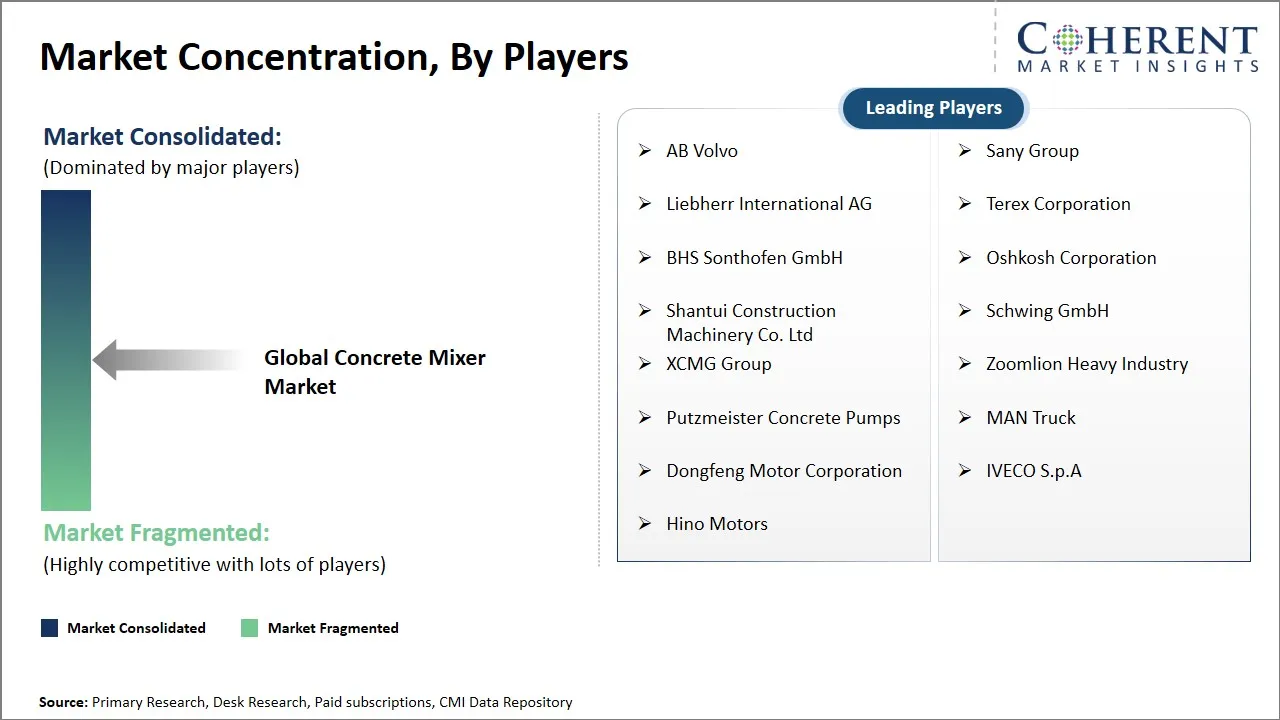
| Companies covered: | AB Volvo, Sany Group, Liebherr International AG, Terex Corporation, BHS Sonthofen GmbH, Oshkosh Corporation, Shantui Construction Machinery Co. Ltd, Schwing GmbH, XCMG Group, Zoomlion Heavy Industry, Putzmeister Concrete Pumps, MAN Truck, Dongfeng Motor Corporation, IVECO S.p.A, and Hino Motors | ||
| Growth Drivers: |
| ||
| Restraints & Challenges: |
| ||
Market Dynamics
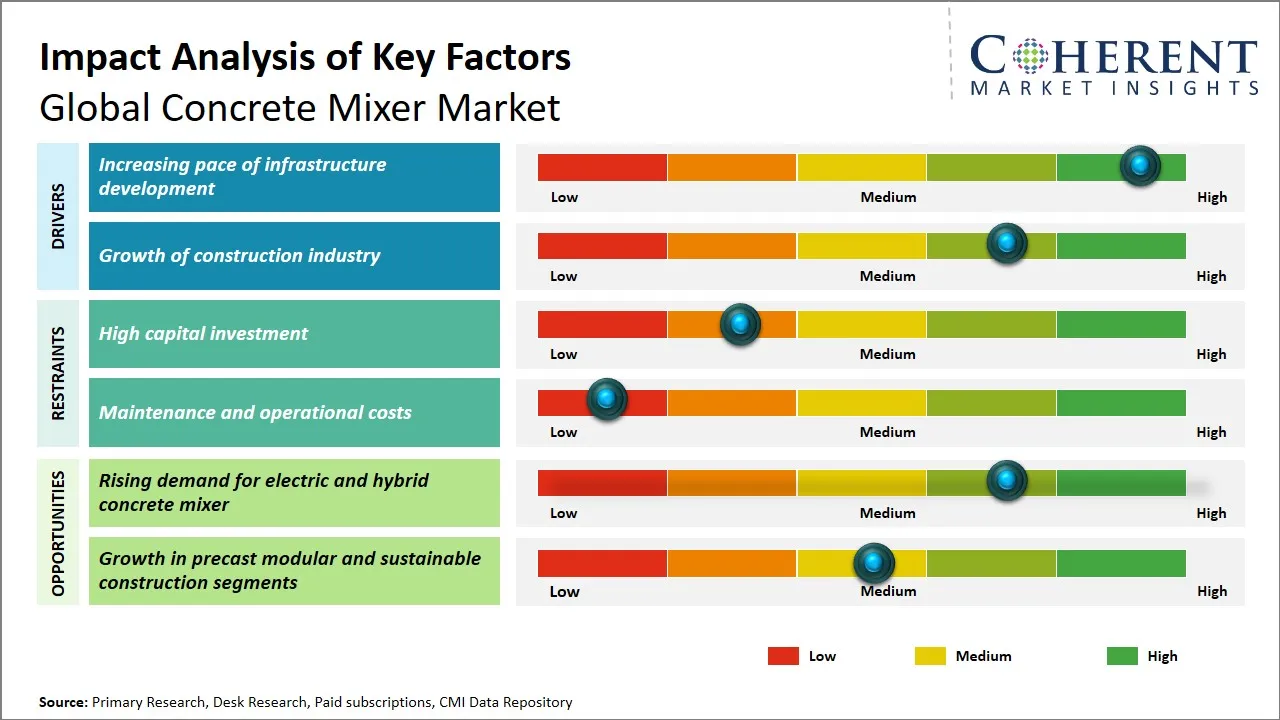
Global Concrete Mixer Market Driver - Increasing Pace of Infrastructure Development
The fast pace of construction in developing and wealthy nations alike is boosting global interest in concrete mixers. As cities grow and economies expand, officials fund major projects like roads, rail networks and business hubs span where fresh concrete must be blended quickly yet reliably. Since such jobs call for steady output and big quantities, machines that blend ingredients thoroughly help maintain standards while cutting down on physical work.
In addition, upgrades in how buildings go up - with more reliance on pre-blended materials - are pushing site managers toward smarter tools that speed things up without sacrificing precision. Furthermore, rising attention to eco-friendly construction boosts demand for accurate, automated mixing - something concrete mixers provide. Due to expanding building projects alongside faster tech uptake, growth in this sector remains strong, pushing the concrete mixer market ahead.
Global Concrete Mixer Market Opportunity – Rising Demand for Electric and Hybrid Concrete Mixers
The global concrete mixer market sees strong growth potential as demand rises for electric and hybrid models - this shift comes from tighter environmental rules alongside efforts to support greener construction methods. Diesel-run mixers release high levels of carbon dioxide while generating loud noises, pushing firms and makers to seek cleaner options. These new mixer types provide clear benefits such as fewer emissions, less fuel use, yet operate more quietly matching trends toward sustainable buildings and public rewards for low-impact tech.
Urban expansion plus infrastructure projects in ecologically fragile zones also favor electric versions to cut down air contamination and sound disruptions. Improvements in battery tech, electric motors, or hybrid setups help these mixers run better and go farther - so they can match traditional ones. Because more builders now see long-term savings from using less fuel and needing fewer repairs, interest is growing. Equipment makers teaming up with EV specialists also push progress, aiming at smarter concrete mixing tools. As a result, electric or hybrid mixers could change the industry’s direction, thereby opening fresh opportunities while driving R&D spending into greener machinery.
Analyst Opinion (Expert Opinion)
- Demand now favors mixers that use less energy, work faster, or hold more, especially where ready-mix concrete spreads quickly. In Europe and North America, rules push firms to choose cleaner trucks; these often link up with digital systems like real-time tracking, automatic ingredient control, or sensors that send data online. Meanwhile, developing markets show stronger interest in lightweight, mobile, and simpler models, due to rising numbers of local builders working on isolated job sites.
- Top international players control large-capacity transit mixers, whereas smaller and medium-sized makers grow fast in portable plus self-loading models. A shift toward electric-powered mixer trucks appears alongside lighter composite drums, alongside tailored mixing methods for low-emission concrete, now gaining focus due to greener building demands. Even with disrupted supplies and unstable material prices, prospects stay favorable thanks to major upcoming infrastructure projects, smarter job site processes through tech tools, and worldwide momentum on eco-friendly construction systems.
Speak to the analyst
Want personalized insights?
Take the findings above to one of our principal consultants, or have the report rebuilt around the segments, geographies and competitors you actually track.
Market Segmentation
- Type Insights (Revenue, USD Billion, 2021 - 2033)
- Drum Mixers
- Twin Shaft Mixers
- Pan Mixers
- Truck-mounted Mixers
- Others
- Mobility Insights (Revenue, USD Billion, 2021 - 2033)
- Stationary
- Portable
- End User Insights (Revenue, USD Billion, 2021 - 2033)
- Infrastructure Projects
- Residential Construction
- Commercial Construction
- Regional Insights (Revenue, USD Billion, 2021 - 2033)
- North America
- U.S.
- Canada
- Latin America
- Brazil
- Argentina
- Mexico
- Rest of Latin America
- Europe
- Germany
- U.K.
- Spain
- France
- Italy
- Russia
- Rest of Europe
- Asia Pacific
- China
- India
- Japan
- Australia
- South Korea
- ASEAN
- Rest of Asia Pacific
- Middle East
- GCC Countries
- Israel
- Rest of Middle East
- Africa
- South Africa
- North Africa
- Central Africa
- North America
- Key Players Insights
- AB Volvo
- Sany Group
- Liebherr International AG
- Terex Corporation
- BHS Sonthofen GmbH
- Oshkosh Corporation
- Shantui Construction Machinery Co. Ltd
- Schwing GmbH
- XCMG Group
- Zoomlion Heavy Industry
- Putzmeister Concrete Pumps
- MAN Truck
- Dongfeng Motor Corporation
- IVECO S.p.A
- Hino Motors
Sources
Primary Research Interviews
- Construction Equipment Manufacturers
- Concrete Production Companies
- Construction Contractors and Builders
- Equipment Rental Service Providers
Databases
- IBISWorld Industry Reports
- Euromonitor International
Magazines
- Construction Equipment Magazine
- Concrete Producer Magazine
- Equipment World Magazine
- International Construction Magazine
Journals
- Journal of Construction Engineering and Management
- Construction and Building Materials Journal
- International Journal of Construction Management
Newspapers
- Construction Dive
- Equipment Today
- Construction News
- Building Design + Construction
- Construction Week Online
Associations
- Association of Equipment Manufacturers (AEM)
- National Ready Mixed Concrete Association (NRMCA)
- European Construction Equipment Committee (CECE)
- International Association of Concrete Repair Specialists
Public Domain Sources
- U.S. Census Bureau Manufacturing Statistics
- European Commission Industry Reports
- Government Construction Statistics
- International Trade Administration Data
Proprietary Elements
- CMI Data Analytics Tool
- Proprietary CMI Existing Repository of information for last 8 years
Get access to 250+ pages report
Every segment, forecast, competitor profile and data table behind the analysis above — available for instant download.
- ESOMAR Member
- ISO 9001:2015 Certified
- D-U-N-S Registered
- GDPR & CCPA Compliant
Missing comfort of reading report in your local language? Find your preferred language:
Transform your Strategy with Exclusive Trending Reports
Frequently Asked Questions
The global concrete mixer market is estimated to be valued at USD 5.17 Bn in 2026 and is expected to reach USD 8.15 Bn by 2033.
The CAGR of global concrete mixer market is projected to be 6.7% from 2026 to 2033.
Increasing pace of infrastructure development and growth of construction industry are the major factors driving the growth of the global concrete mixer market.
High capital investment and maintenance and operational costs are the major factors hampering the growth of the global concrete mixer market.
IoT-enabled mixers with real-time monitoring and automated mixing controls are transforming accuracy, efficiency, and fleet management.
Smaller mixers are thriving because they suit low-budget contractors, small-site construction, and rural development projects.
In terms of type, the drum mixers are estimated to dominate the market revenue share in 2026.