

Global Connected Aircraft Market Size and Forecast – 2026 to 2033
Coherent Market Insights estimates that the global connected aircraft market is expected to reach USD 6 Bn in 2026 and will expand to USD 50 Bn by 2033, registering a CAGR of 25% between 2026 and 2033.
Key Takeaways of the Connected Aircraft Market
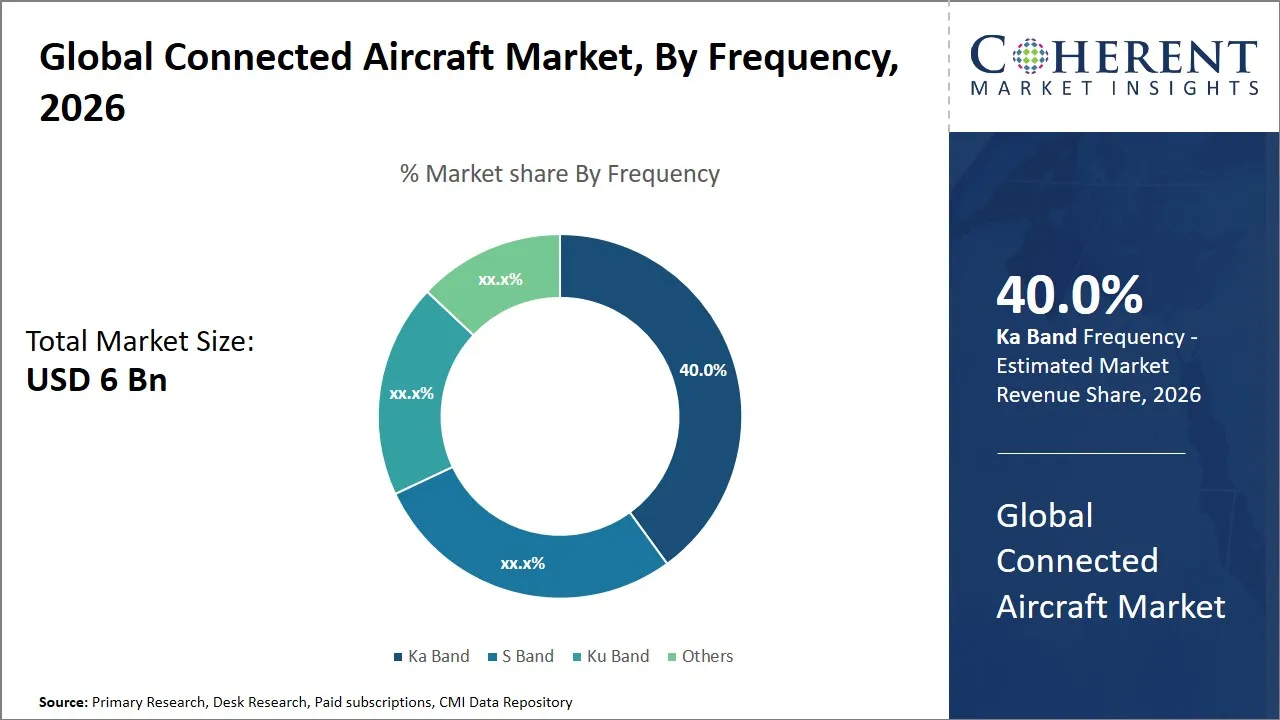
- The Ka band segment is expected to account for 40% of the connected aircraft market share in 2026.
- The system segment is projected to capture 53% of the market share in 2026.
- The commercial segment is anticipated to account for 31% of the global connected aircraft market share in 2026.
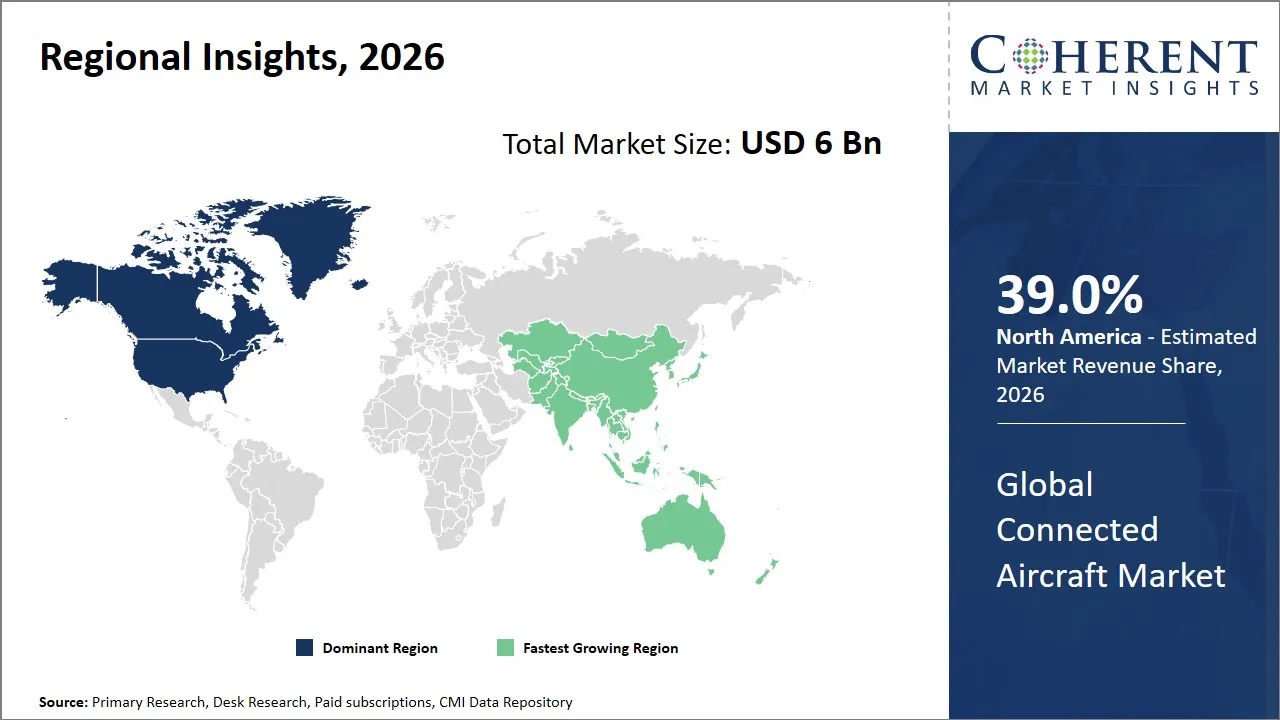
- North America is projected to dominate the connected aircraft market in 2026 with a 39%
- Asia Pacific is expected to hold 27% share in 2026 and is expected to record the fastest growth over the forecast period.
Currents Events and Its Impacts
Current Events | Description and its Impacts |
GA-ASI Completes First Flight of Belgium's MQ-9B SkyGuardian |
|
Segmental Insights
- Current Industry Events of 2026
- Market Size Estimation
- Regional Breakdown
- Competitive Landscape
- Customer Intelligence
- Segmental Analysis
- Pricing Analysis
- Key Market Drivers, Challenges & Future Trends
- Customized Insights Section
Why Does the Ka Band Segment Dominates the Global Connected Aircraft Market in 2026?
The Ka band segment is expected to hold 40.0% of the global special mission aircraft market share in 2026. Expansion stems from rising need for fast, high-volume in-flight internet services. Driven by performance advantages, Ka Band sees wider adoption than alternatives like Ku Band or S Band. At 26.5–40 GHz, these signals carry more information per second. Higher capacity supports quick downloads, live chats, and uninterrupted video use midflight. With travelers demanding seamless online access, greater throughput becomes essential over time.
For instance, on May 12, 2025, Viasat Inc. announced that JetXP, its next-generation business aviation connectivity service, has been selected by more than 400 customers since becoming commercially available at the end of last year.
System Segment Dominates the Global Connected Aircraft Market
The system segment is expected to account for 53.0% of the market share in 2026. Primarily, expansion follows rising need for complex communication plus navigation tools capable of extended connections. Infrastructure built on antennas, modems, routers, and onboard servers. Advanced setups now enter wider use by carriers and plane builders, driven by smoother access, stronger data protection, improved service handling midflight.
Why is Commercial the Most Widespread Application in the Connected Aircraft Market?
The commercial segment is projected to account for 31.0% of the special mission aircraft market share in 2026. Expansion mainly results from aviation prioritizing stronger links between travelers alongside smoother daily operations. What defines commercial flight activity are single-aisle and twin-aisle planes, widely adopted for both local and global travel paths. A key influence here stems from rising traveler demand - onboard networks must match the fast, stable web access available outside airports.
Operational Cost Reduction via Real-Time Aircraft Health Monitoring
Benefit Category | Approx. Metric/Data |
Total potential annual OPEX savings | Up to USD 15 billion per year |
Fuel cost savings (annual) | ~USD 1.3 billion from 1 % fuel reduction |
Fuel volume reduction (annual) | ~3.39 billion liters |
Fuel burn reduction potential | Up to 2.5 % fuel efficiencies |
Predictive maintenance cost savings | Up to USD 5.6 billion |
Maintenance, Repair & Operations (MRO) spend baseline | USD 62.1 billion (2016); USD 90 billion by 2024 |
Flight delay cost reduction | USD 1.3–USD 2.4 billion |
Reduction in troubleshooting/maintenance time | Up to 25 % |
Regional Insights
North America Connected Aircraft Market Analysis and Trends
The North America region is projected to lead the market with a 39% share in 2026. Expansion originates in a mature network tied to air travel and national security operations, supported by consistent policy direction alongside a resilient commercial flight system. Driven notably by one dominant nation, progress follows sustained funding into research efforts, sophisticated orbital systems, and data transmission frameworks developed through joint work among corporate entities and federal bodies including aviation and space authorities.
Key producers of airplanes, firms recognized globally, are located here, joined by firms specializing in real-time information flow during flights, creating momentum within the economic segment. Expectations around smoother journeys for travelers, improved logistical performance, and mandatory compliance standards push carriers toward integrating digital tools across entire fleets. Exchange patterns remain balanced, as the region engages heavily in cross-border transactions involving high-tech components related to flight, enabling swift spread of new methods and international cooperation.
For instance, on December 12, 2025, Bombardier announced that the Government of Canada placed orders for six Global 6500 aircraft to perform worldwide utility flights and support missions such as aeromedical evacuations, disaster relief, humanitarian aid and national security operations.
Asia Pacific Special Mission Aircraft Market Analysis and Trends
The Asia Pacific region is expected to exhibit the fastest growth in the market contributing 27% share in 2026. A surge in air travel demand shapes part of the growth pattern. Larger airplane collections appear alongside digital upgrades in Asian skies. Countries like China, India, and Japan move ahead under national plans for smart terminals and local plane making. Government backing plays a role here. More people can afford flights now, while low-cost carriers multiply steadily.
This shift nudges the adoption of connected cabins and live monitoring during upkeep. Movement happens fast, helped by foreign investments flowing in. Partnerships between companies from different countries add momentum. Chinese firm, COMAC, builds linked tech into new aircraft designs. Japanese counterpart Mitsubishi Aircraft follows similar paths. Global suppliers such as Panasonic Avionics and Thales grow reach through cooperative deals across borders. Progress unfolds without pause.
Global Connected Aircraft Market Outlook for Key Countries
Why is the U.S. Emerging as a Major Hub in the Connected Aircraft Market?
Despite global shifts, progress in airborne connectivity continues strongest within U.S. borders. Emerging at the forefront stand Boeing and Honeywell Aerospace, companies moving beyond growth into redefining aircraft communication systems. Rather than depend on legacy frameworks, their efforts center on real-time data handling, predictive maintenance analysis, alongside improved connectivity through satellite-linked networks. Major carriers based here pour resources into improving in-flight links, a trend mirrored by federal backing for smarter sky navigation frameworks. Beyond corporate effort, a dense web of space-based transmitters enables consistent high-speed internet access midflight.
Is China the Next Growth Engine for the Connected Aircraft Market?
Notably, China has become a key player due to deliberate government-backed strategies, particularly those linked to the "Made in China 2025" initiative, focused on advancing domestic skills in aviation technology and interconnected digital infrastructures. Airlines like China Southern and China Eastern have contributed significantly; their growth fuels demand for more sophisticated in-flight communications and optimized management systems. At the same time, COMAC integrates connected flight designs into both smaller regional aircraft and wide-body jets, strengthening homegrown manufacturing in aerospace design. Working together with international companies - such as Panasonic Avionics and Collins Aerospace - brings broader features in live data transmission and electronic cockpit setups.
U.K. Special Mission Aircraft Market Analysis and Trends
Even with advances in many regions, focus holds firm on Britain’s part in shaping smarter aviation through hubs near Farnborough and Cambridge. Expertise clusters there, fueled by companies like BAE Systems and Rolls-Royce, where work unfolds on self-adjusting engines and live tracking during flights. Public support funds projects aiming at cleaner performance, layering digital improvements into existing frameworks. Partnerships form - not only locally but beyond borders, bringing resources; insight flows both ways, deepening skill. Quiet momentum builds when regulation, money, and international coordination move together. Progress takes shape without fanfare.
India Special Mission Aircraft Market Analysis and Trends
A shift unfolds across India's skies, marked by airlines focused on affordability and rising numbers of travelers. Regional access gains momentum through initiatives like UDAN, prompting interest in aircraft technologies that support smoother, safer flights. Fleet modernization takes shape at companies such as IndiGo and Air India, where better data links and onboard services become priorities. From behind the scenes, a surge in domestic tech talent contributes fresh approaches to airplane connectivity and smart systems. Partnerships with global firms including Thales and Gogo introduce new depth to locally driven advancements.
Japan Special Mission Aircraft Market Analysis and Trends
Emerging from industrial precision, Japan's networked flight industry grows through swift tech uptake, active original manufacturers, and state-backed digital frameworks in air travel. Notably involved, Mitsubishi Aircraft Corporation develops future-ready short-haul planes featuring embedded communication tools. Passenger comfort and system consistency drive carriers like ANA and Japan Airlines toward funding onboard internet access alongside continuous plane diagnostics. Backing comes from national initiatives that encourage aerial upgrades, working jointly with firms including Panasonic and Honeywell. These alliances allow complex airborne networks to take root, positioning the nation firmly within global advancements - quietly shaping what follows.
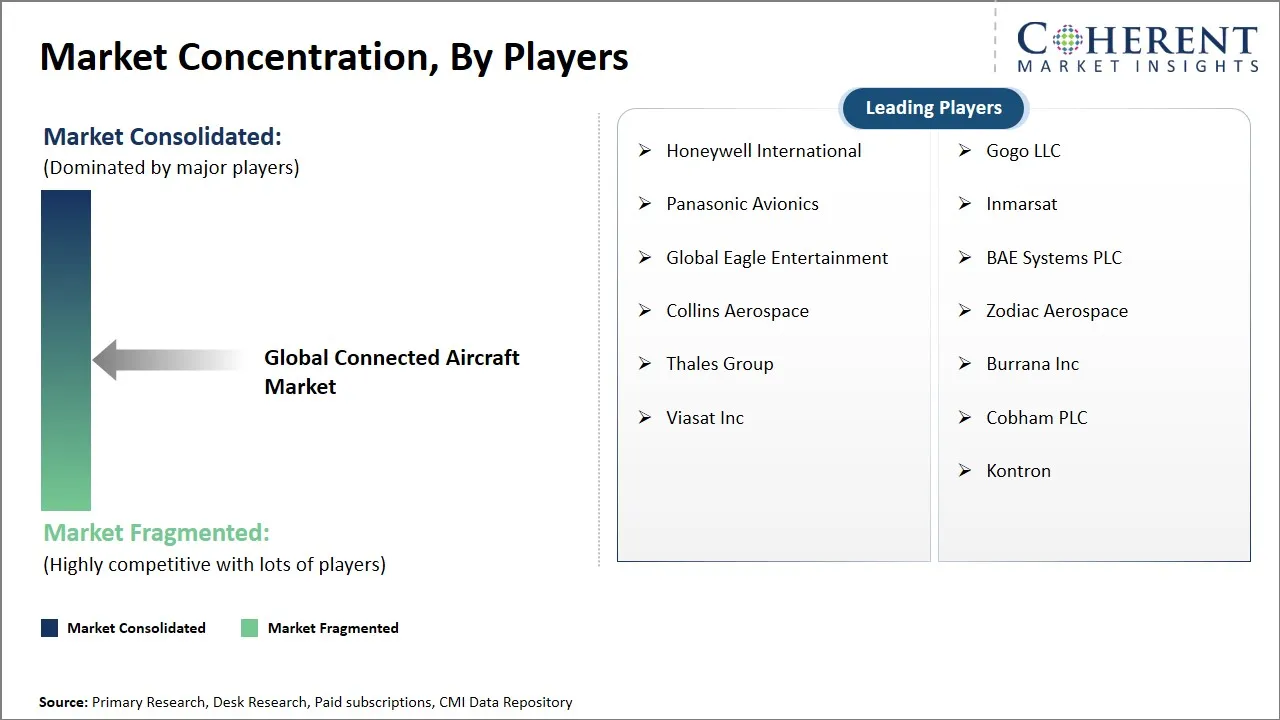
Market Players, Key Development, and Competitive Intelligence
Key Developments
- On January 7, 2026, Qatar Airways, the operator of the world’s first and largest Starlink equipped widebody fleet, became the first carrier globally to enable Boeing 787-8 with Starlink. The airline has also equipped its entire Airbus A350 fleet with Starlink enabled connectivity.
- On November 6, 2025, International Airlines Group (IAG) announced a partnership to implement Starlink enabled high speed wi-fi connectivity on Aer Lingus, British Airways, Iberia, LEVEL and Vueling aircraft, with the first aircraft due to go live with the service in early 2026.
Top Strategies Followed by Global Connected Aircraft Market Players
Player Type | Strategic Focus | Example |
Established Market Leaders | Major Order Confirmation | On July 21, 2025, L3Harris Technologies received a USD 300 million contract from Italy to deliver two Gulfstream G550 aircraft provisioned for a modern electromagnetic warfare system. |
Mid-Level Players | Business Agreement | On January 22, 2024, Saab and the U.A.E. Ministry of Defense announced they have signed a contract and Saab has received an order regarding in-service support for the GlobalEye Airborne Early Warning and Control (AEW&C) solution. |
Small-Scale Players | Textron Product Showcase | On June 16, 2025, Textron Aviation Inc announced the debut of its new multi-mission Beechcraft King Air demonstration aircraft at the 2025 Paris Air Show. |
Market Report Scope
Connected Aircraft Market Report Coverage
| Report Coverage | Details | ||
|---|---|---|---|
| Base Year: | 2025 | Market Size in 2026: | USD 6 Bn |
| Historical Data for: | 2020 To 2024 | Forecast Period: | 2025 To 2032 |
| Forecast Period 2026 to 2033 CAGR: | 25% | 2033 Value Projection: | USD 50 Bn |
| Geographies covered: |
| ||
| Segments covered: |
| ||
| Companies covered: | Honeywell International, Gogo LLC, Panasonic Avionics, Inmarsat, Global Eagle Entertainment, BAE Systems PLC, Panasonic Avionics Corporation, Zodiac Aerospace, Thales Group, Burrana Inc, Viasat Inc, Cobham PLC, Rockwell Collins Inc, Kontron, Collins Aerospace, and Viasat | ||
| Growth Drivers: |
| ||
| Restraints & Challenges: |
| ||
Global Connected Aircraft Market Dynamics
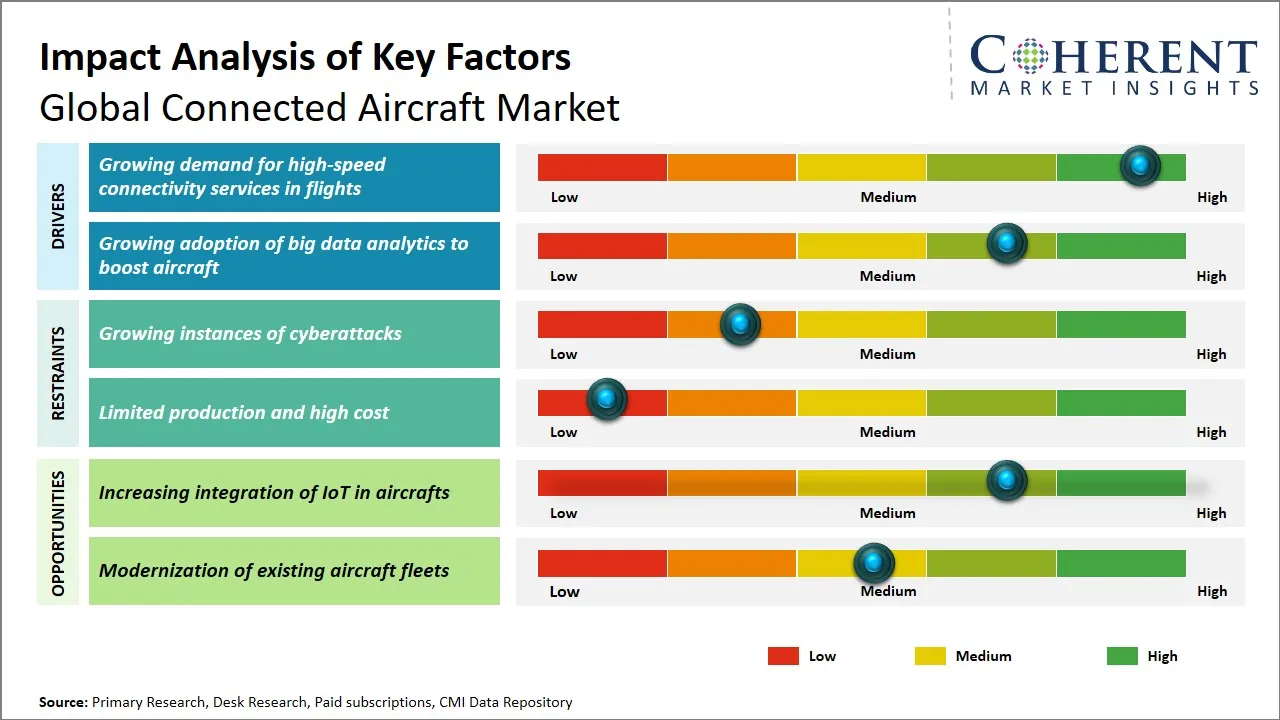
Global Connected Aircraft Market Driver - Growing Demand for High-Speed Connectivity Services in Flights
The aviation industry is witnessing a significant shift as passengers increasingly expect seamless, high-speed internet connectivity during flights, driving the demand for advanced connected aircraft solutions. Travelers, whether business professionals or leisure passengers, prioritize uninterrupted access to streaming services, video conferencing, and real-time communication while airborne, mirroring their on-ground digital experience. This surge in connectivity expectations is compelling airlines to invest heavily in state-of-the-art small satellite communication systems and onboard Wi-Fi 6 technology to enhance passenger satisfaction and maintain competitive advantage.
On September 4, 2025, JetBlue announced it will be the first airline in the world to sign on with Amazon’s Project Kuiper, an advanced low Earth orbit satellite broadband network, to bring even faster and more reliable connectivity to its popular onboard Wi-Fi known as Fly-Fi.
Global Connected Aircraft Market Opportunity - Increasing Integration of IoT in Aircrafts
The rising integration of Internet of Things (IoT) technologies within the aviation sector presents a significant growth opportunity for the global connected aircraft market. IoT enables real-time data collection and analysis from various aircraft systems, enhancing operational efficiency, safety, and passenger experience. Airlines and aircraft manufacturers are increasingly adopting IoT solutions to monitor aircraft health, predict maintenance requirements, and minimize downtime, thereby reducing operational costs. Furthermore, IoT facilitates improved fuel management and optimized flight routes, contributing to sustainability efforts crucial for the industry’s long-term growth.
For instance, on April 8, 2025, RTX's Collins Aerospace joined the Digital Alliance for Aviation to expand predictive maintenance and health monitoring solutions. Collins Aerospace will advance predictive health monitoring solutions for airlines as part of the Digital Alliance for Aviation, an Airbus-led initiative powered by the Skywise platform.
Analyst Opinion (Expert Opinion)
- A steady evolution marks the modern connected aircraft landscape, shaped by carriers integrating connectivity into standard operations rather than offering it selectively. Passenger demand for reliable, fast internet access now runs parallel with operator goals like continuous equipment assessment, foresight in repairs, efficient fuel usage, and improved airborne coordination. Shifting patterns appear in infrastructure choices, where advanced satellite networks gain favor, especially those using Ka-band frequencies or combining geostationary and low Earth orbit platforms.
- Performance across networks now matters more than mere access to signals when flying. What follows depends largely on how well systems cover every region without drop-offs. Being part of original equipment manufacturer setups from the start gives certain providers an edge. Instead of selling just links between ground and sky, stronger offers combine live data tools with secure operations support. Those who link flight-based internet to analysis engines tend to last longer in this space.
Speak to the analyst
Want personalized insights?
Take the findings above to one of our principal consultants, or have the report rebuilt around the segments, geographies and competitors you actually track.
Market Segmentation
- Frequency Insights (Revenue, USD Bn, 2021 - 2033)
- Ka Band
- S Band
- Ku Band
- Others
- Type Insights (Revenue, USD Bn, 2021 - 2033)
- System
- Solutions
- Application Insights (Revenue, USD Bn, 2021 - 2033)
- Commercial
- Narrow Body
- Widebody
- Business Jet
- General Aviation Aircraft
- Military
- Others
- Regional Insights (Revenue, USD Bn, 2021 - 2033)
- North America
- U.S.
- Canada
- Latin America
- Brazil
- Argentina
- Mexico
- Rest of Latin America
- Europe
- Germany
- U.K.
- Spain
- France
- Italy
- Russia
- Rest of Europe
- Asia Pacific
- China
- India
- Japan
- Australia
- South Korea
- ASEAN
- Rest of Asia Pacific
- Middle East
- GCC Countries
- Israel
- Rest of Middle East
- Africa
- South Africa
- North Africa
- Central Africa
- North America
- Key Players Insights
- Honeywell International
- Gogo LLC
- Panasonic Avionics
- Inmarsat
- Global Eagle Entertainment
- BAE Systems PLC
- Zodiac Aerospace
- Thales Group
- Burrana Inc
- Viasat Inc
- Cobham PLC
- Kontron
- Collins Aerospace
Sources
Primary Research Interviews
- Senior Aviation Technology Executives from leading airlines
- Connected Aircraft Solution Providers and System Integrators
- Aircraft Manufacturers and OEMs
- Aviation Regulatory Authorities and Safety Officials
Databases
- Aerospace & Defense Intelligence Database
- Aviation Industry Database (AID)
- International Air Transport Association (IATA) Statistics
- Federal Aviation Administration (FAA) Aircraft Registry
Magazines
- Aviation Week & Space Technology
- Aircraft Interiors International
- Aerospace Manufacturing and Design
- Air Transport World
Journals
- Journal of Air Transport Management
- Aerospace Science and Technology
- International Journal of Aviation Management
Newspapers
- The Wall Street Journal (Aviation Section)
- Financial Times (Aerospace & Defense)
- Reuters (Aviation Industry Coverage)
- Bloomberg (Aerospace Markets)
- Aviation Daily
Associations
- International Air Transport Association (IATA)
- Aerospace Industries Association (AIA)
- Airlines for America (A4A)
- Aircraft Electronics Association (AEA)
- International Civil Aviation Organization (ICAO)
Public Domain Sources
- Federal Aviation Administration (FAA) Reports and Publications
- European Aviation Safety Agency (EASA) Guidelines
- International Civil Aviation Organization (ICAO) Standards
- Boeing Commercial Market Outlook
- Airbus Global Market Forecast
Proprietary Elements
- CMI Data Analytics Tool
- Proprietary CMI Existing Repository of information for last 8 years
Get access to 250+ pages report
Every segment, forecast, competitor profile and data table behind the analysis above — available for instant download.
- ESOMAR Member
- ISO 9001:2015 Certified
- D-U-N-S Registered
- GDPR & CCPA Compliant
Missing comfort of reading report in your local language? Find your preferred language:
Transform your Strategy with Exclusive Trending Reports
Frequently Asked Questions
The global connected aircraft market is estimated to stand at USD 6 Bn in 2026 and is projected to reach USD 50 Bn by 2033.
The CAGR of global connected aircraft market is projected to be 25% from 2026 to 2033.
Growing demand for high-speed connectivity services in flights and growing adoption of big data analytics to boost aircraft are the major factors driving the growth of the global connected aircraft market.
Growing instances of cyberattacks and limited production and high cost are the major factors hampering the growth of the global connected aircraft market.
In terms of frequency, Ka band is estimated to dominate the market revenue share in 2026.
Satellite communication (Ka-band, Ku-band, LEO) and air-to-ground networks form the core technologies.
North America is expected to lead the global connected aircraft market in 2026.