

Global Convenience Store Market Size and Forecast – 2026-2033
The global convenience store market is estimated to be valued at USD 773.94 Bn in 2026 and is expected to reach USD 1,250.93 Bn by 2033, exhibiting a compound annual growth rate (CAGR) of 7.1% from 2026 to 2033.
Key Takeaways of the Convenience Store Market
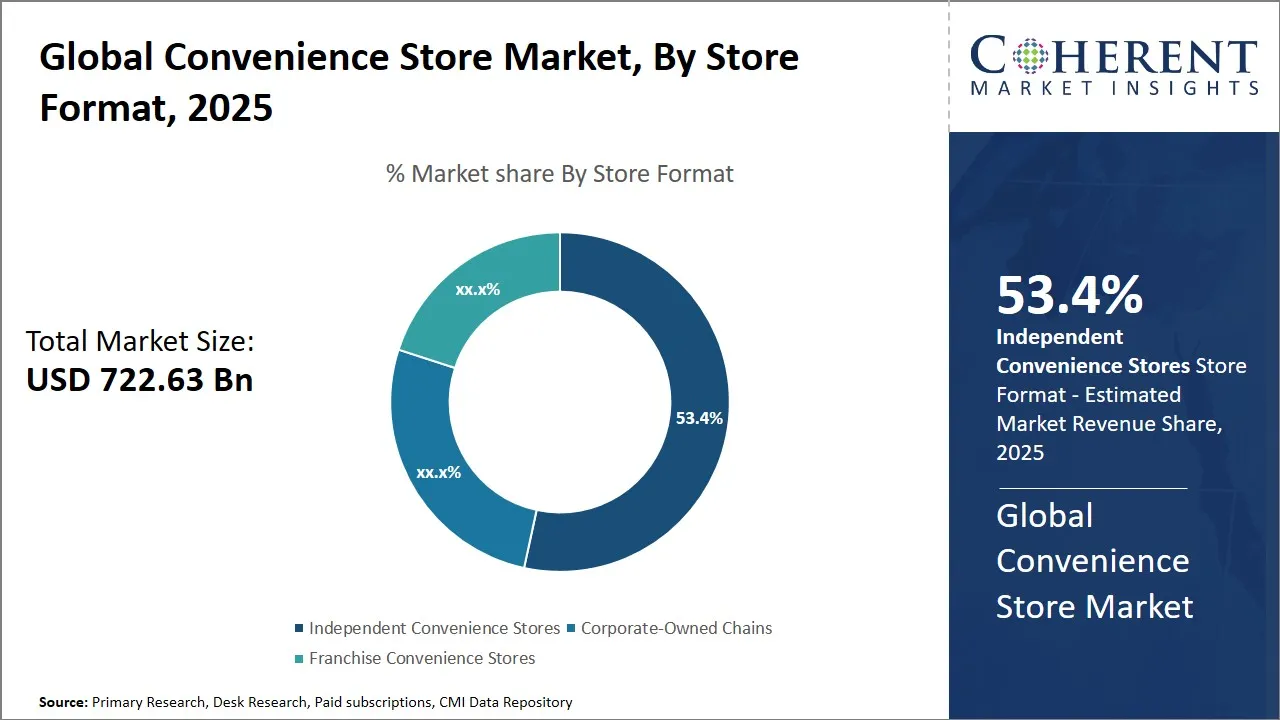
- Independent convenience stores segment is expected to account for 54.4% of the global convenience store market share in 2026.
- The food and beverages segment is projected to hold a 41.5% of the market share in 2026.
- The adult’s segment is expected to capture 43.6 % of the convenience store market share in 2026.
- North America is set to lead the global convenience store market in 2026 with 40.5 % share. Asia Pacific will be the fastest‑growing region in 2026 with 22.5%.
Market Overview
One of the most significant changes in the convenience store industry is the use of technology to improve the shopping experience. In order to attract technologically proficient customers, retailers are more and more frequently implementing digital payment systems, self-checkout kiosks, and loyalty programs based on mobile apps. Moreover, an emphasis is put on healthy and ready-to-eat food products, which consumers deem as more convenient and better for the health. Sustainability efforts, like minimizing plastic consumption and local products' procurement, are also impacting the market, synchronizing stores with larger environmental issues and consumer beliefs.
Current Events and Its Impact
Current Events | Description and its Impact |
Acceleration of digital & automation technologies in C‑stores |
|
Regional regulatory and policy shifts impacting store formats and location growth |
|
Segmental Insights
- Current Industry Events of 2026
- Market Size Estimation
- Regional Breakdown
- Competitive Landscape
- Customer Intelligence
- Segmental Analysis
- Pricing Analysis
- Key Market Drivers, Challenges & Future Trends
- Customized Insights Section
Convenience Store Market Insights, By Store Format - Independent Convenience Stores Segment Dominate Due to Localized Accessibility and Personalized Service
Independent convenience stores segment is projected to account for 54.4% share in 2026, due to their distributed accessibility and personalized services that cater to community- specific needs. Independent stores, as opposed to chains or franchises, are generally owner-managed and thus there is a strong link between them and their customers. This link makes it possible for them to be very quickly developing their stock and services that reflect the very particular likes and wants of the nearby area.
In the U.S., local, independent convenience stores, called "mom-and-pop" shops, are prevalent in smaller towns and neighborhoods. They bring a personal touch to the market with store owners knowing their customers by name and changing their inventories according to frequent customer requests. These stores can easily bring in niche products or seasonal items that larger chains may not give priority to.
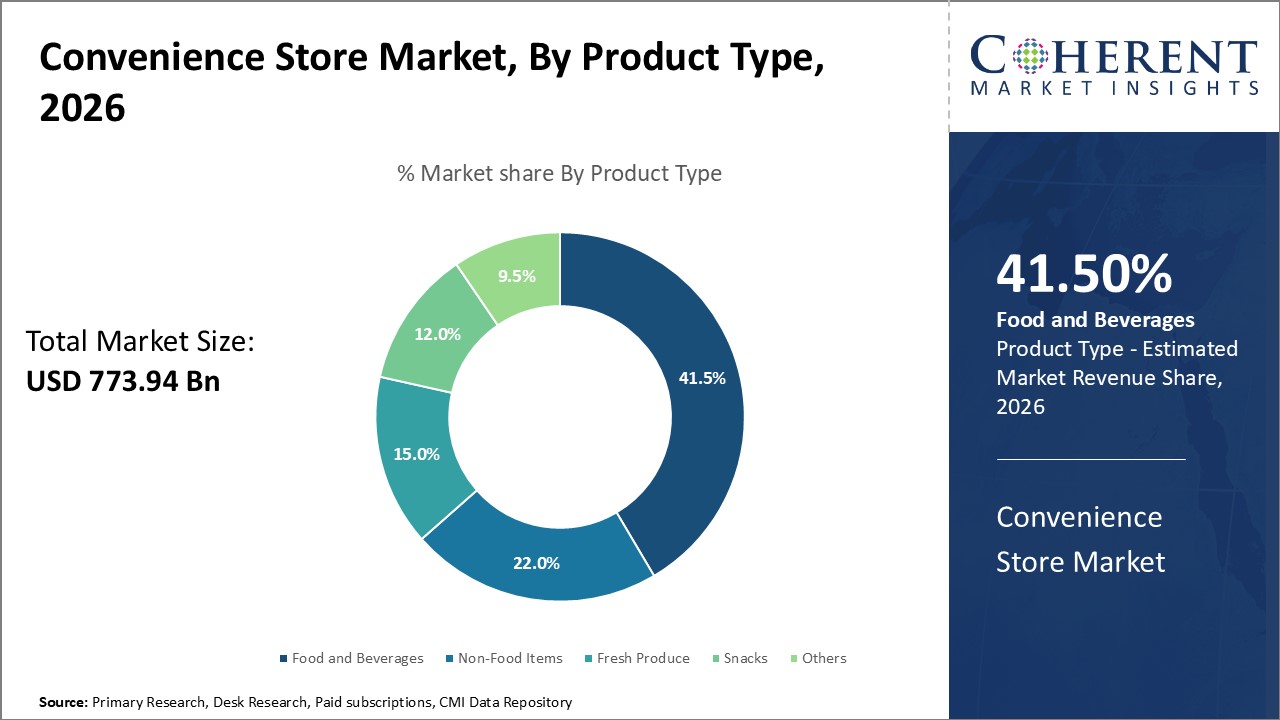
Convenience Store Market Insights, By Product Type - Food and Beverages Segment Dominates the Market Due to Rising Demand for Ready-to-Eat Options and Healthier Choices
The food and beverages category is expected to account for 41.5% of the global convenience store market share in 2026, which is a trend influenced by changing consumer lifestyles that prioritize quick and accessible food. As city life gets more and more hectic, people are demanding that quick food items such as ready-to-eat or grab-and-go food—be nutritious and high-quality as well. So, the segment is being greatly supported by such demanding consumers.
C-stores do a great job in meeting this demand and selling a variety of food and drink products, which sometimes even includes a full meal in a package. While the changing consumer behavior toward more nutritious food items such as organic juice, low-calorie snacks, and fresh fruit beverages has been one of the factors making c-stores hard to resist for the health-conscious crowd. They are constantly increasing the variety of their products, which makes them more appealing to health-conscious shoppers.
Convenience Store Market Insights, By End User Demographics – Adults Segment Dominates the Market Through Preference for One-Stop Convenience and Time Efficiency
Adults segment is projected to hold 43.6% of the global convenience store market share in 2026, as they are the main customers who depend on these retail formats for their diverse lifestyle needs. Adults, mainly consisting of young professionals up to middle-aged people, are balancing the sectors of work, family, and social life which ultimately leads them to the problem of solving their shopping needs quickly and without hassle thus, convenience stores can provide these customers with the fastest of their needs.
The growth in this segment is mainly due to adults' growing dependence on convenience stores for essential daily purchases including meals, drinks, supplies, and even medicines. Convenience stores' long operating hours suit the non-traditional schedules of adult consumers, which may include very early mornings, late nights, and weekends, making them the retail outlets of choice beyond normal business hours.
Store Format Expansion & Automation Adoption Rates (% of convenience stores adopting smart shelves, self-checkout, or computer-vision systems)
- Smart shelves with RFID sensors and computer vision systems for inventory tracking are widely implemented, with about 74% of retailers deploying IoT and related smart shelf tech to continuously monitor stock and reduce shrinkage.
- Self-checkout systems, including AI-powered kiosks and mobile wallet integrations, have seen significant adoption, with self-checkout transactions expected to make up nearly 40% of all retail transactions globally by 2026, reflecting high acceptance in convenience stores.
- Computer vision and AI applications (e.g., planogram compliance, theft detection) are becoming standard in smart convenience stores, supporting automation of shelf audits and improving operational accuracy.
Regional Insights
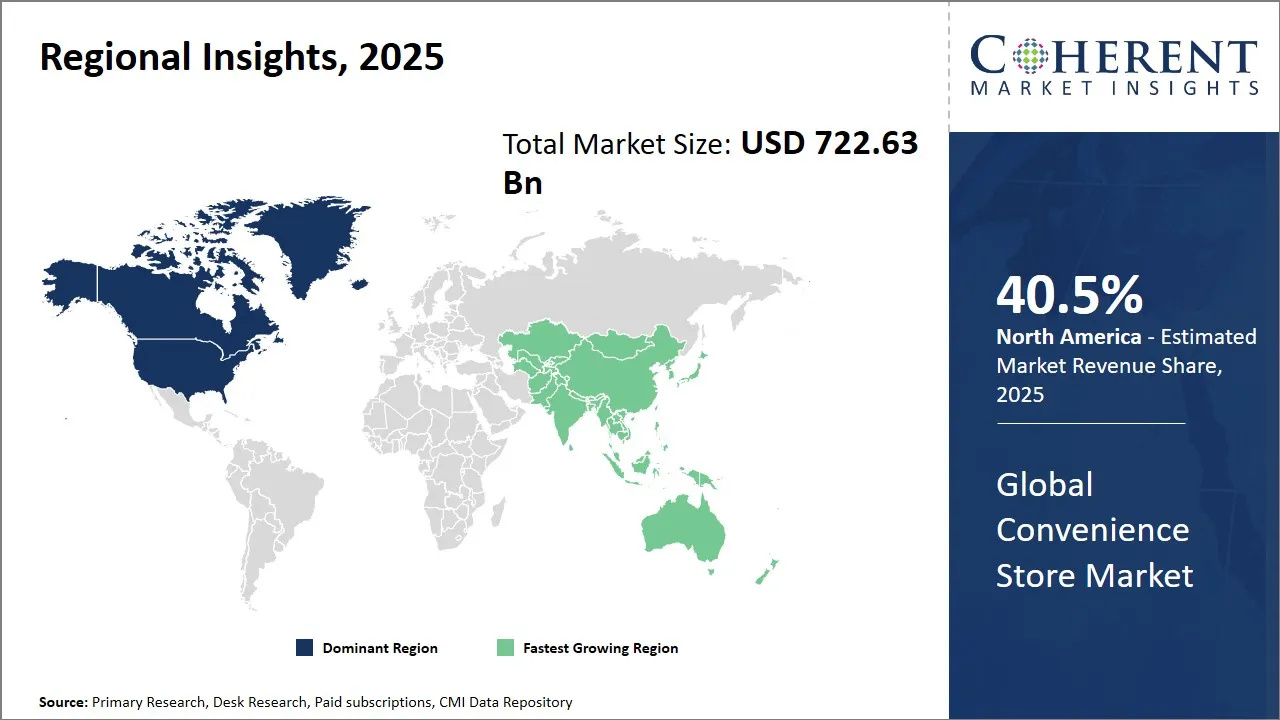
North America Convenience Store Market Analysis and Trends
North America is expected to dominate the global convenience store market with 40.5% share in 2026. The retail landscape in this region is characterized by a very developed infrastructure and high buying power of the consumers, and also by the fact that most of the population lives in urban areas. Besides, solid logistical systems and state-of-the-art supply chain management techniques have made it possible for the convenience stores to function well, thus being able to meet the demands of the consumers in a timely manner. Generally speaking, government policies suggest that business operations are not too difficult, as regulations are quite streamlined, which in turn makes the country a suitable place for both local and international companies to operate in.
With the presence of major industry players like 7-Eleven (run by Seven & I Holdings), Circle K (Alimentation Couche-Tard), and Speedway (which was recently bought by 7-Eleven), the market continues to be dominated. These companies have never ceased to bring innovations by being the first ones to accept digital payments, offering loyalty programs, and widening the range of products to meet the changing consumer wants and needs. In addition, North America's favorable trade conditions, with a quick connection to suppliers and manufacturers from various parts of the world, enable the convenience stores to keep their prices low and have a wide range of products available, thus reinforcing the region's stronghold in the market.
Asia Pacific Convenience Store Market Analysis and Trends
The Asia Pacific region is predicted to be the largest market growth contributor with a share of 22.5% in 2026, due to rapid urbanization, higher disposable incomes, and lifestyle changes in the emerging markets. The upturn in modern retail formats and a young, tech-savvy consumer base also contribute to this growth. Furthermore, strategic government initiatives to improve retail infrastructure and attract foreign direct investment have been instrumental in the rapid expansion. The enormous variety in consumer tastes compels the market players to continuously innovate and come up with new localized offerings, which in turn, creates competition and drives innovation.
Some of the major retailers like FamilyMart have been very active in expanding their operations in Japan, China, and South Korea. In addition, the integration of e-commerce and cashless payments have greatly improved store convenience, thus making them the preferred shopping destinations. The trade dynamics such as better regional trade agreements and supply chain development have made it possible for the stores to source products efficiently, thus catering to a vast variety of needs and preferences.
Global Convenience Store Market Outlook for Key Countries
U.S. Convenience Store Market Trends
The landscape of convenience stores in the U.S. is marked by fierce competition and constant changes. The companies that are the largest in the industry such as 7-Eleven, Circle K, and Casey’s General Stores are not only the largest but also the most influential. These companies are benefiting from customers’ preference for quick and multipurpose options. Thus, stores are increasing product assortments with items like fresh food, ready-to-eat meals, and health-conscious offerings. The incorporation of technology such as mobile ordering, loyalty apps, and contactless payments is constantly changing the way consumers interact with the stores and the overall shopping experience is also improved.
Japan Convenience Store Market Trends
Japan has leading position in the convenience store sector, where the companies 7-Eleven Japan, Lawson, and FamilyMart are the biggest. One of the main characteristics of this market is the high level and variety of services, and the detail in customer experience. The Japanese stores are famous not only for the variety of ready-to-eat meals, but also for daily essentials and bill payment services. The joint effort between government agencies and private retailers to maintain safety, hygiene, and environmental sustainability is a major factor contributing to a highly efficient market ecosystem.
China Convenience Store Market Trends
China's rapid urbanization and evolving consumption patterns have made it a hotspot for convenience store growth. Domestic and international operators such as 7-Eleven, Lawson, and local chain Meiyijia are expanding aggressively. Regulatory encouragement for retail modernization and infrastructure development are vital factors stimulating the market expansion. The Chinese convenience store market puts a higher emphasis on digital integration, where mobile payments, app-based promotions, and delivery services from convenience stores are widely adopted to meet consumer convenience demands.
Germany Convenience Store Market Trends
Germany convenience store market is propelled by a well-developed retail infrastructure and a focus on sustainability. Leading companies like REWE Group and Edeka operate convenience formats alongside traditional supermarkets, blending convenience with quality. Consumer preference for organic and fresh products influences product offerings in stores. Moreover, stringent regulatory frameworks around food safety and packaging sustainability steer market operations towards environmentally conscious practices.
Brazil Convenience Store Market Trends
Brazil represents a growing convenience store market within Latin America influenced by urban population growth and changing consumer habits focusing on quick service and accessibility. Key players such as Grupo Pão de Açúcar and local chains like AMPM capitalize on store locations near transit areas and workplaces. Government policies fostering retail development and trade agreements enabling diverse product imports also play a role in shaping market dynamics. However, economic volatility poses operational challenges, making agility and responsive supply chain solutions critical for sustained success.
Market Players, Key Development, and Competitive Intelligence
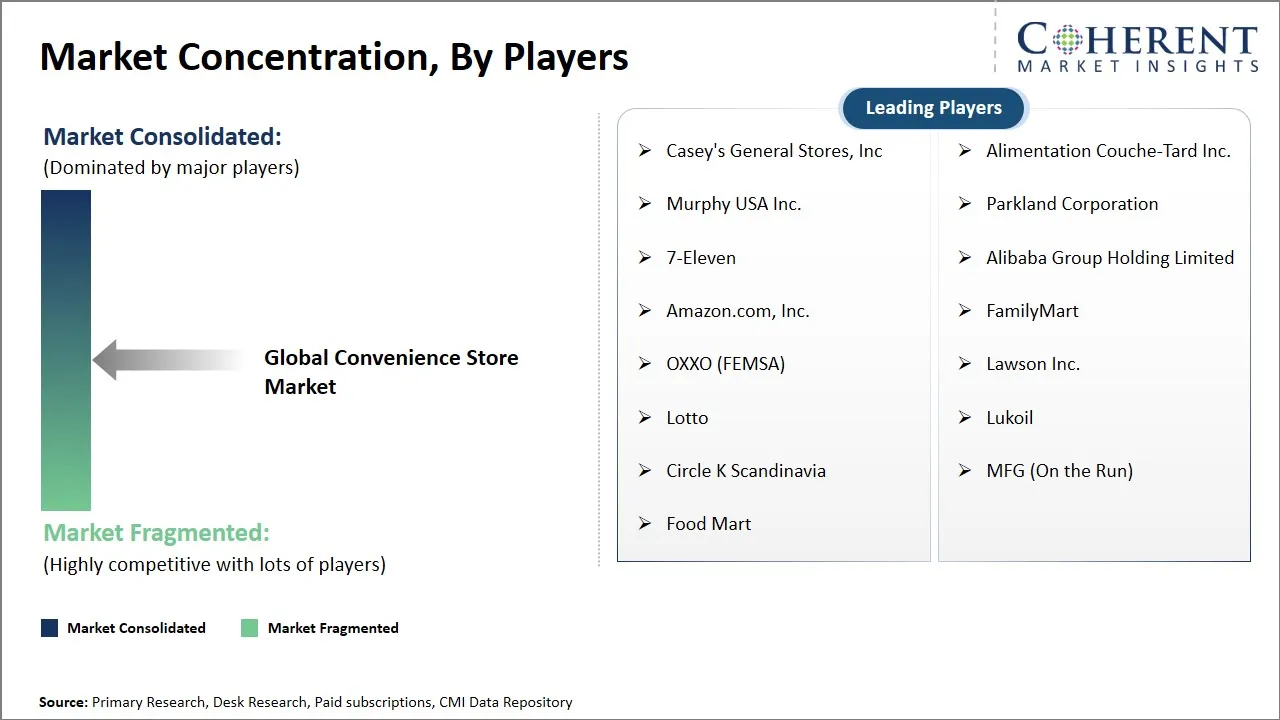
Key Developments
- In May 2025, Alimentation Couche-Tard raised its offer for Seven & i to USD 47.2 Bn, with CDPQ signaling financing support.
- In October 2024, Nouria agreed to buy Enmarket’s 132 stores, extending its reach into the U.S. Southeast.
- In August 2024, FEMSA’s OXXO brand bought Delek’s 249 U.S. stores for USD 385 million, marking its American debut.
Top Strategies Followed by Global Convenience Store Market Players
- The market is mainly contributed to by the established players who efficiently use their large resources and invest heavily in Research and Development (R&D). The innovation that comes with the focus lasts the companies to come up with and even launch high-performance products that are in line with the constantly changing consumers' preferences thus securing and sustaining customer loyalty through product differentiation. Their global presence aids in gaining access to the new customer base while at the same time developing new urbanization and changing lifestyle trends in the underdeveloped regions that would be their competitors globally.
- For example, the unveiling of smart unmanned stores that by facial recognition and RFID automation was undertaken by FamilyMart in Japan. Besides this, expansion is considered the mainstay when it comes allied to Circle K's parent company, Couche-Tard, who have purchased more than 4,000 stores in Europe and the U.S. over the last decade, thus making it possible for them to tap into the new urban clusters and frontier Asia Pacific markets coming up.
- The convenience store market players positioned in the mid-level adopt a realistic strategy that is primarily based on providing solutions that are economically reasonable and having the quality/durability ratio just in the middle. Their target is to win over the delicate group of customers who look for good value and are not willing to compromise the reliability of the product. To ramp up the capacities of their operations and get a wider market share mid-market firms often resort to forming partnerships and alliances.
- For example, Casey's General Stores (U.S.), boasting around 2,600 stores, has made it a point to offer low-cost fresh food options (pizza, bakery items) and experienced a double-digit growth in its private-label sales in 2024—showing that quality at lower prices attracts even those customers who are very sensitive to price changes.
- New entrants in the convenience store industry are mostly resorting to provision of innovations and specialized service as a means of differentiation which, in turn, is becoming the most important factor for their survival amid the fierce competition. Such businesses often target a particular market segment by either coming up with special features or innovative products that are able to satisfy the needs or preferences of the consumers in that segment.
- For instance, E-Mart24 in South Korea used robots during night time to reduce labor cost while still being open all day and night—thus gaining an innovation advantage over the bigger competitors. FreshStop (South Africa) makes it easy for customers to buy healthy snacks that are quickly available near pump stations, thus, connecting with the local dietary patterns instead of competing by size.
Market Report Scope
Convenience Store Market Report Coverage
| Report Coverage | Details | ||
|---|---|---|---|
| Base Year: | 2025 | Market Size in 2026: | USD 773.94 Bn |
| Historical Data for: | 2020 To 2024 | Forecast Period: | 2026 To 2033 |
| Forecast Period 2026 to 2033 CAGR: | 7.1% | 2033 Value Projection: | USD 1,250.93 Bn |
| Geographies covered: |
| ||
| Segments covered: |
| ||
| Companies covered: | Casey's General Stores, Inc, Alimentation Couche-Tard Inc., Murphy USA Inc., Parkland Corporation, 7-Eleven, Alibaba Group Holding Limited, Amazon.com, Inc., FamilyMart, OXXO (FEMSA), Lawson Inc., Lotto, Lukoil, Circle K Scandinavia, MFG (On the Run), and Food Mart | ||
| Growth Drivers: |
| ||
| Restraints & Challenges: |
| ||
Convenience Store Market Dynamics
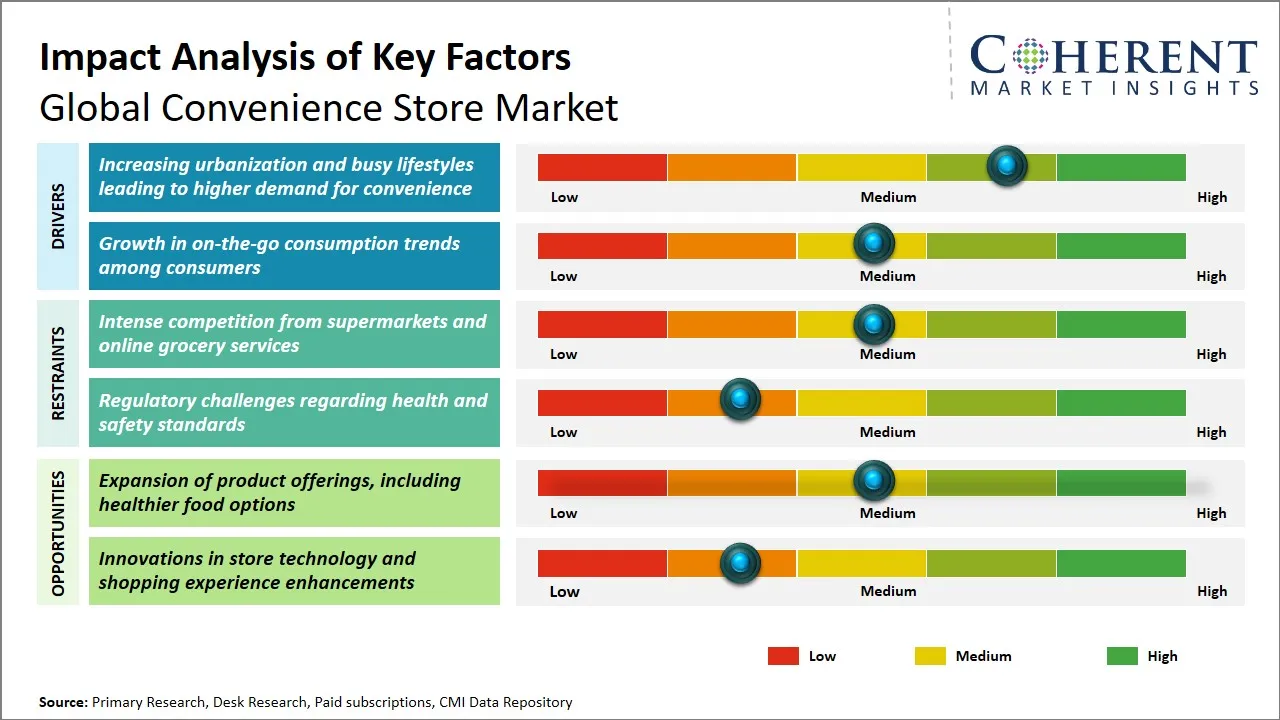
Convenience Store Market Driver - Increasing Urbanization and Busy Lifestyles Leading to Higher Demand for Convenience
The combination of rapid urbanization and increasingly busy lives has been one of the main factors in the global demand for convenience stores worldwide. It is no longer quite easy to live in the Z-city area, but people still move there because of the better job opportunities and living conditions. This, alongside the limited availability of time, has made it necessary for people to use retail solutions that are quick and accessible. The efficient retailers that are located just right beside where people live and work have a great variety of products that suit consumers who are always on the run and who value time over extensive choice. The changing trend of consumers toward shorter shopping trips and instant product availability reflects the growing favor of the convenience stores over the traditional supermarkets.
For example, 7-Eleven Japan, has reported that its most productive stores are the ones next to the metro stations and in the office districts of Tokyo, where the high number of people working their accounts for more than 2,000 transactions per store each day during peak hours. Very similar trends can be seen in New York and London, where Circle K and Tesco Express are among the chains that have already established their presence in city centers with a lot of foot traffic.
Convenience Store Market Opportunity - Expansion of Product Offerings, Including Healthier Food Options
The global convenience store market is a huge opportunity for healthier food options, product offerings being the main channel. The consumers' preferences appear to be moving towards wellness and nutrition, and at the same time, the convenience stores could take advantage of this trend by making their stocks more varied than just snacks and ready-to-eat meals. Expanding the assortment to include fresh, organic, low-calorie, and plant-based products will surely appeal to the health-conscious consumers who are after quick but functional food selections. Such a transformation goes along with increasing knowledge of lifestyle-related diseases, as well as the demand for transparency in food sourcing and nutritional content.
For example, Taking Casey's, launched a new range of fresh salads, protein bowls, and plant-based wraps in the U.S. in 2024, thereby gaining a 22% increase in same-store food revenue from health-oriented customers.
Analyst Opinion (Expert Opinion)
- The global convenience store market is on a fast track for growth, driven by changing consumer lifestyles and an increasing preference for quick-service options. Insights from the Global Convenience Store Summit (2023) and the National Association of Convenience Stores Show (2022) showcased pivotal trends, with companies like 7-Eleven and Circle K leading innovations in product offerings and in-store technology. 7-Eleven’s introduction of a mobile app featuring personalized promotions and delivery options exemplifies the market's response to the growing demand for convenience and seamless shopping experiences.
- Discussions at these conferences emphasized the critical need for convenience stores to diversify their product ranges, incorporating healthier options and locally sourced goods to attract a broader customer base. However, challenges such as intense competition from online retail and changing regulatory environments were frequently cited as barriers to expansion.
- Companies that focus on enhancing customer engagement through loyalty programs and digital innovations will likely maintain a competitive edge. Ultimately, the growth of the global convenience store market will depend on its ability to adapt while meeting the evolving preferences of consumers in a fast-paced retail landscape.
Speak to the analyst
Want personalized insights?
Take the findings above to one of our principal consultants, or have the report rebuilt around the segments, geographies and competitors you actually track.
Market Segmentation
- Store Format Insights (Revenue, USD Bn, 2021 - 2033)
- Independent Convenience Stores
- Corporate-Owned Chains
- Franchise Convenience Stores
- Product Type Insights (Revenue, USD Bn, 2021 - 2033)
- Food and Beverages
- Non-Food Items
- Fresh Produce
- Snacks
- Others
- End User Demographics Insights (Revenue, USD Bn, 2021 - 2033)
- Adults
- Teenagers
- Children
- Regional Insights (Revenue, USD Bn, 2021 - 2033)
- North America
- U.S.
- Canada
- Latin America
- Brazil
- Argentina
- Mexico
- Rest of Latin America
- Europe
- Germany
- U.K.
- Spain
- France
- Italy
- Russia
- Rest of Europe
- Asia Pacific
- China
- India
- Japan
- Australia
- South Korea
- ASEAN
- Rest of Asia Pacific
- Middle East
- GCC Countries
- Israel
- Rest of Middle East
- Africa
- South Africa
- North Africa
- Central Africa
- North America
- Key Players Insights
- Casey's General Stores, Inc
- Alimentation Couche-Tard Inc.
- Murphy USA Inc.
- Parkland Corporation
- 7-Eleven
- Alibaba Group Holding Limited
- Amazon.com, Inc.
- FamilyMart
- OXXO (FEMSA)
- Lawson Inc.
- Lotto
- Lukoil
- Circle K Scandinavia
- MFG (On the Run)
- Food Mart
Sources
Primary Research Interviews
- Store Operations Director – Leading Global Convenience Store Chain
- Regional Manager – Major Asia Pacific Convenience Retail Franchise
- Technology Innovation Lead – Retail Platform Integrator
- Sustainability Specialist – Food Retail Certification Body
Stakeholders
- Retail Store Operators (including multinational and local chains)
- Franchisees and Independent Convenience Store Owners
- End-use Sectors
- Grocery and FMCG/CPG (Fast-Moving/Consumer Packaged Goods)
- Food & Beverage On-the-Go
- OTC Pharma/Personal Care sold via convenience stores
- Regulatory & Certification Bodies (food safety, retail compliance)
- E-commerce and Omnichannel Retail Platform Providers
- Technology Solution Vendors: POS, inventory management, loyalty, AI-based analytics
Databases
- Euromonitor International (Global retail and convenience segment data)
- Statista (Convenience store market statistics and trends)
- NielsenIQ Retail Measurement Services
- UN Comtrade Database (import/export FMCG flows to convenience retail)
Magazines
- Retail Week – Global convenience retail innovation and news
- Convenience Store Decisions – U.S. and global trends, digital transformation
- Chain Store Age – Store operations, technology, expansion news
- Progressive Grocer – Product launches and convenience retailing
Journals
- International Journal of Retail & Distribution Management – Retail store management, convenience trends
- Journal of Foodservice Business Research – Foodservice in convenience retail
- Journal of Retailing – Store format innovation, consumer behavior
- Retail and Consumer Studies – Evolving shopping patterns, convenience segment studies
- Journal of Marketing Channels – Multi-channel and convenience model strategies
Newspapers
- The Wall Street Journal – Retail expansion, convenience store M&A, competitor news
- Financial Times – Global retailing, convenience store investments
- The Economic Times (India) – Asia Pacific growth, digital retail
- South China Morning Post – Expansion and consumer trends in Asia
Associations
- National Association of Convenience Stores (NACS)
- Retail Industry Leaders Association (RILA)
- Consumer Goods Forum (CGF)
- Asian Convenience Store Association (ACSA)
Public Domain Sources
- World Health Organization – Food safety guidance for retail
- OECD – Retail sector analysis and workforce trends
- U.S. Food & Drug Administration (FDA) – Food retail and packaging regulations
- European Commission – Retail compliance and product standards
- World Bank – Global retail sector studies and regulatory impact
Proprietary Elements
- CMI Data Analytics Tool, Proprietary CMI Existing Repository of information for last 8 years.
Get access to 250+ pages report
Every segment, forecast, competitor profile and data table behind the analysis above — available for instant download.
- ESOMAR Member
- ISO 9001:2015 Certified
- D-U-N-S Registered
- GDPR & CCPA Compliant
Missing comfort of reading report in your local language? Find your preferred language:
Transform your Strategy with Exclusive Trending Reports
Frequently Asked Questions
The global convenience store market is estimated to be valued at USD 773.94 Bn in 2026 and is expected to reach USD 1,250.93 Bn by 2033.
The CAGR of the global convenience store market is projected to be 7.1% from 2026 to 2033.
Increasing urbanization and busy lifestyles leading to higher demand for convenience and growth in on-the-go consumption trends among consumers are the major factors driving the growth of the global convenience store market.
Intense competition from supermarkets and online grocery services and regulatory challenges regarding health and safety standards are the major factors hampering the growth of the global convenience store market.
In terms of store format, the independent convenience stores are estimated to dominate the market revenue share in 2026.
Casey's General Stores, Inc, Alimentation Couche-Tard Inc., Murphy USA Inc., Parkland Corporation, 7-Eleven, Alibaba Group Holding Limited, Amazon.com, Inc., FamilyMart, OXXO (FEMSA), Lawson Inc., Lotto, Lukoil, Circle K Scandinavia, MFG (On the Run), and Food Mart are the major players.
North America is expected to lead the global convenience store market in 2026.