

Global Counter Drone Market Size and Forecast – 2026 To 2033
The global counter drone market is expected to grow from USD 4 Bn in 2026 to USD 20 Bn by 2033, registering a compound annual growth rate (CAGR) of 25% from 2026 to 2033. The global counter drone market is driven by increased defense modernization initiatives and homeland security investments. On June 2, 2026, DroneShield announced that it has received a USD 24.9 million contract supporting the mission of the U.S. Department of War’s Joint Interagency Task Force 401 (JIATF-401). The contract is for the supply of mobile and fixed site counter-drone solutions, comprising hardware, subscriptions, warranties and services. (Source: DroneShield)
Key Takeaways of the Global Counter Drone Market
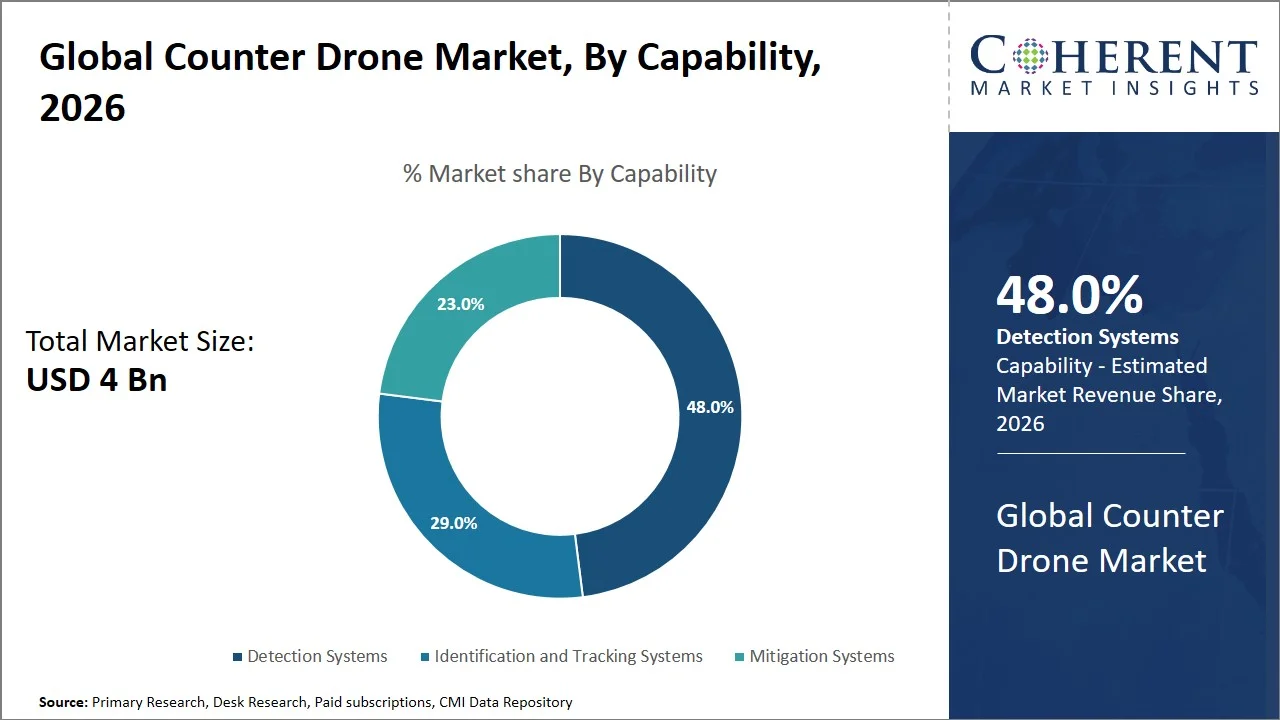
- The detection systems segment is expected to account for 48.0 % of the global counter drone market share in 2026. Increasing regulatory focus on airspace security and unauthorized UAV mitigation is driving the growth of the segment. On June 1, 2026, Motorola Solutions announced it has entered into a definitive agreement to acquire D-Fend Solutions (D-Fend), an industry leader in counter-drone technology, for a purchase price of USD 1.5 billion. (Source: Motorola Solutions)
- The fixed systems segment is estimated to capture 51.0 % of the market share in 2026. Growing protection requirements for ports, oil and gas facilities and utilities is driving the growth of the segment. On September 11, 2024, DroneShield announced the launch of SentryCiv, its latest solution designed specifically for critical infrastructure protection.
- The radar-based systems segment is estimated to capture 33.0 % of the market share in 2026. Growing deployment of radar and directed-energy countermeasure technologies is a major factor driving the growth of the segment. On April 20, 2026, Echodyne announced its inclusion as a primary radar system within Trust Automation’s Small-Unmanned Air Defense System (SUADS) Counter-UAS platform, to be delivered to the U.S. Air Force under a USD 490M IDIQ contract.
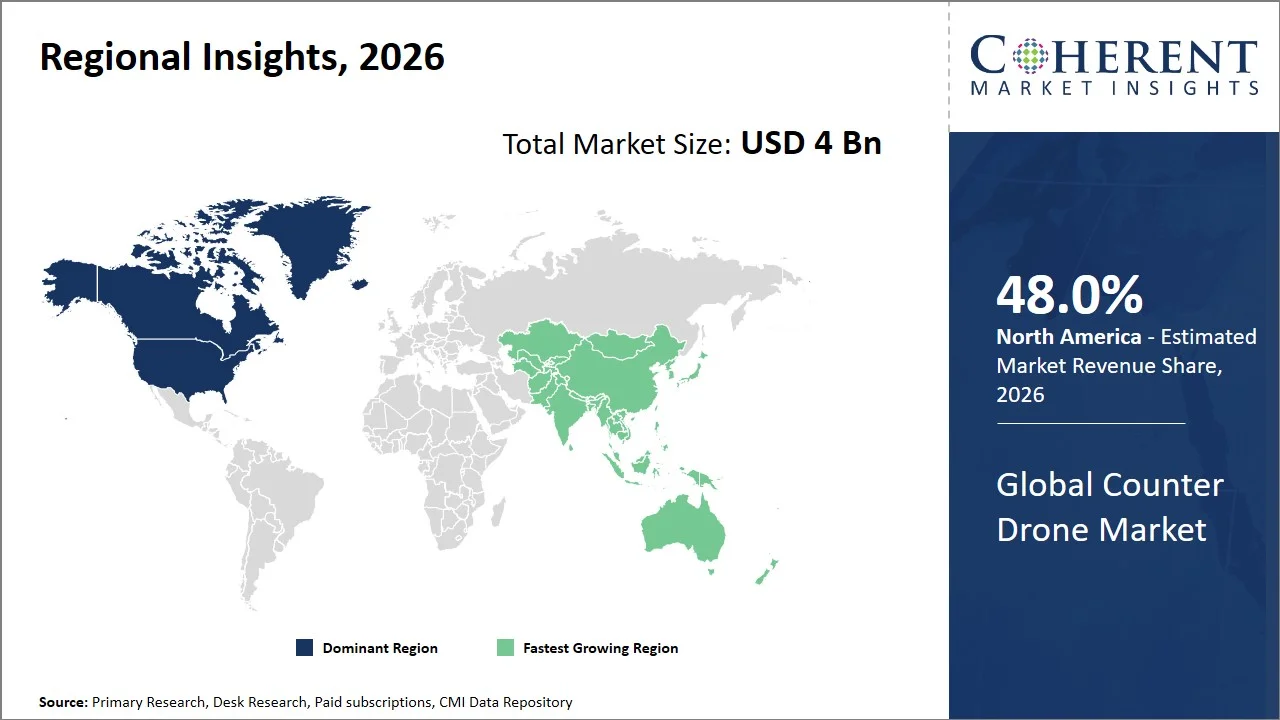
- North America is expected to dominate the counter drone market in 2026 with a market share of 48.0 %. Increasing adoption of laser and directed-energy neutralization technologies in North America is driving the growth of the regional market. On February 12, 2026, the U.S. Army deployed AeroVironment Inc's LOCUST laser counter-drone weapon system near El Paso International Airport.
- Asia Pacific is expected to account for 23.0 % share in 2026 and is projected to record the fastest growth over the forecast period. Rising demand for portable and mobile counter-UAS platforms in Asia Pacific is primarily driving the growth of the regional market. On December 24, 2025, DroneShield announced it has received a standalone contract for USD 6.2 million from an in-country reseller for delivery to a military end-customer in an Asia Pacific country.
- Adoption of AI-Powered Multi-Sensor Detection Systems: Counter-drone systems are progressively using artificial intelligence with radar, radio-frequency (RF), electro-optical/infrared (EO/IR) and acoustic sensors to enhance threat detection accuracy. These systems employ AI-driven analytics to quickly identify, classify and track drones, while minimizing false alarms, making them particularly effective in complicated urban and warfare contexts.
- Growing Deployment of Directed-Energy Countermeasures: Defense agencies and security operators are boosting investments in directed energy weapons and high-power microwave technology to neutralize drones. These directed-energy devices can enable rapid, precise, and cost-effective engagement of many drone threats without the need of conventional kinetic interceptors, and hence can support scalable airspace protection.
Segmental Insights
Why Do Detection Systems Dominate the Global Counter Drone Market?
The detection systems segment is expected to account for 48.0% of the global counter drone market share in 2026. Detection systems are a major part of counter-drone deployments, as the effectiveness of drone mitigation depends on early and precise threat detection. Detection capabilities are a top priority for organizations operating military installations, airports, critical infrastructure and public venues who need to continuously monitor airspace, identify unauthorized drones from legitimate aerial objects and give enough response time before a threat reaches protected assets. Consequently, investments in sophisticated radar, radio-frequency, electro-optical, and acoustic detection technologies have continued to grow in the defense and civilian sectors.
In addition, the use of AI-enabled detection systems is providing further impetus to the segment. On August 19, 2025, D-Fend Solutions launched EnforceAir PLUS, a transformational new offering for counter-drone defense. EnforceAir PLUS is a cyber-driven, multilayer, AI-enhanced counter-drone system comprised of foundational RF-cyber detection and takeover technology, now integrated with auto-calibrated radar detection and optional jamming mitigation. (Source: D-Fend Solutions)
- Current Industry Events of 2026
- Market Size Estimation
- Regional Breakdown
- Competitive Landscape
- Customer Intelligence
- Segmental Analysis
- Pricing Analysis
- Key Market Drivers, Challenges & Future Trends
- Customized Insights Section
Why is the Fixed Systems Segment the Most Widespread Deployment?
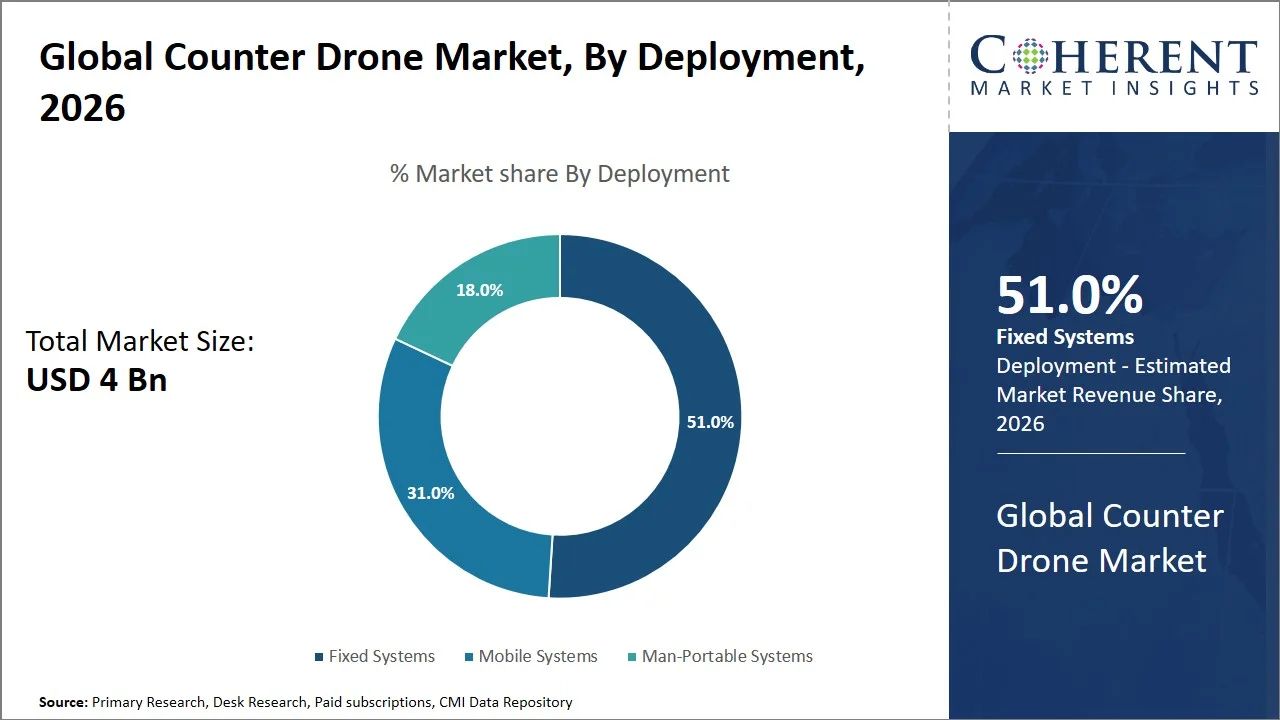
The fixed systems segment is expected to account for 51.0% of the global counter drone market share in 2026. Fixed systems are extensively used because they offer continuous, 24-hour surveillance and security of high-value areas such as military posts, airports, power plants, government institutions and vital infrastructure sites. These sites require permanent counter-drone protection with built-in detection, tracking and mitigation capabilities. Fixed systems are the preferred option as they can offer reliable long-term security, wider coverage and easy integration into existing security networks.
On May 19, 2026, Fortem Technologies announced a contract with Lockheed Martin to deploy autonomous counter-drone systems to protect critical infrastructure. Under the agreement, Fortem will provide its TrueView radar sensors and DroneHunter autonomous interceptors, which will be integrated with Lockheed Martin’s Sanctum C-UAS Mission Management software. (Source: Fortem Technologies)
Radar-Based Systems Dominate the Global Counter Drone Market
The radar-based systems segment is expected to account for 33.0% of the global counter drone market share in 2026. Radar-based systems are widely used due to their ability to detect and track over long ranges and in all weather conditions, which is critical to detect small, fast, flying and low flying drones. However, radar systems are immune to environmental conditions or line-of-sight limitations and can therefore provide continuous monitoring of large areas, enabling security operators and defense forces to detect potential threats early and to take timely counter-measures.
On October 28, 2025, the U.S. Army awarded Saab a contract to provide Giraffe 1X radars in support of security co-operation partners. The order value is approximately USD 46 million. The order underscores the growing demand for Saab’s advanced radar technology to strengthen air defense and Counter-Unmanned Aerial Systems (C-UAS) capabilities worldwide.
Currents Events and their Impact
Current Events | Description and its Impact |
European Union Action Plan on Drone and Counter-Drone Security (February 2026) |
|
U.K. Defence Innovation Funding for Counter-Drone Technologies |
|
Counter Drone Market Dynamics
Market Drivers
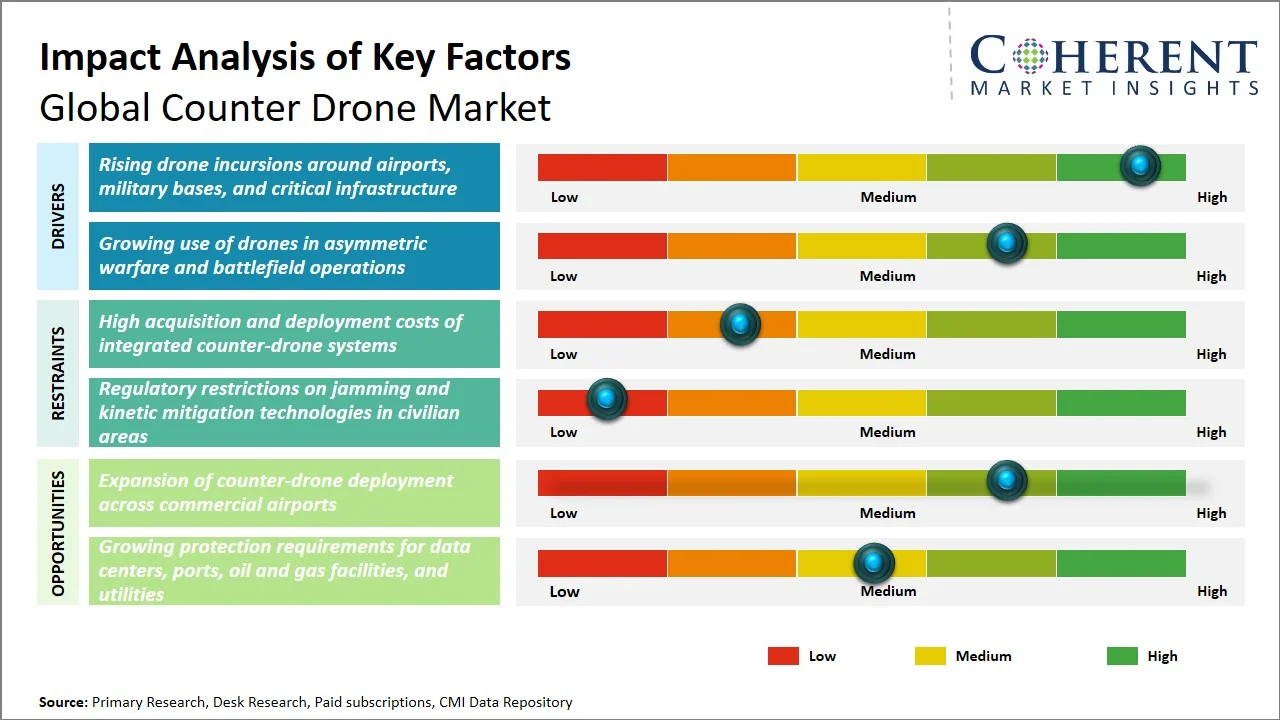
Rising drone incursions around airports, military bases, and critical infrastructure
Increasing number of drone incursions around airports, military bases, government facilities, power plants and other critical infrastructure is creating a huge demand for counter-drone technologies globally. Such incidents are a serious threat to public safety, national security and operational continuity. As a result, governments and infrastructure operators have deployed sophisticated detection , tracking and mitigation systems to detect and neutralize potential drone threats before they can interfere with operations or cause damage.
On April 7, 2026, Ondas Inc. announced that its subsidiary, Sentrycs, secured multiple contracts from federal, state and local public safety and security organizations valued in the millions of dollars to support airspace security operations during the 2026 FIFA World Cup, which will take place in 16 cities across the U.S., Canada, and Mexico. (Source: Sentrycs)
Growing use of drones in asymmetric warfare and battlefield operations
The use of drones in asymmetric warfare and battlefield operations has heightened the requirement for counter-drone capabilities among defense forces globally. Small, low-cost unmanned aerial systems are increasingly used for surveillance, intelligence gathering, target acquisition, and precision strikes. This creates new security challenges and forces militaries to invest in advanced counter-UAS solutions that can detect, track, and neutralize hostile drones in real time.
On June 20, 2026, the U.S. Army announced a new Indo-Pacific command that blends traditional formations with cyber, space, unmanned systems and electronic warfare capabilities. It will combine sensors, drones, precision weapons and digital networks into one architecture across land, air, sea, space and cyberspace.
Emerging Trends
- Rising Demand for Mobile and Tactical Counter-UAS Platforms: There is a rising need from military forces for vehicle-mounted, portable and fast deployable counter-drone systems to safeguard personnel and forward operating bases. The proliferation of drones in modern warfare calls for lightweight technologies to detect and mitigate threats in dynamic operating contexts.
- Expansion of Counter-Drone Protection for Civilian Critical Infrastructure: Counter-drone technology is transitioning from military use to airports, power plants, oil and gas installations, seaports, government buildings, data centers and huge public venues. With illegal drone activity and security threats on the rise, critical infrastructure operators are using integrated counter-UAS systems to protect their assets, operations and the public.
Regional Insights
Why is North America a Strong Market for Counter Drones?
North America is expected to account for a market share of 48.0% in 2026. North America is still the focal point for counter-drone innovation and operational deployment, driven by large military requirements and vital infrastructure protection projects. In the U.S., the Department of Defense has increased its acquisition of multilayer counter-UAS technologies, and businesses such as Anduril Industries and Dedrone have won deployments at military sites, airports and public events. There has also been increased testing of autonomous detection networks, AI-enabled threat categorization systems and mobile counter-drone devices in response to the evolving drone swarm threats in the region. On May 8, 2026, the Pentagon’s counter-drone task group announced a pilot program to deploy high-energy laser and directed-energy devices at five military installations around the U.S. The program is designed to safeguard military infrastructure and domestic operations from drone threats and to expedite the operational deployment of laser-based counter-UAS capabilities.
Why Does the Asia Pacific Counter Drone Market Exhibit High Growth?
Asia Pacific is projected to account for 23.0% of the global counter drone market and is expected to register the fastest growth. Governments across Asia Pacific are moving quickly to acquire counter-drone technologies to boost border security, modernize their militaries and defend vital infrastructure. China, India, Japan, South Korea and Australia are all deploying sophisticated radar, electronic warfare and RF detection systems to counter increased drone activity around military bases and other sensitive assets. Domestic defense technology investments and the incorporation of counter-UAS capacities into broader air-defense frameworks further support regional demand. On March 31, 2026, NUBURU, Inc. announced that its wholly-owned subsidiary, Lyocon S.r.l. secured an initial deployment order for its portable directed-energy laser dazzler system for counter-drone defense applications from a tier-one government-owned defense electronics organization operating within a centralized government procurement framework in a major Asia Pacific defense market.
Global Counter Drone Market Outlook for Key Countries
Why is the U.S. Emerging as a Major Hub in the Counter Drone Market?
The U.S. remains at the forefront of counter-drone system operational deployment and technology development. The Department of Defense has expanded the use of the Joint Counter-Small Unmanned Aircraft Systems Office (JCO) framework to standardize counter-UAS procurement, while companies such as Anduril Industries have rolled out their Lattice AI platform and autonomous detection networks for military and homeland security use. The country is also developing directed-energy counter-drone projects comprising high-energy laser and microwave systems that have been tested for defense of military bases and critical infrastructure.
Is China the Next Growth Engine for the Counter Drone Market?
China is boosting its counter-drone capabilities through a blend of military modernization initiatives and home-grown technology. Chinese defense firms have developed an integrated counter-UAS solution that combines radar, electronic warfare, RF detection and jamming technologies to be used around military facilities, border regions and big public events. The U.K. has also invested in anti-drone capabilities as part of its overall air defense architecture, reflecting increased concerns about low-altitude drone threats and unmanned swarm operations.
Israel Counter Drone Market Analysis and Trends
Israel is one of the most operationally experienced counter drone markets due to persistent security requirements and continuous exposure to unmanned aerial threats. Companies such as Israel Aerospace Industries, Rafael Advanced Defense Systems, and Elbit Systems have developed advanced counter-drone platforms that integrate radar, electro-optical sensors, artificial intelligence, and electronic attack capabilities. Israeli systems have been deployed domestically and exported internationally, with extensive operational validation contributing to their global adoption.
India Counter Drone Market Analysis and Trends
The India counter drone market is being influenced by expanding border security requirements and the rising usage of unmanned systems in regional security problems. Indigenous manufacturers and defense organizations have fast-tracked the development of anti-drone technologies, including counter-drone systems of the Defence Research and Development Organisation and solutions from enterprises such as Bharat Electronics Limited. Simultaneously, government programs are vigorously promoting domestic manufacture in support of defense self-reliance, and counter-drone systems have been deployed to defend important infrastructure, national events and strategic military sites.
U.K. Counter Drone Market Analysis and Trends
The U.K. is enhancing its counter-drone capabilities through defense modernization and improved national infrastructure protection. The government has backed the development of advanced counter-UAS technologies through defense innovation programs, with organizations such as BAE Systems and the UK Ministry of Defence involved in trials of AI-enabled detection systems, electronic warfare solutions and directed-energy weapons. The country is also strengthening counter-drone deployments at military locations, airports and big public events in response to changing aerial security concerns.
Global Counter Drone Market - Unauthorized Drone Incidents
Region | Estimated Unauthorized Drone Incidents (2025) |
North America | 4,800 |
Europe | 3,600 |
Asia Pacific | 4,200 |
Middle East & Africa | 1,250 |
Latin America | 650 |
Global Counter Drone Market - Counter-Drone Procurement Spending by Government Agencies
Government Agency | Country | Estimated Counter-Drone Procurement Spending (USD Billion, 2026) |
U.S. Department of Defense (DoD) | U.S. | 22.0 |
Ukrainian Ministry of Defence | Ukraine | 3.8 |
Ministry of Defence | Saudi Arabia | 1.6 |
Ministry of National Defence | Poland | 1.3 |
Ministry of Defence | Australia | 0.9 |
How is the Expansion of Counter-Drone Deployment Across Commercial Airports Creating New Growth Opportunities in the Counter Drone Market?
The growing deployment of counter-drone solutions in commercial airports is offering major development prospects for the counter drone market by boosting the demand for sophisticated airspace monitoring, threat detection, and drone mitigation technology. Airports are investing in integrated radar, radio frequency, electro-optical and artificial intelligence-based systems to thwart unlawful drone activity that can interrupt flight operations, jeopardize passenger safety and cost expensive delays. As aviation authorities raise the bar for security requirements at airports and adopt dedicated counter-UAS frameworks, technology providers are presented with opportunities to deliver long-term surveillance networks, command-and-control platforms and scalable drone defense solutions for existing and new airport infrastructure.
On June 15, 2026, Robin Radar Systems entered a strategic partnership with the Netherlands Organisation for Applied Scientific Research (TNO) to industrialize and commercialize a new multi-mode airborne radar. Designed for advanced ground and sea imaging, search-and-rescue missions, and intelligence, surface surveillance, and reconnaissance (ISR) for defense, security, emergency response and government users, the innovative new radar platform will be deployed as a payload aboard large unmanned aircraft systems (UAS).
Market Players, Key Development, and Competitive Intelligence
Key Developments
- On April 20, 2026, Leonardo DRS, Inc. announced that it has successfully integrated its Maritime Mission Equipment Package (M-MEP) on an autonomous unmanned surface vessel (AUSV), delivering a new counter-unmanned aerial system (C-UAS) capability designed to detect, track, identify, and defeat aerial unmanned threats operating in the maritime domain.
- On October 15, 2025, DroneShield announced the launch of DroneSentry-C2 Enterprise (C2E), a new software platform designed to provide strategic-level command and control for large-scale and distributed counter-drone operations, as well as the first flagship deployment of the platform, in a critical Eastern NATO flank area.
Competitive Landscape
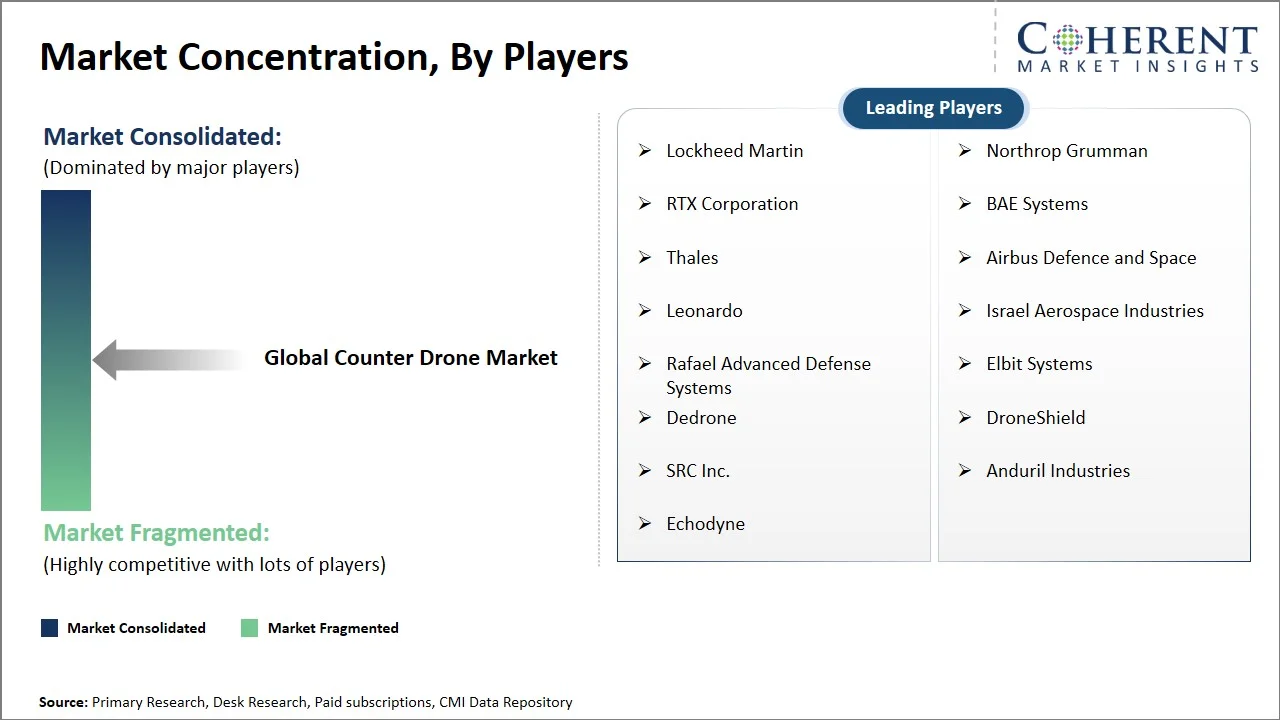
The worldwide counter drone industry is characterized by the existence of traditional defense contractors, specialized counter-UAS technology suppliers and rising autonomous security startups competing through technological innovation and strategic collaborations. Increasingly advanced drone threats are being met with comprehensive solutions that include radar, radio-frequency sensors, electro-optical/infrared systems, artificial intelligence and electronic warfare capabilities. Defense contracts, government-funded modernization efforts, product launches and collaborations to expand operational capabilities for military, homeland security, airport and critical infrastructure applications are driving market competition.
Market Report Scope
Counter Drone Market Report Coverage
| Report Coverage | Details | ||
|---|---|---|---|
| Base Year: | 2025 | Market Size in 2026: | USD 4 Bn |
| Historical Data for: | 2020 To 2024 | Forecast Period: | 2026 To 2033 |
| Forecast Period 2026 to 2033 CAGR: | 25% | 2033 Value Projection: | USD 20 Bn |
| Geographies covered: |
| ||
| Segments covered: |
| ||
| Companies covered: | Lockheed Martin, Northrop Grumman, RTX Corporation, BAE Systems, Thales, Airbus Defence and Space, Leonardo, Israel Aerospace Industries, Rafael Advanced Defense Systems, Elbit Systems, Dedrone, DroneShield, SRC Inc., Anduril Industries, and Echodyne | ||
| Growth Drivers: |
| ||
| Restraints & Challenges: |
| ||
Analyst Opinion (Expert Opinion)
- Increasing defense modernization projects and stringent airspace security standards around the globe are projected to impact the counter drone market substantially. More attention is being paid to multi-layered detection and mitigation structures, and investments are flowing into artificial intelligence-enabled threat identification, autonomous response systems, and directed-energy technologies. Ongoing market growth over the projection period is expected to be supported by continued buying activity by defense agencies and infrastructure operators.
- Growing deployment of counter-drone systems across commercial airports, vital infrastructure facilities, border security operations and public events are likely to generate significant growth prospects. With the evolution of drone threats, it’s expected that more advanced technologies, high-energy lasers, high-power microwaves, autonomous counter-UAS platforms, and AI-powered sensor fusion solutions, will be more employed. Furthermore, the growth of defense budgets, rising deployment of mobile counter-drone systems and increased regulatory focus on airspace protection are likely to drive long-term market expansion internationally.
Speak to the analyst
Want personalized insights?
Take the findings above to one of our principal consultants, or have the report rebuilt around the segments, geographies and competitors you actually track.
Market Segmentation
- Capability Insights (Revenue, USD Billion, 2021 - 2033)
- Detection Systems
- Identification and Tracking Systems
- Mitigation Systems
- Deployment Insights (Revenue, USD Billion, 2021 - 2033)
- Fixed Systems
- Mobile Systems
- Man-Portable Systems
- Technology Insights (Revenue, USD Billion, 2021 - 2033)
- Radar-Based Systems
- Radio Frequency Systems
- Infrared Systems
- Laser-Based Systems
- Acoustic Systems
- Electronic Warfare
- Platform Insights (Revenue, USD Billion, 2021 - 2033)
- Ground-Based
- Naval-Based
- Airborne-Based
- Handheld Systems
- End User Insights (Revenue, USD Billion, 2021 - 2033)
- Military and Defense
- Homeland Security
- Law Enforcement
- Critical Infrastructure
- Commercial Enterprises
- Airports and Aviation Authorities
- Regional Insights (Revenue, USD Billion, 2021 - 2033)
- North America
- U.S.
- Canada
- Latin America
- Brazil
- Argentina
- Mexico
- Rest of Latin America
- Europe
- Germany
- U.K.
- Spain
- France
- Italy
- Russia
- Rest of Europe
- Asia Pacific
- China
- India
- Japan
- Australia
- South Korea
- ASEAN
- Rest of Asia Pacific
- Middle East
- GCC Countries
- Israel
- Rest of Middle East
- Africa
- South Africa
- North Africa
- Central Africa
- North America
- Key Players Insights
- Lockheed Martin
- Northrop Grumman
- RTX Corporation
- BAE Systems
- Thales
- Airbus Defence and Space
- Leonardo
- Israel Aerospace Industries
- Rafael Advanced Defense Systems
- Elbit Systems
- Dedrone
- DroneShield
- SRC Inc.
- Anduril Industries
- Echodyne
Sources
Primary Research Interviews
- Defense & Security Equipment Manufacturers
- Military & Law Enforcement Agencies
- Unmanned Aerial Systems (UAS) Technology Providers
- Airport & Critical Infrastructure Security Managers
Magazines
- Defense News Magazine
- Aviation Week & Space Technology
- Jane's Defence Weekly
- Unmanned Systems Technology Magazine
Journals
- Journal of Unmanned Vehicle Systems
- Journal of Defense Modeling and Simulation
- IEEE Transactions on Aerospace and Electronic Systems
Associations
- Association for Unmanned Vehicle Systems International (AUVSI)
- Aerospace Industries Association (AIA)
- European Defence Agency (EDA)
- Small UAV Coalition
Public Domain Sources
- U.S. Department of Defense (DoD) Official Publications
- Federal Aviation Administration (FAA) Reports & Data
- NATO Counter-UAS Reports & Policy Documents
- European Union Aviation Safety Agency (EASA) Publications
Proprietary Elements
- CMI Data Analytics Tool
- Proprietary CMI Existing Repository of Information for Last 10 Years
Get access to 250+ pages report
Every segment, forecast, competitor profile and data table behind the analysis above — available for instant download.
- ESOMAR Member
- ISO 9001:2015 Certified
- D-U-N-S Registered
- GDPR & CCPA Compliant
Missing comfort of reading report in your local language? Find your preferred language:
Transform your Strategy with Exclusive Trending Reports
Frequently Asked Questions
The global counter drone market is expected to stand at USD 4 Bn in 2026 and is expected to reach USD 20 Bn by 2033.
The CAGR of the global counter drone market is projected to be 25% from 2026 to 2033.
Many advanced counter drone platforms are specifically designed to detect and manage multiple drones simultaneously.
Electronic warfare technologies can disrupt communication and navigation links used by hostile drones.
In terms capability, the detection systems segment is estimated to dominate the market revenue share in 2026.
Rising drone incursions around airports, military bases, and critical infrastructure and growing use of drones in asymmetric warfare and battlefield operations are the major factors driving the growth of the global Counter Drone market.
High acquisition and deployment costs of integrated counter-drone systems and regulatory restrictions on jamming and kinetic mitigation technologies in civilian areas are the major factors hampering the growth of the global counter drone market.