

Global Directed Energy Weapons Market and Forecast – 2026 to 2033
Coherent Market Insights estimates that the global directed energy weapons market is expected to reach USD 7.5 Bn in 2026 and will expand to USD 33 Bn by 2033, registering a CAGR of 18% between 2026 and 2033.
Key Takeaways of the Directed Energy Weapons Market
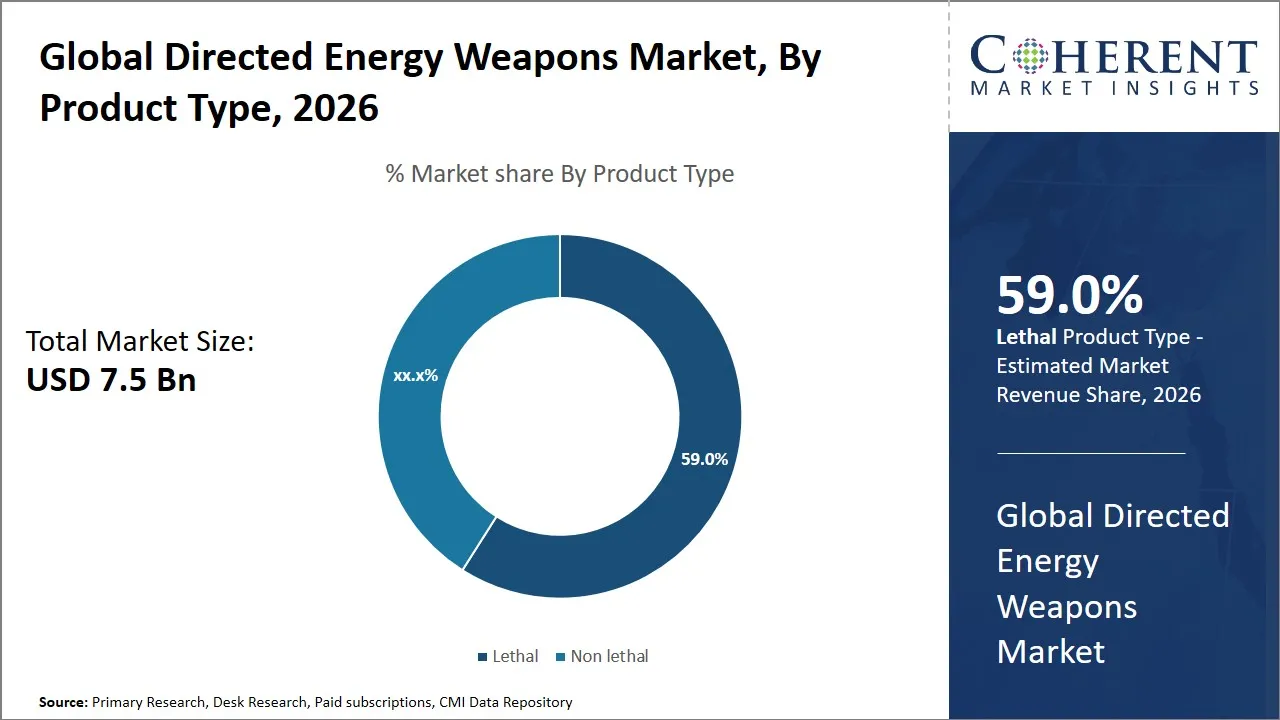
- The lethal segment is expected to account for 59% of the directed energy weapons share in 2026.
- The high energy laser segment is estimated to capture 43% of global directed energy weapons market share in 2026.
- The military and defense segment is projected to hold 57% of the market share in 2026.
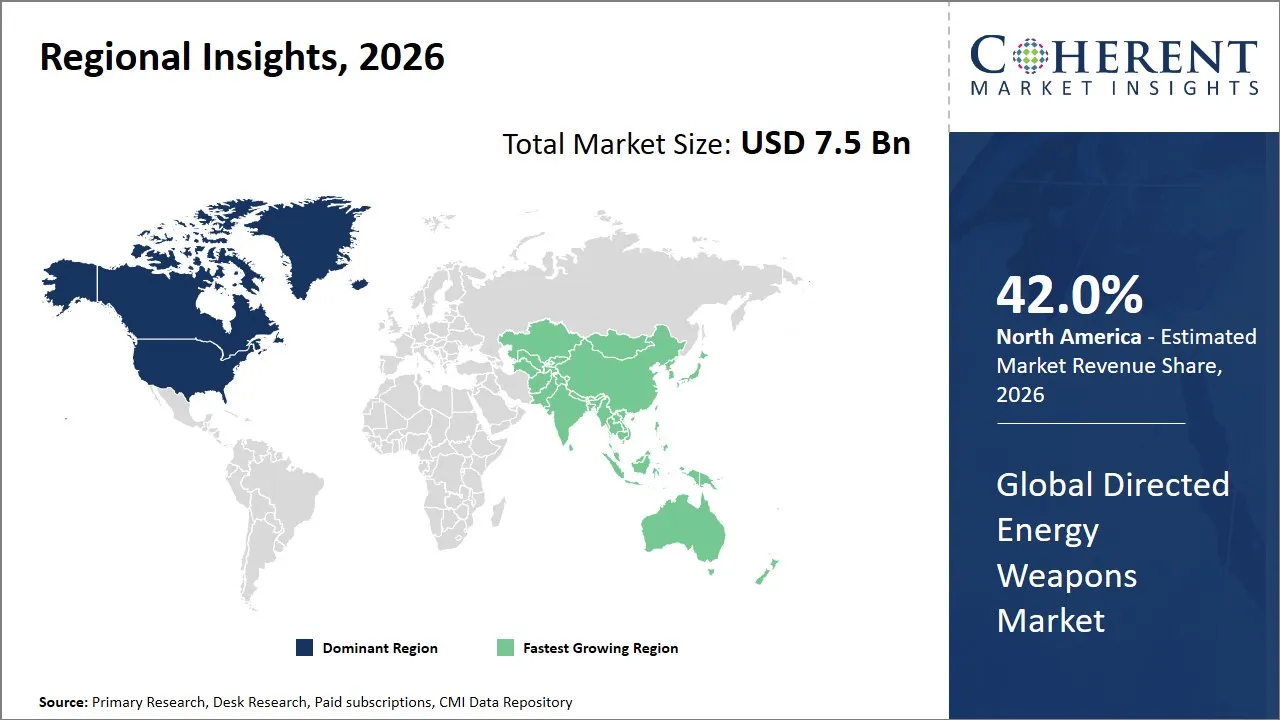
- North America will dominate the directed energy weapons market in 2026 with an estimated 42%
- Asia Pacific will hold 27% share in 2026 and is expected to record the fastest growth over the forecast period.
Currents Events and Its Impacts
Current Events | Description and its Impact |
BAE Systems Test Completion |
|
Segmental Insights
- Current Industry Events of 2026
- Market Size Estimation
- Regional Breakdown
- Competitive Landscape
- Customer Intelligence
- Segmental Analysis
- Pricing Analysis
- Key Market Drivers, Challenges & Future Trends
- Customized Insights Section
Why Does the Lethal Segment Dominate the Global Directed Energy Weapons Market in 2026?
The lethal segment is expected to account for 59% of the market share in 2026. Owing to rising relevance in modern combat strategies, usage has expanded significantly. With precision targeting capability, such arms enable rapid response against adversaries. Still, operational demands shape how often they are utilized across varied missions. With less unintended harm than conventional arms, such systems disable or eliminate threats effectively. Given today’s unpredictable security landscapes, armed organizations find this level of performance particularly valuable.
High Energy Laser Segment Dominates the Global Directed Energy Weapons Market
The high energy laser segment is expected to account for 43% of the market share in 2026. Owing to unmatched precision and flexibility, multiple domains now favor high-energy lasers. Progress moves fast; results appear at once, unlike older arms. Costs go down while adapting to changing goals. Without waiting, movement takes place. Immediate reactions come from these systems when complexity rises. Precision in moments defines their role.
For instance, on December 18, 2025, AeroVironment, Inc announced the successful delivery of two Joint Light Tactical Vehicle (JLTV)-mounted mobile C-UAS Laser Weapon Systems (LWS) to the U.S. Army as part of the second increment of the Army Multi-Purpose High Energy Laser (AMP-HEL) prototyping effort.
Why is Military and Defense the Most Widespread Application in the Directed Energy Weapons Market?
The military and defense segment is expected to account for 57% of the market share in 2026. Geopolitical strains shape much of the momentum of the directed energy weapons market. As global risks shift constantly, military priorities adapt accordingly. New dangers arise where older systems fall short. In the present landscape, tools are emerging that go beyond outdated gear. Where older machines fail, one answer rises - energy aimed with care. When battle shifts shape, so must the reply. Precision becomes vital where chaos grows. Capability defines what actions survive. Adjustable tools gain importance quickly. Mainstream defense strategies now include what was previously seen as trial-based only.
Cost-Per-Shot and Operational Expense Breakdowns
Metric | Directed Energy Weapons (DEW) | Kinetic Interceptor Weapons |
Operational Per ‑Shot Cost (Total) | USD 1–USD 50+ | USD 80 – USD 5,950,000+ |
Typical SAM Interceptor Cost | NA | USD 100,000 – USD 4,000,000+ |
Cost to Engage 100 Threats | USD 3.50–USD 5,000 | USD 10M–USD 500M+ |
Iron Beam | ~USD 3.50 per shot (electricity) | USD 50,000+ per missile |
Regional Insights
North America Directed Energy Weapons Market Analysis and Trends
The North America region is projected to lead the market with a 42% share in 2026. Primarily, expansion stems from large defense spending, a developed defense network, followed by consistent governmental support. Ahead lies the U.S., influenced by extensive studies funded through organizations including the Department of Defense and DARPA. Rooted over time is industrial strength in this region, home to companies like Raytheon Technologies, Northrop Grumman, and Lockheed Martin, which develop power solutions using laser and microwave technologies. Because of dependable supply networks, strong protections for inventions, combined with wide international collaborations, North America holds a distinct position.
What drives demand for such equipment often stems from government-led efforts aimed at modernizing military infrastructure. As drone and missile risks grow, so does the requirement for stronger defensive responses. At times, progress follows tools; just as often, it grows from steady systems guiding change. Cooperation among trusted countries sets how global trade unfolds. Because of shared goals, their standing in worldwide commerce grows more resilient. Despite differences, alignment on key issues guides economic outcomes. When trust exists, market access often improves without forceful negotiation. Not every agreement leads to gain, yet mutual understanding helps reduce friction. Through coordinated moves, advantages emerge where competition once dominated. Over time, consistency in collaboration reshapes how value flows across borders.
For instance, on September 30, 2025, HII announced a capital investment in a new integration, production and test facility to support phase two of the U.S. Army’s Enduring-High Energy Laser (E-HEL) weapon system program. This facility will expand on HII’s existing laser capabilities and will enable assembly and factory acceptance testing of HEL prototypes and subsystems, reinforcing HII’s commitment to delivering next-generation technologies for the future force.
Asia Pacific Directed Energy Weapons Market Analysis and Trends
The Asia Pacific region is expected to exhibit the fastest growth in the market contributing 27% share in 2026. Geopolitical strains play a role in recent shifts. Spending on protection rises, especially across Asia's leading nations - China, India, Japan, and South Korea. For these countries, building laser-powered arms at home has become a focus. Money moves toward startups working on light-driven shields. With focused government aid, local companies begin advancing steadily. Independence matters more now; thus, certain governments back originality in warfare equipment. A web of providers forms through these actions. From guidance as much as resources does advancement arise. Fast adoption of tools defines growth, where vessels multiply on water and above. International defense firms link in, pushing movement ahead. Influence takes form when commerce changes - joint ventures, technology exchanges matter deeply. These moves quietly redefine standing across markets.
Global Directed Energy Weapons Market Outlook for Key Countries
Why is the U.S. Emerging as a Major Hub in the Directed Energy Weapons Market?
Still leading worldwide, the U.S. sustains a highly developed defense sector through large-scale investments in research and development. Backed notably by institutions such as DARPA and the Department of Defense, technological progress continues at scale. Platforms employing directed energy - like powerful lasers - are deployed by key firms including Lockheed Martin, Raytheon Technologies, and Northrop Grumman. These tools are designed to counter missiles, drones, and airborne risks. Integration into active operations sees such weaponry installed on warships, planes, and land-based units. Innovation thrives due to collaboration with international allies, alongside strict oversight of technology exports. Dominance persists under these interconnected conditions.
Is China the Next Growth Engine for the Directed Energy Weapons Market?
From national goals arises a growing Chinese focus on energy-based weapons, shaped by internal research growth. Quiet advances appear in hidden facilities, guided by defense planning. Neutralizing threats from above - drones, swift objects, orbiting units become a priority through focused beams. Companies tied to government, including CETC and Norinco, move ideas toward working systems. Support continues without pause, aligning discoveries with real-world demands. Worldwide attention rises as regional needs evolve, guiding expansion across nations. Progress gains speed quietly, driven by foresight instead of showy displays.
India Directed Energy Weapons Market Analysis and Trends
India expands its work in directed energy weapons. At the forefront, the DRDO strengthens homegrown skills in lasers and electromagnetic fields. Collaboration between private firms and labs opens fresh paths for development. Attention shifts toward compact defenses against drones as well as high-intensity beam methods. Progress follows a path set by policies favoring self-reliant manufacturing. Working alongside countries like Israel and the United States brings added value due to combined knowledge. Advancement takes place under conditions of independence, supported by selective partnerships.
Japan Directed Energy Weapons Market Analysis and Trends
Ahead in directed-energy weapons throughout the Asia Pacific, Japan pushes forward driven by expertise plus national priorities. Because of missile threats and unmanned aircraft risks, coastal forces along with ground units apply such technology - with stronger focus on naval deployment. Companies including Mitsubishi Electric work together with Toshiba to develop high-output laser tools using state funding. Continued public spending combines experimental security science with cooperative projects between allied-country contractors. These steps gradually shift how Japan manages enduring safety demands.
U.A.E Directed Energy Weapons Market Analysis and Trends
A shift unfolds within the U.A.E’s directed energy field, driven by nearby threats and precise budget allocation for defense. Security concerns guide efforts to shield key infrastructure and frontier zones against aerial attacks. With national initiatives leading the way, partnerships involving global firms like Raytheon and Lockheed Martin enable local manufacturing alongside customized system creation. Positioned centrally, the nation gains prominence through commitment to cutting-edge defense tools. Influence spreads across Middle Eastern and African areas due to technological ambition.
Market Players, Key Development, and Competitive Intelligence
Key Developments
- On November 14, 2024, Raytheon, an RTX business, received a U.S. Army contract to develop directed energy wireless power beaming technology for battlefield operations. The project, aligned with the Department of Defense's Operational Energy Strategy, aims to streamline logistics and enhance troop safety through long-distance power distribution.
- On November 25, 2024, Thales Australia and the University of Adelaide announced a partnership to develop a unique laser directed energy weapon (LDEW) designed to counter drone swarms on the battlefield.
Top Strategies Followed by Directed Energy Weapons Market Players
Player Type | Strategic Focus | Example |
Established Market Leaders | Lockheed Martin New Facility | On August 5, 2025, Lockheed Martin established a new prototyping hub at its Center for Innovation in Suffolk, Virginia, aimed at advancing the Command and Control (C2) capabilities for the United States’ Golden Dome for America initiative. |
Mid-Level Players | AeroVironment, Inc Major Delivery to U.S. Army | On September 3, 2025, AeroVironment, Inc announced the successful delivery of the first two mobile counter-unmanned aircraft system (C-UAS) prototype Laser Weapon System (LWS) to the U.S. Army Rapid Capabilities and Critical Technologies Office (RCCTO) as part of the first increment of the Army Multi-Purpose High Energy Laser (AMP-HEL) prototyping effort. |
Small-Scale Players | Epirus Test Results | On September 10, 2025, Epirus announced the results of an August 26 demonstration of the company’s Leonidas high-power microwave (HPM) system that delivers weaponized electromagnetic interference to counter swarms of robotic, asymmetric threats. |
Market Report Scope
Directed Energy Weapons Market Report Coverage
| Report Coverage | Details | ||
|---|---|---|---|
| Base Year: | 2025 | Market Size in 2026: | USD 7.5 Bn |
| Historical Data for: | 2020 To 2024 | Forecast Period: | 2026 To 2033 |
| Forecast Period 2026 to 2033 CAGR: | 18% | 2033 Value Projection: | USD 33 Bn |
| Geographies covered: |
| ||
| Segments covered: |
| ||
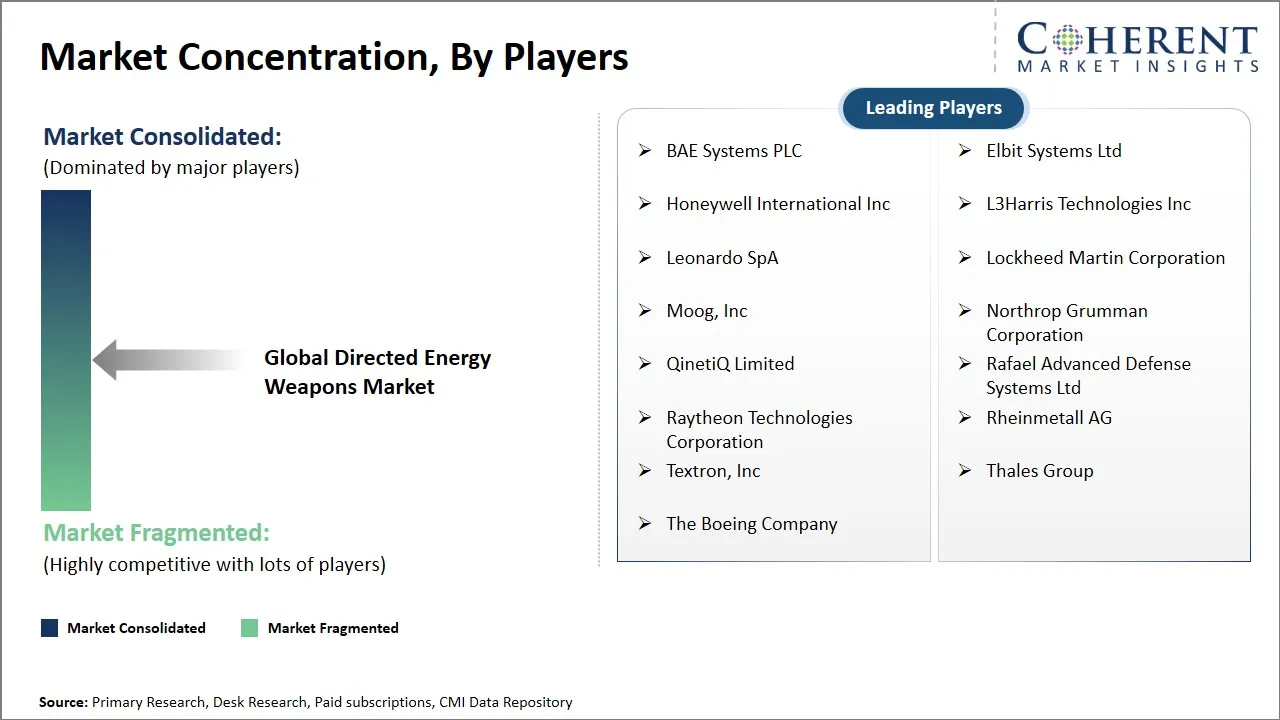
| Companies covered: | BAE Systems PLC, Elbit Systems Ltd, Honeywell International Inc, L3Harris Technologies Inc, Leonardo SpA, Lockheed Martin Corporation, Moog, Inc, Northrop Grumman Corporation, QinetiQ Limited, Rafael Advanced Defense Systems Ltd, Raytheon Technologies Corporation, Rheinmetall AG, Textron, Inc, Thales Group, and The Boeing Company | ||
| Growth Drivers: |
| ||
| Restraints & Challenges: |
| ||
Global Directed Energy Weapons Market Dynamics
Global Directed Energy Weapons Market Driver - Growing expenditure on military
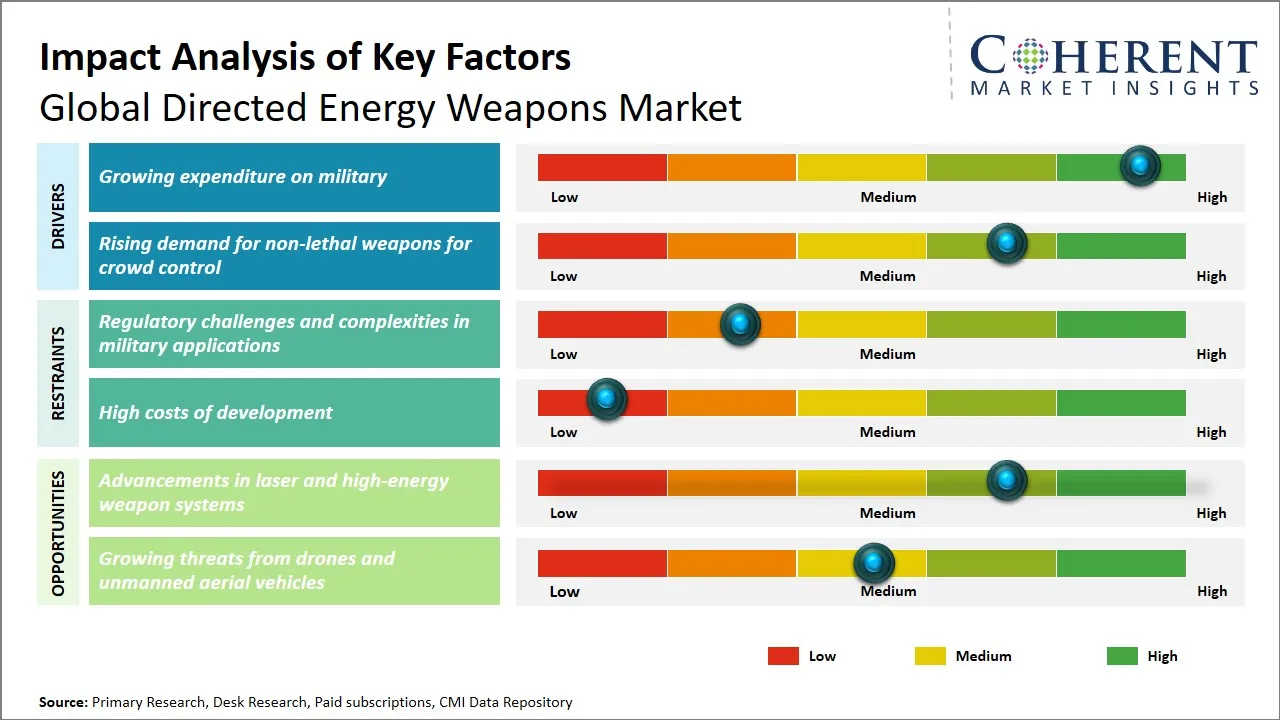
Worldwide rises in defense funding strongly influence how quickly directed energy weapons advance. As nations focus more on updating armed forces, weapons, rockets and missiles, due to changing global risks, attention turns toward high-tech tools with tactical benefits. These systems stand out through exact targeting, fast response times, fewer expenses during use when set beside traditional weapons, making them fit current upgrade plans. With greater financial backing, state programs can dedicate larger portions of budgets to exploring, refining, and fielding such technology within wider strategies for strengthening combat readiness. While investment grows, so does momentum behind automatic weapon integration into active service.
On January 9, 2026, the U.S. President, Mr. Donald Trump, proposed a USD 1.5 trillion defense budget for 2027, a big jump from the USD 901 billion provisioned for 2026.
Global Directed Energy Weapons Market Opportunity - Advancements in laser and high-energy weapon systems
Emerging progress in solid-state and fiber lasers has reshaped how directed energy weapons perform under field conditions. Power delivery now reaches higher levels while equipment shrinks in size, altering deployment options across combat zones. Precision in engagement stands improved, limiting unintended impact during operations involving aerial or ballistic hazards. Advancement in beam control allows immediate response to fast-moving targets such as unmanned aircraft or incoming projectiles. Market expansion follows closely behind these functional upgrades within directed emission systems.
For instance, on January 5, 2026, Rheinmetall and MBDA announced that they are planning on establishing a joint venture for their naval laser activities in the first quarter of 2026.
Analyst Opinion (Expert Opinion)
- Gradually emerging into initial field use, directed energy weapon systems move beyond trial phases as unconventional combat risks grow more common. Because these arms respond at light speed, carry abundant ammunition reserves, offer reduced firing expenses when set beside traditional missile blockers, they draw strategic interest across armed forces worldwide. High-intensity laser units and powerful microwave tools form key parts of this category now gaining traction. Government support remains steady, especially within the United States, China, and several nations across Europe and the Gulf region. Development timelines stretch over years, marked by tight coordination among major defense contractors and scientific institutions. Funding flows consistently, shaped by urgent security demands and evolving battlefield dynamics.
- Still, expansion faces limits due to engineering demands, ecological concerns, while also struggling with system compatibility - especially in energy supply, heat control, alongside resilience during extreme conditions. Looking ahead, experts see early adoption mostly in protective functions like drone interception, close-in aerial threats, instead of attack-oriented missions. In general, projections suggest careful confidence; progress will unfold gradually, where advantage goes to those delivering consistent operational results, adaptable power systems, along with smooth alignment into current military frameworks.
Speak to the analyst
Want personalized insights?
Take the findings above to one of our principal consultants, or have the report rebuilt around the segments, geographies and competitors you actually track.
Market Segmentation
- Product Type Insights (Revenue, USD Bn, 2021 - 2033)
- Lethal
- Non-lethal
- Technology Insights (Revenue, USD Bn, 2021 - 2033)
- High Energy Laser
- High Power Radio Frequency
- Electromagnetic Weapons
- Sonic weapons
- Application Insights (Revenue, USD Bn, 2021 - 2033)
- Military and Defense
- Homeland security
- Regional Insights (Revenue, USD Bn, 2021 - 2033)
- North America
- U.S.
- Canada
- Latin America
- Brazil
- Argentina
- Mexico
- Rest of Latin America
- Europe
- Germany
- U.K.
- Spain
- France
- Italy
- Russia
- Rest of Europe
- Asia Pacific
- China
- India
- Japan
- Australia
- South Korea
- ASEAN
- Rest of Asia Pacific
- Middle East
- GCC Countries
- Israel
- Rest of Middle East
- Africa
- South Africa
- North Africa
- Central Africa
- North America
- Key Players Insights
- BAE Systems PLC
- Elbit Systems Ltd
- Honeywell International Inc
- L3Harris Technologies Inc
- Leonardo SpA
- Lockheed Martin Corporation
- Moog, Inc
- Northrop Grumman Corporation
- QinetiQ Limited
- Rafael Advanced Defense Systems Ltd
- Raytheon Technologies Corporation
- Rheinmetall AG
- Textron, Inc
- Thales Group
- The Boeing Company
Sources
Primary Research Interviews
- Defense Technology Manufacturers
- Military Defense Contractors
- Government Defense Procurement Officials
- Laser Technology System Integrators
Databases
- SIPRI Arms Transfers Database
- Jane's Defence Equipment Database
- GlobalData Defense Intelligence Center
Magazines
- Defense News
- Jane's Defense Weekly
- Miitary & Aerospace Electronics
- Defense Technology International
- Aviation Week & Space Technology
Journals
- IEEE Journal of Quantum Electronics
- Journal of Directed Energy
- Defense & Security Analysis
Newspapers
- The Wall Street Journal
- Financial Times
- Defense Daily
- Breaking Defense
- Military Times
Associations
- Directed Energy Professional Society (DEPS)
- Association of the United States Army (AUSA)
- National Defense Industrial Association (NDIA)
- International Association for the Study of Pain (IASP)
- Aerospace Industries Association (AIA)
Public Domain Sources
- U.S. Department of Defense Reports
- Congressional Research Service Publications
- NATO Research Reports
- Government Accountability Office (GAO) Reports
- International Defense Technology Reports
Proprietary Elements
- CMI Data Analytics Tool
- Proprietary CMI Existing Repository of information for last 8 years
Get access to 250+ pages report
Every segment, forecast, competitor profile and data table behind the analysis above — available for instant download.
- ESOMAR Member
- ISO 9001:2015 Certified
- D-U-N-S Registered
- GDPR & CCPA Compliant
Missing comfort of reading report in your local language? Find your preferred language:
Transform your Strategy with Exclusive Trending Reports
Frequently Asked Questions
The global directed energy weapons market stood at USD 7.5 Bn in 2026 and is expected to reach USD 33 Bn by 2033.
The CAGR of global directed energy weapons market is projected to be 18% from 2026 to 2033.
Growing expenditure on military and rising demand for non-lethal weapons for crowd control are the major factor driving the growth of the global directed energy weapons market.
Regulatory challenges and complexities in military applications and high costs of development are the major factors hampering the growth of the global directed energy weapons market.
In terms of product type, lethal is estimated to dominate the market revenue share is 2026.
BAE Systems PLC, Elbit Systems Ltd, Honeywell International Inc, L3Harris Technologies Inc, Leonardo SpA, Lockheed Martin Corporation, Moog, Inc, Northrop Grumman Corporation, QinetiQ Limited, Rafael Advanced Defense Systems Ltd, Raytheon Technologies Corporation, Rheinmetall AG, Textron, Inc, Thales Group, and The Boeing Company are the major players.
North America is expected to lead the global directed energy weapons market in 2026.