

Global Crane Rail Market Size and Forecast: 2026-2033
The global crane rail market is estimated to be valued at USD 75 Bn in 2026 and is expected to reach USD 153.50 Bn by 2033, exhibiting a compound annual growth rate (CAGR) of 8.7% from 2026 to 2033. This significant growth reflects increasing demand across various industrial sectors, driven by expanding infrastructure projects and advancements in crane technology.
On October 28, 2025, DP World received two fully electric, Super Post Panamax quay cranes, featuring the longest reach of its kind in Ecuador, as part of the company’s ongoing USD 140 million berth expansion project at the Port of Posorja, Ecuador. (Source: DP WORLD)
Key Takeaways of the Global Crane Rail Market
- The heavy duty crane rails segment is expected to account for 41.0 % of the global crane rail market share in 2026. Heavy duty crane rails are preferred as they offer utmost reliability in heavy industrial operations. On July 15, 2025, Cimolai Technology advanced turn-key construction of two Goliath cranes at Porto Val da Rio in Chioggia, Italy with delivery scheduled for 2026. (Source: Cimolai)
- The overhead cranes segment is estimated to capture 32.0 % of the market share in 2026. The growing adoption of overhead cranes for modernizing existing infrastructure is a key driver for the segment’s growth. In May 2025, Konecranes received a contract from Palm to modernize an automated paper roll warehouse at its Wörth facility in Germany. The project includes the delivery of four automated cranes equipped with vacuum lifters to replace existing units. (Source: Konecranes)
- The steel segment is estimated to capture 59.0 % of the market share in 2026. The log shelf-life and durability of steel is preferred over other materials. On April 13, 2026, ArcelorMittal Europe announced that it will present its latest developments at Wire & Tube 2026, in Düsseldorf, Germany. The joint presence underlines ArcelorMittal’s commitment to customer proximity, sustainable steel-making and high-performance product solutions across key industries. (Source: ArcelorMittal)
- North America is expected to dominate the global crane rail market in 2026 with a market share of 41%. Growing development initiatives by local manufacturers is a major factor driving the growth of crane rail market in North America. On February 11, 2026, Terex reported strong 2025 results and highlighted continued investment in crane and lifting equipment operations tied to infrastructure and industrial growth across North America. (Source: Terex)
- Asia Pacific is expected to account for 24. 0% share in 2026 and is projected to record the fastest growth over the forecast period. Growing use of RMG cranes in the region is a major push for the crane rail market in Asia Pacific. On January 29, 2026, Konecranes announced that an Indian container terminal operator has placed an order for two Konecranes Rail-Mounted Gantry (RMG) cranes for its new terminal in India. This follows its earlier investment in 30 Konecranes Rubber-Tired Gantry (RTG) cranes for the same location. (Source: Konecranes)
- Rapid Automation of Ports and Intermodal Terminals: Across Asia Pacific, North America, and Europe, ports and logistics hubs are increasingly deploying automated Rail-Mounted Gantry (RMG) cranes, AI-enabled crane controls, and remotely monitored lifting systems.
- Electrification and Sustainable Crane Operations: Industrial operators are accelerating the shift toward electric and hybrid cranes to reduce emissions and improve energy efficiency.
Segmental Insights
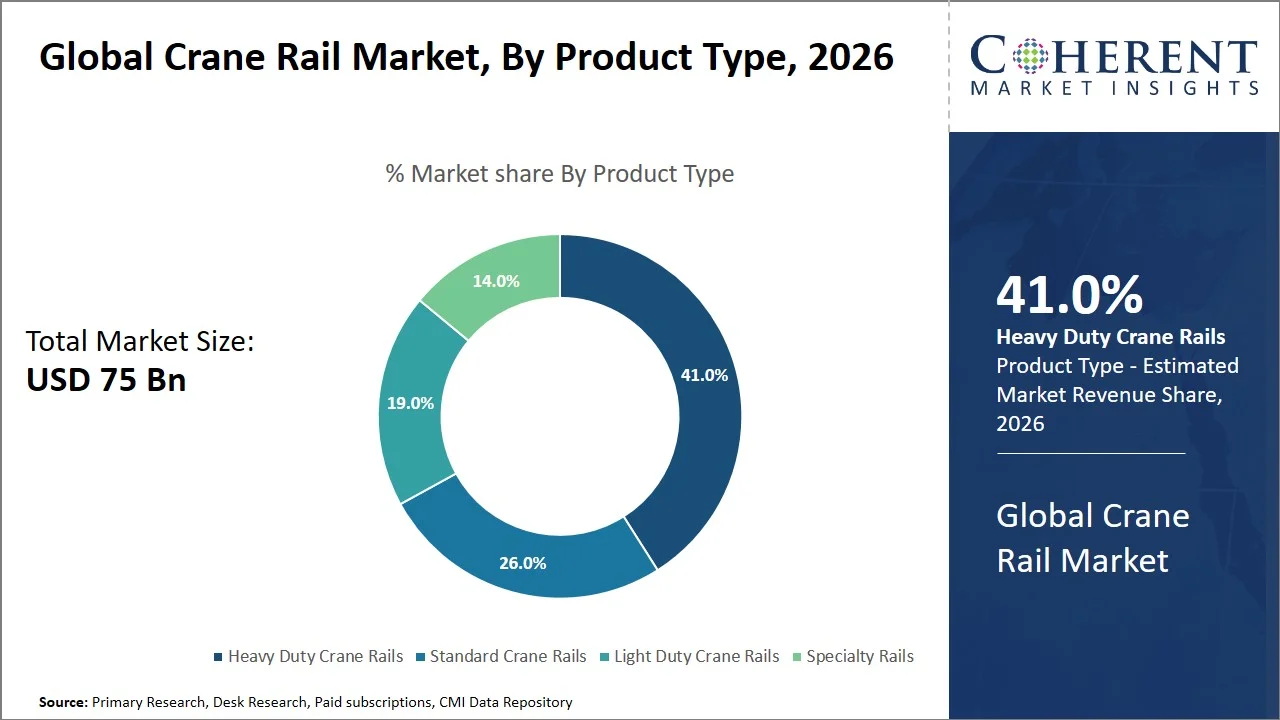
Why Do Heavy Duty Crane Rails Dominate the Global Crane Rail Market?
The heavy duty crane rails segment is expected to account for 41.0% of the global crane rail market share in 2026. The increasing need for heavy duty crane rails for reliable heavy industrial operations is a major growth factor. On March 17, 2026, Cranex Limited achieved a historic milestone by securing a USD 382,000 order from BHEL-Bhopal for manufacturing and supplying a 220/80 ton double girder EOT crane. This marks the company's first high-capacity crane order in its 53-year history, demonstrating customer confidence in its engineering excellence and manufacturing capabilities, with delivery scheduled for February 2027.
(Source: ScanX)
- Current Industry Events of 2026
- Market Size Estimation
- Regional Breakdown
- Competitive Landscape
- Customer Intelligence
- Segmental Analysis
- Pricing Analysis
- Key Market Drivers, Challenges & Future Trends
- Customized Insights Section
Why are Overhead Cranes the Most Preferred Crane ?
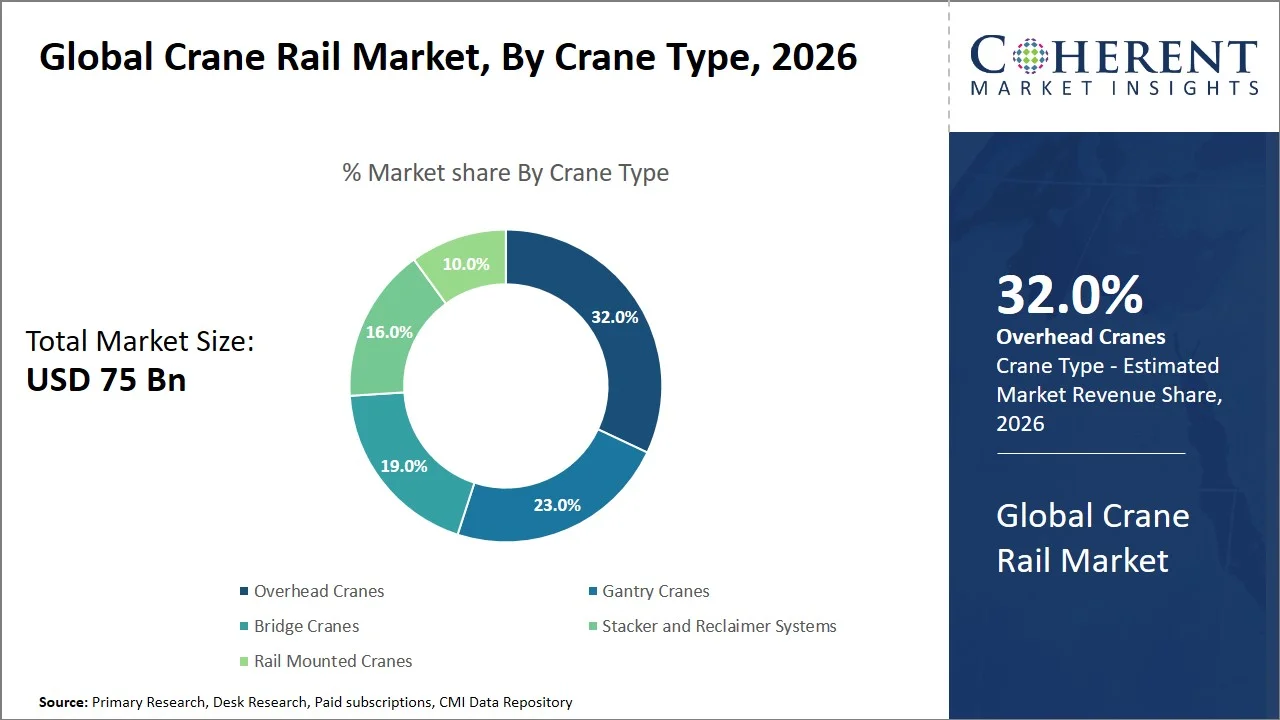
The overhead cranes segment is expected to account for 32.0% of the global crane rail market share in 2026. Increasing need for advanced lifting technologies is a key factor pushing the growth of the segment. On February 18, 2026, Huisman confirmed that it received the first order for its newly designed Process Overhead Crane, marking a major milestone in the company’s strategy to leverage its offshore expertise and expand into markets that require advanced handling and lifting technology. (Source: Huisman)
Steel Segment Dominates the Global Crane Rail Market
The steel segment is expected to account for 59.0% of the global crane rail market share in 2026. The durability and resilience provide by steel structures is unmatched in comparison to other materials, thus driving the segment growth. On June 17, 2025, British Steel announced it has secured a five-year contract worth USD 590 million to supply train tracks for Network Rail, in a move which could help safeguard the short-term future of the Scunthorpe steelworks. (Source: British Steel)
Currents Events and their Impact
Current Events | Description and its Impact |
European Union Machinery Regulation (EU) 2023/1230 |
|
(Source: OSHA)
Global Crane Rail Market Dynamics
Market Drivers
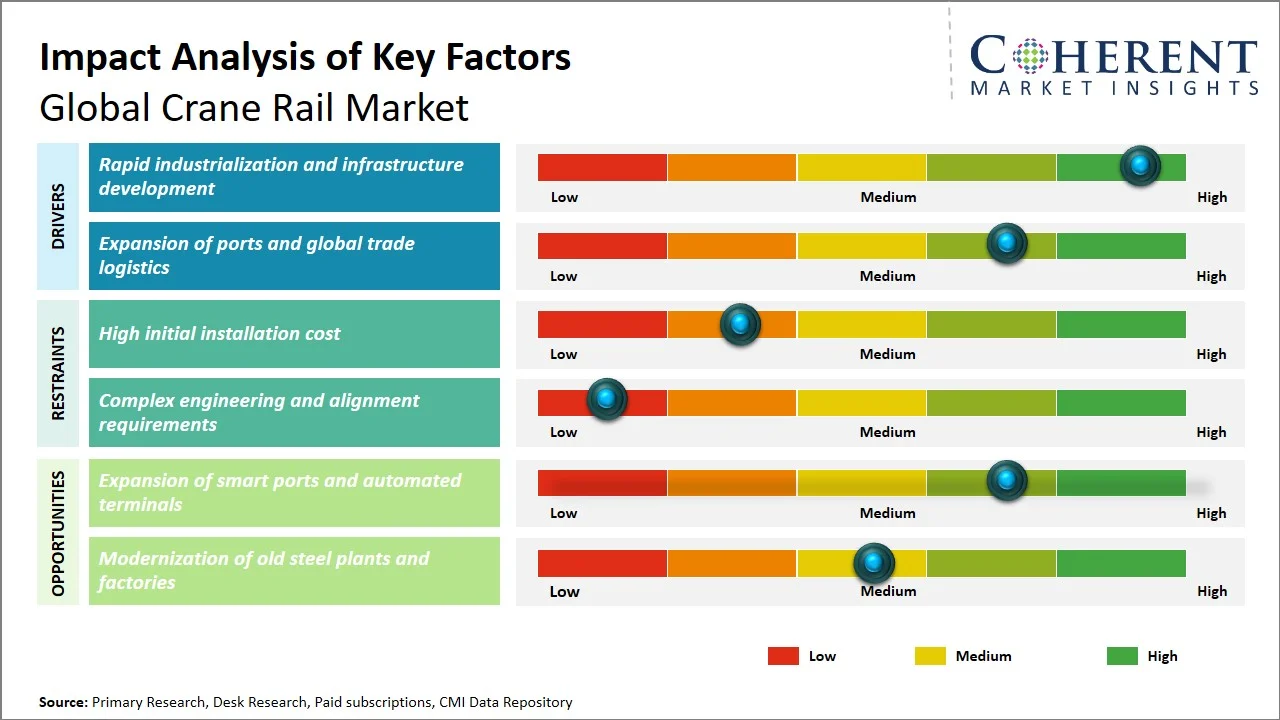
- Rapid industrialization and infrastructure development: Fast-moving industrial growth in both new and mature markets push up interest in crane rails. Because production, building work grows, better ways to move goods become necessary and overhead cranes fill that function. Large public works like shipping hubs, airfields, energy stations, and city expansions depend on strong lifting technology. This reliance increases pressure on rail performance under intense weight and long-term usage demands. High durability becomes essential when operations run nonstop. Rail integrity influences overall system safety more than often acknowledged. Long spans require precise alignment support beneath moving equipment. On September 18, 2025, Liebherr and Transnet Port Terminals (TPT) entered a 10-year partnership to support the long-term reliability and performance of key port equipment across South Africa. The agreement includes ship-to-shore (STS), rubber-tyred gantry (RTG), rail-mounted gantry (RMG), and mobile harbor (LHM) cranes, backed by a 20-year asset management program. (Source: Port Technology)
- Expansion of ports and global trade logistics: Worldwide, port growth pushes need for better crane rail setups. As trade expands, so does pressure on existing infrastructure. Instead of simple upgrades, new systems appear - driven by size, volume, shift. Automated terminals rise - not just in number but scale. Intermodal links gain priority alongside deepwater handling zones. Bigger ships require rethought layouts beneath them. Firms like DP World adapt early; Konecranes follows close; ZPMC supplies at scale. Rail-mounted machines multiply where speed matters most. Smarter tools enter service under constant load. Efficiency emerges through movement patterns, not only power. Throughput improves when tracking blends with placement accuracy. Connectivity grows embedded within daily operations. Heavy rails now face stricter performance roles. On May 20, 2025, DP World announced plans to invest USD 2.5 billion to expand its global logistics network, launching major infrastructure projects across India, Africa, South America, and Europe in response to rising demand for resilient, integrated supply chain solutions. (Source: DP World)
Emerging Trends
- Growth of Ultra-Heavy Lifting and Mega Infrastructure Project: Large-scale infrastructure developments, including offshore wind farms, petrochemical facilities, shipyards, metro rail systems, and modular construction projects, are increasing the demand for ultra-heavy crane rail systems.
- Rising Demand for High-Strength and Smart Steel Crane Rails: As crane capacities and operating cycles increase, the market is shifting toward higher-performance crane rails with improved fatigue resistance, wear durability, and predictive maintenance capabilities.
Regional Insights
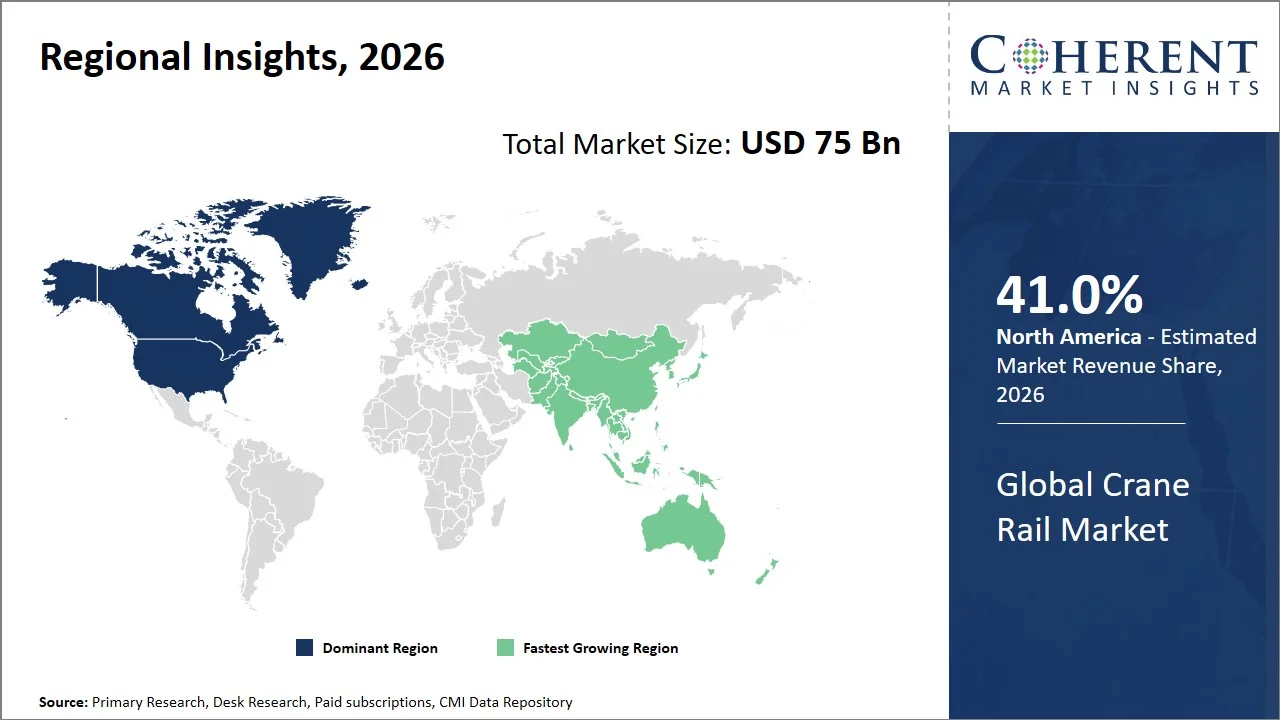
Why is North America a Strong Market for Crane Rails?
North America is expected to account for a market share of 41% in 2026. North America is a strong market for crane rails due to its large-scale investments in port modernization, intermodal rail expansion, and industrial infrastructure upgrades. Major ports along the U.S. East, West, and Gulf Coasts are adopting automated container handling systems, while freight operators like Union Pacific and Canadian National are expanding rail-linked logistics hubs to support rising trade volumes.
At the same time, reshoring of manufacturing, growth in sectors such as automotive, steel, and energy (including LNG and offshore wind), and government-backed infrastructure programs are driving the demand for heavy-duty overhead and rail-mounted cranes. On June 11, 2024, Equinor broke ground on construction at the South Brooklyn Marine Terminal (SBMT), kicking off the revitalization of the venerable port facility into a hub for offshore wind on the East Coast and a critical contributor to New York’s renewable energy ambitions. (Source: Equinor)
Why Does the Asia Pacific Crane Rail Market Exhibit High Growth?
Asia Pacific is expected to account for a market share of 24% in 2026 and is expected to register the fastest growth rate over the forecast period. In the Asia Pacific region, dominance in the global crane rail market is primarily driven by the robust industrial infrastructure and rapid urbanization across countries such as China, India, Japan, and South Korea. Heavy industry, building sites, and shipping hubs occupy much of this area. Owing to these activities, need grows for tracks that support lifting equipment. On January 7, 2026, Konecranes introduced its new Konecranes X-series crane and S-series low headroom hoist to the Australian markets during a launch event at its Smithfield facility. The introduction follows the full rollout of the X-series in EMEA and phased launches of the S-series hoist and X-series crane in other regions, supporting the company’s continued focus on providing advanced and reliable lifting solutions. (Source: Konecranes)
Why is the U.S. Emerging as a Major Hub in the Crane Rail Market?
Older systems still shape U.S. crane rail setups, though big ports bring extra challenges; changes in how factories are laid out now influence demands. Instead of broad strategies, Trinity Industries teams up with Webb Enterprises to concentrate on specialty rails using new connection methods for work involving shaped metals, automobiles, and aircraft structures. With safety standards blending into environmental regulations, companies show preference for durable, accurate rail installations. Inside modernizing facilities, automation spreads gradually - track updates follow, accommodating advanced lifting equipment through altered production environments.
Is China the Next Growth Engine for the Crane Rail Market?
Momentum builds across Asia Pacific as crane rail demand rises alongside China’s factory activity and continuous construction efforts. Port upgrades spark new transit routes, each aligning with long-term infrastructure needs. Instead of standalone units, companies including Sany and Zoomlion integrate hoisting systems within guided frameworks, whereas global players like Konecranes adapt operations through joint ventures influenced by regional dynamics. Proximity of production sites to active developments shifts timelines and cost models, subtly reshaping patterns in global supply chains.
Japan Crane Rail Market Analysis and Trends
Even small in scale, precision defines Japan's making of top-tier crane rails, shaped by demands across vehicle factories, dockyards, metalworks. As worldwide attention rises slowly, local names such as Mitsui Mining & Smelting with Hitachi Construction Machinery turn effort toward adjusting alloy mixes alongside smooth integration between parts. Owing to strict rules requiring deep checks plus uniform results, what emerges regularly outlasts minimum strength norms. Under these pressures, Japanese makers stand unspoken at the front - sending dependable frameworks overseas, never loud about it.
Industrial expansion drives progress in India’s crane rail market, yet government efforts such as "Make in India" contribute just as much, tied closely to urban construction plans. Factories producing steel, cement, or power create steady demand - this leads to greater reliance on material handling tools. Collaboration brings change: companies like Escorts and BEML work differently now, learning from international counterparts through joint paths. Public infrastructure upgrades bring better tracks; behind formal updates, quiet backing takes form. Arriving alongside foreign investment is a flow of expertise, altering how local operations function. Not driven by rhetoric, advancement emerges when outside equipment becomes part of daily regional .
Global Crane Rail Market - Port Automation & Container Throughput
Metric | Examples | Throughput Impact |
Automated Stacking Cranes (ASC) | DP World London Gateway (UK), Hutchison Ports terminals, Rotterdam Euromax | +25% to +50% yard productivity; +27% storage density |
Ship-to-Shore (STS) Crane Upgrades | PSA International Singapore, APM Terminals Rotterdam, Los Angeles ports | +15% to +30% crane cycle efficiency |
Container Throughput per Terminal Area | Rotterdam “ghost terminals”, Hamburg CTA, DP World Jebel Ali | Up to +47% terminal capacity on same footprint |
Rail-Mounted & Electrified Crane Systems | Konecranes, ZPMC deployments globally | 10–25% energy efficiency improvement |
Autonomous Crane Adoption | Rotterdam terminals, PSA automated yards, APM semi-automated terminals | 20–35% labor efficiency gain |
How is Expansion of Smart Ports and Automated Terminals Creating New Growth Opportunities in the Global Crane Rail Market?
Large ships moving more cargo make dockside speed essential. With automated systems spreading into port regions, global needs shift for rail-mounted cranes. Rather than rely on older techniques, several ports adopt linked control networks together with unmanned machinery. As sensor inputs feed constant updates, intelligent setups guide hoisting devices precisely along fixed paths. When mechanical motion must align perfectly, nothing matters more than accuracy. Should conditions remain unchanged, precision in placement still matters. When demands grow stronger, reliability becomes expected rather than chosen. On January 14, 2026, PSA International Pte Ltd announced it has set a new benchmark in global container handling, achieving a record of 105 million Twenty-foot Equivalent Units (TEUs) across its ports and terminals worldwide for the year ended December 31, 2025. (Source: PSA International)
Market Players, Key Development, and Competitive Intelligence
Key Developments
- On February 4, 2026, Columbus McKinnon Corporation announced that it has completed its acquisition of Kito Crosby Limited from funds managed by leading global investment firm, KKR.
- On January 5, 2026, Hiab completed the acquisition of the Brazilian crane manufacturer ING Cranes, announced on November 26, 2025. The acquisition significantly enhances Hiab’s presence in Brazil, complementing its current portfolio in the market.
Competitive Landscape
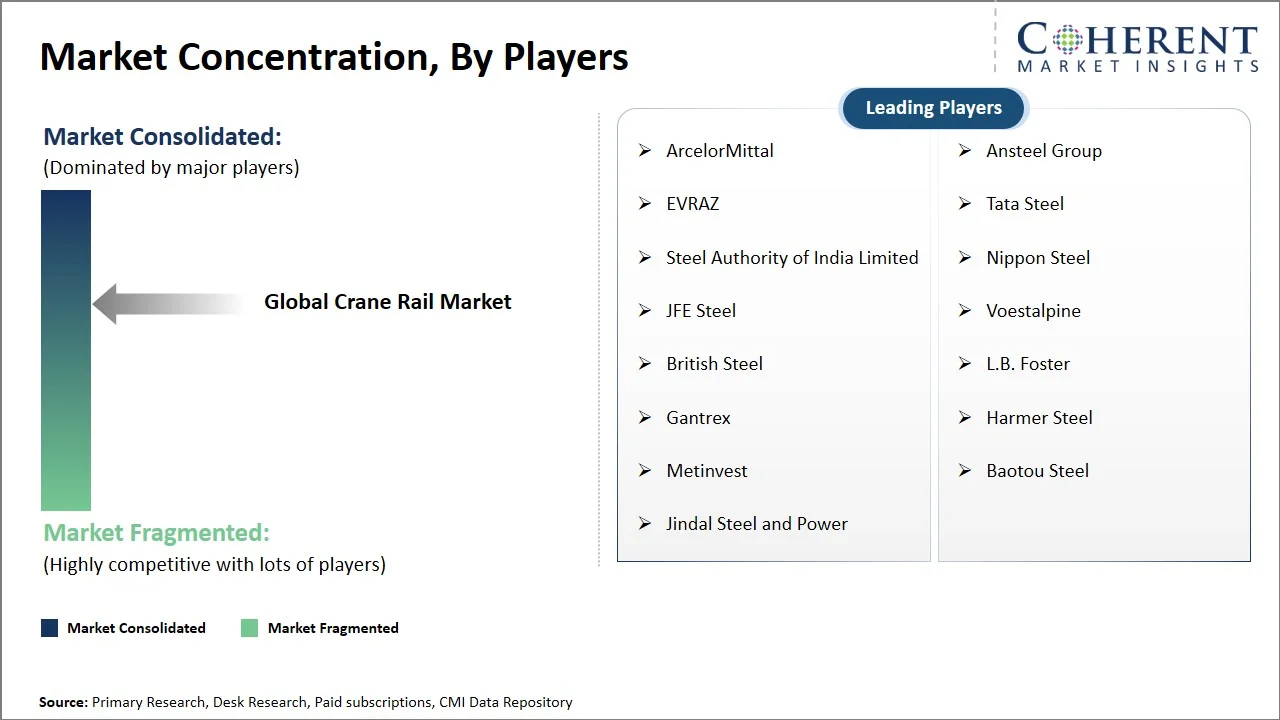
Steel manufacturers, specialized rail providers, and machinery fabricators influence global crane rail market across distant regions. Leading positions in heavy-duty rails belong mainly to companies like ArcelorMittal, Tata Steel, Vossloh, EVRAZ, and Pandrol. Firms including Konecranes, Liebherr, and ZPMC set direction through integrated lifting systems delivered to ports and industrial areas. As automated freight centers develop and plant modernizations accelerate, demands on suppliers grow stronger. Attention moves gradually to durable metal blends, precision engineering, followed by maintenance approaches improving equipment life cycles.
Market Report Scope
Crane Rail Market Report Coverage
| Report Coverage | Details | ||
|---|---|---|---|
| Base Year: | 2025 | Market Size in 2026: | USD 75 Bn |
| Historical Data for: | 2020 To 2024 | Forecast Period: | 2026 To 2033 |
| Forecast Period 2026 to 2033 CAGR: | 8.7% | 2033 Value Projection: | USD 153.50 Bn |
| Geographies covered: |
| ||
| Segments covered: |
| ||
| Companies covered: | ArcelorMittal, Ansteel Group, EVRAZ, Tata Steel, Steel Authority of India Limited, Nippon Steel, JFE Steel, Voestalpine, British Steel, L.B. Foster, Gantrex, Harmer Steel, Metinvest, Baotou Steel, and Jindal Steel and Power | ||
| Growth Drivers: |
| ||
| Restraints & Challenges: |
| ||
Analyst Opinion (Expert Opinion)
- The crane rail market is a stable high-growth industrial segment driven by long-term infrastructure investment cycles rather than short-term demand fluctuations. The market is expected to grow at a healthy pace, supported by automation in logistics, expansion of manufacturing hubs, and modernization of port infrastructure. Increasing adoption of smart monitoring systems, IoT-enabled rail diagnostics, and predictive maintenance solutions as key value drivers.
- Following changes in how industries operate, crane rail development ties directly to smart manufacturing systems alongside modern harbor setups. As urban areas expand rapidly, demand increases - notably within emerging economies establishing plants and transit structures. In contrast, mature countries focus more on renewing worn infrastructure rather than constructing fresh layouts. Performance might soon depend on digital integration, using embedded sensors to monitor strain, wear patterns, or predict maintenance needs before breakdowns occur. Large-scale projects, offshore power installations, semiconductor plants, interconnected logistics hubs, require durable rail solutions designed for continuous heavy usage over long durations.
Speak to the analyst
Want personalized insights?
Take the findings above to one of our principal consultants, or have the report rebuilt around the segments, geographies and competitors you actually track.
Market Segmentation
- Product Type Insights (Revenue, USD Bn, 2021 - 2033)
- Heavy Duty Crane Rails
- Standard Crane Rails
- Light Duty Crane Rails
- Specialty Rails
- Crane Type Insights (Revenue, USD Bn, 2021 - 2033)
- Overhead Cranes
- Gantry Cranes
- Bridge Cranes
- Stacker and Reclaimer Systems
- Rail Mounted Cranes
- Material Insights (Revenue, USD Bn, 2021 - 2033)
- Steel
- Alloy Steel
- Composite
- Application Insights (Revenue, USD Bn, 2021 - 2033)
- Steel Mills
- Ports and Shipyards
- Industrial Manufacturing Plants
- Logistics and Warehouses
- Mining Operations
- Power Plants
- Regional Insights (Revenue, USD Bn, 2021 - 2033)
- North America
- U.S.
- Canada
- Latin America
- Brazil
- Argentina
- Mexico
- Rest of Latin America
- Europe
- Germany
- U.K.
- Spain
- France
- Italy
- Russia
- Rest of Europe
- Asia Pacific
- China
- India
- Japan
- Australia
- South Korea
- ASEAN
- Rest of Asia Pacific
- Middle East
- GCC Countries
- Israel
- Rest of Middle East
- Africa
- South Africa
- North Africa
- Central Africa
- North America
- Key Players Insights
- ArcelorMittal
- Ansteel Group
- EVRAZ
- Tata Steel
- Steel Authority of India Limited
- Nippon Steel
- JFE Steel
- Voestalpine
- British Steel
- L.B. Foster
- Gantrex
- Harmer Steel
- Metinvest
- Baotou Steel
- Jindal Steel and Power
Sources
Primary Research Interviews
- Crane rail manufacturers and suppliers
- Construction and infrastructure project managers
- Railway infrastructure contractors
- Port and harbor equipment operators
Magazines
- Railway Track & Structures Magazine
- Construction Equipment Magazine
- Port Technology International
- Heavy Lifting & Specialized Transport Magazine
Journals
- International Journal of Railway Technology
- Journal of Construction Engineering and Management
- Transportation Research Record
Associations
- International Association of Ports and Harbors (IAPH)
- Railway Industry Association (RIA)
- Construction Industry Institute (CII)
- International Crane and Specialized Transport Association
Public Domain Sources
- World Bank Infrastructure Database
- International Trade Centre (ITC) Market Analysis
- Government statistical offices and trade departments
- United Nations Industrial Development Organization (UNIDO)
Proprietary Elements
- CMI Data Analytics Tool
- Proprietary CMI Existing Repository of information for last 10 years
Get access to 250+ pages report
Every segment, forecast, competitor profile and data table behind the analysis above — available for instant download.
- ESOMAR Member
- ISO 9001:2015 Certified
- D-U-N-S Registered
- GDPR & CCPA Compliant
Missing comfort of reading report in your local language? Find your preferred language:
Transform your Strategy with Exclusive Trending Reports
Frequently Asked Questions
The global crane rail market is expected to stand at USD 75 Bn in 2026 and is expected to reach USD 153.50 Bn by 2033.
The CAGR of global crane rail market is projected to be 8.7% from 2026 to 2033.
Rapid industrialization and infrastructure development and expansion of ports and global trade logistics are the major factor driving the growth of global crane rail market.
High initial installation cost and complex engineering and alignment requirements are the major factors hampering the growth of the global crane rail market.
In terms of product type, heavy duty crane rails are estimated to dominate the market revenue share in 2026.
ArcelorMittal, Ansteel Group, EVRAZ, Tata Steel, Steel Authority of India Limited, Nippon Steel, JFE Steel, Voestalpine, British Steel, L.B. Foster, Gantrex, Harmer Steel, Metinvest, Baotou Steel, and Jindal Steel and Power are the major players.
North America is expected to lead the global crane rail market in 2026.