

Decorative Accessories Market Size and Forecast — 2026-2033
The Global Decorative Accessories Market is expected to be valued at USD 735.08 Bn in 2026 and reach USD 1,048.64 Bn by 2033, exhibiting a compound annual growth rate (CAGR) of 6.1% from 2026 to 2033.
Key Takeaways of the Global Decorative Accessories Market:
- The lamp & lighting segment is expected to lead the market holding a share of 42.7% in 2026.
- Among application, the residential segment is projected to dominate with a share of 42.6% in 2026.
- The hypermarkets/supermarkets segment is expected to lead the market with a share of 32.3% in 2026.
- North America is expected to lead the market with a share of 39. 6% in 2026. Asia Pacific, holding a share of 29.3% in 2026, is projected to be the fastest growing region.
Market Overview
The market for decorative accessories is expected to witness positive growth over the forecast period. Factors such as rising disposable incomes, improving standards of living, and changing consumer preference for home décor and interior designing are expected to provide impetus to the market expansion. Consumers are increasingly willing to spend more on home décor items that complement their home interior and reflect their personalities, styles, cultures, and trends. Furthermore, the rapid growth of online retailing is increasing the ease of purchase of decorative accessories worldwide, thus supporting the market growth. However, volatile costs of raw materials may hamper the market growth during the forecast period.
Product Type Insights
Product Type Insights - Versatility and Style Drive Lamp & Lighting Dominance
In terms of product type, the lamp & lighting segment is expected to contribute the highest share of 42.7% in the market in 2026 owing to the versatility and style it brings to any home or office space. Lamps and lighting allow consumers to set the perfect mood or atmosphere with just the flip of a switch. Whether it's a table lamp to light up a reading nook or recessed lighting to highlight architectural details, lamps and lights can transform a room. They are also a very budget friendly way for consumers to experiment with different designs, materials, and finishes to reflect their unique personality and taste. New technologies have also expanded lighting options, like smart bulbs that can be adjusted remotely or set to routines. This has further increased the appeal and usage of decorative lamps and lighting fixtures. The styles range from traditional to modern so there is a lamp for every decor preference. Lamps are also portable and easy to rearrange, making them a top choice for tenants or those who frequently redecorate. All of these factors drive strong and consistent demand for decorative lamps and lighting across both residential and commercial settings.
Application Insights
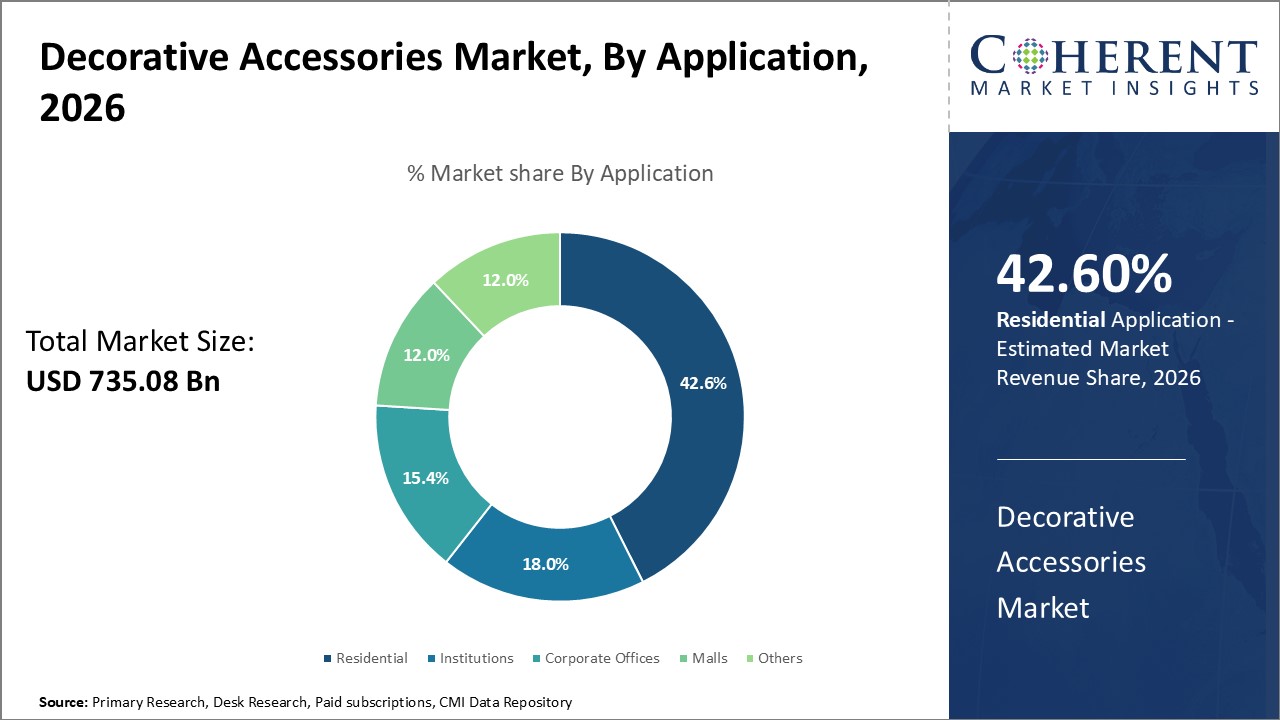
Application Insights – Residential Segment Leads with Personalization and Growing Home Improvement Trends
The residential segment is expected to hold the largest market share of 42.6% in 2026, driven by the rising importance of personalizing home environments and the global trend of home improvement. As more people spend increased time at home, especially with hybrid and remote work becoming mainstream, there has been a significant surge in demand for stylish and functional decorative accessories. Consumers are more willing than ever to invest in items that make their living spaces more comfortable, visually appealing, and reflective of their personal style. Decorative accessories, such as throw pillows, vases, wall art, and lighting, are affordable yet impactful ways to refresh and elevate home interiors without the need for large renovations. Additionally, social media platforms like Instagram and Pinterest continue to inspire consumers with interior design trends, motivating frequent redecorations and seasonal makeovers. The ease of access to a variety of designs through online and offline platforms also supports consistent demand. The residential sector continues to dominate due to its vast and recurring customer base, which includes homeowners, renters, and home staging professionals.
Distribution Channel Insights
Distribution Channel Insights – Hypermarkets/Supermarkets Dominate due to Accessibility and Product Variety
The hypermarkets/supermarkets segment is expected to contribute 32.3% market share in 2026, making them the dominant distribution channel in the decorative accessories market. These retail giants attract a high volume of foot traffic and provide consumers with the convenience of one-stop shopping, allowing them to explore a wide range of decorative products alongside their routine purchases. Their expansive shelf space and strategic in-store displays allow for seasonal themes and style inspiration, often influencing impulse buys. For price-conscious buyers, these outlets offer competitively priced home decor items, often through private labels or exclusive collaborations with well-known designers and influencers. Furthermore, many hypermarkets and supermarkets have adopted omnichannel models, enabling customers to browse online and purchase in-store or vice versa—enhancing overall shopping flexibility. Their ability to offer a broad variety of products across styles, functions, and price points continues to make them a go-to destination for decorative accessories across both urban and suburban markets.
Regional Insights
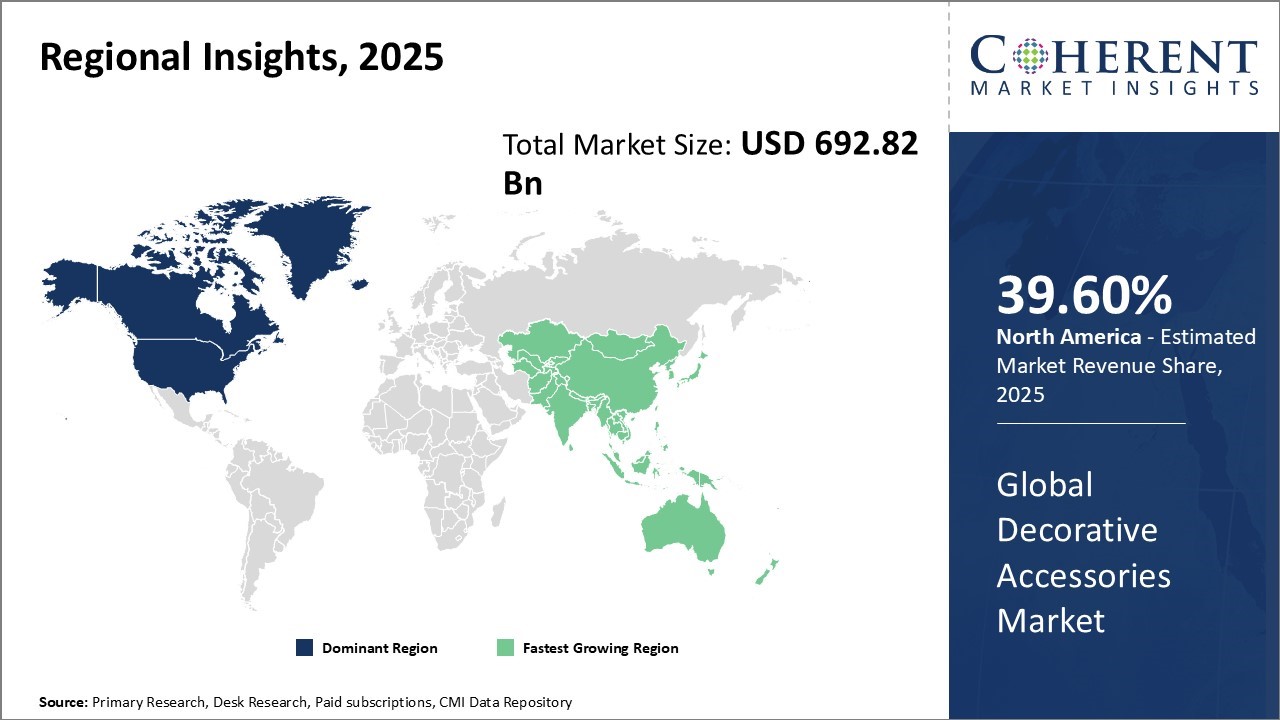
North America Decorative Accessories Market Trends
North America is projected to hold a market share of 39.6% in 2026, making it the dominant region in the global decorative accessories market. The region benefits from a highly design-conscious and trend-driven consumer base that frequently updates home interiors in line with seasonal styles and evolving aesthetics. A strong culture of DIY and home improvement, supported by platforms like Pinterest, Instagram, and HGTV, continues to drive the demand for decorative accessories. Additionally, high disposable incomes and an established homeownership base allow consumers to allocate more budget toward premium and personalized home decor items. The well-developed retail infrastructure, including specialty stores, department stores, and large-format retailers like Target and HomeGoods, provides easy access to a wide variety of decorative products.
Asia Pacific Decorative Accessories Market Trends
The Asia Pacific region, holding a share of 29.3% in 2026, is expected to exhibit the fastest growth in the decorative accessories market. Firstly, the region is home to some of the largest consumer markets like China and India which strengthens its market potential. Rapid urbanization has fueled the growth of residential and commercial construction activities across developing nations. Secondly, rising disposable incomes and expanding middle class population have increased consumer spending on home decor and furnishings. Consumer preference for aesthetically appealing interior décor drives the uptake of decorative items.
Decorative Accessories Market Outlook for Key Countries
U.S. Decorative Accessories Market Trends
The U.S. decorative accessories market continues to remain lucrative, driven by an affluent consumer base and growing demand for premium and personalized products. Leading domestic brands like Pottery Barn, West Elm, and Magnolia (by Joanna Gaines) continue to expand their retail footprints and introduce seasonal collections to cater to evolving consumer preferences. Innovation is central to competitive differentiation, with manufacturers integrating smart features and sustainable materials into lighting, furnishings, and decor. Strategic acquisitions—such as Williams-Sonoma’s investment in artisanal and sustainable brands—enable companies to broaden portfolios and boost market share. The strong e-commerce infrastructure further strengthens direct-to-consumer (DTC) channels across the U.S.
China Decorative Accessories Market Trends
China decorative accessories market holds immense potential, reinforced by government-driven infrastructure projects, and growing consumer aspiration for well-decorated homes. Local players like Zara Home China, Gujia Home, and Red Star Macalline benefit from cost-efficient manufacturing and wide domestic distribution. Meanwhile, international brands, such as IKEA and H&M Home, have ramped up localized production and design collaboration with Chinese artisans. The rise of online retail platforms like Taobao and JD.com, especially in Tier II and Tier III cities, supports omnichannel growth. However, challenges persist in the form of rising labor costs, environmental regulations, and ongoing geopolitical tensions, particularly with the U.S.
India Decorative Accessories Market Trends
India represents one of the fastest-growing markets in decorative accessories, fueled by initiatives like ‘Housing for All’ and Smart Cities Mission. The increasing middle-class population, improved urban infrastructure, and rising aspirations drive demand, particularly in metro and Tier I cities. Local manufacturers such as FabIndia, Chumbak, and Pepperfry lead in offering affordable yet aesthetically rich decor options, blending traditional designs with global appeal. A stable political climate and rising foreign direct investments (FDIs) are attracting global brands to collaborate or set up operations locally. Additionally, digitization and online marketplaces are unlocking rural and semi-urban potential. The growing design ecosystem, supported by institutions and exhibitions, fosters a strong culture of innovation.
U.A.E Decorative Accessories Market Trends
The U.A.E remains central to decorative accessory expansion strategies in the Middle East due to its robust construction and tourism sectors. Projects like Expo 2020, Dubai Creek Harbour, and NEOM in the broader GCC context continue to drive commercial and residential decor demand. Local players such as Danube Home, Marina Home Interiors, and 2XL Home have carved strong market positions by offering both affordable and premium options, often in collaboration with international brands like Ashley Furniture and Versace Home. Consumers in the U.A.E show a high preference for luxurious, imported designs, with cultural and ethnic diversity fueling demand for eclectic and regionally inspired styles. The U.A.E also serves as a logistics and design hub for exporting to neighboring GCC countries.
Market Players, Key Development, and Competitive Intelligence
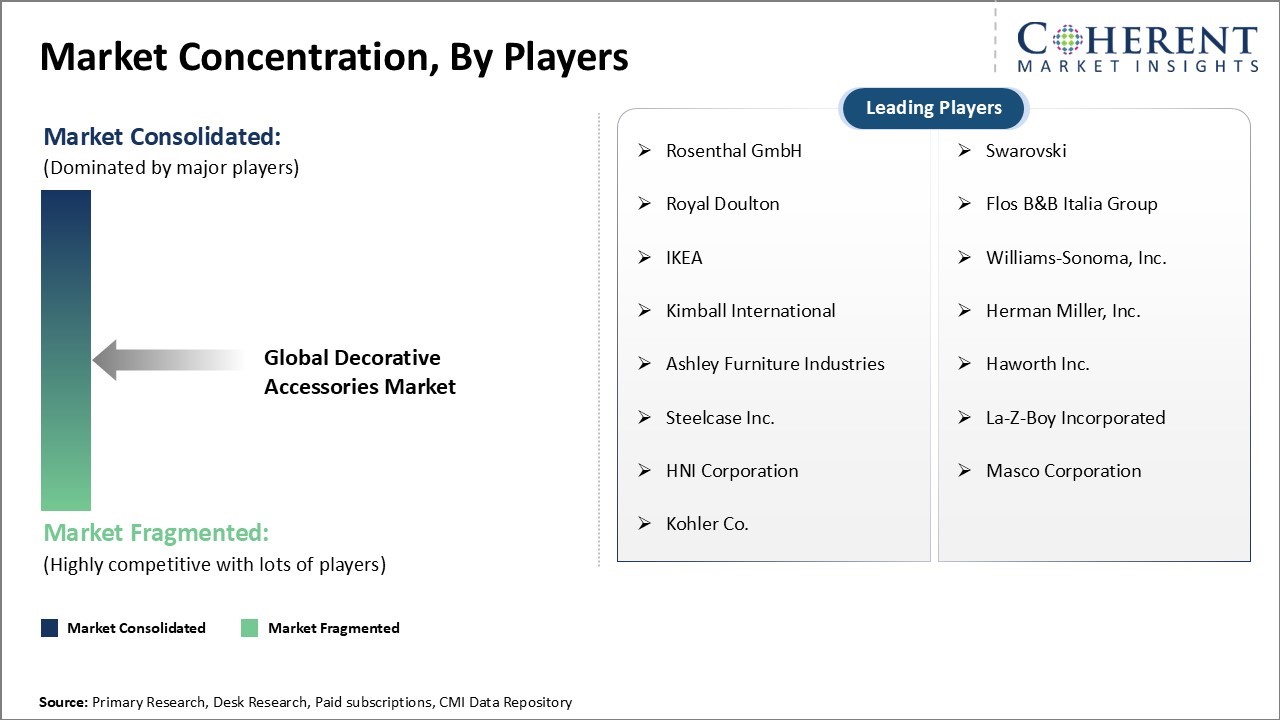
Key Developments:
- In May 2024, Design Holding, an international group, rebranded to Flos B&B Italia Group to strengthen the identity of the group, which contains brands, Flos and B&B Italia
- In May 2023, Williams-Sonoma, Inc., a sustainable home retailer, launched a new brand, GreenRow. The brand utilizes sustainable materials and manufacturing practices to create colorful, vintage-inspired heirloom quality products. GreenRow’s debut assortment features living, bedroom, and dining furniture as well as rugs, bedding, bath, baby, lighting, pillows, throws, curtains, table linens, dinnerware, and décor.
Top Strategies Followed by Global Decorative Accessories Market Players
- Established Players: Leading companies focus on diversifying their product lines, expanding into new markets, and integrating advanced technologies to maintain and strengthen their market dominance.
- Anthropologie, traditionally known for ready-to-wear fashion, significantly expanded its home decor line by over 100%, introducing categories like custom furniture with extensive configuration options. This move positions the brand as a comprehensive destination for interior decor.
- Banana Republic, a renowned clothing retailer, ventured into the home decor and furniture market with the launch of BR Home, offering items for various living spaces made from sustainably sourced materials. This strategic move leverages its existing brand reputation to tap into the home furnishings sector.
- Mid-Level Players: Mid-sized companies often adopt strategies such as regional expansion, strategic partnerships, and enhancing customer engagement through digital platforms to increase their market share.
- Urban Ladder, an India-based omnichannel furniture and decor retailer, expanded from an online-only model to operating 50 physical stores across major Indian cities, aiming to double its retail presence by March 2024. This strategy enhances its brand visibility and customer reach.
- Small-Scale Players: Smaller companies differentiate themselves by focusing on niche markets, emphasizing sustainability, and leveraging social media for brand building and direct sales.
- LIKHÂ, a homewares brand, collaborates with local artisans to offer unique, sustainable products. This not only supports local craftsmanship but also appeals to consumers seeking ethically made decor items.
Emerging Startups – Decorative Accessories Industry Ecosystem
- Sustainable Solutions: Startups are emphasizing eco-friendly and ethically sourced products appeals to environmentally conscious consumers.
- Example: The Citizenry focuses on ethically sourced and sustainably made home decor items, catering to the growing demand for responsible consumerism.
- Direct-to-Consumer (DTC) Models: By bypassing traditional retail channels, startups offer high-quality products at more accessible price points.
- Example: Brooklinen sells premium home textiles directly to consumers online, reducing costs and enhancing customer relationships.
- Community Engagement and Social Proof: Building communities around brands and leveraging user-generated content fosters trust and engagement.
- Example: Houzz connects customers with home improvement professionals and other homeowners, allowing users to share ideas, projects, and reviews, enhancing social engagement.
- Collaborations with Designers and Artisans: Companies partner with designers and artisans which results in unique, limited-edition products that attract niche markets.
- Example: Hem collaborated with ceramicists Mr. John Booth and Mr. Ian McIntyre to create whimsical ceramic centerpieces, blending contemporary design with traditional craftsmanship.
- Current Industry Events of 2026
- Market Size Estimation
- Regional Breakdown
- Competitive Landscape
- Customer Intelligence
- Segmental Analysis
- Pricing Analysis
- Key Market Drivers, Challenges & Future Trends
- Customized Insights Section
Market Report Scope
Decorative Accessories Market Report Coverage
| Report Coverage | Details | ||
|---|---|---|---|
| Base Year: | 2025 | Market Size in 2026: | USD 735.08 Bn |
| Historical Data for: | 2020 To 2024 | Forecast Period: | 2026 To 2033 |
| Forecast Period 2026 to 2033 CAGR: | 6.1% | 2033 Value Projection: | USD 1,048.64 Bn |
| Geographies covered: |
| ||
| Segments covered: |
| ||
| Companies covered: | Rosenthal GmbH, Swarovski, Royal Doulton, Flos B&B Italia Group , IKEA, Williams-Sonoma, Inc., Kimball International, Herman Miller, Inc., Ashley Furniture Industries, Haworth Inc., Steelcase Inc., La-Z-Boy Incorporated, HNI Corporation, Masco Corporation, and Kohler Co. | ||
| Growth Drivers: |
| ||
| Restraints & Challenges: |
| ||
Market Dynamics
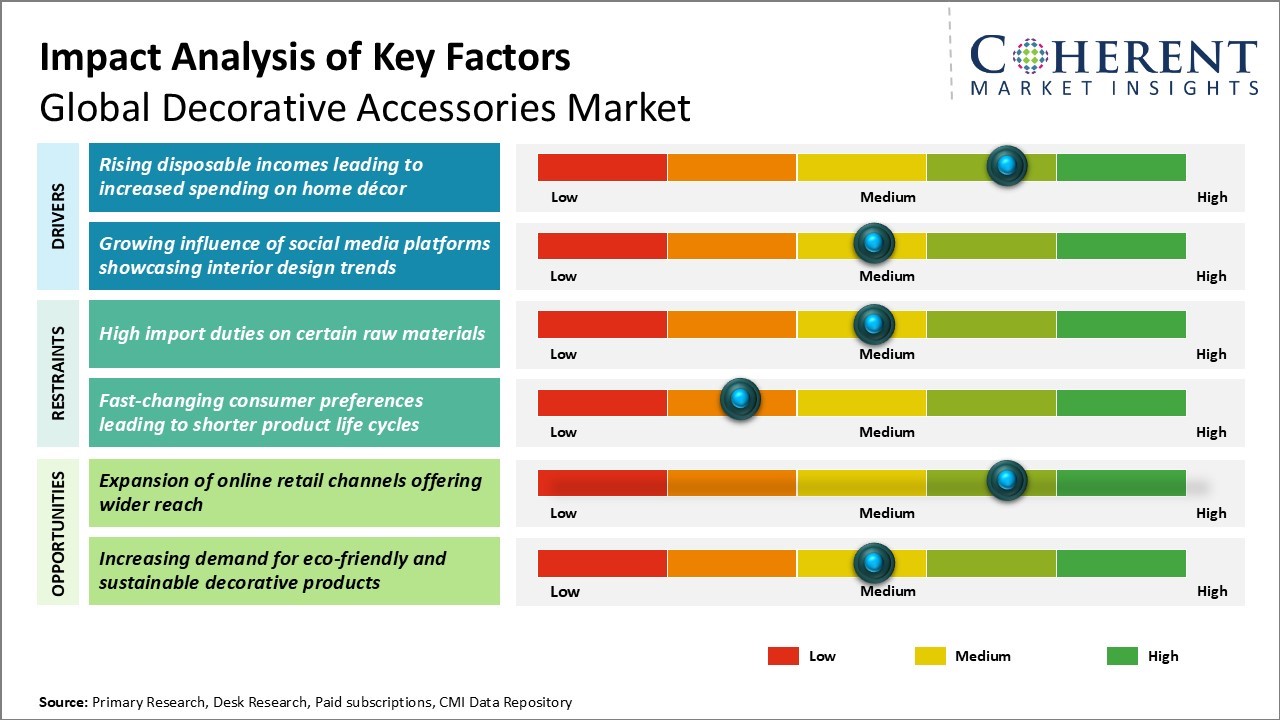
Global Decorative Accessories Market Driver – Rising Disposable Incomes Leading to Increased Spending on Home Décor
With rising disposable incomes in developing economies, consumers are able to spend more on home décor and furnishings. Countries like India, China, Brazil, and others in Asia Pacific and Latin America have seen strong economic growth over the past decade which has translated to greater spending power for consumers. As people's incomes rise, their priority shifts from necessities to discretionary spending on items that enhance their lifestyle and standard of living. Decorative accessories that beautify the home and add aesthetics are becoming increasingly desirable purchases. People want their homes to reflect their socio-economic status and rising prosperity. This growing demand is benefitting the decorative accessories market as manufacturers are launching new innovative products catering to evolved consumer tastes. The home décor segment is one of the biggest beneficiaries of rising disposable incomes in developing nations.
Global Decorative Accessories Market Challenge – High Import Duties on Certain Raw Materials
One of the major challenges faced by players in the global decorative accessories market is the high import duties imposed on certain key raw materials used in manufacturing various decorative accessories. Stringent import regulations and customs duties in many countries significantly increase the cost of procuring raw materials such as metals, glass, woods, plastics etc. This negatively impacts the profit margins of decorative accessories manufacturers. Compliance with ever-changing duty structures also adds to the overall production costs. Furthermore, the price increase resulting from duties often has to be passed on to the end consumers making the accessories less competitive in the international markets. This acts as a deterrent for both manufacturers as well as consumers and hinders the growth of the market globally.
Global Decorative Accessories Market Opportunity – Expansion of Online Retail Channels Offering Wider Reach for Market
The growth of online retail channels is a major opportunity for players in the global decorative accessories market. The proliferation of e-commerce websites offering home décor and accessories has enabled easier access to a wider customer base globally. Online platforms provide a cost-effective means for manufacturers to promote and sell their products directly as well as through third party retailers. They also offer enhanced visibility and discoverability compared to brick-and-mortar stores. Furthermore, the option of convenient home delivery appeals to modern customers and drives sales. Leading online retailers such as Amazon, Wayfair, and IKEA are strengthening their portfolio of decorative accessories to cater to evolving consumer demand. This expansion of online retail networks effectively expands the reach of the market, thus opening up new growth avenues.
Analyst Opinion (Expert Opinion)
- The global decorative accessories market is expected to witness steady growth over the coming years, fueled by rising disposable incomes, urbanization, and increasing consumer interest in aesthetically appealing interiors. Additionally, the influence of social media platforms and home décor influencers is significantly shaping consumer preferences and driving demand for stylish and customizable decorative items.
- One of the major challenges facing the market is the rapidly shifting consumer trends, which result in shortened product life cycles and increased pressure on manufacturers to innovate continuously. Moreover, high production and raw material costs can also restrain market profitability, especially in price-sensitive regions.
- North America remains the dominant region in the market, backed by high consumer spending, a strong retail infrastructure, and a high concentration of leading manufacturers. Meanwhile, the Asia Pacific region is anticipated to be the fastest-growing market due to rapid urban development, an expanding middle-class population, and increasing interest in modern home aesthetics.
Speak to the analyst
Want personalized insights?
Take the findings above to one of our principal consultants, or have the report rebuilt around the segments, geographies and competitors you actually track.
Market Segmentation
- Product Type Insights (Revenue, USD Bn, 2021 - 2033)
- Lamp & Lighting
- Rugs & Pillows
- Pottery & Vases
- Others
- Application Insights (Revenue, USD Bn, 2021 - 2033)
- Residential
- Institutions
- Corporate Offices
- Malls
- Others
- Distribution Channel Insights (Revenue, USD Bn, 2021 - 2033)
- Hypermarkets/Supermarkets
- Specialty Stores
- Departmental Stores
- Online
- Others
- Regional Insights (Revenue, USD Bn, 2021 - 2033)
- North America
- U.S.
- Canada
- Latin America
- Brazil
- Argentina
- Mexico
- Rest of Latin America
- Europe
- Germany
- U.K.
- Spain
- France
- Italy
- Russia
- Rest of Europe
- Asia Pacific
- China
- India
- Japan
- Australia
- South Korea
- ASEAN
- Rest of Asia Pacific
- Middle East
- GCC Countries
- Israel
- Rest of Middle East
- Africa
- South Africa
- North Africa
- Central Africa
- North America
- Key Players Insights
- Rosenthal GmbH
- Swarovski
- Royal Doulton
- Flos B&B Italia Group
- IKEA
- Williams-Sonoma, Inc.
- Kimball International
- Herman Miller, Inc.
- Ashley Furniture Industries
- Haworth Inc.
- Steelcase Inc.
- La-Z-Boy Incorporated
- HNI Corporation
- Masco Corporation
- Kohler Co.
Get access to 250+ pages report
Every segment, forecast, competitor profile and data table behind the analysis above — available for instant download.
- ESOMAR Member
- ISO 9001:2015 Certified
- D-U-N-S Registered
- GDPR & CCPA Compliant
Missing comfort of reading report in your local language? Find your preferred language:
Transform your Strategy with Exclusive Trending Reports
Frequently Asked Questions
The global decorative accessories market is estimated to be valued at USD 735.08 Bn in 2026 and is expected to reach USD 1,048.64 Bn by 2033.
The CAGR of the global decorative accessories market is projected to be 6.1% from 2026 to 2033.
Rising disposable incomes leading to increased spending on home décor and growing influence of social media platforms showcasing interior design trends are the major factors driving the growth of the global decorative accessories market.
High import duties on certain raw materials and fast-changing consumer preferences leading to shorter product life cycles are the major factors hampering the growth of the global decorative accessories market.
In terms of product type, the lamp & lighting segment is estimated to dominate the market revenue share in 2026.
Rosenthal GmbH, Swarovski, Royal Doulton, Flos B&B Italia Group , IKEA, Williams-Sonoma, Inc., Kimball International, Herman Miller, Inc., Ashley Furniture Industries, Haworth Inc., Steelcase Inc., La-Z-Boy Incorporated, HNI Corporation, Masco Corporation, and Kohler Co. are the major players.
North America is expected to lead the global decorative accessories market in 2026, holding a share of 39.6%.